
Technology
Basis Platform
Advertising Operating System
Communication Portal
Intelligent Collaboration
All Channel Activation
Activate Media on Every Channel

Consulting
Resources
One of the biggest global annual advertising experiences is right around the corner! South by Southwest (SXSW) is certain to be packed full of fascinating conversations and critical insights for digital marketers. If you’re planning your trip and feeling overwhelmed by the long list of events and offerings, this should help: We’ve picked out seven panels and presentations that you won’t want to miss. With topics spanning from data privacy, to activism and equity, to the turbulent world of social, you’ll level up your marketing prowess by attending just a few of these.
Without further ado, here are our favorites:
It only makes sense to kick things off with a topic that's on the minds of advertisers everywhere—and one that it’s critical for marketers to get ahead of. Not only will 2023 see a new crop of state-level data privacy laws take hold (hello CPRA), but a majority of advertisers are still highly dependent on third-party cookies. And with Google set to deprecate cookies in its Chrome browser next year, many advertisers are wondering how to forge ahead. In this presentation, Basis Technologies’ own Noor Naseer will break down what advertisers need to know, and detail how they can prepare for a privacy-centric future.
Advertising? In this economy? While some brands may choose to cut marketing budgets during economic upheaval, those same brands may (ironically) end up spending more when the economy recovers as they try to regain market share. As such, it’s up to marketers to communicate the value of maintaining share of voice, even during turbulent times, to decision-makers. In this presentation, agency veteran Nancy Hill will share strategies for marketers looking to defend their budgets.
Brands are at an interesting turning point when it comes to taking a stand on social issues. While “checking the box” may have been somewhat acceptable in the 2010s, consumers have now grown weary of brand inauthenticity. Gen Z, in particular, has a fine-tuned radar for detecting BS and are more than happy to call it out on social media when they see it. Here, social justice organizers working both within and outside of agencies will discuss how brands can go beyond traditional corporate responsibility.
Digital advertising has a CO2 problem. This session will cover why advertisers should care about their impact on the environment, and demonstrate how they can significantly reduce their carbon emissions each year without upending the reach or efficiency of their advertising. Of course, advertisers can’t solve the climate crisis on their own—and this presentation will touch on how the advertising system will need to change as well. Real talk: We'd attend this presentation solely because it’s led by the inventor of the ad exchange, Brian O’Kelley, but we’re also curious to hear about his solutions to one of the biggest problems facing advertisers (and, you know, humanity).
Despite the diversity, equity, and inclusion work that many brands have prioritized in recent years, the industry has yet to achieve equal pay. This panel will specifically explore the pay gap between white and BIPOC influencers, which currently sits at a shameful 29%. Panel experts will not only explore the factors perpetuating this pay gap and ideas for how the advertising industry can close it, but also other DEI issues such as algorithmic bias and tokenism in influencer marketing.
TikTok really is changing everything: from the music industry, to how Gen Z searches online, to the marketing funnel. Consumers are no longer consistently moving from the top of the funnel to the bottom, but are instead shifting in and out of the funnel more fluidly. In this presentation, TikTok’s Rachael Ryan and Material’s Jeff Stone will explore how the platform has changed the marketing paradigm and offer tips for how marketers can adjust their strategies accordingly.
It’s been a turbulent couple of years for social media. The very nature of the channel makes it rife for brand safety concerns, not to mention additional considerations that have cropped up lately around specific platforms (ahem, Twitter). This panel will explore how advertisers can actually lean into that risk to create a presence that stands out. It sounds...risky, we know! But don’t worry, the presenters also plan to cover how brands should react when a calculated risk has unsavory consequences.
—
Fascinating stuff, right? Happy learning—and please do stop by “Will Data Privacy Kill Advertising?” on March 13th, hosted by Basis Technologies’ very own industry veteran and thought leader, Noor Naseer, and say hello!
Before beginning their relationship with Basis in June 2022, the international award-winning Nue Vodka brand owned and distilled by Southwest Spirits was positioning itself to become one of the most well-known vodka brands in the Dallas Fort Worth area. After establishing themselves as a premium, yet affordable vodka in DFW, this client's subsequent goal was to gain market share in the vodka category in markets where there was a greater need for brand awareness.
Basis’ Managed Services team first conducted thorough market and consumer research to validate assumptions about spirits sales, consumption frequency among U.S. adults, and ad spend patterns among alcohol brands. Basis then provided Nue Vodka with an awareness strategy designed to help the brand reach its growth goals and paired it with an analysis comparing its sales in different markets. Ultimately, Basis’ digital media execution correlated with 27% higher average daily sales. In response to the positive business results, the vodka brand doubled its ad spend.
GOAL
DETAILS
APPROACH
RESULTS
Welcome to Scout! Each week, our team tracks down the best digital marketing articles, POVs, and reports—so you don't have to. Here’s what to read from the week of 2/24/23– 3/2/23 to stay ahead of the curve:
Despite the economic uncertainty and high inflation that have defined the last few years, many consumers have been “spending their way through it.” But now, with extra savings from the pandemic dwindling and household debt rising, the tide may be turning. A key takeaway? Brands “can no longer assume that consumers will have the ability or the will to accept higher prices.”
TikTok is a trendsetting app (The latest trend? #Deinfluencing). And with US adults spending more and more time with it, platforms like YouTube and Netflix are losing ground. Learn more about what—and who—is driving TikTok’s growth and what it means for marketers in this report.
There’s a lot to keep track of these days in the world of artificial intelligence! This article is a good one to bookmark (and regularly check back on) for updates on how brands are taking advantage of the newest AI technologies.
Digital audio is everywhere—and offers seemingly endless opportunities to advertisers. But how can marketers effectively harness its power? This guide covers the latest trends, insights, and research so advertisers can make the most of this unique opportunity to connect with consumers.
—
Want a monthly digest of all the best Scout content delivered straight to your inbox? Sign up for the Basis Scout newsletter!
To navigate the growing complexity of digital marketing and the rising importance of first-party data, marketers are deepening their tech stacks. In particular, more brands are considering investing in a customer data platform, or CDP.
In this month's episode, Cory Munchbach, CEO of CDP company BlueConic, breaks down the use cases for a CDP, how to identify if you're well-positioned to leverage one, and best practices to help marketers reap the rewards of this popular but complex tool.
Noor Naseer: Hey listeners. Right before we get into this episode, a quick mention. I've referred to our guest Cory Munchbach as the president and COO of her company, but she has since been promoted to CEO. Even if you don't know Cory, when you listen to our conversation, you will immediately get a sense of why this promotion is so well deserved. A big congrats to her from AdTech Unfiltered. And with that, let's get into the intro.
---
Noor Naseer: More brands and agencies are doing exploration into how they can be consumer privacy-centric while simultaneously collecting and segmenting first-party data sets. Even though we've somehow escaped the sunsetting of third-party cookies yet another year, the well of precise advertising and marketing data is expected to dry up very soon.
Hey everyone, I'm Noor Naseer, host of AdTech Unfiltered, and today we'll be looking at a tech stack opportunity that more brands are turning towards: CDPs, or customer data platforms. To get a breakdown on what a CDP is, what it's for, how it's being used, and who's in the best position to use one, we speak with Cory Munchbach, President and Chief Operating Officer at CDP company BlueConic. While CDPs are not a turnkey solution, like so many other ad solutions that advertisers are familiar with, they do offer a strategic opportunity to hone in on first-party data collection that goes well beyond the cookie-focused options of today. And time is of the essence for advertisers to explore new avenues. This episode on CDPs with guest Cory Munchbach starts right now.
We're moving into this cookieless future, and supposedly one of these future opportunities that advertisers can embark on is a CDP. So, there's a lot of curiosity. There's also a lot of confusion. Let me ask you a baseline question. What is a CDP?
Cory Munchbach: Great, let's start. I love that intro. Curiosity and confusion are probably the best two descriptors of this category. Interestingly enough, I've been doing a lot of thinking about this lately, too, which is that, in some ways, there's never been more need for what a CDP does. And I'll answer that question in just a second. But at the same time, the category continues to be noisy, and it's sort of confusing for everybody, and they're trying to figure out how things fit. And that's always been a little bit of a tension with this particular category.
What a CDP does, at its most fundamental level, is give largely non-technical users, I should say, people in the business, a database of first-party, individual customer-level data that is designed to be used in the context of customer experience, of marketing, of digital product; essentially, in a broader base activation set, lots of words in there that you could sort of unpack. I think part of the challenge is that a lot of the things that I just mentioned mean something a little bit different to each company—how it's structured, how they think about activation and customer experience. But all of it just to say that before CDPs, you had a lot of channel-specific systems, or you had a lot of back-end IT data systems. But there wasn't something that served as the natural translation between the richness of the first-party data that you need to drive your business, and the places where that data would inform consumer interaction. CDP exists to be that sort of point in the middle of unification and activation for the customer, again, largely focused on those business sort of non-technical types of users in an organization.
NN: So it sounds like there's this very exciting opportunity that CDP's can bring to the table. But along with that excitement comes more labor and complexity, to actually operate all the opportunities that could be born from a CDP. So you also mentioned first-party data, which is really at the center of the utilization of many data platforms, including a CDP.
I think many of the clients that I have been entertaining conversations with and maybe just general marketers at large, will think about first-party data in relation to a CRM system or doing a CRM upload so that you can do some sort of matching and find people online. That might be the kind of more foundational exposure that they have to what first-party data can bring to the table. I'm curious, as far as from your perspective, Cory, how have you started to help clients who are curious about the CDP space to understand what some of the prerequisites they need to bring as far as types of data so that they can take advantage of what a CDP can offer.
CM: Yeah, this is a great question. And I'm going to unpack a couple pieces of it because I think this is also again, where some of the difficulty navigating this space comes into play. I've been, as have you, an observer of marketing technology for a long time outside of my sort of current context. And one of the areas where I continually find buyers or users, however you want to think about it, sort of underprepared, is being specific about the use cases that they are bringing to a given technology. And that could be a CDP. But it could be any number of other tools as well.
What I mean by that is segmentation or personalization isn't a use case—it’s a capability. It can take a nearly infinite number of forms, depending on who your customer is, what your business does, who owns that initiative, what other technology you have. So, admittedly, part of the confusion comes from the fact that there's a lot of variables involved in a technology-enabled kind of conversation; again, not just CDPs.
The first part of where you start from is really nothing to do with technology. What are some of the issues or opportunities that you see in your organization that you have today? And sort of divorce that entirely from the tech. So that can be things like we'd love to be more individualized in our marketing, but we don't have the data, or we don't have access to the data, or we don't have access to the data at the sort of velocity that we need to have it in order to use it. Or it could be that we don't have access to the data in a way that's scalable, because it costs too much every time, and we need to pull the data.
I just gave you in a couple of seconds, a number of examples that would largely be bucketed into a data access issue. But of course, which one or combination is going to mean something quite different for what might be the right solution to that problem. And so again, being really religious about how you are defining your problems and opportunities that you're trying to solve for has to be the place that folks start, rather than from the technology that you think is going to solve it.
That's my first call to action. I beat the use case drum a lot. And it also directly relates to the question you asked around preparedness. You are going to be frustrated if you select a technology and then start to retrofit use cases to it. Because even among the CDP category, they're not all identical. We all do different things and have maybe places that we over index or under index in terms of strengths. So if you try to figure out after the fact, the way that the technology is going to bring value to the business, it's going to be really frustrating. Then it also starts to answer the second part of that question, which is around data readiness.
The way I think about it is, particularly EP buyers, what's the data that is closest to your customer, and to the way that your organization drives revenue. So, that can be transactional data. If you're a retailer, that's really important. If you're a publisher, it's subscription-based data; where that lives already. Your “how you get it” is going to vary. But you want to try to get to that highest value data upfront, and prioritize it around what do we know about you and how it potentially impacts the way we drive revenue for the business. That's also at least somewhat of a guard against the fact that a lot of companies have the tendency to just say, well, let's bring all the data in and figure out what we're going to do with it later. Not only is that operationally inefficient, it's also really increasingly problematic when you think about privacy concerns and wanting to move to a better data set that is actually usable, but without kind of needing to boil the ocean.
So that's where the biggest bottlenecks are. Most companies are far less ready to embark on these initiatives as they think they are. And it's largely because of the lack of time spent thinking specifically about the use cases and how that relates to the data they should prioritize and what that roadmap looks like. So it's an awesome question, and one that really, I think, shapes a lot of the success or frustration that can come with some of these implementations and getting value over time.
NN: I think there's a lot of legs to that question. It can just basically vein-off in many directions. And it has to be answered in that way. Right? It's not one question. It's kind of 10 questions baked into one as far as all the unpacking that needs to occur. This data readiness piece is something that requires a lot of planning and preparation on the part of the brand in order to figure out how they want to take advantage of a solution like a CDP. I would say that we as an industry in the adtech or martech space have become really acclimated to not always doing that pre-work. Instead, we'd like a solution to show up. And then we want to backpedal our way into that solution working for us so we can quickly propose that to higher-ups who want to make sure that we're hitting some sort of marketing or advertising business goals, and you want it to be turnkey, too.
I think that's another thing about CDP's. It's not turnkey. It's this massive cruise ship or something of substantial size, that's going to take a lot of time and energy to figure out how to make it work for the custom needs of your business and your marketing goals. With that, I wanted to ask you another question that was correlated with your past answer, which is doing the shepherding of the data, doing the wrangling of the data. You said that, probably you don't want to have a big mess of information, and then just say, “Let's move on and figure it out after the fact”. If I need to do that, as part of my preparation to get ready, and I approach you and say, “Look, I'd like to get into a relationship with a CDP. But my data is very messy right now, I don't have a clear vision on what to do next.” How would you direct me so I can get myself into a place where my ducks are in a row, as far as getting that data ready to be entered into a CDP?
CM: Yeah, I mean, first of all, I would love more people to start from that place, the problem is often that the assumption that the data is all set. And so just sort of taking that for granted and not actually realizing that it's quite messy, and then having to sort of fold that into the process. Because to be clear, that is a big part of the journey right out of the gate with CDP expectation. In fact, the data is going to need some normalization, some cleansing, what have you, it's when we don't have enough understanding of how messy it is or what the state of it is in advance, nor does the potential customer, that it ends up being really, really sloppy.
We have many examples where we've gotten the data, often from old ERP-type of systems, like things that nobody's really kept a good eye on, or certainly not the teams that we're working with, when the data comes in. And they'll say, “Well, there's something wrong with the data”. And it's like, “Yes, because the source system is wrong.” And now for the first time, potentially, in years, you have visibility into the fact that that data has been being managed poorly, or what have you. And on the one hand, there are some customers who are psyched because they have visibility, and now they can fix it. For others, it's actually really frustrating, like the “Ostrich Effect,” right? Where it's like, well, we didn't know it was a problem. Therefore, it wasn't a problem. But now that we've seen it and realize it, we actually have to do something about it.
So you know, you have kind of mixed reactions, it can be sort of emotional, in terms of how to get started. Again, we expect that there's going to need to be data that gets normalized or cleansed or tidied up, what have you. What is necessary to get that right. Technically speaking, that's not necessarily a huge issue. It's more about the level of effort. Certain data is more complex. If it needs to be cleansed in a source system that is owned by it, you need to get on that queue, like there might be some operational considerations. And that's when we just have the conversation about what is, from a business perspective, the top priority here. Is the top priority to show that you can have value out of a CDP in about three months or so, where you're stuck with a couple of use cases? Cool, then maybe we should focus on something that's perhaps a little bit smaller. While we wait for some of the other data situations, we can run these things in parallel, other customers, the priority, and there's total recognition that it's maybe going to take a little bit longer. For other customers, the priority is that they want to get the data first. And it's okay to not have some of those like quicker activation wins.
NN: One of many things you just mentioned was that sometimes the data, maybe it's a little dusty, it needs to be cleaned up, and that there could be multiple sources from which it's coming. And maybe there are some antiquated systems in which that data is being stored currently. And that there's going to be this evaluation process. What does that evaluation process look like for you? When somebody who is showing up two weeks before it's Tax Day, and they have just like a mess of papers flying around? They're like, “Listen, I don't know how to do this. You're the expert who can help me figure this out.” I feel like that's where a CDP like BlueConic might step in and would need to really consult an organization that's in a messy place. And you mentioned, ERPs as an example of a potentially antiquated system. What do you want an advertiser or marketer to bring to you as part of that consultation process to make sure that you are in fact uncovering all the data sources that could be valuable to bring into a CDP?
CM: It's a fabulous question and quite frankly, it's pretty simple. On the one hand, we need the list of use cases and the way they're thinking about how you're going to use the data. And then on the other hand, any sort of sample data file that we can look at. So we have our amazing team who's been doing this for a long time working with hundreds of customers. They know exactly what they're looking for when they look at a 100-row sample that you pull from your CRM or what have you. And they will ask questions about the data structure, where it's coming from, the type of integration that we're going to use to bring the data in, how we want to think about storing it. All these kinds of questions are totally standard, every customer's answer to them is going to vary. That's where the sort of the bespoke aspect of it comes into play. But again, it's not really rocket science.
Typically, data can take a fairly finite number of forms. And it's just a question of being able to see it. So if we can see even a couple rows, a couple examples, coming from different systems and have that to look at and then ask questions about, like, let's make some choices about what that should look like and, again, why you're going to use it in certain ways. One of the gaps is that I think a lot more education can be done, and we can play a role in that. But the format and structure of data is directly related to the ways that it can be used. There's a reason you can't do anything with data and Google Analytics. It's how it's structured. It's how it's collected. Right? That is an architectural question, as much as it is an interface one.
So there are choices to be made about how you're going to use the data that needs to be answered upfront. And so it is just a lot of questions. But if we understand how you want to use the data, those use-cases, and then we have some sample files from the places that are going to be coming in, it's really not overly complex after that, to get to a sort of a place where okay, this is what we're going to need, this is the kind of path forward and how that will look to make sure we can get the data into the system.
NN: So you also mentioned use-cases and that's part of the expectation as far as understanding like, what does a client want? And I think that's a perpetual question that solution providers are going to ask of brands that they're working with. What's your expectation in association with like taking advantage of this relationship? But I think there's a little bit of the chicken and the egg scenario with CDPs, where sometimes the advertiser or the marketer just doesn't know exactly what the opportunities could be. So how might you, as a CDP solution provider, help a client understand or prospective client understand what use cases might be on the table for them to take advantage of?
CM: Totally. Okay, so a couple of things here. One is that, generally speaking, there's at least sort of a high enough level of common use cases by industry, for example. We have an opportunity to work with hundreds of customers. There are some common themes and types of use cases that our customers are using. We do webinars every year on last year's top 10 use cases for CDPs and the year before. So we're putting that together in a library and documenting that.
There's a lot of material out there. I mean, maybe there's a little bit of a point where like, if you have no idea how or why you use a CDP, you're not ready to make the investment in one because it’s not just the technology partner you're choosing, but you might not be staffed, you need to think about measurement. So it's incredibly important to us that our buyers are informed and ready so that when they choose us, we know that they've made the right choice, because again, maybe we're not the best fit for you, because you've got some funky edge use cases that another CDP is better designed for something like that.
So there is a ton of material out there. And then practically speaking, assuming you at least have a general sense of what you're trying to accomplish, our core methodology starts with a use-case discovery workshop really getting in there and asking questions. When you say this, tell us more about that. What does that mean? What other systems do you have in place? It's really a question of getting familiar with how do you maximize value. What will that look like for us? What are common use cases for my vertical or companies of a similar size? We have tons and tons of material about that, case studies, etc. And then once we get started, it's a core component of implementation to be asking these questions and understanding your priorities, making these recommendations and kind of guiding you along the way.
We talk a lot about our customer experience. It has three core pillars; expertise, partnership, and empathy. Expertise is, we can bring you tons of information for you to choose from, and help you make the right choices. But partnership is also being right there with you and trying to help you navigate that not just with the information, but the pros and cons and understanding your business so that we can make sure that you're successful. But a lot of that is a lot of non-technical work, actually to make the technology maximally successful.
NN: I wanted to also ask you about something else that is really key for why somebody would want to embark on a CDP relationship or meet the threshold to make a CDP relationship valuable, and that is the volume of data that you need to bring to the table. So, Cory, if you could tell me a little bit more about how much data is expected for a potential marketer or prospective marketer to bring to the table in order for a CDP relationship to be valuable. Love to learn a little bit more about that.
CM: Yeah, A great question. But it's a hard one to sort of triangulate because again, there's so many different types of data, you could have a business where, I think actually this is a good way to illustrate this, is that our publishing customers, for example, have hundreds of millions of profiles in the platform; largely anonymous. It’s web traffic, people coming back to read, but not necessarily authenticated, or logged in. And of course, a big part of what publishers use BlueConic for is to increase the number of what we would kind of call recognized or addressable profiles, they have an email address or something about them that takes them beyond like a web cookie, or what have you.
By contrast, our retail customers and our folks that maybe have a loyalty program or something like this, our heavy e-commerce have fewer total profiles, but are much more addressable. Because, again, with e-commerce, even those loyalty programs, as I say, have an identifier that makes it sort of unique to you in a persistent way. Meanwhile, sort of third example, maybe I'll pull in like our CPG customers who don't have a ton of profiles, nor do they have a ton of identifiable profiles. They're much more immature, if you will, in this journey, because they've relied historically much more either on retail partners, right shopper marketing and sort of collaborations there, or on third-party buying lists and/or working with MSPs to sort of build up these third-party databases.
So you may have three very large, very well-known organizations in three different industries that have completely different data volumes relative to the business, but how they might value each profile is completely different. So I give that context, because it's maybe less about, you know, total number of profiles, per se, and more about how that reflects what's going on in your business.
What I will say is that a CDP, one of its sort of reason for being, is solving how complex the data ecosystem typically is, within an organization, whether again, I mentioned, its web, it's email, it's CRM, it's your former DMP. It's all of these pieces. It's your data warehouse. So you don't have a lot of complexity in terms of channels and or inputs, then maybe a CDP, at least companies like mine, where we're working on much larger sort of enterprise complex organizations, maybe there's a different CDP, a different sort of partner. But that's where that sort of assessment upfront shows that readiness to go back to that question is so important that you have a good grip on that and that you're matching your requirements with the right vendor. And of course, the right cost as well, right. You don't want to overpay if you're not actually using it or getting features that you don't find useful. So that's a good part of the readiness aspect that we were talking about before,
NN: I'll just continue to extend our readiness conversation by asking about having talent internally that can be dedicated to the CDP. So that's something else, I think, in some other types of solution relationships or partnerships, a lot of the responsibility falls on the solution provider to do all the labor; whereas I think when you have a customer data platform, you're going to want to have dedicated internal resources working on that. So how do you, in the event that you are working with a client or a marketer that doesn't have a clear understanding of what types of resources they need to put forth, clarify what those expectations need to be, so that they are making sure that they're investing appropriately?
CM: This is a big one for me, because I feel like marketing and marketing-adjacent teams are always being asked to do more with either the same amount or less, and people staffing, skills, resources, are in the crossfire of that. A couple things on this particular point. And this is again, where we've done a lot of work sorting out different role types that we typically see and ways of structuring the project team to make sure that you're getting the most out of this. So that can be even things like from a governance perspective, how are you thinking about that? If you want to be more matrix, what are the types of roles that you should be versus having more of a center of excellence? We've got customers with both.
So thinking about the organizational implications of a tool that is inherently cross channel or cross-system, cross-team is super, super important. There's not a wrong way to do it. There's not a right way to do it, necessarily, just what makes sense for your organization. In terms of skill sets, this is actually very gratifying. We have a number of customers who are posting jobs right now for a CDP Project Leader. Forbes just posted a job to hire a CDP Project Lead. Heineken's is hiring a consumer data strategist. Colgate is hiring someone focused on this for their Hills’ brands. So you’re starting to actually see jobs crop up either sort of product owner type of roles, or more technical function roles to be on the data side.
What is generally or consistently true, what I would say is that someone who is designated by the organization as a project owner or product owner type of role is really important. Again, in order to get the most out of this, you're talking about complexity. You're unlikely to have an organization where the same set of people is also the inputs and the outputs; that's just probably unrealistic. And so having someone who is empowered to coordinate all of those different pieces is really key.
In terms of the hands-on keyboard types of users, you know, those folks often do exist, kind of already in your org. Maybe they've been working on marketing automation. Maybe they were your DMP people before that. So that skill set is, especially once implemented, largely training and being able to make sure that you've got that stuff going on. The most complexity is during that implementation period, where you likely have a lot more folks involved. We have a colleague who sort of describes it, as, getting the plane to altitude and landing it right, that takes much more skill than flying it. So you are thinking about those types of roles that need to be part of that.
You and I talked a few weeks ago about role agencies in this ecosystem. And I am very glad to see a lot more of the sort of the SIs and digital agencies beefing up their CDP chops to help clients navigate this. Again, a lot of the time, it's much more of a temporary role, it's getting some stuff in there in the first place. But then letting it kind of live within the business. Agencies can play a hugely impactful and efficient role there as they build up those practices.
NN: So let's expand the conversation down that route, because I'm glad you brought that up. Because inevitably, that needs to be a part of this conversation. Agencies are inevitably a part of these conversations. And the thing is, it is kind of a tricky place for an agency to be in, not to call an agency a middleman, but you are in the middle of potentially a really valuable solution that could be brought over to a marketer and a marketing organization not knowing how to navigate that. And then also you suggest something where a lot of the legwork and the blood, sweat, and tears actually is going to fall on them in many ways, too. So I'm curious as to how you might advise an agency that sees a lot of value and that understands the benefits associated with the CDP. How might they want to broach the subject of how a client that they work with might want to consider going down a road of exploring?
CM: Yeah, to be honest, if you're an agency working with a brand or a publisher right now, you should be having this conversation. Because the things that are largely driving CDP adoption, whether you end up investing in a CDP or not, are still happening to you. So for example, the third- to first-party data transition and cookie deprecation. If CDP doesn't end up being the answer, I have some questions for you. But that headwind is happening. That transition is happening, whether you invest in the solution to fix it or not.
We just watched two years where digital transformation initiatives of a similar kind of characterization, if you ask McKinsey, I think they said they were sped up by five years. All of these things that happened because of COVID accelerating. Again, happening already, but now happening to you faster, that's not going to change. And meanwhile, sort of the ongoing changes to consumer privacy, consumer expectations of how they engage with brands, all of that is also continuing to happen whether you like it or not.
So the answer to those things does not only lead to CDP, but it certainly leads to a world in which a CDP is part of how you navigate things that are happening to marketing and to brands and publishers right now. So there's an enormously important role for agencies to play in assessing on a customer-by-customer or client-by-client basis. What does this mean for you? How are we going to respond to it? How ready do we feel? There's just a massive, and critical, I would say, role for agencies to be bringing their best practices from across their client base, and making sure that everyone is ready to tackle this and not just kind of think about it, like whether you see it as the opportunities that I think it really can be, it's going to happen anyway. So the choice is yours, whether it happens to you or it happens for you. And I think agencies can be big advocates for making it happen for you instead of to you.
NN: What's your experience as far as the ratio of how often an agency is coming to the table to engage in this conversation with you versus how often a marketer is coming to engage the conversation first?
CM: It’s still majority coming from the marketing side but I would say in the last like 12 or so months, it's become much closer and you're seeing a lot more of the RFPs and sort of CDP evaluations coming from a brand or publisher having done sort of a data strategy or broader business strategy with an agency in the first place. So they brought in someone to evaluate the company and like where we need to be investing. And one of the conclusions among likely many was, doing a CDP evaluation.
So we're seeing what I would call an agency-influenced decision to start looking at CDPs much, much more commonly than in years past. So, like last 12 to 18 months or so. And I would expect that trend to continue. In addition to it being the right thing, because that's what the business world needs also, let's be honest, it’s very self-serving. There's an enormous amount of work to be done, as we just talked about. Getting clients ready for a CDP is no joke. I love doing use case workshops with customers and I'm grateful when they use our materials. But we're not consultants. So there's a lot of opportunity before we even get involved where that work can be done, again, to make more efficient use of the time that they do spend with us (the vendor) and an agency that's a revenue stream in its own right, in addition to sort of being the logical place to be spending time. So an upward or an increasing trend, certainly. But I would say still, the majority is coming from what ostensibly appears to be a brand having made a decision that this needs to be a part of where their organization is going.
NN: Something we talked about earlier was that there are going to be some organizations out there that aren't ready and maybe they're quite far away from being ready as far as potentially onboarding a CDP. Maybe they just seemingly are not in a position where doing something with a CDP is accessible in the short-term. What would you suggest, seeing that we are moving into this cookieless future now seemingly faster than we were in the past? And organizations need to do more as far as making sure that they're getting pipes set up to capture first-party data? And maybe they're a couple years out from the potential opportunity of working with a CDP? Do you have any advice for those types of organizations that have really relied so heavily on the third-party cookie, they've perceived third-party cookie data as their data, and now they realize they need to become better stewards of their own first-party data? What would you say to them if they might have some preliminary years of work or whatever preliminary work they need to do that's going to take some time? What are your thoughts on that?
CM: I think it's a couple of things. One is like, you are ready now because you have to be, it just may be how you start that looks different. So I think the CPGs are a great example of this where the question is not, do we wait until we have enough first-party data to then start using a CDP? No, this becomes your zero to one. You don't need to have had a CRM; you skipped that step. Fine. No problem. But you’ve got to start somewhere.
So it's more for me about you know, what are we building on top of? If it's going from literally only third-party data that's hosted elsewhere and you have no control over it, then that's totally fine. That just means that we're going to start from use cases that are more geared towards building up your first-party data. I think Heineken is an amazing example of this. They've been a customer of ours for a few years. They started with largely web data, and increasingly started to add physical events and online events, like, beer tastings, and things like this. So you'd get data from people who registered for those, and then started to build that up. Now several years in, they're expanding into all kinds of new channels. How they're thinking about using that data is incredibly rich compared to where they were just a couple of years ago. But it started with, we have a DMP, we need to figure out how to move off of the DMP. And so there we go. So it was much more of a replacement type of scenario.
On the other hand, if you look more at our retailers, and folks like that, who have tons of first-party data transactions, loyalty programs and web data and all this other stuff, but it's just not combined into a single view of the customer that they can actually use; that's still a reason to start now. It's just we use this Arthur Ashe code, a lot of it “start where you are, use what you have, do what you can; that needs to be today”. It's just more of a question of, if you're going to say, well, we're not going to be ready for a CDP for three years. That's not universally applicable. There may be some data cleansing if you're in that scenario. But if you're in the scenario of we just need to have a first-party data strategy that needs to start this minute.
So like right-sizing that answer to sort of where your organization is, but if three years from now you're like, “Okay, I'm ready for a CDP '' like that boat sailed on you in a big way I think. Unless you have a different answer for all of the things, I talked about- first-party data and being more resilient and agile and being able to keep up with your customers. You may have a different answer for that. But CDP is largely part of that. I think we're a lot closer to everyone needing to have a clear answer for that for themselves, than spending the next few years kind of getting ready for that eventuality. That's the good thing, I think about Google's change in a lot of this. Kicking the can down the road, again, was obnoxious and super self-serving. But they have put a deadline on us. This was a forcing mechanism. And as we all know, and I get why, like the martech/adtech industry doesn't move unless it's forced to. So the forcing is happening. You've already missed your window, if you were hoping to just kind of get to do it on your own terms. Now is the time.
NN: So, I think what happens to some brands, and you mentioned this just moments ago, is that they may not have that thoughtful of a first-party data strategy. So maybe unlike the Heineken scenario that you described, where they are doing a lot of collection, but there was some streamlining that went on. And then there was an opportunity for them to embark on the leveraging of a CDP in bigger and better ways. Whereas some people are just more in that dusty data space, we really have just left a lot of stuff in these archives and an archaic place. We don't understand how those things come together. There are cobwebs all over them. We're not dedicating resources to take a look at them in inappropriate ways. And so, I think some of your suggestion is to say that if you haven't started working on it, that internal work needs to start right away. Then also setting up more pipes for that data to be coming through in clean ways and where there's a process to say, “Our intention is to orient these pools of data so that we can have it to have insights and new types of audiences extrapolate it”. I feel like that might be a larger suggestion.
CM: That’s a big part of it. There are some sunk cost fallacy aspects of this too, which is like, is the data worth bringing in? Really? I mean, I know you spent a lot of money on it, I totally get it, fair. But let's be honest with ourselves, right? You have this opportunity. Oftentimes, we see with new customers where they come in, and they say, “We're going to import five years' worth of data into a CDP. So we can use it for segmentation also”. And then we start to look at it with them, right, we look at those data files that I talked about, and when should we get in there? And it's like, turns out a lot of it is garbage. A lot of it doesn't have great lineage around consent or opt in. You're not really sure if it's really that great. Do you want to spend the resources cleaning it? Or do you want to say “you know what, maybe we just bring in two years' worth of it.” That's enough to be the basis for some historical trending and things like that to inform what we want to do next. But we don't need to saddle ourselves with the baggage of what came before.
Another example that I often will talk about is like third-party data appends, which are still legal in the US. We get the question, “Can you bring in data from those types of sources?” And of course, technically, we can. It is a file. And you import it the same way you import a lot of data. But the real question is about, again, having a clean slate of first-party data that you can confidently say is consented and the lineage of all of it, how much do you really want to bring in of third-party data that maybe isn't legal in a couple years, or maybe in a shorter period of time. There may be use cases for it again, we come back to the use cases and the value there. But I do find that the CDP conversation is an opportunity to sort of really check some of our assumptions and start fresh, or at least start from a better place. Sometimes that isn't just cleaning up, it is saying, “Look we’re just going to put this one in the graveyard and be okay with it.” And we see that pretty often. It's not usually the starting point. But we often do get there when people have that chance to sort of be confronted with, start fresh, or just kind of leave some things behind.
NN: Yeah, and I think a part of that confrontation and starting fresh can be a frustrating one for some marketers who thought, that they had all this information that was going to be available to them. And now they also need to bring in legal and these new consumer privacy regulation considerations and then saying, “Okay, not only can we not use the data from yesteryear, we also need to bake in new processes that consider consumer privacy in ways that we haven't considered consumer privacy”. I think there are definitely brands out there that are doing kind of the bare minimum as far as, “Hey, I think that these are absolute necessities as far as to not get our hand slapped in relation to regulation”. But if you're going to dive deep into some of these types of conversations, you need to think about how that data is being acquired. Are you meeting that consented threshold? I think there are still brands today that do not have those conversations.
CM: You're absolutely right. The other part of it is that it's not just the consent. We should be asking ourselves, what is the value we're providing back to the customer? Let's also not take for granted that this is just a consensus or a checkbox situation. Why would anyone want to consent? What are we doing? What are we giving them that is so valuable that their precious data, if we think it's so precious, then we should be holding ourselves to a standard of giving them back something of some kind of comparable value.
I sort of used this as a thought exercise sometimes. If we were to end up in a situation where every single website was just a blank screen, unless you sort of ostensibly logged in every time. You've had to put an email in or some data in. Is your content, product, experience, media worth someone jumping through that hoop? Would they do that every single time? Do they like you enough? If you feel nervous about a scenario where that level of gait comes into play, then you need to look at much more than just your tech and your consent and your governance. You need to be thinking about the brand experience and the quality of what you're doing because that is the equity that you are playing with.
NN: Do you have any advice for brands that have been locked up in a scenario of where they're doing a lot of their marketing or advertising, leveraging just third-party cookie data? They're in the business of using Facebook ads and site retargeting and search ad behavioral targeting, just a lot of third-party cookie focus. Now they need to start to reroute themselves and understand that we have a road ahead of us and we need to get moving quickly knowing that there is this anticipated date where these mechanisms that we've become reliant upon will no longer be available. I know you shared a lot of advice on the front end of our conversation and mentioned use cases that you need to ask yourself, but if you feel disoriented, what do you say to those types of clients? How would you advise them as far as how to take themselves out of the state of overwhelm and move into a state of action?
CM: This is perfectly phrased as well. This is going to maybe be a little bit of an unconventional answer. Marketing and finance need to have a conversation because transitions like this are rupturing. There are going to be performance implications, while you transition away from something to another mechanism of driving the business, especially if you have not started. The benefit of having gotten started sooner and starting now is that you maximize how much overlapping runway you're going to get between the full end of your DMP and whatever you replace that with on the other side. It gives you more opportunity to experiment and figure out what works.
So your job right now is to give yourself as much runway to try new and different things as you possibly can, before everything actually becomes no longer possible. The only way to do that and do that well is to kind of buddy-up with finance on this and be like, “Look, this is how much we're spending. This is the implications of it”. And ask finance to help model out like, “Okay, if we change this, and we do that. What are the implications here? And help us message that to the rest of the organization that this is a planned loss or a planned couple of quarters where it's going to have an impact on margin or what do you like that sort of rise.” This is why I say, this can either happen for you or happen to you, it's going to happen.
So being able to proactively tell the story, describe what it is that you're doing, be specific, as opposed to just saying like, “Numbers are down because third party cookies are going away”. Like, sure that's true. But why leave it at that? So talking to finance, figuring out some of that modeling and starting to think about if you look at your marketing or advertising, how much of it is driven by third-party data, to what extent if you have the means to assume that the technology exists, because the technology always exists. But what would be a logical replacement or a good adjacent replacement, for example, to what you're using? And then make a list of that; technology-agnostic to start. Do an audit of that. Start to try to map that up. And then you start to look at “Okay, where would I get this data?” Do we have an option to get it today? Does it need to be a vendor? Does it need to be a CDP? Does it need to be a data warehouse?
Whatever the questions and answers are, you can start to look at those but there will be a cost of course. And it's going to take time. And one of those is finite and it's the time. So being able to get started on it, it can be overwhelming. But my company is half Dutch and there's a saying in Dutch. “How do you eat an elephant? One bite at a time.” So, I think this is the moment that we're at. I know it feels big and scary. But there is a path forward. Like I said, sort of partnering with the business from afar enhances perspective on that and really treating it as a business thing, as opposed to just a marketing kind of issue is really critical, I think, to being successful and having the kind of transparency and narrative around that to make it successful and effective for people.
NN: Final question, on my end, are there any things that are burgeoning on the horizon for CDPs, for brands and advertisers to be excited about?
CM: So much. I think, in some ways CDP’s have been around for a long time, yet, the confusion still exists and we're still only scratching the surface of the kinds of use-cases and cool things that the platform can do. I'm super energized about some of the things that data science can start to be brought into the mix and figuring out how to do better optimization of the experience with smarter algorithms, things like that. A lot of this stuff around privacy and the forcing mechanism that it represents, for how brands think about their customer engagement strategy, I think is a long time coming, and being able to use the data to inform those choices and be able to do more effective kind of privacy experience at scale really gets me excited as well.
Then the last thing, I think, is just a huge amount of opportunity still on kind of the orchestration life cycle side of things. Not just the right message, right person, right place, but sort of sequencing. A lot of this, to me, has to do with being able to do really hard things at scale, which is a big shift. I think we're still again, kind of scratching the surface on some of those areas. But I expect to see big kinds of leaps and strides in the coming couple of years for sure.
NN: A lot of things for advertisers and marketers to reflect on if they haven't gotten onto the path of pursuing a CDP. So appreciate the time and the introduction to CDP's and things to look forward to in the future.
CM: Thanks for having me. It's been a pleasure.
NN: Thanks again to Cory Munchbach, President and Chief Operating Officer at BlueConic for giving a breakdown on customer data platforms for advertisers and marketers. Like Corey mentioned, there's a dearth of information out there for advertisers to assess if adding a CDP is the right next step for a first-party data strategy. With the volume and variety of customer data platforms becoming more diverse and accessible, it's a great time to explore options. You can go to BlueConic’s website to learn more. That's it for now, and thanks for listening to AdTech Unfiltered. I'm Noor Naseer and another episode is coming up real soon.
What’s new in the realms of paid search and social media? Basis’ Senior Vice President of Paid Search and Social Amy Rumpler compiles all the latest news, trends, and resources each month for easy access.
Twitter recently relaxed its advertising policies, allowing cannabis companies to advertise in the 21 states where the sale of recreational cannabis is legal. To get into the weeds: Advertisers must be licensed by the appropriate government bodies, can only target jurisdictions where they are licensed to advertise, must be pre-authorized by Twitter, and cannot target people under the age of 21, among other standard advertising policies. Also, creative cannot specifically promote sales, so messaging should remain focused on awareness and branding.

Two young businesspeople patiently monitoring Twitter’s advertising policies.
Twitter’s new feature is exactly what it sounds like. As part of an effort to generate more revenue while creating ad units with high perceived ease and value, brands can now pay for their tweets to appear in search results for specific keywords on Twitter. It’s similar to promoted tweets that appear in users’ timelines, but with the added benefit of appearing in search results.
According to data from Sensor Tower, top brands spent a total of 400% more in 2023 to advertise on TikTok between January 1 and the Super Bowl, compared to the same time frame in 2022. Meanwhile, top advertisers spent 43% less on Twitter during this same time frame when compared to the year prior (well, hello, Search Keywords Ads…) Given that Twitter has long billed itself as the top second screen platform during the big game, AdWeek believes this shift in momentum is notable.
The company’s vice president of global business spoke with The Drum recently about what lies ahead for the year, including a continued focus on becoming a stronger and more nimble organization. At the same time, the company is leaning more heavily into AI through features like Advantage+, which allows advertisers to reach and convert audiences with less setup time and better efficiency. In a separate but related Digiday article, GroupM predicted 90% of digital ad campaigns will be influenced by AI by 2027.
Speaking of AI, Search Engine Land compiled a list of top use cases for ChatGPT that search marketers can test today. Topping the list: creating strategic ads and assets, including multiple variations, in minutes; optimizing landing pages; analyzing and researching competitors; and investigating performance changes along with possible causes. Perhaps ChatGPT can help potential Twitter advertisers brainstorm a list of biddable search keywords…
Digital Trends put together a helpful comparison of Google’s Bard and ChatGPT, based on currently available information (Bard is in Beta testing; ChatGPT offers both a free and paid version). The main differences seem to be their intended use cases, with ChatGPT supplying direct answers to direct questions, and Bard being designed mainly to augment Google Search. For all the plusses of both platforms, they’ve also faced challenges: Internal Google documentation shows that employees are still tinkering to ensure Bard gets answers to questions right, and ChatGPT returned incorrect and problematic answers in early demos. Regardless, most media outlets and industry experts seem to agree that AI is driving the “next generation of search.”

Spoiler alert: The mom leaves her AI android son in the woods to, um, power down.
If 2022 was a year of crisis in social media, 2023 is poised to be a year of opportunity. eMarketer’s predictive report for the coming year discusses how the rise of BeReal and other new apps might impact Meta, Snapchat, and TikTok; plus, what could happen to TikTok amid governmental regulations; and which platforms stand to benefit most from Twitter’s user and advertiser decline. The silver lining lies in the platforms’ abilities to develop new ad formats (hello again, Search Keywords Ads…) and technologies to engage users and brands alike.
This new partnership will allow Conde Naste Entertainment to produce and share exclusive content via Pinterest, aligned with key seasonal moments and events. With video content continuing to dominate in engagement, the addition of high-end publisher content could help drive more discovery, interest, and usage of the app throughout 2023—usage which advertisers can benefit from as well.
It looks like Meta is taking a step back in its ambitions for social commerce domination and is pausing its push for live shopping features on Instagram, after doing the same on Facebook last year. While increasingly popular in China and among younger audiences, the tactic didn’t seem to catch on with the masses in 2022. The timing is interesting, as elsewhere it’s being reported that Amazon, TikTok, and YouTube are doing the opposite and leaning more heavily into live shopping this year.

Hey, those heather gray slant-pocket joggers aren’t gonna buy themselves.
The new Artifact app combines articles, facts, and artificial intelligence into a curated news experience based on user interests and engagement. As users tap on articles that interest them, Artifact will learn and determine what new articles to serve them in the future (similar to TikTok’s approach with video). This article includes a link to join the Artifact waitlist.
The first quarterly eMarketer report of 2023 addresses predictions for how social network ad spending will change this year, as well as the key trends that are likely to influence user behavior and engagement. TikTok remains a standout in the space, as short-form video continues to dominate. In fact, video now accounts for more than half of all social ad revenues, and by 2026 it will capture more than 12% of overall media ad spend in the US.
—
Want a monthly digest of all the best digital marketing articles, POVs, and reports delivered straight to your inbox? Sign up for the Basis Scout newsletter!
Each month, Basis Technologies’ Programmatic 101 series tackles a different facet of programmatic advertising—from best practices for buyers, to competitors in the space, to trends you should know.
Advertisers have enjoyed the benefits of programmatic media since 2007, when demand side platforms were first introduced. With the flexibility, transparency, and access to real-time data that programmatic provides, advertisers have the option to either plan a full funnel campaign or focus on specific initiatives such as awareness, site traffic, or direct response. With so many objectives and corresponding key performance indicators (KPIs) to choose from, advertisers must make their selections carefully in order to set performance expectations and drive results.
One of the first aspects of campaign planning is to translate a client’s business goal into a digital objective. For example, a client may want to focus on increasing market share. You have a few options here: You could translate the goal of increasing market share into an awareness objective and focus on reach; you could translate it into a traffic objective and focus on site visitors, or you could translate it into a direct response objective and focus on sales or return on ad spend (ROAS). The best way to cut through the digital objective clutter is to identify the top two or three metrics the executive team wants to look at to determine success, and match those metrics with a corresponding KPI.
Once you have identified the business goal, the digital objective, and the key metrics that you’ll use to evaluate success, the next step is to select the KPI that will help drive performance. Ultimately, you want your campaigns to produce full-funnel results, starting with awareness, moving to traffic or consideration, and finally, eliciting an action (i.e., a conversion). Let’s review these three stages:
Advertisers have two main goals when running campaigns with the objective of awareness:
It’s key to remember that when a client is running an awareness objective, the KPIs are not set up to control for cost. Why? Because the client’s focus is on reach and communication, not efficiency.
Advertisers have two main goals when running campaigns with the objective of traffic or consideration:
Note: CPLPV and CPC are very similar KPIs, but CPLPV requires a pixel placement to ensure a page has fully loaded before counting. CPC, on the other hand, does not require a pixel, and only counts if a user clicks on an ad.
Advertisers have one main goal when running campaigns with the objective of conversion: to drive a consumer to complete an action. That action could be purchasing something online, downloading a visitor guide, requesting more information, or visiting a brick-and-mortar location.
Like a consideration objective, it is imperative that the KPIs you use in a conversion/action campaign control for cost, or at least take cost into consideration, as advertisers want to drive as many actions as possible as efficiently as possible. The recommended KPIs for this objective include:
Advertisers will also sometimes use the number of conversions as a KPI. However, we don’t recommend it—since the focus is on the number of actions rather than driving those actions as efficiently as possible, this strategy can drive up cost.
Need a visual recap of what we just discussed? Check this out:
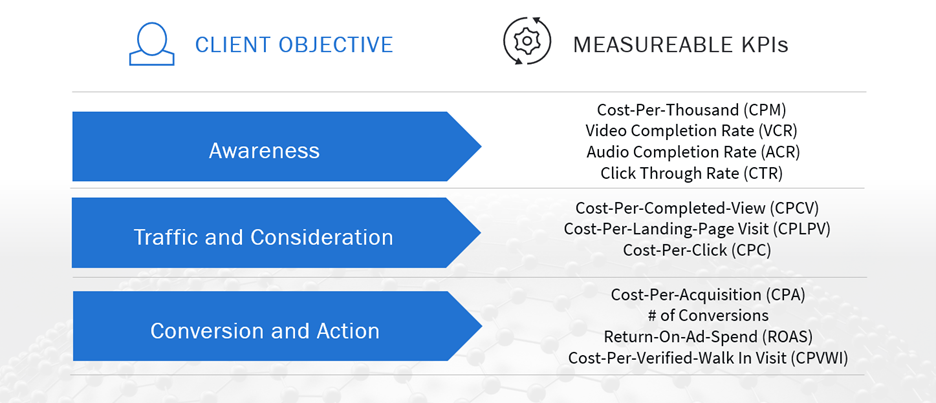
It’s important to keep in mind that depending on a client’s business goal and budget, a single programmatic campaign may have multiple objectives, targeting tactics, and KPIs. In this case, you’ll need to consider each factor both individually and in context of the larger campaign.
Want to learn more about the stages of the marketing funnel, and discover how a consumer’s decision-making process lines up with each stage? Check out AdTech Academy’s Marketing Funnel Basics Certification!
Welcome to Scout! Each week, our team tracks down the best digital marketing articles, POVs, and reports—so you don't have to. Here’s what to read from the week of 2/10/23– 2/16/23 to stay ahead of the curve:
Amidst upheaval in the tech industry, many social media companies are making cuts to their teams assigned to handle dis- and misinformation. False and misleading information online is still a significant and pervasive threat, and critics are concerned that this move puts companies’ “bottom line[s] above the public good.”
Speaking of social media: things have been turbulent of late in the worlds of Meta, TikTok, Twitter, and beyond. With the social media landscape evolving rapidly, this piece breaks down what advertisers need to know.
Besides that Tubi ad that had us yelling “Who sat on the remote?!” at our friends and family members, this year’s Super Bowl ads were largely underwhelming. Learn more about why most missed the mark and how those that succeeded pulled it off.
Less than 48 hours after its debut, more than one million people had already joined the waitlist to try Microsoft’s new ChatGPT-powered Bing search engine. And that interest could be a big (dollar) sign of what’s to come: Microsoft estimates that gaining just 1% more market share in search could translate to an additional $2 billion in ad revenue.
Analyst Ben Evans’ annual exploration of the tech industry’s macro and strategic trends has arrived, and this year’s is a can’t-miss. Check out the slides to learn about advertising’s role in the convergence of tech, media, and commerce (with a dash of AI for good measure!)
—
Want a monthly digest of all the best Scout content delivered straight to your inbox? Sign up for the Basis Scout newsletter!
Digital marketing client finds laser-sharp targeting and cost savings when switching to Basis DSP.
THE ASK
THE SOLUTION
THE RESULTS
Basis had much stronger audience segmentation capabilities. Our client found targeting segments to be much easier and was impressed with our extensive PMP deals library.
ABOUT THE COMPANY
This client is a digital marketing agency in the higher education industry. Over the past seven years, they’ve generated more than $2 billion in revenue for over 100 clients. Their primary advertising goals are getting qualified leads, driving conversions, and reaching high-intent audiences that are interested in continued education whether it be college or post-graduate programs.
"Basis to me is the clear WIN. In the first month, we delivered a better CPL on retargeting on Basis. MediaMath has had plenty of time to mature and is on average delivering higher CPL, with Basis retargeting CPL at $89 and MediaMath at $172." - SVP of Media and Development
2022 was a rocky year for social media. Economic headwinds and increasing consumer privacy demands collided with shifting user behavior and new and emerging players to upend the status quo. Apple’s App Tracking Transparency (ATT) policy also severely diminished social platforms’ targeting and measuring capabilities and, consequently, cut into their bottom lines. And all the while, rumbling in the background, regulatory pressure is building while a pair of Supreme Court cases could significantly affect the power and responsibilities of Big Tech behemoths.
All this has led to a great deal of media hyperbole around the so-called demise of social media in recent months. But as Mark Twain may have tweeted were he around today: “The reports of social media’s death are greatly exaggerated.” A whole generation of people don’t know of a world without social platforms, and crises or not, social still commands a quarter of US digital ad spend. But—and this is a big but—social media is undoubtedly evolving rapidly, making it harder and harder for advertisers to keep up and optimize their social budgets.
Fortunately, we’re here to help. Let’s dive into the latest from the worlds of Meta, TikTok, Twitter, Snapchat, and YouTube and consider how events unfolding today will impact the landscape tomorrow, including channel-specific perspective from Basis Technologies’ SVP of Paid Search & Social, Amy Rumpler:
As we begin 2023, Meta is no longer the titan of innovation it once was. Sixteen months after rebranding alongside Mark Zuckerberg’s gamble on the metaverse, Meta is facing mounting losses, declining revenues, staff reductions, growing competition, increased privacy-related investigations, and minimal consumer adoption of VR. To say it’s been a tough transitional year would be putting it lightly.
The silver lining for this social giant is that despite all those challenges, its ad business remains the envy of almost every other digital media company across the globe. Meta is expected to generate $51.34 billion in US ad revenue this year, a number that only Google can beat and one that dwarfs its social media counterparts. By all accounts, this is a huge moment for Meta, so every decision it makes will be closely scrutinized by analysists and advertisers alike. Starting with its plans for Facebook...
Facebook advertising—the foundation of Meta’s business today—is running aground. Ad revenues on the platform dropped by 8.5% in 2022 and are expected to fall another 1.2% in 2023. To try and right the metaphorical ship, Facebook is concentrating on areas of the app that are most resonating with users—namely, Groups and Reels. It introduced several enhancements to both features in the last quarter, all in a bid to spur more engagement within the platform and offer creators more ways to monetize their content. It’s a sensible move at a time when influencer marketing is in high demand across the social spectrum, but only time will tell if it can help Facebook correct its course.
Like its Meta sibling, Instagram is also working overtime to retain its creator community.After a series of missteps with creators and its commerce offerings, chief among them its decisions to eliminate its affiliate commerce program and remove the shopping tab from the main navigation bar, Instagram appears to be pivoting away from social commerce. Instead, it’s hunkering down and getting back to its key strength—advertising—while paying particular attention to incentivizing content creation and massively enhancing its Creator Marketplace. Instagram needs influencers to keep posting original material on the app to continue attracting new audiences, and these moves are designed to encourage just that.
Meta’s advertising power is the result of their massive reach, high user engagement, well-developed targeting capabilities and ad products, and ability to generate ROI. Historically, they’ve far outmatched the competition in nearly all areas (especially when you take into account the full ecosystem of Meta ad placements and the mature automated ad tools available through their network). Recent developments might mean a slowdown in ad revenue growth for Meta, but it’s still a safe bet for most advertisers, and no one is better positioned to pivot quickly than Meta. Yes, the door is open for other platforms to claim advertising share, but don’t expect Meta to lose their seat at the head of the table in 2023. - Amy Rumpler
A trendsetter and a trailblazer, TikTok is fundamentally changing the way consumers digest content. But there seems to be a double-edged narrative around the app these days.
On one side, this video-sharing juggernaut looks like it’s in a tremendous place—it coasted along relatively unscathed last year amidst the larger social media tumult and it’s fast becoming a pillar of many brands’ media plans. US ad revenues increased 139.9% in 2022 and are expected to grow a further 36.0% this year. User numbers are increasing, and average time spent with the app is also on the rise.
But then there’s the other side to this platform. TikTok’s ascension is not happening in a vacuum, and it’s currently facing scrutiny on multiple fronts. Areas of contention include its effect on young users, its management of data, its dissemination of misinformation, and the one that just won’t go away: its links to China. The biggest threat to TikTok’s US growth may very well be government legislation seeking to ban the app because of mounting security fears. In a bid to assuage those concerns, TikTok is playing the transparency card, proposing to give US officials some degree of oversight into its famed algorithms.
For now, these issues are unlikely to deter consumers and advertisers, but they’re certainly worth watching.
The challenges TikTok faces in 2023 are not new. Since its arrival on US soil, the app has lived in the shadow of all of the concerns mentioned, ever-present alongside any positive outcomes or mentions covered in the news. Advertisers and users, however, don’t seem to care. As things stand, the risks aren’t enough to outweigh the benefits for brands, and they certainly haven’t convinced young Americans to spend less time in the app or delete it altogether en masse. As long as users continue to embrace the app, so too will advertisers. 2023 should be a banner year for TikTok, with more new brands than ever before testing the platform, and spend from brands already investing in the app continues to rise in response to campaign success, new feature releases, and increasing comfort levels with creating TikTok-worthy ad content. - Amy Rumpler
Ah, Twitter! Where do we even begin?
Suffice it to say, Twitter’s future remains a source of constant speculation. It was only in October 2022 that Elon Musk took the reins following a tumultuous, protracted takeover saga, and ever since he’s been rewriting rules and loosening content moderation on what seems like a whim. He’s also laid off half the workforce, feuded publicly with Apple, overseen chaotic policy rollouts, and already promised to resign as CEO based on the results of a Twitter poll—and that’s barely scratching the surface.
Altogether, the unpredictability and radical changes are making stakeholders uncomfortable, and it’s scaring off Twitter’s main source of revenue: Advertisers. US ad spend on Twitter fell a massive 46% in November 2022 from a year earlier, and user numbers are also predicted to drop 6.2% in 2023 to 48.3 million.
Can Musk turn things around and make Twitter into a success? Who knows, but don’t expect the turmoil to end anytime soon. In its current state, it’s clear that many brands see Twitter as a risk not worth taking.
I’m not sure this is the horse I’d recommend betting on in the race for 2023 ad dollars, even with high-stakes odds on the table. Without a clear vision for the future, a conceivable plan for shorter-term advertiser support, or glaring advantages in ad cost compared to results produced, most advertisers will continue to steer clear of Twitter in 2023. There are just too many more compelling options available elsewhere. That said: as long as users continue to rely on Twitter for up-to-the-minute news and information, some brands (maybe challenger brands, for example, or those in emerging verticals) will still be willing to invest. - Amy Rumpler
On to Snapchat—the one-time darling of the ad industry that’s now facing an uphill battle to get its stagnating ads business back on track after a seriously shaky 2022.
The good news is that Snap CEO Evan Spiegel seems to have something that Meta and Twitter do not: a transparent and crystal-clear vision for the future. And that vision involves doubling down on its augmented reality capabilities as a differentiator.
The biggest challenge facing Snapchat over the years has been that brands have seen it as a non-essential player in the digital ad market—a platform without a firm identity and one that many advertisers have failed to fully appreciate. By paving this new course dedicated to AR, Snapchat can start to carve out a niche space for itself in 360-degree campaigns alongside the other major social channels. It’s also recently struck partnerships with a series of ad industry heavyweights (Disney, Adidas, Amazon, HBO Max, and Kroger, to name but five), a promising sign for the future. The fact that Snapchat can also act as a testing ground for metaverse-based activations may further work in its favor as brands look for soft entryways into that space.
Snapchat is a great play for the future-forward brand marketer who desires to be on the cutting edge of metaverse-applicable advertising. Of all of the partners poised to make a splash in a more or fully virtual environment, Snapchat is paving the way through their AR capabilities (which are still often copied by other platforms). If you’re looking to create fully immersive customer experiences, and can embrace the latest technological and creative applications to truly engage users in new ways, then Snapchat is the place to play. Whether this strategy will pay off in 2023 is speculative, but brands that are willing to go out on a limb with Snapchat today may very well end up ahead of the competition by embracing marketing strategies of tomorrow. - Amy Rumpler
As digital video consumption hits overdrive, YouTube is locked in battle on multiple fronts: Its ad business under attack from streaming platforms on one side, and social media rivalries with TikTok and Instagram on the other. The platform’s ad revenues are still projected to climb, though—9.6% this year to $8.06 billion before jumping another 14.2% in 2024—with an ever-increasing share of those dollars coming from connected TV.
This estimated growth comes as YouTube has been making some pretty big moves. In just the last six months, it has launched a dedicated page for podcasts, nudged itself into Amazon Prime Video and Roku’s market by offering streaming subscriptions, snagged the coveted NFL Sunday Ticket, and begun testing a new hub of free, ad-supported streaming channels. Put it all together and YouTube is looking to become a central video-fueled destination across various formats and genres, which should provide some exciting opportunities for advertisers.
Of all partners on this list, YouTube may be in the best position to capitalize on momentum in 2023 and beyond. They sit perfectly balanced between traditional and digital TV/streaming and social/engagement networks, allowing them all the advantages and ability to tap into upward trajectory trends of both sides of the advertising coin. Backed by Google data and dollars, and chock full of content that hits on a deeper level than what we tend to see on social networks, the appeal for both advertisers and users will remain undeniably strong. If YouTube isn’t part of your 2023 marketing strategy, I’d reconsider. - Amy Rumpler
The wild world of social media is undergoing deep, disruptive change, and there’s little evidence to suggest things will settle down anytime soon. For advertisers looking to chart a path through the chaos, staying agile and regularly revisiting the basics will be key, and that starts by making sure messaging is native to the medium and the target audience. Marketers that establish those firm foundations will be better positioned to weather social storms and pivot accordingly.
Looking for advice about how to get your social campaigns off the ground, but don’t know where to begin? Our Media Strategy & Activation team can point you in the right direction