
Technology
Basis Platform
Advertising Operating System
Communication Portal
Intelligent Collaboration
All Channel Activation
Activate Media on Every Channel

Consulting
Resources
Less than one year after its public debut, generative AI has the marketing and advertising world’s full attention.
The next-generation artificial intelligence tech burst onto the scene late last year with the debut of ChatCPT and DALL-E 2, both from Silicon Valley AI pioneer OpenAI. ChatGPT, in particular, has grown into a near-overnight sensation, reaching a million users in just five days and hitting 100 million active users faster than any consumer app in history to that point.
One of OpenAI’s biggest early investors, Microsoft, has since poured an additional $10 billion into OpenAI while beginning to introduce a host of new AI-powered features, including a ChatGPT-powered version of Bing search engine.
In turn, Google—a generative AI innovator in its own right and the first company to utilize large language models (LLMs)—has introduced its own AI chatbot, Bard, its own AI chatbot, while promising new, soon-to-launch AI-powered features in Google Search, Gmail and more. Another major player, Meta, has spent nearly 10 years and billions of dollars on AI and has taken to touting its LLaMA as a powerful open-source language model. And dozens of other companies have also begun introducing generative AI-powered tools into the marketplace.
Altogether, AI is already proving to be a powerful disruptive force in the marketing and advertising world, and the wider implications of this AI revolution could be extraordinary. Microsoft founder Bill Gates has called AI as major a tech innovation as the internet or the PC, while also warning that AI’s emergence will inevitably result in the loss of white-collar jobs. Or, as the Harvard Business Review put it, "The question isn’t whether AI will be good enough to take on more cognitive tasks but rather how we’ll adapt."
So, how will the next generation of AI affect marketing and advertising?
For this report, we surveyed over 200 marketing and advertising professionals from top agencies, B2B and B2C companies, non-profits, and publishers to see how marketers are feeling about AI today and how they believe it will shape the industry going forward.
Findings include:
Say you're running an ad campaign, and you want to target 35-year-old moms who enjoy board games and luxury fashion. How do you serve ads to that specific audience? Without knowing where board-game-loving, luxury-fashion-buying moms spend their time, it could take months of trial and error to figure out which ad placements will reach that audience most effectively.
The great news? Programmatic advertising allows marketers to leverage data and streamline the process of connecting with the right audiences on the right channels. Today, we’re digging into how marketers can use different campaign targeting tactics to reach consumers, as well as how they can do so in ways that respect consumer privacy.
Unlike site-direct planning, programmatic media is focused on audience buying. In other words, programmatic allows advertisers to focus more on finding the right audience than on finding the right website. This emphasis on audience means that advertisers can pull from a variety of data sources to determine how best to target consumers based on where they live, the content they consume online, their brick-and-mortar visitation, the apps they have downloaded on their mobile device, and more.
By targeting specific audiences, marketing teams can ensure they aren’t wasting ad spend on consumers who aren’t likely to convert. And with a variety of targeting options and the ability to combine them within one campaign, programmatic makes it easy to use your budget wisely and efficiently.
There are many targeting options available for marketers using programmatic. Read on to learn about six common targeting strategies in detail:
Behavioral targeting allows marketers to serve ads to unique individuals across multiple devices based on their demographics, behavioral attributes, intent, or interests. Demographic data could include gender, age, income, or education, while interests might include cooking, gardening, or fitness. In addition to using second- and third-party data for behavioral targeting, marketers can leverage first-party data gathered via tracking behaviors or actions completed on their websites (i.e., page activity, purchase history, etc.).
It's important to note that the deprecation of third-party cookies will impact how advertisers can leverage third-party data in behavioral targeting. To adapt to the privacy-first future, marketers will need to lean into more privacy-friendly targeting techniques, such as first-party behavioral targeting.
Leveraging website or app targeting is a great strategy when you know what sites or apps you want your ads to run on. Marketers often combine inventory types in a single campaign to best use the targeting options available. For example, you can use a list of sites you want to target (either website or app), and layer on the audience segments you’re looking for on these pages using behavioral targeting.
Custom site lists help ensure your ads are serving on the desired sites and generally come at a more efficient cost than private marketplace deals (more on these shortly!). The only downside to running custom site lists programmatically is that there is less control over where ads will serve on the site and how much budget will spend. If an advertiser needs more control, it’s better to go through a private marketplace deal.
A private marketplace (PMP) provides access to prepackaged deals where publishers and providers bundle high-quality ad inventory. Typically, these deals come at a higher CPM and ensure that the best ad placements on a website go to the highest bidder. Though less cost-efficient, PMPs are one of the best ways to get your brand in front of qualified traffic in highly visible placements. For example, within Basis, users have access to an Inventory Directory. There, users can select deals or negotiate directly with providers. The PMP will show all details on price, volume, device types, and supported ad formats.
PMPs are a great option for campaigns where a brand wants to be exposed to high-quality traffic and premium placements. Even more, PMPs are a privacy-friendly way to tap into high-quality, targeted audiences.
Depending on the product, it can take several visits before online shoppers decide to make a purchase. To keep consumers engaged, marketers can leverage retargeting to bring them back to a website, maintain their interest, offer additional info, or keep their brand top of mind.
How does it work? Well, in platforms like Basis, advertisers can build audience pools based on website interactions such as specific page visits, cart abandonment, or button clicks, and then target custom messaging to those segments. Overall, retargeting is an essential strategy for engaging consumers who have already shown interest, and earning their conversions.
Geotargeting or geofencing is a hot topic for marketers because it focuses on targeting individuals within a specific geographic perimeter, or “fence.” These digital boundaries are built around specific places of interest, such as a competitor’s location or a place where your audience group is congregated.
Geotargeting allows teams to reach audiences in strategic locations, and to do so in a privacy-friendly way. Marketers can leverage first-party data (such as a zip code entered at checkout) or location-based data (summer in Texas = HOT) to personalize ads and target them to key audiences.
Contextual targeting is another privacy-friendly targeting solution that advertisers can leverage in their programmatic campaigns. Contextual targeting serves ads based on the content of a specific website, page, or channel. This could look like an online bank running ads during a personal finance podcast, a makeup brand serving display ads on websites with makeup tutorials, or a sports gambling company targeting live sports content on CTV devices. That’s the beauty of programmatic: You can get very specific with targeting different types of content on specific pages. These content targeting segments can be topics as broad as sports, news, or entertainment, or as specific as baseball, healthcare news, or award shows.
Targeting is one of the areas that the impending cookieless future will impact most. The good news is that many of the targeting strategies we just discussed are either inherently privacy-friendly (such as PMPs and contextual targeting) or can be adapted to be privacy-friendly through the use of first-party data.
That said, this shift will require advertisers and marketers to test and adopt new strategies and technologies for effective programmatic targeting. Advertisers will need to focus on building direct relationships with consumers, leveraging their own first-party data, and shifting their targeting tactic mix to identify and reach relevant audiences in a privacy-conscious manner.
__
Want to learn more about how marketers can connect with audiences in meaningful and privacy-friendly ways? Check out our guide, Beyond Third-Party Cookies: Your Guide to Privacy-Friendly Advertising, for a deeper dive.
What’s the weirdest museum you’ve ever been to? If you haven’t visited the National Mustard Museum in my home state of Wisconsin, I’m here to tell you that you’re missing out. It’s got everything: An exhibit on the history of mustard, the “exquisite Gibbons Collection of sterling silver and porcelain mustard pots,” and thousands of varieties to try and buy—from root beer mustard to Pear mostarda to gingerbread Dijon.
While quirky destinations like these are fun for townies and tourists alike, creative marketers can also benefit from understanding the significance of such local attractions—especially in today’s industry, which is slowly but surely transitioning toward more privacy-friendly methods of serving tailored messages to consumers.
Unconvinced that America’s Favorite Condiment Museum has anything at all to do with winning marketing strategies in a cookieless world? Stick with me here and let’s take a look.
Like the Greeks and Romans prescribing mustard to cure the bubonic plague, geo-based targeting can serve as a balm for marketing organizations transitioning away from third-party cookies (except that localized marketing actually works...no offense to our Hellenic ancestors!)
How, exactly? Despite Google delaying third-party cookie loss to 2024, the fact remains that our industry is in the midst of an identifier crisis. News coverage of data breaches and data privacy regulation, combined with updates to iOS and Android that have increased the transparency of mobile data collection, have levelled up consumers’ understanding of how companies collect and use their data. As a result, consumers (understandably!) want more control over how companies gather and leverage their personal information and online behavior. To accommodate consumers and regulators alike, the marketing world is on the brink of a tectonic shift away from a targeting world that revolves around the third-party cookie.
In their place, marketers must lean into other targeting methods. Contextual and geo-based targeting, for example, are both not only tried-and-tested, but often more cost-efficient than user ID-based targeting. We’ve already taken a closer look at contextual targeting, so let’s examine some of the ways geo-based targeting strategies like location targeting, localized marketing, and geotargeting can help advertisers reach their audiences.
Location targeting might seem basic to some marketers, but it’s hard to understate the power of doing it right. Targeting by country, city, or even zip code presents advertisers with information that’s ripe for personalizing brand messages: language, food, weather, sports teams, music, history, landmarks—the list goes on. This type of targeting presents the opportunity to build custom creative with specific audiences in mind (sometimes referred to as “localized marketing”). Advertisers can use information about different locales to relay brand messages that feel thoughtful and personalized, but not invasive.
For instance, to promote their original series “Wednesday”, Netflix ran localized, place-based advertisements around the world that featured creative geared towards the culture of those markets. Take a look at this billboard from LA, for example:

These localized ads played into a bold, omnichannel advertising strategy from Netflix, in which consumers encountered Wednesday ads everywhere from the TikTok and Uber apps to the trays in airport security lines. Wednesday is now the second-most-viewed English language series on Netflix, thanks in part to their innovative marketing approach.
While the tone of the Wednesday creative matches the personality of the character upon which it’s based, not all location-based ads have to be so cutting. Consider the following examples:
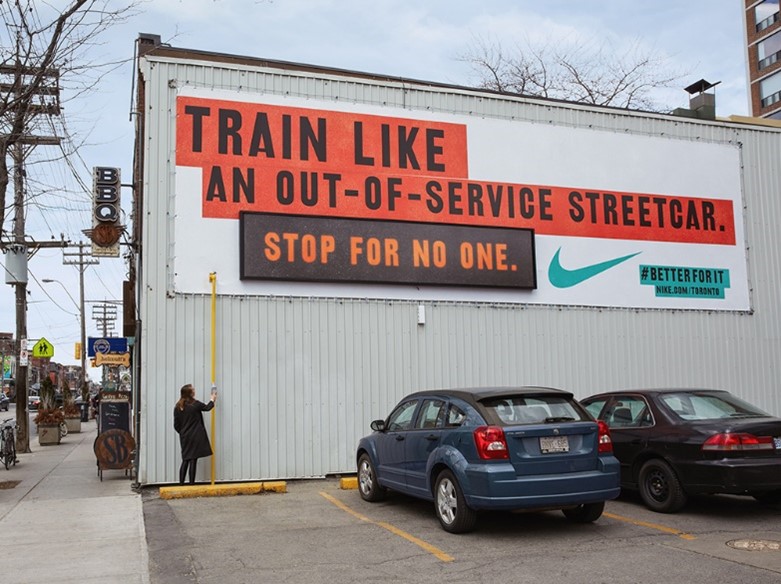
In Toronto, Nike built a brand awareness ad around local transit frustrations.

In Philadelphia, Vitamin Water featured a piece of locally-loved slang to get their message across.
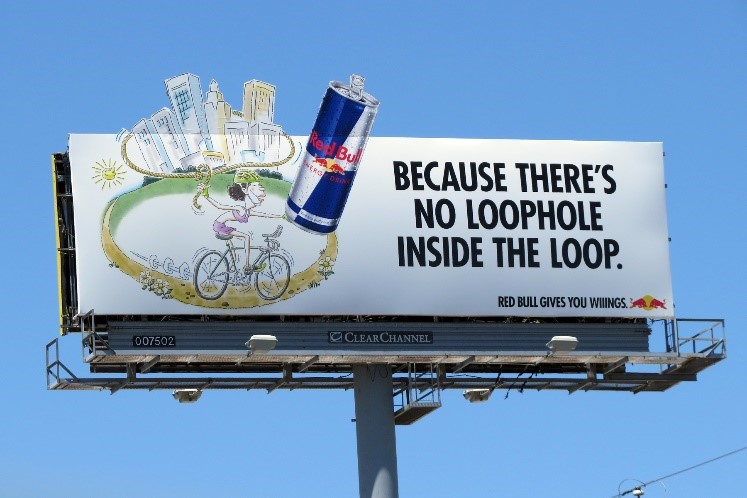
In Chicago, Red Bull made the iconic Chicago Loop the star of a billboard ad.
If you’re from Toronto, Philly, or Chicago, seeing one of these ads may have made you smile—which is exactly what localized media is supposed to do! At its best, a localized ad feels like being seen by a brand—like the two of you are sharing an inside joke—and elicits positive associations that come with knowing that brand spent time and money to connect with you and your people.
Those warm fuzzy feelings are priceless from a marketing perspective, and for that reason, ads with localized creative might be some of the most enjoyable and unobtrusive that consumers can come across. They’re just targeted enough to feel tailored, but not so targeted as to feel creepy (i.e., "How did you know I was just talking to a friend about wanting to visit Dijon next summer, internet??”). And in the modern marketing world, that’s a crucial balance to get right.
Of course, just because we live in a certain zip code doesn’t mean that we spend all our time there, and advertisers can get even more granular in their geotargeting based on consumers’ real-time location data and/or locations that they’ve recently visited. In a privacy-first world, using first-party data is a no brainer here, because consumers generally understand first-party data collection as something that’s meant to streamline their digital experience (like Weather.com remembering your zip code or the Kohl’s app knowing that February in Chicago is sweater weather, not swimsuit season).
Brands can also tap into second- and third-party data to power geotargeting campaigns, but this is where marketers must tread lightly, as the use of that data opens up privacy concerns. This kind of geotargeting uses information like GPS data collected from mobile apps to serve ads to customers when they enter specific geographies. But location data, in the eyes of regulators and consumers, is personal data—and that means marketers must be extremely careful about how they gather, utilize, and store it. Under pieces of legislation like GDPR, CCPA/CPRA, and COPPA, there are rules for how companies can interact with location data. If brands don’t comply, they run the risk of legal consequences and subsequent loss of brand loyalty once the news gets out.
The issue gets even more complicated considering that due to the complexity of the media supply chain, many data providers and brands simply don’t know that they’re violating these regulations. For example, a report from fraud detection platform Pixalate found 70% of the top 1,000 most popular apps directed at kids on the App Store and Google Play share GPS signals or IP addresses with marketers, implicating those marketers in potentially violating COPPA. There are a lot of companies out there that have no idea where their data comes from and they’re using it anyway—don’t be like those companies!
Despite privacy concerns, the location data industry is growing at breakneck speed: 90% of global companies that use location data expect its use to become more important in coming years, and location data is seeing rapid adoption in the retail, CPG, travel, finance, real estate, and logistics industries.
So, how can marketers tap into second- or third-party location data without running the risk of violating consumer trust and data regulations? Here are a few guidelines:
An example of guideline number two in action: Basis is integrated with intelligence and measurement company Cuebiq, which allows Basis marketers to build audience pools based on mobile users’ location behaviors, and measure in-store visitation resulting from ads. Cuebiq prioritizes privacy by always asking users to opt into sharing their location before collecting it, and by providing users with multiple options to opt-out of location sharing at any time. Plus, Cuebiq was one of the first location providers to join the Network Advertising Initiative, a group that maintains and enforces high standards for data collection and use, which is another good sign that they’re serious about privacy.
All in all, geotargeting can be a huge boon for marketers, but with great power comes great responsibility. And failing to uphold your responsibility to consumer privacy can result in catastrophe (kind of like the catastrophic shortage of mustard France is experiencing right now—but that’s a story for another day).
Like people in the market for a new house or storefront, the marketers of the future will constantly be thinking about “location, location, location.” It’s hard to overstate the importance of place, and one thing’s for certain: Location targeting, localized marketing, and geotargeting will all be significant players in the digital advertising ecosystem of the future.
And, like 9th-century monks in Northern France making bank on mustard, marketers who tap into geo-based targeting (in privacy-friendly ways, of course!) will find themselves very well off, indeed.
—
Speaking of geo-based targeting, did you know that 2022 marked the second consecutive year that digital out-of-home ad spend grew by more than 20%? It's a channel that's privacy-friendly, allows advertisers to personalize their messaging based on location-based contextual relevance, and comes with all the capabilities that give digital advertising its power and efficiency. Learn all about how to tap into this growing opportunity in The Power of Place: Your Guide to Digital Out-of-Home Advertising.
Digital out-of-home (DOOH) is making quite a splash in the world of advertising. As of 2022, the global DOOH market was valued at $18.80 billion, and it’s forecast to reach $58.67 billion by 2030. That’s an increase of more than 212%!
With the many benefits the channel offers, it makes sense that it’s experiencing rapid growth. DOOH allows advertisers to connect with audiences when they’re outside of their homes, in contextually relevant environments, when they often don’t have their eyes glued to their phones (but do still have them handy to interact with elements like QR codes). Put simply, when used as part of a holistic omnichannel strategy, digital out-of-home allows advertisers to reach audiences in key moments of impact.
And, thanks to its digital nature, DOOH allows advertising teams to harness the latest innovations in adtech to maximize their return on ad spend (ROAS). From its targeting, personalization, and reporting capabilities, to the real-time bidding and automation offered by programmatic DOOH (pDOOH), this channel combines the best qualities of OOH with the power of digital advertising.
Even more, DOOH is ripe for creativity. We’re talking big, bold messaging, compelling carousels of images, mesmerizing motion, and more. After all, these are messages that people are often seeing on their way from place to place—what better opportunity to have fun with the creative elements to capture their attention?
Today, we’re sharing several of the most compelling digital out-of-home ads we’ve seen, and digging into why they stuck with us. Whether they succeeded due to a strategic use of video or a humorous approach, or by tailoring relevance to the specific moment, advertisers can learn a lot about the DOOHs and DOOHN’Ts of DOOH (sorry, we couldn’t resist!) from these ads.
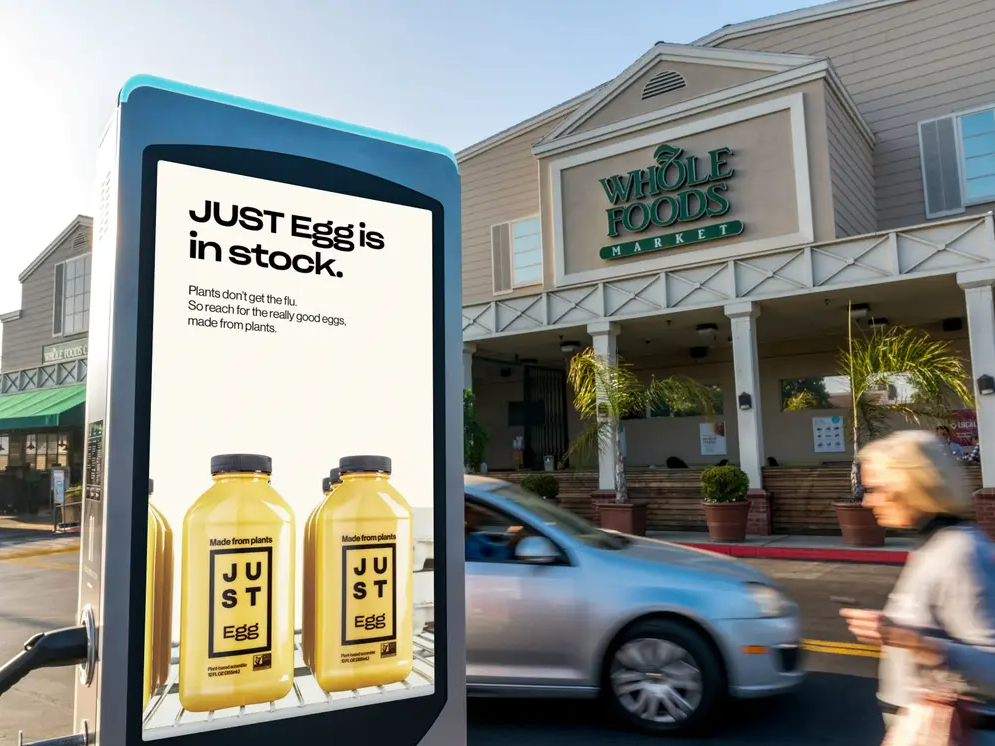
Remember when the price of eggs skyrocketed last year? While we were panicking about the future of omelets and quiches, the company JUST Egg saw an opportunity. They ran DOOH ads for their plant-based eggs, using messages like “Plants don’t get the flu” to elevate their product and brand at a strategic moment when the alternative (i.e., chicken eggs) was less available.
JUST Egg placed their messages in high-traffic, public places where they were truly relevant (think outside of a grocery store, or near a major shopping center). And, since they chose to use DOOH rather than a traditional OOH billboard or urban panel, they were able to leverage messaging that was relevant for a specific moment, and to make creative adjustments easily—by updating digital files—once the momentended (i.e. once the price of eggs returned to normal).
Our key takeaway: It pays to seize the moment. In other words, certain messages might make a more profound impact during certain times. Paying attention to the latest news, events, and trends can help ensure your brand is connecting with audiences in a way that’s meaningful to them when and where they are. And, using a channel like DOOH ensures that marketers can not only reach people in high-traffic, contextually relevant locations, but that they can also quickly adapt messaging if needed.

Ah, the holiday season. For most, it’s a time to be enjoyed with friends and family. And though we can’t speak for everyone, we know of a certain trope about spending time with in-laws (which might not be a trope if there wasn’t at least some truth behind it…).
For this campaign, Roku decided to keep it real and lean into these mixed feelings about the holidays. They ran digital billboards that joked about how consumers could use their streaming TV devices to escape time spent with in-laws—a message that, we’re sure, many could relate to. By using digital out-of-home, they were able to place their quippy creative on a big, bold display, and in a high-traffic location. And, by using the digital iteration of OOH, they ensured they could easily update their creative once the season ended, to avoid the ad looking outdated once the holidays were over.
Our key takeaway: Personalization looks different on a one-to-many channel like digital out-of-home. Rather than being tailored to specific individuals based on demographics, behavioral data, and other available personal data, DOOH is personalized to groups of people that are likely to encounter a specific ad. Here, Roku formulated a message that was relevant to the season and personal to many. By considering their target audience and the specific context and moment they’d see this ad, Roku was able to connect with viewers in a compelling way that felt personal.
To promote its new series, Resident Evil, Netflix took out a massive digital billboard in Times Square. But this wasn’t just any billboard—this was a 3D digital billboard, one which allowed Netflix to display a frighteningly life-like “licker” (a zombie creature from the horror series) moving about and seemingly smashing the “glass” it was contained by.
Our key takeaway: If we saw this while walking the streets of New York, it would certainly stop us in our tracks. Thanks to the digital nature of DOOH, there’s a significant opportunity for advertisers to use video and motion to captivate and mesmerize audiences. This could look like something as bold as the 3D billboard above, or could include using video footage (rather than a static image) to show off the features of your product in a more immersive way.
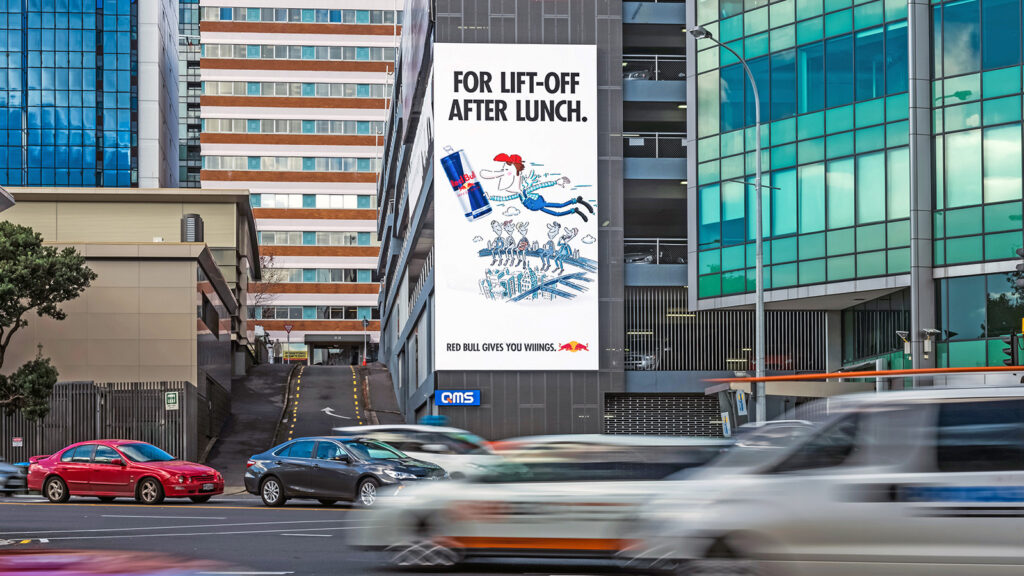
Remember how we talked about DOOH allowing teams to meet people with the right message, in the right moment? Red Bull took this to the next level with these digital signs. By using dayparting, or running ads at specific times of the day, Red Bull met viewers at the right time with the right message: “Feeling the afternoon slump? Red Bull can help!”
Our key takeaway: This is another example of the power of personalization on a one-to-many scale. By designing this ad specifically for the post-lunch moment, Red Bull was able to drive higher engagement than, say, a more generic ad that ran on a digital billboard all day.
With ad spend projected to increase dramatically over the next seven years, now is a great time for marketers looking to ride the DOOH wave to start testing and learning on the channel. Start with some of the ideas we outlined above: From seizing an interesting cultural moment, to using the latest digital tech to captivate audiences with motion, to leaning into the power of dayparting, DOOH offers a slew of ways to get creative in connecting with consumers.
__
Want to level up your DOOH expertise even further? Check out our guide, The Power of Place: Your Guide to Digital Out-of-Home Advertising. In it, we break down everything digital advertisers need to know about DOOH so they can leverage it effectively within their omnichannel media mix.
Pop quiz: In which digital space can you find the exact location of a friend, attend a virtual concert, send pics and texts that only last as long as you want them to, peruse digital content generated and shared just for specific audiences, and peek into the lives of celebrities? Snapchat, of course!
While the platform is sometimes dismissed a non-essential advertising channel, brands looking to reach younger audiences—as well as those seeking to be at the forefront of augmented reality (AR)- and metaverse-related activations—would do well to keep an eye on Snapchat. And while the app’s parent company, Snap, has been having an up-and-down couple of years from a performance standpoint, its AR-focused vision for the future and unceasing popularity with Gen Z and millennials offer distinct advertising opportunities to social marketers.
What led to this moment in Snapchat’s history, where does the app stands today, where will its future lead, and how can advertisers make the most of their Snapchat spend? Read on to find out.
Since it arrived on the market, Snapchat has seen some serious ups and downs (welcome to the wild, wild world of social media!) When it hit the app store in 2011, its offering was unique: Picture-based chat functionality that gave users the ability to limit the amount of time a recipient was able to see their message.
Snapchat then because first social app to popularize AR with the introduction of lenses in 2015, which allowed people to use a variety of filters that altered their appearance, has since fueled hours of wonder and hilarity as people experimented with making themselves look (arguably) more attractive (who remembers their flower crown filter era?), less attractive, and just plain ridiculous.
All together, Snapchat was the fifth most downloaded app of the 2010s—and Meta found that threatening enough to offer a $3 billion acquisition deal in 2013, which Snap declined.
Fast-forward to today: While the platform has continued to see strong user growth, its ads business has faced a turbulent past couple of years. 2022 was particularly difficult, as the company lost two of its top ad executives, laid off 20% of its employees and restructured, and saw its Q3 net losses almost quintuple year-over-year. Importantly, this didn’t happen to Snap in a vacuum—Meta and X (formerly Twitter) also experienced revenue losses, restructurings, and mass layoffs. And on the upside, Snap appears to have benefited from X's decrease in traffic last year: while traffic to X's ad portal decreased by 19% year-over-year in October 2022, traffic to Snap’s ad portal increased by 47%.
Even still, the core of Snap’s revenue troubles likely stem from the fact that Snapchat functions mostly as a chat app, which has made it harder to monetize with ads than it is for other social media platforms like Facebook, Instagram, X, and TikTok.
So, does that mean advertisers should ignore Snapchat? Not at all! The app offers a consumer base that’s particularly engaged, with the average user opening Snapchat over 30 times per day and spending over a half hour on the app every day. And, when done well, Snapchat ads can prove particularly engaging: The travel app Hopper found that Snapchat users booked flights four times as often as customers brought to the app from other platforms. Even more, some exciting things may lie in store for Snap as it further differentiates itself with a renewed investment in AR.
As an AR pioneer, Snap is well-positioned to differentiate itself as a leader in the field. This could prove to be huge for the company (and for advertisers), as AR is set to explode in coming years:
While Snapchat’s current AR functionalities are mostly entertainment-focused, there’s significant room for development of more revenue-driving use cases, such as social commerce.
The big takeaway? While Snap has struggled to bring in consistently high ad revenue in recent years, the course it’s charted towards AR innovations could mitigate some of its struggles to monetize the platform. Of course, there’s a lot of uncertainty here, as these new AR features could take years to develop and refine. Still, for future-forward brands who want to be on the frontlines of advertising innovation while connecting with a highly engaged audience, testing and learning on Snapchat could pay off in a big way.
Let’s say you’ve made the decision to start working Snapchat ads into your marketing mix. What creative is most likely to resonate? How do you make the most of your investment? And how can you work Snapchat into your cross-channel campaigns? Read on for our top recommendations:
Similarly to TikTok, Snapchat rewards advertisers who make their ads feel native to the platform’s specific environment. Snap recommends using ads that last for five-to-six seconds, don’t come off as overly polished, and are designed for users watching with sound on. Creative that features user-generated content (UGC) can be particularly impactful.
Snapchat also provides several unique offerings that advertisers can leverage to take their campaigns to the next level. A few to consider:
As with any advertising channel, your Snapchat spend will typically be most impactful when you’re leveraging the channel as part of a cross-channel—or better yet, omnichannel—campaign. With a cross-channel approach, advertisers can reach their audiences at complementary touchpoints in the spaces where they spend their time, providing a smooth and more unified customer experience.
Of course, managing a cross-channel campaign comes with its own unique set of challenges, and hopping in and out of lots of different platforms can create the very opposite of a smooth and unified experience for advertisers, depriving them of a clear and easy way to gauge the success of one channel versus another and creating barriers to shifting spend based on performance. One solution for marketing teams here is to leverage an omnichannel advertising platform, where advertisers can track the performance of all their campaigns (including campaigns on social platforms like Snapchat, TikTok, and Facebook) within a single interface, providing a single source of truth and eliminating the time-consuming need to switch back and forth between platforms.
While Snap (like all social media companies) has had its share of ups and downs, it’s never stopped innovating and adapting to consumer and technological trends. And while plenty of competitors have come and gone, Snapchat keeps users coming back day after day, and year after year. With that loyal audience and the brand’s commitment to leading the way in social media AR, Snapchat offers some enticing and unique opportunities to social advertisers.
—
Want to make the most of your Snapchat spend? Then you’ll want to be a video advertising expert.
The video advertising landscape has evolved considerably in recent years, and between streaming video’s ongoing takeover and innovative emerging technology like interactive content and generative AI, that trend shows no signs of slowing. Check out the Video Unleashed Guide for a deep dive into everything marketers need to know.
When was the last time you opened a social media app? Caught up on your favorite show on a streaming platform? Scrolled through a website page on your desktop or phone? You’re doing at least one of these activities (if not three all of them) right now, right?
Don’t worry, our goal here isn’t to call you out on your daily screen time: it's to point out that all three of these digital engagements provide prime opportunities for advertisers to connect with you via video ads. Whether it’s via CTV (which is dominating this year’s TV upfronts), social video (did you know that US TikTok users spend almost an hour per day on the platform?), or good old display (in 2021, video accounted for more than 50% of display ad spend), video ads are an increasingly popular way to reach audiences.
Of course, most marketers don’t need to be sold on the value of a well-thought-out digital video advertising strategy. Production aside, one of the biggest challenges advertisers face in the realm of video lies with measurement. To employ an effective approach, advertisers must tap into the multiple types of digital video and navigate various platforms, each of which offers different measurement capabilities. As a result, it can be tough to know which metrics to track and tougher still to gain a holistic view of video ad performance.
If you’ve got a bad case of measurement malaise, you’ve come to the right place. Let’s take a look at four critical metrics you can use across all types of digital video—video completion rate (VCR), engagement, cost per completed view (CPCV), and viewability—and break down how each one should play into your performance evaluation process.
VCR is the legacy metric for measuring digital video. It's a number that answers the question, “What percentage of my video plays were viewed all the way through?” If your VCR is high, you know that a good number of viewers have consumed your brand story in its entirety. Plus, it’s a good indication that your ad is engaging enough to capture and maintain people's attention.
However, it’s important to note that evaluating success via this metric will look different depending on the inventory source. On CTV, for example, advertisers can expect 90% VCR or above. For 15-second pre-roll ads or ads on a video platform like YouTube, on the other hand, 20-40% is more common. And, the percentage will decrease the longer your ad is.
VCR is a legacy metric for a reason, and a solid choice for evaluating ad performance. However, it’s often not the best metric to use when evaluating social video ads, as social platforms simply don’t optimize towards users completing videos. Think about it: The whole idea of a social video feed is that it’s quick and scrollable, encouraging users to consume as many videos as possible (it’s the dang algorithms that are to blame for those late-night hours lost to TikTok and Instagram Reels, not us!). In this environment, alternative metrics such as engagement may prove to be a better fit.
Engagement quantifies the number of interactions or quality of interactions users have with your digital video ad. On social media, engagement is measured via clicks, likes, comments, or shares.
In a survey of over 500 digital video marketers across the world, engagement was the metric most frequently ranked as “important.” And while it has a place in measuring performance across all types of digital video, it’s particularly impactful in environments like YouTube or social feeds, where there’s more opportunity for interactivity. Due to the scrollable nature of these spaces, advertisers will want to focus less on whether consumers were able to view their entire brand story, and more on whether their content earned viewer’s clicks.
Advertisers will always want to understand the efficiency of their spend, especially during times of economic upheaval. So it makes sense that CPCV, which calculates the cost you’re paying for each completed view of a video, is a metric that advertising leaders want to check in on when evaluating campaign performance.
However, CPCV numbers don’t vary much from video to video, especially within a programmatic initiative. It’s true that ads run in places like Hulu will be more expensive because you’re paying for that premium environment, but even in the context of premium video spaces, your CPCV won’t fluctuate too much. It’s hard to pull relevant insights from numbers that are the same across the board, which is why CPCV works best as a complementary metric: It’s a good number to keep an eye on, but you’ll want to bolster it with other numbers like VCR or engagement to get a more nuanced picture of how your ads are performing.
Like CPCV, viewability is a solid metric to include in your reporting because it provides reassurance about the effectiveness of your spend. Specifically, it reassures advertisers that they are paying for impressions where at least half of an ad’s pixels are viewable: The IAB defines a viewable impression as one where at least 50% of the ad’s pixels are visible in a browser window for one continuous second or longer. In this way, it’s an important part of a holistic digital video measurement approach.
But like Nina Simone and Wilco, Viewability can be a bit misunderstood. See, your viewability percentage represents the number of viewable impressions out of the total number of measurable impressions. If you’re thinking, “But aren’t all impressions measurable?”, well, we’re glad you asked! There are, in fact, some cases where an impression pixel isn’t deemed measurable—for example, if a pixel isn’t firing properly, then the ads associated with that pixel won’t end up being measured.
What does this all mean for you? Essentially, it just means that your viewability percentage is actually the percentage of viewable impressions within the percentage of measurable impressions, as opposed to overall. This by no means compromises the value of the viewability metric—it's just something to be aware of when pulling insights from your reporting.
Now that we’ve covered the value of four key digital video measurement metrics, it’s important to remember that the key to effective digital video measurement lies not just in the knowledge of when to prioritize certain metrics, but in the ability to pull data and assess performance holistically, across multiple digital video types and platforms.
For this, marketers often seek out tools like an automated, holistic reporting dashboard, which not only makes it possible to assess the effectiveness of your ads using the same metrics across multiple platforms and video types, but it saves them from the tedious, error-prone time suck that is manual reporting—not to mention the inherent discrepancies that tend to pop up whenever you’re relying upon multiple analytics sources (which are regularly as high as 20% when pulling from third-parties). Platforms with built-in holistic reporting capabilities can consolidate data across many channels and platforms, giving marketers a bird’s eye view of digital video advertising performance across common metrics such as VCR, engagement, CPCV, and viewability.
There you have it: Once you understand the uses of VCR, engagement, CPCV, and viewability across types of digital video, it’s a whole lot easier to assess which metrics to prioritize in specific cases. And with holistic analytics dashboards, marketers can improve the quality of their data and have more time to strategize around how to best leverage this powerful channel.
—
Of all the digital advertising channels, video just might be the most complex—and measurement isn’t the only aspect to master! Check out our guide to learn everything advertisers need to know about making the most of this rapidly changing, highly engaging medium.
Turbulence around holiday shopping appears to be the unwanted gift that keeps on giving. Recent years have been marred by supply chain disruptions, inflation, and widespread economic uncertainty (not to mention a pandemic and international conflicts), foiling many holiday shoppers’ plans. And though we hate to be a Grinch about it, it’s beginning to look a lot like this year’s holiday season will bring more of the same.
Wondering how the nuances of 2023 consumer behavior will impact holiday spending and see what advertisers can do to optimize their investments for Q4? Read on to find out (and to get some industry-specific recommendations for automotive, higher education, CPG, and cannabis brands!)
While this holiday season will likely include some undesired economic turbulence, the good news is that shoppers and advertisers alike now have a few years of comparable experience under their belts.
Like last year, price—which encompasses not just sticker price, but also factors such as coupon availability, perceived value, and/or the promise of free shipping and free returns—will be top-of-mind for consumers, more than a third of whom are buying less than they were six months ago. Customer loyalty is still the goal—especially in a world where 20% of customers produce 80% of your profits (s/o to the Pareto Principle!) But with economic uncertainty coloring all aspects of the holiday shopping experience, it's more important than ever for marketers to test their messaging, see what is resonating with consumers, and then make data-informed decisions as they implement and optimize campaigns.
Additionally, customers starting their holiday shopping earlier in the year is another trend that’s showing no signs of stopping. Last year, October e-commerce sales increased by almost 10%, thanks to pre-holiday season promotions like the Prime Early Access sale. As a result of promotions like these, plus consumer concern over shipping delays, low inventory, and higher prices later in the year, the holiday season now effectively spans all of Q4.
Finally, online shopping continues to gobble up a bigger slice of the holiday pie, with holiday retail e-commerce sales expected to grow by 11.9% this year. But brick-and-mortar is still very much in the game—in fact, in 2022, in-store holiday spending rose above $1 trillion for the first time ever.
Now that you’re aware of the biggest general holiday shopping trends impacting the 2023 season, let’s get into some industry-specific learnings:
For decades, automotive consumers have been trained to take advantage of great offers from automotive brands around this time of year. As a result, there are more in-market auto shoppers during the holiday season.
Rising interest rates and the microchip shortage continue to put pressure on the industry, but there are differences from this time last year that should deliver more advertising investment: vehicle availability is improving, and new electric vehicle brands, models, and tech are fueling massive buzz for the industry as a whole.
To best connect with automotive consumers this holiday season, advertisers should take advantage of increased site visits with retargeting, using purchase intent data to build audience segments (since purchase intent signals are strong drivers for life stage changes and major purchases like auto), and tapping into the football season by targeting premium CTV sports inventory with PMPs.
- Jim Zabel | VP, Client Development - Auto
While there may be temptation to lighten advertising spend during Q4 when rates are a little higher, higher education marketers should refrain from doing so because the holiday season is crucial for recruitment!
For prospective undergrads, many families have important conversations about their future over the holiday break. Plus, the target market for undergraduate campaigns is likely spending way more time on TikTok and CTV over the holidays, since they’re on a break from school and have more time on their hands. These channels are always good ways of meeting this audience when and where they are, but even more so over the holidays.
- Kara Klein | Director of Client & Media Services
If you’re a CPG advertiser, you've been building brand awareness all year long, and now is the time to help those investments pay off by focusing your advertising efforts on driving to purchase. Digital shelf optimization and point of sale activation are musts, and when it comes to media efforts, brands should prioritize screens and channels that meet consumers when and where they’re in a purchase mindset. This could look like using QR codes on CTV, placing “Add to Cart” CTAs on display ads, tapping into e-commerce opportunities within TikTok or Meta and, of course, leveraging retail media networks and their point-of-sale capabilities.
And here’s a bonus tip for CPG challenger brands: Make your dollars work smarter by concentrating on less crowded spaces, where your message will stand out, and by utilizing platforms with first-party shopper data to identify high-value shoppers or lapsed purchasers. And for brands large and small, be mindful of distribution and make sure that if you have messaging in-market, you’ve also got ample product on your shelf.
- Ashley Thorn | Director, Client Development
In a market that’s growing more and more saturated, cannabis and CBD brands would do well to take up some space this holiday season. Investing in increased holiday spend will allow brands to not only reach their typical audience, but also cast a wider net to reach consumers looking for that perfect gift—and/or for help mitigating holiday stress.
These audiences are not the typical cannabis customers, so competitors will be less likely to target them, allowing your brand to own the space. Complement these efforts with promotional codes to encourage users to try something new. Then, after the holiday season, be sure to retarget holiday shoppers with loyalty messaging and promotions to encourage repeat purchases.
- Jane Frye | Director, Client & Media Services
—
While it may seem like Q4 is eons away, now is the time for advertisers to get started on their holiday campaign planning. Want to make sure you’re able to make the most of the seasonal opportunity? Our 2023 Holiday Advertising Checklist covers everything marketers need to know to enjoy a successful Q4.
Welcome to Scout! Each week, our team tracks down the best digital marketing articles, POVs, and reports—so you don't have to. Here’s what to read from the week of 7/7/23 - 7/13/23 to stay ahead of the curve:
Retail media is forecast to account for more than one-fourth of US digital ad spend by the end of 2027. Check out the IAB's comprehensive guide—and we do mean comprehensive, to the tune of 48 pages long—to learn about the opportunities available in the space, as well as how to navigate its challenges.
This rebound is either an indication that the industry has rediscovered its momentum, or proof that agencies are forced to continually add more folks to their teams to deal with an overly complicated media landscape. It’s also worth mentioning the forecasts that automation and AI could replace 33,000 advertising agency jobs by 2030—which sounds scary—so check out Benedict Evans’ AI and the Automation of Work for a more optimistic (read: less scary) take on how AI will impact labor.
Since generative artificial intelligence’s dramatic public debut last fall, there’s been a lot of buzz around how best to regulate it, within an advertising context and beyond. Comedian Sarah Silverman’s recent lawsuit against OpenAI and Meta—in which she alleges the companies “copied and ingested” her copyrighted work to train their AI bots—underscores the need for regulation.
We know, it’s only July, but we wanted to be the very first to offer you a holiday gift: The ultimate checklist to help with your holiday campaign planning, buying, and reporting this year. From key dates to plan for, to how to make the most of your data, to setting up your measurement and reporting systems, this helpful resource covers everything advertisers need to ensure a happy Q4.
Show off your marketing chops with our question of the week. This week’s hot topic: digital advertising regulation.
Which country temporarily banned ChatGPT earlier this year over data protection and privacy concerns?
Get the answer, plus a deep dive into the latest updates on digital advertising regulation, right here.
—
Want a monthly digest of all the best Scout content delivered straight to your inbox? Sign up for the Basis Scout newsletter!
From vibrant billboards in urban centers, to point-of-purchase screens, to digital screens at EV charging stations, digital out-of-home advertising is everywhere.
Also known as DOOH, the channel allows advertisers a unique opportunity: Connect with consumers when they’re on-the-go, in contextually relevant environments, when they may be less reachable on their personal devices. And, thanks to the inherent benefits of digital technology, it lets them do so in a way that allows for targeting, tracking, optimizing, and measuring the success of those campaigns.
DOOH is an emerging channel—and one that’s quickly gaining steam. As such, more and more advertisers are embracing it as part of their larger omnichannel media strategies to reach audiences in key moments of impact. In this guide, we explore how savvy marketers can make the most of the DOOH opportunity. We dig into the latest trends, insights, and research to help advertisers leverage the power of place in their DOOH campaigns.
In this guide, you’ll learn:
Ready to level up your digital out-of-home advertising expertise? Fill out the form to download your copy of the guide today!