
Technology
Basis Platform
Advertising Operating System
Communication Portal
Intelligent Collaboration
All Channel Activation
Activate Media on Every Channel

Consulting
Resources
Audio is everywhere. And digital audio? Some might say it’s having a magic moment. More people than ever are tuning in—74% of US internet users last year, to be precise—and seasoned listeners are upping their time with the channel.
Whether through the true crime podcast they binge on their morning commute, the songs they blast on their smart speakers while cooking dinner, the live sports broadcast they stream on their laptop while knocking out a last-minute work project, or the tunes they jam to during their evening workout, digital audio is pervasive in people’s lives. It’s a channel that both complements traditional radio and extends beyond it, allowing listeners to tune in from virtually anywhere and enabling advertisers to use proven adtech tools to connect with audiences in the moments they’re listening.
Why is digital audio such a powerful medium, and how can advertisers harness that power in their campaigns this year? Today, we’re digging into all this and more as we explore the state of digital audio in 2024. Ready to talk about it, talk about it, talk about it? Let’s dive in.
In an increasingly fragmented (and, thus, complicated) digital media ecosystem, digital audio offers advertisers a unique opportunity to reach audiences in an intimate and targeted manner. By leveraging the power of sound to engage with listeners, advertisers can connect with audiences during the one-fifth of their daily digital media time spent listening to digital audio. Beyond commanding a substantial share of listeners’ time, digital audio’s popularity also spans age, identity, and background. In other words: It’s a great way to connect with a variety of audiences where they’re spending a good amount of time—and often highly-engaged time.
Digital audio’s popularity with listeners makes sense, since it allows them to listen to the content they want, when they want, and where they want. With this wealth of benefits and increased convenience, it’s no shock that listeners are increasingly tuning into digital audio over traditional AM/FM radio. Though, notably, broadcast radio still has a strong foothold with listeners, and can be effective when used alongside digital audio (more on this shortly!).
And just where are people tuning in to digital audio? Though listening can happen on a wide variety of devices—desktops, laptops, mobile phones, smart speakers, tablets, connected cars—74% of US listeners reported that smartphones were their top choice of device when listening to music and/or podcasts. Talk about tak[in’] it on the run!
If digital ad spend had a personal anthem, it would be “Where You Lead”—and it would be sung directly to consumers. Predictably, with people increasingly tapping into digital audio, ad spend has followed in kind. Don’t believe us? Check it out:
Plus, audio listeners are highly engaged with the content they consume and tend to respond well to audio advertisements as a result. Case in point:
All in all? For advertisers who still haven’t found what [they’re] looking for when it comes to their media mix, this might be the year to give digital audio a try.
Amidst the digital audio boom, broadcast radio remains a resilient and effective advertising channel, serving as a trusted companion for a diverse audience. Though it is less portable and offers less listener choice than digital audio, AM/FM radio still commands a sizeable amount of audiences’ time—an hour and twenty minutes per day for US listeners in 2024, to be precise. Its enduring presence, rooted in accessibility and widespread availability, provides advertisers a unique opportunity to connect with a broad demographic.
The great news? It doesn’t need to be an “either/or” situation when it comes to digital audio and broadcast radio: In many cases, they work better together. On the one hand, digital audio allows advertisers to reach specific audiences through targeting capabilities and personalized content delivery. This versatile channel can be effectively used at various touchpoints along the customer journey. In contrast, broadcast radio, with its widespread reach and established listener base, excels in building broad awareness and driving consideration. By strategically combining these channels, advertisers can establish a unified brand presence and engage with audiences at pivotal moments throughout their customer journey. And by leveraging an omnichannel platform that allows advertisers to tap into both digital audio and broadcast inventory through the same interface (alongside other digital channels), advertisers can gain a holistic understanding of their campaign performance, enabling them to optimize their ad spending and maximize impact in the competitive landscape.
In 2024, cookieless advertising is top-of-mind across the industry: Google’s third-party deprecation in their Chrome browser is officially underway and set to be completed by the end of the year, a seemingly-final blow to the identifier that was once ubiquitous in digital advertising. As advertisers grapple with how best to connect with audiences amidst cookie deprecation and widespread signal loss, channels that offer inherent privacy-friendly advertising features come with significant benefits.
Digital audio is one of these channels, as it allows advertisers to target specific audiences with contextual and walled garden opportunities. For example, teams can use contextual targeting in podcast ads to connect with listeners when they’re tuning into relevant content, or leverage dynamic ad insertion (DAI) technology alongside platforms’ second-party data to serve personalized ads to targeted audiences.
In the past, one of digital audio’s downsides for advertisers was that it lacked a clickable element—unless, of course, banner ads were used alongside the audio content in question. In a last-click attribution world (aka a world driven by third-party cookies), audio couldn’t deliver as effectively as other digital channels. However, the impending loss of third-party cookies is poised to redefine the rules of engagement, potentially leveling the playing field for audio advertising by removing that barrier to adoption.
Overall, as signal loss continues to pose challenges to advertising teams, digital audio stands out as a valuable channel, offering advertisers the ability to build genuine connections and capture audience attention effectively.
In many ways, digital audio advertising is what dreams are made of: Time spent with the channel is increasing, more and more people are listening each year, it provides a personal avenue to engage with consumers, and it allows for privacy-friendly and personalized advertisements.
Digital audio is everywhere, and the opportunities to reach consumers in meaningful, personalized ways that drive action are significant. For advertisers looking to connect with consumers when and where they’re spending time with media, including digital audio in your 2024 marketing mix just makes sense.
—
Want even more audio insights? In our guide to audio advertising, we dig deeper into this channel’s potential, and provide strategies digital advertisers can use to make the most of the audio opportunity. It’ll have you belting “I’ve got the power” at the top of your lungs.
Thanks to a great matchup, a hyped halftime show, and (perhaps) just a little help from the world’s biggest pop star, Super Bowl LVIII drew a record 123.4 million viewers across the US, making Sunday night’s event the most-watched telecast of all time. The game aired on CBS (which accounted for 112 million of those viewers—the most ever for a single network) and was simulcast on streamer Paramount+. There was also a kids-focused broadcast on Nickelodeon, Spanish language coverage on Univision, and additional streaming options available via the CBS Sports website and app and on NFL+.
Of course, fans weren’t just tuning in to see if Patrick Mahomes and the Kansas City Chiefs could take down the San Francisco 49ers and capture their third Super Bowl title in five years (spoiler alert: He could). They were also there for the ads, which fetched a record-tying $7 million dollars a pop for a 30 second spot on the main broadcast.
Let's take a quick look at some of the top marketing stories from this year's Super Bowl:
Football may reign supreme as America's most popular professional sport, but on the NFL's biggest stage, the advertisements also play a starring role. Two-thirds of viewers say they pay attention to commercials during the Big Game—with 12% saying they tune in primarily for the ads—showcasing why Super Bowl Sunday is still one of the most meaningful mass-market messaging vehicles available to brands.
This year, newcomers like CeraVe and Kawasaki joined Super Bowl mainstays like Budweiser and PepsiCo to tout their brands on advertising’s biggest night—and, in the case of most advertisers, for days or weeks beforehand, with teaser trailers and even full versions of some ads dropping as early as mid-January. Celebrities were a-plenty, appearing in 53% of commercials during the game by our count. And AI showed its influence, with ads for Google Pixel 8, Etsy, and Microsoft Copilot all touting their AI-powered capabilities.
In 1995, the price of a 30-second spot during the Big Game surpassed $1 million for the first time. Just 20 years ago, back in 2004, a Super Bowl ad cost $2.3 million. But in recent years, with the Super Bowl standing out as one of the few cultural events guaranteed to draw a massive, unified audience (and with streaming and social extending the hype around spots for weeks before the game itself), the price of a :30 second commercial has skyrocketed, hitting record-setting $7 million in 2023 and 2024.
Of course, with a single ad amounting to nearly eight figures, the question inevitably becomes: Is it worth it?
Well, research shows that brands who have Super Bowl ads can expect to see a 68% increase in online conversation volume on the day of the game. That boost ebbs to 22% in online and offline conversation volume within a week, and then to a 16% increase about a month after, before leveling off from there.
As for revenue, an academic study from Stanford University and Humboldt University found that brands can expect to see a post-game sales increase if their spot featured a new launch, had category exclusivity, and if the product has a low price point. Meanwhile, when brands air Super Bowl ads alongside their competitors, it tends to result in an overall sales increase for that category, though sales for specific products advertised within that category can be mixed. Lastly, products with higher price points can take longer to see an increase in sales, if any. So even with the wide reach that Super Bowl ads provide, a meaningful sales return is by no means guaranteed.
Brands in the Super Bowl ad roster may also see a spike in brand awareness. Ads featuring inspirational stories, smart casting, humor, and positive messages often correlate to a lift in positive associations, so the right creative and messaging can be key to success.
Which ads won the day among Basis employees? An internal poll of 136 Basis team members found that Dunkin’s “DunKings” ad (featuring Ben Affleck, Jennifer Lopez, Matt Damon, and Tom Brady) was the most popular commercial during this year’s game. CeraVe’s inaugural Super Bowl spot, featuring actor Michael Cera (Cera? CeraVe? Get it?) was also a hit, taking the #2 ranking just ahead of Google’s heartwarming ad for its Pixel 8 smartphone and BMW’s Christopher Walken-centric ad.
Now, it wouldn’t be 2024 football coverage if we didn’t spend at least a few minutes talking Taylor Swift. The pop superstar began dating Kansas City tight end (and State Farm/Campbell’s Soup/Subway/Lowe’s/Experian/Pfizer ad star) Travis Kelce last fall—and her presence at games has brought a new level of interest in the NFL this season. It’s also brought in some serious cash, with one firm estimating that Swift has created a “brand value” of $331.5 million for the Chiefs and the NFL.
As for the Super Bowl, Swift was shown 12 times on the CBS broadcast for a total of 53 seconds (accounting for approximately 0.34% of the game’s 4:20 airtime). Kelce, meanwhile, logged nine catches for 93 yards in his team’s big win.
A look at the most popular privacy-friendly advertising solutions among marketers today—and the challenges awaiting those who won't adapt to the cookieless future.
Signal loss is more than just a buzzword. It’s the evolving challenge to connect meaningfully with audiences amidst a heightened focus on user data privacy, fueled by consumer demands, regulation, and major changes from tech giants. In 2024, signal loss is a pressing issue for all advertisers, but it’s particularly urgent for those who aren’t already actively adapting privacy-friendly strategies and solutions.
This year, signal loss will hit an inflection point as Google restricts third-party cookie access in its market share-leading Chrome browser. Advertisers have had quite a long runway to prepare for this pivotal year—so how well prepared are they for a world without the targeting and attribution afforded by cookies?
In surveying more than 200 marketing and advertising professionals from top agencies, brands, non-profits, and publishers, we found that 51% of marketers and advertisers feel their organization is fully prepared to succeed in a cookieless world. However, that leaves another 49% who don’t feel fully prepared—some say they’ll be actively exploring new solutions for as long as the next 12 months, and others have no immediate plans to implement new solutions at all.
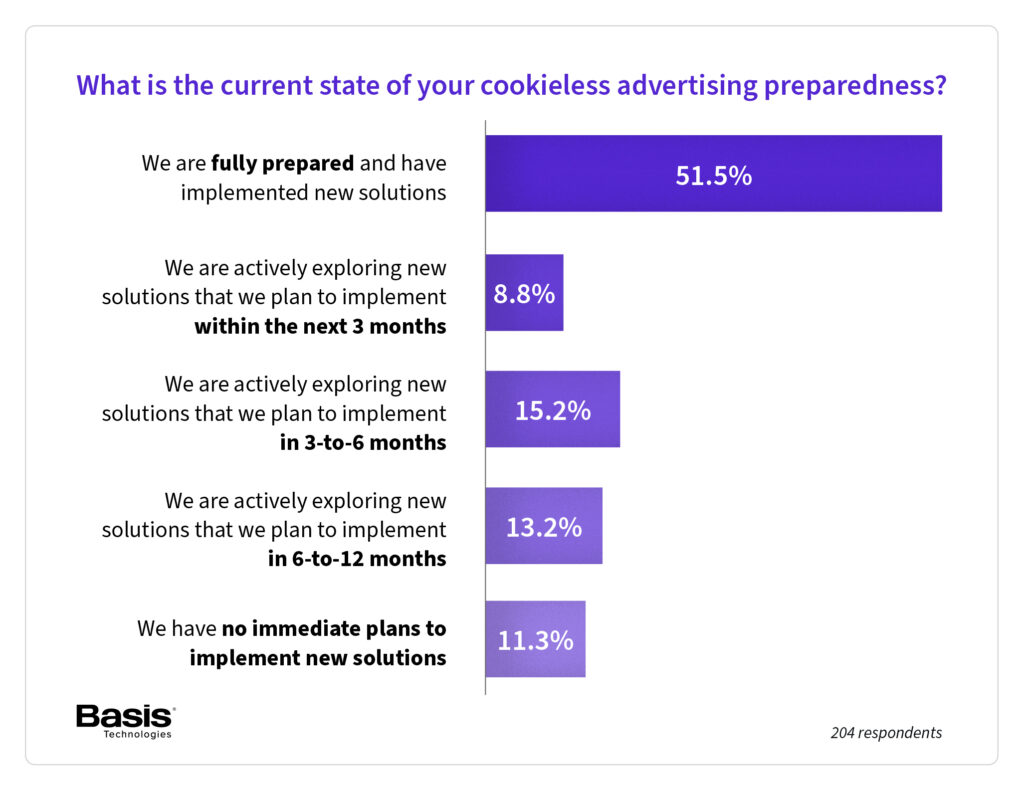
So, how has that 51% of advertisers prepared for the death of cookies in Chrome? And what challenges are on the horizon for those who don’t implement privacy-first solutions as soon as possible? Read on for all the answers.
Let’s set the stage by exploring how we got here in the first place. In recent years, the issue of signal loss has grown due to factors including third-party cookie deprecation in browsers like Safari and Firefox, Apple’s App Tracking Transparency (ATT), and privacy-minded digital advertising regulations. Even before Google began cookie deprecation, these developments, driven by widespread consumer demand for increased control over personal data and more transparency over how it’s activated, stifled advertisers’ ability to target and track between 50 and 60% of internet users.
The loss of cookies in Chrome will further exacerbate signal loss, and the urgency of the matter seems clear to most advertisers: Close to 60% say they feel it’s extremely important to implement new identity solutions in the next six months.
Again, many marketers say they’re fully prepared for this seismic shift, with cookieless solutions in place today. What might advertisers who aren’t prepared learn from those who are?
Overall, addressing signal loss includes testing some of the privacy-first tactics that are helping marketers overcome targeting and attribution hurdles. Three front-runners—first-party data, lookalike audiences, and contextual targeting—are each already being used by 75% or more of surveyed marketers, and for good reason.
First-party data could be seen as the gold in the hills of the digital marketing landscape. By its nature, the act of collecting first-party data is privacy-friendly, and the process to activate it isn’t reliant on cookies. The efficiency it affords, not to mention its high level of relevance and opportunity for personalized messaging, makes it an attractive option. Further, the cookieless analysis of first-party data in a data management platform can be used for lookalike modeling, allowing advertisers to increase their addressable audience pool. And no less than 80% of marketers surveyed have begun using contextual targeting to serve targeted messages to prospective customers based on their content-based interests and intents.
Knowing these options are available, how can marketers best begin to embrace them? If the adage that “you can’t manage what you don’t measure” holds true, applying a test-and-learn mindset can help advertisers learn what cookieless solutions work best for their specific clients or brand. Here are a few examples of what advertisers in specific industries might try:
Ideas like these are cookieless, but they still reach all funnel stages, and their results can be compared to historicals or used as benchmarks for future campaigns.
As our digital world hurtles toward its cookieless destination, many advertisers have concerns about the efficacy of privacy-first and cookieless advertising. They’re anticipating the continued erosion of audience targeting and addressability, plus a path to measurement and attribution that’s littered with obstacles. But at the macro level, advertisers’ hesitancy to adopt the right solutions for the right reasons will only prolong their signal loss, with major efficiency and efficacy implications. These include:
The takeaway? Early adopters who invest in privacy-first solutions will set themselves up for competitive success, protect themselves from regulatory action, and build trust with privacy-conscious consumers.
As Google deprecates third-party cookies in Chrome, 2024 will be a pivotal year for signal loss, and advertisers can no longer delay adopting privacy-friendly and cookieless solutions for targeting and attribution.
The just-over-half of marketers who say they’re fully prepared for cookieless advertising have set themselves up for long-term success. On the other hand, for marketers who don’t identify and apply the right solutions soon, there will likely be consequences in store for their signal fidelity, their advertising campaigns, and even their bottom lines.
—
Want more insights on how marketing and advertising leaders feel about the state of signal loss? In our report, Identity vs. Privacy: Digital Advertising in a Cookieless World, we share results from our survey of more than 200 industry professionals, exploring the urgency to prepare now, beliefs about future advertising effectiveness, and how well current solutions truly address consumer and regulatory privacy concerns.
Historians say the act of setting New Year’s resolutions dates back some 4,000 years to the ancient Babylonians. Since those early years, the evolution of New Year’s resolutions has maintained one commonality: future improvement.
Our resolutions capture our aspirations for the futures we want to live. We aim to stop bad habits, start healthy ones, or make big changes that stretch us out of our comfort zones—setting goals to reach, creating strategies to achieve them, and identifying ways to track our progress.
Of course, advertising industry professionals are no strangers to goal setting, strategy development, and performance measurement. We need those skills to fuel 2024’s forecasted ad spend growth, which follows 2023’s rocky start but generally stable finish. So, in the spirit of the New Year and of helping marketers improve their campaign efforts in 2024 (and beyond), we asked three Basis media experts—Page Kelley, Jared Rosenbloom, and Dan Wilson, our Group Vice Presidents of Integrated Marketing Solutions—to provide some suggestions for New Year’s resolution that advertisers can embrace to improve campaign outcomes in the coming year.
Page Kelley: Now that Google has started phasing out third-party cookies from users’ internet browsers, marketers should start to test and understand new cookie-proof ad targeting tactics to gain an understanding of their performance. There are many solutions and approaches to addressing a cookieless future, and marketers will remain a step ahead if they have data-driven learnings to minimize the impact.
Take the opportunity to test the effectiveness of activating your customers’ first-party data, using data modeling to create look-a-like audiences, and enhancing ad relevance with contextual targeting. You may find you’re able to make more out of your opted-in customer data and even increase your data pool, and you might learn more about certain audience segments, ad placements, or creative approaches that help you purge underperformers and focus on winners. The unknown can be frightening and intimidating, but using your own findings to create an action plan can ease the dramatic impact to your bottom line.
Jared Rosenbloom: Consider test-and-learn budgets with new and fast-growing channels. Digital out-of-home (DOOH) and dynamic podcast advertising are two channels that are growing leaps and bounds post-pandemic. In the past, marketers were nervous to advertise on novel channels due to a bit of a “Wild West” ad supply stigma. The reality is that DOOH and dynamic podcast advertising have consolidated their ad supply, making the inventory seamlessly available. Measurement of these channels is also far more interesting today, with options to track impression delivery by audience/geography and to use visit lift studies for brands with brick-and-mortar locations. A test-and-learn approach means not putting all your eggs in one unknown basket, and it means measuring effectiveness and investing more in what works while not overspending on what doesn’t.
Dan Wilson: Watch out for getting stuck using an overly simplified view of defining and achieving marketing objectives. If you’ve spent any time recently in industry forums or professional social networks, you will quickly find that the industry is abuzz debating which types of marketing strategies lead to the greatest revenue impact: brand-focused or performance-focused. Though these are certainly thought-provoking and relevant discussions, don’t let them lead you to a “one or the other” mindset. It is important to ensure your approach is mindful of the multiple touchpoints of the consumer journey and the objectives you can reach throughout, that it stays nimble, and that it’s rooted in a test/learn/optimize philosophy. With the availability of new and innovative channels and a constantly evolving measurement landscape, there is no need to pick only one approach.
JR: Use automatic content recognition (ACR) technology to strategically determine broadcast spend versus convergent TV spend for 2024 and beyond. ACR is a technology that is built into smart TVs to recognize content, including ads, being played on your television. And, from an advertising standpoint, that helps to target ad placements and measure ad performance. Studies using ACR data provide advertisers with an impressive analysis tool to recommend what level of broadcast-to-digital spend makes the most sense for your brand and/or your competition. These studies are done with reputable companies like TVAdSync and Samba, who work directly with TV manufacturers like Vizio, Samsung, and others. Marketers should not fear the sticker shock of these ACR studies, because they can provide long-term benefits for reach, frequency, relevance, and overall performance.
From the ancient Babylonians to modern-day marketers, people have long embraced the tradition of using New Year’s resolutions to kickstart self-improvement. They’re often the things we commit to stop doing, start doing, or sometimes drastically change in our efforts to better ourselves.
Similarly, marketing and advertising professionals constantly seek out ways to improve their ad campaigns—from planning to performance to measurement. By resolving to start to test cookie-proof targeting tactics and emerging channels, to stop using an “either/or” dichotomy of brand vs. performance, and to leap into innovative data use like CTV’s automatic content recognition, advertisers will start the New Year off on a path toward success, both in 2024 and beyond.
—
Want to learn more about how to make the most of your New Year? Download our 2024 digital advertising trends report to learn more about how capturing attention, navigating the upcoming election, and riding out hype cycles can influence your plans and strategies in the months ahead.
Signal loss is having a significant impact on digital advertising, with third-party cookie deprecation, frequency capping, and attribution concerns as regulatory bodies, browser developers, operating system owners, and consumers increase their focus on user data.
The Interactive Advertising Bureau (IAB) estimates that signal loss stemming from existing third-party cookie deprecation in Safari and Firefox and Apple’s App Tracking Transparency (ATT) has already curbed advertisers’ ability to target and track 50-60% of internet users.
But the biggest hammer is about to drop, as Google intends to deprecate third-party cookies in its wildly popular Chrome browser by the end of 2024, ushering in a new age of cookieless advertising where alternative identity solutions are critical to digital advertising success.
On the brink of this type of transformational moment, how is the advertising industry preparing (or not preparing) for increased signal loss and a cookieless world? What do industry professionals they think of the leading alternative identity solutions? And how do marketers and advertisers feel about privacy and its place in the larger identity conversation?
For this report, Basis surveyed over 200 marketing and advertising professionals from top agencies, brands, non-profits, and publishers to see how they are reacting to third-party cookie deprecation and signal loss, and to gauge their feelings about privacy and user data as we head into a pivotal year for the advertising industry.
Findings include:
Take a moment and pause. As you read this, consider the environment you’re in right now. How many tabs do you have open on your browser? If you’re on your phone, take note of how many apps you have running, the notifications pinging for your attention, the subtle pull of the endless stream of tasks vying for your focus. Perhaps you’re reading this while listening to music or a podcast? Maybe you’re skimming as you walk on an under-desk treadmill, or (perhaps most likely of all) you’re switching back and forth between reading this post and working on a project you need to complete by end of day.
In today’s digital world, we live in a near-constant state of distraction and multitasking. We are ever connected and our attention often divided, dispersed across screens and responsibilities. Given this inundation of content, it’s no surprise our attention spans are shrinking.
For digital advertisers, then, seeking and capturing attention is critical. After all, attention matters for memorability: If audiences can’t remember what they’re seeing from an advertising standpoint, it’s going to be difficult for them to remember the messages being served to them and the brands and advertisers connected to those messages. And if they can’t remember the brands connected to those messages, it’s unlikely they will use or purchase the products or services they offer.
So, how can advertisers better capture attention in the year ahead? By taking an audience-centered approach, crafting creative that captivates, and focusing on high-quality ad placements. Read on to learn key considerations for capturing audience attention, cutting through the clutter, and crafting winning campaigns in 2024 (and beyond).
We live in an age of endless distractions fueled by a desire for instant gratification. Bored by the video that popped up on TikTok? Just scroll. Underwhelmed by the show you’re watching on Netflix? Hop over to Hulu. Not a fan of the playlist you originally picked for your workout? Here’s an AI-generated one based on the songs you listen to most!
How can advertisers break through this noise to both capture attention and sustain it?
It starts with having strong creative. With a literally endless supply of other content available at all times, advertising teams need to ensure their creative is standout so that their audiences don’t tune out, scroll by, switch apps, or simply forget about it.
In 2024, audiences will consume more than 12 hours of digital media per day. In this context, it’s not simply enough to get a message in front of audiences. Advertisers can do every single thing right with their tech and targeting—getting in front of the perfect person at the perfect time—but if the creative is a miss, then they’re not going to capture that individual’s attention or make the most of that opportunity.
Instead, advertisers need to produce thoughtful creative that tells their client or brand’s unique story in a way that resonates and drives action. To do so, advertising teams can embrace a host of strategies and tactics, including:
Beyond investing in standout creative, digital advertisers looking to capture attention must focus on the quality of their ad placements. There’s a big difference between delivering 100 impressions on a low-quality site (or with low-quality targeting) that lead to zero conversions vs. 10 high-quality impressions that lead to two conversions. This focus on quality is especially important given the rise of made-for-advertising sites (MFAs) and the steady increase in low-quality AI-generated content, both of which can syphon ad spend away from higher-quality inventory.
Advertisers should actively seek to avoid bidding on this inventory in their campaigns, leveraging tools like a dynamic MFA blocklist and taking advantage of buying methods like programmatic guaranteed and private marketplace (PMP) deals to secure high-quality and premium placements. Additionally, advertising teams will benefit from leaning into KPIs that gauge the quality of impressions to determine not only if their ads are being seen but also if they’re sticking with audiences.
The final consideration for capturing audience attention in 2024? Focusing on identifying, getting to know, and targeting ideal audiences with precision.
Marketers should re-double their efforts to familiarize themselves with their target audience, conducting (or investing in) thorough market research to grasp their demographics and behaviors. From there, advertisers will want to tailor content to those distinct audiences by creating personalized ads addressing their specific needs, desires, and pain points—and, of course, to make sure those ads are reaching those audiences on the channels where they’re spending time.
Advertising teams can leverage pre-bid segments and custom PMP deals, and tools like custom bidding algorithms and pixel-based verification, to both capture and measure users’ attention, helping marketers answer the questions: What have people actually seen, and what’s stuck with them? They can then use the data and insights they gather to make optimizations responsive to their audience’s wants and needs. By putting audiences front and center, advertisers can maximize outcomes and craft campaigns that inspire action.
In digital advertising, seeking and capturing audience attention is not simply a strategy—it’s a necessity. As consumers gain access to an increasing amount of captivating content, advertising teams that focus on getting a compelling story in front of the right audience on the right channel will find success.
__
Want to learn even more about how to make the most of your campaigns this year? Check out our webinar, Future in Focus: 2024 Digital Advertising Trends. In it, Basis Technologies’ VP of Media Innovations and Technology Noor Naseer shares insights and strategies to help advertisers tune out the noise and instead focus their attention (see what we did there?) on the most important, proven trends in 2024.
Basis has been named Ad Age's #1 Best Places to Work in its 2024 rankings, leading all companies with over 200 employees. The annual list honors companies that are "quantifiably ahead of the pack", factoring in everything from pay, to benefits, to corporate culture and leadership.
The list for 2024 is particularly notable, showcasing 50 companies after a year in which advertising businesses faced the joint challenges of an unsettled economy, a changing media market, and a tight talent pool.
In its story, Ad Age recognized Basis for its industry-leading benefits and culture, including its popular Flex Friday initiative:
"Throughout 2023," it notes, "Basis offered a program of flexible Fridays, during which employees were allowed a respite from the normal wheelspin to take time as they saw fit, such as completing personal errands, learning new professional skills or getting a head start on the weekend. Basis tinkered with the format, alternating each week between a full day and half day of flexibility in order to find the right balance of productivity and relaxation. The program became a win-win for employer and employees...and the company is continuing it in the form of weekly half-days of flexibility through 2024."
To find out more about what this recognition means to Basis, we spoke with Michelle Michael (VP, Talent Acquisition) about the honor and what makes Basis such a special place to work.
Michelle Michael: Everyone always says, “It’s the people.” And even though it sounds cliché, it’s true. We treat people like human beings, and we encourage everyone to be their whole selves at Basis.
I’ve been here for 10 years, and I’ve never seen an attitude of “This isn’t my problem,” or “I'm too busy to help you,” or “I don't care what's going on with you”. In my experience, it's been the opposite of a toxic culture, and people feel cared for. They feel supported. And that's true regardless of whether it's about work or in your personal life.
MM: I think people really value Basis’ emphasis on flexibility and support.
Our flexible paid time off policy, Flex Fridays, and the ability to work remotely allow our people to work and use their time in ways that are best for them. Basis’ contributions to employees’ health savings accounts, 401k accounts, and student loan payments allow for financial freedom and for employees to accomplish more with their money. Flexibility with time and money is always going to be a top benefit for people!
When it comes to support, Basis offers amazing resources like access to mental health apps such as Ginger and Headspace, an annual wellness and benefits event called Wellnesspalooza, and custom training and education programming. We always try to take the extra step at every opportunity to support our people.
Support at Basis also goes beyond traditional “benefits”. It’s a part of our culture: It’s getting a gift in the mail after you have a baby with your partner, it’s getting flowers if you're going through a challenging time in your life, it’s a virtual party thrown by your coworkers for your 10-year anniversary—that’s the kind of culture we have here at Basis.
MM: It’s very validating. So many people here work really hard to make Basis special. From the tech teams making a product that is changing the industry for the better, to the services teams that put clients’ needs first, to the Talent & Development team that is constantly curating a wonderful experience for our employees. It definitely feels validating to have that sort of work, care, and culture recognized and celebrated.
Basis subscribes to the belief that the happier our employees are, the better we can service our clients, and the happier they're going to be, too.
It's all connected. Our founder, Shawn, knew this from day one, when he said that happy employees lead to better ROI, meaning happier clients and more success. Because you're not going to have a successful company or a successful product (at least, not for long!) if you have miserable people working for you. This type of recognition and celebration only motivates us to do more—to be more innovative, to be more supportive, and to continue to listen closely to our employees so that we can continue to create the type of environment that makes Basis so special.
At Basis Technologies, we believe we're most successful when our employees feel like the best version of themselves. To celebrate this recognition, we asked a few members of our incredible team to share what working at Basis means to them:
What’s happened recently in the realms of paid search and social media? Basis Technologies’ Robert Kurtz (Group VP, Search Media Solutions), Jenny Lewis (Director, Social Media Investment), Sofia Petrovsky (Director, Search Media Investment), and Mitch Wills (Director, Social Media Investment) have compiled all the latest news, trends, and resources for easy access.
Google has officially begun phasing out third-party cookies in Chrome. A new feature called Tracking Protection rolled out in January to roughly 1% of users globally, blocking cookies that track users’ browsing history across websites. While this is a small step toward Google's eventual removal of cookies, it is also a reminder for publishers and marketers to move swiftly toward adopting strategies for cookieless advertising. (Want to look into the cookieless future? Our guide to privacy-friendly advertising can be found here.)
An Adalytics report last December claimed some search ads appearing on the Google Search Partner Network (SPN) may have ended up alongside unsuitable content and on websites that violate Google policies. While advertisers are automatically opted into the SPN, they now have the option to opt out on Search and Shopping ad campaigns. Google is also temporarily allowing brands to opt out of the SPN on artificial intelligence-powered Performance Max (Pmax) and App Campaigns, though sources told AdWeek that could end March 1.
A recent study by Authoritas found that Google's Search Generative Experience (SGE) displays links that are significantly different from the top organic search results for most search queries. The AI-generated summaries rarely overlap with traditional search results, with only 4.5% of links matching exactly. This means SGE is potentially surfacing lesser-known websites that might struggle to reach the top 10 organically while bypassing established top-ranking pages, which could impact organic traffic for some businesses.
The TikTok Marketing Partners Program announced new measurement partners: Cross-Channel (for attribution) and Lift (for incrementality). Cross-Channel partners will analyze the impact of TikTok ads across marketing touchpoints before users make a purchase, including multi-touch attribution and post-purchase survey. Lift partners measure the incremental impact of TikTok advertising, focusing on brand lift, sales lift, store visit lift, and tune-in lift.
TikTok and Ticketmaster are expanding their ticketing partnership into more than 20 new markets following a successful beta launch in the US in 2022. Certified artists on TikTok in participating countries can use an in-app ticketing feature to allow fans to buy tickets to their events directly within the platform. No news yet as to if or when this ticketing feature will be accessible to advertisers, but the successful integration could bode well for future event discovery and in-app purchase options for event-based advertisers on TikTok.
In the run-up to the 2024 elections, Meta has shared some of the steps it says it’s taking toward protecting elections online—not just during election periods, but at all times. In recent years, Meta has developed an approach it claims will ensure the integrity of elections on its platforms, that gives people a voice, helps support participation in the civic process, and combats voter interference and foreign influence.
Pinterest has released its annual trend report, Pinterest Predicts, harnessing the power of Pinterest’s predictive trend data to give consumers and advertisers a head start on what it believes will be the biggest and hottest trends for 2024.
—
Want a monthly digest of all the best digital marketing articles, POVs, and reports delivered straight to your inbox? Sign up for the Basis Scout newsletter!
Pharmaceutical marketers today have their work cut out for them. On the one hand, technological developments like digital healthcare, personalized medicine, and artificial intelligence are reshaping how consumers take care of their health. On the other, signal loss in digital advertising, created by factors like Apple’s App Tracking Transparency, digital advertising regulation, and the loss of third-party cookies, is changing how advertisers can target consumers and assess campaign performance.
Amidst all this technological transformation, however, a key marketing tenet remains true: To market effectively, you must know your consumers. Pharmaceutical advertisers who take the time to understand the various segments they want to reach will create a level of relevance that cuts through the noise and builds trust and memorability with their target audiences.
To that end, let’s get to know how five key pharmaceutical consumer personas look, sound, and feel as they shop for these critical medicines.
“There’s almost too much information to sift through, but I’ll do whatever it takes to improve my health.”
More than 116 million US adults live with chronic conditions, some of the most common including heart disease, cancer, and diabetes. These consumers are often aged 45 and older, are married, and have college degrees and annual household incomes less than $100,000. They visit their doctors often and are mindful of what they have to say. This professional advice is particularly valuable because, between the media's coverage of this industry and pharma's large ad spend, this group is constantly bombarded with information about their conditions and available treatments. Because their health negatively impacts important things like family time, they’re willing to do what it takes to manage their symptoms.
Industry advertisers can prepare this group with the right questions to ask during their frequent doctor visits by leveraging messaging that relates to their experience and sharing how their brand can help. For high relevance, marketers can use contextual targeting to align ads with content about conditions, and take over ad inventory of resource-focused websites known as “condition centers.” At the same time, advertisers can tap into data providers who create custom models based on anonymized patient diagnosis and treatment information to reach target audiences wherever they are in the digital world, whether researching or simply relaxing.
“I have to trust my doctor and my medications if I’m going to maintain my quality of life.”
There are just over 102 million US adults in this segment, and they’re typically aged 50 and older, married, college educated, and bringing in less than $100,000 per year. These folks see their healthcare professionals regularly for check-ups, screenings, and the like, and take their recommendations seriously when it comes to medications and lifestyle. They use the drug brands their doctors recommend, and stick to the brands they know even if their favored brand is a little more expensive, unless a change is deemed necessary. Therefore, it’s important to approach this audience with a mix of emotional appeal and hard evidence that they can bring to conversations with their doctor.
That loyalty only leaves a bit of room for new brands to enter a patient’s consideration set, but this audience does stay up to date on alternatives, so the window is slightly open. Given the broad nature of this segment, search advertising can help people who are looking for answers to their health-related questions when they are in the discovery stage, while contextual targeting can reach those who are researching specific ailments. For awareness, a mix of CTV and radio is a great way to bridge the gap between traditional media and digital for this audience.
“This is stressful. I still work when I’m sick AND I have to search for OTC drugs I can afford and trust.”
Forty-eight million plus younger US adults rely on over-the-counter medicine to manage symptoms of illness. Typically aged 18 to 44, they were born and have come into adulthood in an age of two economic crises and a pandemic… and, understandably, they’re stressed. Between career (where they earn $50,000-$250,000 per year) and family (they’re mostly unmarried but in some cases living with a partner and with kids in the home), they’re stretched thin—sometimes so thin that they don’t care for their health issues as well as they should.
Because of this constant state of stress, it may take a while for pharma advertisers to get their attention, but this group is always looking for ways to improve their health. And given their level of digital savvy, they know how to seek out answers. Once they find what they’re looking for, they would rather try out OTC options and skip the visit to the doctor. So, it’s important to be there when they are doing research around their condition, making search a top channel for this audience. Point-of-care platforms focused on telehealth are also a great option, as the younger audience continues to utilize these platforms over in-person visits.
“I’m trying not to worry—I just had surgery, and I don’t want my recovery to be hard and expensive.”
This key audience segment is made up of the more than 46 million US adults who go “under the knife” each year. They’re usually aged 55 and older, either married or not married, have some college education, and tend to earn $100,000-$250,000 annually. Surgical patients tend to do what their doctors tell them, only using or switching drug brands as recommended by their physicians. These folks are all too familiar with the healthcare system as they navigate procedures that require more care than just a standard visit. It’s important to focus on information using high-impact placements that can help establish trust with the brand.
While they may not be easily swayed by pharmaceutical ads, they do their due diligence, taking care to perform research about health and wellness on trusted websites and ensuring their health insurance covers all prescriptions. Industry advertisers should consider sponsored content with top healthcare publishers paired with condition center takeovers to appear during that investigation. For a broader approach, CTV and streaming audio can communicate in-depth messages more effectively than channels where space to include information can be limited, such as display.
“My job is already demanding, but I can’t let my patients down by not doing my research or recommending costly drugs.”
It’s hard to discuss the pharmaceutical industry without looking at the 7.4 million healthcare workers who diagnose patients and prescribe their medications. They are generally women, aged 25 to 54, who are married with children, have graduated college, and are earning $75,000 or more per year. Their passion for their career leads to a lot of positives for their patients: Healthcare workers are typically very analytical in their decision-making process, looking for the best options for their patients and the most efficient way to deliver results. Pharma advertisers should reach them on the platforms where they actively engage with other professionals, like Doximity and Sermo, or LinkedIn for those on the administrative side.
Because this segment tends to be strapped for time, they often stick with what’s already working for their patients. However, advertising that’s adjacent to their research can bring forth new options for consideration. Marketers should align ads contextually with this group’s favored content, like trade publications and discussion sites, by setting up custom private marketplaces and using programmatic guaranteed for preferred rates and direct deals. Point-of-care platforms can also help reach doctors when they are in the process of making treatment decisions. Last, ads should include compelling, informative messages that highlight the benefits of the product.
Industry advertisers have much to weigh as they look to fuel business growth by targeting key groups of consumers. By incorporating the personas outlined above into their planning, marketers can ensure that their approaches are suited to the pharmaceutical consumers of today. Strategic targeting and messaging based on the characteristics of these personas will be just what the doctor ordered for brands to maintain or grow market share and consumer trust.
—
If you’re looking to connect with pharmaceutical consumers in a meaningful way, advertising automation can help. It empowers your team to get more granular and efficient when reaching audiences on the channels they prefer and to deploy impactful, personalized messaging. Download our guide to learn more about how advertising automation can help you create intentional, omnichannel experiences for key audiences.