
Technology
Basis Platform
Advertising Operating System
Communication Portal
Intelligent Collaboration
All Channel Activation
Activate Media on Every Channel

Consulting
Resources
What’s new in the realms of paid search and social media? This month, Courtney Shaw, VP of Social Media Solutions, and Maggie Shelton, Director of Search Media Investment, compiled all the latest news, trends, and resources for easy access.
To comply with European Union regulations, Meta will begin offering people aged 18 and over who live in the EU, the European Economic Area, and Switzerland the option to pay a monthly subscription fee to use Facebook and Instagram without ads. Those who don’t subscribe can continue to use the platforms for free, while seeing ads deemed relevant to them. Advertisers do not need to take action as a result of this update, and campaigns targeting people ages 18 and up are expected to continue delivering as planned.
Google's new generative AI tools are designed to help marketers create, edit, and iterate on images with less reliance on professional tools or creative teams. The tools can perform basic tasks like altering the background color behind product images, as well as more advanced jobs such as adding products to specific scenes (for example, you could ask Google's AI tool to "place this item on the beach, surrounded by shells"). As Google continues to expand its range of ad formats, this will most immediately be useful to help version creative into multiple ad assets.

“Please put a hat on this horse and make the background red…no, blue…no, green…”
As early as consumers have begun their holiday shopping, 50% still have more to buy after Cyber Week, and they’re going heavy on digital for their research. Marketers looking to maintain momentum from the cyber holidays should consider an omnichannel approach to reach shoppers who are determined to find the right gift. Google has more supporting information and insights here.

Eggnog helps!
Snapchat’s creator community is thriving, with content creators growing highly engaged audiences by giving Snapchatters an authentic look at their lives. Creator Collab Campaigns is Snapchat's new suite of products designed to make it easier for advertisers to partner with the platform’s influential, audience-rich creator community.
Amazon's massive share of the e-commerce market provides them with robust audience targeting data. Advertisers can now leverage this targeting across Amazon and Amazon-owned properties (including Twitch and IMDb). While campaigns are currently display-only and limited to select verticals, they represent a huge opportunity for advertisers trying to reach more hard-to-find cohorts of consumers.

Now that’s Katniss-level targeting.
—
Want a monthly digest of all the best digital marketing articles, POVs, and reports delivered straight to your inbox? Sign up for the Basis Scout newsletter!
Cannabis marketing regulations are multi-tiered and constantly in flux. While an array of cities and states have legalized and decriminalized various forms of cannabis, the substance is still illegal at the federal level. At the same time, social media platforms like Facebook, audio platforms like Spotify, and search platforms like Google each have different policies for how marketers can promote cannabis products. And on top of all that, cannabis marketers must comply with a growing matrix of consumer privacy regulations. The result? An ever-shifting regulatory landscape that requires a considerable amount of up-front research compared to other consumer packaged goods.
While navigating these various regulations might feel like reefer madness, marketers can minimize overwhelm by approaching them in four tiers: Federal, state, platform-specific, and from a general advertising compliance standpoint. Read on for an overview of each layer:
At the federal level, cannabis marketing is regulated by the Federal Trade Commission (FTC), the Federal Drug Administration (FDA), and the National Advertising Division (NAD). There are two big rules that brands must follow here. First, to comply with the FTC’s Truth in Advertising laws, product descriptions must be backed by legitimate research and must not mislead consumers.
Second, brands may not make any claims that a cannabis product can cure, prevent, diagnose, or treat a serious disease. Brands may, however, make what the FDA calls a structure/function claim. A structure/ function claim:
For example, a brand could not legally state that a CBD product cures insomnia, but it could legally state that a CBD product promotes sleep.
On the state level, State Departments of Health set regulations for cannabis advertising. These regulations vary widely—for example, cannabis marketing is generally prohibited in Delaware, while cannabis marketers in Colorado can advertise across a variety of channels, granted those advertisements adhere to certain restrictions. While there are some general State-level cannabis marketing rules that hold true across the board, it’s critical to research marketing regulations in each state where you plan to advertise. While you’re at it, make sure to look into cannabis advertising restrictions based on city and county jurisdictions as well!
Marketers must also research cannabis marketing guidelines for each platform where they plan to place ads, as they all vary. For example:
With accessible and affordable advertising options like Facebook, Instagram, and Google largely off the table, marketers will need to tap into tools designed to clear this regulation barrier. Basis, for example, is integrated with Cannavu, which operates the largest ad marketplace for curated, compliant cannabis advertising opportunities. Cannavu accesses ad impressions on canna-compliant publishers, automating the publisher selection process for marketers.
Beyond ensuring that campaigns meet the requirements of federal, state, local, and platform-specific regulations, cannabis marketers must also be aware of the broader shift towards privacy-friendly advertising. This includes preparing for the impending deprecation of third-party cookies, updating marketing strategies to meet the growing consumer demand for data privacy, and ensuring compliance with privacy regulations such as GDPR, CCPA, and CPRA.
The movement towards privacy-first marketing means that marketing teams must be particularly diligent about compliance when acquiring and activating cannabis customer data, and that they must vet all their partners and vendors to ensure that they display the same level of attention to privacy. At the same time, as more and more privacy-focused regulations pop up across the country, cannabis brands must continually monitor these regulatory developments to in order to avoid costly fines.
There you have it: By approaching cannabis marketing regulations at the federal, state, local, and platform levels, and by meeting the requirements of the overall advertising industry’s regulations, marketers are sure to cover all their regulatory bases.
__
Interested in learning more about the cannabis marketing landscape? Check out Cannabis Marketing in the Roaring 2020’s to learn about who is buying cannabis, how to market to them, and what sets a cannabis campaign up for success.
You’ve just landed your dream job as an SEM professional, and your boss is asking you to deliver your “PPC campaign strategy”—you know, that brilliant, air-tight plan you put together to help your brand or client not only meet, but exceed their business objectives?
There's just one small problem: You don't have a strategy. In fact, while you may know a lot about PPC, you’ve never actually sat down and documented how you make PPC magic happen. Where do you start? There’s so much to cover and so little time, especially given the fact that developing a competitive PPC campaign strategy isn’t as easy as it used to be. Advertisers now have a number of ways to target their audiences, which makes distributing ad spend a challenge.
Don’t worry—we’ve not only organized the process of developing a PPC strategy into an easy framework, but we’ve also created a quick PPC strategy checklist to ensure the strategy you do eventually develop is an effective one.
In short, our five-step framework for an effective PPC strategy involves selecting the right platforms, targeting features, and ad types to deliver your message, and balancing your investment in each. If you’re ready to develop a more advanced PPC campaign strategy for your business, these 5 steps can help you get a head start. Let’s dig in!
Defining what you want to achieve with PPC is the most important part of building an effective campaign strategy. Getting clear on your goals will help you choose the platforms and ad types that are best suited for your marketing needs.
Consider these common PPC goals:
If your main goal is brand awareness, then social media and display ads are ideal for your strategy. If your priority is to generate leads, then you can explore Facebook’s lead capture ads. If your main goal is to drive sales, then most of your PPC investment should be in search or product listing ads (PLA).
Sophisticated PPC strategies use a combination of ad types and platforms to target their audience. First, determine your main goals and prioritize them. Then, use this information to decide which platforms and ad types you should invest in.
Next, let’s review how to target your audience with Google Ads PPC. The kind of audience you target and their point in the sales funnel will also tell you which advertising options you should invest in.
The key to success with Google Ads audience targeting is not targeting the most relevant keywords related to your business, but targeting based on intent. The keywords you bid for, the ads you display, and the landing pages you send people to all need to match the position individuals are at in your sales funnel.
There are three main categories of search intent keywords:
Now, most businesses can’t and shouldn’t target all these categories of keywords for PPC. The ones you focus on should depend on your business type and other marketing strategies. For example:
Of course, search isn’t the only PPC channel you can optimize for. There are several other types of audiences you can target on the Display Network, YouTube, and Gmail, such as:
When targeting large amounts of keywords, creating unique optimized landing pages for your ads can be a challenge. However, directing visitors to generic product pages or landing pages equates to wasted ad spend. Not only are site visitors less likely to convert, but their on-site behavior can also lead to lower Quality Scores, making reaching them through PPC even more challenging.
The most effective PPC managers draw a strong link between audience targeting and landing page optimization. The more relevant a landing page is to the initial search intent or audience demographic interest, the more likely it is that site visitors will click through, sign up, make a purchase, or otherwise take action.
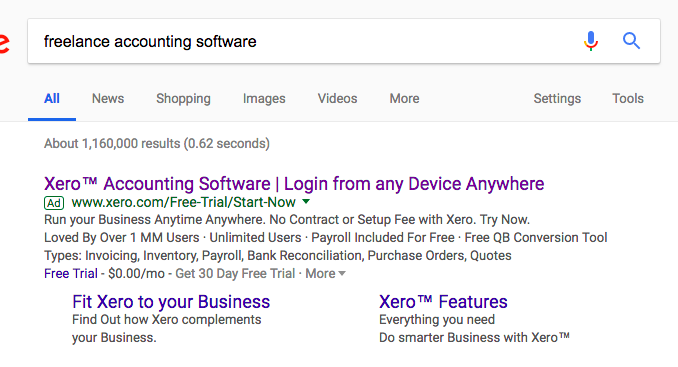
Here’s an example of thoughtfully optimizing landing pages based on initial search intent: You searched for “freelance accounting software” and found an ad for Xero:
You click through and their landing page copy focuses on their value proposition for on-the-move freelancers, not business owners as a whole:
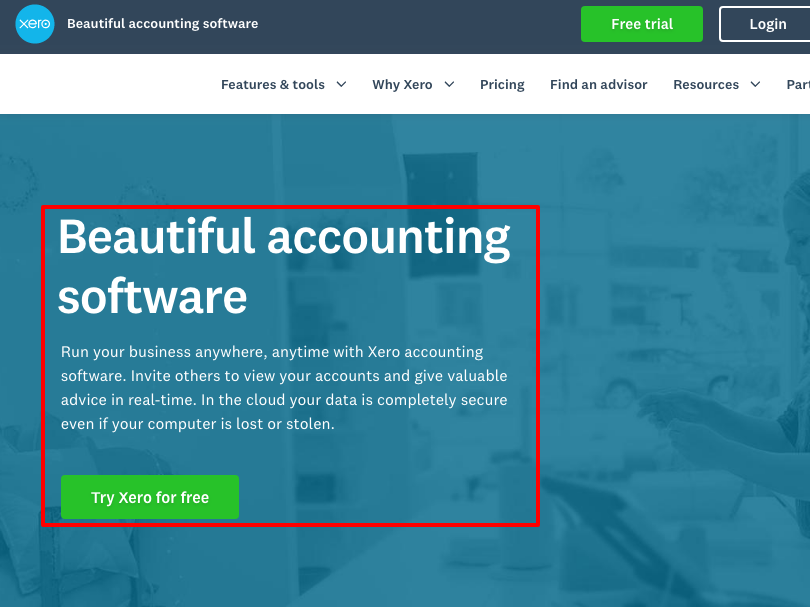
That level of message match—from the intent of the search query, to the carefully crafted ad copy, to the optimized landing page verbiage—provides a valuable user experience with high relevance that’s more likely to result in the user taking your desired action.
Once your audience targeting is set up and you’ve created your relevant landing pages, you’re ready to create and optimize your ads.
Your ads serve as the link between search intent/audience interest and the landing pages you’ve already optimized. The goal is to briefly illustrate your unique selling proposition and offer value. You’ll want to experiment using different copy, visual media, extensions, and other elements to optimize your ads.
For search campaigns, Responsive Search Ads (RSAs) make it easy to include a variety of headlines and description lines that Google will mix and match to create an ad that’s targeted toward what it knows about the user. The key is to include variety, so your headlines and description lines should have varied calls to action and value propositions. You can’t just rewrite the same headline and make it slightly different. Try to include as many keywords in your ad as possible and match it to your landing page content. You want the user to have a seamless experience from keyword to ad to landing page. Google will automatically show the top-performing ad creative the most often.
Beyond ad copy, elements like sitelinks, callouts, phone numbers, reviews, and location extensions are great ways to include more information in your ad and take up more room on the top of the page. At the same time, this will push your competitors further down in the results.
When you have enough data to make decisions, swap out the lower-performing ad assets (the headlines, description lines, and extensions) for new variants. Over time, you’ll improve your ad quality and your account performance.
As we discussed above, ad content optimization integrates better into the ad creation process when you use the right tools. The real focus of your analysis is identifying what keywords and targeting features help drive your campaign goals.
Here are some important metrics to consider for search, display, and/or social ads (depending on your campaign goals):
If your goal is lead nurturing, you may also want to take on-site engagement metrics, such as number of page views or new or returning visitors, into consideration.
Keeping track of key metrics can help you evaluate the relevance and effectiveness of your advertising elements (ad copy, targeting, landing pages, etc.). It can also help you understand which keywords and audience targeting strategies are most valuable for your unique business.
There are a lot of ways to optimize your PPC ads for conversions using data science. Once you have a good understanding of the best keywords and audience targeting, you can use those insights to implement advanced targeting strategies to improve your ROAS even more. Using query segmentation to prioritize revenue-driving keywords is one example of an advanced bid optimization strategy you can implement manually.
PPC strategy optimization is an ongoing process. Here’s a quick checklist to recap the steps you need to take to optimize your strategy.
These five steps are foundational to developing a competitive PPC strategy. The key is to identify at what points in the sales funnel you want to target your audience, choose the right platforms and ads to accomplish that, and then optimize your PPC advertising material. Over time, you’ll identify what elements of your strategy deserve the most investment to improve your ROAS.
—
Want to level up your PPC strategy even further? Our team of experts can help. Connect with us to learn more!
Have you heard the news? The future is cookieless, and it’s coming up fast—in the second half of 2024, to be precise!
To prepare for a world without third-party cookies, it’s important that members of the advertising industry understand what’s changing and embrace new ideas and collaboration. The success of any identity solution is heavily dependent on scale, and so partnering with an independent owner of a solution with the most scale—or, better yet, partnering with multiple—is likely to be the best option when the dust settles. Working as a group, evaluating options, and sharing principles is the best course we can take to minimize the impact on customers.
With that in mind, here’s a look at the current and future state of third-party cookie deprecation and how groups are working toward innovative identity solutions.
Yes, third-party cookies are on their way out. That said, it's not an all-at-once farewell: Firefox and Safari have already eliminated cookies, while Google, over the past few years, has announced, then delayed, then again delayed Chrome’s third-party cookie deprecation. Despite these postponements, the day will eventually come when third-party cookies are no longer supported in Chrome. However, the transition will be an incremental one, starting in Q1 2024 with about 1% of Chrome users, and progressing gradually from there.
The demise of third-party cookies stems from concerns over consumer privacy and data protection. 86% of people in the US say data privacy is a growing concern for them, and with consumers demanding more control over their online footprint, legislators have stepped in, enacting privacy regulations such as GDPR, CCPA, and CPRA. At the same time, tech giants and browsers are taking proactive steps to rebuild trust by putting an end to the cross-site tracking that third-party cookies enabled.
Cookieless tracking monitors user activity on websites without relying on browser cookies. These tracking tools allow marketers to measure cookieless click-through conversions, granting them the ability to track performance, report on campaigns, and maximize ROAS without compromising consumer privacy.
Unfortunately, there’s no “silver bullet” replacement for third-party cookies (yet). Savvy marketers are leaning into a mix of privacy-friendly solutions to minimize the impact of third-party cookie loss on their campaigns, including (but not limited to) cookieless tracking, first-party data, contextual targeting, anonymized data sources, premium inventory, and audience profiling.
New identity solutions have also emerged, offering ways to glean insights from and target messaging to audiences while adhering to privacy-first principles. What do these burgeoning identity solutions look like? Let’s dig in:
In February 2020, the International Advertising Bureau (IAB) introduced Project Rearc, a global initiative designed to get stakeholders across the digital advertising and media supply chain together to re-architect digital marketing in a consolidated effort to harmonize personalization and consumer privacy. And in June 2022, as part of this initiative, IAB Tech Lab released its Global Privacy Platform, a mechanism for transmitting consumer choice signals from websites and mobile apps to advertising technology companies.
Along with other industry leaders, Basis has been an active participant in Project Rearc—reviewing the proposals, evaluating specs, and providing feedback. It proposes rigorous technical standards and guidelines that inform how companies collect and use such an identifier so that:
LiveRamp introduced IdentityLink in 2016. The technology, now known as RampID, allows resolving hundreds of different identifiers for consumers used on devices and marketing platforms in a privacy-compliant manner. It doesn’t matter if data is offline or online, first-party CRM or third-party behavioral, online exposure data or mobile app download data—all of it can be tied back to a unique, privacy-safe identifier at the consumer level.
The digital media ecosystem is a dynamic one, with new methodologies, tools, and opportunities emerging every day. The third-party cookie has been a protagonist for the last 20 years, but it’s not the only character in this story. And with the third-party cookie going the way of MySpace, we are at the dawn of a new era for adtech—one filled with opportunity and room for innovation in the way we connect with our audiences.
Advertisers who focus on making the most of their first-party data and cookieless media alternatives, optimizing campaigns based on real-time learnings, and embracing identity solutions that are high-performing and privacy compliant, are sure to be well-positioned for the cookieless future.
As we go through these changes together, it’s important that industry players stay committed to working together, listening to the market, collaborating with regulatory bodies, adapting and developing new products, and keeping customers/users abreast of changes as they develop. If we can do that, we’ll all emerge from a place of strength and primed for success in our new, cookieless world.
—
Want to learn more about how to embrace the cookieless future? Check out Beyond Third-Party Cookies: Your Guide to Overcoming the Identity Crisis.
Digital video is everywhere: from the TikToks and Reels we scroll through when we first wake up, to the news we digest during our lunch break, to the videos that pop up as we browse dinner recipes, to the YouTube videos we watch on the treadmill, to the TV we stream as we’re winding down for the evening. Thanks to this omnipresence, digital video provides advertisers a distinct opportunity to connect with people when and where they’re consuming media—and in a highly engaging and captivating way.
In this guide, we explore how savvy marketing teams can leverage digital video channels effectively and cohesively to create a customer journey that engages audiences and inspires action. We dig into the latest trends, insights, and research to help advertisers integrate digital video successfully into their paid media campaigns.
Ready to level up your digital video advertising expertise? Download your copy of the guide today!
What’s new in the realms of paid search and social media? This month, Nick Tuttle, Director of Search Media Investment, and Lauren Brown, Director of Social Media Investment, compiled all the latest news, trends, and resources for easy access.
TikTok and Google are exploring a new partnership that would integrate Google’s search prompts and web-based search results into TikTok’s own search stream. Clicking or tapping a result would open a web browser within TikTok rather than opening Chrome or another app. This initiative arose from studies that, according to Google SVP Prabhakar Raghavan, show “almost 40% of young people, when they’re looking for a place for lunch, they don’t go to Google Maps or Search. They go to TikTok or Instagram.”
All of X’s interaction counts and action buttons—except the views counter, added back in December—may soon only be visible within the post details (viewable once users click into or expand the post). When Instagram tested something similar in 2019, post engagement declined, so this will likely cause a drop in X’s reposts and quotes. However, analysts suggest this could also slow the spread of misinformation and may lessen competition for vanity metrics.

X appears to be close to launching new pricing tiers for X Premium, including an ad-free subscription option. Recently surfaced back-end code suggests there may be three tiers: X Premium Basic, X Premium Standard, and X Premium Plus. X owner Elon Musk claims that encouraging users to pay for the app is a way to combat the rise of bots and AI-generated spam.
The Wall Street Journal detailed pricing for Meta’s proposed ad-free Facebook and Instagram subscriptions, based on Meta’s submission to European Union officials. The impetus for these ad-free options is the EU’s evolving data privacy regulations, which put more strain on Meta’s capacity to personalize ads and content based on user activity. According to WSJ, Meta’s plans would cost around $14 per month for an ad-free Facebook or $17 per month for both Facebook and Instagram.

Microsoft kicked off the fall with a series of new product updates for Audience Ads. The tech giant said these updates will help advertisers achieve better results with less effort and create more engaging ads that are served to a higher-value audience. Expect to see ads in new markets, within more games, on additional video platforms, and in the free consumer version of Microsoft 365. Predictive targeting and new AI bid strategies are also part of the rollout.
Despite investing $100 billion in Bing, the search engine says it simply can't compete with Google due to its monopoly position, according to Microsoft CEO Satya Nadella. The ongoing US vs. Google anti-trust trial has already uncovered behavior from Google like raising ad prices to meet revenue targets. The trial’s outcome could potentially reshape the company and the search landscape.

As the world's largest video sharing platform, YouTube is ripe for data analysis on its users, content, and performance metrics. A look at the current state of AI-generated content, user and creator demographics, and expectations for multiple languages for accessibility has uncovered trends that could soon impact YouTube creative development and audience targeting.
Meta is rolling out its first generative AI-powered features in Ads Manager for ad creative—Text Variations, Image Expansion, and Background Generation—to enable the creation of ad variations quickly and automatically, with the system optimizing to the best-performing ads.
Amazon is set to roll out upgraded generative AI capabilities that offer a more conversational, detailed, and personalized user experience. Shoppers will be able to compare products in real time and seek additional details, reviews, and recommendations tailored to their search context. Advertisers may need to reassess campaign strategies to maintain visibility among AI-powered results.

—
Want a monthly digest of all the best digital marketing articles, POVs, and reports delivered straight to your inbox? Sign up for the Basis Scout newsletter!
For much of its history, the digital advertising world has been something of an iceberg: its surface shiny and bright, lighting up internet users’ screens while supporting organizational growth and powering the digital economy. Adtech largely ran out of the public’s site—back before the average Joe understood the connection between a morning Google search for lampshades and an afternoon ad for a home goods store.
But further down, below the surface, cookies and third-party data and a web of interconnected platforms and ad networks and publishers and advertisers intertwined to serve targeted ads to customers who had little idea as to why they were seeing them—and even less of an idea of how much of their personal data was being used in the process.
For better or worse, it sure seems like those days are behind us for good.
While the mechanics of digital advertisers long stayed out of the spotlight, most modern consumers now have at least a baseline understanding of how cookies work, how apps try to track them on their mobile devices, and how their social media and search activities are the fuel that powers the data economy. And, with that knowledge in hand, the majority of those consumers are increasingly invested in the privacy and ethical use of their data: Between March 2022 and March 2023, 85% of consumers reported deleting a mobile app, 82% opted not to share their personal data, 78% avoided a certain website, and 67% didn’t make an online purchase as a result of privacy concerns. Regulators, in tandem, have passed and enacted (and enforced) a variety of privacy-minded digital advertising laws in states across the US— from California, to Virginia, to Connecticut.
Of course, data privacy isn’t the only aspect of digital advertising that’s being pulled into the spotlight. A slew of Justice Department lawsuits and FTC activity now show that the world is paying very, very close attention to the inner workings of digital advertising and many of its major players. And while the coming deprecation of third-party cookies might seem like all the massive change that advertisers can handle right now, marketers will need to read the writing on the wall if they want to position themselves for success in this new era of heightened scrutiny.
For those keeping track at home: Trust + Advertising = Essential. Anti-trust + Advertising = Huge, Existential Problem.
A handful of high profile antitrust lawsuits are currently poised to impact two of digital advertising’s biggest players—tech titans Google and Amazon—and, depending on the results of those suits, reshape the entire industry.
Let’s take a closer look at each:
The US Justice Department, together with 11 state Attorneys General, is taking Google to court over its alleged violation of US antitrust laws, claiming the company—which owns a 90% market share in search—made anticompetitive deals to secure and maintain its status as the preeminent search engine on phones and web browsers. These included multibillion-dollar agreements with Apple and Firefox-maker Mozilla ensuring their products would use Google as the default search engine on consumers’ phones and browsers. The Justice Department’s argument is that Google's made these deals to maintain its dominance and eliminate opportunities for competition from other search rivals. Meanwhile, Google maintains that the company’s longtime search market supremacy is due simply to the fact that its search engine is just better than everyone else’s, and that consumers are going with the best option out there.
A key part of the government's case is focused on how Google has long leaned on its search dominance to fuel its $162.5 billion paid search empire and to harvest reams and reams of consumer data, which it then uses to power its larger ad business and, of course, to keep people using its platform and its products. But it’s that overall ad business that’s the focus of yet another lawsuit facing the tech giant.
The Justice Department’s second suit against Google (which, like the other case, is also supported by several state Attorneys General) pertains to the company’s digital advertising presence more broadly. In this case, the Justice Department is arguing that Google is so deeply involved with every aspect of the digital advertising ecosystem that they have an anticompetitive and monopolistic hold on the space. The following visual from the Justice Department illustrates Google’s dominating presence on both the sell-side and the buy-side of the digital advertising business (and, for good measure, its ad exchange):
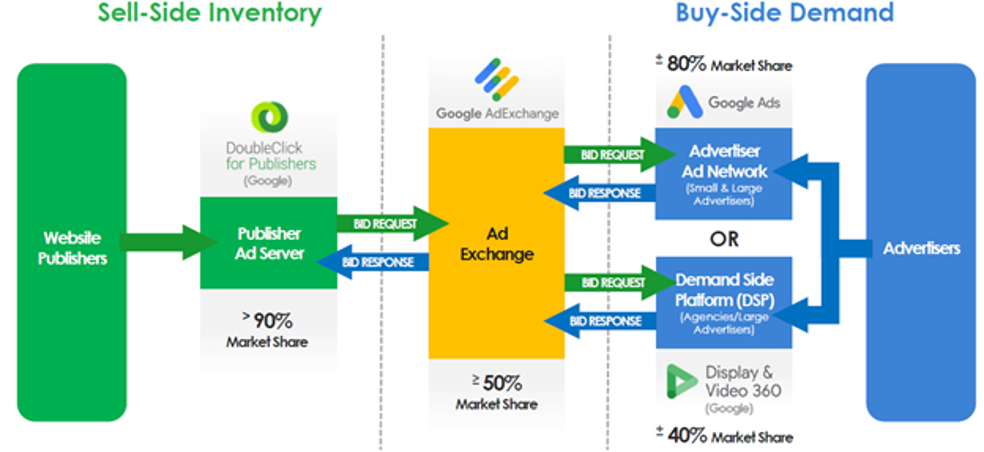
If the Justice Department is successful in either of these antitrust cases against Google, the outcome will likely result in massive fines or, potentially, the forced breakup of Google’s advertising business. Whether that means a negotiated deal with prosecutors where Google spins off some or all of their ad business into its own separate entity, or whether it means that selling certain parts that ad business to other folks in the industry, remains to be seen. But no matter the outcome, if the Justice Department is successful, it will mean monumental implications for everyone in the digital advertising industry.
Before we dive into all of those implications, though, let’s look at one final antitrust lawsuit for good measure, this one targeting Amazon:
Lastly, we have the lawsuit against Amazon by the Federal Trade Commission (FTC). Here, the FTC has filed a suit against Amazon alleging an anticompetitive hold of the online “e-tail” space, where Amazon has an enormous advantage over most of its “competitors” (if you can even call any other American online retailers “competitors” to Amazon). While this case only just filed, Amazon will likely point to brands like Walmart or Kroger as suitable adversaries and question why those retail and grocery giants aren’t being sued, too. It remains to be seen how this case will play out, but it's certainly worth keeping an eye on, especially given Amazon's Prime dominant position in the retail media space.
The convergence of these three cases, along with the increased scrutiny over data privacy in digital advertising and Meta’s ongoing struggles with regulators in both the US and the EU, reveals some inconvenient but essential truths about the current state of digital advertising and the larger digital ecosystem in which advertisers participate.
First, it shows that regulation of digital advertising is starting to pick up here in the US, much more so than we have seen in previous years or under previous administrations. Combined with the continued rollout of state-level privacy laws (not to mention the industry’s own self-regulation in cutting down on third-party cookies), we are starting to see more regulation in the US around these platforms and large tech companies in a way that could lead to an industry-wide sea change.
Second, it shows that the digital advertising industry has a big, bright spotlight on it for the first time since…well, pretty much ever. Historically, much of digital advertising industry has felt like a black box, and that has led to some fairly understandable criticism—from complaints about insufficient transparency within programmatic advertising, to the too-often-covert ways in which many companies have gathered user data, to the subsequent difficulties users have had in trying to manage that data. But with government entities and consumers alike showing new levels of interest in the digital advertising ecosystem, how it works, who the main players are, and what exactly they’re doing with people's data, that black box is being pried wide open for the world to see.
Add it all together, and it’s very possible that we’re entering a new era of digital advertising—one defined by a level of scrutiny this industry has never before had to feel. Consumers are pushing for increased transparency, and regulators are cracking down on giants like Google and Amazon in ways that could significantly reshape the landscape. Advertisers will need to prepare accordingly.
So, how can digital advertisers best situate themselves for adapting to all this change? A few recommendations:
At a minimum, digital advertisers should make sure they’re keeping an eye on regulatory developments. It’s not yet clear how these three cases will play out—they could lead to anything from the indefinite continuation of the status quo up to (and including)a radically and permanently altered digital advertising landscape. Regardless, it's critical for digital advertisers to keep tabs on what’s going on so that they can make informed decisions based on the latest developments.
Next, advertisers must prioritize consumer data privacy—not only because of the challenges posed by signal loss, but because consumers (and government regulators) are demanding it. Marketers would do well to examine the questions behind the identity crisis, integrate privacy-friendly solutions like contextual and first-party data-based targeting, and make sure their teams invest in learning everything they can about privacy-friendly advertising. Investments in first-party data hygiene (and things like CDPs) are likely to prove particularly critical—especially if advertisers end up needing to work with new partners due to the result of these antitrust suits—and finding reliable partners with access to lots of high-quality inventory and data will be essential in the years ahead.
If these lawsuits do, in fact, lead to a world in which there is even more media fragmentation and complexity, marketers will need to ensure they have the requisite tools and systems to navigate that complexity efficiently and effectively. And don’t forget the importance of the company you keep: Finding and establishing good relationships with your vendors, and aligning with future-forward partners (aka people who value data compliance and consumer trust as much as you do), will be key.
Finally, this spotlight on digital advertising creates a great opportunity for advertisers to step back and take stock of their strategies, partnerships, and systems to ensure that they’re not just using whatever the default partner or technology is simply because it’s the default. If advertising via Google or Amazon makes sense for you and your organization, that’s great! But it's still worth taking that step back to identify whether and where there might be other opportunities. And in a world where we may end up seeing major changes at major players in the digital advertising space, now is the perfect time to start that evaluation process with the comfort of knowing that it will likely be at least a year or two before the result of these cases start having real world implications.
With a variety of forces at work to put a spotlight on the industry, the scale of all these potential changes to the digital advertising ecosystem can feel a bit overwhelming. But with change comes opportunity, and this new focus on our industry offers marketers a rare moment to take that aforementioned step back and ensure that all their advertising practices are aligned with what consumers are asking for and, ultimately, are what make the most sense for you and/or your clients.
At the same time, this is an enormous opportunity for the industry as a whole. If the Justice Department and the FTC win their cases against Google and Amazon, the digital advertising world could well wake up to a more competitive playing field, ushering in new space for challengers to generate more of the thing that’s driven our industry from the very start: innovation.
—
Want to ensure that you’re regularly keeping tabs on all the most important industry developments, with just one click? Sign up for the Basis Scout newsletter to get a monthly digest of all the best digital marketing articles, POVs, and reports delivered straight to your inbox each month.
In this episode, host Noor Naseer delves into the intricacies of supply path optimization (SPO) with Ian Trider, Basis Technologies' VP of Product (DSP).
Trider sheds light on the supply path’s crucial role in impactful programmatic media buying, and on how this strategy enhances transparency and efficiency in the digital advertising supply chain. Listen in to learn how advertisers can benefit from selecting optimal paths to reach their target audiences while minimizing costs and fraud, amongst other hot themes.
Noor Naseer: This episode we're taking a closer look at the supply side. There's a rising consciousness around supply path optimization (SPO) in 2023. While not a new concept, adtech players are presenting new offerings to remove redundant intermediaries and streamline access to supply. Ian Trider, VP of Product for Basis DSP joins me to share his perspective on SPO and some other supply-oriented topics including header bidding, and also qualifying inventory types alongside the IAB Tech Lab, and more. Let's get into this episode with Ian now.
__
NN: This episode this week we are featuring an inside guest here at Basis. It's Ian Trider. He's a VP of product, specifically working on the DSP. Ian, how are you doing?
Ian Trider: Great, Noor. How are you?
NN: I am doing well. I'm noticing a lot of changes internally at Basis and, of course, there's a lot of changes happening in the industry. Very curious for your perspective. You're known both internally and externally as a person who's a truth teller. So today I wanted to focus on things on the supply side, so we'll just jump into one topic and then get into a couple of other ones, starting off with header bidding. Header bidding is not a new topic in the industry—it’s been around for, I want to say, eight plus years, maybe introduced around 2015. For people who aren't too familiar, and they want to get acquainted with what's happening on the supply side, can you give me a definition of what header bidding is?
IT: Header bidding is a glorious messy hack. So, before header bidding, the idea of displaying the ad and asking for the ad were co-mingled. These were not separated in any way. So, there was no concept of being able to ask an ad exchange, do you have an ad for me for this ad slot? What's the bid worth? And then being able to make a decision based on that information. And header bidding solved for that and decoupled the idea of asking for something to show in the ad slot from actually displaying it. And so, in practice, header bidding involves some code that a publisher runs on their web page before their ad server actually starts and does anything, and that handles the part that requests from ad exchanges.
And the glorious hack part is where that client-side code sets some special targeting setting in the ad server. So that even though the ad server doesn't know about header bidding, it makes it possible through some roundabout means to cause the ad server to sort of trick it into valuing that. Suppose it's a bid coming in from an exchange like OpenX, it allows the ad server to know that OpenX is offering a bid at a $1.25 or whatever the case might be, and it enables a holistic auction. It enables full, actual real-time price competition between any exchanges that you're integrating via header bidding between Google's ad exchange, and also, with anything that's booked directly in the ad server.
So, header bidding completely changed everything. It caused a lot of changes for the supply side because the interesting thing there is that suddenly there's very little differentiation to be found between ad exchanges for publishers. I mean, all of the exchanges are getting to compete equally in real time. So, as a publisher why do you care who is offering to fill the impression? All notable ad exchanges are integrated with all the same DSPs. So, it caused a lot of shake up on the supply side.
NN: Are there any potential drawbacks or challenges associated with header bidding? Who would they be for? I think your answer already clarified this to an extent, but just to hear your follow-up take.
IT: Yeah, I mean there's a couple of different ways to look at that. In the technical sense you can look at it, which is it needs to block display of the ads for a short period while this auction happens where all ad exchanges are solicited for the particular opportunity. And that's happening from the user's web browser. So that puts some burden on their device, consumes some bandwidth, but it also means a delay before those ad slots can load which can have some negative effect for the publisher in reducing the number of impressions that come to exist. Although the extent of adoption of this, I think indicates that publishers see the benefits as outweighing the costs. And there's different ways to mitigate that too. There's technology available that allows that to be moved completely away from the client side.
Certainly for ad exchanges it means that they need to find some other way to differentiate themselves. Because when a publisher can ask in real time for “What's your best price, OpenX?” and “What's your best price, PubMatic?” there's no reason for a publisher to not just plug as many of them in as possible. Right? There's very little opportunity cost for the publisher: They can simply plug in more and more and more of these and, in fact, they do. That does lead to an interesting side effect, though, for the buy side, which is if a publisher plugs in six ad exchanges and they're doing that because they want to try and maximize the opportunity that they'll get a valuable bid. But the problem is that means six bid requests going to DSPs. Six bid requests that all of those exchanges have to send out. But six bid requests are going to the DSP for what is actually one single impression opportunity. So, in that regard there's a fair bit of waste involved.
NN: And when you say “waste,” how would you qualify what the metric of waste is?
IT: Bandwidth consumed, servers needed, resources needed—because a DSP has to have servers running that can listen to that bid request traffic. And it's kind of illogical to listen to six bid requests that are for exactly the same opportunity and for which the ability to bid and win on is the same. Because, again, if it's being evaluated in real time, if it's solely a question of “best price wins,” then it really doesn't matter which of those opportunities the DSP bids on. It can win it or not all the same, depending on what's in competition. In that regard, it's wasteful.
NN: You mentioned a little bit earlier, Ian, that there has been incredible adoption of this. So, can you say a little bit more about what adoption has looked like? Would we say that most of the industry has adopted header bidding in some capacity?
IT: Yeah, the best source I know of that is—actually, I think it's discontinued now—Adzerk, which is now Kevel, was publishing a header bidding index where they tracked the adoption of header bidding across—I think it was the Comscore top 500 sites or somebody's top 500 sites. Anyway, the vast majority of major sites are now using header bidding, often with many different exchanges plugged in. So, I would say that at this point this is absolutely the industry norm for how publishers handle integrating with exchanges, publishers of any notable size, that is.
NN: And have there been any updates in the header bidding space? Has there been ongoing conversation about the iterative improvement of header bidding in 2023?
IT: Keep in mind header bidding, like I said, it's an incredible hack. All of this happens without the publisher ad server, and I'm talking about Google Ad Manager because, de facto, that's the only publisher ad server that matters. It's got probably 98% plus market share. This is happening without any explicit functionality in Google Ad Manager to support it. It's a workaround. At the beginning there was not any sort of standard framework for doing this. The way you set up header bidding with each ad exchange was totally customized to that exchange.
Header bidding wrappers came to exist that standardized this, with the most popular being prebid.js, which is an open-source framework that is supported by all major exchanges and a lot of minor ones. And it is now the most common way publishers configure this, by using the prebid.js code and hooking up the adapters for the various exchanges they want. It makes it relatively easy to implement header bidding.
Further advancement includes moving this to the server side. Instead of having the user's web browser make the request to each and every ad exchange, what if we just have the user's web browser make one request to a server, and have that server make the request to all the ad exchanges? And that is facilitated in a couple of different ways. But the open-source sort of role would be with pre-bid server, which is a server-side implementation. It's something that a publisher can host or pay somebody to host that moves all of that to the server side. So, it is indeed the case that the web browser makes one request to the user's web browser and one request to the publisher servers. And then it fans out to however many exchanges they want to go to from there. But the interesting thing about that is before, when it was all client-side, publishers would have a practical upper limit on the number of exchanges that they could plug in. Because there's only so many things you can try and get a user's web browser to do simultaneously, especially if it's on a slow connection. But if you move that server-side it now becomes nearly infinite. So, this is the thing I was mentioning about the duplication of bid requests, the fact that a DSP could see like six requests for every one impression. In that regard, this server-to-server stuff does make it worse because it sort of removes the shackles of what the end user's device can feasibly do.
NN: I want to extend from an introductory conversation around header bidding. Not that anything with you, Ian, ever feels introductory. I know you really get into the weeds on everything that you're knowledgeable about. But header bidding is one aspect of supply path optimization. Maybe we weren't calling it that back then. But now there has been this uprising very recently, in the last two plus months, around this breakage in the programmatic supply path with SPO. Can you give us an introduction to where that started and where there's been this link breakage in what has otherwise been a pretty tight-knit chain that's been around in the programmatic media space for quite some time?
IT: Certainly. What do you mean by “link breakage”?
NN: That we're going directly to publishers for this inventory and taking out some of what would be defined as a middleman.
IT: The interesting thing about that is if you ask five people for a definition of supply path optimization you will get five different definitions. The way that I would define it is about removing unnecessary indirection in the supply chain. And by unnecessary indirection I mean more people involved in the supply chain than is absolutely necessary. This ties back to header bidding because again header bidding made it possible to solicit all of the exchanges simultaneously, so there is no such thing. Nobody has preferred access; now all of the exchanges have equal access to all the same inventory via header bidding. So, at that point it's even a question of if the publisher has six exchanges integrated via header bidding, what's the point in listening to the traffic from all of those?
But beyond that, there's also indirect supply paths. A surprising number of companies in the ecosystem are heavily dependent on reselling supply to some other larger company. And you can see this in what happens from the publisher’s perspective with ads.txt. So, ads.txt of course being the specification that IAB Tech Lab rolled out to try and quash domain spoofing misrepresention—the ability for people to claim that they have inventory for some domain and just lie about it, ads.txt greatly mitigates that. And it requires the publisher to list all of their authorized supply paths. And a sort of tier-one, A-player sort of exchange will not be asking for anything in that file, other than one line representing that publisher's account on that exchange. But once you get below that you'll find that the sort of smaller players will ask for a large number of records to be added, because they want to or rely on reselling the supply. They lack many direct integrations with the DSPs and instead they rely on reselling the impression through larger exchanges.
The amount of bid request duplication that a DSP can see as a result of that actually gets quite extreme, and it also introduces a lot of problems for fraud and other issues, because when an impression gets resold through many different parties it tends to obscure where it came from. Knowing where the traffic came from is absolutely essential to knowing that it's genuine. Moreover, if it passes through a lot of different hands, all of those hands have to get paid right. So, in any supply chain that is highly indirect, the adtech tax is much, much higher.
I see supply path optimization as an exercise in removing redundant, unnecessary, duplicative supply chains—inefficient supply chains. An example of that is, suppose we're directly integrated with an ad exchange. Maybe it's one of the smaller ad exchanges, but we're directly integrated with them. But they also hold an account on three or four of the major ad exchanges and resell all of their traffic through those major exchanges. As we implement supply path optimization, we are directly integrated with that exchange, so we don't accept the traffic from their accounts on the bigger exchanges. There's no point. It's exactly the same traffic we're seeing directly, but with less transparency and more adtech tax because that bigger exchange has to get paid. So that's the angle that we've focused on, although there's definitely multiple different interpretations of what supply path optimization should mean.
NN: I want my next question to be about who's most impacted, but I think if I was listening to your answer carefully or not so carefully, you made it pretty clear that the core impacted parties include anyone who's selling it from a duplicative standpoint. Are there other parties who are also impacted in this shift?
IT: Yeah, well a very aggressive supply path optimization stance could attempt to deal with that scenario where the publisher is integrated with six exchanges via header bidding. This is not even forgetting about the indirect resale of their supply; we're just looking at direct exchange integrations. If you wanted to get really aggressive with the supply path optimization you could try and decide which of those six paths to listen to, because they should theoretically all be equivalent. Some of them might be less expensive and have lower adtech tax than others. This is not a level of supply path optimization that we're doing at the platform level. You start to get into this line where it starts to tamper with what the buyer would like to control over. And, so, we take a little less aggressive stance than that. But you could go that far. If you take it that far then it potentially affects all of the supply side players and has a likelihood of pushing some of the bit players out.
NN: So I want to explore a little bit about what you said further, As far as analyzing or evaluating who to go with if there are six supply partners that you could be working with and you're evaluating the fees and potential cost implications. What does that evaluation process look like for you to minimize duplication and just bring more efficiency to the overarching platform?
IT: One of the other reasons why we don't do that type of “figure out which of those six direct supply paths to listen to” is because fundamentally it's nearly impossible to actually reliably do that. The problem is there's no way to know that the six bid requests that you're receiving are all for the same impression and there's no way to reliably analyze that multiple supply paths are literally sending you the same opportunities. There's lots of subtleties in this: A publisher could work with some exchanges only for certain geographies or for certain ad formats. So there's a lot of complexity in that. And there are some efforts that have been made to try and give some more information that helps with this like a global placement ID, like the idea of a global transaction ID. Neither of those things is anywhere near universal though.
In practice, it would even be considered the question of fees. The fee information is not something that the buy side has. The buy side does not know precisely what the publisher is being charged by the exchange. Certainly, you could go ask the publisher. I'm sure there's plenty who wouldn't mind telling. But it's possible to see that indirectly: For example you could look at the win rate and you could say, “Well logically the exchange with the highest win rate must have, from the perspective of the buyer campaign, the exchange with the highest win rate must have the lowest fee because they're sending the highest effective bid into the publisher's auction.” But there's subtleties in that that interfere with doing that sort of analysis at a platform level. There are subtle technical differences in the way the exchanges operate. For example, some of them tell the DSP upfront what categories and advertisers are blocked. Some of them don't. And so, because of that one that doesn't provide that information, the DSP will bid not knowing that an ad is going to be blocked, and that's something that affects the win rate right. So, there is a surprising amount of subtlety in this. And it starts to get really risky really fast to try and duplicate those direct supply paths.
So, at present we're not attempting to do that. We're just addressing the obviously, clearly indirect supply paths, intermediaries, and other low-value or questionable sellers.
NN: How would you say that that philosophy that we're using at Basis compares to what's happening on a larger scale in the adtech industry? There are multiple adtech players who have really created a lot of noise around the development of products or solutions that are focused on—like there’s this nomenclature around this new SPO release. So how do we distinguish what we're doing from what other folks are doing?
IT: The thing about this is it's not necessarily bad for the buyer for a DSP to more directly integrate with the publisher, but there are a couple of considerations that you need to keep in mind. When there's this separation of concerns where the DSP is clearly working for the buyer and the SSPs are clearly working for the publisher. Up until a couple of weeks ago I was the vice president of RTB platform operations, so I was directly involved in the supply path optimization endeavors or anything to do with supply quality. And it's not a problem you can just block: So you know if there's fraud, or if there's some sort of supply quality concern of another sort, or it's an indirect supply path you can just block it. You don't have to ask anybody. It's real time bidding. A DSP doesn't owe anybody on the supply side anything and it doesn't have to bid on anything. However, if the DSP starts working directly with publishers, now there's human-based complications. Now it's not as easy as just blocking it because there's a publisher that you have a direct business relationship with that's expecting you to be buying their impressions. So, it starts to really muddy the waters in a way. There’re ways that it can be managed but it's something that a buyer would be warranted to make sure that the DSP has carefully considered so that the DSP isn't making choices that aren't aligned with the buyer’s interests.
NN: If you were a media buyer, Ian, is there anything else worth knowing as a buyer as it relates to the progression of work from an SPO perspective from the DSP that you work with?
IT: Yeah, it's not so much about the DSP they work with, but I would express a lot of skepticism about ad exchanges coming and offering SPO. Because the thing is, the nature of SPO in the sense I described of removing indirect supply paths can't just be a matter of cutting a deal with an exchange and giving all your money to them. How does that ensure that that's the most efficient supply path or that it's removing duplicate supply paths? So honestly the amount of subtle data that goes into analyzing this stuff is extreme. And I think that buyers are best served by working with DSPs that have good platform-wise policies, because as a buyer you would absolutely lose your mind trying to do this yourself. First if you can even get the data, because the necessary information for this is not typically in DSP reporting. You can probably get it out of log-level data from DSPs, but then you're going to need an ads.txt crawler and you're going to need a seller's json crawler. And you're going to need to parse supply chain data. And then you're going to have to have a bunch of analysts pore over it for a huge amount of time. And you could do that, or you could just let the DSP take care of it and do it once across all the DSP's customers.
NN: I also wanted to talk to you today, Ian, about defining inventory. Something that you've worked on as a part of IAB Tech Lab has been the redefinition of some supply types and one of them being in-stream. Can you tell us a little bit more about your involvement there and how you've helped define this one supply type?
IT: Look, here's my position: The definition of in-stream has fundamentally not changed. The definition of in-stream is an ad displayed before, in the middle of, or after some video content that the user chose to watch. Now, the problem is that there are some companies that have been really stretching that definition. There's a lot of ad space on the internet that's being called “in-stream pre-roll” that I don't think qualifies as content that the user chose to watch. I mean, when somebody says in-stream or when you talk to a buyer about in-stream, they're probably thinking something like YouTube, ads before some streaming video content that the user meant to watch..
They probably weren't thinking or expecting that it's going to be some floating player that pops up in the bottom corner of the screen on a recipe blog that just shows some unrelated video content that they never asked for and plays an ad before it. There's a lot of inventory being circulated that's being labeled in-stream that fits that definition. So, the adjustments to the definition are intended to clarify and bring us back to what in-stream is intended to mean. And put things like what I described into their own sort of category which is being called, “accompanying content”. Hopefully this should clean up and ensure that when buyers are bidding on in-stream inventory they're actually getting what they expect instead of these other formats that are only in-stream if you squint really hard at them. But it does mean that if people are expecting to get large volumes of in-stream video inventory at $7 CPM it's just not going to happen.
The real in-stream inventory is inherently scarce and valuable and it will trade at those prices. But if that other format I described is of interest or desirable to buyers in the future, it'll be possible to explicitly target that format now. So, the inventory is not going anywhere, it's just being more correctly labeled.
NN: Your focus as of late has been on in-stream, or recently has been on in-stream, but there is probably an issue with the definition of a lot of different inventory types. When did you really start picking up on the fact that there were people putting things into boxes that they didn't belong in? I'm sure it's been happening in the industry for as long as it's been in existence. But when did you decide to really get involved?
IT: This conversation has been going on for a while in the Tech Lab working groups. And I don't want to speak too much about what happens inside there because it's private business until public release of something. Broadly, people lying about things is an ongoing, fundamental concern in real-time bidding because somebody once described it to me as trading bites for money. A publisher sending a bid request series of bites of information. And depending on what you set in there, depending on which bites you send it, affects how much money somebody's going to give you. And so there's a natural incentive to convey the inventory in a way that'll maximize what people are willing to bid on it. The problem is when that's not true it starts to look an awful lot like fraud.
NN: That's the thing about fraud. We haven't talked about fraud in particular today, but I think there are some gray spaces and maybe redefining the terms of what something a client thinks they're buying is, versus what they're actually buying—it falls into that kind of gray space. So, I also wanted to ask you about other types of gray spaces that exist, including MFA or “Made For Advertising” websites. What are your thoughts there? I feel like I'm encountering MFA websites all over the place. They're not great environments for me as the user. But I think a lot of advertisers and marketers are unintentionally buying in those spaces. What do you think the advent of this is? Are clients not being advised? Do they not know? Can you give us a little bit of backstory on just MFAs in general?
IT: First, I'd say it's not a new phenomenon. This has been around forever, and, in fact, is fundamentally nearly the entire online publishing industry—I mean all publishing is made for advertising, if you really think about it. Like, the point is to sell inventory. The point is to bring eyeballs to the site and the site has ad slots on it and you sell ad inventory. But of course, that's not what anybody means by “made for advertising.” They specifically mean sites that are not really intended to deliver real value to the user, that are almost always—like nearly exclusively—visited by paid traffic. So, users arrive there by clicking on paid links or things like that.
The value of a site is largely in its audience. People want to put ads in the New York Times because the New York Times has a certain audience, and that audience is valuable to advertisers. So, one of the problems with these made for advertising sites is they don't have any endemic audience. You can't say, you know, “here are the sort of people who visit the site.” It's just whoever clicked on the link in the recommendation widget. That doesn't mean that is valueless inventory. It's just that it's not got a lot of innate value. I mean, if you sprinkle some third-party audience data over it, it might have some value. But by itself, it's just sort of filler. It's just a sheer sort of tonnage.
Related to this is the problem with this paid traffic sourcing, is that it's a very hard arbitrage. The objective here is you're going to buy eyeballs into the website and get people into the site. You want to make more money off the ads you serve to them than it costs you to get them to the site. That's really hard math to make work. One of the ways some of these sites do it is with the ridiculous slideshows, where they suck you in with some very sort of shocking or interesting thing in the thumbnail in the recommendation widget. And after you've clicked through 20 pages you find out that it was never a part of the slideshow in the first place. But they've now served a ridiculous number of ads to you.
One thing that a lot of sites end up doing is resorting to very questionable sources of traffic. There's sort of a hierarchy of paid traffic sources and up at the top are things like Facebook traffic from Facebook ads and things like that. And then some of the higher-end native ad or like recommendation widget-type sources. But things start to go downhill very fast all the way to the point of just absolute blatant bots, because it is all about that arbitrage of “How do I make more money from serving ads than it costs to bring this person to the page?” And because that math is so tricky, it drives the owners of these sites toward the dodgier and dodgier traffic sources. And as a consequence, these sites tend to have a lot of invalid traffic, or it's certainly not high-value traffic in the best case, but in the worst case outright bots.
NN: How often do you think the supply side or generally speaking has there been an uprising of rejection of these types of sites? Or do sometimes people try to create the opposite case of what you've said? You’re saying there isn't an inherent audience; some people might say, “No, but people are intentionally clicking on them.” And they might be seeing some value. They just have to do some extra labor, and that extra labor implies there's more clicks. So, people might be coming up with their own use case just to go back to the original question. Like has there been this rejection or the opposite?
IT: I'd say there's an increasing rejection of this by the buy side. The sell side, on the other hand, it is important to keep in mind that nearly everybody gets paid a percent on what gets transacted. For an ad exchange, there's a natural incentive to add more and more inventory. More inventory means more money gets transacted, which means they make more money because they get a percent of the spend. And that's true for DSPs as well. But the thing is DSPs are exposed to the entire universe of inventory. It's a very big universe, it's too big of a universe. So, the incentives aren't quite the same. The DSP doesn't need to listen to all this. The DSP is probably looking at their hosting bills and going, “Oh my God how am I gonna pay these bills? They are getting out of control.” So, there isn't the same incentive to tolerate the traffic.
Then, as for buyers, I think it's going to vary. I think you will find buyers that are perfectly happy with it. The buyer incentives aren't always necessarily aligned with the advertisers either. So, it's sort of just a fundamental concern of this industry. I would say the interest in doing something about this is largely coming from the buy side.
NN: That's fair. I am curious what you think is going to happen in the future as these gray spaces continue to mutate—if it's not in-stream tomorrow, it's going to be something else. And if it's not MFA, what do you think is going to be the next mutation?
IT: The bad things always trend toward the novel spaces with less verification and more buyer excitement and higher CPMs; in other words, connected TV. The risks in that environment are substantial. I very strongly encourage people to heavily scrutinize precisely what they're buying and who they're buying it from, but it's the holy grail because it's got high CPM, scarce supply, very little actual verification of what it's served to or where it's served is technically possible, which is just a perfect storm for bad people to exploit. But I think we'll probably see this with other emerging formats, too. I think you can probably expect that problems will come up with audio, even digital out-of-home, perhaps. Digital out-of-home, for example, one simple way is there's this idea that one display of the ad is worth ‘n’ impressions. Where ‘n’ is more than one usually. Where does that number come from? And on a reputable exchange where that comes from is some sort of auditing organization like Geopath, that's actually physically audited and observed and done traffic counts and come up with an estimate of how many viewers that's expected to have. But in the worst case it could just be a number somebody makes up and if you make that number bigger you make more money. So, that's something it'll be necessary to watch out for in the future.
NN: Ian Trider is the VP of Product on the DSP at Basis Technologies. Ian, I know you have a lot to share and there's going to be more conversations to be had, so thanks for the time.
IT: Thanks, Noor.
__
NN: Thanks again to Ian Trider, VP of Product for the DSP at Basis Technologies. I'm planning to feature Ian on a lot more episodes because he's very knowledgeable about intricacies in the adtech space, particularly aspects that not everyone is promoting and publicizing. And really, that's what we're here to do: to learn more about the adtech space and some of the things that are not always being discussed. So, until then, this is Noor Naseer. More Adtech Unfiltered real soon.
It’s been over a year since the Consumer Financial Protection Bureau (CFPB) issued an interpretive rule that enhanced the regulation of digital financial services marketing under the Consumer Financial Protection Act (CFPA), ushering in a new era of regulatory scrutiny for marketers in the space.
Given the increase in digital advertising investment from financial institutions (FIs), it’s more critical than ever for advertisers working for FIs to understand and adhere to these regulations. However, legal documents like the 13-page CFPB ruling can be difficult to understand.
If you’re a finserv marketer looking to make sure you understand everything you need to know about this ruling, you’ve come to the right place. This piece will break down what the ruling means, how it’s changed the advertising landscape, and how marketers can adapt.
Even before the CFPB ruling, there were some regulations in place to ensure financial institutions marketed their products and services in a way that was clear and non-deceptive. After all, these products are inherently quite personal and, as such, they need to be advertised in a way that builds—rather than erodes—trust.
Pre-CFPB ruling, financial institutions were responsible for ensuring their advertisements met messaging and targeting requirements outlined in the CFPA. Specifically, FIs had to make sure none of their ads were “unfair, deceptive, or abusive acts or practices” in how they portrayed and/or targeted their products or services. To comply, FIs adopted many internal processes to ensure that all aspects of their advertising—from the creative, to the messaging, to the targeting—were reviewed by internal legal compliance teams and/or evaluated by compliance third parties.
But as investment in digital channels has grown, FIs have spent more and more money purchasing advertising services from third-party companies. These agencies and other service providers are helping brands develop messaging and creative, and, in some cases, actually executing on different campaigns. In other words, there are a lot of different third-party organizations and companies that can make up the matrix of an FI’s advertising operations, and while some FIs handle everything internally, some leverage full-service external offerings, and others use a combination of the two.
Here's why all of this matters: Before the CFPB ruling, it was the financial institutions who were responsible for ensuring their ads and campaigns maintained regulatory compliance. But what happens when an external agency oversees crafting messaging and developing creative, or when a third-party service provider handles targeting? That’s where the CFPB interpretive ruling comes in.
With the CFPB’s interpretive rule, it’s no longer just financial institutions that are culpable for regulatory compliance and who bear responsibility for the messaging and targeting of their ads: Agencies and third-party service providers are also responsible. In other words, all the digital marketers who contribute to an FI’s campaigns are as subject to the CFPA as the FIs themselves.
Now that financial services marketers can also be held liable if they violate the CFPA, it’s no longer an option just assume (or hope) that that FIs are maintaining compliance and not doing anything that’s considered “unfair, deceptive, or abusive”. Instead, Service providers must ensure they are doing due diligence on their end so that their campaigns—specifically, the messaging and targeting of their campaigns—comply with all necessary regulation.
So, how can agencies and other service providers set themselves up to comply with this CFPB ruling? Here are a few key strategies:
With the new CFPB ruling, agencies and other service providers need to take a step back and ask: “How well do we understand the CFPA, and what systems do we have set up to ensure we adhere to it?” If your team already has deep expertise—great! If not, there’s an opportunity to collaborate with your legal/compliance department to dig into these regulations and up your team’s expertise.
When your team has an expert-level understanding of these regulations, you’re in a better position to lend that expertise to your clients. Which leads us to our next strategy…
Service providers need to communicate clearly and work closely with clients to ensure campaigns meet all regulations and to demonstrate that they can trust you and your capabilities when it comes to compliance. This might mean lending that aforementioned expertise on how to best leverage different digital channels within campaigns while maintaining regulatory compliance. It could mean developing new review processes across both service providers and FIs. Or it could mean building new methods of communication around campaigns to ensure all parties are on the same page about messaging, creative, and targeting tactics.
In the context of this ruling, it is critical for teams to have an in-depth understanding of how data is collected and leveraged. This is especially important when there are multiple sources of data used in a campaign—for instance, if an FI uses both first-party data as well as second- or third-party data they’ve purchased through a data collection agency. Both agencies and FIs themselves need to get clarity on how data is collected and stored (and anonymized, if applicable), as well as how consumers can opt in or out, depending on their personal privacy preferences. In other words, it must be clear to all involved parties where data comes from and how it is being utilized.
Though the CFPB ruling may have made things a bit more complex for many financial services marketers, it will also help agencies and other service providers ensure they are connecting with customers in a way that builds trust. By embracing the opportunity to deepen their knowledge of consumer financial protections, strengthening partnerships with the financial institutions they serve, and clarifying how data is collected and stored, agencies and other service providers in the financial services space can meet today’s regulatory demands while satisfying consumer expectations—in other words, a win-win.
_
Making sure campaigns are compliant with the CFPA is one critical piece of running successful campaigns in the financial services industry—but it isn’t the only one. In today’s privacy-centric world (and with the deprecation of third-party cookies in Google Chrome fast approaching), advertisers also need to make sure they’re connecting with consumers in privacy-friendly ways. Like adhering to the CFPA, using privacy-friendly advertising solutions can help financial services advertisers strengthen trust with key audiences.
Eager to learn more about advertising in a privacy-friendly way? Check out our guide, Beyond Third-Party Cookies: Your Guide to Privacy-Friendly Advertising.