
Technology
Basis Platform
Advertising Operating System
Communication Portal
Intelligent Collaboration
All Channel Activation
Activate Media on Every Channel

Consulting
Resources
As 2026 progresses, brands are taking a harder look at their agency relationships.
A full 85% of US B2C marketing executives plan to review their media agencies this year. That level of reevaluation reflects a broader shift in what brands want from their agency partners, and what they’re no longer willing to accept.
Agencies are feeling this pressure. Some 65.3% of agency professionals have had clients move work in-house within the last year, and 87.3% say the traditional agency model is broken or heading in that direction. This leaves brands in a difficult position. As the industry transforms, they’re evaluating agency partners against rising expectations—sharper AI judgment, leaner operations, clearer business storytelling—while agencies are still evolving to meet them. In this context, asking the right questions can separate partners built for where the industry is going from those still operating on where it’s been.
Below are five questions worth asking before signing a contract, renewing one, or kicking off a review:
First, brands should start with the structural questions nobody wants to open a pitch with: Who owns the data? Who owns the tech stack? What gets packed up and sent with the brand if the relationship ends, and what stays behind?
This matters more in 2026 than it did even two years ago. The share of full-service and media agencies managing eight or more tools has more than doubled since 2024 (from 22.1% to 46.7%), with more than a third now juggling 10 or more tools. Every additional tool is another place where a brand’s data, historical insights, and optimization learnings can live with the agency rather than with the brand itself. When the agency changes, the brand often has to start from scratch.
The agencies worth partnering with in 2026 are comfortable with portability and clear about ownership. They can articulate exactly what a brand owns, where that data sits, and how it would transfer in a transition. Better still, they’re open to operating inside a brand’s owned media infrastructure rather than requiring the brand to operate inside theirs. When the tools, the data, and the vendor relationships belong to the brand, a roster change doesn’t mean starting over.
As a practical first step, brands can ask for a consultative audit of how an agency’s stack maps to their own. They can explore where it complements, where it duplicates, and what a brand should own directly to protect long-term flexibility, regardless of who handles execution. That distinction signals whether an agency is confident competing on the quality of its strategy and service rather than the stickiness of its tooling.
Asking whether an agency uses AI no longer yields much signal—it’s used at more than 99% of agencies today, with nearly 60% of professionals using it daily. The sharper questions get at how agencies are using the technology, and where they are deciding not to apply it.
Strong answers to these questions will be specific. An agency should be able to name the workflows where AI is adding real value, those where it’s being tested with clear guardrails, and the places where the team has consciously held back. Brands should also expect a clear answer on how an agency protects sensitive data inside AI tools. A vague answer—or worse, a reflexive “AI everything”—is a red flag. AI tools can produce strategies that sound authoritative but aren’t rooted in reality: predictions built on extrapolated data, synthesized “case studies” that don’t reflect actual market outcomes, audience insights the tool inferred rather than verified, etc. When an agency builds recommendations on that kind of output without pressure-testing it, the brand ends up paying the cost.
A stronger approach sounds thoughtful and curious. Take AI-powered search as an example. Some platforms are monetizing chat-based search in ways that could eventually open powerful new audience and targeting opportunities. But right now, the data is a black box and the measurement is thin. An agency that says, “We’re watching this closely. Here’s what we want to see before we recommend it, and here’s how we’ll know when it’s ready,” is showing exactly the kind of judgment a brand is paying for. An agency that says, “Let’s just run ads there and see what happens,” is not.
The same principle applies as agencies adopt agentic AI. A partner that’s using agents to streamline planning cycles or improve reporting, for example, should be able to walk through what the agent is doing, where the underlying logic is coming from, what the human is still doing, and why that split makes sense.
Similar questions apply to how AI is used for ad creation. The IAB acknowledged the industry’s concerns around this use case in early 2026 with its first AI Transparency and Disclosure Framework, citing a widening gap between how advertising executives think consumers feel about AI-generated ads and how those consumers actually feel. Brands should expect their agency partners to have a specific, current point of view on that gap, and for them to be able to explain the strategy behind their approach to using AI for creative generation. Clarity on these questions can help brands discern a meaningful AI strategy from something any agency could offer.
Transparency is a word nearly every agency uses. What it actually delivers in practice is where brands often find a gap. Some 88.3% of agency professionals say the digital advertising industry needs more of it, which is both encouraging and telling: The people closest to the work know there’s a gap worth closing.
Transparency doesn’t just mean a brand gets a dashboard. Dashboards show a brand what happened—real transparency explains the “why” behind what happened. Why was budget shifted between channels last week? Why was a particular audience deprioritized? Why did the team recommend pausing a tactic that was still performing? The “why” is where trust gets built, and it’s what brands should expect from their partners.
Transparency also shows up in how agencies handle pricing. The traditional structures—commission, FTE, billable hours—were built around the time-intensive, often-manual labor AI is now compressing or automating. The agencies adapting fastest are moving toward pricing tied to outputs and outcomes rather than hours, an evolution brands evaluating partners should welcome. Brands should expect the upside of that shift: clear fee structures, visibility into what’s a pass-through cost versus a markup, and flexibility on the pricing model itself, whether that’s project-based, IO-based, a clean percentage of media, or something custom to the engagement. Agencies that treat their pricing as a black box tend to treat a lot of other things that way too.
Over half of agency professionals (54.0%) say their client relationships are more strained today than they were two years ago. Much of that friction traces back to a storytelling gap. Agencies often speak in impressions, clicks, and conversion rates. Brands, on the other hand, answer to CFOs, boards, and a CMO role that has been reshaped in recent years to tie every dollar back to measurable business return.
The capability gap brands should explore with agency partners is the ability to connect campaign performance to business outcomes. In other words, they should look for agencies who can move from “We drove a 12% lift in CTR” to “We drove a 12% lift in CTR, and here’s how that shaped pipeline. Here’s what it suggests about audience intent, and here’s what we’d recommend next based on the business context you’ve shared with us.” That kind of translation and storytelling is the work agencies increasingly have to own, as connecting the dots between media activity and business impact is where real value gets created.
The agencies positioned to do this work well tend to have one thing in common: They’ve invested in connected infrastructure that pulls their work together across channels, so their teams aren’t spending the majority of their time stitching together data from disconnected tools. When the foundation is sound, human attention can shift to interpretation and strategy, which is where brands are actually trying to buy value in the first place.
Though a simple question, it’s a meaningful one. The top performing agencies in 2026 are proactive partners. They bring POVs on industry shifts before the brand has to chase them down. They flag emerging channels with a clear stance on whether they’re worth testing and why. They raise risks early, even if those risks might reduce their own scope of work.
A reactive relationship is one a brand has to manage, whereas a proactive one is one a brand can lean on. The difference shows up in small moments, like whether a weekly check-in brings new ideas to the table or just rehashes last week’s performance. But those small moments add up. Over a year, they can be the difference between an agency acting as a vendor and one acting as an extension of the brand’s own team.
The strongest version of this dynamic feels less like a brand managing an agency and more like a brand working with a trusted partner who’s actively looking out for its bottom line.
Brands are investing in digital advertising to drive business impact, and agencies too often deliver activity instead. Closing that gap, between what’s happening in a campaign and what it means for the business, is the real work of partnership in 2026.
The industry is in the middle of a structural reset. Revenue models are under pressure, AI is redefining what agency labor actually looks like, and brands have more options for how to get the work done. The brands that come out of this period with the strongest partnerships will be the ones asking the sharpest questions and holding out for agencies whose answers line up with how their business runs.
__
Interested in a deeper look at what’s reshaping the agency business in 2026, including how agencies are thinking about AI, tech stack consolidation, and the future of their revenue models? Explore the 2026 Advertising Agency Report.
CTV is on track to account for more than half of all digital political ad dollars in 2026, but buying premium inventory effectively is getting harder. In this session of Basis’ 2026 Political Advertising Bootcamp, members of our Candidates & Causes team are joined by two seasoned political media practitioners for a candid, expert-level discussion on how to navigate the CTV landscape heading into the fall.
Watch now to learn what it actually takes to run CTV that delivers for political clients.
You’ll Learn:
Key Takeaways:
That streaming TV advertising playbook you relied on last year? It’s already outdated. Between shifting viewer behavior, emerging platforms, and growing concerns about inventory quality, the video ecosystem is changing fast.
By 2030, connected TV will capture more than 40% of global TV ad investment, reflecting a fundamental shift in how audiences consume video content. Today, however, linear TV still offers mass reach—which means advertisers must strategize around extracting maximum value now while planning for continued viewership declines. Meanwhile, the rise of social video, growing concerns about inventory quality, and complexities around addressability are reshaping what it means to run a successful video campaigns.
For advertisers building video strategies this year, understanding the nuances of this changing landscape is critical. Read on for six insights to guide your TV and CTV planning in 2026:
With nearly seven in 10 advertisers planning to increase their CTV spend in 2026, the industry’s commitment to CTV is continuing to accelerate. However, there's still an increasingly wide gap between ad spend and viewership: In 2027, there will be a 14-point gap between the percent of time US adults spend with CTV per day and the percent CTV ad spend makes up of total US ad spending.
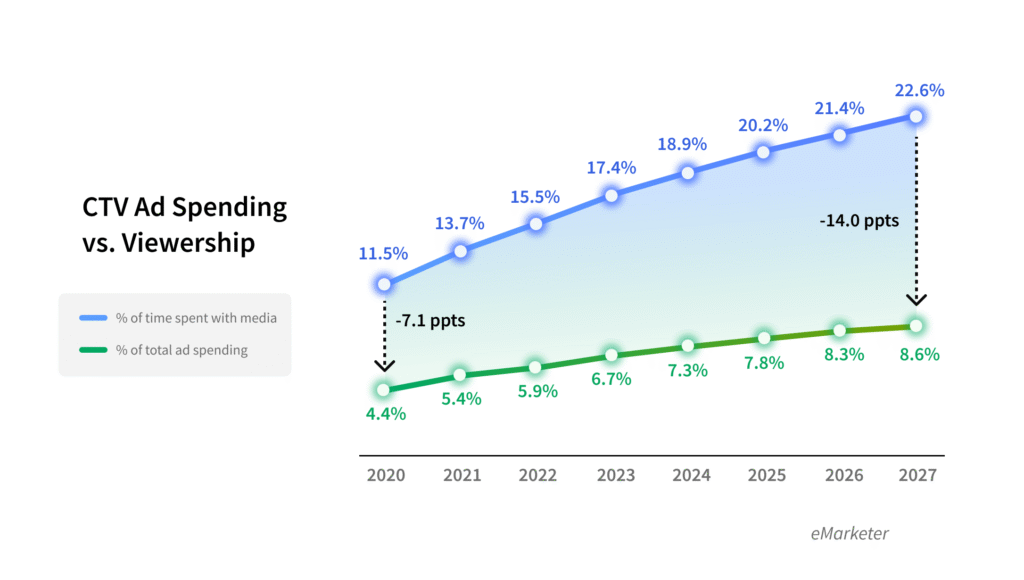
CTV's advantages make this gap notable. The channel combines television's high-impact storytelling with digital precision targeting, superior completion rates, and direct attribution to consumer actions. In fact, three-quarters of American CTV owners prefer targeted ads to enhance their viewing experience, and more than one in five viewers have used their CTV devices to complete a purchase after seeing an ad. Add to this the emergence of new CTV ad formats and expanding inventory options, and it's clear that advertisers who match their spend to viewership now stand to gain significant competitive advantage before the market catches up.
But don’t write off linear TV just yet: While connected TV continues its steady climb, traditional television still delivers the kind of mass reach that many campaigns need, particularly those focused on driving brand awareness.
And no, this isn’t just your grandparents watching Jeopardy (or you watching Jeopardy, if Jeopardy is your thing!). Audiences across all age groups still tune in to traditional broadcasts, though younger generations are doing so less frequently than their older counterparts.
However, linear TV’s reach is eroding as more viewers shift to streaming alternatives: In 2026, CTV offers access to 15% more of the US population than linear. Advertisers must ensure their linear and CTV strategies complement each other in the short term, while planning for linear’s decline and the continued rise of CTV and social video.
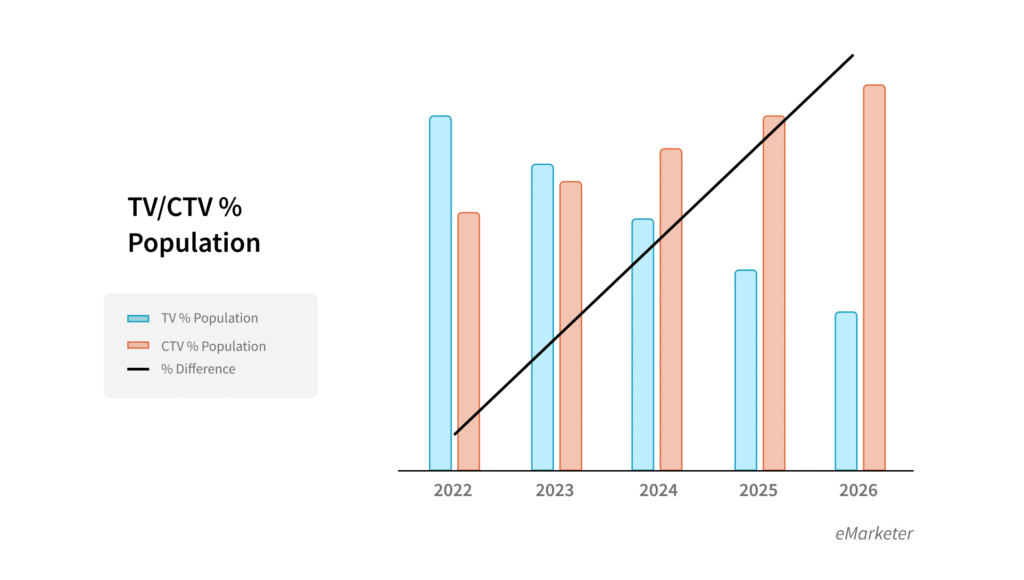
This might look like running broad awareness campaigns on linear TV during high-profile events like live sports, then using CTV to extend reach to cord-cutters and younger viewers who don't watch traditional TV. Or, it could look like managing CTV campaigns with a platform that offers Open Addressable Ready (OAR) capabilities, which enable consistent, addressable campaigns across both linear and streaming using unified audience data and measurement. Advertisers should also allocate budget dynamically—shifting spend to CTV as linear reach declines, while maintaining traditional TV presence where it remains cost-effective.
Ultimately, success in streaming TV advertising lies in treating linear and CTV as complementary tools in a holistic video strategy that evolves alongside viewer behavior.
The boundaries between TV and social media are dissolving faster than audiences can scroll to the next video in their TikTok feed. This is especially true among younger audiences, with nearly 80% of young people aged 10-24 reporting that they watch movies or TV shows on social platforms.
Sports content, in particular, is driving social video engagement (as well as live CTV engagement): Between 2020 and 2024, the percentage of Americans who reported they watched live sports games on social media platforms in the last month grew by 34%.
Following these viewership trends, US advertisers invested more than $10 billion more in social video than in linear TV in 2025.
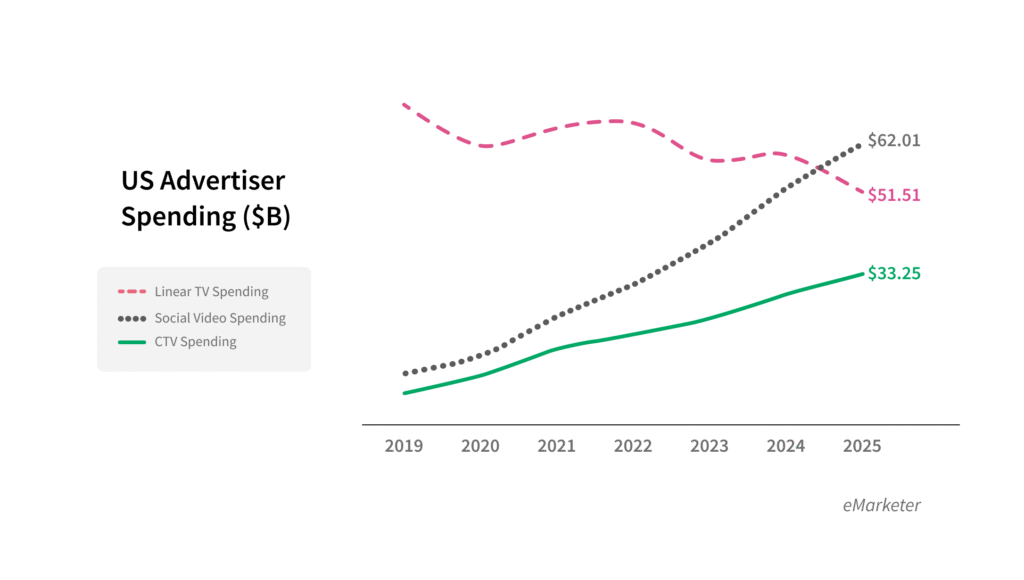
Recent spending trends show social video and CTV budgets are climbing while linear investments decline: In 2025, CTV and social video dominated the priority list for video advertising budgets, setting the stage for continued growth in 2026.
The living room TV? Still relevant. But today, it’s far from the only screen that matters for reaching video-watching audiences.
In 2026, buying inventory from a recognizable streaming service doesn’t guarantee your ads will appear in brand-safe, high-quality environments. As the streaming ecosystem has matured, the term “premium” has been applied so broadly that it’s lost much of its meaning. Spoiler alert: Slapping a well-known logo on an ad buy doesn’t automatically make it premium.
Much of what advertisers purchase on major platforms runs within long-tail apps, user-generated content channels, or bundled placements that offer minimal transparency. As a result, 15% of streaming TV ad spend is wasted in low-quality environments rather than premium streaming content.
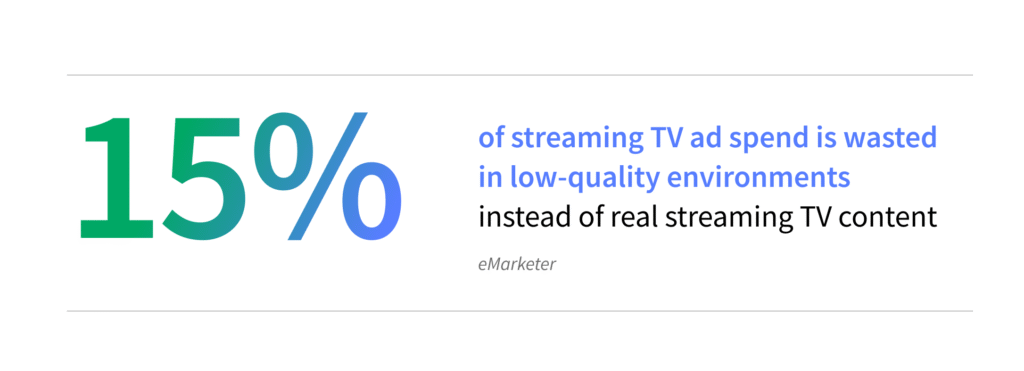
Considering this, it’s critical that advertisers demand transparency from their CTV providers. Just as important is implementing quality controls when buying CTV inventory to ensure spend isn’t wasted on low-quality placements—for example, by checking in on campaigns midstream to make sure ads are showing up where intended. Overlaying ACR (automatic content recognition) data into CTV buys can also help by offering more precise visibility into placements, verifying exactly what content appeared on-screen when your ad ran.
Ultimately, premium placement in streaming comes from verification and control, not brand recognition alone.
While video strategies of the past focused on specific channels and distribution methods, the video strategies of the future will focus on following engaged audiences wherever they’re consuming content, regardless of the screen.
This means treating CTV, social video, and linear TV as complementary tools in a unified strategy rather than competing channels. Advertisers must align their content objectives with inventory-specific tactics across platforms. Broad awareness campaigns might justify run-of-content purchases, but performance-focused initiatives demand curated placements and app-level visibility.
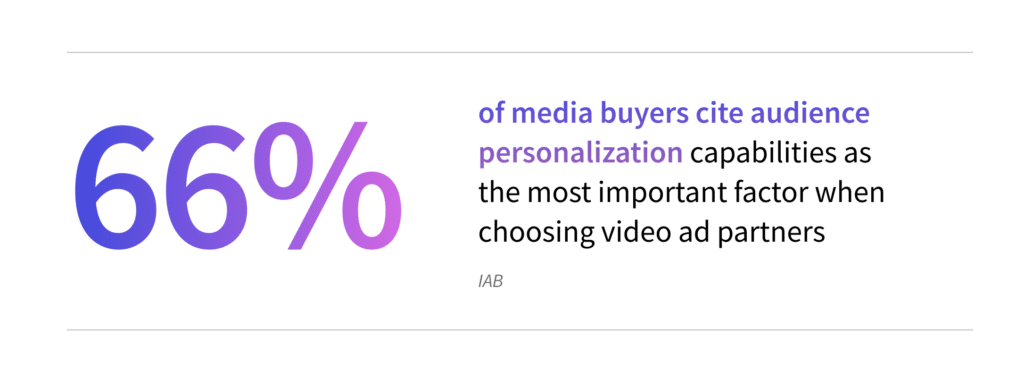
The shift from channel-first to audience-first planning is showing up in how advertisers choose their partners: 66% of media buyers cite audience personalization capabilities as the most important factor when choosing video ad partners.
Marketing teams are implementing this audience-first approach by leveraging CTV targeting parameters including behavioral and demographic segmentation as well as content-level contextual targeting to connect with viewers in high-quality environments—then extending those learnings across social video and other channels. AI-powered, all-channel platforms can help with this by automatically applying these learnings to optimize buys across channels.
Streaming TV’s promise of precise, addressable advertising faces a critical data quality challenge. Many platforms claim they can offer addressability, but the accuracy varies significantly based on the kind (and quality) of data powering it.
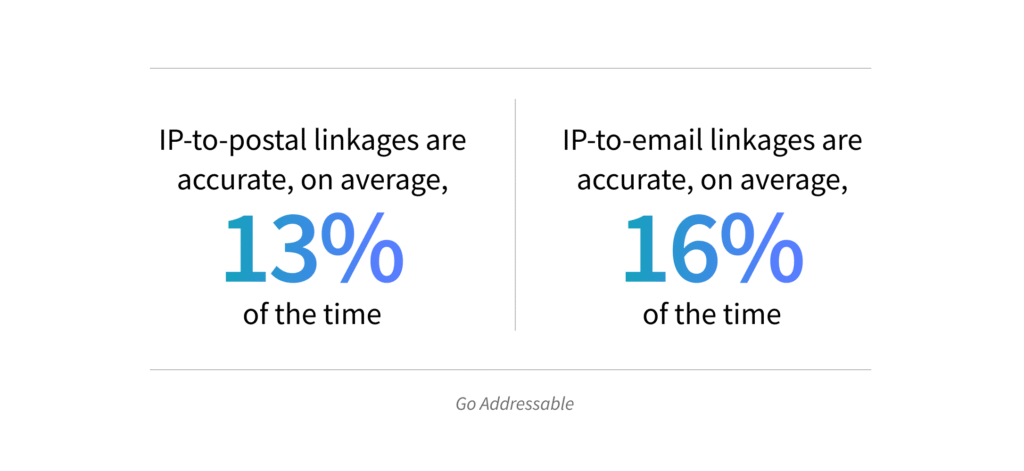
IP-based targeting, which many platforms rely on, suffers from significant accuracy problems. IP-to-postal linkages are correct just 13% of the time on average, while IP-to-email connections hit the mark only 16% of the time. Yes, that means they’re wrong a whopping 87% and 84% of the time, respectively! These error rates undermine the targeting precision that makes addressable TV attractive in the first place.
As the addressability landscape develops, advertisers must understand what kind of addressability the platforms they invest in offer. To accomplish this, teams should ask their CTV partners specific questions: What data sources power your targeting capabilities? How accurate is your addressability, and how do you measure it? Do you primarily use deterministic data or probabilistic data? Platforms that can’t answer these questions transparently may not offer the precision they promise. And to enhance precision, advertisers should layer first-party and deterministic data—which offer the highest level of targeting accuracy—into their buys.
Today’s streaming landscape offers tremendous opportunities for advertisers willing to navigate its complexities. Success requires moving beyond assumptions about premium inventory, channel effectiveness, and targeting precision, and crafting strategies grounded in audience behavior, content quality, and data transparency.
Six Key Takeaways:
—
Want to dive deeper into what’s shaping the future of advertising? Check out Rewinding to Fast Forward: The 2026 Digital Advertising Trends Report for more insights into how the media landscape is evolving and what it means for your marketing strategy.
A leading political marketing and advertising agency was working on a high-profile ballot initiative in California that was drawing heavy linear spend from both sides of the issue. To reach new voters with counter-messaging, the agency needed a smarter, more cost-effective approach to extend reach beyond saturated linear environments. To do so, they turned to Basis.
With Basis, the agency was able to leverage CTV as a more cost-effective media buying strategy across four key markets (Los Angeles, Sacramento, San Diego, and San Francisco). After the agency shifted more spend to CTV/OTT as it outperformed linear TV, the client sharpened their narrative on how the channel can inform, persuade voters, and reach new audiences. Deploying this approach, the campaign sourced 94% net new voters via CTV.
Performance:
OTT/CTV: Unique Audience: 4,821,292 | Reach: 14.55%
Total TV (Linear + Digital): Unique Audience: 19,563,025 | Reach: 59.05%
Total - All Platforms: Unique Audience: 24,095,505 | Reach: 72.74% | Incremental Audience: 4,532,480
1) Customized Targeting Strategies
The campaign deployed a precision CTV strategy using Basis’ audience matching and Comscore insights, targeting both known voter pools and identifying new audiences. This significantly extended the incremental reach with limited overlap (6%) between CTV and linear viewership.
2) Tailored Partner Recommendations
With Comscore’s Advanced Reach Measurement, Basis delivered detailed market-level reports and insights, uncovering new voter segments to target.
3) Regular Optimization & Support
Basis monitored campaign delivery daily and optimized placements to maximize impact while controlling frequency. This approach maintained efficient exposure across channels throughout the campaign.
4) Custom Political-Approved Private Marketplaces (PMPs)
Basis built custom PMPs featuring premium CTV, OTT, and audio inventory approved for political advertising. This maximized the campaign’s ability to reach voters in high-quality, compliant environments at scale.
The client is a leading marketing and advertising agency specializing in political campaigns, combining strategic insight with agile execution to boost brand presence, deliver measurable digital results, and help clients reach the right audiences.
Industry: Marketing & Advertising, Candidates & Causes
Company Size: 21-50 employees
Locations: USA
Key Goal: Increase brand awareness
The advertising agency world is at a crossroads.
After years of mounting pressure, the forces reshaping the industry have reached a critical threshold. It's one that threatens not just how agencies operate, but whether the business model that has sustained them for decades can survive. Client relationships are more strained. Profits are shrinking. Tech stacks are sprawling. And AI—the technology most agencies are counting on to turn things around—is poised to reshape everything from revenue models to headcount.
To understand what this moment means for the advertising industry, Basis surveyed more than 200 professionals at leading agencies, exploring how they feel about their jobs, their agencies, and the forces shaping their futures.
Select findings include:
Despite these challenges, advertising agencies still have ample opportunity. Global advertising spend is projected to cross $1 trillion for the first time in 2026, and brands still need partners who can help them navigate an increasingly complex media landscape. But the agencies best positioned to capture that opportunity may look very different from those that have dominated the last decade.
Download the full report today for the complete findings, along with strategic takeaways for agency leaders navigating the road ahead.
Every election cycle, political campaigns compete with nonpolitical advertisers for the same inventory—driving up costs, limiting availability, and creating brand safety challenges. In 2026, that pressure is set to reach new heights.
The 2026 midterm elections are on track to be the most expensive midterms in US history. Political ad spending this cycle is projected to reach $10.8 billion, a 20%-plus increase over the 2022 midterms’ $8.9 billion and nearly on par with the $11.2 billion spent during the 2024 presidential cycle.
The forces driving that spending are significant. Control of both chambers of Congress is up for grabs, with 35 Senate seats in play, including special elections in Florida and Ohio. All 435 House seats will be contested, and a record number of House members are not seeking reelection, creating open-seat races where neither candidate benefits from incumbency. And with a deeply unpopular president, a war started without congressional authorization, and rocketing gas prices setting the backdrop for the cycle, the political environment is primed for aggressive spending on both sides.
For nonpolitical advertisers, this translates to tighter inventory, higher CPMs, platform-specific restrictions, and heightened brand safety concerns across channels. That complexity is compounded by challenges resulting from a fragmented media environment and the rise of AI-generated content. Here’s what marketers need to know heading into peak political spending:
Key Takeaways:
During the 2024 election cycle, political ad spending totaled $11.2 billion, with the presidential race alone accounting for $3.2 billion. Without that top-of-ticket race in 2026, spending will concentrate more heavily on congressional and gubernatorial contests—especially in the states and media markets where those races are most competitive.
On the Senate side, spending is projected to hit $2.8 billion, slightly surpassing the 2024 record. Georgia, Maine, Michigan, New Hampshire, and North Carolina are the cycle’s most closely watched races, with multiple contests likely to surpass $500 million in ad investment. States like Iowa, Nebraska, Ohio, and Texas could also attract significant spending as Democrats pursue pickup opportunities against a 53-47 Republican majority. And the pressure is building early: Campaigns are moving up their ad timelines to secure inventory before rising demand pushes them out of competitive markets.
Spending on House races, on the other hand, is projected to reach $2.2 billion, marking the first time spending on the chamber will exceed the $2 billion mark. With competitive seats concentrated in the New York and Los Angeles media markets—12 of the projected 40 competitive seats sit in those two metropolitan areas—nonpolitical advertisers in those regions will likely feel outsized pressure.
Gubernatorial spending is expected to hit $1.95 billion, with open seats in Georgia, Michigan, and Wisconsin driving substantial activity in those states. Arizona, Nevada, and New Jersey are also projected to see significant gubernatorial ad spending, with New Jersey’s race alone expected to more than triple its 2021 investment. And downballot spending, driven by ballot propositions and state legislative races, will account for 36% of all political ad spending, representing $3.9 billion.
The bottom line for nonpolitical advertisers is that political spending in 2026 will not be distributed evenly across the country. It will cluster in specific states, specific metropolitan areas, and specific channels.
Political advertising follows a predictable cadence. Historical data shows that roughly 50% of a cycle’s political dollars run in the 30 days before Election Day, with about 25% concentrated in the final 10 days. Early voting may push some of that spending slightly earlier in 2026, but the Labor Day-to-Election Day window will remain the period of highest intensity.
Sports programming will intensify the pressure. The FIFA World Cup, hosted in the US, Canada, and Mexico from June through July, will drive significant demand for sports-adjacent inventory, particularly on CTV and streaming platforms. That demand will overlap with the early stages of general election spending, which means CPMs in sports-adjacent inventory could start climbing well before the traditional September-through-November political window. Then, from Labor Day through Election Day, college football and the NFL will overlap directly with peak political ad spending. And with political advertisers increasingly using live sports as a targeting proxy—reaching voters in specific states and metropolitan areas based on the games they watch—nonpolitical advertisers competing for the same inventory in battleground states should expect particularly elevated CPMs during that window and plan their sports buys accordingly.
Geographically, the hottest markets will track directly with competitive races. States projected to see the highest total political spending include California ($1.1 billion), Michigan ($936 million), Georgia ($757 million), North Carolina ($669 million), and Texas ($556 million). Advertisers with heavy presence in those states should plan for elevated CPMs and limited premium inventory throughout Q3 and Q4.
Broadcast television still commands the largest share of political ad spend, at just under 50%. But that share is effectively flat from the last cycle, and broadcast revenue is actually declining slightly from 2024. The growth story is in CTV.
Connected TV is the only media channel projected to see increased spending over the 2024 presidential cycle. Spending on the channel is projected to reach $2.4 billion in 2026, up from $2.34 billion in 2024, and accounting for 23% of total political ad spend.
Several factors are accelerating this shift. First, cord-cutting continues to reshape the television market. Streaming captured 47.5% of all TV viewing in December 2025, while cable’s share continued to decline. As audiences—including older demographics who have historically been the most cable-loyal—continue migrating to streaming platforms, political advertisers are following them to CTV. At the same time, CTV’s targeting capabilities allow political advertisers to reach specific geographies and demographics with precision that broadcast cannot match.
For nonpolitical advertisers, this creates a compounding inventory challenge. Major CTV platforms like Netflix and Amazon Prime Video do not currently accept political advertising, which pushes political dollars more heavily into platforms that do: Hulu, Roku, YouTube, and others. That concentration effect means CPMs on those platforms will spike and inventory could be tight, particularly in competitive markets during the September-through-November window. On the flip side, those same political-ad-free platforms represent inventory that nonpolitical advertisers can access without competing against campaign dollars at all.
Beyond linear and connected TV, digital spending on social platforms like Facebook, Google, Snapchat, and X will account for an estimated 13% of total political spend this cycle, down from 15% during the 2024 presidential cycle. That decline is consistent with typical midterm cycles, where social media and digital as a whole command a smaller share of spend without a presidential race on the ballot. Still, nonpolitical advertisers in battleground states should expect increased competition for display and online video inventory. And as political content—both paid and organic—saturates social feeds in the weeks before Election Day, ad environment quality and brand adjacency becomes harder to control.
Audio, meanwhile, remains one of the most underutilized channels in the political media mix, despite consumers spending a significant and growing share of their media time with audio content. For nonpolitical brands looking for less congested environments during peak political season, programmatic audio may offer an efficient alternative.
With so many different channel- and platform-specific considerations, omnichannel visibility is particularly important in 2026. Advertisers who can see and adjust all of these dynamics from a single vantage point—shifting budgets from high-pressure CTV inventory to less contested audio or display, for example— will be better positioned to make proactive, considered decisions rather than scrambling to adjust when pricing spikes hit.
Brand safety is a perennial concern during election years. In 2026, the continued rise of AI-generated political content adds a new layer of complexity for political and nonpolitical advertisers alike.
Deepfake political ads are already running in midterm campaigns. In March 2026, the National Republican Senatorial Committee released an 85-second deepfake video of James Talarico, the Democratic Senate nominee in Texas, depicting a realistic but entirely fabricated version of the candidate reading old social media posts directly into the camera. Similar AI-generated attack ads have appeared in the Georgia Senate race and in state and local contests across the country.
There is no federal law governing the widespread use of AI in political advertising, and while 26 states have enacted some form of deepfake disclosure legislation, enforcement remains limited and laws vary widely in scope. At the same time, social media platforms like Meta and X have rolled back professional fact-checking programs in favor of community-based moderation, which can be slower to catch synthetic content, if it catches it at all.
For nonpolitical advertisers, this means the content environment around political news coverage, political ads, and social media will be more volatile and less predictable in 2026. The specific risks will vary by channel and by advertiser. Consider a healthcare brand whose display ads unexpectedly appear alongside coverage of an abortion ballot initiative, or a family-oriented retailer whose pre-roll video ads run ahead of an AI-generated political attack ad on YouTube. The brand safety risk is meaningful even when the adjacency is accidental. Three-quarters of consumers feel less favorably toward brands that advertise on sites that spread misinformation, and ads that avoid risky political content see a 32% lower cost per conversion and significantly higher success rate than those that appear alongside it.
Brand safety controls—including site-level block lists, keyword exclusions, and contextual targeting—will be critical, particularly for display and online video placements where ads appear directly alongside editorial and user-generated content. CTV presents fewer adjacency risks because ads appear within streaming content rather than alongside it. Agility is a major competitive advantage considering the brand safety risks that accompany the midterms. Advertisers who can quickly adjust placements, update exclusion lists, and monitor brand safety across channels from a single, unified platform will be better equipped to respond when conditions shift—whether a deepfake goes viral, a controversial ad surfaces, or a political story dominates a news cycle.
Navigating a $10.8 billion political advertising cycle requires both planning and flexibility. Here are practical considerations for the months ahead:
The 2026 midterms will test nonpolitical advertisers' ability to maintain reach and performance in a historically expensive and complex media environment. With a record amount of political spending projected to flood broadcast TV, CTV, and digital channels, the pressure will be acute in battleground states and high-profile metropolitan areas from Labor Day through Election Day.
What makes this cycle particularly challenging is the convergence of multiple pressures at once: record midterm spending, a shifting CTV landscape where political dollars are concentrating on a subset of platforms, AI-generated content complicating brand safety, and major sports programming overlapping directly with peak political season. Advertisers who treat these as isolated issues rather than compounding ones risk being caught off guard by pricing spikes and inventory shortages that are already predictable.
The post-election window is worth planning for as well. November through December historically offers favorable pricing as political dollars exit the market. Brands that build their Q3 and Q4 pacing with that rebound in mind can recover reach and efficiency quickly.
__
For more on how political advertising is shaping this year’s cycle, check out The Ultimate Guide to Political Advertising in 2026.
Lighthouse Digital Media partnered with Basis as part of its broader advertising operating system to strengthen campaign execution, improve efficiency, and scale performance across channels. Combining their strategic planning and optimization expertise with Basis’ automation and workflow capabilities, the team delivered measurable value and exceeded client expectations.
Lighthouse Digital Media is a full-service digital advertising partner specializing in search, social, video, programmatic, and analytics. They pair strategic planning with transparent reporting to deliver data-driven campaigns that exceed performance benchmarks, delivering measurable, repeatable results.
Lighthouse needed a unified platform to simplify multi-channel activation and billing while delivering strong click-through-rate (CTR) and video completion performance for a nine‑month financial services awareness campaign.
They needed a solution that enabled:
Lighthouse Digital Media approached this campaign by focusing on performance, operational efficiency, and brand integrity across a complex multi-channel activation. Lighthouse evaluated how to best manage campaign complexity while preserving the agility and hands-on optimization approach that differentiates its client work.
Basis served as the technology partner that enabled the Lighthouse team to efficiently activate campaigns, manage workflows, and optimize performance across tactics and channels—freeing the team to focus on strategy, audience insights, and performance refinement rather than administrative execution.
With a $182,000 budget and an 8-month campaign flight, Lighthouse developed and executed a cross-channel strategy that leveraged display and video tactics across multiple audience segments and targeting approaches.
Lighthouse leveraged Basis to execute a scalable, multi-channel campaign strategy while maintaining a high level of control and optimization throughout the engagement.
Results:
“Technology is most valuable when it enables smarter decision-making, not when it replaces it. Basis provides the infrastructure and efficiencies that allow our team to stay focused on what we do best: strategy, optimization, and delivering best possible results for our clients.” - Lighthouse Digital Media
Key Takeaways:
AI is transforming how consumers search online and what paid media can accomplish within those environments.
This transformation is resulting in three key shifts that marketers must understand to invest effectively in paid search:
For advertisers, understanding how to strategize around each of these shifts is essential to building a paid search strategy that holds up in an LLM-powered environment.
The search results page has always been a place where advertisers vie for attention, but AI is changing the terms of that competition. AI Overviews now dominate above-the-fold real estate on Google for about half of all queries, pushing paid and organic listings further down the page. As users opt to scan AI-generated summaries first and scroll less as a result, there are fewer moments for them to see and act upon your ads.
This attention compression directly affects paid search performance, with recent research finding that the presence of an AIO correlates with a 58% lower CTR for the top-ranking page. As advertisers compete for fewer available clicks, these changes could drive up CPCs as well.
For agencies and internal marketing teams, it's critical to proactively communicate the context of these changes to stakeholders, so that declining CTRs and rising CPCs are understood in context rather than treated as performance failures.
Not all search intent is affected equally by AI. AIOs are showing up predominantly for the upper-funnel, research-driven queries that users rely on to learn, compare, and evaluate before making a final decision. In fact, 99.2% of the keywords that trigger AIOs are informational in intent.
This means that it has become more difficult for paid search to deliver the upper-funnel discoverability and efficient clicks it is known for. There are also emerging implications for programmatic, as fewer impressions become available from key publishers whose organic traffic is being absorbed by AI-powered search experiences.
Action- and decision-oriented queries, however, remain largely unaffected—which presents a clear opportunity for search advertisers. Lower-funnel, intent-driven keywords should be prioritized accordingly.
Perhaps the most important mindset shift for search advertisers right now is reframing the value paid search provides. As AI search increasingly resolves questions without site visits, paid media will drive fewer clicks. But that doesn’t necessarily mean those investments are driving less value.
Clicks have long been advertisers' primary focus because they’re measurable, but paid search has always contributed to outcomes beyond that immediate action. Paid search-driven brand exposure drives recall and brand trust, influences later decisions and return visits, and impacts whether a brand makes it into a consumer’s consideration set at all.
Of course, measuring the impact of paid search in this way is more complex than traditional paid search attribution. As the causality between paid search exposure and action becomes harder to track, teams will need to lean more heavily on marketing mix modeling and multi-touch attribution to connect paid media investment to business outcomes.
AI’s impact on paid media performance is already significant: Attention is more compressed, different intents are leading to different outcomes, and the click-based model of demonstrating paid media value is under pressure.
Advertisers who understand these dynamics and adjust their strategies, benchmarks, and measurement approaches accordingly will be far better positioned to drive results from paid search investments as the search landscape continues to evolve.
—
Looking for more insights on the future of search engine marketing? Explore everything marketers need to know about the shifting landscape by watching our recent webinar: Is Search Totally F**ked? What Do We Do Now?.
In this episode, former Discover media and audience strategy leader Clare Liston joins host Noor Naseer to break down how top marketers actually evaluate adtech and martech partners.
From avoiding “shiny object” syndrome to pressure-testing vendors with direct questions, Clare shares a practical framework for choosing tech that drives real business outcomes. She unpacks why most adoption is reactive, how to think about ROI within working media, why human credibility matters more than jargon, and more.