
Technology
Basis Platform
Advertising Operating System
Communication Portal
Intelligent Collaboration
All Channel Activation
Activate Media on Every Channel

Consulting
Resources
Unless you’ve been doing nothing nowhere all at once for the past, say, 10 months or so, you know that artificial intelligence (AI) and automation have seized the marketing limelight.
Most of the current buzz centers around the potential business impact of new tools within the field of generative AI. But even before this boom, agencies and brands have been increasingly leaning into automation and AI technologies to unlock efficiencies and improve collaboration. One study found that 90% of marketers are using them to strengthen customer interactions, 89% are using them to enhance data integration, and 88% are using them to personalize the customer journey across channels. Other use cases include resolving customer identity, driving best offers in real-time, and bridging online and offline experiences. Indeed, marketing organizations today have so much disparate data at their fingertips and so many disparate systems to manage throughout any given campaign lifecycle that leveraging automated technologies to save time and cut costs is critical to unlocking success.
Automation and AI are spurring brands’ digital transformations, igniting conversations, and capturing headlines…but what exactly do we mean when we talk about “automation” and “AI”? The terms are often used interchangeably, but in order to make smart decisions about how to invest in them and grasp their possible impact, it’s important to know how they differ and where they fit into the marketing and advertising ecosystem. Here, we unpack all that, and more.
The sometimes-synonymous use of these terms stems from the fact that automation is a broad category encompassing an entire class of technologies that includes AI itself. In advertising parlance, however, there are some key distinctions to be made.
The automation umbrella refers to a type of software that follows pre-programmed rules—it substitutes human labor across the campaign workflow, tapping into patterns to perform tasks that are repetitive and predictable. In the process, it enables scale that is virtually impossible to achieve without it.
AI, on the other hand, describes software designed to simulate human thinking—it is, as the name suggests, intelligent. Predicting outcomes under conditions of uncertainty is one of the most challenging aspects of digital advertising, and AI platforms can be a powerful ally in that fight by dynamically identifying and analyzing situations and crafting conclusions.
Simply put: automation works with data, while AI understands data.
Digital advertisers use basic automation in an assortment of ways—for example, in leveraging programmatic media buying or eliminating incomplete or redundant lead information. But it can also help brands and agencies manage the myriad new channels and platforms that have caused media complexity to soar while sapping marketers’ time. Media buyers can use automation to simplify workflows and increase agility as they build out adaptable cross-channel experiences.
From streamlining planning processes, to optimizing ad spend in real-time, to centralizing all reporting, to reconciling financial data, automation can help marketing organizations tame the fragmented markets and accomplish things they never could with manual processes alone. And side note: this powerful technology can also enrich the employee experience by significantly reducing redundant and tedious tasks in favor of more meaningful, higher-level strategic work.
Let’s move on to the topic of the moment.
It seems like barely a day passes without some marketing-related story about AI hitting front pages and homepages. The constant flurry—or, rather, blizzard—of new tools to hit the mainstream is whipping up an industry-wide frenzy.
OpenAI’s DALL-E 2 got the ball rolling when it burst onto the scene in late 2022. ChatGPT came next, gaining a million users in its first five days and reaching 100 million within just two months (making it the fastest-growing web platform ever). And GPT-4 has kept the hype going (and growing)—a tool proving adept at solving logic puzzles, building websites from a notebook sketch, creating business plans, telling jokes, and even passing bar exams. It’s also the technology powering Microsoft’s Bing Chat (you know, the one that went a bit crazy).
Of course, Mountain View was never going to sit back and let Redmond enjoy all the attention, so Google too has launched an API for its own language learning model (LLM), PaLM, alongside a number of other enterprise AI tools that it says will enable businesses to generate text, images, code, videos, and audio from simple natural language prompts. This includes Bard, Google’s chatbot, which runs on the company’s Language Model for Dialogue Applications (also known as LaMDA).
Big picture-wise, this is all game-changing stuff in the world of marketing. These new LLMs have accelerated the adoption of AI, and it’s easy to see where the advertising applications of these tools fit in. Brands and agencies are already reportedly using it to draft creative assets and brainstorm strategically, help refine consumer messaging based on online shopping habits, map out new marketing touchpoints, and scale their existing operations to do more with less.
It’s important to remember, though, that AI consists of so much more than just generative AI. Many aspects of digital advertising already leverage the technology to facilitate things marketers use regularly—think machine learning, behavioral marketing, contextual targeting, dynamic pricing, bid shading, and digital assistants.
Of all those areas, contextual targeting is probably the most widely adopted. Just over half (53%) of brand and agency marketers are currently using it, with another 33% planning to do so in the near future. This is no surprise considering the end of third-party cookies looms on the horizon. Since it doesn’t rely upon the use of personal data, contextual targeting neatly sidesteps identity issues, making it a sound (and cheaper) option for advertisers in this new privacy-forward future. It also adds an additional layer of filtering for page quality, helping to boost brand safety by avoiding lower-quality content and pages that don’t align with desired standards.
All said, the various applications of AI offer many of the same benefits as automation: They enable marketing organizations to build more robust actions that are regulation-compliant, all at a magnitude that would be implausible without them.
If you’re not already leveraging automation and AI, start your journey by assessing the opportunity for your organization and establishing high-impact use cases. Laying out the capability and governance groundwork ahead of time is critical to implementing and utilizing the technology successfully.
Identify where you can find quick wins with the highest automation potential and then branch out. In parallel, develop a long-term vision for more comprehensive transformation that features automation and AI in your workflow and operating model.
We’re still in the early days of generative AI and marketers can already use it to help with creative processes. But—and this is a big but—you must tread carefully. While the cost-savings this technology offers may be tempting, especially in today’s economic climate, advertisers that use it could find themselves embroiled in legal battles. Create guidelines around when, where, and how your organization adopts AI and ensure AI-generated content is always vetted by a human with relevant subject matter expertise.
The use of automation and AI can feel threatening to many marketers. But at least right now, the technology is at a stage where it’s there to help them do their jobs better and quicker. And who doesn’t want that? Marketing leaders should make sure they’re engaging their employees about how they’re using it and address any associated concerns they may have.
Developments in AI are poised to disrupt our industry. Changes will likely come slowly at first, but it’s essential to keep a close eye on them. Early adopters are more likely to reap the benefits down the line and late movers may struggle to keep up. Start testing and gain the advantage of early learning.
Automation and AI each have sweeping definitions that encompass a variety of complex technologies. Both are already indispensable tools for driving the kinds of large-scale, personalized, omnichannel advertising experiences that today’s consumers demand. It’s by no means essential for every marketer to be an expert in both, but looking into the future of digital media, it’s clear that automation and AI will have an enormous impact on our industry.
---
If you’re interested in learning more about how to incorporate automation and AI into your marketing but unsure of where to start, reach out to our Media Strategy & Activation Team. You can also check out AdTech Academy, which offers courses that cover an array of automation and AI-based topics, including algorithmic optimization, behavioral targeting, contextual targeting, machine learning optimization, programmatic advertising, and many others.
Welcome to Scout! Each week, our team tracks down the best digital marketing articles, POVs, and reports—so you don't have to. Here’s what to read from the week of 3/16/23 - 3/23/23 to stay ahead of the curve:
More and more consumers are heading to visual platforms, such as YouTube, to watch podcasts. (What’s next, watching TikToks on Instagram? Oh, wait…) To adjust to this crossover, media buyers are figuring out next steps with podcast publishers, from how to buy—video, audio, or both—to how to define and attribute success.
It’s been a busy week for Big Tech on the regulatory front. TikTok’s CEO Shou Zi Chew is testifying before a Congressional committee against threats that the US could ban the app. Meanwhile, industry group NetChoice launched a new litigation center to tackle issues ranging from state social media laws to antitrust suits.
The state of data privacy in advertising is a burning topic. With consumers and regulators alike pushing for change (and third-party cookie deprecation in Chrome rapidly approaching), advertising teams would be well-served to explore privacy-friendly solutions now. If you’re looking for a framework to set your team up for success in a privacy-focused future, this piece is for you.
After a somewhat rocky start to its advertising debut, Netflix’s recent series of moves demonstrate “they’re serious about the ads business.” This article breaks down the factors that contributed to the streaming service’s initial “bumpiness” for advertisers, as well as where things could go from here.
—
Want a monthly digest of all the best Scout content delivered straight to your inbox? Sign up for the Basis Scout newsletter!
Grace Briscoe is SVP of Candidates and Causes at Basis Technologies
Digital advertising spend soared even higher for the 2022 US elections. This seemed like an aberration because of the record-setting 2020 US elections that generated the highest voter turnout ever. One could reasonably assume that the 2022 Midterms would not generate the same level of marketing as the previous cycle that featured presidential candidates at the top of the ticket. Yet, there was cautious optimism for ad dollars flowing into the market.
In 2022, more than 1,000 campaigns for state, local and national races managed their digital ad buying through Basis Technologies’ workflow automation and business intelligence platform, Basis, encompassing more than $130 million in political ad spend across video, display, native, audio, and text ads.
Basis Technologies has been trusted by agencies and consultants in politics, public affairs, and advocacy for 15 years. We’ve worked with candidates and advocacy groups at all levels, from Presidential to local elections. This experience gives our team a diversified view on how digital media is being utilized in political marketing.
This is the third research report Basis Technologies has published on the US elections and digital ad spending. Our 2020 report confirmed the growing use of programmatic advertising and the emerging interest in CTV ads, seemingly giving a 2022 winning playbook for midterm campaigns. The marketers followed through, perhaps at the cost of other tried and true tactics.
Could 2024 see the same rate of growth in CTV ad spending? It will likely depend on how inventory availability in programmatic (guaranteed, private marketplace or open bidding) affects tactical decisions. And as ad targeting restrictions based on consumer privacy begin taking effect (on top of Google deprecating third-party cookies in Chrome in 2024), common tactics to identify voters could be constrained. Luckily, political advertisers have long been comfortable with uncertainty.
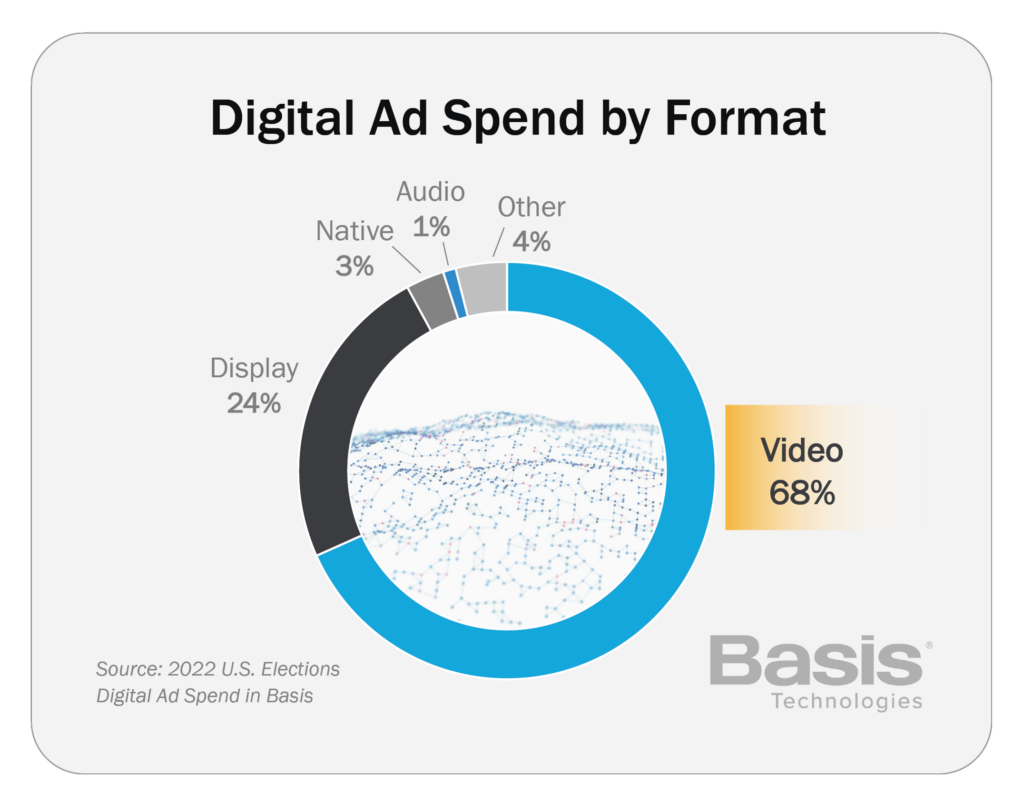
Video ads, whether linear TV or digital formats, have long been popular for political marketers. When we began tracking this data in 2018, video already comprised a majority of ad spend – and that was a time when CTV ad opportunities were nascent. Now that the CTV train is rolling, we can expect continued dominance of video ad spend — the question is how much more can political marketers spend in this format. Much of CTV growth came from video ad dollars previously being spent on desktop. The redistribution in device spend did not necessarily boost format spend for video. There is finite high-quality video inventory now, but publishers could expand video offerings just in time for 2024, when a presidential contest could mean a bigger boost in ad sales than in a midterm.
Other formats should be monitored, especially audio. Native, audio, and others combined had miniscule volume in 2018 (4%) and 2020 (3%). But 100% growth is intriguing, and we believe a significant part was driven by Spotify allowing political ads for the midterms (it did not allow this in 2020). As digital audio and broadcast radio ad inventory become available via programmatic channels, this category could be poised for growth in 2024.
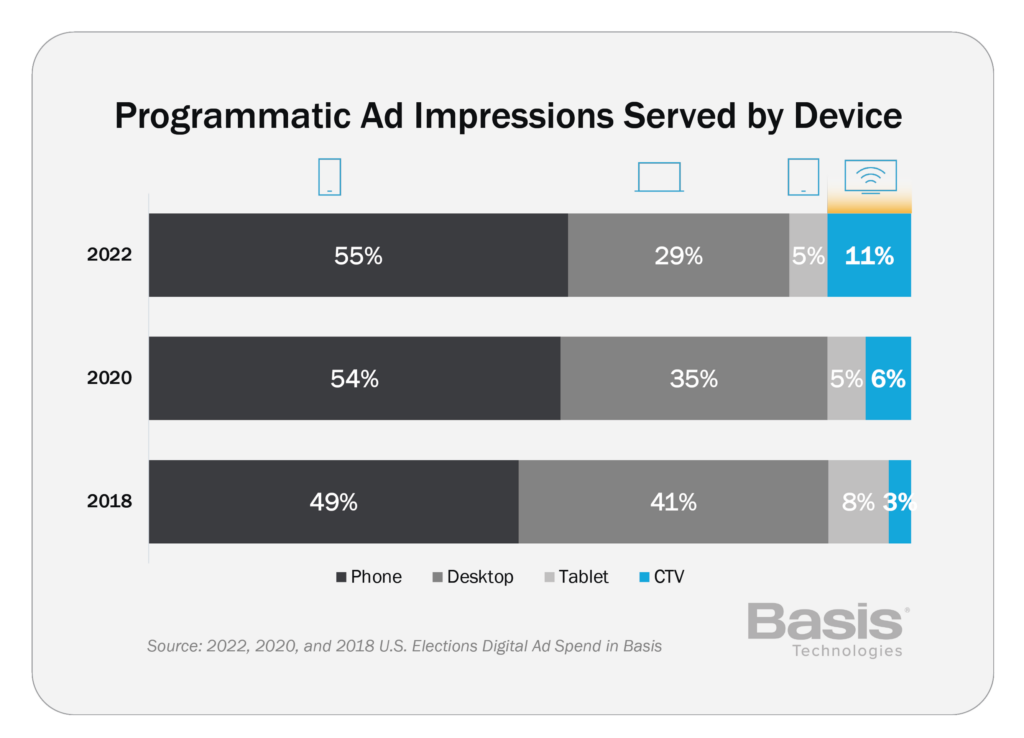
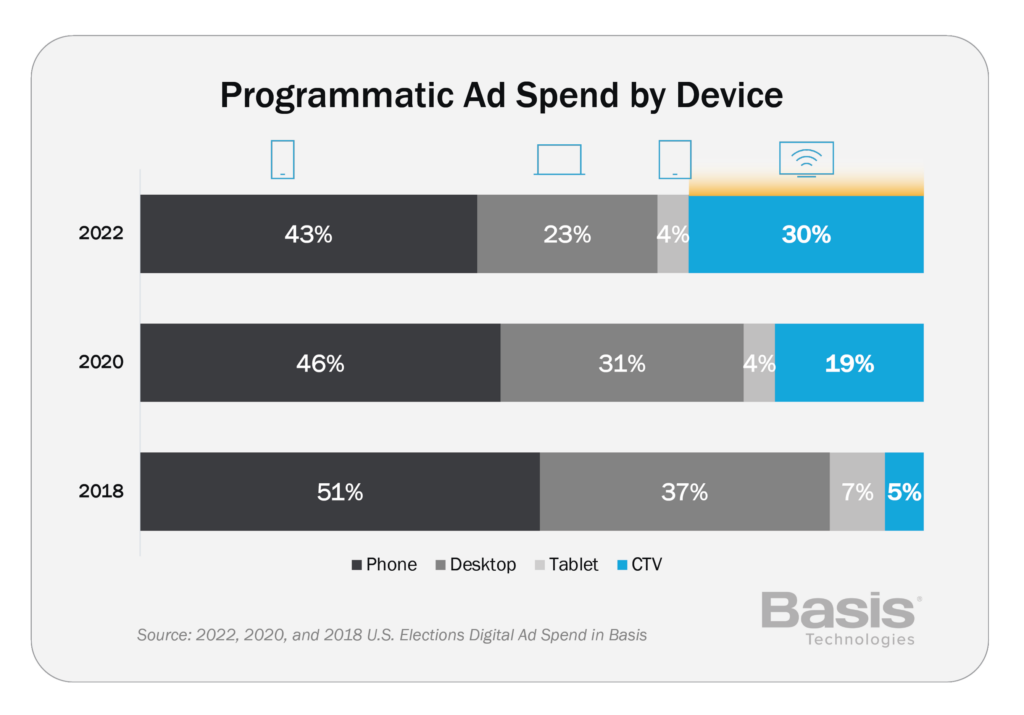
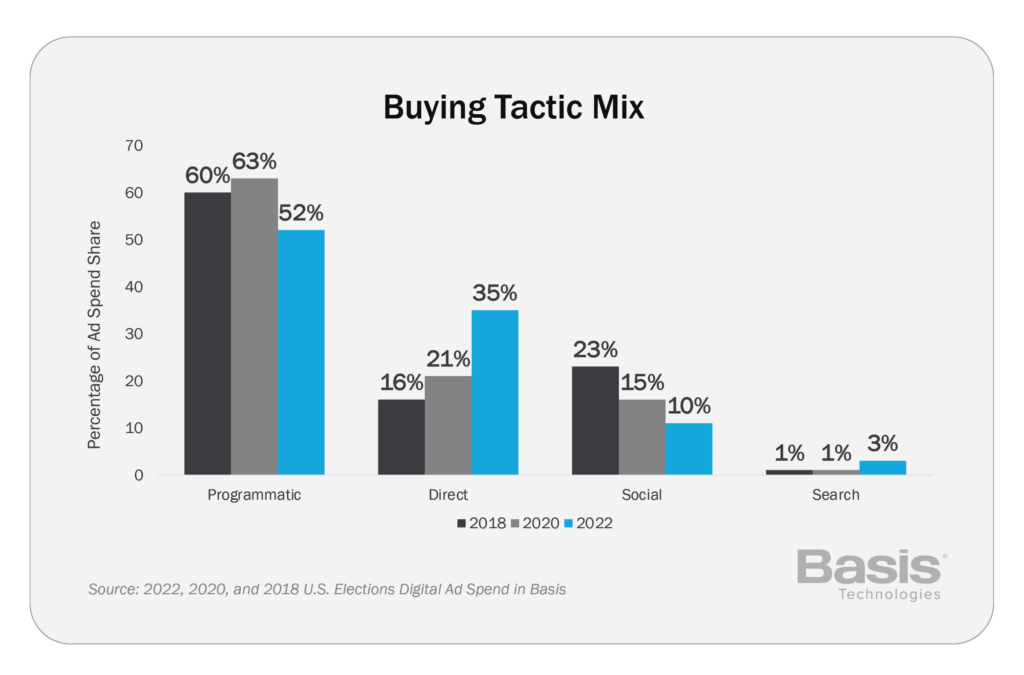
Even though CTV had a significant impact in shifting the media spend by device in programmatic channels, its effect was even greater for direct buying methods. For many inventory suppliers, CTV ad opportunities were primarily available via direct channels. CTV ads was almost half of direct spending for 2022 political marketers. This could be contributing to the decline in social advertising share over the past elections. However, the major social media ad vendors have also implemented restrictive policies for political advertising, in addition to having younger audiences (who are low-propensity voters).
Although programmatic advertising is still the most popular buying tactic, its decline in share in 2022 was unexpected. Nevertheless, programmatic channels experienced strong growth on ads served to CTV channels in impressions and, more so, in spend (67% growth from 2020 to 2022). Private marketplaces are favorite tactics, and we anticipate that increased adoption of programmatic guaranteed as a buying methodology to secure reserved inventory is likely to reverse the curve toward direct IOs. The primary loser in this evolution is desktop ads. While share in mobile ad spend declined somewhat from 2020 to 2022 (it was still steady in impression count between the two cycles), desktop impression and spend share took major hits.
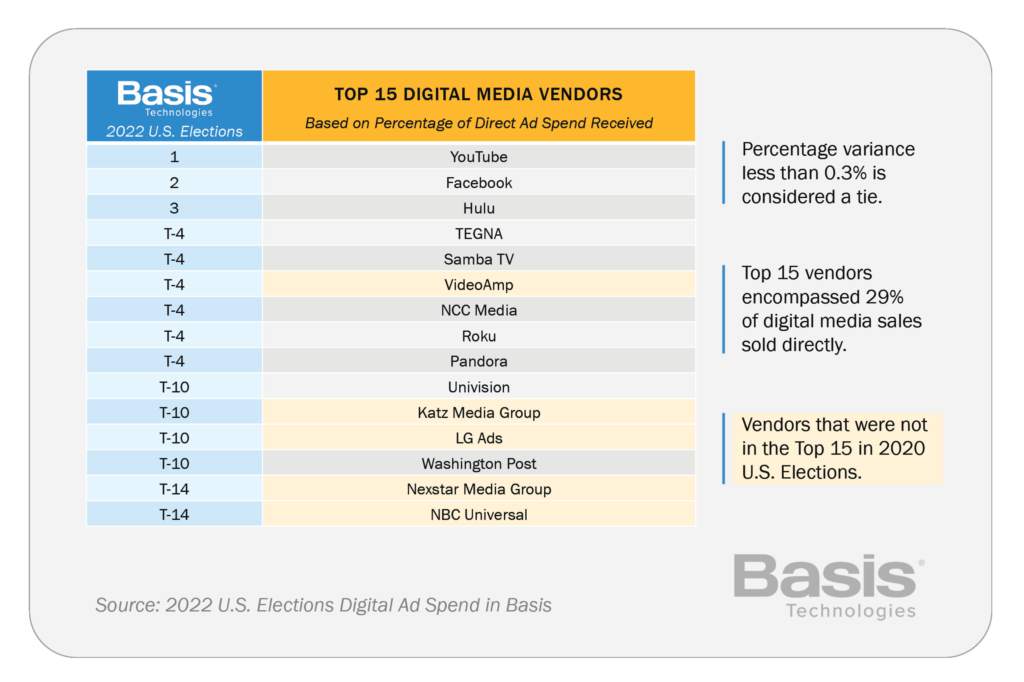
Direct buying was lifted by the demand for CTV inventory. Our report tracks the vendors that received the most ad spend via direct channels (agency or political campaigns transacting an IO with vendors directly). This report has tracked the top 15 vendors in this category of buying, and the past two cycles have displayed the rapid rise of CTV advertising.
Traditional media brands CNN, Fox News, New York Times and Politico, known for politics, were knocked out of the 2022 top 15. These shifts speak to the need for stronger ad options specific for CTV at scale that can lure advertisers from the ease and efficiency of programmatic.
Overall total share of the top 15 vendors declined, going from 38% (2018) to 36% (2020) to 29% (2022).
The top three vendors had 28% in 2018, but now sit at 16% share of direct spend share in 2022. Notably, OTT/CTV vendors went from 4% (2018) to 14% (2020) to 16% (2022). More spend may be going to the long tail, and the duopoly dominance appears to be weakening. The development to watch in 2024 is Twitter, which will allow political ads for the first time since 2019.
Samba TV continued to rise, likely because of advertiser interest in automatic content recognition targeting. New to the list, VideoAmp’s presence also speaks to the importance of CTV planning and measurement tools. Pandora’s consistency for the past three cycles shows it remains the top source for streaming audio. Operational execution and inventory exclusivity make a big different in securing direct ad buys. As 2024 rolls around, the strength of direct buying could be affected as programmatic channels continue to develop better tools in frequency capping and measurement.
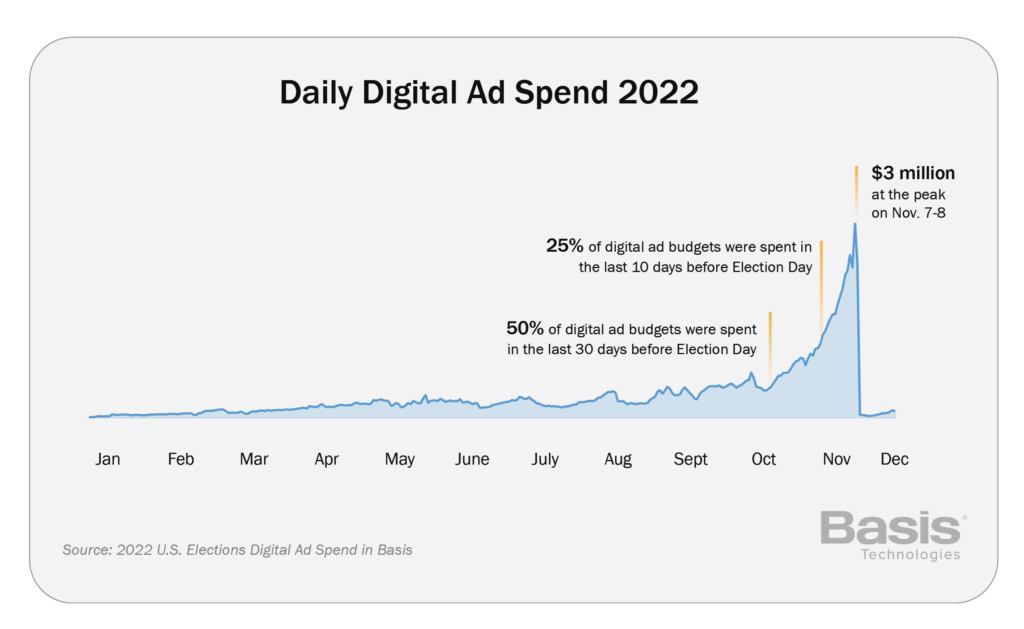
Political ad spending throughout the Midterm election year followed the same pattern as previous election cycles. Half of budgets are spent in the last 30 days before election day for persuasion and early voting and 25% is spent on the last ten days to get out the vote. This is the pattern for cycle upon cycle. The delay in congressional mapping and redistricting had little effect in the overall trend. A few factors that could affect this in 2024 are the presidential primaries and additional runoffs. Even though the country seems a little bit more energized for presidential elections than for midterms, savvy political marketers know that urging turnout and influencing down-ballot votes is still a monumental task.
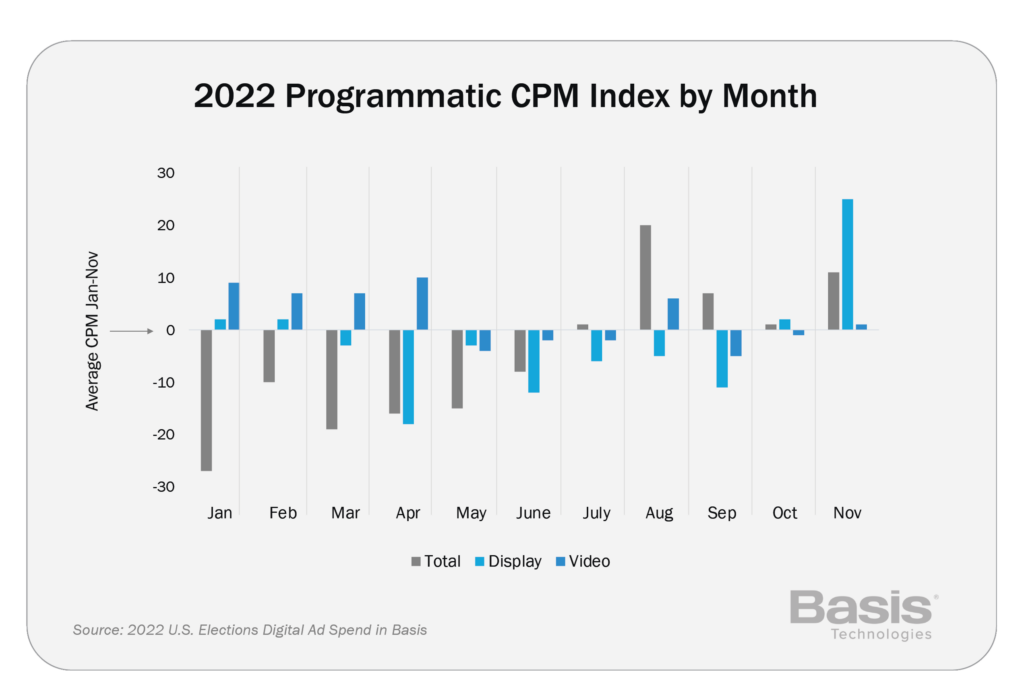
Our programmatic CPM index compares the average pricing per month to the average CPM for the whole election cycle for political marketers. The significant price difference between January and November was driven by ad formats purchased, rather than factors concerning demand and supply. Video made up the majority (74%) of programmatic spend. While video CPMs remained steady throughout the cycle (we saw a variation of less than $1.50), the increased volume of spending on video from August to November at the higher base CPMs commanded by video was the driver of the overall increase. Display totals did also show significant inflation in the days leading up to the election. Although not published in this report because of its marginal impact within overall spend, native ad formats experienced the largest change in CPMs, which averaged over 140% higher in November than in January.
When all buyers are saving budgets for the end, there’s little opportunity to capitalize on lower pricing in the summer months. This pattern should urge advertisers to lock in favorable pricing negotiated in advance through programmatic guaranteed, private marketplaces, or even simple direct buys with vendors.
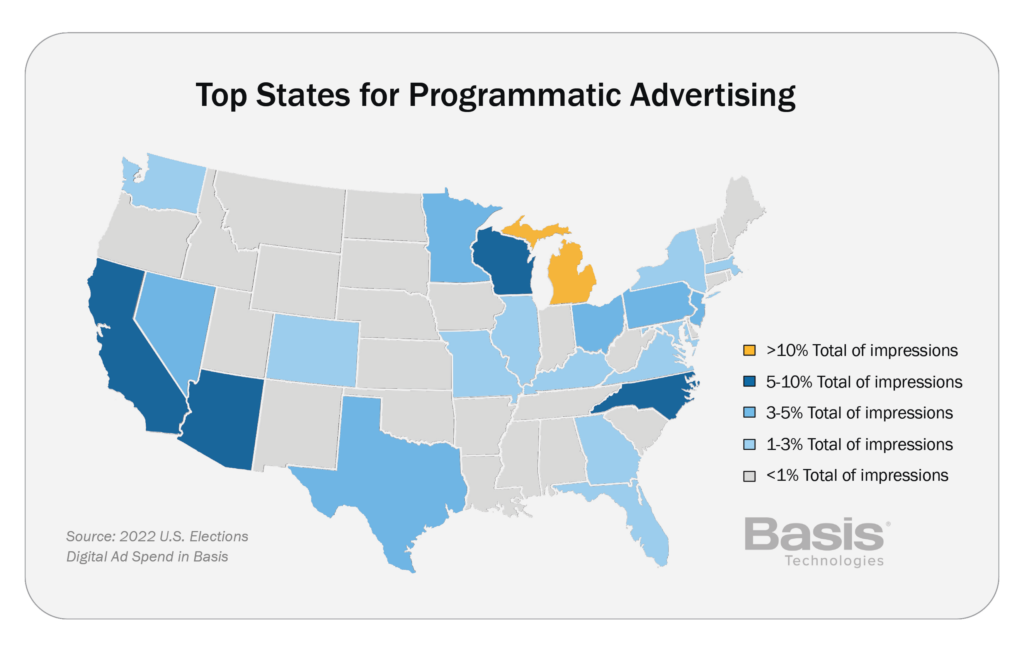
Michiganders were the clear winner (or loser?) during the midterms, receiving the most programmatic ad impressions. People in other large, populous states such as California, Texas, Pennsylvania and Ohio also saw the most ads in terms of impressions and spend. The numerous congressional and state senate seats, and their competitiveness, in these areas are contributing factors for driving ad serving. Beyond the top 11, a large majority of states received 2% or less in total ad impressions in 2022, including Illinois (1.76% impressions share). These numbers could change dramatically when the electoral college is a factor in 2024.
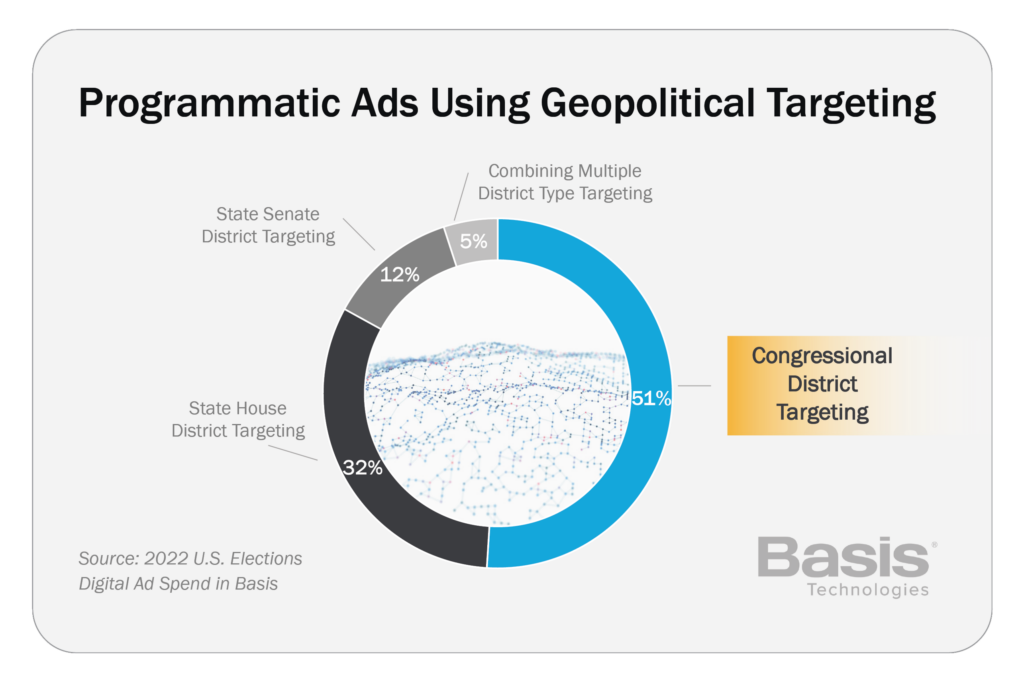
Almost 20% of political programmatic ads used geopolitical targeting, where advertisers select specific districts to target. The most popular among these tactics is Congressional District Targeting, likely as a factor of the larger districts. Frequent updating of geopolitical districts throughout the chaotic redistricting process was key to the effectiveness of this targeting.
When Google blocks third-party cookies on Chrome, it could trigger political marketers that were heavily reliant on cookie-based tactics to move more spend into other tactics. As these marketers grow more familiar with these tactics (State Legislative District Targeting just debuted in 2022), they may decide that 2024 is the right time to transform their campaigns to these forms of finding voters.
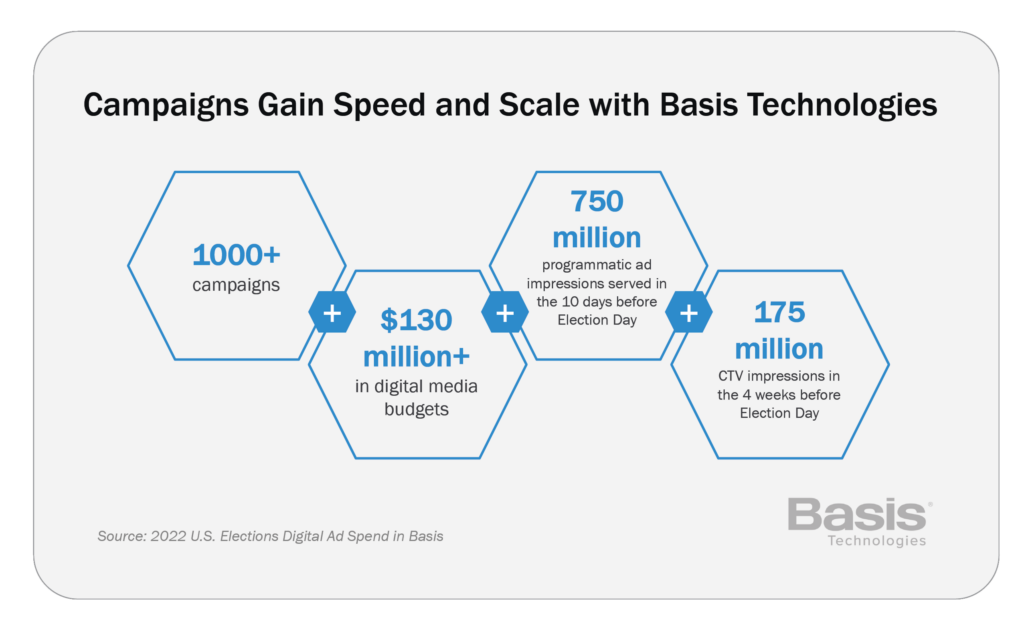
CTV advertising was the dominant story in nearly every aspect of the 2022 midterm elections. More than 750 million programmatic ad impressions were served in the final 10 days and 175 million CTV impressions in the final four weeks.
Political marketers are sharpening strategies and tactics heading into 2024. Premium guaranteed placements, procured through direct buys, are key despite the ongoing popularity of programmatic ads. As more guaranteed placements can be transacted through programmatic pipes, this could bring more efficiency and effectiveness to political marketers, especially for CTV. And as marketers approach signal loss, now is the time to evaluate the solutions that overcome that challenge such as ID alternatives, contextual targeting and geopolitical targeting.
~~~
Basis Technologies has been trusted by agencies and consultants in politics, public affairs, and advocacy for over 15 years. Its Basis platform provides a comprehensive selection of unique buying methods across all channels and devices, utilizing all major creative types and formats. Basis Technologies offers flexible service models with expertise in ad buying tactics for programmatic, vendor-direct, search, and social. Since 2007, Basis Technologies has helped power digital media for over 2,500 political campaigns and independent expenditure committees, and over 2,500 issue advocacy advertisers. Basis Technologies is headquartered in Chicago with 44 offices covering North America, South America and Europe, including a Washington, DC, hub for its Candidates + Causes team.
Learn more about Candidates + Causes advertising with Basis
Each month, Basis Technologies’ Programmatic 101 series tackles a different facet of programmatic advertising—from best practices for buyers, to competitors in the space, to trends you should know.
With 73% of consumers expecting companies to understand their unique needs, personalization in marketing is no longer an option—it’s an imperative.
Behavioral targeting is one of the most common techniques used by marketers to deliver personalized messages. At the same time, the impending loss of third-party cookies in Google’s Chrome browser will change how marketers are able to use this kind of targeting in their campaigns.
Looking to understand how behavioral targeting works, what benefits it offers, and what it might look like in a future without third-party cookies? You’ve come to the right place.
Behavioral targeting is when an advertiser targets potential consumers based on their interests or behaviors demonstrated online, in-app, or in-store. To leverage behavioral targeting, advertisers must have access to first-, second-, or third-party behavioral data.
Digital marketers collect first-party behavioral data by tracking behaviors or actions completed on their websites, such as site page activity and purchase history.
Marketers can also tap into second-party data (i.e., first-party data that is collected by a business other than your own) and third-party data (i.e., data sets that are aggregated by data collection companies) to power behavioral targeting.
Behavioral data is used to build better, more individualized customer experiences. For example, Target collects shopper data for all in-store and online purchases. They can then use this first-party data to make personalized suggestions based on individual customers’ buying history.
As mentioned earlier, behavioral targeting can go beyond first-party data. For example, let’s say you’re an advertiser looking to target new moms and have maxed out first-party data targeting (retargeting, CRM, lookalike, etc.) from your own website. You could tap into second-party behavioral targeting by purchasing Visa’s New Mom Segment, which they create based on the first-party credit card information they collect.
Marketers can also turn to third-party data providers, which create various audience segments based on aggregations of data, for behavioral targeting. However, with the coming loss of third-party cookies in Chrome, increasing regulation over how companies can use consumer data, and a public that’s concerned about data privacy, it’s best for marketers to lean into more privacy-friendly targeting techniques.
Behavioral targeting offers marketers a variety of benefits, including the ability to:
While browsers like Safari and Firefox are already operating without third-party cookies, the loss of third-party cookies in Chrome will impact advertisers even more significantly.
Since third-party behavioral targeting relies mainly on cookies, data companies must find new privacy-compliant ways to create the same—or similar—audiences. As a result, we expect the use of third-party data to become model-based instead of a one-to-one match. To make up for the changes in third-party data opportunities, advertisers will do more to make the most of their first-party behavioral data and lean into second-party behavioral targeting tactics.
Want to learn more about how you can prepare for the cookieless future? Check out our guide to navigating the identity crisis.
Noor Naseer is VP of Media Innovations & Technology at Basis Technologies. Her presentation earlier this month at SXSW 2023 explored a question at the forefront of many advertisers’ minds: Will data privacy kill advertising?
Here, Noor offers a framework for what advertising teams can do today to set themselves up for success in a privacy-focused future.
Scroll through any major news site, and it’s clear that data privacy in advertising is a burning topic. The last few years have ushered in a staggering amount of privacy-focused regulation and legislation, and regulators are cracking down on holding companies accountable to these new standards. At the same time, more and more consumers are concerned about data privacy—86% of US consumers, to be precise—and people today have greater control over how companies use and share their personal information. Couple these factors with the impending deprecation of third-party cookies in Google Chrome, and it’s no surprise that advertisers are concerned about the future.
The question on everyone’s mind is this: How can marketers connect with consumers in a way that’s scalable, personalized, and privacy-friendly?
The most important thing to know is that the right approach will look different for everyone. Even more, it will involve a massive investigative undertaking to figure out what solution (or combination of solutions) works best for your target audiences and your marketing team. As of yet, there’s no one-size-fits-all replacement that advertisers can employ in place of third-party cookies. And, though it might be tempting to wait around for someone to come up with such a solution, those who choose progress over procrastination when exploring privacy-friendly solutions will come out on top.
As I explored earlier, consumers are demanding increased privacy when it comes to their data. But, they still want personalized experiences with the brands they’re interacting with. One recent report found that 73% of all consumers say they expect companies to understand their unique needs, and more than half say they expect all offers to be personalized.
Without third-party cookies, what’s a marketing team to do?
First, teams should develop a healthy appreciation that this is a complex shift and there will likely be a margin of difference between the third-party cookie targeting of the past and the cookieless solutions of the present.
Then, teams should embrace this opportunity to experiment and test available alternative solutions. The reality is that not every solution is right for every brand or company. Without testing what’s available, it will be difficult to determine what will work best for your unique team and audience.
Here are some of the solutions that digital advertisers can explore and test—whether alone or in concert with one another—as they adapt to the data privacy demands of today:
As advertisers move beyond third-party cookies, first-party data will become increasingly important. Since this is data that consumers willingly give to brands, it is inherently privacy-friendly. And, because it comes directly from users, it is both high-quality and accurate.
For advertisers looking to make the most of their first-party data, here are a few questions to consider:
There’s a reason that contextual targeting is having a moment in digital advertising: It’s a privacy-friendly solution that’s both time-tested and cost-efficient. Contextual advertising works by allowing advertisers to place their ads in contextually relevant environments. For example, a bakeware brand could use contextual targeting to place display ads alongside recipes on a website, or a snack food company could target their ads to digital out-of-home (DOOH) screens at gas station pumps to entice hungry travelers.
Though it still relies on some user data for personalization, geotargeting is an accessible targeting solution that is more privacy-friendly than cookie-based IDs. Advertisers can harness the power of geotargeting and location targeting to reach audiences at the right time, in the right way, and with the right message. And via targeting by country, city, or even zip code, advertisers can utilize available information about specific locations—such as language, food, weather, and local landmarks—to create personalized ads for users in those areas.
Recent advancements in machine learning and artificial intelligence (AI) present additional opportunities for privacy-friendly targeting. Take, for instance, Basis’ integration with TransUnion Audience Platform (TAP). TAP’s technology allows advertisers to pair their first-party data with TAP’s audience pool (which covers 99% of the US population). Through machine learning, that first-party data can then be enhanced with more data points across a variety of categories to create holistic consumer profiles for more personalized messaging and targeting. Similar to geotargeting, AI does rely upon some personal user data and, as such, will be worth examining and evaluating as it continues to develop.
It’s clear that the digital advertising landscape is undergoing a significant shift, with the push for increased data privacy at its center. And while it’s true that we have a little time before the loss of third-party cookies in Chrome, it’s imperative that marketing teams use that time wisely.
How? My recommendation is to start testing some of the privacy-friendly options discussed above as soon as possible. In doing so, you’ll be on your way to determining the unique combination of cookie alternatives that works best for your brand(s) and your audiences.
__
Want to learn more about how your team can overcome the challenges posed by data privacy? Check out our guide, Beyond Third-Party Cookies, where we do a deeper dive on how advertisers can overcome the identity crisis.
At the start of every year, digital marketing teams around the world draw up checklists of short- to medium-term challenges they must address in order to meet the moment successfully. The 2023 edition probably includes big-ticket action items like:
Of course, there are many moving targets on this list—the landscape changes, and new priorities emerge. However, there are certain challenges that remain ever-present, and those always-on initiatives are essential to driving brand awareness and customer acquisition.
Maximizing return on investment (ROI) from programmatic ad spend is one such example. It’s an enterprise that’s simultaneously crucial (given the ubiquity of the programmatic market) and complex (given the pace of evolution across the digital ecosystem).
Programmatic ad spending remains strong in the US, despite—or perhaps because of—macroeconomic headwinds. Indeed, the flexibility afforded by programmatic makes it a safer bet in times of uncertainty, as advertisers can quickly shift budgets and optimize spend toward channels, platforms, or formats that are delivering high returns without the headache of navigating cancellation terms. The medium is so pervasive today that it encompasses over 90% of US digital display ad spending and its share is expected to increase incrementally through 2023 and 2024. Programmatic also continues to gain traction in maturing channels including connected TV (CTV), digital out-of-home (DOOH), and podcasting, as well as more traditional channels like linear TV (more on all that later). Then there’s the added dynamics of retail media networks, around which programmatic advertisers are swirling with interest thanks to their treasure trove of first-party consumer data and closed-loop attribution.
Put it all together and it becomes clear that maximizing ROI on programmatic ad spend is a huge undertaking. It requires connecting the dots between different tech players in the supply chain, different point solutions, different pricing methodologies, and unstandardized metrics—that’s a lot of moving parts! Here, we’ll break down some of the complexities involved in driving programmatic performance, including definitions and formulas, important trends across the current programmatic landscape, and tactics marketers can implement to capitalize on programmatic’s potential.
Ready? Let’s dive in.
Programmatic advertising ROI is exactly what it sounds like: it refers to the return on investment a company makes from its programmatic media buying initiatives. It can be calculated to show the payoff on programmatic spending holistically or it can be broken down in more granular terms—be it by channel (CTV, audio, native, etc.), device (smartphone, desktop, TV), ad type (video, non-video), campaign, creative, or even demographic and geographic data.
It’s pretty simple, really. And, also, really important to measure.
At a time when marketers are facing mounting pressure internally and externally—from boardrooms to justify spending and from consumers to deliver seamless personalized advertising experiences—it’s more critical than ever for marketing organizations to accurately track performance and identify where they are most effective. Embracing the use of ROI as a discipline can help build more robust and agile brands that are set up to cultivate meaningful long-term relationships with their audience. It’s marketing 101 in 2023.
Calculating ROI is done through a straightforward formula: subtracting the initial investment from its final value, dividing the resulting number by the cost of the investment, and finally, multiplying it by 100.
For example, let’s say a company spent $250k on a social campaign that generated $1 million in revenue. The number crunching would look like this:
Net income ($1 million – $250k = $750k) / Cost of investment ($250k) = 3. x 100 = 300%.
Obviously, the goal with any ROI-based project is to end up with as high a positive number as possible, but success is truly in the eye of the beholder. What constitutes a triumph depends on all manner of factors. Some companies also establish a threshold for ROI that considers risk tolerance and the cost of human resources, below which they may be hesitant to make investments.
It’s also worth noting that ROI doesn’t necessarily have to be financial in nature. Once marketing organizations have set up ways to track the dollar value of programmatic activities, there are also benefits to factoring softer metrics into the equation—think engagement on social media, ad impressions, new subscribers, video views, or website sessions. They all contribute to building brand awareness and establishing an active presence in the minds of consumers. When managed properly, these KPIs can help reduce the need for paid media in the first place, thus essentially driving higher ROI in the process.
Blink and you’ll miss something significant in the world of programmatic, such is the speed of its evolution and growth. Right now, programmatic accounts for 91.1% of total US digital ad spending, with marketers stateside forecast to spend $21.49 billion more on programmatic display ads than they did last year (a 16.9% jump). For context, that’s more than double the increase predicted in Canada, China, France, Germany, and the UK combined.
But where’s all that money going? How does it break down? And how is it being served? Let’s explore:
This is easier said than done, especially when a given campaign can span several channels and platforms that report against independent metrics. Brands today are using an average of 18 disparate data sources in their campaigns (up from 15 in 2022). And incredibly, only 14% of marketing organizations claim to have a complete 360-degree view of their customer base. Fourteen percent! Operating through disconnected silos leaves you susceptible to all kinds of issues from an operational and legal standpoint. It's also a drain on resources with media planners forced to spend a disproportionate amount of time trying to wrangle their data into a cohesive story. Gaining unfiltered visibility into your data at scale is truly transformative in the modern advertising climate—and maximally effective, consumer-centric advertising (and consequently better ROI) is next to impossible without it.
Once you have your data ducks in a row (or if they are already lined up nicely), be sure to actually use your analytics to understand your baseline potential and develop strategic hypotheses that can inform campaign execution. Learn as much as you can. Play with different scenarios. If your data reveals distinct clusters of consumers who derive different value and benefits from associating with your brand, apply that knowledge to the stories you’re telling across your programmatic media—that’s data-driven marketing. Then it’s all about testing. Programmatic makes it easy to swap out concepts. Experiment with copy, visuals, links, whatever, and narrow down what your audience is responding to. If there’s any doubt whether something is working, simply turn it off and observe the effects.
Regardless of how good your data is, how streamlined your measurement is, or how robust your targeting is, nothing can mitigate the shortcomings of ads displaying lackluster creative. Given how much digital media people consume on a daily basis (8 hours and 23 minutes’ worth, to be precise), simply “turning up” and exposing your brand or product is not enough. Your marketing must forge emotional connections with consumers and set you apart from all the noise. That means tailoring your messaging and design and creating specific stories for specific personas. It also calls for more collaborative ways of working between your media folks and creative teams—get together to discuss the finer details of audience segmentation and dive into the successes and failures of past performance. Your ads will become all the richer as a result.
Sure, programmatic is automation in action. So, by definition, if you’re executing media buys programmatically, you’re already actively embracing automation. But fully leveraging the potential of advertising automation extends to what happens behind the scenes, aka the platform(s) you use to activate and measure your campaigns. Programmatic is a complex beast, so it’s vital to utilize technology that simplifies some of the work for you and helps you stay nimble—be that by consolidating your workflow, using machine learning to optimize bid adjustments, or centralizing performance data. Those who do so can save time, cut costs, and focus on what matters: strategy and outcomes.
Time commitments aside, there are no drawbacks to regularly auditing your programmatic supply path. As the market collectively adjusts for a focus on privacy and the end of third-party cookies, advertisers and publishers are cutting out unnecessary intermediaries and opting out of relationships that don’t offer clear value as part of this sea change. New laws have also come into play requiring a more thorough understanding of who has access to consumer data throughout the bid stream, meaning there is no better time to conduct a review of your partners. A violation around data today can have serious repercussions—just ask Sephora and Kochava.
It’s a new day for marketers, and industry-wide transformations are reshaping how brands connect with consumers. Programmatic is just one cog in that machine, but it’s a powerful and dynamic one. Orchestrating performance across programmatic channels relies on a host of capabilities and processes, but for those willing to invest in them, better campaign ROI awaits.
---
Looking for more programmatic content? You’re in the right place. We’ve got the top seven programmatic advertising trends to know for 2023. We’ve got everything you need to know about programmatic guaranteed. And we’ve also got a handy quiz that helps you identify which programmatic buying method is right for your organization (including all-in on in-housing, a hybrid approach, or outsourcing).
“It was love at third sight...”
“I want to be the third to thank you for...”
“Third impressions are everything...”
Third is...okay. But first? First is what we strive for—from the Olympics to the weekly trivia night at your local dive bar. Why should sourcing consumer data be any different?
Since the invention of the cookie in 1994, digital advertisers have grown dependent on third-party cookies for techniques like audience targeting, retargeting, geo-based retargeting, cross-device targeting and tracking, frequency capping, and attribution. But third-party cookies are on their way out, with regulators, consumers, and tech providers alike pushing for advertising methods that prioritize consumer privacy.
And yes, Google may have delayed third-party cookie deprecation in Chrome until the second half of 2024. But regulators and consumer behavior have made it crystal clear that businesses need to prioritize consumer privacy now: 2022 has been a landmark year for data privacy-focused regulation, and regulators are cracking down like never before: just ask Sephora, BNSF Railway Co., or TikTok. With 86% of US consumers saying that data privacy is a growing concern for them, it’s of critical importance for advertisers not to procrastinate on incorporating alternative targeting tactics into their marketing strategies.
While brands and agencies will need to adopt a mix of solutions to move beyond third-party cookies, first-party data will undeniably be one of the main players helping advertisers ensure they are showing messages to the right people, in the right places, at the right times. Below, we’ll outline a few examples of how advertisers can squeeze every last drop of value out of their first-party data. But first, let’s take a look at what makes first-party data a winner in a world that prioritizes consumer privacy:
First things first: the fact that users freely give their first-party data to brands is perhaps its biggest strength. As consumers have become more digitally savvy, they’ve come to demand transparency into how their personal data is used by the businesses with which they interact. This is particularly true of younger generations like millennials and Gen Z: 91% of Gen Z, for example, feel that being able to find out which companies are storing their personal data is a basic human right.
In order to build trusted relationships with these consumers, brands need to be able to provide that information in an accurate and organized way. While the chain of middlemen involved in third-party data collection and storage makes this difficult, it's easier to communicate information about personalization and targeting efforts powered by first-party data (so long as your data house is in order, of course). When it comes to transparency and privacy, first-party data will always come in first.
With almost 90% of consumers likely to enjoy personalized offers, personalization is quickly becoming a key differentiator for brands. And in contrast to third-party data, which is aggregated from a variety of different sources and consequently suffers from low reliability and accuracy, first-party data is highly accurate because it comes directly from users. That means that personalization and targeting efforts fueled by first-party data are more likely to resonate. And from a quality perspective, first-party data can’t be beat: each data point comes with the promise of someone who has demonstrated a clear interest in your brand’s offerings.
Even more, quality personalization efforts can encourage consumers to share even more of their information directly with brands: in one survey from Merkle, 90% of respondents expressed willingness to share more personal information after having a positive experience with a brand. Talk about a positive feedback loop!
Despite its clear benefits, one of the main concerns advertisers have when it comes to first-party data is scalability. While the proliferation of providers makes it easy for advertisers to acquire just about all the third-party consumer data as they are willing to pay for, first-party data is not quite as effortless to gather. That means it's important for advertisers to find ways to amplify the first-party data they do have access to.
To that end, let’s explore a few of the ways advertisers can use solutions like automation and strategic partnerships to boost their first-party data:
If you’re going to leverage your first-party data, you’ve first got to have first-party data. That means investing in a customer relationship management (CRM) platform, which collects and stores information about customers and prospects, from email addresses and phone numbers to information about all your interactions with a certain individual. Think of a CRM as a hub for first-party data, and a reference for making future interactions with customers and prospects as personalized as possible.
The question now becomes how to actually leverage that data to create targetable audiences. After all, the people whose information you store in your CRM will have already expressed interest in your product or brand and consented to your use of their information, so having those addressable segments is likely to be highly effective (and valuable).
Many marketers target their CRM data by investing in a platform or vendor that’s separate from their advertising platform. They send their CRM data to the vendor, the vendor processes the data and sends it back to the adtech platform the marketer is using, and the platform then re-processes the data and provides targetable segments to the advertiser. But because there are so many steps and parties involved in this process, it often takes hours or even several days before advertisers can use those audiences to target.
Of course, many marketers will want (or even need) to use their first-party data more quickly. For example, airlines that collect first-party data when potential customers begin the checkout process need the ability to retarget users who abandon their carts before purchasing a ticket. Airline brands know that users are not likely to wait a week or more before deciding which flight and airline to go with, so waiting several days to receive targetable audience segments from a separate CRM platform could result in missed opportunities and lost revenue. And though it’s easy enough to retarget these groups today by using third-party cookies, that won’t be the case for much longer.
For those marketers who want or need to access and use their data more quickly, it makes sense to use a platform with built-in integrations that allow direct uploading of CRM data to streamline the process. By uploading CRM data directly into a platform, advertisers can access targetable audiences within hours instead of days. They’ll also enjoy the benefit of having a single source of support, which means one less platform to learn and one less vendor to include in billing systems and to account for when planning campaign budgets.
Just because someone tells you their name, email address, and location doesn’t mean you have a good understanding of who they really are. Likewise, just because you’ve collected some first-party data from your consumer base doesn’t mean you understand how to continue building strong relationships with them. For this reason, audience profiling is one of the most important ways advertisers can leverage first-party data.
Via strategic data partnerships and advertising automation, marketers can use first-party data as a starting point to create detailed user profiles informed by consumer demographics, interests, and buying behavior. Advertisers can then create more personalized marketing strategies based on these profiles. How does it work? We’ll use Basis’ integration with TransUnion Audience Platform (TAP) as an example here:
TAP’s audience pool, created from data points sourced from a combination of public, private, self-reported, and modeled data, covers 99% of the US population. When advertisers upload their first-party data into Basis, the platform can match that information to TAP’s vast data pool of consumers. Machine learning technology can then enhance that first-party data with more data points across categories like demographic, financial, automotive, employment, political, and purchases and interests. The result? In-depth consumer profiles that marketers can use to target and inform personalized messaging.
While audience profiling helps marketers better understand their current and past consumers, look-a-like modeling can help them tap into new audience pools. And while marketers can also leverage third- or second-party data for look-a-like modeling efforts, first-party data will provide the most accurate results. Let’s use Basis’ integration with TAP again as an example:
Once TAP has created those robust audience profiles with a brand’s first-party data, machine learning technology can identify other TAP-identified audiences that are similar to those consumer profiles. This addresses the concern of first-party scalability by creating large-scale audiences out of a smaller amount of first-party data. All marketers have to do is provide a seed audience via their CRM—or place a TAP pixel on their site, which will collect its own first-party data—and TAP’s machine learning technology can amplify it with additional audience pools.
Another powerful way to leverage your first-party data is to use it in tandem with contextual. Contextual targeting is having a moment, thanks to the fact that it’s especially privacy compliant, serving ads based on the content of digital environments instead of user IDs.
And while contextual is an effective strategy on its own, coupling it with first-party data can create an even more personalized consumer experience. How does it work? Let’s use Basis’ partnership with Peer39 as an example:
To leverage first-party contextual targeting in Basis, a brand can opt-in to automatically deliver campaign data like impressions, clicks, conversions, and media cost by URL to Peer39. Peer39 then analyzes the brand’s media distribution and performance across contextual signals, pulling insights about where audiences are spending time and consuming content. Based on those insights, Basis creates customized contextual targeting categories that are optimized to reach target audiences. By creating new categories with which to target, this technique expands the impact of a brand’s first-party data.
While privacy-compliant advertising hasn’t become the status quo quite yet, that's the direction our industry is hurtling towards. Come the loss of third-party cookies in Chrome, it will be critical to have robust methods in place for making the most of your first-party data—but marketers who start testing those methods now will gain a significant competitive advantage. Let the procrastinators come in third: early adopters are going for gold.
—
First-party data isn’t the only tool advertisers need in their privacy toolkit. Check out Basis’ suite of privacy-friendly advertising solutions to see how we're giving our users a well-rounded set of solutions for privacy in digital advertising.
Welcome to Scout! Each week, our team tracks down the best digital marketing articles, POVs, and reports—so you don't have to. Here’s what to read from the week of 3/3/23 - 3/9/23 to stay ahead of the curve:
Please note: Our Scouts will be off duty next week. Check back on 3/23 for the next edition!
In the wake of International Women’s Day (IWD), many brands have come up against accusations—and very legitimate ones, we might add—of inauthenticity in their social activism-focused campaigns. This piece from AdWeek digs into what brands are doing wrong and provides guidance on how marketers can observe events like IWD meaningfully.
Attending SXSW in Austin this year? Your agenda of BBQ joints to check out will pair nicely with this list of panels and presentations to consider attending! From data privacy, to activism and equity, to the turbulent world of social, you're sure to level up your marketing game by attending just a few of these. See ya there!
With ChatGPT now available via API, what started out as a fun distraction across the globe is now being leveraged to empower tech companies like Snapchat, Microsoft, and Quizlet. One step closer to the singularity... (kidding!)
The California Privacy Rights Acts (CPRA) is considered by many to be the most comprehensive consumer privacy regulation in the US. But with a budget of just $10 million, how will the CPPA (the enforcement agency created by CPRA) regulate giants like Meta, who spent over $19 million on lobbying in 2022? Plus: California isn’t the only state grappling with advertising regulation-related conflicts...
—
Want a monthly digest of all the best Scout content delivered straight to your inbox? Sign up for the Basis Scout newsletter!
2022 was a record-breaking year for political digital ad spend—all without a Presidential race at the top of the ticket. In fact, political advertisers poured so much money into campaigns that they essentially propped up the otherwise sluggish US ad market. But how do political campaigns come together and operate working towards the ultimate “One Day Sale” known as Election Day? What were the principles of successful political ad strategies during the 2022 midterms? And how do those strategies apply outside the campaign trail and into the worlds of B2C and B2B?
In this webinar, Basis Technologies’ Candidates & Causes VPs Jaime Vasil and Brian Wohlert explore these questions and more. Drawing on decades of experience working with political clients (and helping them win on election day), they open up the political marketing playbook to share the critical lessons it offers for marketers across other industries.