
Technology
Basis Platform
Advertising Operating System
Communication Portal
Intelligent Collaboration
All Channel Activation
Activate Media on Every Channel

Consulting
Resources
Amazon’s invasion of the SEM territory has officially begun. Last year, Amazon’s search ad revenue surpassed that of Microsoft, taking the number two spot behind Google. Amazon will end this year strongly with a 12.9% search ad market share, while Microsoft will take a mere 6.5% of that same pie. According to eMarketer, this dark horse is expected to take additional market share from the top players and secure $11.7 billion of search ad revenue between now and the end of 2021.
Amazon has a compelling advantage over its eCommerce search engine counterparts thanks to its unique position at the bottom of the consumer buying funnel. Today’s consumers visit Amazon to discover new products, read reviews on and/or price check a product. But Amazon truly stands out because those who search on this site are already in the mindset to make a purchase. Unlike its competitors, Amazon does not need to persuade potential buyers down the conversion funnel.
Given the inevitably immense advertising influence of Amazon sponsored ads, and with the winter holiday season fast approaching, let’s explore some best practices around preparing for peak shopping periods on Amazon. You’ll be able to apply these methods for various shopping dates such as Prime Day, back-to-school season, Valentine’s Day, Mother’s Day, and many more.
Your first step is to understand your business goals for the upcoming peak shopping season. If you’re unsure, start by answering this question: Is my main objective to drive brand awareness or sales? Note that it’s entirely normal to have more than one goal. However, you should be able to prioritize given multiple goals.
Next, align your targets with your goals. If you’re looking to boost brand awareness, your success metric would be impressions. Therefore, make your brand and products visible to more shoppers by taking measures to increase traffic. If eligible, run both Sponsored Brands and Sponsored Products campaigns in order to maximize your opportunity to reach as many potential customers in multiple ad placements (i.e. search results top of the page and product details page). Sponsored Brands campaigns are highly effective in reaching potential customers, still lingering at the top of the conversion funnel, with new brands and product offerings. However, if your campaigns are receiving less than expected impressions, make sure:
On the other hand, if you’re determined to drive more sales, then your key success metrics would be conversions and Advertising Cost of Sales (ACoS). Once you have a significant amount (i.e. at least two weeks) of historical data, conduct a keyword-level performance analysis to identify the top-performing keywords that will help you reach your sales goals. Additional metrics you might find helpful in determining which keywords to raise your bids on during the peak shopping dates include total sales, click-through rate (CTR), and conversion rate. If your campaigns are resulting in low conversions, try adding negative targeting to prevent your ads from serving for the poor-performing keywords.
With your business goals and success metrics in mind, adapt your campaigns to account for the peak shopping period’s landscape.
Adapt your bids: With heightened traffic volume during peak shopping periods comes an increased competition on keyword targeting for Sponsored Brands and Sponsored Products, as well as product attribute targeting for Sponsored Products. Match your bids to how much you’re willing to pay for a click in exchange for peak shopping period impressions.
Adapt your budget: Consider increasing your daily budgets by at least 200% in order to account for higher traffic (i.e. impression and click) volume. The chances are that your campaigns will deplete your daily budget much faster during major shopping dates and ads will be unintentionally paused until the following day. Adapting your budget will prevent you from missing out on conversion opportunities during the remaining prime hours of the day.
Adapt your campaign schedule: The days leading up to and trailing a holiday can be just as profitable as the special day itself. Turn your campaigns on earlier and keep them running a few days past the peak shopping dates in order to capture as much of the available traffic as possible.
Adapt your bidding tactics: If your ads are eligible to serve in placements such as top-of-the-page or product details pages, consider setting bid multipliers (up to 900%) to give them a better chance of securing those high-converting opportunities.
Lastly, remember to give yourself ample time to adapt your campaigns. Amazon recommends budgeting at least two to three weeks prior to the start of any major shopping dates.
Conduct your due diligence on whether Amazon Advertising is a good fit for your business. If the answer is yes, here is Everything You Need to Know About Amazon Ads in 2020 to get you started. However, if you’re not quite ready to take on this endeavor, for now check out our blog post on A Digital Marketers Guide to the Holidays for more general tips on facing the holiday season head-on!
Our people are a large part of what makes Centro such a great place to work. We’re excited to introduce you to some of Centro’s most interesting people in our newest blog series, as they share their ‘Centro stories’ and a variety of experiences that have impacted their work and life.
Tyler Kelly was the fourth employee hired at Centro. After ascending to SVP of Client Development in just seven years, Tyler managed a team that grew partnerships with more than 300 agencies.
In his current role of President, Tyler is busy putting fourteen years’ worth of Centro experience to good use. Read on to learn how this original Centron has built our reputation for outstanding customer service from the ground up.
Clare McKinley: What’s the most exciting thing about our product, Basis?
Tyler Kelly: In essence, it’s that we’re fulfilling an industry need through automation. Not only does Basis automate low-value tasks, it automates low-value tasks from the beginning through the end of the media buying cycle. That means that the efficiencies created by automation start in media planning and run all the way through billing and reconciliation.
In an industry that’s experiencing a lot of turmoil, the end-to-end consistency Basis offers is groundbreaking.
CM: How does Centro as a company play into the larger conversations about automation that are happening in the industry right now?
TK: In short, we’re leading the charge.
Right now, the average media professional uses 15 different tools to do their job. That’s obviously not sustainable. From an automation standpoint, the question is, how do we scale the entire process? Basis is the only technology I know that can scale all digital media channels (search, social, display, and programmatic) from end to end.
We’re also invested in educating our industry on where automation is headed. For example, we partnered with the 4A’s to kick off their Future of Automation study. They reached out to businesses all over the country to put a finger on the pulse of what automation means to media professionals.
One of the most important findings is that automation is seen in two different ways. One is through programmatic, and how businesses can automate their media. The second is broader: How can we scale the entire process of running a business? How can we create processes that streamline and create more efficiencies within agencies? Those are the questions we’re trying to answer with Basis.
CM: Could you speak to the custom solutions Centro offers its clients, and how they set Centro apart as a provider?
TK: We have a spectrum of custom solutions we offer our clients. The first is full managed service. For businesses that can’t do their own buying, we can execute everything from front to end.
Then we have Centro as a programmatic vendor. There are a lot of agencies out there that have been doing direct and using third-party programmatic partners, but they want to see what’s actually happening within their programmatic channels. Our team executes the programmatic channels within Basis for these clients, and they get full transparency into their programmatic buys.
The next option, which I think is the most unique in the industry, is our media execution solution. It’s great for clients who want to start doing media planning on their own eventually, but aren’t quite there yet. With this solution, our services team operates within a client’s instance of Basis until they’re ready for self-serve. We are the only media technology with a 300-person service team executing this type of solution, and we've seen tremendous success.
Self-serve is the last option—the client implements Basis on their own.
CM: Centro is known for its customer service. How do you create a best-in-class customer experience without compromising quality?
TK: Customer success is ever-evolving, but our philosophy stems from Shawn and his adoption of Raving Fan service in the early days.
Within our customer success team, we have a dedicated person for each account, regular QBRs (Quality Business Reviews) to make sure everything is running smoothly, and a technology help line that clients can call any time of day.
It ensures that clients have access to a single point of contact—a person they can call—and grants access to all of the resources available within the customer success team.
CM: How have you turned “sales relationships” into partnerships?
TK: The most important thing is to get away from the idea of being just a vendor. In order to do that, you need to help clients accomplish their business goals.
On the client side, we’re asking, how do we help the client sell more of whatever they’re trying to sell? How do we help them achieve their goals? On the agency side, how do we help them scale their agency? How do we help them win more business? It’s about showing that they can increase their bottom line and media performance by partnering with Centro.
CM: What’s your strategy for anticipating customer needs currently, and into 2020?
TK: I would say the biggest learning we had this year was around education. The industry still needs a lot of education around digital buying and digital buying practices.
As we look at our clients, success is all about guiding, educating, and making them better. That’s the strategy we’re going to continue with, because it helps everyone in the industry—us included.
Earlier this year, the 4As set out to create a 360-degree view of programmatic and other forms of automation. In partnership with The 614 Group, a multi-part initiative was conducted via content research, qualitative interviews, and quantitative surveys. Centro joined as a Platinum Sponsor to help underwrite the study, and to increase our own understandings of how automation is impacting business.
Now that the study is complete, Centro, along with 4As and The 614 Group, is sharing research findings and conducting roundtable discussions with 4As member agencies on a multi-city roadshow throughout the US.
Holiday retail sales across crossed the $1 trillion mark in 2018, thanks in large part to the growth of eCommerce sales between Thanksgiving and Christmas. Paid search advertising offers huge opportunities to gain exposure and drive revenue during the holiday season, but competition is higher now than ever before.
Google has made some key changes to the search algorithm that will impact how your ads will be displayed when someone is searching for your target keywords, most notably with impression share bidding and query level targeting. There are numerous changes businesses have to make to their marketing campaigns to stay ahead of the competition during key holiday shopping weeks. These tactics are not yet mainstream in the PPC marketing fraternity, though, and only a few marketing managers know how to prioritize seasonal advertising tactics to maximize results.
Search engine advertisers who invest in the right collection of strategies can set themselves up to dominate the PPC landscape this holiday season. Here, we take a look at what you should do.
The holiday season represents a great opportunity to increase clicks, conversions, and sales. But you’re only going to see these benefits if you allocate enough budget to the holiday months.
How much budget you should save for November and December really depends on past performance. Look back on your campaigns from previous years and see how your impression share and clicks changed during key seasons.
Some questions to think about while creating your holiday strategy this year are:
Begin by calculating the revenue that your keywords generated in the past seasonal years. The best way to do this is by looking at your Google Ads Auction Insights report. This includes valuable metrics on how your ads performed compared to your competitors. Pay particular attention to:
Compare your performance on these metrics during November and December versus other months of the year. If your impression share, average position, and other metrics perform poorly during the holiday season, then you’re not allocating enough budget to keep up with competitor changes.
You also need to evaluate if you wasted any money on Google ads.
For eCommerce sellers, it’s easy to assume a larger portion of your annual sales will happen in the months before Christmas. Rather than creating a monthly budget to meet PPC sales goals, it’s better to consider how holiday shopping opportunities can impact annual sales overall, then budget accordingly.
Say, for example, you run a winter sports gear eCommerce business. You already know that search volume for your product keywords will be low from May through August. With this knowledge, you can decrease your monthly PPC budget for those months and reallocate it to November and December. This ensures you maximize your profit on holiday PPC campaigns while simultaneously meeting your annual sales goals overall.
If you don’t have a lot of historical data to evaluate your seasonal ad spending, then keyword search volume can help you understand targeting and bidding opportunities. Take your target keywords to Google Trends and see patterns in how search volume changes across the year. The keyword “board games” for example triples in search volume every December like clockwork:
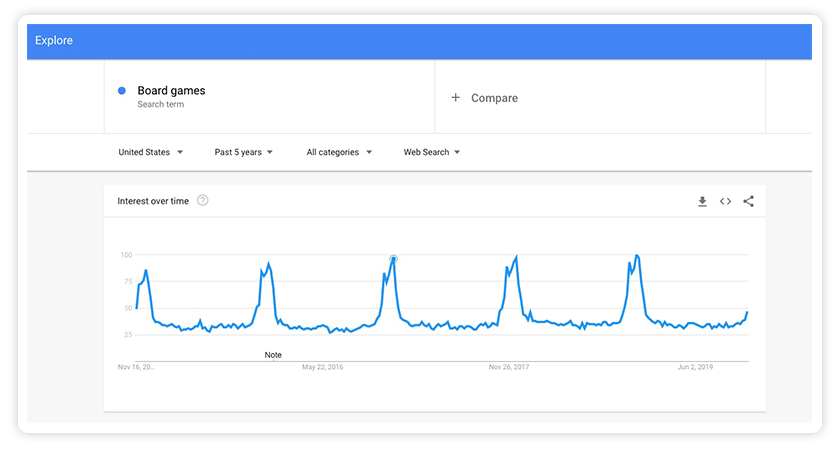
Keywords like these offer more impression opportunities during the holidays versus other times of the year. It makes sense, then, to increase bids for these keywords to get a higher impression share and, in turn, clicks. At the same time, you might discover some product-related keyword phrases don’t show a dramatic increase in search volume or sales during the holiday season. You can redistribute ad spend by bidding less on these keywords during that time.
Even if you use automated bidding, you can still make manual bid adjustments to target more valuable keywords during the holiday shopping season. It’s vitally important, though, that you know when to gain control of your automated bidding strategy. Ultimately, it’s a machine, and your results from the machine will only be as effective as the information given to it.
Most advertisers don’t bother creating campaigns to target holiday-specific keywords every year. So this is a huge missed opportunity to reach a highly targeted audience that is ready to convert on search.
For instance, someone searching for “stocking stuffer ideas for toddlers” is definitely looking for Christmas gifts, and therefore is more likely to purchase the sponsored product suggestions:
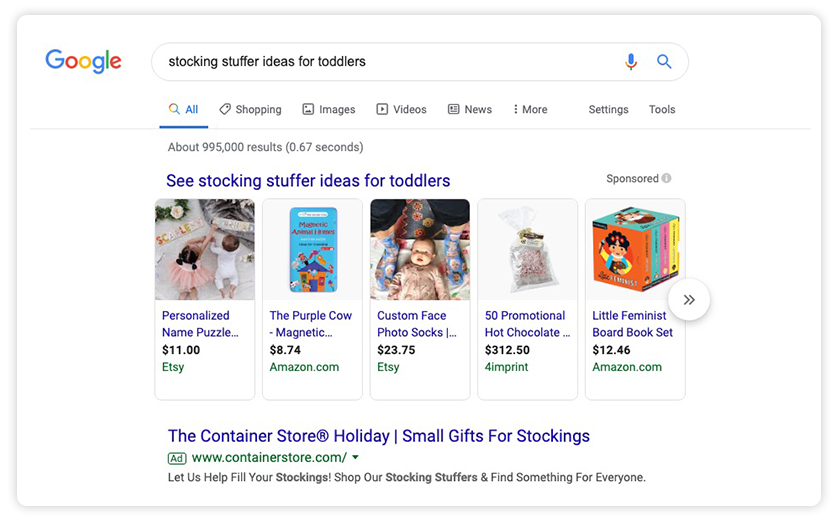
It doesn’t require a significant time investment to create dedicated holiday PPC campaigns. Simply duplicate one of your current campaigns, replace the keyword lists, allocate more budget, and then wait for the increased conversions to roll in.
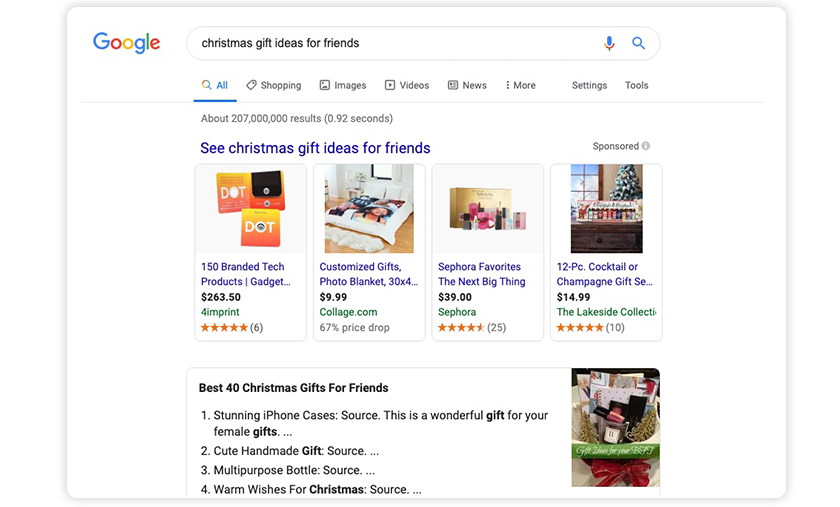
Now let’s look at another long-tail keyword - “christmas gift ideas for friends”. Consumers searching with this type of phrase know that they want to purchase something; they’re just not sure exactly what. Your ads are an opportunity to show them what you have on offer. Even if they don’t purchase the product you’re promoting, they can click through and convert on your website.
Whether you’re running shopping ads or a traditional search ad campaign, it’s important to include relevant information that relates to the very specific audience you’re targeting. For example:
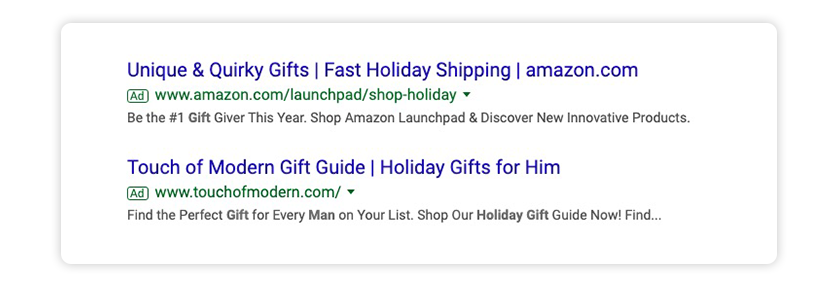
People who look for holiday gift ideas online are often crunched for time. So, one of the above ads includes “Fast Holiday Shipping” in the headline to speak to this need. The second ad’s description says “Find the perfect gift for every man on your list.” This implies their business is a great place to find a gift for husbands, fathers, brothers, etc.
You should definitely base this year’s holiday PPC campaigns on last year’s performance, but don’t let that limit you from trying out new strategies altogether. The winter season is a great time to test out new channels, campaigns, and targeting strategies.
Set aside a certain portion of your PPC budget to try new initiatives. It could be a new targeting strategy or trying out a new feature in Google Ads. If you haven’t already, consider investing in automated bidding strategies. Instead of turning off your manual bidding campaigns, simply create an additional automated one. Then you can test and see which performs better.
Google’s Smart Bidding offers a variety of bidding strategies based on differing business goals. You can also use seasonality adjustments if you expect major changes in your conversion rates based on select events. Smart Bidding automatically considers predictable seasonal factors like Black Friday, Cyber Monday, etc.
Last year Google also introduced Smart Shopping campaigns for eCommerce advertisers. These combine Standard Shopping and display remarketing campaigns, helping advertisers win ad placement in prominent places across networks.
Arguably the biggest opportunity that eCommerce sellers should take advantage of this holiday season is Bing paid search. In November last year, Bing saw the highest retail growth from 5th November pre-Cyber Week. Here were their top categories for click share from 23rd - 27th November:
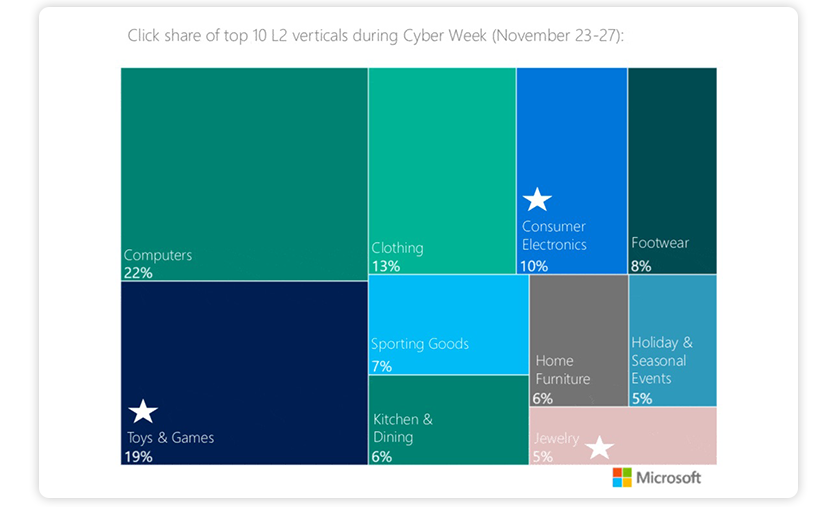
Bing PPC is less crowded than Google, making it easier to outbid your competition. The Bing audience is also willing to spend more on retail products than those on Google. So, consider investing in Bing this holiday season to get more reach and drive more sales.
Feed optimization is something that you should be working on all year round. But right before the holiday shopping season is an excellent time to start cleaning things up to ensure you give your conversion percentages a boost. This includes optimizing such elements as:
Regardless of whether you’ve already optimized all these things before, there’s always changes you can make that might improve click-through rates. Something as simple as changing the main product image can have a huge impact on performance. You can use Supplemental Feeds to test changes you make to different feed variations.
You should also go through and make sure all your fields are populated as missing data can cause Google to disapprove of products. Then you need to be certain that you’re not sending paid traffic to any “out of stock” product pages. You don’t want this happening during peak holiday shopping weeks.
Targeting audiences during the holiday season is a bit different than the rest of the year because people are primarily not shopping for themselves. In order to better target gift-givers, advertisers need to make changes to their marketing content and ads.
People often know what they want to buy for themselves, but are unsure about what others will like. Your marketing content should make efforts to convince readers that your products are something their loved ones would enjoy. Including social proof from other happy customers is a great way to do this. Solicit user-generated content (UGC) from your previous customers to highlight on your landing pages.

Creating top of the funnel content like gift guides can also help shoppers make decisions about the types of products they want to buy for their friends and family. This is a great way to supplement your paid search efforts with content for organic search engine results.
For your advertising copy, consider the target demographic in this case. People often do their holiday shopping online because they’re too busy to hit the physical stores or they’re looking for deals. Your ad copy should reflect this need. If you want your ads to perform well, promotions are simply a must. Use promotion extensions for search ads to highlight a sale, free shipping, free gift, etc.
Lastly, if your business offers gift cards and free shipping, make sure these options are clear on all your sales and product pages. Particularly in December, when shoppers are feeling rushed, they’re more likely to turn to gift cards rather than buying a product. You can even create special promotions highlighting your gift card offerings (e.g. buy a gift card valued $100 or more and get an additional $10 gift card free).
The type of ads you use can also have a huge impact on performance when targeting gift-givers. Showcase Shopping ads, for example, are a great option to help shoppers understand what kind of products are available related to a broad keyword search. Showcase Shopping ads allow you to group a selection of related products together to introduce audiences to your brand:
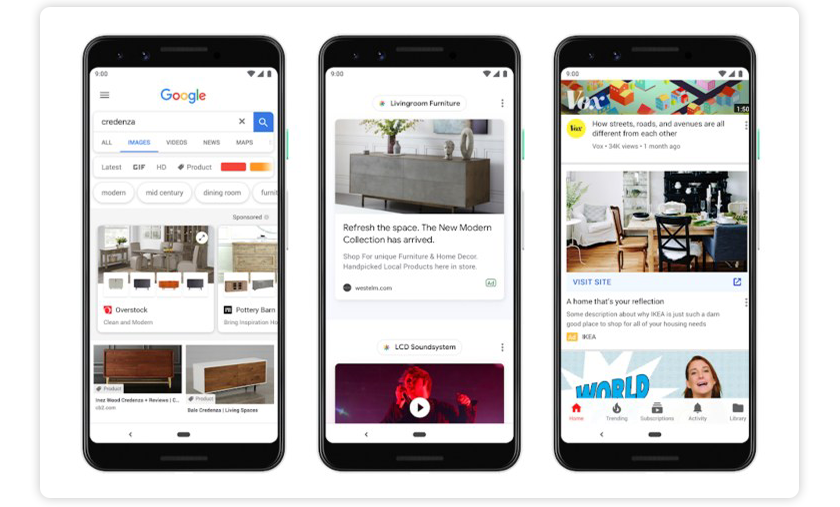
This is a great option for targeting first-time shoppers who want to learn more about a selection of products they’re interested in purchasing as a gift for someone else. This year, advertisers can also include video content as part of their Showcase Shopping ads, offering a new opportunity to stand out from competitors.
Audience targeting is another important area in which to make changes in order to better reach gift-givers with your advertising message. You may want to refocus efforts with your current audiences and/or add new audiences to improve your targeting.
Add new audiences
If you’ve created marketing content for your organic SEO efforts, you can build new audiences based on those who’ve interacted with it. For example, visitors who viewed a wishlist from your eCommerce store or people who viewed a gift guide.
Prepare remarketing lists
Remarketing lists are a great way to reach holiday shoppers later in the season. They may have visited your website in early November, but you can convince them to finally convert right before Christmas with a special offer.
Your remarketing lists can include repeat past purchasers, but what about the people who bought from you last November then never made a purchase again? These are much more likely to be gift-givers. Add them to your remarketing lists to convince them to shop with you again this holiday season.
Consider cross-channel marketing
Remarketing lists are also a great opportunity to drive conversions with cross-channel marketing. To explore the opportunities here, check out your Audience report in Google Analytics. This will show you how your audiences move through the funnel across marketing channels.
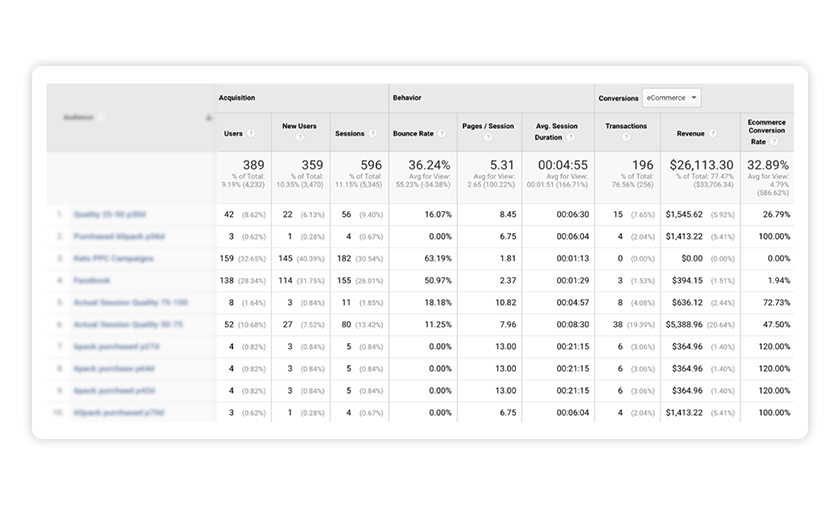
Do some experimentation here. You might find that re-targeting shoppers who clicked on your search ad with a relevant Facebook ad drives more conversions. Cross-channel marketing gives advertisers the opportunity to really drive their message home, convincing shoppers to buy.
As mentioned above, most people prefer to do holiday shopping online because they’re busy, it’s convenient, and they’re looking for deals. Shoppers have many options to make purchase decisions online. If you want them to choose your products, you need to make every effort to minimize barriers to purchase.
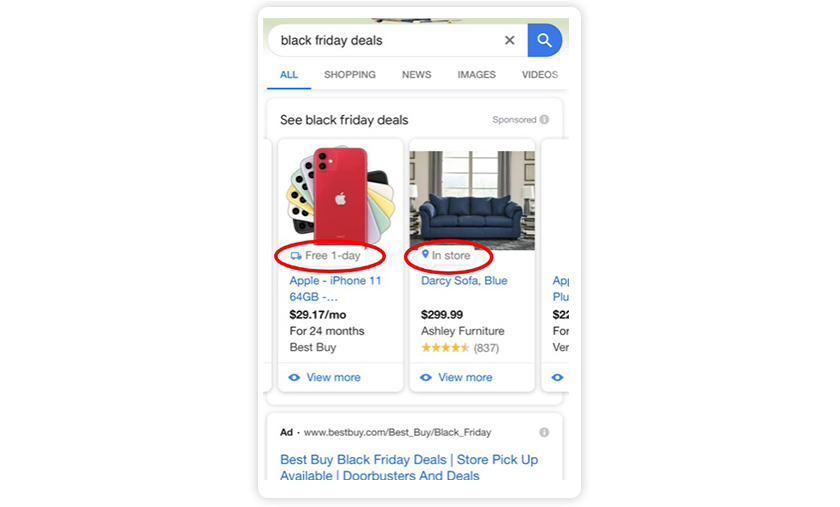
Offering free shipping is one of the best places to start. 9 out of 10 consumers say free shipping is their biggest incentive to shop online. Another important factor is the option for in-store pickup. Especially in a week or so before Christmas, many people are shopping online with the hopes of picking up a product in-store. These are both benefits that you can highlight on your product pages as well as in your shopping ads with merchant promotions:
There are many other changes that can make the online shopping experience easier and help reassure customers they’re making a good choice. You can guarantee shipping delivery before the holidays, for example. Or highlight your return policy, so they know they can get their money back if someone doesn’t like their gift. Streamlining your checkout process is also essential.
Businesses today have made a lot of efforts to improve mobile user experience, yet mobile cart abandonment is still 86% on average - much higher than on desktop. Lowering cart abandonment on mobile is particularly important during the holiday season, as last year the mobile share of digital commerce reached 40% on Thanksgiving.
In addition to improving mobile user experience on-site and during checkout, I would definitely suggest setting up a series of cart abandonment emails and retargeting ads to help capture these sales.
Online shopping during the holiday season will only continue to grow. Incentives like sales, same-day shipping and in-store pick up have made online the preferred shopping method for many before the holidays. So optimizing your holiday PPC campaigns to capture traffic isn’t just worthwhile, it’s mandatory for eCommerce success today. Prioritizing key months in your PPC strategy will ensure you stay ahead of the competition and maximize the value of holiday shopping to drive more sales every year.
Most Americans are already sold on the American dream—however, with the 2008 housing crash etched in most consumers' memories, marketing a global real estate company is not without challenges.
As VP of Marketing & Media Strategies at RE/MAX, James Schwartz oversees digital marketing, media, and creative services for over 6,800 offices and 100,000+ agents. He is tasked with attracting and retaining realtors by providing innovative marketing tools that work - to close deals and help clients buy and sell properties in more than 100 countries.
In this episode, James shares the primary challenges of operating within a crowded and competitive marketplace and how RE/MAX utilizes digital strategies to make it easy for realtors to get in front of prospective buyers and sellers.
The holidays are upon us! As you’re making your advertising wish list this season, don’t forget to add search and social. Think about it—your customers are already compiling wish lists of their own and now is the time to reach them wherever and whenever they are filling their carts.
These days, it seems there are more ads competing for consumers’ attention than snowflakes on the ground. Therefore, it’s critical that your message reaches the preferred audiences at the right moments. Search and social campaigns are nimble and well-suited to adapt to holiday demand!
Target, segment, and engage your audiences with the right search and social techniques, and make for a very jolly holiday season. If you’re looking for a last-minute holiday or year-end push, download our holiday infographic for strategies to boost performance quickly.
A three-pronged combination of changing consumer buying habits, the vast proliferation of data, and a constant need to stay at the forefront of digital disruption has prompted organizations to place greater importance than ever before on using statistical insights to drive strategic decision making. By embedding data analytics into their core strategy, business executives can begin to streamline their internal operational processes and then identify and react quickly to unfolding market transformations. The effectiveness of employing such a data-first approach has been proven time and again in various surveys carried out by leading think-tanks. According to one such study conducted by the McKinsey Global Institute, a data-driven organization is 23 times more likely to turn prospects into customers, six times more likely to retain them, and 19 times more likely to generate a profit as a result. Quite compelling numbers.
In order to keep pace with this newfound reliance on statistical analysis, there has naturally been a rise in marketing technology designed to extract lucrative insights found within the troves of data. Chiefmartec illustrated this in their latest supergraphic that details all the solutions at play in the marketing technology landscape today. Back in 2011, there were only 150 companies. As of this year, there are over 7,000.
This Martech boom has ultimately streamlined the marketing industry in multiple ways, empowering advertisers to become more efficient and scale their efforts seamlessly. It now rings true that tapping into the potential of artificial intelligence and machine learning to reach desired audiences more effectively is no longer a pipe dream. Many companies have already realized this, and so as technology progresses, it has become clear that marketing without some form of automation is a mistake that no business can afford; not if they want to outperform their competitors that is.
The question arising from this rapid evolution, then, is just how can it be navigated successfully. How do marketing managers decipher which tools will drive the most value, improve efficiency, strengthen risk management, and lift profits?
Our latest eBook looks to provide some of the answers.
Inside, we open up with some commentary on why investment in digital ad spending has skyrocketed before moving on to analyze the ways digital teams can exploit technology to gain more frontline monetization opportunities. We then close with what we see as a paradigm shift in the industry and discuss how the fundamental role of a performance marketing agency must change in 2020 and beyond.
To help break it down, we’ve put together this handy infographic that offers a quick snapshot of the main themes.
![The New Performance Marketing Agency Model [An Infographic]](https://centro.net/wp-content/uploads/2019/11/Infographic-New-Performance-Marketing-Agencel-Model.png)
It’s clear that statistical analytics, with its multiple use cases and wide-ranging applications, is breaking traditional business models and ecosystems. There is now simply too much complexity in the world of digital marketing to ignore the benefits of leveraging big data. The industry demands sophistication, machine learning, and automation to get everything you need quickly and to respond to what is available for a targeting perspective.
~
If you’d like to talk to a best-in-class performance marketing agency about certain challenges you’re facing and how to develop strategies that cater to your audience, get in touch with our experts at QuanticMind Digital.

If you’ve been gingerly dipping your toes into OTT (Over The Top) advertising—2020 is your chance to jump in and make a big splash!
The new year will not only ring in a new decade, it will also hold the Tokyo Summer Olympics and U.S. presidential elections—just think of all the eyes tuning in to these momentous events!
The way the we consume entertainment has changed since the days of traditional TV, but the average time spent watching digital video is on the incline. Audiences are out there—and they are on multiple devices.
There are 200 million active CTV (Connected TV) viewers and nearly 98 million households that own a CTV device. OTT and internet-enabled devices like Roku, Firestick, and Xbox are great for reaching audiences on multiple devices. Based on those numbers alone, it’s clear that Advanced TV will be a big winner in 2020.
The Olympics have embraced changing TV viewing habits with their slogan, “Discover Tomorrow,” and a Sony/Panasonic partnership to broadcast games in 8K resolution in 2020. With 26 million viewers (that’s one-fourth of all TV viewers), NBC is on pace for $1.2 billion in ad spending during the games and the weeks leading up to it. General Manager of the IOC’s Global Olympic Channel, Mark Parkman, stated “as the Olympic Channel continues to grow and evolve, we are dedicated to making our content available wherever our audiences are watching, in an effort to create more personalized experiences for our viewers.”
On November 12th, 2019, Disney launched its much-anticipated platform Disney+. Disney is new to the streaming scene but is set to compete with the big players like Netflix and Hulu in 2020. Disney+ achieved 3.2M app downloads within the first 24 hours post-launch.
There are no shortages of audiences to engage with via OTT. How do you make sure you’re not wasting your ads on the wrong ones? Good news—OTT is addressable, meaning it can serve different ads to different people consuming the same content.
You can use sophisticated targeting capabilities to put the right messages in front of the right people, allowing for more personal connections and meaningful experiences for consumers.
Political campaigns have also caught on to the trend, with OTT ads increasing 200% between 2016 and 2018. Digital video went from 1% of advertising budget to 30% of the budget in just two years. The 2020 election will also see a bigger piece of the OTT pie with 2018 budgets coming in at $740 million and 2020 budgets projected at $1.6 billion. That’s the largest percentage of overall budgets devoted to digital video to date!
2020 may seem like it’s still in the distant future, but these big events will be here before we know it! Don’t wait when it comes to OTT—2020 is your year to win!
Learn more about Connected TV Advertising with Centro.
In this day and age, when organizational decision-making is becoming increasingly influenced by data and analytics, there’s simply no excuse for being in the dark with regard to who your target audience is and what exactly they want.
Over the last decade, there has been an extraordinary growth of technology that empowers marketers to collect and then leverage troves of data across each of the varying stages of their buying cycle. The times of mass broadcasting and throwing a blanket over consumers have long since disappeared, with sophisticated tools paving the way for marketers to continue to reach a wide audience, yet now with pinpoint precision. Essentially, marketing leaders no longer have to guess the demographic make-up of their customers - instead, to build relevant strategies, they just need to follow the metaphorical bread crumbs found amongst the data at their disposal.
Of course, being data-driven is much trickier than it would first appear. Many companies naturally talk the talk about having data at the forefront of their decisions, partly because they know it makes sense and partly because it’s in fashion and embodies everything about what a modern marketer should be all about.
In reality, though, the majority of marketing departments fall short in this area because it’s hard to find the right people who are specialized in the fields of predictive analytics and amplification. It further rings true that running a marketing operation where data is coherent across the various internal departments is also challenging and eliminating the human touch can be daunting. Ultimately, only a small percentage of businesses have the conviction and organizational nous to really walk the walk when it comes to relying on statistical insights to drive the composition of their campaigns.
The question arising then, is how does one become truly data-driven?
Let’s begin with the actual gathering of data and the most direct place for that to come from. The very definition of data-driven marketing refers to the construction of strategies built on information prised from the analysis of big data that is compiled from consumer interactions and engagements online.
While there are a great many channels and opportunities in which marketers can reach consumers in the digital space and collate massive amounts of data as a byproduct, search engine marketing is undoubtedly the most effective source. Just consider that every search query that leads to a click on a paid ad and subsequent conversion has countless elements throughout that entire journey that can be tracked and reported on (assuming you have the right tools in place behind the scenes). Each piece of data garnered can be looked upon as a mini treasure chest of information that yields enormous potential to optimize your output, not just in terms of SEM, but across your whole marketing portfolio. Learnings and correlations that are surfaced can easily be transferred into other outlets for testing and experimentation. If certain messaging or themes drive clicks and conversions through paid search, why wouldn’t the same elements resonate with your consumers elsewhere?
That’s a hypothetical question.
The answer is that they will. Sitting in front of your data goldmine, you can start to dissect and extract actionable information about your consumers - their preferences, searching habits, pain points, backgrounds, and other intelligence. This wealth of knowledge can then be utilized to predict future behaviors and deliver omnichannel personalization at scale, which will ensure you cut through all the noise and clutter and stand out from your competition. The knock-on effect of delivering tailored marketing content specific to a consumer’s wants and needs is increased engagement and more actions that help you reach your business goals.
Here are a few areas in which paid search insights could be integrated seamlessly:
Retargeting is a critical component of any successful marketing operation. Since the practice itself is based upon the premise of reaching out to people who have previously purchased from you or exhibited interest in specific products or services, retargeting efforts will clearly be more powerful when you have access to a stockpile of data detailing precisely who is looking for what. When executed correctly, retargeting can elevate the consumer experience and meaningfully improve the quality of visitors to your website.
Social media marketing is an important outlet for all digital marketers, offering a conversational space for brands to increase awareness, drive heightened website traffic, and increase sales. It would seem fairly obvious that insights garnered from paid search concerning content and targeting tactics could easily be rotated into social for testing. You’d be surprised how many marketers are not doing this, though. If some creative ad copy is generating high click-through rates and conversions through SEM, why wouldn’t you replicate that social?
As you collect all sorts of demographic and behavioral data concerning your prospects, take a second to think about how powerful that can be when employed on an individual basis. Armed with relevant information, you can distribute emails with extremely personalized messaging, speaking to the prospect directly and creating a one-to-one connection. You can further leverage the technology available today to set up nurturing campaigns that automatically respond to consumers’ actions and help guide them through the sales funnel.
The comparisons here should be obvious. In a recent study conducted by Jumpshot, it was found that 54% of consumers now go directly to Amazon when looking for a specific product. In short, it’s vital that you’re just as visible on Amazon as you are on Google. While the two are not the same and require different strategies, learnings can be applied from your paid search efforts on Google. Again, consider the keywords that are successful; consider the messaging that is generating clicks. Feed this back into your Amazon ads and product pages to turn shoppers into buyers.
Claiming top spot in the organic segment of search engine results pages has never been more important for businesses. Gleaning findings from SEM data is the best way for SEO professionals to go about doing that. Armed with such valuable insights, it’s possible to filter specific themes and then estimate search volumes for select keywords or phrases. Having access to information that determines what content is appealing to specific demographics is incredibly important for those working with SEO.
In the end, consumers want to see content that’s useful to them. In an era when buying cycles are becoming increasingly comprised of micro-moments, it’s paramount that your business is there, with the right messaging, every step of the way, across multiple channels.
The way to do this is to run a well-oiled data-insight-execution machine. Continuously switching modes from data collection to driving wide, large-scale implementations will unquestionably be a challenge and require tight-knit co-ordination between your various internal marketing factions. The results, though, are undeniable. Consistent, coherent, and accurate messaging will be rewarded with enhanced engagement, brand trust, and brand perception. Over time, this will turn into increased purchases, advocacy, and importantly, loyalty.
The future of data-driven marketing remains bright. As predictive tools and machine learning-powered marketing continues to proliferate, a data-driven approach will be an essential component of marketing organizations.