
Technology
Basis Platform
Advertising Operating System
Communication Portal
Intelligent Collaboration
All Channel Activation
Activate Media on Every Channel

Consulting
Resources
When you are a specialty retailer and distributor of professional beauty supplies with more than 5,000 stores worldwide, a small bump in store sales can represent a large chunk of revenue. When the company decided to launch a national digital campaign to drive off-line sales and in-store traffic, it turned to Basis Technologies.
Our solution had to meet three key challenges:
The Basis Technologies media services team took a strategic approach while leveraging our owned & operated tech, Basis to generate better outcomes. The team utilized several cross-platform partnerships to drive awareness, cultivate consideration, and close the loop from ad exposure to visit and purchase.
Campaign parameters included target audiences of existing plus “look-alike” customers as well as KPIs of positive Return-on-investment and an increased click-through rate.
We also created a custom dashboard to monitor, optimize, and show success in an easy-to-digest format.
The client now has the ability to place retargeting and sales pixels, which has further increased real-time sales optimization opportunities to leverage its online audience, drive customer purchase intent, and impact in-store revenue.
~
NRG Energy is a Fortune 500 company, operating in the United States and Canada. NRG is committed to delivering innovative solutions while advocating for competitive energy markets, customer choice, and working towards a sustainable energy future.
In 2020, like many leading brands, NRG was reevaluating their partner strategy with their agency of record, and the pandemic only moved the process forward. NRG selected Basis Technologies to lead their digital media efforts starting in early 2020. Basis Technologies provided the right combination of holistic digital media expertise, technology, and business solution to fit their growing needs.
Basis Technologies' media services team developed a full-funnel approach, utilizing site direct and programmatic buying methods for video, native display, search, and social channels to find key decision makers online to build awareness and drive high-quality leads. How Basis Technologies supported NRG Energy:
Basis Technologies' subject matter experts plan, buy, analyze and activate campaigns across all digital channels & devices.
Leverage owned & operated media planning and buying software Basis by Basis Technologies for better media performance.
Utilize $2MM third-party research tools to access audience, competitive, and industry insights trends to better target audiences.
Provide accurate real-time data reporting and analytics for a holistic view of all campaigns.
~
Digital streaming dominance only continues to expand as consumers stream audio content at unprecedented rates. This new and lasting behavior is fueled by convenience, on-demand content, and the rise of connected devices. How can marketers take advantage of this shift, and what does the future hold for audio advertising?
In this Centro webinar, leaders from Pandora and SXM Media detail audio trends pre- and post-COVID, the rise of podcasting, and programmatic audio capabilities.
It’s the question that will drive the next 15-20 years of advertising: “how do we reach Gen Z?”
Generation Z—or those born between 1997 and 2012—has arrived on the scene, and marketers would be wise to start paying attention to this new generation. More racially and ethnically diverse than any previous generation, Gen Z is entering adulthood as digital natives, never truly knowing a world before the Internet, smartphones, or social media.
Projected to become America’s largest generation by 2034 and with an estimated spending power of over $140 billion per year (and growing), it’s critical that advertisers start developing the strategies they need to reach and appeal to this remarkable generation.
Most Gen Z consumers say they want brands to share their values, follow ethical standards, and do good for the world. More than two-thirds of Zoomers “expect brands to contribute to society,” and 61% say they would pay more for products that are produced in an ethical and sustainable way. This can’t just be window dressing-type stuff, either—it takes more than updating the banner image on your social media profile to, say, a Pride-themed logo every June to demonstrate your values. Gen Z is too digitally-savvy for anything that’s purely superficial, and they will call you out on our own feeds if they smell something inauthentic (or worse, if they can prove ideological inconsistencies or contradictions).
What’s more, demonstrating a commitment to these values will help your brand stand out from the crowd: a recent study found that only 39% of brands are trusted in North America and 71% of consumers have “little faith” that brands will deliver on their promises. At the same time, 64% of all consumers say they prefer buying from companies with a reputation for purpose as well as profit, and more than half are willing to pay more for a brand that takes a stand. Don’t just espouse values in ads and tweets—instead, demonstrate your commitment to them by taking action. Do that, and reap the benefits—especially with Gen Z.
Generally speaking, Gen Z isn’t crazy about sharing their personal information. Less than one-third of teens say they are comfortable disclosing anything other than contact information and purchase history. As the first generation of true digital natives, there is no naivety among Gen Z when it comes to data collection: they know you’re collecting it, and they know that you’re using it.
To the extent that they can, Gen Z users are taking control of their data and personal information, with a majority (58%) of individuals age 18-24 saying they have adjusted their social media privacy settings. Meanwhile, 61% said they would feel better about sharing personal information with brands if they could trust it was being protected and stored securely.
What can companies do to address these concerns? As it turns out, the real key to data privacy and Gen Z may just be as simple as transparency.
Nearly two-thirds (64%) of individuals ages 13-24 globally say it’s fine for companies to collect data about them as long as they are being transparent about what they’re doing. However, a remarkable 91% of Gen Z believes it’s a human right to know what information companies are holding about them. The last thing a brand should do is play games (or worse, be cavalier or careless) with something that virtually an entire generation of young adults believe to be a human right. The lesson: be upfront and transparent about your company’s data usage and respectful of the end user at every step of the data process.
When you think “Gen Z” and “Social Media,” your next thought is probably one word: TikTok.
Yes, the China-based app that survived near-banishment in the U.S. is indeed growing larger by the day, driven in no small part by its popularity among Gen Z. By the end of 2021, TikTok will pass Instagram in terms of U.S. Generation Z users, and it is expected to catch Snapchat as the favorite app of Zoomers by 2025.
Why does the micro-video app resonate so strongly with Gen Z? Perhaps due to its ability to create and sustain influencers, which is very much in line with this generation’s approach to the platform. Research shows that Gen Z tends to use social media to learn from influencers, not to showcase their own high-class lifestyles (à la Millennials), and 70% of Zoomers follow at least one influencer on platforms like YouTube, Instagram, or TikTok.
The influencer effect has had a direct impact on spending. Nearly 40% of adult Zoomers (ages 18 to 23) say their purchasing decisions are most influenced by social media, while almost half (44%) the members of Generation Z have made a purchase decision based on a recommendation from a social influencer, compared to 26% of the general population. Clearly, incorporating influencer marketing into your overall social media advertising efforts could be a good way of reaching targeted Gen Z audiences.
Where does Gen Z turn to get its entertainment, and how can advertisers connect with them?
Among Gen Z, “playing video games” was their favorite entertainment activity (26%), followed by “listening to music” (14%), “browsing the internet” (12%), and “engaging on social platforms” (11%). Notably, only 10% of Generation Z said that “watching TV or movies at home”—the top choice of Boomers, Gen X and Millennials—was their favorite form of entertainment.
What brings together all of these activities? Yep: they’re all forms of digital media. And it’s not that they’re cord cutters, either—after all, for Gen Z, there were never even any cords to cut.
Across the spectrum of entertainment services—be it streaming video, music, or gaming—users said they were far more likely to cancel because of a price increase than an increase in the amount of advertising on the service. Among respondents to a recent survey, nearly half of all consumers said that low price was the most important factor in deciding to subscribe to a new paid streaming video service. As you might expect, this sensitivity to cost has prompted people to seek out more cheap/free ad-supported options, with 55% of survey respondents saying they use at least one free, ad-supported video service.
In this type of environment, ads (and advertisers/marketers) are a crucial part of keeping content/digital media accessible to streaming audiences—particularly for Gen Z. This is also likely to lead to more CTV and programmatic advertising opportunities for marketers, not to mention a huge opportunity in the world of video games/gaming.
Video Games/Gaming
Speaking of video games, according to a recent survey, 87% of Generation Z said they play video games at least once a week. It’s also more than just a form of entertainment—most Generation Z respondents said that during the pandemic, video games helped them stay connected to other people and get through difficult times.
Researchers estimate that U.S. mobile game ad revenues will increase 17% in 2021 to $4.79 billion, up from just $2.29 billion in 2018. U.S. Esports ad revenue is projected to increase by 12% to $215.9 million, up nearly 50% from 2018, and U.S. gaming video content ad revenues are estimated to grow an astonishing 32% this year to $2.27 billion, more than double where they were in 2018.
A recent report found that gamers are becoming more accepting of in-game ads, with sentiment toward banner ads and in-game video ads improving over the past year. Rewarded video ads—or ads that award players things like in-game currency or other items for watching—are even more popular, with 11% more U.S. gamers saying they “liked” these rewarded video ads compared with those who said they “can’t stand them.” And with Facebook announcing that it will soon begin running ads in VR games on its Oculus Quest headsets, the options for reaching this growing and coveted audience are only increasing.
Streaming Audio
The other dominant platform for Gen Z? Streaming music—one study showed that more than half of adults ages 18 to 29 listen to streaming music every day. Gen Z listens to an average of 18+ hours of audio a week, with much of that coming from streaming audio and podcasts. In the U.S., 27.8 million Zoomers listen to at least one podcast per month, with that number expected to surpass 40 million by 2024, and nearly 1/4 of all podcast consumers are now from Gen Z.
Comparable to how video games represent more to gamers than just entertainment, streaming audio means more to young adults than just background noise. A study found that 73% of Gen Z and Millennial Americans use audio to cope with stress and anxiety, and 54% of Zoomers say they’ve started listening to more podcasts to stay informed and entertained.
What does the world of audio advertising look like these days? Overall, U.S. digital audio ad spend is forecast to grow by 16% to hit $5.59 billion in 2021 and will grow to nearly $8 billion by 2025. Over $1 billion of those digital audio ad dollars will be via programmatic, accounting for nearly 20% of all digital radio ad spending, while programmatic digital audio ad spend is projected to hit $1.57 billion by 2023. As the number of Gen Z audio listeners continues to grow, so too (unsurprisingly) does the audio advertising market.
Gen Z is on multiple connected platforms and devices, and with their growing buying power it’s critical to reach them where they are. Advertisers will need to stay nimble with this ever-increasing array of entertainment options—not to mention the generation’s penchant for hopping from one streaming platform to another, based on wherever they can find the latest content or the best deal. Embracing the power of both programmatic advertising and advertising automation can help marketers reach their audiences wherever they might be, whenever they might be there.
Whether it’s display, streaming video, audio, gaming, CTV or elsewhere, leaning on programmatic advertising and using automation to help streamline and optimize advertising efforts are some of the best tools advertisers have to reach Gen Z consumers in the years ahead.
---
Even with Google’s recent decision to delay the retirement of third party cookies in Chrome until 2023, the loss of numerous longstanding ad identifiers still looms large. While brands and advertisers may have more breathing room to figure out alternative solutions, the quest for finding those alternatives demands dedicated and ongoing attention in 2021.
Angelina Eng, VP of Addressability and Measurement at the IAB, shares her thoughts on the technical maneuvers that advertisers must take on to navigate a rapidly approaching future with far fewer reliable identifiers.
It was back in 2012 that native advertising first burst on to the scene as the new shiny tool available to marketers. Ever since then, adoption of the medium has grown at a steady pace to a point where it is now the dominant advertising format, accounting for 62% of all display spend in 2021 according to eMarketer. This growth is a reflection upon the changing mindset of the advertising world. As consumers today become more demanding with brands and progressively skeptical of modern advertising strategies, marketing organizations are rising to meet these challenges with increasingly intrepid, increasingly bolder content that meaningfully integrates into the passion points of their target audience and meets them where they are in their buying journey.
It’s working, too. Native advertising is clearly striking a chord with consumers. In a study carried out by ShareThrough in collaboration with IPG Media Lab, it was found that native ads registered an 18% higher lift in purchase intent and a 9% lift for brand affinity responses as compared to banner ads. It’s an ad medium that rips up the rulebook, breaking away from what established go-to-market campaigns look and feel like. Some native ads are born from large-scale bespoke productions crafted by specialized content teams using complex designs and UX principles—the type championed by the likes of The New York Times, The Wall Street Journal, The Atlantic, The Guardian, The Financial Times, and The Washington Post. Others are more subtle, less flamboyant, yet just as impactful.
So, what makes for successful native advertising? What factors distinguish powerful sponsored content from that which becomes instantly forgettable? The most effective native ads always abide by the medium’s prime differentiator: non-disruption—they blend naturally into the form and function of the editorial habitat in which they live. Over and above that, the truly great native advertising campaigns offer hyper-relevant content for their audiences in a manner that exudes authenticity, providing education and entertainment all at once. They are, in essence, inherently valuable to the reader.
In this article, we take a deep dive into five of our favorite examples from the last year. Covering a wide gamut of markets with campaign focus ranging from text and illustrations to video and social media, these native ads all have one thing in common: astonishing creativity and innovative approaches.
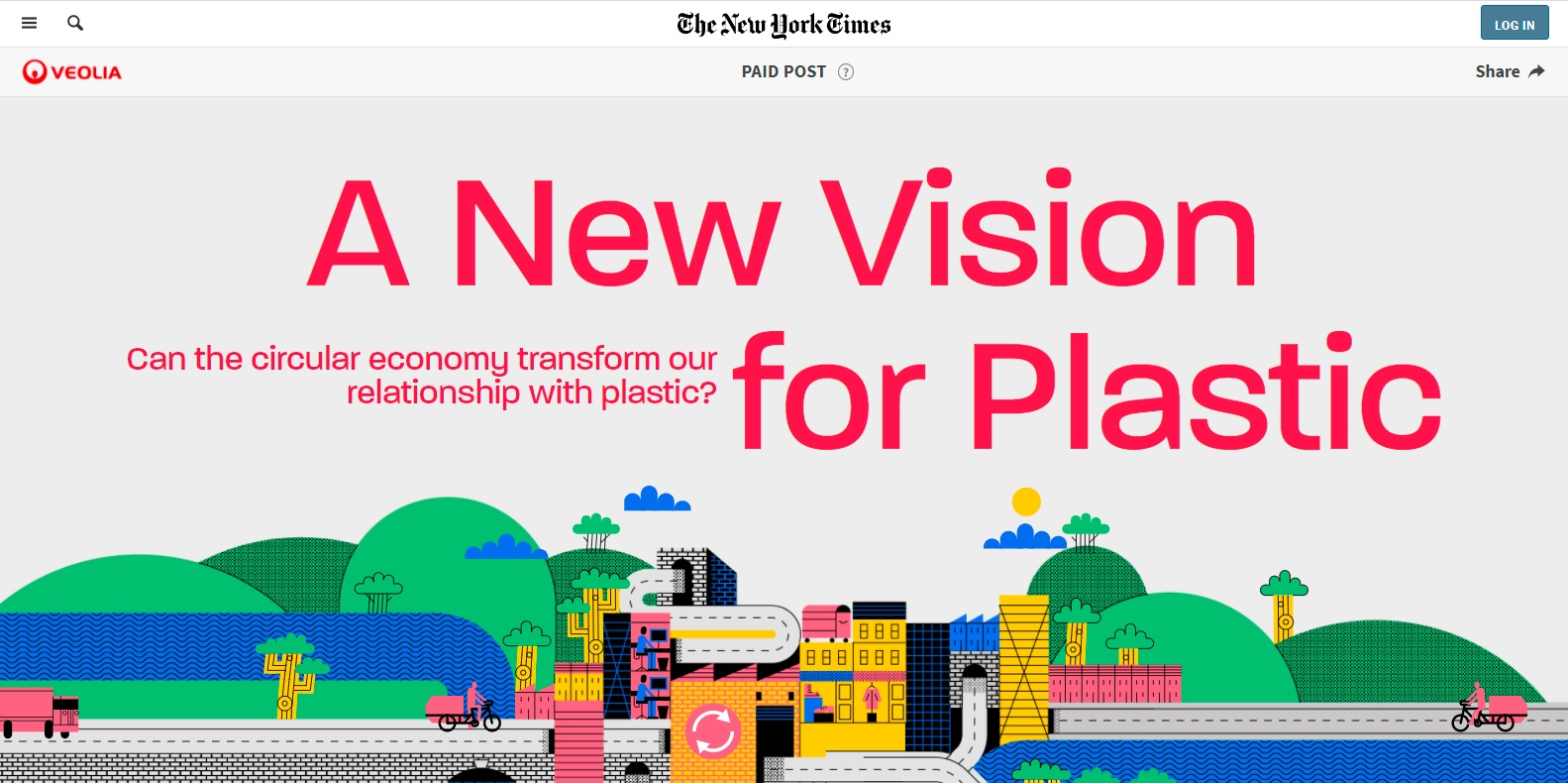
About the Ad
Can the circular economy transform our relationship with plastic? This is the question posed by environmental solutions leader Veolia in their extravagant native ad that aims to shine a light on the economics behind the global plastic ecosystem. Developed in partnership with The New York Times’ in-house content development agency T Brand Studio, the initiative was launched back on June 5th, 2020, to coincide with World Environment Day, and has since been widely disseminated across the web and included in The NYTs’ Climate Solutions Special Report.
Why it Works
Through this campaign, Veolia demonstrates how plastic can be transformed from a damaging source of pollution into a precious resource when we equip ourselves with the infrastructure to recycle it. Built around dynamic eye-popping graphics that bring the issues associated with the subject to life, this ad cuts through the clutter concerning environmental welfare to deliver compelling reasons why we should all get involved in the process and change our relationship with plastic. The campaign was supplemented by a series of posts on The NYTs’ social channels that creatively framed Veolia as a forward-looking trailblazer in the manufacturing of green products.

About the Ad
Luxury jewelry brand Piaget teamed up with The Financial Times to illuminate the stories of four exceptional women who are combatting antiquated attitudes in order to smash through glass ceilings and rise to the top of their respective fields. The objectives of the campaign were three-fold: to position Piaget as a leader in actively disseminating the importance of female empowerment; to raise awareness of the brand among a young female audience; and to contribute to the ongoing discourse around the evolving perceptions of femininity. The four women to feature include visual artist Chen Man, actress Constance Wu, and co-founders of RAD Carineh Martin and Arianne Phillips, each of whom share a passion for creativity and a deep empathy with the world beyond their own personal borders.
Why it Works
Anchored on a dedicated destination site on ft.com, this highly visual multimedia native ad uses a combination of in-depth written content and three medium-length videos to portray its narrative. The campaign is ultimately so compelling because the stories told by these pioneering figures are incredibly inspirational. A diverse melting pot of backgrounds, professions, and visions converge to work toward the same fundamental goal of inspiring other women and girls around the world. Dynamic graphic design and thought-provoking content—the two hallmarks of quality native advertising—merge seamlessly here to allow Piaget’s message of empowerment to reverberate with readers in a wonderfully authentic, impactful manner.
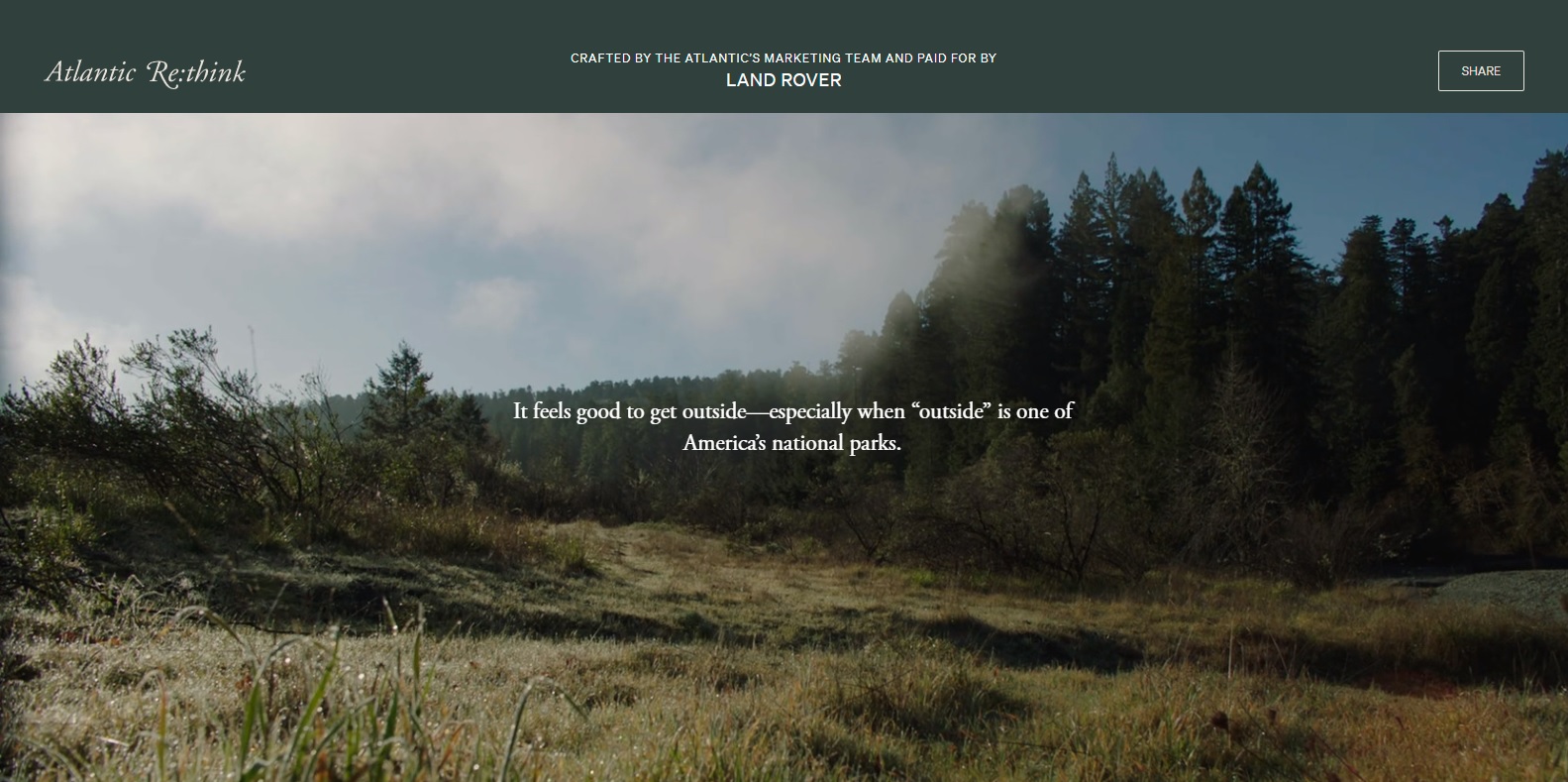
About the Ad
Over the last year, stepping out from the home and venturing into the wilderness has taken on more profound meaning than ever before. It has never felt so great to be immersed in the beauty of nature. To underscore this truth, Land Rover joined forces with Atlantic Re:think—the creative marketing studio within The Atlantic—to craft a campaign fronted by John Mayer, in which the renowned musician takes an almost spiritual journey into the Redwoods of Northern California behind the wheel of the new 2020 Land Rover Defender. Throughout his adventure, Mayer goes hiking with a local guide, practices some river fly fishing, enjoys a spot of off-roading, and pauses for the occasional moment of self-reflection. It’s a story about the power and necessity of escaping daily routines to be outdoors.
Why it Works
Shot in March 2020, the six-minute film was designed to capture the experience of getting away into nature while simultaneously framing Land Rover as the ideal vehicle and companion with which to do so. It does that perfectly. Atlantic Re:think pushes the boundaries of native advertising in this campaign by tapping into top talent, big ideas, and abstract visual concepts. The ad is so much more than the film itself, though. There are stunning accompanying photographs. There is insightful written content. And there is entertaining behind-the-scenes footage. The piece also offers some related articles on why we need the great outdoors, including an extraordinary piece lifted from the 1862 issue of The Atlantic, and then concludes by encouraging readers to get outside themselves with links to the locations of National and State Parks across the United States. The final words are “Close your computer. Turn off your phone. Get outside.” Never has that advice been more salient.
About the Ad
According to German national rail provider Deutsche Bahn, 72% of Germans fly abroad for their holidays every year. In an effort to inspire the German population to travel within the country instead, and enjoy the benefits of cheap train travel, Deutsche Bahn got together with their creative partners at Ogilvy to build a campaign illuminating the beauty of domestic destinations closer to home. To do that, the team employed an algorithm to identify locations in Germany that resembled iconic international landmarks that people were looking at online when researching summer travel plans. The brand then ran automated programmatic native ads, targeting travel enthusiasts and local influencers, juxtaposing the real-time costs of flying to select places—for example Vancouver, Canada or Santos, Brazil—against the cheap 19-euro fare to visit a lookalike spot in Germany.
Why it Works
By colliding the two worlds of creativity and programmatic, this ad was able to scale quickly and reach highly targeted audiences with unrivaled precision. The outcomes speak for themselves. Over the course of two weeks, the campaign generated close to 10,000 unique personalized assets that resulted in the sale of two million special price tickets in two-thirds of the time it traditionally takes. Deutsche Bahn increased revenue by 24% and saw an 850% lift in click-through rate year-over-year, helping them to achieve the best ROI of any summer campaign in its history. It was, unquestionably, an unqualified success. In a talk about data-driven creativity in Cannes, Sheryl Sandberg—the Chief Operating Officer at Facebook—declared that this campaign was “the future of advertising”. A ringing endorsement.
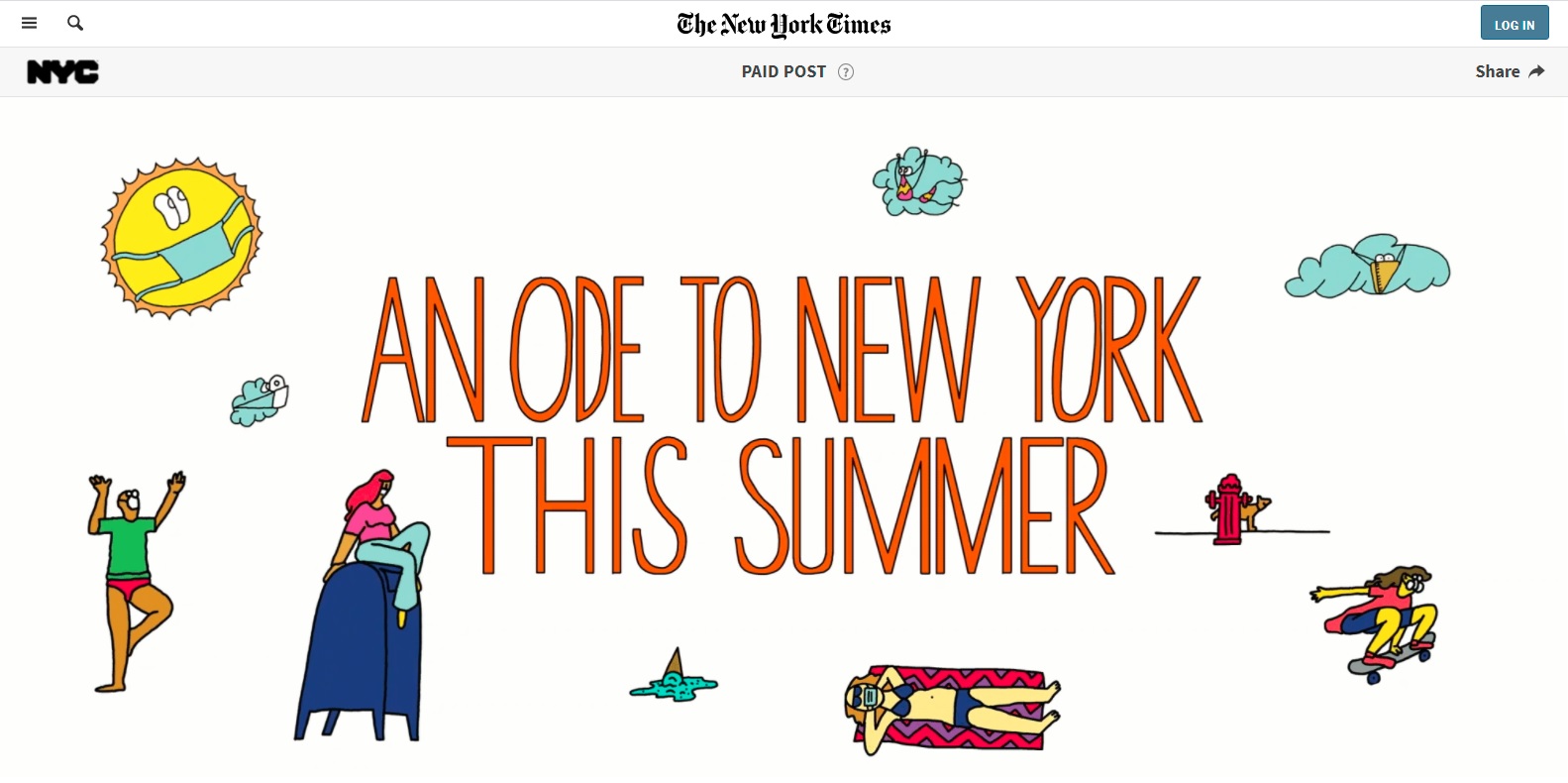
About the Ad
Back in the early spring of 2020, the term social distancing was an alien concept to most. As the weather warmed up and the coronavirus pandemic gripped the United States, New York City’s Mayor’s Office needed to educate New Yorkers on new public interventions and measures that were now vitally important to follow. The City wanted a light-hearted, playful ad that would both engage readers and subtly encourage them to change their behaviors so that a safe summer could be enjoyed by everyone inside and outside of the home. They partnered with T Brand Studio to bring it to fruition.
Why it Works
“Be Smart — Keep at least six feet apart. What’s that look like? Misty Copeland rehearsing her spins; 3 trash and recycling bins. The length of 2 baseball bats; or 6 bodega cats. The umbrella of a hot-dog vendor; an XL beach towel in all its splendor.” The list of clever rhymes goes on. With compelling copy and attention-grabbing animated illustrations based on some classic NYC staples — baseball, bodega cats, hot-dog stands, and more—this ad shows social distancing in relatable terms while highlighting to audiences what makes the city so unique. This guide was one of three to be published on nytimes.com promoting safety measures throughout pandemic, and they were also showcased in full-page print ads in The New York Times, representing a shared goal to help Americans through an uncertain and unsettling time.
The sheer diversity of these campaigns illustrates that there is no single formula for success when it comes to native advertising. With continued advances on the programmatic native front and more and more inventory emerging on publisher sites, delivering compelling and effective sponsored content is becoming increasingly tangible for brands. No longer are marketing teams confined to running native ads embedded within in-feed environments; the options are there now to branch out and create hybrid models of advertising that seamlessly connect with desired audiences in new and meaningful ways. From made-to-order long form features to podcasts and infographics and everything in between, the possibilities are boundless.
Know your audience. Respect the host media’s DNA. Be courageous. Adhere to these three principles and you can become empowered to get your content in front of the people that matter to drive improved brand engagement.
~
If you’re looking for assistance with your native ad campaigns, we have a host of free resources available. You can register to join our upcoming webinar exploring why native continues to be a top-performing medium; you can check out our comprehensive guide to native advertising that includes a selection of creative best practices; or you can simply get in touch and have a conversation with our digital media experts.
Go out and get inspired. Maybe your next native ad will be on our list in 2022.
Centro’s Director of Product Marketing breaks down our response to Google’s recent announcement.
The topic of identity is changing by the minute. The amount of information and updates on privacy and third-party cookies can feel overwhelming to marketers looking to stay ahead of the game. Our teams at Centro and Basis are tracking these updates and helping marketers understand their impact. Are you confused by the changes? Reach out! We’re here to help.
Today, news broke that Google has delayed the release of cookie-blocking in Chrome until late 2023, a significant delay in a lightning-fast conversation. At Centro, we believe this is a healthy move for our industry. This pause will ideally create a solution that is a win for all parties.
Google’s Chrome browser has a 67% market share, but accounts for approximately 76% of webpage views, according to Centro's internal data. This represents a massive and motivating number of impressions.
With that volume on the line and a short window, many companies sprinted toward solutions—some good and some lacking—when Google first announced cookie blocking. Others adopted a wait-and-see strategy. Basis has taken an active role by developing cookieless conversions (currently in beta), building an identity testing framework (also in beta), releasing a contextual insights report, and integrating LiveRamp’s IdentityLink.
The initial deadline, while aggressive, kickstarted solutions and brought a lot of needed attention to this issue. What the industry needs now is time. Ad tech providers need time to refine identity solutions. Advertisers need time to prepare their targeting and analytics strategies. Publishers need time to adjust their revenue models.
As we’ve previously published in an open letter from Centro’s founder and CEO, the privacy discussion is an opportunity to address the real problem of consumer privacy, and become better as an industry. Many of the privacy solutions being developed are simply exploiting loopholes and circumventing the legislation, instead of targeting the real issue. Any success with these loophole-solutions will be short-lived, since they are not respecting the rising concern for data privacy.
Chrome’s new target date does not change the mission to create a solution that satisfies all parties and, most importantly, respects users. Chrome has significant market share, so this delay provides a little breathing room and a small sense of relief.
However, the truth is that privacy regulation is in various stages across different avenues. We have been experiencing cookie loss from Safari, Firefox, Apple’s iOS, and others for a while now. Basis has proactively adapted, and is prepared for continuing privacy changes. Our software and services teams are filled with strategic leaders, digital media domain experts, and technical authorities, all well-versed in identity.
Does this delay change how marketers should prepare for cookie loss? Not really—we just have some extra time to thoughtfully prepare. There should still be a sense of urgency.
Here are our recommendations on preparing for privacy changes:
Looking for more guidance on how to prepare for a privacy-first future? Check out our write-up of three groups working toward innovative identity solutions.
A woman’s wellness company wanted an expert partner to help develop a strong digital media strategy that connects with the right audience and drives purchase conversions.
Basis Technologies' managed services solution provided a strategic planning framework based on market intelligence to guide the development of audience insights, data requirements, channel strategies, and measurement plans for long-term success.
The Basis Technologies team implemented an all-channel–full-funnel approach that leveraged audience insights and targeted women 45-65+ with beauty, wellness, and luxury shopper affinity. The team used upper-funnel tactics such as podcasts and display to help drive awareness and website traffic. Also, the team used retargeting, cart abandonment tactics, along with Search and Social to drive final conversions.
Basis Technologies provided the digital media expertise that resulted in 8,430 purchases generating over $650K in revenue with an impressive $1.32 return on ad spending.
~
Simply put, paid social comprises of any post on a social media network that has dollars supporting it. The truth is, organic social posts don’t usually gain many views or reach most of the audience following a page. To get content in front of brand-new or returning customers, brands need to pay up!
Today, that means moving beyond boosting posts and tapping into the various buying options that exist within platforms such as Facebook, Instagram, Twitter, Snapchat, Pinterest, LinkedIn, TikTok, and Reddit.
The great news is that advertising on social media is a very effective way to reach just about any audience. While all social networks offer some type of advertising, the first step in determining where to buy is to identify which networks are the most popular with your target customer.
You can also look at which platforms perform well for you organically, which ones your competitors are leaning into, and which ones have the best targeting options to allow your message to get in front of the right person.
For example, Pinterest is a great place to reach women. Their targeting options include (but are not limited to) creating audiences based on what users are interested in, the search terms they use to discover new ideas, and the actions they take to engage with pins and websites.
Facebook and Instagram have very similar targeting options, but may allow you to appeal to a wider customer base. If you’re looking to reach millennials or younger consumers, Snapchat or TikTok might be the right choice. And if a more business-focused client is the key to growing sales of your product or service, you can try LinkedIn’s very detailed targeting options to find folks based on their skill set, job title, industry, group memberships or employer company.
You’ll also want to consider the different methods of buying that are available on these platforms. They all offer the option to secure ads in a real-time biddable auction that you can access self-serve. Ads in the auction can be optimized toward the lowest possible cost per result.
This is different than buying solely based on impression cost, because the auction serves the ads to the person who is likely to take action after viewing the ad. This is particularly advantageous when the goal of your campaign is to gain long-term brand awareness, ad engagements, website traffic, online conversions, leads, app installs, or online or offline sales.
Outside of the advertising auction environment, many social networks also offer specific reserved inventory (or types of ads) that can be bought at a flat rate. Examples include Reddit subcategory takeovers, premium Facebook video ads that show in front of curated content, and Twitter trending topic takeovers. To secure one of these types of ads, you’ll need to work directly with a representative from the social network, or with a company that has partnerships to leverage on your behalf.
The final consideration when buying a social media ad is selecting the ad format you want to use. Photos, videos and carousel ads that feature multiple images or videos in one ad unit are now commonplace across all of social. Depending on your campaign goal, you might want to consider A/B testing different types of creative to see what performs best, or experimenting with more interactive ad formats like augmented reality lenses.
The good news is that, regardless of the creative format you choose, all of these ads can be bought in the same ad auction and optimized within one campaign to meet your primary business objective efficiently and effectively.
Learn more about how Basis creates effective paid social strategies for our clients here.