
Technology
Basis Platform
Advertising Operating System
Communication Portal
Intelligent Collaboration
All Channel Activation
Activate Media on Every Channel

Consulting
Resources
“I rented a lake house in Austin with my dog Fenway.”
“I went to Africa and hiked to see gorillas in Rwanda.”
“My husband and I spent three full weeks covering the entire West coast!”
“We took a two-week trip to Italy for a wedding and absolutely loved it.”
These are just a few of the experiences Centro employees have had through Centro’s sabbatical program. What is a sabbatical, you ask? It’s three-weeks of paid time off that any Centron can take advantage of during their fourth year of employment.
In competitive industries such as tech and finance, professionals often work 60+ hours per week—in addition to being available 24/7 by smartphone. The employees of today are waking up and checking their work accounts for emails, calls, and texts before their feet even hit the floor.
Today’s around-the-clock work week has created new concerns for employers, including high rates of employee burnout and turnover.
A vacation day here and there is great, but we all know how fast a long weekend can fly by. Centro’s sabbatical program was created when our leadership team asked themselves what might change if employees could take longer breaks from work. How would it affect their mental health and productivity? How would their engagement change when they returned to the office?
Formal research has found that employees are more productive and creative after returning from longer breaks, and that these breaks offer companies valuable insights into succession planning and organizational chart stability. Feedback from Centrons who have taken advantage of the sabbatical program has confirmed these research findings:
“It is rare during anyone’s professional career they can take three weeks off...It was a special time to see a different part of the world and, most importantly, spend time together.”
“I was able to reflect and establish goals for the next part of my life. It was incredibly restorative.”
“The sabbatical was an amazing lesson of how to delegate responsibility and offered a completely new perspective on my return to work.”
We’ve seen first-hand that our business benefits from the program as well. To quote Emilie Clark, whose team member recently returned from sabbatical, “I now have someone with the commitment and engagement of a new hire with all of the competency and knowledge of a tenured member of the team.”
Curious about Centro’s sabbatical and total compensation offerings? Learn more about our perks and benefits here.
Businesses today must stretch their budgets to reach more and more profitable marketing channels, both online and off. The number of options only continues to grow. Online retailers and eCommerce sellers, in particular, have an important choice to make between Google Shopping, Amazon, and Facebook to promote their products.
Platforms are also constantly evolving, offering new targeting functionalities and benefits to entice advertisers. Facebook remains a powerful innovator, making it the most valuable option for marketers who want to invest in social media advertising.
Here are some reasons why Facebook marketing remains a good investment today and will continue to be an important advertising outlet in the long-term:
Platforms like Google and Amazon have impressive targeting options, but none can compare to Facebook’s capabilities. Facebook has been collecting detailed demographic and behavioral data on its users for more than a decade. Below are just some of the many targeting options advertisers can use to build audiences on the platform:
Facebook advertising allows you to create customized audience groups based on any combination of these targeting factors:
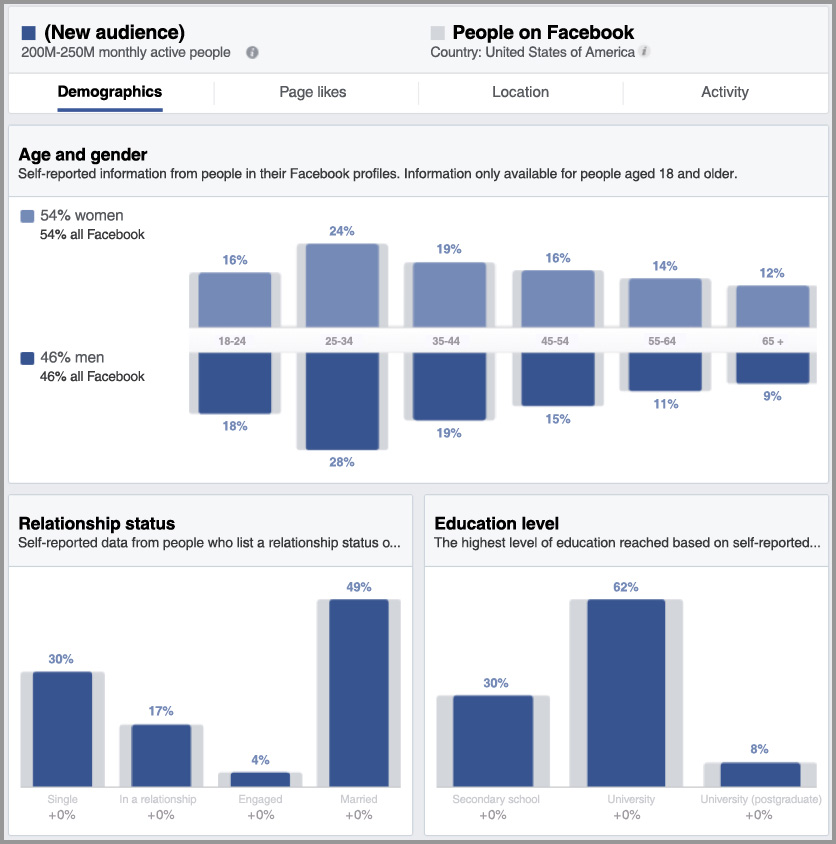
Other advertising outlets offer some of these targeting options, but not at the same volume or granularity as Facebook. When you use Facebook ad targeting to its full extent, you deliver more relevant marketing messages to your audience. This drives more clicks and conversions overall.
According to a recent survey from Clinch, consumers agree that Facebook is the best platform for product discovery and purchasing. As long as Facebook continues to offer the best targeting options in the ad industry, this is unlikely to change.
There are lots of ways to spread your marketing budget in 2020. Marketing managers are stuck with the difficult task of deciding how much to invest in different advertising channels. In general, social media advertising can help you drive improved performance with a lower budget investment. Facebook is the leader in helping advertisers target very specific audiences and increase revenue from their marketing dollars.
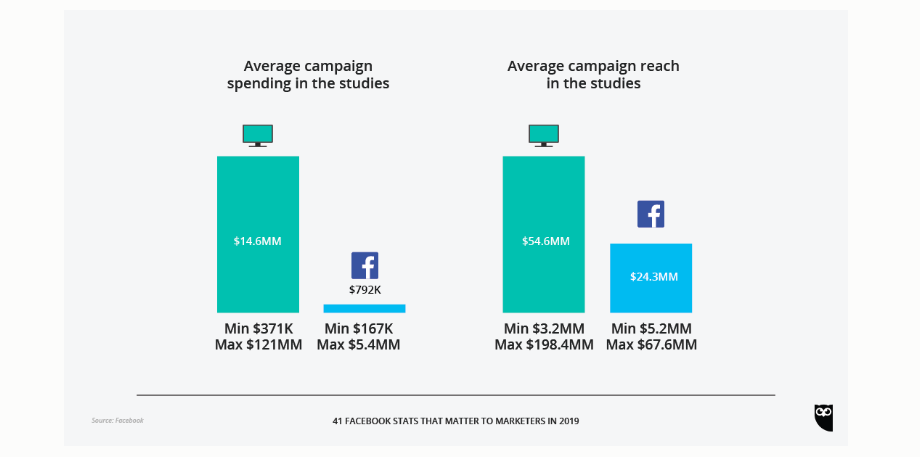
According to Hootsuite, marketers spend 20 times as much on TV ads as they do on Facebook videos. Despite spending 20 times more, though, the reach for TV campaigns is less than half of a social campaign:
In another survey asking advertisers which platform offers the highest digital ad ROI, 48% choose Google search. Facebook came in second at 30%, significantly leading all other social platforms in performance.
If marketers plan to invest in social media advertising at all, Facebook must be the place to start. In today’s competitive landscape, all managers must be carefully investing their budgets in strategies that drive the most revenue.
Facebook offers a variety of ad types: image, video, slideshow, carousel, instant experience, collections, and more. You can optimize your campaigns using any of these options to drive sales of your products. Carousel ads, for instance, allow you to include an array of images that illustrate the value of your product.
Facebook ads also offer some unique features designed to help eCommerce sellers drive sales on the platform. For example, multi-product ads offers advertisers the chance to display numerous product images in a single ad:

You can set it up so when someone clicks on individual products in an ad, it takes them to a unique landing page. With visual Facebook ads, you can further promote discounts to encourage your audience to act now:

Facebook Shops is a valuable (and often underutilized) feature that helps you create a virtual storefront on the platform. No other social media outlet has a similar option. A Facebook Shop is a page with a selection of products connected to your business page. It’s the most appealing to merchants, retail, and eCommerce advertisers who want to reach more people with their products on Facebook.
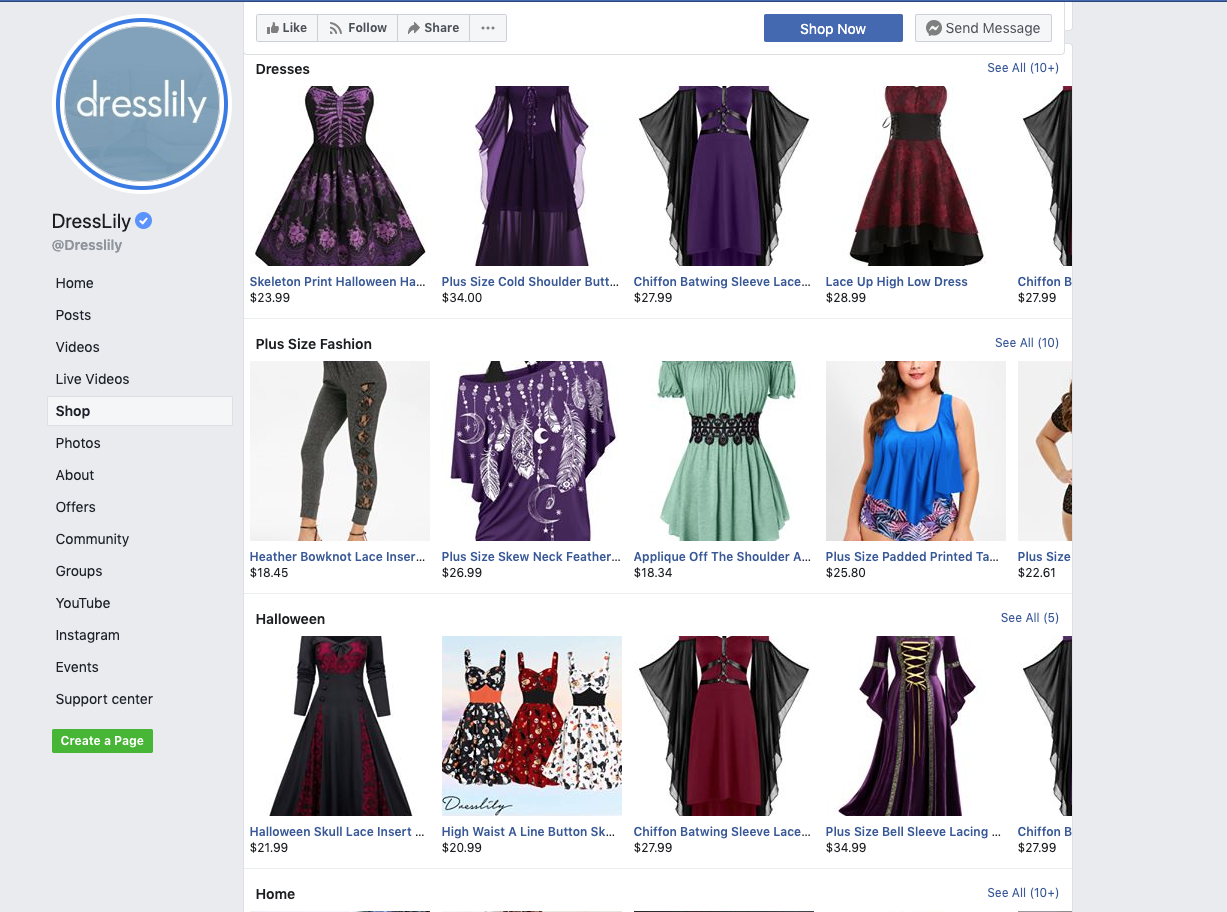
A Facebook Shop can help you:
Instead of displaying products on static pages on your eCommerce site, Facebook Shops encourages people to engage in social conversations surrounding your products. This offers social proof that can influence more people to buy.
It’s possible to create Story Ads for both Facebook and Instagram. This is a valuable strategy to capture the attention of your audience on the platform—especially considering that more than 300 million people use Facebook Stories and Messenger Stories every day.
Facebook Story Ads help advertisers meet all sorts of goals, including building brand awareness, video views, app installs, conversions, traffic, and generating leads. For eCommerce sellers, they’re a great opportunity to showcase products in real-world applications:

According to an Ipsos survey, 62% of people say they’re more interested in a brand or product after seeing it in a story. And more than half of people say they’re making more online purchases as a result of seeing stories.
Since Story Ads are included alongside normal stories from people’s friends, it’s much easier to capture audience attention with your ads. Facebook might not be the only advertising platform offering Story Ads (Snapchat also has this option), but it definitely has the largest audience to work with.
Your advertising strategy shouldn’t exist in isolation from the rest of your marketing initiatives. Getting people to click on your ad is just the first step in the customer journey. You need to effectively nurture them to make a purchase as well.
Facebook Messenger offers a huge opportunity for advertisers to nurture their leads. Rather than sending ad clicks to a landing page on your website, you can direct them to a conversation with your business in Messenger.
So, what’s the main benefit of this?
A look at Facebook’s 2019 Holiday Shopping Guide tells us that 65% of holiday shoppers report being more likely to shop with businesses they can instantly message.
Once you open a dialogue with your audience in Messenger, you can use the platform to deliver more relevant marketing content. You can also use it for lead generation by capturing their contact information. This is particularly valuable for businesses promoting expensive products or those with a long sales cycle.
Facebook further allows you to create ads to target audiences within Messenger. No other advertising platform offers this kind of interactive targeting and nurturing scenario. Having the ability to converse with your audience using customer service representatives or even automated chatbots can do wonders for turning ad clicks into sales for your business.
Facebook is constantly coming up with new ads, targeting features, and optimization functionalities to improve how people can market their products on the platform. For example, in September 2019, they updated their product catalogs to improve the speed of data feed uploads. This helps eCommerce advertisers keep their data feeds current and accurate, so their ads match the information on their landing pages.
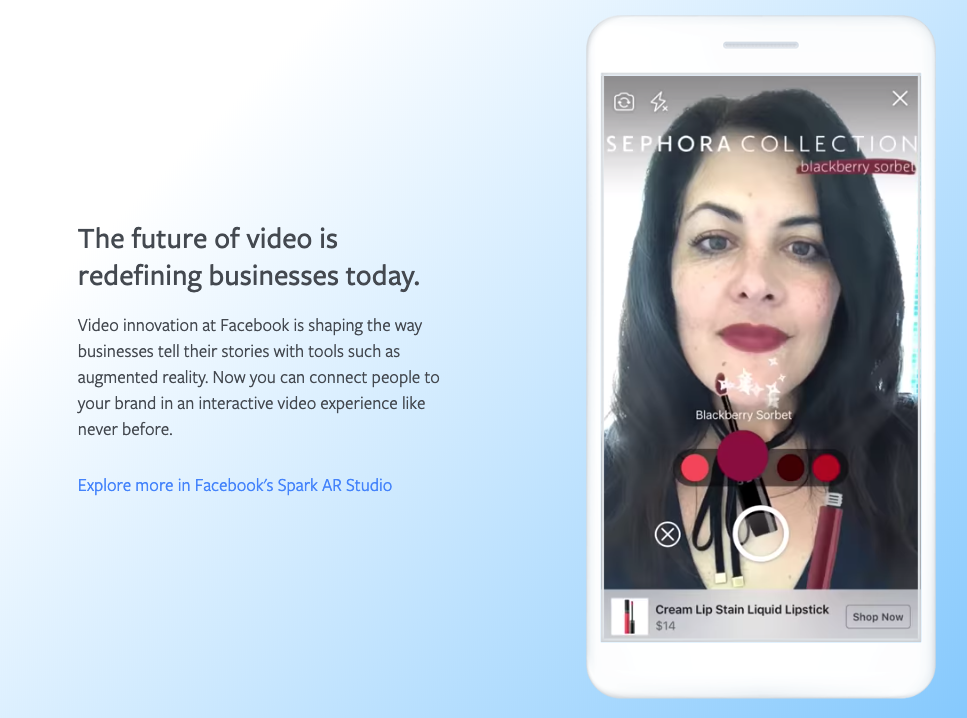
While small changes like this can go a long way to improving conversions and revenue, it’s Facebook’s ability to revolutionize the online shopping experience that really makes it one of the most valuable advertising platforms. At a recent marketing conference, Facebook hinted that updates to their AR platform will have applications for retail and shopping environments. In the future, AR shopping will allow shoppers to virtually try on products using a phone camera.
This offers a unique shopping experience where people can match makeup colors, test out a piece of furniture, try on sunglasses, and more:

Whether you’re just getting started with Facebook marketing or you’re looking to reinvest, these important strategies are trends for success in 2020 and beyond:
One of the biggest benefits of Facebook marketing is creating and targeting different audience groups at a granular level. A lot of advertisers don’t bother digging into these specific groups, though, simply because they’re smaller. Targeting smaller groups of people drives up your cost per 1,000 impressions (CPM), but it also gives you an opportunity to create a marketing message that’s relevant to each.
Smart advertisers invest in creating numerous ads as well as making micro-changes to each to improve targeting. Look at this multi-product ad for nursing dresses, for example:
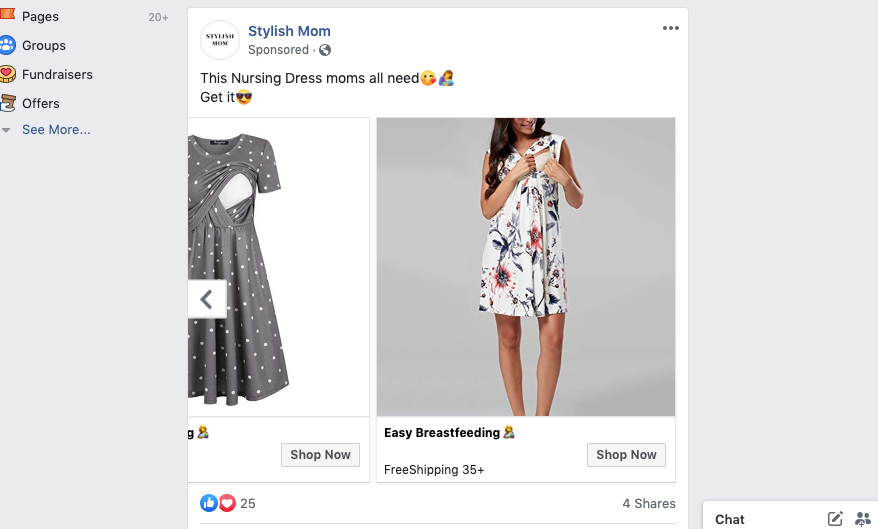
It’s targeting women of childbearing age, but the brand could be more specific with their ads by also targeting life events (e.g. maternity dresses for pregnancy versus nursing dresses for after giving birth).
Facebook can also help you discover new audiences to target based on your current audience data. Lookalike Audiences is a feature you can use to reach out to new people who may be interested in your business because they have similar traits to your current audience.
Creating video marketing content for Facebook is often very involved and costly, but it also delivers the best results. Video remains the most popular content type on a platform known for passive engagement.
There are several different types of video content that advertisers can invest in, from video posts to Stories and Facebook Live. People spend three times as much time watching a live video than a pre-recorded one. Live videos offer some humanity for brands, making them look more authentic.
Brands can also upload 360 videos to Facebook. These are videos that record all 360 degrees of a scene so viewers can watch different angles. Brands like AT&T, Samsung, and Nestle have boosted posts using this video format to successfully capture audience attention, improve engagement, and drive conversions.
Prioritizing mobile user experience in marketing is nothing new, yet many marketers take it for granted today. Having a responsive website design is just the first step in optimizing for mobile. You also need to have ongoing assessments of user experience for your different marketing initiatives, especially with Facebook. Consider:
Mobile-first Facebook marketers need to know how their ads and marketing content look on mobile devices. When users click on ads, how do the landing pages appear?
Marketers must also consider how audiences might perceive their brand if they only interact with their marketing content on mobile. For example, mobile ads take up much more screen space than on desktop. Could your brand possibly come off as intrusive or annoying in this format?
Businesses should further test out the ease of use on the path to conversion on mobile versus desktop devices. Eliminate barriers to ensure users can easily shop and convert on mobile. Thanks to AR videos, Stories, Facebook Shops, and multi-product ads, a lot of the shopping experience can happen on Facebook itself, as opposed to your website. So mobile-first optimization means considering both your website and the advertising platform itself.
Facebook advertising isn’t just about broadening your brand reach on social media, it’s also a valuable platform on which to target your current leads, convincing them to convert. If you install Facebook’s tracking pixel on your website, you can easily launch retargeting campaigns. This allows you to show ads to people who have engaged with your brand in the past. Previous website visitors that you retarget with display ads are 70% more likely to convert.
Facebook allows you to create custom audiences for targeting based on different behaviors, such as visiting a certain web page or adding items to a cart without checking out. You can also upload data you’ve collected from your audiences, such as their names, email addresses or phone numbers. Facebook will automatically connect this information to their associated Facebook profile.
Businesses can use retargeting ads for a number of objectives, from awareness to consideration and conversion. eCommerce sellers get the most value by targeting conversions, online catalog sales, or in-store visits.
It’s important to remember that Facebook is a platform for passive engagement, as opposed to active searching for products and services. Marketers can target their audiences with the most relevant message, but it can easily become part of the background of scrolling and content consumption.
If marketers want to drive their audience to take action, they need to offer a reason. For eCommerce sellers, this can be promoting an offer or sale to drive conversions. For businesses looking to generate leads, this can be promoting a sweepstake to capture contact information.
Facebook’s AR technology also offers new options to encourage audiences to engage with your products:
Data giant Facebook is constantly looking for new ways to leverage user information to create a better advertising experience. With ad revenue as high as $16.6 billion per quarter, the platform is invested in helping advertisers make it easy to reach their target audience and drive conversions.
So the question is not if Facebook advertising is a good investment, but instead how businesses can best allocate their budget and ad strategy to maximize the benefits for their marketing initiatives.
As we round out the final quarter of another successful year, I am reminded of all the stresses that come with the holidays. Slowing down, reflecting, giving back, and showing gratitude are some of my favorite tools for relieving that stress.
As I take a moment to reflect and show gratitude, I’m especially thankful for Centro’s philanthropic organization, The Giving Tree. The Giving Tree is our outlet for encouraging corporate social responsibility among our employees, and we have been hard at work all year long.
Our goal is to partner with a diverse group of charities to drive positive change where we live and work. We’ve made an impact with various organizations across the country, including Rosie’s Place, Volunteers of America, Girls on the Run, Habitat for Humanity, and The Birthday Party Project.
Did you know that volunteering is good for the soul? Here are four ways volunteering or giving back can improve your work and life:
1. Volunteering helps mitigate depression and anxiety.
The social connection that comes along with helping others has a profound effect on our overall psychological well-being. Formal research has shown that volunteering results in lower rates of depression, especially in people 65 years of age and older.
2. Volunteering makes you happy.
By measuring hormones and brain activity, researchers have found that volunteering is correlated with better mental and physical health. Human beings are hard-wired to give to others—the more we give, the happier we feel!
3. Volunteering increases self-confidence.
There is a natural sense of accomplishment that comes with helping your community. The better you feel about yourself, the more likely you are to have a positive view of your life and future goals. Surveys have confirmed that volunteering is correlated with greater self-esteem and life satisfaction.
4. Volunteering provides a sense of purpose.
According to Project Helping, 96% of people say that volunteering enriches their sense of purpose. Whatever your age or life situation, volunteering can help take your mind off your own worries, keep you mentally stimulated, and add more zest to your life.
There’s still plenty of time to make an impact before the end of the year! Don’t forget that it’s far better to give than to receive this holiday season. Learn more about the Centro Giving Tree here.
Google Conversion Optimizer, automated bidding, smart bidding. Google Ads’ free-to-use, in-house bidding tools have been labeled different names over the years, with one overarching design concept: to alleviate PPC managers from the complexity of bid management using tools built-in to Google Ads.
Google offers many bid strategies and has continued to expand that list over time. Current hallmark strategies include Maximize Conversions, Target CPA, and Target ROAS, among others. Requirements? The more important, conversion-based strategies require accurate conversion tracking using the Google pixel, but outside of that Google strategies are available to any program.
Why would Google want advertisers to use their own bid optimization options? Is it to offer an out-of-the-box convenient solution to inexperienced advertisers? Or is it to straddle the line between improving conversion rates and increasing CPCs? The speculative answer is both. Rumor has it that Google poured development resources into their bidding capabilities (once viewed as a poor strategy) to accommodate the many thousands of small-time advertisers who may not know much about digital ads and who have more important things to focus on. Mission accomplished; so well, in fact, they got the attention of large advertisers with dedicated PPC teams and vendor relationships. Where do things stand now?
Auction time bidding (or ATB) is a type of real-time bidding based on specific user in a particular context, such as on a certain website or within a mobile app. This feature has gained recent publicity, but it’s been the case for a long time. Google rightfully recognizes it as the premier benefit of their own bidding solutions. As the publisher serving the ads, Google can interact with search queries, including bidding on each unique search query, rather than having a single bid per keyword like all other bidding options are tied to. This means the relevance of every search query is evaluated and bid on in real-time, leading to more effective and efficient campaigns and helping advertisers hit their KPIs.
For broad match keywords, this capability can be especially valuable, since the relevance of search queries can vary widely.
Example:
| Search Query | Keyword | Auction Time Bid | Keyword Bid |
| ‘household maid service’ | ‘household cleaning service’ | $3.50 | $1.50 |
| ‘best household cleaning supplies’ | ‘household cleaning service’ | $1.10 | $1.50 |
Google claims to use the full suite of user data. There are still many limitations to Google’s array of user data, but it grows every day. The majority of that data is available to utilize by anyone via bid adjustment modifiers. However, much like with auction time bidding, there are some data points that only the publisher serving the ad can interact with at the time of auction. A couple of examples are browser and operating system. There’s no consensus about how impactful this data may be, but since only Google can make use of this data in real-time, it is another bidding advantage.
This is also related to auction time bidding. Because Google can bid on each search query, there’s no need for the use of different match types. A campaign with only broad keywords would theoretically perform as well as if that campaign also had phrase and exact match. This may be especially valuable to smaller advertisers that lack budget or resources to build and maintain a larger, more sophisticated, ad account.
With Google uniquely bidding on every search query, an advertiser has no access to the complete bid history of any keyword or any individual auction. Keyword level CPCs are not reflective of auction dynamics, given that the bids for each search query may be incredibly wide-ranging, even for the same keyword. So, the CPC for a given keyword acts as the average of all the unique bid auctions, and that is the most information available. For advertisers looking to analyze granular performance, the possibilities with Google are limited.
Using Google bidding means relinquishing control across different market segments to what Google interprets as the most likely to convert. That’s fine in a vacuum, but an advertiser will commonly know more about their business than what’s reflected in historical online conversion metrics. For instance, a business is set to release a new mobile landing page or has a call center with variable staffing availability. Google can only react to how those efforts change conversion rates over time, which is too late, and businesses miss out on influencing website traffic based on important information that Google cannot incorporate.
Google bidding is restricted to relying on conversion data tracked by the Google pixel. This means a user is unable to incorporate extraneous or contextual data into bid optimization. Manual or vendor bid strategies can layer in BI data such as product inventory, or contextual data such as weather. For many businesses, performance is closely tied to external influences, and it’s best to take advantage of that data wherever applicable.
Included in the Google Recommendations tab is a recommended list of campaigns to apply smart bidding (typically with Target CPA). This list can be downloaded and includes an estimated performance impact for each campaign. The catch is that not every campaign will be recommended for smart bidding, usually because Google requires a minimum threshold of conversion volume to achieve confidence in performance. Google projects when it’s unlikely to be effective and it’s not designed to accommodate campaigns with limited volume. Depending on campaign size and conversion rates, this gap in coverage can make up a significant portion of spend.
We at Basis have seen time and time again a pattern that Google bidding increases CPCs. Belief is that Google is aggressively targeting and bidding up relevant searches, but if that increase in CPC is not met with an increase in conversion rates, CPAs go up and margin goes down. This inflation is also everlasting. Hypothetically, if more and more players in the auction rely on Google bidding, the net impact on auction dynamics results in a higher cost to generate the same amount of clicks, and everyone simply pays more to Google.
It’s best to understand the trade-offs using smart bidding versus a manual strategy or a bid management platform. Know what is being given up by relying on Google bidding using only Google tracking. There’s an obvious theme to relying on smart bidding - you bought a car from Google and you are having them drive you around in it. If you’re an inexperienced driver or aren’t sure where you want to go, this is an effective solution, but for anyone who wants the ability to input direction, you’re ceding complete control.
The seasoned advertiser will likely understand what bid strategy to utilize for different segments of their program and business. With a proper understanding of the Pros and Cons of Google automated bidding, an advertiser can test and recognize the ideal strategies. To achieve peak performance, that may include the use of myriad strategies. And it makes sense, X + Y is better than X or Y in isolation, once you understand where X > Y and Y >X. Rarely is a bidding solution one size fits all. Keep on learning. Google may or may not be the right solution.
To achieve your ROI goals, you need to target the right Advertising Cost of Sale (ACoS), the key metric Amazon uses to illustrate how your ad spend leads to targeted sales.
Here’s how it’s calculated: ACoS= Ad spend/Sales
Say, over the course of a month, you spend $170 on advertising which generated $680 in revenue. ACoS = 170/680 = 25%.
So, what’s a good ACoS? It really depends on your profit margin. Your profit margin is your profit per unit sold divided by the price. If for example you sell a $100 product on Amazon and it costs $75 to produce, your profit per unit is $25.
Profit per unit / Product price = Profit margin
$25/$100=0.25
Your profit margin is 25%.
So, how high can your advertising cost of sale be in order to break even and eliminate wasted spend from your advertising efforts? In this case, 25%. But of course, you want a profit. So your ACoS needs to be lower. Maybe 10% or 15%. It all depends on your pricing point and business needs.
The good news is there are many changes you can make to improve your ACoS on Amazon. Spending less money on ads is not the only way to lower your ACoS. Here are 9 areas to focus on to optimize your ads and improve performance.
Amazon offers both manual and automatic campaign options. Each strategy has its benefits. With automatic campaigns, you allow Amazon to determine when to display your ad based on keywords identified in the title, description, and other aspects of your listing. Automatic campaigns are easy to set up and can help you identify relevant long-tail keywords to target.
With manual campaigns, you define your target keywords and set your own bid rates. This allows you complete control over strategy and targeting.
If you’re just getting started with Amazon advertising, it’s recommended to begin with automated campaigns then gradually switch to manual. Automated campaigns will help you understand how the system works and hopefully identify some important keywords you should target. Once you do switch to manual, make sure you have a precise campaign structure that improves targeting. Creating relevant ad and keyword groups allows you to better control bidding on different product types to improve ACoS.
Your cost of advertising and ACoS performance ultimately depends on how much you bid on the keyword, ad group, or campaign. As with Google Ads, Amazon will show you the average bids for keywords. Use this as a starting point for setting your bids. In general, you should bid lower on low converting keywords and higher on high converting keywords. If your impressions are too low, consider increasing your bid or referencing the buy box status to ensure your Amazon Standard Identification Numbers (ASINs) are eligible to serve.
Optimizing your bids is really a balancing act. Bidding high improves your product rankings and can drive more clicks, but also potentially increases your ACoS. Bidding low decreases your product rankings and can cause you to lose clicks, or worse, not qualify for the auction at all. The best strategy is to test different bid levels and see how they impact performance.
If you already run campaigns with Google AdWords Shopping, resist the urge to simply copy over keyword lists from Google Ads. Amazon is a completely different platform, where different keywords may be more or less valuable for campaign success.
The best resource for finding relevant keywords to target is Amazon itself. Type a base keyword into Amazon’s search bar and take a look at suggested results to get ideas:

There are also quite a few third-party keyword research tools out there that can help you build keyword lists specifically for Amazon.
Whatever keywords you find, just make sure they best represent the intent of your target audience when looking for your products. Some keywords are more relevant than others, especially for different products and ad types. Look at Sponsored Products, for example. Specific, long-tail keywords are the most relevant to target because you’re showing ads to people who are looking for something specific. With Sponsored Brands, on the other hand, your goal is to build awareness for your brand and its product offerings. In this case, targeting more generalized keywords is most relevant.
Similar to Google and Bing Ads, Amazon allows you to target keywords and specify different match types. Here are the three main match types you can use:
Here’s an example of how match types work:
| Keyword: Hiking boots | Keyword match type: | ||
| Search Terms: | Broad | Phrase | Exact |
| Hiking boots | ✓ | ✓ | ✓ |
| Hiking boots for women | ✓ | ✓ | ? |
| Women’s boots for hiking | ✓ | ? | ? |
| Hiking shoes | ? | ? | ? |
| Women’s boots | ? | ? | ? |
It’s difficult to know which match types will be the most valuable for your campaigns. In general, targeting phrase or exact match keywords can lower your ACoS, because you’re limiting your ad visibility to people who are searching for something very specific. But, leaving out broad match keywords means you miss out on more click opportunities that can lead to sales.
It’s best to create different ad groups for each match type so you can test and see which ones are converting better. You should also look at the search query report on a regular basis. These search terms indicate what queries are currently triggering your ads. You may want to add any converting search terms as exact match keywords to generate more conversions. You should also add irrelevant queries as negative keywords.
As with Google Ads, you can add negative keywords to your Amazon campaigns. Negative keywords are irrelevant keywords that you don’t want your ads showing for. Say, for example, you sell beard grooming and trimming kits and want to target the keyword “shave kit.” You can add “shave kit for women” as a negative keyword because the keyword is irrelevant to your product.
To get some ideas of negative keywords to add, you can download Amazon’s Search Term Report. This is a report of all the search terms people use to find your ads. Go through the terms and see if there are any queries that are misleading or irrelevant to your product.
Some businesses like to include brand keywords as negative keywords in their campaigns. If someone’s using your brand name in their search query, they are much more likely to click on your product from organic results anyway. Showing an ad would just encourage them to click on your sponsored product, wasting your ad spend.
That said, some advertisers like to target brand keywords because they have a high conversion rate. You can test out the value of targeting or eliminating brand keywords by creating a separate campaign and monitoring performance.
In January 2019, Amazon rolled out bid adjustment features similar to Google Ads. You can adjust your bids manually, or use dynamic bids to adjust bids up or down.
Automated options use machine learning to determine the likelihood an ad click will convert, then adjust bids accordingly. You can allow dynamic bids to adjust up and down, or down only. Amazon also allows advertisers to set placement bid adjustments to reach the top of the search page or product page placements. You can set up to a 900% increase.
Bid adjustments are a powerful tool that can help you prioritize targeting certain ad positions that are likely to convert. You can always create a test campaign to try out different bidding strategies and monitor results.
Succeeding with Amazon advertising isn’t just about targeting the right keywords and setting the right bids. Your product listing itself needs to be optimized to get visibility. Amazon uses a search algorithm known as the A9 algorithm to rank products in search results. Even if you’re promoting a product, Amazon still has to consider its relevance for a specific search query when ranking your ad.
That’s just one reason why it’s important to optimize your product listings. After clicking on your ad, consumers are also much more likely to convert if they land on a highly optimized product page. Optimizing your product listings can improve ad rank, clickthrough rate, and conversions.
Here are some important factors to consider when optimizing your Amazon product listing:
Keyword Placement
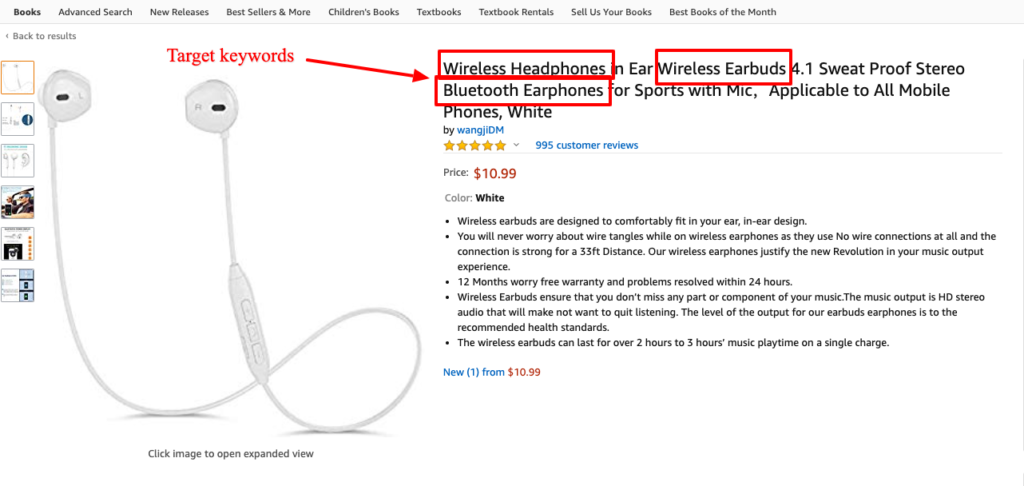
It’s very important to include target keywords in both your product name and description. This shows both Amazon and shoppers that your product is relevant to what they’re looking for. Of course, you’re likely targeting many keywords for the same product. Prioritize the most valuable (high converting) keywords and put them at the beginning of your product title. You can include other relevant keywords at the end of the title and in the description.
Images
Include high-quality images that illustrate the value of your product. The primary image should have a white background. Additional images can show different sides of the product, different varieties, or use cases. Use all 7 image slots. Optionally, the last image slot can include a video of the product.
Bullet Points / Description
The bullet points section is an important place to illustrate the value of your product. Focus on features that matter to your target audience the most. In the description, you can go into more detail about specifications and include more relevant keywords as well.
Product reviews are probably the most important factor shoppers consider when making a purchase decision. But they also have a huge impact on whether or not someone clicks on your ad. Product title and reviews are the most prominent aspects of an ad:
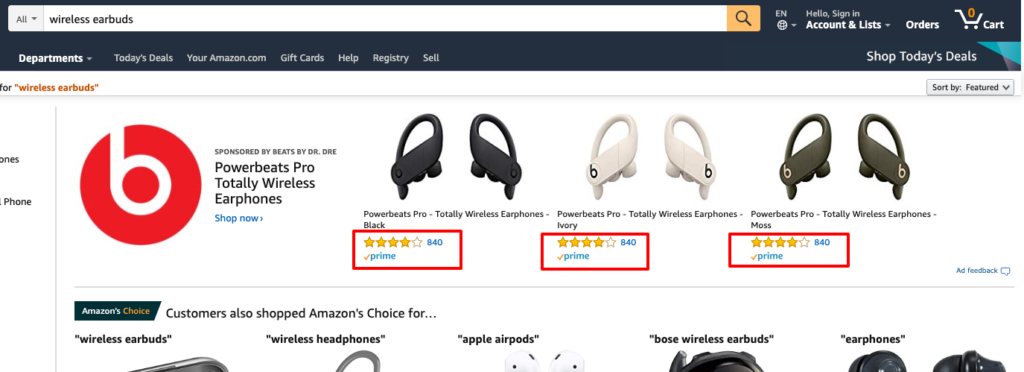
It doesn’t matter how well you target your keywords or how high you bid on placement, your products won’t get clicks if they don’t have positive reviews.
So, as part of your marketing efforts, encourage your audience to leave reviews for your products. You can do this easily by emailing your current customers, asking them to review their past purchases. Of course, even the best products will get some negative reviews, but you can mitigate their impact by addressing customer concerns. Try to make dissatisfied customers happy so they will remove their negative reviews. If someone has left your product a negative review and it seems unfair, then you can also request Amazon to remove it. Having a high number of positive reviews for your product can improve click-through rates on your ads and reduce necessary ad spend to drive results.
ACoS is an important performance metric, but it isn’t the only thing you should be paying attention to. Other important campaign metrics include:
These metrics can tell you a lot about which areas of your advertising campaign need improvement. Look at the click-through rate, for example. If you have a very low CTR, then it’s likely there’s something wrong with your targeting. Maybe your ad is showing up for irrelevant keywords. Experiment with narrowing down your keyword lists to see if CTR improves.
Whenever you want to make major changes to your ad, ad groups, or targeting, it’s easy enough to set up a new campaign. Then you can test these changes and see if they have the desired impact on key performance metrics.
Investment in Amazon advertising is growing exponentially. If the trajectory continues, it could become more popular than Google Shopping for eCommerce sellers. If you want to get the most value out of your investment in the long run, now’s the time to start investing in performance marketing tactics for Amazon advertising.
At Centro, we know that keeping up with the trade pubs and latest trends can be tough and time-consuming. To make that easier, we’ve compiled all the articles, reports, and other bits of awesomeness you may have missed, but should definitely read. Enjoy our latest list below!
5 Adtech Predictions For 2020 [:04]
With 2020 around the corner, here are 5 predictions and how they may affect companies next year and beyond : 1) privacy regulations will make first-party data even more important 2) creative will displace user acquisition as top priority 3) technology will increasingly connect teams – not just channels 4) most companies will use automation technologies to get the most from data and 5) vendors will start trying to bring CDPs and CMPs together.
Youth in Focus Report [:20]
Pegged as “Not Another Report About Millennials and Gen Z,” this report by UK based agency The People provides some great takeaways for marketers looking to target younger consumers / users, mainly that they are people and not a marketing segment. Some great nuggets to remember throughout that help reiterate what probably you think is cool and important isn’t really. Dig in to see where equality and inclusivity, mental health, and sustainability can play a role in how we look to communicate and connect with younger people.
How Brands are Preparing as the California Consumer Privacy Act Becomes a Reality in 2020 [:11]
The California Consumer Privacy Act, or CCPA, takes effect Jan. 1, bringing a host of new regulations to the nation’s largest state that will significantly restrict how brands collect and manage the consumer data that has fueled digital advertising for years. And California is not alone, there are 27 states at least in the early stages of setting some sort of privacy laws – from Hawaii, Massachusetts, New Jersey, Pennsylvania, Rhode Island to Washington who are each pushing for a bill similar to CCPA.
Can Contextual Targeting Replace Third-Party Cookies? [:05]
As the California Consumer Privacy Act goes into effect in January of 2020, companies are preparing for advertisers to use more contextual targeting. While some agencies believe that contextual targeting is only a band-aid, others believe that the level of contextual targeting will become more sophisticated. For example, advertisers can create dynamic keyword targeting lists in 33 different languages that automatically get updated based on what’s likely to achieve higher performance and reach.
Netflix Partnerships Could Become More Attractive to Marketers in a Down Economy [:03]
CNBC coverage of a new report from Forrester, which predicts that marketers will double their spend on marketing partnerships with Netflix, like product placement and “other creative marketing integrations with brands.” See the plethora of brands prominently showcased in the most recent season of Stranger Things, and the complementary promotion and merchandising by those brands.
Disney Is New To Streaming, But Its Marketing Is Unmatched [:07]
Disney Plus, a new streaming service, will be arriving on November 12. Nobody is doubting Disney Plus anymore as the company has started to exercise its unrivaled marketing power. Disney Cruise line ships carries more than 12,000 passengers at any given moment, and sneak-peek screenings are being offered onboard. Disney Store locations are also hosting “pep rallies” for the High School Musical series. With the traditional cable business in decline and with competition with tech giants, Disney will have an opportunity to make or break it.
The Drum: Roku to Buy Dataxu, Accelerating the Push to Expand its Presence OTT [:03]
Roku announced it will acquire adtech company Dataxu for $150m, a deal that will see Roku take on more ad inventory outside of its own platform. Roku says that Dataxu’s existing tech and partnerships should further their capabilities to sell and measure OTT inventory outside of its platform. Dataxu had raised $87.5m over seven rounds since 2009.
The MRC Standards For TV Ad Measurement Will Force Technical Upgrades For All [:04]
The MRC recently released final standards for cross-media audience measurement of TV and Video. These standards will require work for all players in the market to get a passing grade, including technology upgrades from several members of the supply chain. At this point, online video is best off, connected TV (CTV) must grapple with some challenges, and linear faces the biggest uphill climb of all. For media buyers and publishers with multichannel strategies, getting to a fair apples-to-apples comparison won’t happen until these issues are addressed.
eMarketer: Advertisers on Why WhatsApp’s Status is a Good Testing Ground for Ads [:02]
Ads on WhatsApp are to be expected sometime in 2020. eMarketer spoke to advertisers for their new report on global messaging apps. The expectation is that Status—WhatsApp’s version of Stories—will be a logical testing ground for ads (PDF of article attached).
Solving OOH's Attribution Problem Takes On New Urgency Amid a Renaissance [:06]
With OOH being one of the few non-digital categories growing (4.5% in 2018 over 2017, upwards of $8 billion), the challenge around attribution remains one of the channel’s biggest challenges, with brands are unsure how to measure how many people actually saw an ad and what, if any, impact it had on the viewer. As lines continue to blur between traditional and digital ad buying and execution, new innovations in measurement are offering ways for savvy marketers to more deeply understand the impact of OOH.
Amazon is becoming more important for eCommerce advertising every year. In 2019, marketers will spend $11.33 billion on Amazon advertising. Forrester predicts that in 2020 this number will grow exponentially. As competition rises, it will become more difficult to get visibility for your products while meeting budget and profit goals. To stay ahead of the game, now is the time to start optimizing your Amazon ads for better eCommerce results.
Here’s an overview of how Amazon ads work, and how to start optimizing them for performance marketing.
Right now, Amazon offers four main ad types:
These ad types are designed to help marketers reach their target audience at different points of the shopping process and to target unique business goals. Below we offer a quick insight into how they work:
Sponsored Products
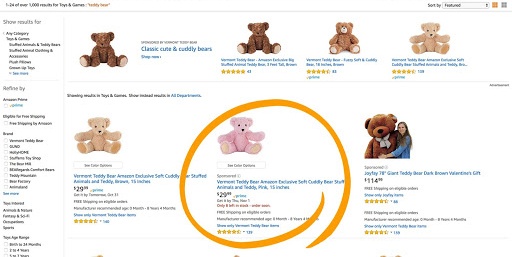
Sponsored Products are ads that appear on the first page of Amazon search results and product pages. They aim to help you boost product visibility and drive sales. These ads are run on a cost-per-click model, so you only pay when someone clicks on your ad. You set your ad budget at a campaign level and designate how much to bid per click.
Sponsored Brands
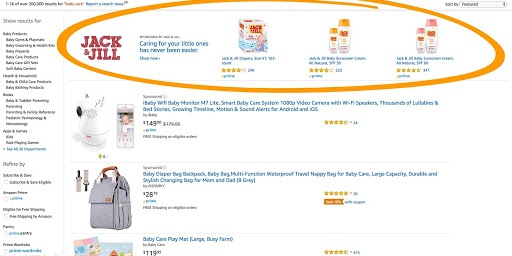
Sponsored Brands are ads that appear in the search results, typically as a banner at the top of the page. They’re designed to reach customers before they know exactly what they want to buy, ultimately helping them to discover new brands and product offerings. For example, a Sponsored Brand ad can target generalized keywords such as “baby care” or “sporting goods.” Shoppers can click on a brand logo or product in the ad. The brand logo takes them to your store page or a custom landing page while clicking on a product takes them to your product page. These ads are also cost per click-based and can be customized for campaign strategy.
Sponsored Display
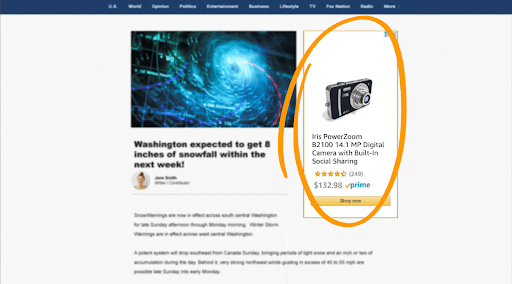
Sponsored Display ads are designed to reach audiences both on and off Amazon. These ads are automatically generated based on shopping activities and your business objectives. Visual aspects of the ads are also auto-generated to aid the promotion of your product catalog. Sponsored Display ads can be used for product awareness, consideration, and driving conversions.
Video Ads
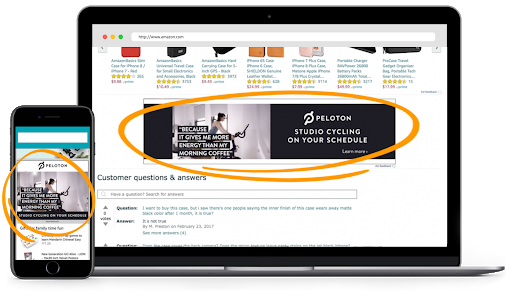
Video ads allow you to deliver high-quality video content on Amazon sites such as IMDb, Fire TV, and other places around the web. Their purpose is to empower businesses to capture audience attention, as well as influence and engage people with their brand. Video ads can be used to deliver a specific brand message or to demo your products and services.
The popularity of Amazon today is indisputable. And for good reason. Where else can you buy high-end clothing, technological gadgets, cleaning products, and home furniture all in one place? According to emarketer forecasts, 51.3% of American households will be Amazon Prime members by the time 2019 draws to a close. A quite staggering statistic.
Of course with this number of customers, it stands to reason that Amazon will be packed with vendors. With this in mind, then, it’s never been more important to take advantage of the various ad options on Amazon to optimize your output and ensure you’re standing out in front of your competitors.
Data is the most powerful asset marketers have available to them. At the same time, using that data effectively is one of the most challenging aspects of the job. In this month’s webinar, we’ll share the marketer’s blueprint for data strategy.
Digital marketers, brace yourself, the holiday season is on its way! Although autumn is just a few weeks old, now is a pivotal time to outline your digital approach for the holidays. Nowadays, most consumers have shifted from the in-store holiday shopping madness to shopping from the comfort of their home or in front of their personal devices. In 2018, consumers spent over $120 billion during online holiday shopping (across 61 days 11/1/18 - 1/1/19), which was up 16.5% from 2017.

This blog post is designed as a guide to help digital marketers prepare their programs effectively and help capitalize on the increased seasonal consumer demand while maintaining performance goals. We’ll run through key tasks that all digital marketers should be checking-off prior to the holiday up-tick to ensure a well-rounded strategy and the best chance for success.
One good method of benchmarking and level-setting expectations is by reviewing last year’s performance to gauge how you should approach the program strategically this year. When reviewing last year's performance, make sure you’re comparing days of the week and isolating pivotal days like Cyber Monday, Black Friday, and Christmas Day. We know that these days act differently to other days throughout the year, so you should treat them like the special cases they are. Other questions you should be asking yourself to help make strategic decisions are:
It’s essential to understand and leverage last year’s performance and data to help make informed decisions on this year’s approach. As the saying goes, “If it ain’t broke, don’t try to fix it”; this can be applied to your digital marketing holiday strategy as well. Look for key areas that showed strong performance against your KPI last year and approach them in the same manner as the last holiday season.
Just like Good Ole’ St. Nick, you need to make sure you’re building your audience lists to help set yourself up for success. If you already have an expansive list of audiences you’re remarketing - great! You’re a step ahead of most marketers. One thing you may want to consider is recycling last year’s holiday audience lists to see if you can garner the less frequent purchasers. However, be aware of any site or program changes over the last year that could’ve impacted those lists.
For readers that don’t have any remarketing lists from last year that remain open (or any at all for that matter), I recommend using the list of ideas below as thought starters.
Once you have your RLSA strategy mapped out, you should begin building lists as soon as possible to allow the audience segments sufficient time to garner members.
As mentioned, this time of year is great for e-commerce, but it’s also a very unique time in itself. Given this known variable, digital marketers should approach all campaigns with a different lens. If you have any campaigns with active ad schedules, ask yourself - do these ad schedules still set us up for success?
If you’re not sure, a good exercise is to analyze last year’s performance (especially on pivotal days like Black Friday and Cyber Monday) by the hour and date. See how your key campaigns performed throughout the hours of the day, and devise schedules that bid up during top-performing and key times of the day. Keep in mind you’re limited to how many windows of time you’d like to optimize against - so choose strategically.
Ad copy is always an important part of any digital marketing campaign, and when the competition heats up on the search engine results page it becomes even more important when you're fighting for the consumer's attention and click. In order to gain the consumer’s attention, make your ad copy compelling and tap into their emotions. Do you have a unique selling position to leverage? What special promos are you running?
Creative should be captivating enough to arrest scrolling, but also show the value your website is bringing by answering the searcher’s query. You can try to show the value that sets you apart from other advertisers by utilizing ad customizers.
If you’re running a promotion, try utilizing Countdown Ads and Promotion Extensions within your campaigns to give consumers a sense of urgency. If you also have the extra time, we recommend saving your holiday time for your family by applying labels and automated rules to these ads to schedule ads with coinciding promo periods.
One last strategy to consider would be to leverage a reactivation campaign with previous purchasers and associating relevant ad copy with these audiences to attract repeat customers.