
Technology
Basis Platform
Advertising Operating System
Communication Portal
Intelligent Collaboration
All Channel Activation
Activate Media on Every Channel

Consulting
Resources
Covid-19 has changed our world, and the economy is experiencing unprecedented change across all industries. In our Industries in Flux miniseries, we’ll address how specific verticals are pivoting in real-time to adapt. Each week, we’ll focus on a different industry, and share strategies based on consumer trends and changes in media consumption.
In part one of Industries in Flux, Centro’s president and 20-year industry veteran, Tyler Kelly, discusses the overall impact of Covid-19 on the media industry. You’ll learn about emerging opportunities within the advertising landscape, as well as how Centro is looking forward to the new normal.
Unless you have a large business with a substantial marketing team, it’s impossible to have all the expertise you need in-house. In today’s world of multichannel marketing, there are simply too many areas to focus on and different ways to optimize. If you want to keep your marketing campaigns streamlined and effective, investing in specialized third-party services is the way to go.
A great many small-to-medium businesses work with marketing agencies in lieu of hiring their own team. The vast majority of marketing organizations harbor strengths and weaknesses in particular areas and agencies likewise have different experiences, knowledge, and technologies to help with certain channels and strategies. Finding the best agency to complement your internal team’s skills will empower you to build a comprehensive strategy that plays to everyone’s strengths. Here, we take a look at the many benefits that come from partnering with an accomplished performance marketing agency.
Skip the learning curve
The digital marketing landscape is constantly changing. There are new channels, marketing strategies, and tools to optimize your efforts. Keeping up with these changes can seem like a full-time job in and of itself. It’s part of an agency’s role to keep up with the latest trends and identify new opportunities for performance marketing. With their help, your business can dive right into new opportunities without having to learn the ropes first.
Save money
Employing external marketing experts is likely to be more cost-effective than expanding your internal team. Hiring someone new means recruiting, paying them a salary, onboarding, training, and dealing with the possibility of churn. When you hire an agency, they have all the knowledge and tools you need in place. They’re able to get right down to improving results, saving you the time and investment that comes with looking for new employees.
Gain a new perspective
Your business and marketing team are effectively siloed from the rest of the marketing world. Working with an agency is an opportunity to get a fresh perspective from new minds working on the project. You might identify a new approach that would have otherwise been missed.
Get access to valuable tools
Marketing agencies don’t just come with expertise, they also come equipped with their own tools. These can include analytical solutions, marketing automation technologies, CRMs, creative applications, and more. Rather than buying and learning how to use these yourself, you can take advantage of your agency's suite of tools.
Improve productivity
Learning and operationalizing new marketing strategies takes a lot of time. When you work with an agency to fill in for areas your internal team doesn't have expertise in, that frees them up to focus on other important strategical tasks.
Drive better results
Most importantly, partnering with an agency can significantly improve the results of your marketing program. Agency success depends on the success of their clients, so they’re motivated to work relentlessly and deliver results that drive revenue for businesses and improve other marketing goals.
Scale quickly
Another major benefit of hiring an external team is that it allows you to increase the capacity of your marketing strategy beyond what your internal organization can handle. Once you start seeing results from your agency’s efforts, it’s easy to scale and grow your business with better marketing.
Agencies can specialize in certain areas of expertise or offer services in a variety of marketing areas. Here are some of the different areas of expertise you might want your marketing agency to have:
Website and Creative
Building mobile-friendly websites optimized for search engines to promote your business. Creating content such as landing pages, product page copy, blog content, and more.
Branding
Some agencies offer branding services to help you build brand awareness and deliver a clear message to your audience. They can help with positioning your brand compared to your competitors, developing your brand’s voice, and more.
Paid Search
This includes optimizing data-driven PPC campaigns to help reach target audiences through search ads. Providing AdWords certified specialists and software tools to automate and optimize PPC bidding.
Social Media
Building social media campaigns to reach and engage audiences on platforms like Facebook, Twitter, and Instagram. May also include YouTube video marketing and paid social media ads.
SEO
Creating target keyword lists for organic search engine optimization and developing strategies to improve domain authority and rank. Agencies can manage SEO and PPC together to ensure the respective strategies complement each other.
Public Relations
Public relations services include messaging, reputation management, media relations, and content marketing. They help your brand to elicit a positive image and help mitigate negative PR on the web.
Email Marketing
This involves developing email campaigns to nurture leads, drive traffic back to your website, and earn sales. Can include providing email automation software services.
eCommerce
Some agencies specialize in helping eCommerce businesses build and manage their website and marketing. This can also include Amazon marketing services.
~
These represent just a few of the main areas of expertise a marketing agency may have. You can find a full list of services on an agency’s website. Then ask for more detailed information pertaining to your needs.
If you want to take advantage of agency marketing expertise, be sure to shop around to find the right fit. There are lots of factors to consider when selecting an agency to partner with, namely their capabilities, how many clients they have, and how they communicate with you. You should also consider how well the agency gets along with your own team.
When vetting a potential agency to work with, be clear about your needs and ask to see examples or case studies illustrating their expertise in these areas. A good agency will tell you if their area of expertise doesn’t match your needs. However, you should still do your due diligence to ensure you choose an agency that offers the most value to improve your marketing outcomes.
~
Interested in gaining access to Centro’s team of dedicated performance-driven digital experts to help solve your biggest challenges? Get in touch with us today!
At Centro, we know that keeping up with the trade pubs and latest trends can be tough and time-consuming. To make that easier, we’ve compiled all the articles, reports, and other bits of awesomeness you may have missed, but should definitely read. Enjoy our latest list below!
Mondelēz Shifts Investments To Paid Media To Capture Online Orders And US Snacking [:02]
In-store marketing have less impact when people are strictly shopping off lists or queuing up orders online. By focusing on media campaigns that can put products in consumers’ minds and on grocery lists, paid media channels are driving snack purchases for the global CPG company. Oreos go great with or without a pandemic.
Facebook’s Q1 Ad Demand Was Way Down Due to COVID – But It’s Starting To Stabilize [:03]
Facebook is far from immune from COVID, but it’s doing well, all things considered. While much of Facebook’s ad revenue is from small and medium-sized businesses, they also saw that for the first three weeks of April, ad revenue was flat year over year. Engagement also saw growth during shelter in place (though not confirmed much of it could be attributed to post 10 album/TV show/movie challenges).
COVID-19 Accelerates Digital Ordering at KFC, Taco Bell And Pizza Hut [:02]
Many quick service restaurants have only recently embraced online pickup and delivery with COVID-19 accelerating existing QSR trends around the use of technology to enable contactless delivery. Many brands have completely revamped their marketing messaging during the COVID-19 crisis.
Quarantine Creates New Opportunities For Video Makers [:01]
A recently released report outlines the most promising topics for opportunities for businesses to keep people entertained, pointing to the biggest opportunities as cooking, comedy, memes, games, and video games.
Digital Publishers Reveal Strategies For Growth [:04]
A new study breaks down the three-phase pattern for all participating publishers. First, you write great content to build an audience; next, you optimize your online experience to keep that audience. Only then can you really start to work on diversifying revenue.
Publishers Use Advertising Downturn to Perform Programmatic Housekeeping [:05]
Publishers are using the quarantine to catch up on programmatic housekeeping, like improving page-loading speeds on their sites, updating their ad tech stacks and refreshing their sales teams on the latest programmatic developments. (have you gotten Certified with Digital Media Essentials?)
Why Google’s Decision To Withhold Programmatic Data Is Pushing Some Advertisers To Pull Ad Spending [:06]
As advertisers search for more transparency, they’re demanding more from their ad tech partners. Google has long given advertisers a cause for concern. Marketers at P&G are looking to reduce the amount of money they put into Google’s ad exchange.
Foursquare And Factual Bet That The Future Of Location Data Is About More Than Advertising [:03]
Foursquare announced their merger with Factual. Together, Foursquare and Factual have more than $150 million in combined revenue, data derived from over 500 million devices worldwide and 400+ employees. The combined company will continue to use the Foursquare brand. The article highlights the rationale behind the deal, why the industry needs an independent location data provider and expectations around the future of location.
OTT-CTV Could Be A Potent Ad Force In 2020 Election [:03]
While presidential candidates increasingly lean on new media channels for communication around their campaigns, social media and CTV/OTT largely remain at the forefront for the 2020 election. Candidates continue flocking to social media where ad platforms like Facebook had a massive impact on votes in 2016. Projections around CTV/OTT usage reinforce and strengthen rationale for why political advertisers will want to spend there. eMarketer forecasts show OTT-CTV ad spend reaching $10 billion by 2021. Due to the social distancing and “stay at home” policies, streaming TV usage has been exceeding earlier 2020 projections.
TikTok announced a new partnership with their first API partner, Sprinklr, allowing in-feed video ads to be placed on TikTok. The customer experience platform will be integral for brands to create, manage and measure ad campaigns. This is one of a few missing pieces that has led TikTok to not yet attracting marketer attention and investment when compared with popular platforms like YouTube and Instagram.
Have you figured out a daily routine for working from home yet? If not, I have some tips to share about the importance of creating one!
I’m Alyssa Brown, Senior Digital Specialist at Centro, and I’ve been working remotely for three years. I’ve found that a daily routine both reduces stress and keeps me focused throughout the day. See my top suggestions for implementing a routine below!
My daily routine actually starts the night before. I wipe down, clean, and declutter my desk when I shut down for the day. As I’m sure many of you are realizing, it’s easy for dishes, papers, and trash to fill up your space throughout the day. Walking into a fresh space every morning really helps me feel put together.
Pro tip: Fill your workspace with things that bring you joy. I usually have a favorite candle burning, a live plant in the room, ideal lighting—whatever makes you happy!
I constantly have to resist logging on at 7:30-8am. I wake up early because I have a toddler—so I am caffeinated, dressed, and ready to go by 7am most days.
Taking some time for myself in the morning helps to center me before I begin my workday. Enjoy those 1-2 hours you would otherwise spend commuting, and create a new WFH routine that starts your day out right!
Actually sign off at 5 pm or when your work for the day is completed, and separate yourself from your workspace. I often find myself lingering later than I need to doing non-work related things, or doing work things that aren’t urgent just because I'm there.
Instead of scrolling, use that time to get up and MOVE. I use the iPhone Screen Time feature to set a 20-minute time limit (per day) for my social media usage. Not having social media in my daily WFH routine is what actually DOES get me up and moving. If you have ten minutes of downtime, do something productive!
Listen to your favorite podcast while you work on something where you can multitask. If you’re like me, podcast hosts feel like "friends” and can help you to feel less isolated (shout out to Ashley Flowers and Britt from the Crime Junkie podcast for being my virtual BFFs!). Remember to keep in close contact with your team and reach out regularly to connect. And speaking of teams… check out these daily routine tips from some of my WFH peers here at Centro:
“Run your day similarly to how you would organize it if you were in the office. Take a shower in the morning and build in a lunch break. It's not a vacation, so keep to your usual M-F schedule as much as possible.”—Holly Maine
“Simulate your commute. Get up, get ready and LEAVE THE HOUSE for at least 30 minutes. If all you do is drive around the neighborhood, so be it. Just get out of the house and then return ready to work.”—Andy Alvarado
“Pretend you're still going into the office to see other human beings. Give yourself time to wake up, have coffee, get a shower, and get dressed—you'll have more energy throughout the day. If you're a parent, try to meal prep in the evenings for the next day so you aren't scrambling.”—Kelly Wittmann
Try to stick to your normal office routine as much as possible! If you would normally get up, shower, snag a protein bar, and hit the gym before work, you should do exactly the same before firing up your computer at home. One thing you want to avoid is changing up your daily routines for the worse, i.e. staying up late or sleeping in. As they say, bad habits are tough to break!”—Rich Brown
I hope these tips are helpful to anyone working from home during this time. Overall, a bit of structure goes a long way for maintaining productivity and contentment! Now, time for a lunch break...
Interested in joining our team? Check out our careers page.
All of my teammates are currently working from home, which means that our team is facing an entirely new set of day-to-day challenges. Step by step, we’re figuring out how to stay productive, engage our teams, and find the silver linings in this situation.
People who are looking for work right now face an entirely different set of challenges. These people may be wondering how to put their best foot forward when interviewing for a role virtually, rather than in person.
At the same time, recruiters are being forced to get creative and work around usual processes such as interviewing candidates in our offices.
Interviewing remotely may seem daunting to both candidates and recruiters who have never done it before. Even for those that have, there are best practices that can help take your interviewing skills to the next level.
Below, I’ll share my top tips for remote interviewing to help you make the most of the interview, put your best professional foot forward, and ultimately accomplish your goals in these challenging times.
We all know how important it is to make eye contact during an interview. This is much tougher to do via video.
When you’re speaking to someone via video conference, your eyes naturally want to focus on their face. Depending on where that face is on your monitor and the location of your webcam, this can cause you to appear as if you are looking down or away.
You can avoid this by resizing and moving the window with the person’s video image. Move it up or as close to your webcam as possible. This will give the closest approximation to real human eye contact.
A neutral background is your best bet—the name of the game here is to avoid anything distracting or embarrassing. It’s also a good idea to avoid having a mirror reflection show up on camera. A plain wall, a screen, or bookshelf is just fine.
If you’re really concerned about background or there are elements you can’t control, find out whether the video conferencing software you’ll be using has the option to use a preset background. If this isn’t available, try hanging up a sheet or curtain behind you. If you go this route, make sure to keep at least two feet of distance between you and the background to avoid shadow.
Because technology can fail, it’s a good idea to check up on all your technology at least an hour ahead of your video interview. Here’s a quick check-list:
Interviewing remotely may be daunting, but don’t forget: so is interviewing in person! There’s plenty of preparation you can do beforehand to minimize your stress. Take a deep breath, smile, and open up that laptop—you’ll be great.
Interested in joining our team? Check out our careers page.
Given that the world has changed drastically in recent weeks, this episode on breakout ideas is even more relevant. Citizens across the globe are now faced with a new normal as they navigate changes to their personal and professional lives. The silver lining for many marketing and advertising professionals is the opportunity to reflect on new methods for connecting with others.
One of those methods is to generate game-changing ideas and share them in impactful ways with the advertising community. Publicis Groupe’s Tom Goodwin is a noted expert on this arena. Tom's prolific idea sharing has led him to be published over 600 times, lead keynote speeches across the globe, amass a social media following of over 700,000, and become the head of insights for one of the world's largest advertising agencies.
Listen in to hear Tom speak to how his passion for sharing ideas has opened up new paths of success and opportunity in his career.
Does your business need a marketing intelligence platform to centralize all those disparate data sources?
Data has always been important in digital marketing. Performance marketers have long been tracking their campaigns and using basic attribution models (first click, last click, etc.) to analyze performance and decipher what tactics and approaches work for them. In 2020, though, things are much more complicated. It’s no longer enough to start tracking performance data halfway through a campaign and make reactionary adjustments. Simplistic attribution models also don’t offer a full picture of what factors are driving key performance goals.
According to Adobe data and Marketing Charts, modern marketers are increasingly implementing a truly data-driven marketing approach through better data integration, tapping into real-time insights, utilizing predictive analytics, and more.
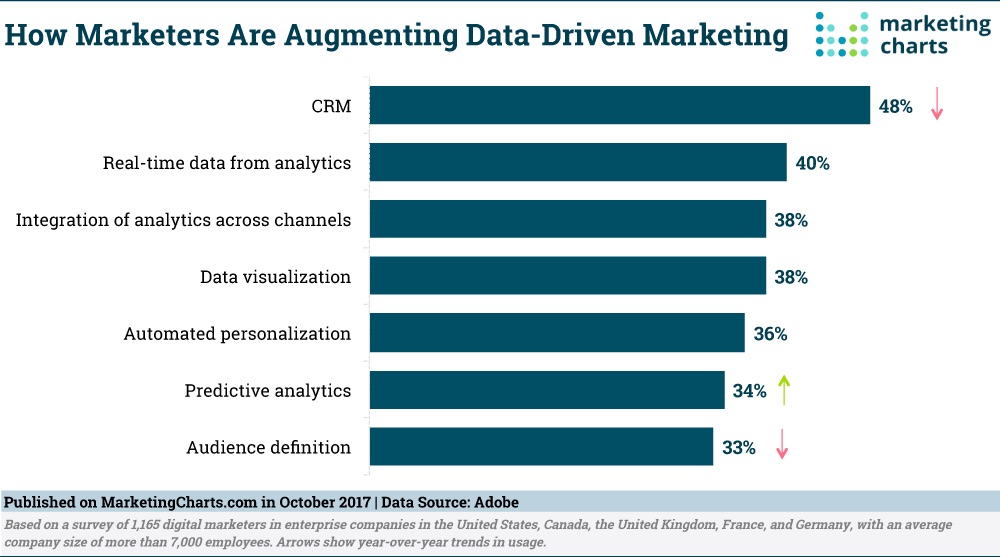
In this era of technological expansion, there is a vast array of tools that marketers can employ to realize these strategies. In this article, we discuss why Marketing Intelligence Platforms represent one of the most powerful options for businesses both large and small.
Today the customer journey is far from linear. There are numerous touchpoints at the awareness, acquisition, and conversion stages that can influence your audience and encourage them to buy. Online touchpoints could include email, search, display ads, social media, third-party sites, your website, and more. Offline touchpoints could include radio, TV, print, direct mail, word-of-mouth, phone, point-of-sale, etc.
10 years ago it was much easier to track a few audience engagements and understand how your marketing campaigns were performing. Today, it’s much more challenging as you may not have the appropriate software capabilities to track certain channels. Even if you do, there are still issues with having your data siloed on different platforms.
That’s where marketing intelligence platforms come in. These tools are designed to integrate data from all relevant tracking technologies you use, whether it be your CRM, advertising platforms, or point-of-sale tool. You can upload any relevant business data you need, such as inventory data, offline call data, and more. The ability to view and analyze all business data from a single platform makes it possible to get a complete picture of your customer journey and consider all relevant factors in making performance-enhancing decisions.
In the past, marketers could learn a lot about their campaign performance using various basic first click, last click, linear, or U-shaped attribution models. Now there are simply too many relevant touchpoints to rely on elementary definitions.
Marketing Intelligence Platforms are equipped with artificial intelligence and machine learning-powered decision engines that can empower marketers to build data-driven attribution models. This strategy utilizes your relevant business and performance data to understand how different audience interactions contribute to the conversion path across the customer journey. With Marketing Intelligence Platforms serving as a unified data source, they can tap into deep funnel data to help you make decisions that improve lead capture and conversion rates.
Centralized data analysis further makes it possible to focus on the key performance indicators that matter most for your business. Clicks and conversions can only tell you so much about your performance. Revenue, profit, cost per acquisition, customer lifetime value, and churn are complex but valuable metrics that performance marketers can utilize to inform optimization changes. When you include data from external data sources (think Weather.com, Nasdaq, DOW) you can also measure market share and what external factors impact performance.
Automatically optimizing based on predicted insights is the key capability that sets Marketing Intelligence Platforms apart from other marketing automation tools. There are plenty of technologies that offer high-end analytics dashboards, yet advanced analytics doesn’t help marketers see through the noise and truly surface the most valuable insights. By taking advantage of artificial intelligence and machine learning, Marketing Intelligence Platforms can not only assess your business data but pinpoint the insights most relevant to your business goals.
The more business data you have, the more necessary this feature really is. Regardless of how many data scientists you have on your marketing team, they don't have the capacity to constantly analyze the ongoing stream of relevant data that flows through. Look at bid optimization, for example. There’s bid landscape data, competition, budget, inventory, and many other important factors to consider on a daily basis. A powerful Marketing Intelligence Platform can process all this data for you and derive lucrative insights to inform optimization tactics. It can then activate these insights by making thousands of bid adjustments daily to make sure your campaigns are always at optimum efficiency.
With the rise of omnichannel, marketing budgets are increasingly stretched thin. Even enterprise-level businesses need to be careful about how much budget they allocate to different marketing channels. Wasting even a small portion of your budget leads to inefficient campaigns and difficulty keeping up with competitor tactics.
Marketing Intelligence Platforms can help businesses make sure their entire budget is spent wisely. Again, it all goes back to unified data management. Data from various marketing channels, customers, products, and departments across your business are all analyzed together so you can understand exactly how different factors are impacting your bottom line. You can also get a deeper understanding of how spending impacts specific goals such as revenue or retention.
The ability of some Marketing Intelligence Platforms to automate insights and make quick changes to optimize your campaigns also has a huge impact on efficiency. The competitive landscape is changing constantly. A machine that can analyze performance based on the latest trends and then make changes to keep your campaigns optimized can significantly reduce wasted ad spend.
Marketing Intelligence Platforms centralize data from the various departments throughout your business, including marketing, sales, operations, IT, etc. As a result, they can provide insights relevant to teams at different levels of your business.
It’s common for teams to operate as siloed units with little collaboration between them. Marketing Intelligence Platforms can set up the marketing team as a leader in analyzing relevant data for different departments and generating ideas for new optimizations. Insights derived from unified data analysis can help improve sales execution and efficiency of other business processes. Comprehensive data analysis also encourages cross-team discussions that can lead to all sorts of new, innovative ideas to improve customer experience, drive more sales, improve retention, and drive growth.
Once you understand how Marketing Intelligence Platforms work, it’s clear there’s a lot of benefits to utilizing one for marketing. Still, it’s easy to come up with reasons to hold off investing in new software and integrating it into your strategy. There’s always a way to justify waiting until your business expands or a new quarter starts. You might even think it’s a good idea to invest in a few years down the line.
However, one thing is clear: the unstoppable rise of Marketing Intelligence Platforms has already begun. There is simply too much relevant data you can use to optimize your marketing strategy and other processes. Businesses that use a Marketing Intelligence Platform are already benefiting from better analytics, optimizations, forecasting, cross-team collaboration, customer service, and more. Sooner or later, investing in this technology will be essential to keep up with competitor performance. For many businesses, it already is.
The COVID-19 pandemic has quickly impacted our lives. From canceled events to shelter-in-place orders, the world looks very different than it did just a few weeks ago. People throughout the world have been asked to work from home, avoid gatherings of over 10 individuals, and eliminate travel in order to flatten the curve of infection. These lifestyle changes are impacting how, when, and where people consume media.
It’s evident that much of the free time that people are now spending at home is occupied by consuming media of all types. Here’s what the new normal looks like from a media perspective:
During the first weeks of shelter-in-place decrees in numerous cities and towns, bandwidth for video streaming services increased by 12%. New subscriber volume for Netflix is also up, with over 250k welcome emails in one March weekend. Netflix is also increasing “winback” efforts to re-engage lapsed subscribers.
Connected TV streams are expected to soar past the 2019 average of 4 hours and 28 minutes per day.
Select publishers are allowing free online access to COVID-19 news and information, regardless of existing paywalls or article limits. Additionally, content creators are getting creative in distributing offerings normally available for a cost. For example, fitness companies are offering free workouts, meditation apps are releasing COVID-19 stress relief content, and musicians are streaming acoustic concerts.
Social distancing has limited in-person interactions. During this time, the need for human connection has been partially replaced by increased use of social media outlets. There has been a 22% increase in Instagram impressions and a 27% increase in TikTok engagement. Time spent on social media is expected to increase, while the types of activities are expected to remain the same (keeping up with family and friends, viewing news and entertainment, etc.).
When it comes to breaking news, consumers prefer TV over other vehicles due to longstanding trust in the medium, as well as the speed of updated information. During this pandemic, we also expect the digital extensions of these TV broadcasts to see a significant boost.
Many live sporting events throughout the world, from NCAA March Madness to the Masters, have been canceled or postponed. The time spent watching sports has since shifted to other video content and video games. Among sports superfans, 61.5% also subscribe to at least one streaming service. Additionally, online gaming has skyrocketed by 75%.
With COVID-19 reaching pandemic proportions, trusted news sources have become essential to day-to-day life. Self-distancing and shelter-in-place orders have increased time spent with trusted digital news outlets. According to WebsiteIQ.com, CNN’s traffic increased by over 30% between December and February. Overall, week-over-week usage patterns show total web traffic has risen by 22%.
Newspapers are significantly more likely to be purchased by people 65 years of age and older, who are strictly observing self-distancing guidelines and staying home. Additionally, the reduction in the number of commuters and travelers who pick up print publications has decreased circulation rate.
As the world adjusts to new habits, people’s media consumption has shifted too. We will continue to share our knowledge and resources during this time to keep advertisers and marketers up-to-date.
Are you looking to navigate through these industry changes? Connect with Centro to get started.
My name is Haley Winckler, and I am the 2020 Content Marketing Wintern (winter intern) at Centro. During my time here, I’ve worked on a variety of projects across social media and the website you’re currently on, from both the Chicago HQ office and my home in Roscoe Village, Chicago. The last two weeks of this internship also happened to fall in line with stricter social distancing measures implemented in an attempt to slow the spread of the new Coronavirus (or COVID-19). While this specific situation is certainly anomalous, for many, the concept of working remotely or working from home (WFH) is not.
Those usually not considered in the remote workforce, are interns! I have had several internships prior to this one, and in only extreme or very special situations could an intern be allowed to work from home. Even before this socially distant period, Centro’s flexibility and culture surprised me in that they were very willing to work with their interns should they need to work from home or remotely for any reason. Now, with a few weeks of working from home at Centro under my belt, I’ve had a chance to reflect on my experience.
Ultimately, I’ve concluded that there are definitely perks and challenges to this scenario. Below, find my perspective on working from home, as an intern.
Perk #1: You’re at Home!
This might sound obvious, but the best part of working from home is exactly that – you’re at home! During the workday, all the comforts of home are right at your fingertips. These might include but are not limited to: your coziest pair of socks; your pet, your favorite foods or snacks (although let’s be honest, nothing beats Chipotle…), and the glorious amenity of your own bathroom. It begs the question, “Why haven’t I worked from home before?”
Challenge #1: Your Team is also at Home
I’m a naturally social person, so I thrive when I can chat with my pod or fellow interns in the kitchen during the workday. I enjoy hearing how your day is going, or how you’re surviving the noisy construction across the street from your apartment, or about that new restaurant you tried last weekend. It can feel lonely when you’re working away from your team—and it’s sometimes easy to convince yourself that you’re out of the loop. Luckily, things like virtual happy hours and phone calls help break down those barriers and have made reconnecting easier than ever – it just may take a little extra communication and effort (and it’s worth it, I promise).
Perk #2: Commuting is Easy-Peasy
My new commute from upstairs to downstairs is far more pleasant and much quicker than my old one into the office—which consisted of a bus and a train, there and back. I’d imagine that those folks who sit through traffic every day are not missing that element of their work week at all. The extra 60 to 75 minutes in my day allow me to make myself a healthy breakfast and get a good stretch in, all before I open my email. I’ve felt more focused and grounded in the mornings as a result of this, and I hope to continue weaving it into my weekday routine (remote or not) moving forward!
Challenge #2: Distractions are Everywhe—Ooh What’s That?
Depending on your environment, it may be hard to focus or be as productive as you might’ve once been from your office. Roommates, significant others, the neighbor’s barking dogs, phone notifications, chores—they’re all right there in front of you when working from home. Self-discipline is the name of the game, and it's not always easy! I’ve found that a clear and organized to-do list, along with regular check-ins with my manager, have helped me stay on track. Oh, and breaks. It’s always good to stand up and step away from your computer every now and then to “reset” your brain. I also try to keep my phone in another room or under something on my desk—for me, “out of sight, out of mind” truly works wonders.
Perk #3: Nothing Lasts Forever
In our current situation, it’s important to remember that “this too shall pass.” I’ve been trying to focus on the silver linings—we’re lucky to be able to work from home, and hopefully our efforts will keep more people healthy and decrease the amount of time we need to spend physically apart. If you’re an intern like me who’s also working from home, know that this is a great sign from your employer—they value and trust you enough as an employee to be reliable and hardworking during this time. Don’t take that trust for granted; show up for yourself and your team every day as you usually would in the office, and kick some butt!
Lemons to Lemonade
Ultimately, attitude plays a big role in any WFH experience. Framing challenges as the rain required for a rainbow to show is a much more fun way to approach this time in our lives. If you’re an intern or young professional like me, this experience working from home is incredibly valuable. Your performance during this time can be a point to bring up in future interviews to exhibit that you’re a flexible, adaptable, productive employee in the face of stressful situations!
Interested in learning more about what it's like to work at Centro? Check out our Culture page here.