
Technology
Basis Platform
Advertising Operating System
Communication Portal
Intelligent Collaboration
All Channel Activation
Activate Media on Every Channel

Consulting
Resources
I’ve had the pleasure of working from home with my husband for several years. The honeymoon phase of spending 24/7/365 together certainly ebbs and flows, but through trial and error, we've found many ways to optimize our "working" relationship.
Here are my five top tips for coworking with a partner:
1. Take turns making lunch
This prevents you from wasting an hour every day asking, “What do we want to eat?” Meanwhile, it feels luxurious on the days your partner makes the meal.
Alternatively, trade off tasks instead of days—for example, one of you cleans and the other makes meals.
2. Show each other your work
Ask for some help on something or show off a new project. It’s amazing how much better your work gets when you have a second set of eyes. Even if it’s just “Can you read this email before I send it?”
And, learn about your partner’s job! It’s shocking how many couples know almost nothing about how their partner spends most of their time. Even if it’s just “What does that acronym you said on that call mean?” Apparently all I say everyday is KPI, CPM, and ROI…
3. Have clear boundaries
Ask before you interrupt and don’t get mad if your partner is busy. Set some clear boundaries like, “When my headphones are on I can’t talk.”
It's also helpful to have a clear boundary activity between working and not working. Even if it’s just “We’ll go for a walk at 6pm.” Otherwise you never really stop working.
4. Plan some post-isolation fun stuff
Start planning a few things you can’t do right now that you’ll do afterwards. Even if it’s just a big dinner or a road trip. Give yourselves something exciting to look forward to.
5. Don't forget the small stuff:
Interested in joining our team? Check out our careers page.
If there’s one thing that sets a marketer apart from the rest, it’s the ability to take complex data and present it in a visual, customized, and comprehensible way. Now, through a proprietary connector, Basis passes planning and delivery data to Looker Studio so users can create branded, tailored, and interactive dashboards.
With this tool, you can provide stakeholders with access to real-time information and easily showcase your campaign’s success. Here's how:
After logging into Looker Studio with your Google account, click here to reach Basis’ connector. Then, authorize both platforms to exchange information.
Once you’ve completed this one-time setup you can select the client and brand you'll be working with.
The dashboard will begin as a blank canvas, which you can personalize with different fonts, themes, and colors.
Looker Studio has the drag-and-drop design interface of PowerPoint, and the charting capabilities of Excel. Additional options include graphs, charts, maps, calendars, images, logos, and more.
We know that starting from zero can seem overwhelming, so we’ve put together a starter template for our users! The template includes a sample report you can leverage to tell the story of your campaigns—plus, we’ve left some notes to guide you through the process.
Now that you’ve completed your dashboard, it’s time to share your data. There are many sharing options: You can invite people to view or edit reports, schedule emails to display reports, post them on your website or social media, or download them as PDFs.
The best part? There are no additional charges to use this service. Start connecting, visualizing, and sharing your data today!
Connect with us to learn more about this and other enhancements we’ve added to Basis this spring.
The difference between ordering a small desert and a small dessert could impact your dining experience.
You partner may reject your marriage proposal if you give them a wring, instead of a ring.
In short, a misplaced word or extra character holds a lot of power!
What happens when your organization’s data contains typos? A ripple effect of errors, as many of us know all too well.
Basis includes a naming convention feature to solve for this issue. Basis users store their company’s nomenclature as formulas, and quickly apply them to line items to create harmonized records. The feature accelerates processes and prevents undesired outcomes resulting from misspelled words.
Your company’s data is one of its most valuable assets! Ensuring that it’s properly logged allows you to:
Automating processes and generating efficiencies across your campaigns, team, and business is at the core of what we do. Learn more about how Basis can help your business! Connect with us today.
The time has come, and it is long overdue. We need to retire using click-through rates (CTR) as a performance metric that defines success on digital display advertising or social campaigns. Sure, it served us well in the early days of digital advertising as a reliable metric we could count on. But now? Let's make digital media meaningful and say goodbye to CTR being the sole measure of success.
As the digital display advertising landscape has become more complex, CTR falls short in connecting the dots and driving results. Many channels and tactics come into play with campaign execution, and CTR is rarely going to provide the most meaningful results towards an agency or brand's overall business objectives.
Ask yourself: what meaning has come from CTR recently? If site traffic is the ONLY goal you care about as an outcome from digital display advertising, then consider moving to a Landing Page View (LPV) goal. This can help bridge the gap between driving site traffic and a user’s time spent on a page. Facebook pushed for this shift from CTR to Landing Page Views in 2018 to combat “clicky” behavior from users and drive more meaningful and efficient performance. Centro quickly adopted this best practice and saw very strong results across many verticals.
If you are looking to move drive stronger results for your brand, then let's all agree to put CTR away. Instead, focus on getting those pixels placed!
Laying out a clear and concise pixel strategy by identifying key actions on the site to track, and ultimately, the most valuable or final action a user can take, provides the opportunity for far more actionable insight for all display advertising campaigns. Not only will you be able to understand true efficiency against media dollars in getting a user to act or convert, but this also creates more clarity around the customer journey.
Here is where the meaning comes in. By understanding your audience's path to conversion, more measurement and analytic solutions arise. From implementing a DMP strategy – to the use of attribution modeling, to testing new creative messaging—all these opportunities and more, can now come into play.
Based on current global, economic, and cultural conditions for the foreseeable future—meaningful approaches to support digital media and display advertising efforts should pay off in the long-run. This time has forced many advertisers to pause, reflect, and reframe their messaging. It is an opportune period to find ways to be precise, deliberate, thoughtful, and thorough in digital media and display advertising executions.
Centro is here to help navigate these difficult times. We highly recommend tuning into Centro’s most recent webinars about Industries in Flux: Advertising Through Crisis and Industries in Flux: State of QSR’s. We also recommend checking out a recent blog post about How COVID-19 is Changing Media Consumption and the most recent Digital Innovations Awesome List, which compiles the latest trade pubs and trends.
As we face a new frontier in every facet of our lives, let us reflect and act on moving digital media into having a positive and meaningful impact in the future. Trust us when we say: the future is free of CTR.
At Centro, we know that keeping up with the trade pubs and latest trends can be tough and time-consuming. To make that easier, we’ve compiled all the articles, reports, and other bits of awesomeness you may have missed, but should definitely read. Enjoy our latest list below!
Agency Life: COVID-19 Will Cause 4 Permanent Changes [:05]
The remote work experiment caused by COVID-19 is transforming agencies. Automation will become even more integral to agency workflows, more offices will shift to a more distributed workforce, companies will reduce their real estate holdings, and agencies will rethink the necessity and extent of business travel.
Brands Can’t Bet on Quibi Without a Pivot That Reflects Millennial Needs [:04]
Brands and advertisers are curious about ad opportunities available from new entrants in the OTT/CTV space. Mobile-only video subscription service Quibi is one of the latest providers now struggling through the streaming wars and trying to make a case to advertisers. This column, by our own Noor Naseer, shares a pulse on where Quibi must improve for brands to consider advertising on the platform.
Cable News Ad Prices Stable Amid Pandemic, Viewership Soars [:02]
The increase of COVID-19 TV news content has come with higher overall TV news viewership and slightly higher “scatter” advertising pricing for cable TV news content over the most recent three-month period. Fox News posted $17,879 for an average 30-second commercial—while MSNBC came in at $11,078 and CNN was at $10,233, according to SQAD, the TV advertising pricing data company.
OTT vs. CTV : What’s In A Name? [:03]
Over the past few years, streaming services and exploded and along with that, confusion on naming conventions. People tend to use OTT and CTV interchangeably, but that is not accurate and the IAB Tech Lab breaks down the nuances. TLDR: Use CTV to refer to a specific type of device, and OTT to refer to content.
Cookieless Web : 3 Areas To Watch In The Second Half Of 2020 [:05]
With the announcement of Chrome to block third-party cookies, there will be three key areas to monitor for a successful transition to a cookieless web: 1) the long-standing battle of the browsers, 2) the walled gardens and how they will help marketers mine customer behaviors, and 3) measurement problems.
New York Times Phasing Out All 3rd-Party Advertising Data [:02]
With third-party data being phased out of the ad ecosystem due to privacy concerns, the New York Times is building out a proprietary first-party data platform. They will begin to offer clients 45 new proprietary first-party audience segments to target ads, and plan to introduce 30 more interest segments in the second half of the year. The segments are broken up into 6 categories: age (age ranges, generation), income (HHI, investable assets, etc.), business (level, industry, retirement, etc.), demo (gender, education, marital status, etc.) and interest (fashion, etc.). Watch for more large publishers to follow suit.
Instagram To Test New Revenue Streams, Including Badges and IGTV Ads [:03]
Instagram is launching new tools that enable video creators to make money, including badges that viewers can purchase during Instagram Live videos. Badges will give viewers a way to support their favorite creatives. Once purchased, badges will appear next to the person’s name throughout the live video as they comment, helping them stand out.
Facebook Shops : The Timing Couldn’t Be Better But It’s Not A Play For Amazon [:05]
Facebook launched a new e-commerce service, primarily aimed for smaller businesses and brands, which will allow them to sell directly on Facebook. The service will be free and the business model will be paid ads.
Cross-Shopping Is On The Decline And Grocers Are Trying to Capitalize [:02]
Cross-shopping, which is when customers visit multiple stores to get the best deal, is seeing a dip in stores as people are trying to get the most out of their shopping trips. Consumers are becoming more “mission-driven” on longer, single-location shopping trips. While more people avoid shopping in multiple stores, price comparison tools are on the rise with less brand sensitivity.
The VR Winter [:06]
VR is not new. It was explored heavily in the 80s, but didn’t work because the technology at the time wasn’t there. More recently Moore’s law and the smartphone component supply chain meant that the hardware to deliver the vision was mostly there, but not enough to make really great mass-market consumer devices. We’ve had 5+ years of experimental projects and all sorts of content has been tried, and nothing other than games has really worked. Has the technology not fully caught up (ie; we need mixed reality contact lenses) or have we just not thought up what the killer experience is for widespread VR adoption?
I am sad and heartbroken at what is happening in our society, cities, and communities right now.
I watched the brutal and unjustified killing of George Floyd this past week by a few corrupt police officers in Minneapolis, MN, in a state of anguish and anger.
I felt the same way as I watched and read about other similar events over the past few years: Trayvon Martin (Sanford, FL), Michael Brown (Ferguson, MO), Laquan McDonald (Chicago, IL), Eric Garner (Staten Island, NY), Freddie Gray (Baltimore, MD), Samuel Dubose (Cincinnati, OH), William Chapman (Portsmouth, VA), Walter Scott (North Charleston, SC), Philando Castile (St. Paul, MN), Alton Sterling (Baton Rouge, LA), Ahmaud Arbery (Glynn County, GA), and Breonna Taylor (Louisville, KY).
These are the names and incidents I remember—and yet, they leave out the hundreds, maybe thousands, of unjustified killings of (mostly) Black men and women that don’t have videos or media coverage accompanying their deaths.
I watched this weekend, as citizens took to the streets of Chicago and across the country, to protest the unnecessary use of deadly force and violence by police and vigilantes in our society. I also witnessed firsthand, the looting and destruction of stores, businesses, buildings, and city landmarks.
To that say my heart is broken for my city and country right now, would be an understatement.
I have heard many friends, pundits, leaders, and politicians quickly jump to comment on the horror of the destruction and looting taking place. And I call bullshit.
The physical destruction of stores and businesses, the out-of-control looting and robbing, and the defacing of historical landmarks are unjust, immoral, wrong, and intolerable. Let there be no question, those who have engaged in these unlawful acts should be arrested and prosecuted under the law.
However, to focus on the looting and robbing as one’s primary and immediate point of view is missing the point and lesson inside this tragic moment.
First, and most importantly, we have a serious and sick problem in our society that is not being addressed. It starts with Black men (primarily) being indeterminately killed for petty offenses, and in some cases no offenses at all, by corrupt and/or poorly trained police officers. Don’t get me wrong, bad cops are bad cops that unjustly kill whites, Hispanics and Asians, too—but Black men are killed at more than twice the per capita rate than white men.
Second, American society is structured around systemic oppression and discrimination of minorities, with Black citizens bearing the heaviest load.
As hard as it is for me to witness looting and destruction in my city, it would be immoral and irresponsible of me to direct my focus, anger, and judgment toward these perpetrators, while ignoring the decades of abuse, incarceration, and injustice that have led us to the current civil unrest and disobedience.
I’m troubled when I see social media posts or talk to people, and the first thing they focus on is the horror of the looting and destruction. My response is, “Where were your Instagram and Facebook posts, and outrage over racial injustice the last few decades? Now that the long simmer of anger over oppression and abuse has reached a boiling point, and is spilling out into your neighborhood and directly affecting your neighborhood, business, or businesses you frequent—you’ve finally decided to become civically engaged, enraged, and publicize your opinion?”
I feel horrible for the businesses and the store owners that have been affected deeply. I know how hard it is to run any kind of business and this weekend has been devastating. It’s even more so when we factor in the backdrop of the COVID-19 pandemic and how catastrophic that impact has been to businesses of all shapes and sizes.
The violence, looting, and larceny is sickening and makes me physically ill. On Sunday morning, I walked around my neighborhood documenting the destruction. I’m not an emotional person but I cried on my walk, thinking about the historical events that led up to this moment—the pain and suffering of the business owners, the amount of work required to rebuild my city, and the extremely difficult jobs the good policemen and women of Chicago have right now.
Physical destruction is temporary. Buildings will get rebuilt. Windows will be restored. Merchandise will be replaced. Graffiti will be removed. The pain of systemic Black oppression, however, lasts generations.
I believe the vast majority of policemen and women are good people. They take their duty to serve and protect seriously. They care about you, your family, and doing all they can to protect our neighborhoods and communities. I find deep truth in the phrase, “No one hates bad cops more than good cops.” As with anything in life, it’s the small percentage of bad apples that ruin the image and reputation of the vast majority.
Just as it would be immoral and unjust to label, or define, all cops by the reprehensible actions of a few bad cops, it is also immoral and unjust to define the entire Black community and protestors by the heinous actions of the looters and criminals terrorizing our cities.
Now is a time where all good people must come together and stand on the side of justice, equality, and fairness in our society. It’s not okay to not pay attention or care about the plight of others, as long as an issue doesn’t directly affect you and or you pretend it doesn’t exist. It’s not okay to wait until your life, or community is personally impacted by the damaging and ruinous effects of police brutality and oppression and then, when it does, focus on the rioters and looters while choosing to ignore the compounding effects of what has led society to the moment we’re in.
Good cops need to call out bad cops. Good cops need to eradicate and eliminate bad cops from their ranks. Good protestors need to call out the criminals in their midst. Peaceful protestors need to stand on the side of law enforcement and call out, prevent, and thwart unlawful acts of violence and looting. The good outnumber the bad by multitudes, and the good should never allow themselves, their causes, or missions, to be defined by the bad with respect to cops and protestors.
So, what can we do?
A complete answer to the question would require a short novel as the list is endless and exhaustive of how we can make a difference individually and collectively. The following are a few thoughts on what we can do in our small circles and corners of society.
On an individual level, we need to take time and seek out where we are prejudiced, or in the case of the white majority, where we are racist. Everyone is prejudiced. I am prejudiced and racist. It’s impossible for all of us not to be prejudiced or racist in some way, shape or form.
Our individual work is not about eradicating and eliminating our prejudices or racism, but rather identifying where we are, so they move to our conscious state, versus them, living in our unconscious psyche. If anyone says, “I’m not prejudiced” or “I’m not racist,” it shows the prejudice and racism deeply rooted in one’s unconscious state. It’s not until we identify where we are prejudiced, are we then open and able to begin the work to understand, evaluate and determine how, and where, those prejudices show up in our thoughts, actions, and daily lives.
Once they are known and consciously identified, we can then objectively observe them, and catch them when they show up on a daily basis. Once they’re caught, it opens the door for us to counteract the prejudice thoughts, and we can begin to reprogram our thoughts and minds. Change doesn’t happen overnight, and it’s not realistic that we will ever fully eradicate all prejudices in our heads—but, the goal is to ensure we control our prejudices and not let our prejudices control us.
The most frustrating and disheartening part to me, relative to the protests and riots this week is that we are experiencing a failure in societal and political leadership. In a time when millions are suffering financially, mentally, or physically due to the coronavirus pandemic and/or the feeling of systemic abuse and oppression, it is a time for leaders to listen first, and then take action.
Unfortunately, I’m not seeing much of either. The first step to deescalating conflict and tension is to listen empathetically, with the intent to understand. When someone is hurting, before we can discuss ways to relieve their pain and suffering, we need to listen, and they need to know we not only heard them but also understand where they are coming from and we honor their right to feel the way they are feeling. At this moment, I’m seeing a lot of threats, condemnation, and blaming of the protestors and rioters, versus empathic listening with the intent to understand.
The next step is to take action and put forth a plan to improve the situation. In this case, what is our plan to reduce the number of unwarranted and unjust killings of innocent civilians or civilians who have committed petty crimes?
The only statement a leader needs to make is that they find these actions morally and lawfully reprehensible, unacceptable, and they are not going to continue under their watch. There needs to be a strict, well-organized, clearly defined, and well-publicized plan on how our elected officials, cabinet, and council members as well as law enforcement leaders are going to address this swiftly, judiciously, and with great force and momentum.
These merciless killings have been going on far too long in this country and the time for hollow words and empty promises are over. We need leaders with the authority to enact substantive changes to step up, put forth a plan, and then execute the plan.
Without a plan, this pattern of unjust killing followed by protests will continue to repeat itself with each instance becoming more and more violent, dangerous, and destructive.
Although corporations and businesses aren’t in as powerful a position as government leaders, there are many things we can do to improve the systemic oppression that exists in our country.
The first is to take Diversity, Equity, and Inclusion (DEI) seriously in our companies. Each CEO needs to directly engage in understanding where their company is falling short, or where they can continue to improve and refine, their DEI initiatives.
DEI isn’t just about percentages of women, minorities, and LGBTQ team members inside of an organization, although that’s a great place to start. It’s about understanding the current culture and how open, welcoming, accepting, and integrative the culture is to minorities or people who don’t resemble the mean population.
It’s about setting high expectations with management and recruiting teams; to put in extra efforts and be proactive about hiring minority candidates. It’s about educating everyone in the company relative to their unconscious biases when interviewing candidates, so the best candidate doesn’t get passed by because they look different than the norm.
The more businesses can improve their hiring practices by creating an increased level of diversity, the better off the businesses will be, and, additionally, the better off society will be. No person of minority ever wants a handout or to feel they got a job because they are in a minority category. Rather, all they want is to know that they have as equal an opportunity as anyone else applying for the job, and then, may the best man or woman, win.
The events of this past weekend are sad, painful, and disheartening. I feel for the Black, and other minority groups, who have felt the pain of oppression for generations; I feel for the protestors who shouldn’t have to take to the streets to have their voices heard; I feel for the businesses who were disrupted and financially struggling before the riots and are now suffering crippling blows because of the riots, and I feel for the good policemen and women who uphold the oath to serve and protect as they are being defined by the crooked and corrupt officers in their ranks.
Mostly, I feel for society right now. We are hurting and divided more so than at any point in recent history. We are sick and unhealthy right now. There is no lack of big and important problems for us to work together on, to improve the lives of all Americans. Yet we spend our time demonizing, insulting, and ridiculing each other.
If there ever was a time to turn our swords into plowshares, it is now.
The faster we lay down our weapons, real or virtual, and start listening, understanding, empathizing, and working together to improve the lives of all of our friends and neighbors, near and far, the faster we will build a country and society we will feel proud of and safe in. Only then, will we know that each person, regardless of the color of their skin, the zip code they grew up in, the school they went to, the gender they identify as or romantically prefer, or the religion they choose to worship—America is the land of the free, the home of the brave, and the country where dreams can, and do, come true—for everyone.
Just about every industry has been hit hard by the coronavirus crisis, perhaps none more so than travel. The vast majority of tourist destinations across the world have been shut down at some point throughout the second quarter of 2020, while social distancing restrictions continue to greatly reduce the capacity for travel businesses to earn revenue.
That said, spending months stuck indoors has left many in desperate need of a vacation. Countries and cities are also taking precautions to support summer travel. Regardless of how bleak things may look, travel marketers should start preparing their strategy to begin their recovery process.
Here’s how you can get started:
Depending on where your business is located, you may still be unable to accept new bookings. But that’s not a reason to leave your marketing strategy on pause until you can. There’s a lot you can do to build brand awareness in the meantime to keep your business at the forefront of customers’ minds for when they can book with you.
Take to your social media channels to deliver your brand message and remind your audience why your business is so great. Look at what other travel brands are doing to keep an active social presence during any ongoing lockdowns—Sunset Marquis, for example, has weekly Facebook Live events where their chef offers at-home cooking tips.
Regardless of whether or not you can welcome any bookings or earn revenue from such brand awareness efforts, these tactics will set you up to start out strong when things open up. You can likewise take this opportunity to promote gift card purchases, as many of your loyal customers may want to support your business during this time. Gift card purchases can further ensure a steady flow of customers when you finally open for business.
Times are still very uncertain, which is why few people are willing to make travel plans right now. If you want to convince your audience to purchase, you need to offer security and incentives to make it justifiable.
According to a recent Fuel Travel survey, here are the factors that would most likely persuade consumers to book a future vacation during the coronavirus outbreak:
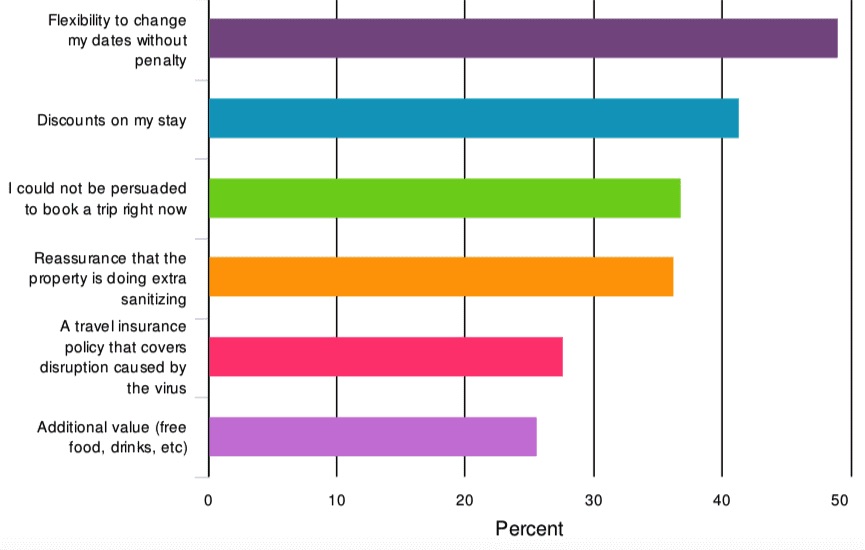
While a lot of people wouldn’t book travel right now for any reason, that number will gradually go down as time passes. There are also a plethora of tactics you can implement immediately to encourage future bookings, namely:
If your business is located in an area that relies heavily on tourism for income, you could take advantage of any city or country-wide ordinances aimed at protecting travelers. The Cyprus government, for instance, has vowed to pay for the vacation of tourists if they get coronavirus after their stay.
Your target in-market audiences need to shift for a while after the coronavirus. It could be quite a considerable period of time before people are allowed to fly to certain countries, and even longer before people feel safe going through the whole process of flying. With that in mind, it makes sense to target local audiences who can reach your destination by driving.
Even if most of your target audience are foreigners, you can bring in a lot of new revenue from nearby locals. People in your area want to go on vacation this summer, but will likely be restricted as well. Your business can be the solution that helps them “get away” and enjoy the summer without going far at all.
Now is a really important time to reevaluate your marketing message and adjust it to fit the realities of coronavirus. The first thing you should do is illustrate that you’re taking the virus seriously. Promoting old videos or photos of large groups of guests sharing food at a buffet is an example of something that might make your audience uncomfortable now. Be sure to go through all your content and look at it through the eyes of someone troubled by a pandemic.
When creating new marketing material, try to deliver a message of hope instead of just focusing on caution. Help your audience see that things will eventually get better and that they can have their travel plans worked out for when they do.
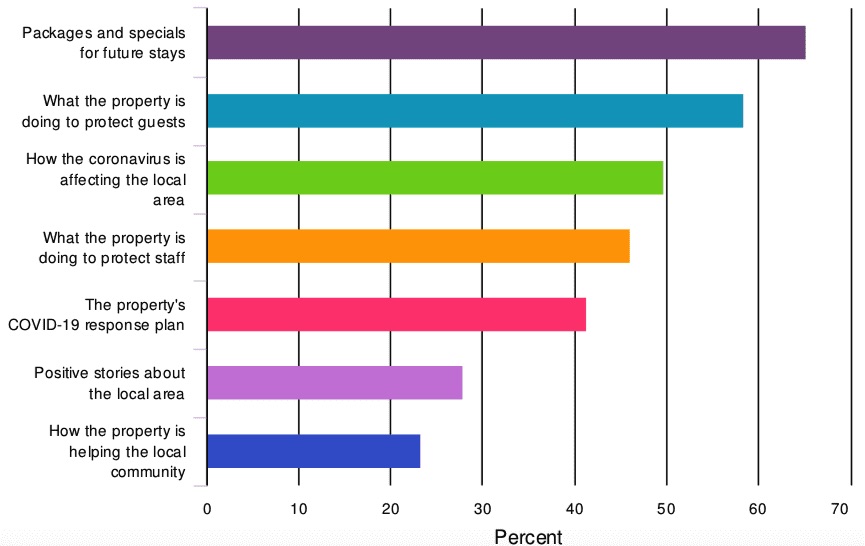
You can also market your business better by focusing on things people have missed most during the pandemic. For example, instead of promoting in-room amenities to an audience that’s been stuck inside for months, it makes more sense to feature outdoor activities they can participate in at a safe social distance. To get some inspiration, here are some of the different topics consumers said they’d like to hear about from hotels during the outbreak:
Now is a really good time to perfect your paid media strategy. Display ads are a great way to showcase your brand awareness efforts and keep your business relevant and in the limelight. Paid search ads are also a fantastic option to focus on. Fewer businesses are investing in paid ads right now, which means cost-per-click (CPC) is going down. This is an opportunity to get more visibility for your ads without having to pay more to compete with other businesses in the auctions. This strategy is particularly valuable when targeting bottom-of-the-funnel audiences looking to book hotels or other travel services for a later date. In your ads, use discounts, amenities, and other incentives to convince people it’s an ideal time to book.
There many strategies you can execute on right now to prepare your marketing strategy for when governments give the green light for travel. The real key to recovery, though, is flexibility. There’s no way to know for sure how much business you’ll get this summer or when things will really start getting back to normal. You need to follow the trends post-pandemic and adapt your strategy to match them.
Start by regularly aligning your marketing plans with your revenue manager. How much you should spend on advertising really depends on how much you can hope to earn. Search volume on your highest-converting keywords can be a good indicator of how many sales you might expect to see this summer. As time goes on, pay attention to your sales projections and invest more aggressively in bottom-of-the-funnel targeting as demand increases. Adjusting your strategy means slowly investing more in lower-funnel and less in upper-funnel initiatives, based on realistic revenue potential.
Once demand starts to go up consistently, you can confidently wind down your brand awareness efforts and focus more on converting leads. For advertising, this means bidding high on brand keywords, investing in retargeting ads, and using other tactics to convince your audience to buy now. Even as things get back to normal, you should still promote special offers to differentiate your business and maximize new sales at the beginning.
Effective communication is one of the most important soft skills you can have in our industry. But even for the best communicators, challenges arise when transitioning from communicating in-person to communicating virtually.
On that note, I wanted to share some tips, tricks and suggestions on how to best communicate with your manager while you're working remotely. Ready? Let's do this!
Now more than ever, you’ll want and need this time together. Make sure you have an agenda for each meeting so that you can use the time effectively and efficiently.
I’ve always found it helpful to wrap up my 1-on-1 with a quick recap of the call so that both my manager and I are clear on what we’ve discussed and any next-step action items.
Many of us take for granted the tremendous amount of information that’s shared when we’re physically in the same office: quick chats in the hall, popping into your managers office, turning to your left or right to ask a question, etc!
This loss of ease might have you feeling like you need more frequent chats with your manager. If this sounds like you, ask for the time you need!
Between email, Zoom, phone, video, text, Teams, Slack and more, we have access to so many ways to communicate.
Take the time to assess what works best for you and your manager. Try to avoid falling into the trap of rapid-fire communication across every tool you have access to. The goal here is to streamline communication, not to make it chaotic or cause confusion.
If you’ve made it this far into my blog post, I may have inadvertently confused, offended, or bored you. Please understand, it wasn’t intentional!
See what I did there? The point is that there is a lot of room for misinterpretation when we communicate via email. So, try to be as clear and concise as possible, and don’t take things personally if you’re on the receiving end of an email that doesn’t sit quite right with you.
Sometimes it helps if you insert some personality into emails to help set the right tone: .gifs, emoji’s, etc. ?
If you exchange 3 emails on the same topic, STOP. You are not communicating clearly. Ask to hop on the phone or if it’s not time sensitive, add it to your check-in agenda.
This one applies to not just your manager but your entire team: Thank them for their hard work, for their generosity, for their understanding…we’re all in this thing together!
“More frequent 1-on-1s. Come to the 1-on-1 with an agenda to discuss with your manager.” —Alana Putterman
“Use texting for an immediate concern. Use email for things that you have more time. Over-communicating is key—sharing both what does and doesn't work to get feedback.” – David Lempp
“Be transparent and over-communicate. Wouldn't be a bad idea to set some expectations on WFH with them, your schedule and the best way to reach each other. Get regular weekly 1-on-1s on your calendar if you don't already have them scheduled. Come prepared with questions, updates, challenges and wins.” —Kelly Wittmann
“I will always go on Teams in the morning and just say, "Hey," to my manager and teammates. It lets them know I’m here and alive, also starts a conversation if necessary.” —Michael Lagioia
“Speak to them about the best way to communicate daily (text, IM, email, call, etc.). Share your goals, priorities and deadlines upfront on a weekly 1-on-1 call. Don’t make assumptions, if you have questions or feel unsure just use the phone and actually speak with them.” —Kami Lentz
Interested in joining our team? Check out our careers page.
While many businesses have been forced to cut back or halt their marketing efforts this year, now is the time to start thinking about the future. It’s expected a major recession will have an even larger impact on society than the coronavirus itself. If your business is going to survive and thrive in the long run, you need to adapt your marketing strategy so it’s maximally optimized for the new world order.
Here are a few key strategies you can start implementing to help your marketing program recover post-COVID-19:
This is probably the most important piece of advice for marketers post-COVID-19. You can’t go back to business as usual after a global pandemic that’s impacted just about every person in the world. Delivering the same old marketing message would simply come off as insensitive.
If you want to keep your customers happy and content, you need to send out a clear message that elicits care and understanding. You’ve probably seen numerous examples of businesses already doing this. Allstate Insurance started a loan program for customers impacted by the coronavirus. Verizon Wireless live streams a weekly series raising money to help small businesses during the pandemic.
Failing to reach out to your audience to show that you’re there to help can have a serious negative impact as well. At the beginning of the outbreak, when Airbnb started canceling reservations and leaving hosts to deal with the losses, there was outrage. Hosts felt abandoned by the company and it was making global news headlines. Airbnb then quickly launched their Superhost Relief Fund, a program offering small grants to hosts struggling to make ends meet.
While the fund doesn’t help the vast majority of hosts, the gesture was all they needed to avoid negative sentiment towards the brand. So, try to do something, no matter how small, to show your audience that you care.
While most of the advice in this article relates to marketing sentiment, there are also some strategic changes you can make to improve your strategy post-COVID-19. One of the most purposeful tactics is investing in PPC ads. According to WordStream, conversion rates from Google ads decreased drastically after the pandemic began. This makes plenty of sense because most ads relate to businesses and services that simply can’t be used during lockdowns. Many people have also been impacted financially, consequently meaning they will be spending less.
Lots of businesses have paused or cut back their PPC campaigns as a result. This leaves a huge opportunity to win PPC auctions and gain visibility for your ads at a low cost. It might seem counterintuitive to invest more in PPC when conversion rates are down overall, but the truth is the drop in cost-per-click (CPC) is much steeper than the drop in conversions. The post-COVID-19 marketing environment offers a unique opportunity to maximize ad visibility while minimizing costs.
Every industry needs to make major adjustments to how they market online — some more so than others. For highly affected industries (e.g. travel), it makes sense to take a break on promoting ticket sales. At the time of writing this in May, some cruise ship companies are already publishing ads promoting summer trips.
The majority of people think it’s way too early for that, which makes cruise companies look negligent as opposed to caring for their customers. However, there are some ways you can cautiously promote your business given these uncertain times. Airlines wishing to sell tickets could switch to promoting safe business travel instead of targeting vacationers.
Switching focus to long-term lead nurturing is another option as well. Restaurants or vacation rentals shut down by the pandemic could market to their audiences with a reminder to “save up for when things open up.” If you do a good job of nurturing leads during the second half of 2020, then the chances are you’ll get a lot more sales in 2021.
An advertising message that was perfectly acceptable six months ago could be perceived in a negative way today. So before using your old material, take a close look at it through the lens of a global pandemic. Take a look at this Progressive Commercial that showed in March. It features two women having a dull time at a karaoke night:
This commercial wasn’t well-received because it was released at a time when all anybody wanted to do was go out for a fun night with their friends. Now may not be a good time to feature marketing content with people gathering in groups or frolicking outdoors. Even if social distancing measures are being eased in the countries you market to, it’s better to think about the long term. People are going to be cautious about mixing with each other for a long time to come and there’s a very good chance the public may be asked to observe distancing protocols again in the future. The key message is ultimately to make sure your content is sensitive to that before publishing it online.
Advertising platforms like Google have been making changes to help businesses adapt to marketing post-COVID-19. You can take advantage of these to improve the efficiency of your campaigns and drive more conversions. For example, Google has already made it free for US-based businesses to list products on Google Shopping. If you’re in eCommerce or hoping to start, now would be the time to do so. They plan to roll out free Google Shopping listings to other parts of the world later in the year.
Google has also made changes to their Local Inventory Ads so that businesses can highlight curbside pickup. Even after coronavirus passes, people will still feel reassured that they can pick up products in a safe and hygienic way. Start tapping into these features to drive more conversions.
Since a recession is just beginning, it’s important that your sales and marketing strategy work together to reassure potential customers that it’s a good idea to buy from you at this time. Even if they like your products, lots of people are hesitant about buying with an uncertain financial future.
There are changes you can make to quell these fears. For example, if you sell expensive products, you can offer financing or payment plan options to get more people to buy. If you offer software or subscription services, consider giving customers the first month free. Being flexible with payment during a recession can help you drive more sales overall.
These are just a few key strategies that will play an important role for businesses as they look to recover their marketing program post-COVID-19. In the long run, you’ll need to look out for and take advantage of every new opportunity to maximize your marketing performance. Pay attention to consumer sentiment and keep an eye out for new trends, features, and technologies you can use to improve the efficiency and effectiveness of your campaigns.