
Technology
Basis Platform
Advertising Operating System
Communication Portal
Intelligent Collaboration
All Channel Activation
Activate Media on Every Channel

Consulting
Resources
Due to advances in smartphone capabilities, we now spend more time on our mobile devices than ever before. Advertisers are aware of this shift and have refocused a majority of their efforts to cater to mobile advertising. However, with the ever-changing guidelines of pixels and cookies on mobile devices, advertisers are struggling to measure the effectiveness of these efforts. Fear not! We provide some insight and best practices on how to track mobile advertising efforts effectively below:
First, let's talk about the cookie—a common tracking tool on desktops, but a term wrapped in caution tape and question marks on mobile. Apple introduced Intelligent Tracking Prevention (ITP) within Safari in 2017 to curb tracking abilities and protect users’ privacy online. There have been several ITP updates since then; all of them have been focused on restricting the utilization of cookies to track user behavior.
In the Safari browser, third-party cookies are fully disabled and first-party cookies are deleted after seven days. From an advertisers’ perspective, this means that conversion activity can be recognized only if a user has: 1. clicked on an ad (thereby setting a first-party cookie), and 2. completed the conversion action within seven days of clicking.
The emergence of ITP has made the measurement of mobile advertising challenging for many advertisers. However, since ITP is focused solely within the Safari browser, there are additional mobile environments that an advertiser can utilize to gain better insights into their mobile advertising performance:
By employing mobile attribution partners, advertisers can track any actions or engagement within their app. These actions range from installs or opens, to placed orders.
If an advertiser wants to drive users to a brick and mortar location, Centro works with partners to measure in-store traffic via paid media efforts.
When a user navigates to an advertiser’s website after exposure to an ad, the phone number on the website dynamically updates to a new, custom number that a user can click to call. An advertiser can then easily attribute their call volume back to their paid media.
It's no secret that mobile advertising lacks a simple solution to measure the overall effectiveness of a campaign. By understanding the goal or target KPI you’re trying to accomplish, Centro can help strategize and implement a plan that will allow for maximum visibility into your mobile advertising performance across all devices.
Learn more about Mobile Advertising with Centro.
Based on those stats alone, audio is everywhere, which means the opportunities for audio advertising are endless. Below are some quick tips for developing effective audio advertising:
1. Audio isn’t clicked—be visually descriptive and include a strong call-to-action (CTA)
According to Spotify, audio ads outperform display ads with brand recall by more than 24%. Focus on strong visual storytelling. While some audio units include a companion banner, always mention your brand and prompt customers with a clear, concise CTA, to direct them where to learn more, buy now, visit your website or local store, or take another immediate action. If there is a companion banner in addition to your audio ad, make sure to keep it simple. It should complement and not distract from the audio ad.
2. Keep it friendly and conversational
Audio advertising allows you to reach customers 1:1 in a highly engaged setting. They may be listening to voices from a trusted news source, a favorite podcast, or singing along to their favorite song. Avoid abrupt sound effects or loud background music that may distract from your primary message and turn off customers. As you often have only :15 or :30 seconds to communicate your message, make sure to highlight your brand or service upfront.
3. Consider your audience and context
With PMPs or private marketplaces, you can target your audience with precision and reach specific, brand-safe audio environments. There are also emerging creative opportunities with vendors like A Million Ads that allow advertisers to dynamically personalize audio messages based on criteria such as age, demo, language, weather, day of the week, and more.
4. Dive into reporting!
Programmatic audio advertising is highly measurable and valuable. With VAST (the IAB’s standard method of serving video and audio), compliant media partners can allow advertisers to report on in-stream audio metrics traditionally available for digital video – such as quartile or completion rate – and compare performance against other digital channels such as paid display, video, search, or social media ads.
5. Audio Advertising with Basis
At Basis, we have the knowledge and experience of our Media Services Organization, backed by Basis DSP, the industry’s most comprehensive and automated digital media platform.
With the rise of major streaming services like Spotify and Pandora, an abundance of scaled, brand-safe podcasts, and the increasing availability of inventory across programmatic channels, it’s now easier than ever to reach your target customer.
Learn more about Audio Advertising with Basis.
https://press.aboutamazon.com/news-releases/news-release-details/customers-shopped-record-levels-holiday-season-billions-items
https://www.forbes.com/sites/adamrowe1/2019/07/16/us-audiobook-sales-neared-1-billion-in-2018-growingf-25-year-over-year/#576e69be6050
https://www.emarketer.com/content/spotify-to-surpass-pandora-listeners-by-2021-sooner-than-expected
https://www.forbes.com/sites/bradadgate/2019/11/18/podcasting-is-going-mainstream/#4b0e92ea1699
https://www.statista.com/topics/3170/podcasting/
https://www.spotifyforbrands.com/en-PS/insights/the-power-of-audio-chapter-2/
https://www.iab.com/guidelines/digital-video-ad-serving-template-vast/
In the Breakthrough 2020 webinar series, Centro features clients who have gotten creative in times of uncertainty. Our guests share the challenges they’ve faced, the tough calls they’ve made, and how it’s all played out against the backdrop of 2020.
These stories will show how leaders are expanding their services, winning new business, adopting automated processes, realizing the benefits of remote working, and more.
Part 4 features Eric Myers, President of Belo + Company, who shares how traditional publishers can reinvent themselves through the expansion of services, while building trust and delivering results for local clients.
Digital marketing is a double-edged sword: you have the data to make the decisions you’d otherwise have to guess at in offline channels, but you also have access to so much data that even deciding which decisions to make is difficult.
As you navigate the latter, you may wonder whether you can afford to make the wrong decisions. But I would argue that you should question whether you can afford indecision. One of the most critical decisions for which to avoid analysis paralysis is choosing how to optimize your campaigns.
Particularly for programs oriented toward generating leads or for membership-based services where a new registration doesn’t reach revenue maturity for a delayed period of time, there is no doubt that every conversion is not created equal. For the performance marketers running campaigns driving traffic to these types of businesses, optimizing to conversions—in these examples, leads or registrations—is the easiest and simplest first step to launch campaigns. But stick to that optimization strategy for only as long as it takes to get the campaign off the ground because it comes with sub-optimal performance. You’ll over-value some conversions and under-value others, meaning that you’ll also over-pay for some that you could have earned more cheaply and miss opportunities for higher volumes of other more profitable conversions.
Forward-thinking digital marketers know this and instead look to link their campaign performance to the true sales and revenue data often housed in CRM systems or other back-office systems that don’t natively tie back to the advertising data stored in publisher platforms.
Recently, you’ve no doubt heard about Google’s promotion of Offline Conversion Tracking, which allows, with some restrictions, advertisers to tie offline data back to gclid identifiers (Google Click ID) and see the data within the Google Ads interface. It also enables advertisers to use certain offline data as optimization targets. Facebook offers similar offline conversion tracking functionality.
As a founding team at QuanticMind (now QuanticMind by Centro), we’ve been living and breathing the concept of offline conversion tracking going back to our time at NexTag, formerly the web’s largest comparison shopping search engine. There, as early as 2004, we helped retailers, financial institutions, universities, travel providers, automotive sellers, and other leading advertisers connect their sales and revenue data back to the ad units they purchased from NexTag. This helped advertisers keep a clear understanding of their NexTag ROI and we, as NexTag, argued that it helped us optimize the traffic being sold to the advertisers to meet performance goals. That’s true—we did that—but we also used the data to ensure that performance thresholds were fully utilized.
For example, why would NexTag sell traffic that could tolerate a 200% Return on Ad Spend KPI at a 300% ROAS? If NexTag could sell more traffic and still meet the baseline performance threshold, there’s no question that’s the decision that’s in NexTag’s best interest.
Like NexTag did almost two decades ago, Google and Facebook will undoubtedly use this data for their own benefit, whether to alter your traffic mix or even develop competitive offerings. And maybe that’s OK for your business, maybe it isn’t. But if you don't want to share that “last mile” data with the company selling you traffic (and potentially competing with you), there are plenty of alternatives you can explore to connect advertising data with your offline revenue data (including QuanticMind by Centro).
Regardless of how you choose to do it, you should be optimizing your digital campaigns to the metrics that define business performance. Conversions usually don’t get put in the bank, so optimize your digital marketing campaigns to the metrics that do.
At Centro, we know that keeping up with the trade pubs and latest trends can be tough and time-consuming. To make that easier, we’ve compiled all the articles, reports, and other bits of awesomeness you may have missed, but should definitely read. Enjoy our latest list below!
As The Industry Reinvents Itself, Diverse Perspectives Have Never Been More Critical
A lack of diversity in experience, knowledge, and perspective has hindered healthy development and balance in the industry. The debate that will shape the future without third-party cookies is getting bigger beyond the usual boundaries and focusing on web standards. As an industry, it’s important that the right mix of voices represent all the needs and challenges.
Equity & Inclusion In Action – Advancing Beyond Conversation
The 4A’s has created a document that is designed to start, advance, improve and assist in conversation around diversity, equity, inclusion and race. In this document, you’ll find definitions & impact, building strategies, culture design framework, culture of inclusion, addressing diversity, recruiting for success, social impact, the 4A’s Foundation and professional development resources.
Why Brands Aren't Running Ads On Black Lives Matter Content
Keyword block lists are sometimes thousands of words long, and are designed to keep brands away from bad news, atrocities, and violent crime, so as not to be damaged by association. But a new list of terms have also found their way onto these block lists, depriving publishers of a way to monetize their painstaking coverage of some of the biggest news stories in a generation.
Typically, brand safety tools cross-reference URLs for keywords on block lists. But without greater context, and with many marketers erring on the side of caution, the web is being shaped into an unsustainable place for numerous types of media.
Facebook Tightens Its Policies On Hate Speech In Ads As More Brands Join The Boycott
Over 100 brands have publicly committed to halt advertising in the US, as civil rights and activist groups pressure Facebook to stop the spread of misinformation and hate on its platform.
Will People Actually Opt In To IDFA Tracking?
Starting with iOS 14, which is set for release in September, developers must get permission from users before tracking them with the IDFA on an app-by-app basis. Apple dropped the news recently. A new permission dialog will ask users to allow or deny tracking for advertising before any tracking occurs, either at first launch or before using certain app features.
With The End of Browser Cookie Support, What Will Happen To Measurement And Attribution?
In less than two years, we will all need to re-learn how to track and measure advertising. The three most important things in the latest Google Chrome Privacy Sandbox are: Post-impressions and post-click attribution may be supported after all, will be aggregated data only, and scheduled reporting will be controlled by the browser.
The solution will be RegTech for ad tech. This will have to be a technology that serves the customer first, rather than servicing the advertiser first. It will require a new way of thinking about the advertiser/consumer value exchange and not only will it have to work efficiently, it will have to deliver something that might not be easy to turn into a programmatic algorithm–trust.
Advertisers Must Think Local As The Economy Reopens
The largest local broadcast television group in the United States, Nexstar Media Group, is well positioned with local advertising, and finding smart ways to offer audience extension through digital media for national and local advertisers.
YouTube tests short videos as TikTok threat grows
YouTube started testing an app feature this week that lets mobile users record and share short videos, a key feature of rival TikTok, TechCrunch reported. The Google-owned video-sharing platform announced the test in a blog that provides updates about experimental features.
In the Breakthrough 2020 webinar series, Centro features clients who have gotten creative in times of uncertainty. Our guests share the challenges they’ve faced, the tough calls they’ve made, and how it’s all played out against the backdrop of 2020.
These stories will show how leaders are expanding their services, winning new business, adopting automated processes, realizing the benefits of remote working, and more.
Part 3 features Jay Salyers, SVP at Miles Partnership, who shares how travel and tourism agencies can support industries hard-hit by COVID-19 to accelerate recovery.
Ad servers support the core function of digital display advertising – they serve ads! For marketers, an ad server manages (or “trafficks”) creative assets, landing pages, or any tracking elements – and produces standardized ad tags.
These tags can then be set-up in a DSP or sent directly to publishers to monitor delivery and track campaign performance. Since creative assets are hosted by the ad server, a marketer can make real-time updates to their messaging and effectively manage and optimize rotation of ads across all media partners.
They also have a unified, holistic view of performance instead of relying on reports from multiple partners. Major ad servers include Google Campaign Manager (formerly DoubleClick), Sizmek, or FlashTalking. For publishers, ad servers handle the decision-making, targeting, and placement of ads on their website or app. They can also provide reporting on available ad inventory or basic performance reports, such as the number of impressions, clicks, or click-through rate (CTR).
Over time, certain functionality has been enhanced or integrated into other parts of the ad tech ecosystem. Ad servers often offer rich creative design functionality allowing users to author ads directly in the UI. Some can often integrate directly into tag management or analytics systems, for better workflow and reporting outputs.
If you are thinking about onboarding an ad server, here are a few recommended thought-starters:
Ad serving fees are generally variable costs based on your expected volumes and the creative formats being served. Certain ad platforms may also carry licensing fees or initiation costs. There may also be upcharges for certain formats or accessing certain data.
While most ad servers offer helpful documentation, many are only hosted and self-guided. If you need 1:1 support for your teams, ask about onboarding, training, and ongoing customer service. Some platforms offer full managed service or other technical services at additional cost.
Ad servers should indicate their uptimes and provide sufficient notice for any planned outages or downtime. While many platforms offer self-service reporting, some formats or data is available by request only.
As ad serving systems are often utilized by multiple teams – from creative and operations, to reporting and finance – it’s best to involve those teams in the process, so everyone knows how it works and where they can find the information they need.
Most common ad servers offer real-time delivery, but we recommend ensuring data is regularly audited and follows industry-standard guidelines for measurement. The Media Ratings Council provides an updated list of which ad servers are accredited here. For security, multiple users may need to access campaign data for different reasons. Be sure to confirm that reporting can be scheduled or selectively permissioned.
Thinking ahead, examine how an ad server can improve your workflow. Many offer open APIs that can automate or remove repeated tasks for your team. For example, Basis platform has a two-way integration with Google’s Campaign Manager. This automates the trafficking/setup process and syncs reporting.
Do you have more questions about how to leverage ad servers as it pertains to your display advertising? At Centro, we have the knowledge and experience of our Media Services Organization, backed by Basis—the industry’s most comprehensive and automated digital media platform.
Connect with us today to improve your display advertising campaign’s performance!
Centro announced an API integration with Microsoft Advertising to automate paid search campaign management and reporting. Centro’s customers that also use Microsoft’s self-serve ad platform now receive real-time performance data in Centro’s Basis platform. Basis is the most comprehensive, automated, and intelligent digital media platform in the market, and is the only software to consolidate digital operations across programmatic, direct, search, and social campaigns.
Microsoft Ads is a leading marketing technology solution, providing pay-per-click (PPC) advertising on Bing, Yahoo! and MSN search engines. Bing powers 36.7% of U.S. desktop searches and 11.7 billion monthly searches around the globe. In the U.S., the Microsoft Search Network has 124 million unique searchers. Basis receives data from Microsoft Ads that is standardized and formatted to match a campaign’s analytics and reporting from other sites, channels, and vendors.
According to April Weeks, Centro’s EVP of media services and operations: “Centro understands marketers. When Microsoft Advertising opportunities are being synchronized with omnichannel efforts, Basis eliminates the extra steps necessary to gather and align data from multiple platforms. Basis provides client teams with a holistic view of how their campaign is performing and highlights the parts that need optimization.”
Microsoft’s integration with Basis empowers users to automate cross-channel campaign management, reduces the time needed to assemble and unify reports, and eliminates manual tasks—without compromising quality and accuracy of data. Basis aggregates and rationalizes delivery data from its proprietary demand-side platform (DSP) and major third-party ad servers, as well as search and social vendors.
Media professionals drive efficiency by unifying reports from different tactics and media seamlessly, within Basis. Then, they evaluate Microsoft Advertising performance with all other ad channels holistically, to make informed campaign optimizations. Finally, they assess conversions to attribute how Microsoft Ads interactions affected overall campaign engagement.
Most media management systems and ad-buying platforms do not have automatically standardized data being imported via robust API integrations with major third-party ad servers. Basis users do not have to log into third-party systems, locate campaign data, download spreadsheet reports with dozens of line items, and clean up reports to align them with the campaign’s preferred arrangement of data.
Synchronize your search advertising tactics with all major aspects of your campaigns today! Learn more here.
Marketers today know how critical personalization is to capturing audience attention, engaging them, and influencing them to become customers. That said, the realities and results of investing in personalization are not so simple.
Gartner research predicts 80% of marketers who invest in personalization will abandon their efforts by 2020.
If personalization is so valuable, why let it go?
The issue lies in two key areas:
Here’s what your business can do to avoid these perils and scale your personalization strategy:
There’s a wealth of relevant consumer data businesses can utilize to better target and market to their audience. However major regulations like GDPR and the California Privacy Act have caused many businesses to shy away from using personal identity data from their audience.
This is causing issues for businesses that want to scale their personalization strategy. In fact, 27% of marketers say data is a key obstacle to personalization in advertising.
Utilizing identity data to track leads and personalize your advertising strategy is incredibly valuable. However, you must be prepared to manage your data in a way that complies with consumer privacy laws.
The truth of the matter is, regulatory laws are going nowhere, and marketers need to adapt their strategy so they can utilize all the relevant data they need to effectively target their audience. Instead of relying on walled gardens for audience insights, start considering how you can legally manage your own audience identity data. Start by learning the requirements, then adapting your data collection and management strategy to match.
Securing all necessary audience data isn’t the only solution to scaling personalization. You also need the capacity to personalize content (ad copy, landing pages, and other digital creative). This requires considerable time and resources, making major challenges to scaling personalization. According to an Adobe survey, marketers rank time to create content as the top barrier to personalizing content:
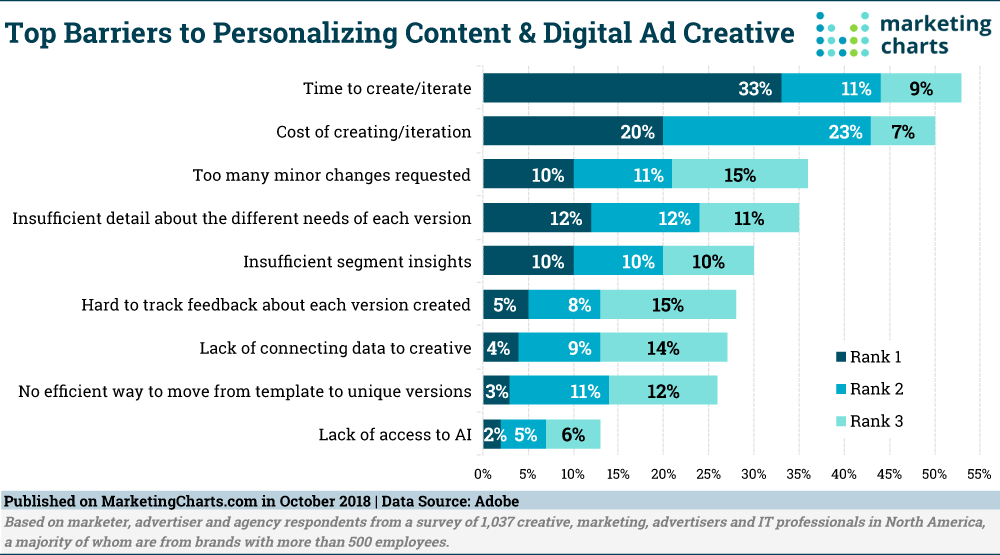
So, what’s the solution?
When searching for more time, the best course of action is to evaluate your internal processes to find ways to improve efficiency. Take a full audit of how your marketing team functions to see if there’s any way to improve time management. Also consider if any tasks can be automated. Even if they don’t relate directly to personalization efforts, freeing up time normally spent on other administrative tasks gives your team an opportunity to reallocate that towards marketing.
With that in mind, there are also quite a few aspects of ad personalization that can be automated. Using Dynamic Search Ads (DSAs) is one example. Available for both Google and Bing, Dynamic Search Ads automatically generate ad content based on your website copy. So if you have a lot of landing pages personalized towards different audience segments, DSAs can help you create relevant ad copy to match them.
Headlines and display URLs can also be dynamically generated, personalizing ads based on the search queries people use to find your business. Automatically generating ad copy can improve marketing efficiency by saving time on the creation of ads. They can also improve campaign performance by delivering a more relevant message and helping businesses fill gaps in their keyword targeting strategy.
Utilizing Google Ad’s internal features to scale your personalization strategy is a start. However, there’s a lot you can also do to improve campaign efficiency and effectiveness using third-party tools as well.
Two key areas to which to allocate budget are analytics and operational technologies. If you’re going to utilize all relevant audience data to inform your targeting and personalization strategy, you need powerful analytics technology to process it.
The more data you utilize, the more opportunities to optimize and scale your personalization strategy. However, this also requires more time manually analyzing data and adjusting your campaigns. The most valuable analytics technologies offer automation features that help marketers analyze data and find the most relevant insights, fast.
Equally important to advanced analytics are operational technologies. These are tools that can help you automate adjustments to your marketing campaigns based on the latest data insights.
The value of your data insights won’t matter unless you can act on them and do so quickly. So make sure you’re budgeting for the right analytics and management tools you need. Having gaps here makes your program less efficient, leaving numerous barriers to scaling personalization.
Personalization in advertising is so often touted as the key to marketing success to a degree that business leaders set personalization goals beyond what they can handle. More importantly, these goals are beyond the scope of what you need to successfully scale your personalization strategy.
Not every single piece of content you create needs to be completely personalized to individual audience members. It’s more important at certain stages of your sales funnel. With that in mind, you can set up strategic objectives to prioritize personalization at key points along the customer journey.
Personalization in advertising doesn’t have to be an all-or-nothing strategy. Start by taking a hard look at your marketing goals and decide what you need to personalize to achieve them. Over time, as you learn how personalization strategies influence your unique audience, you can adjust your strategy and scale it as needed. This is the most important factor that can help marketers illustrate ROI from their personalization efforts in the short and long term.
Personalization is a complex marketing strategy that won’t drive much ROI for businesses unless they break down barriers to scaling it. Using the right approach, it’s possible to avoid these pitfalls and maximize the value of personalization to reach key marketing goals. Just remember to use all relevant data you can, improve the efficiency of your marketing program, invest in the right tools, and set realistic goals for success.
~
To learn more about how our omnichannel DSP can empower you to implement unrivaled levels of personalization throughout your campaigns, get in touch with our digital media experts today.