
Technology
Basis Platform
Advertising Operating System
Communication Portal
Intelligent Collaboration
All Channel Activation
Activate Media on Every Channel

Consulting
Resources
Digital audio advertising has ballooned over the past few years as technology has advanced the access and availability to streaming media, which in turn, has increased users' overall time online. According to the 2019 Infinite Dial report, Americans over the age of 12 years old are listening nearly 17 hours of online audio a week!
This is a huge opportunity to enter the new landscape of audio advertisements. eMarketer also reports that as listenership on traditional radio continues to fall year over year, digital radio is expected to surpass traditional by 2021.
The rise in digital audio streaming creates the need for easy and efficient digital audio advertising. This is where audio advertising, served programmatically, takes the lead. Programmatic audio is a type of digital advertising format designed for placement in audio contents such as podcasts, digital radio, and music-streaming services.
Centro’s Basis has direct PMP partnerships with some of the world’s leading brands and partners in the digital advertising landscape. Programmatic audio served through Basis is served based on an algorithm that analyzes where the targeted audience is within the specific programmatic audio marketplace.
Learn more about the audio advertising opportunity with Centro, here.
Native Advertising
Whether you’re new to digital advertising or a seasoned veteran, you’ve most likely heard clients and brands ask about native advertising. The amount of media dollars that brands are investing in native advertising has continued to increase year over year as the channel has evolved and more inventory has become available.
How Native Ads Work
Native advertising is commercial content that matches the look and feel of the site its on. Basis Technologies works with TripleLift and ShareThrough, two of the top native advertising platforms built for the visual web, to run native ads on our DSP. These platforms leverage pioneering ad and computer vision technology to integrate a brand’s most engaging images, across any device, at scale.
As consumers have become more and more accustomed to digital display banners, they’ve also become ‘banner blind,’ meaning they’ve become trained to ignore the typical areas of a publisher’s site where display banners are usually seen.
Native advertising can come in the form of in-feed content, branded content, or sponsored articles which all give the advertiser placement alongside relevant and engaging content to help mitigate banner blindness. This gives brands the opportunity to build awareness and consideration when the consumer is leaning in to learn more.
Basis Technologies’ experts are here to help! Learn more about Native Advertising with Basis here.
Anyone trying to navigate the Advanced TV space has felt the confusion—is there a difference between over-the-top (OTT) and Connected TV (CTV)? What is the benefit to Addressable TV over CTV? What on earth is an MVPD? Why are there so many acronyms?! Fear not! Centro is here to help navigate this rapidly expanding and increasingly confusing landscape.
The first piece of this puzzle is Advanced TV—this umbrella term encompasses each of the targeted TV types: Connected TV, OTT, Addressable TV, and Programmatic TV. Advanced TV is also typically the term people use to talk about the targeted TV landscape overall. With that down, we can tackle the definitions and differences for each type of Advanced TV. See? You’re already getting it!
Some other terms often thrown around in the advanced TV space are MVPDs, vMVPDs, SVOD, and AVOD. Think of these as different sources of inventory for the types of Advanced TV. Review more detail on each of these services, below:
The Advanced TV landscape is complex, but hopefully this guide helped clarify some of its intricacies. Buyers can access and discover CTV/OTT inventory through the private marketplaces and open exchange in Basis. Centro teams can also advise and execute buys across data-driven linear and addressable TV—learn more about Centro’s Connected TV offering here.
If you run online marketing campaigns for your organization, you’ve probably heard a thing or two about the benefits of investing in automation to streamline reporting and drive more effective decision-making. According to statistics outlined in a study by Marketo and Ascend2, 52% of marketers surveyed declared that applying artificial intelligence to analytics and reporting was considered the most valuable use of automation.
There is a crop of business leaders today, though, who still regard automated reporting as an option, not a real necessity. In this blog post, we dive into some of the tangible costs that using repetitive manual reporting processes could have on your business operations.
Arguably the largest hidden cost of repetitive manual reporting is your loss of a major competitive advantage. Manual reporting is so slow that it’s necessary to delay decision-making that can improve your sales and marketing performance. Collecting data from different sources, compiling them into complex spreadsheets, and manually evaluating them can lead to significant errors in interpretation. This means decision-makers have less confidence in results, which can also lead to missed opportunities.
Businesses that analyze performance manually usually do so monthly or quarterly. However, in today’s competitive landscape, it’s critical that you make changes in real-time. There’s no way to calculate the full cost of delaying decisions until you replace it with automation. Once you do, it’s easy to see that your business was missing out on potential sales and revenue by doing things the slow way.
In the worst cases, marketing managers are pushed to make major decisions before data analysis is even ready. They have to move forward with their best guess as to the right course to take, which could lead to even more losses. Missing the competitive advantage isn’t just about lacking productivity. As described above, automation technologies can also help you gain more accurate and valuable insights in comparison to what you could discover on your own.
Just know that if your business doesn’t invest in automated reporting, your competitors will. They will take advantage of improved productivity and more accurate insights to secure more sales and revenue that you’ll continue to miss out on.
Regardless of how careful you are, there will undoubtedly be human errors when reporting is carried out manually. It’s easy to hit the wrong key, copy the wrong data field, or misinterpret information in data reporting. You can also run into issues when different people work with your reporting data simultaneously. Without clear, company-wide definitions for each data field, you’re likely to run into discrepancies when everyone creates their own methodologies.
Ultimately, the real cost of human error is two-fold. One: undetected errors lead to inaccurate data and reports. And two: detected errors require ongoing time and resources to fix. While it may not be necessary to automate all data management, leveraging automation for your reports can minimize preventable mistakes. Automated tools essentially empower you to compile and analyze your data while reducing inaccuracies safely. Top-of-the-line tools have functionalities in place to prevent errors within the automation process itself, one example of which is anomaly detection features that automatically pause bids and flag data if performance starts to deviate significantly from projections.
Many businesses today hold out on adopting automation, but all that leads to is increased labor costs. Why would a CMO pay for several employees to manually execute a task when one person could do it with the assistance of automation? It doesn’t make sense.
Having a group of people work on the same assignment simply takes longer, and as a result of human error, they are also likely to spend additional time going back and fixing mistakes. When automation is employed, marketing organizations can accomplish the task with a higher degree of accuracy in a shorter period of time, which frees up employees to work on other, more critical projects.
Manual reporting allows you to build custom reports that focus on the insights that matter most to your business. With automation, however, you can do all that and more. Many automated data management and consolidation technologies use artificial intelligence to help users derive enhanced actionable insights from their data sets. Centro’s intelligent automation platform, Basis, leverages machine learning to discover correlations between different data points that can expose performance insights that would have otherwise gone undetected with manual reporting.
Automation also enables you to process and analyze significantly more data than you could with manual reporting alone. Look at advertising, for example. The competitive bidding landscape changes every day. Businesses can adjust their bids to take advantage of these changes, but only if they can analyze all the relevant data daily. Not even a team of the best data scientists are up to that task. With the help of AI-driven automation, however, you can do that. You’ll be empowered to surface timely insights and make appropriate changes to your campaigns that will drive improved performance.
The exercise of pulling together reports manually undoubtedly absorbs countless hours and resources. You have to gather data from various sources, verify it, conduct your analyses, build your charts and reports, etc. Depending on the size of your business and how much data you have to process, this could take employees several hours minimum. The universal reporting and analytics platform within Basis is one such solution that does all this work automatically, empowering marketers to consolidate their disparate data sources in one central location and completely eliminating the time it takes to stitch together disconnected performance reports.
By taking advantage of automation on this scale, employees become liberated from repetitive tasks and can instead focus on more complex initiatives where they can use their expertise to truly move the needle.
Thanks to the EU’s GDPR, the California Consumer Privacy Act, and other regulations coming into play, it’s become incredibly important for businesses to keep their consumer audience data safe. There are now strict rules about what kind of consumer data you can collect, how you store it, who can access it, and what it is used for, etc. Failing to comply with these regulations can lead to legal prosecution and massive fines.
This creates a big problem for businesses that regularly handle their data manually. Lack of knowledge and simple mistakes can lead businesses to break the law or compromise the security of their data. If this happens with your business, you’re legally obligated to notify your customers about the breach. That won’t look good for PR. Today, the majority of automation tools designed for data management strictly follow data privacy compliance laws. Managing your data within their system helps keep it safe and minimizes your liability.
In companies who still report manually, there’s usually one specific person who manages the data spreadsheet on behalf of the team. They define all the labels, create all the formulas, and run the analyses. What happens when this person is on paid time off or moves on? Who feels confident enough to go into the spreadsheet and pick up where this person left off?
When you automate data reporting, you’re not relying too heavily on your data expert to keep the ship afloat. Many different team members can easily work with the system to get the insights they need without having to put their hands on the raw data. This makes things easier for your team as a whole and eliminates the potential for major data issues caused by human error.
Manual data reporting equals numerous repetitive tasks. We’ve established that. You have to collect all the data, verify it, analyze it, create reports, and distribute results, etc. Often you have several people working on a single project at once. That makes it very difficult to keep track of who’s working on what, and what’s complete. This can also lead to duplication of effort — if nobody knows who’s working on which reports, it’s common for individual teams to create identical reports of their own.
When you work with one tool to automate data reporting like Basis, this issue goes away entirely. The reports are made automatically, and everyone knows exactly where to find them.
The above list illustrates just a few of the many hidden costs of using manual reporting in lieu of automation. Most of these costs are interrelated and compound each other to have a significant negative impact on your business. What’s more, leaders have no way to realize these losses unless they try out automation first.
Automating even some aspects of your marketing strategy comes with numerous benefits, namely improved productivity, better insights, more confidence in results, enhanced workflows, more leads, more sales, and increased revenue. With better, faster insights, you can make quick changes to your marketing campaigns to achieve these goals.
When you invest in advanced technologies like those offered by Centro, it’s also possible to automate changes to your advertising campaigns based on these insights. The more you can take advantage of AI-driven technologies to streamline your marketing process, the greater benefits you’ll start to see.
Forward-thinking media teams will have noticed that the COVID-19 pandemic has brought increased opportunities to win with video. The stars have aligned, with:
All these developments add up to the much-anticipated convergence into omnichannel video, which will impact the industry for years to come.
In this month’s webinar, Forrester Research’s Jim Nail shares how agencies and brands can ready themselves for the growing opportunity in omnichannel advertising.

‘Ask the Expert’ is a series that breaks down the tools, tech, and trends you’ve been hearing about in the trade pubs and around the office. We ask our in-house experts the tough questions and write up the answers in bite-sized pieces for your reading pleasure.
This month’s topic? Brand safety on news and information sites. We brought in a partner—Connatix’s chief revenue officer, Jenn Chen, to give us the breakdown.
Why is brand safety a topic of interest when it comes to serving ads on news outlets?
News sits at the heart of knowledge and information—especially now when consumers are spending more time online than ever before for the latest updates. News sits in a unique and critical place between the public and advertisers, whose allocated budgets help front-line journalists. While advertisers know they need news inventory to reach most of their consumers, they also have to protect and promote their brand in a positive way. Brand safety is an essential criterion to allow them to accomplish objectives, without sacrificing core advertising principals.
How can advertisers assess brand safety levels on video news content?
Today, there are very few solutions that allow advertisers to target the context of both page-level and video content. Advertisers usually layer on a pre-bid page-level solution such as Peer39, Oracle Grapeshot, Integral Ad Science, DoubleVerify, Moat, or a DSP’s built-in solutions for targeting. However, page-level solutions are not without limitations—they require advertisers to spend additional time and resources on reaching out to individual publishers and asking them to include first-party data on the backend to categorize video private marketplaces (PMPs). Ultimately, advertisers should consider solutions that can add another layer of insight with in-video context in order to target efficiently and safely.
How are news publishers properly classifying their content to fit their advertisers’ safety requirements?
Traditionally, publishers and their editorial teams manually classify content by grouping them into feeds, adding keyword tags, and also using their own technology solutions to decode transcripts and audio files into first-party categorizations. Video indexing tools help publishers use content contextualization to analyze the content on-site and, in their videos automatically, to complete an otherwise manual process.
How is Connatix solving problems with video content classification?
With our goal of creating engaging video experiences for readers, Connatix has developed technology that classifies and contextualizes videos by sentiment, content category, keywords, and famous individuals to help both publishers and advertisers scale in-video buying in a brand-safe way.
How does Connatix work with advertisers, DSPs, and publishers?
One of our goals at Connatix is to bridge the gap between publishers and advertisers. We build our platforms and tech to streamline processes and deliver effective video experiences across the board. For advertisers and DSP partners, Connatix helps curate our direct-to-publisher supply, optimizing towards goals alongside the brand’s DSP partner. Connatix offers the most efficient way to contextually target and access unique video supply activated inside our players. For strategic partners, we also create custom creative and data solutions with both parties to drive video performance. For publishers, Connatix offers a full-stack video solution: video player, CMS, ad server, and SSP/exchange. We work with over 500+ publishers, helping them improve their content strategy and creation as well as advertising monetization.
Are you interested in learning how Centro can boost your video advertising with brand safety? Learn more about our video advertising capabilities.
What are you going to watch? Yes, you!
One of the most daunting decisions we make today is what to watch. All of us are constantly inundated with content options and it’s hard to not find the experience overwhelming. Personally, I end up re-watching The Office instead of finding something new. That said, it’s not all bad! Thanks to the Connected TV (CTV), we now know the best way to watch. Looks like you’ve found your show! While it’s loading, let’s explore how your CTV works, below!
What is Connected TV?
A Connected TV (CTV) is a television or connected device with an Internet connection and a UI that enables users to access content through applications such as Smart TVs, Gaming Consoles, and Set Top Boxes. Centro will serve video ads to users on various Connected TV devices including Roku, Xbox, Apple TV, and more.
Connected TV is channel accessible via programmatic media which takes place in a Private Market Place (PMP). A Private Market Place is an exclusive, invitation-only exchange where premium publishers make their inventory and audiences available to a select group of buyers, programmatically. PMPs not only have premium inventory but also allow for higher win rates as there is less competition for ads to be shown.
For example, SpotX is a Video Advertising Platform that creates PMPs that are made up of premium publishers, such as Pluto TV, Samba TV, and Discovery. These publishers offer hundreds of channels with a plethora of content. Therefore, if you choose TNT’s Animal Kingdom on the SlingTV app on your CTV device and see an ad, this ad has won this inventory via the SpotX PMP.
How Does Connected TV Advertising work?
Is your show still loading? Good. Your next question may be, how are these ads targeted to me on my CTV device? This can get tricky as CTV devices are not tied to a device ID, which is how advertisers are able to target ads via desktop and mobile. Instead, CTV devices are tied to an IP address because they are connected to the internet, as well as, the rest of your household. PMPs curate publisher inventory based on content indexes. Therefore, if the Animal Kingdom indexes high against auto intenders, then you will most likely be receiving a car commercial.
Oh, looks like your show is about to start! Well, I think we made the best of a boring situation. Next time you turn on your CTV device with your friends, take advantage of the load time and impress them all with your understanding on how Connected TV advertising works—and enjoy that streaming content from the comfort of your couch!
Want to know more? Learn more about the Connected TV advertising opportunity with Centro, here.
At Centro, we know that keeping up with the trade pubs and latest trends can be tough and time-consuming. To make that easier, we’ve compiled all the articles, reports, and other bits of awesomeness you may have missed, but should definitely read. Enjoy our latest list below!
This Is How Covid-19 is Affecting the Advertising Industry [:11]
Covid-19 has no doubt changed the way people consume media, therefore changing the way advertisers across the globe are spending their media dollars. Many advertisers are realizing that their long term strategy needs to be shifting their messaging to one that focuses on their mission, their e-commerce experience and brand-building.
Pandemic Brings Change to ‘Bloated’ Ad Industry [:06]
As advertising spending declines this year by 25%, the timing of a full recovery may be several years out. Many marketers are finding ways to be innovative and successfully do more with less, while also addressing regional messaging related to the pandemic and overdue calls for increased diversity.
Follow the Money: How Digital Ads Subsidize the Worst of the Web [:12]
An interesting non-industry perspective from Wired, about how the internet has some terrible content and how much of the internet is ad-supported. Brand safety continues to be important, and so does an advertiser’s partnership with media buyers and the platforms.
Adobe Exiting Political Ad Business [:02]
Last Friday, omnichannel DSP Adobe confirmed that they will be exiting the political ad business. The change requires businesses to scramble to other sources. The Wall Street Journal reported that the move was driven by a need for the DSP to focus on larger, more stable clients.
Side note: did you know that Centro has an amazing team dedicated to Candidates & Causes?
2020 U.S. Report on Programmatic In-Housing [:10]
An updated report from the IAB and Accenture shows that the US continues to not just lead with programmatic media investment, but also with in-housing programmatic, though that means different things to different organizations. While 69% of US brands have brought functions in-house and are seeing increases in transparency and efficiency, the support of an outside partner remains crucial.
The Cookie Is Crumbling And COVID-19 Is Still Here, But Digital Advertising Will Be OK [:05]
Despite the continued challenge presented by COVID-19 and the projected impairment posed by losing third party cookies, Rob Rasko of the 614 Group shares 3 reasons why he believes the industry will survive the death of the cookie.
Will People Actually Opt In to IDFA Tracking? [:03]
Starting in September, developers must get permission from users before tracking them with the IDFA on the app-by-app basis. Will people actually opt in when presented with an explicit choice between being tracked and not being tracked? Current consent rates range from 50%-70%. However, with the ‘allow tracking’ button, some experts think that 95% of people will opt out. The clock is ticking on GAID (the Google Advertising ID.)
OTT Leaders Outline Different Paths Through the Pandemic and to Profitability [:04]
There’s no single template for taking over-the-top video services to sustainable success. Three executives at smaller OTT services shared that lesson in a round of interviews that closed out FierceVideo’s OTT Blitz Week virtual conference.
Unilever, Anheuser-Busch Join Test of Pandora's Voice-Powered Ads [:02]
Acura, Anheuser-Busch, and Purple Mattress are among the brands testing interactive ads that respond to voice commands on Pandora. The streaming platform recently started the next stage of a voice-powered ads pilot that originally launched in December, after hearing that 72% of listeners found the voice ads easy to use. I said, THEY WERE EASY TO USE!
How is the marketing landscape going to look after COVID-19? Should businesses go back to following the same strategies that worked for them in the past, or have we entered into a whole new territory?
Realistically, both of those assessments are correct. Following marketing best practices is still important, yet much has changed about what businesses should prioritize and focus on. Arguably the most important tactic that will help businesses navigate the post-pandemic ecosystem is monitoring marketing ROI. Here’s why:
Many businesses have downscaled their marketing efforts significantly since the pandemic began. It just didn’t seem like the right time to be pushing the public into buying products and services.
Now we’re many months down the road and the economy is still running. The vast majority of marketing organizations that took a break at the onset of COVID-19 have returned to work. Many never rolled back their initiatives. According to Advertiser Perceptions, only one in 10 new product or service launches have been canceled for 2020; 41% are proceeding as planned, and 48% were simply pushed to the second half of the year.
While there are, of course, plenty of businesses that are still in survival mode, many are not. Influencer Marketing Hub’s recent Coronavirus Marketing & Ad Spend Impact Report indicates that one in four companies are set to increase their marketing activities this year. So if your competitors aren’t taking a break, why should you?
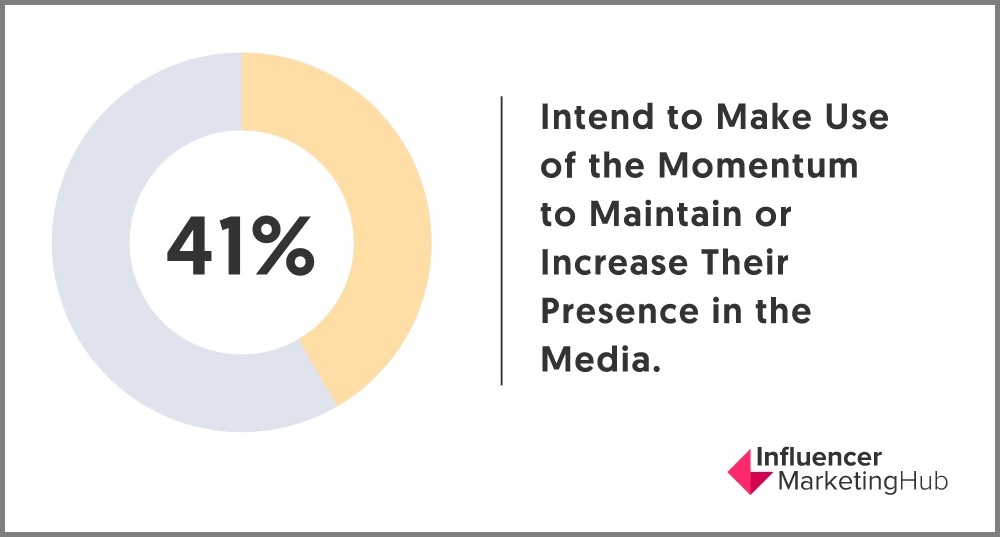
A large number of CMOs are investing heavily right now. If you want to keep up with your competition—or even outpace and outperform them—you need to ramp up your performance monitoring and optimize your marketing strategy post-pandemic.
Previous campaign performance has always been a valuable indicator of what to expect from your current efforts. However, that’s all completely changed. Adapting to new economic and societal norms is bringing businesses into whole new territory.
Marketers now are changing which channels they invest in and how much budget they allocate towards each. IAB’s COVID Impact on Ad Spend Report documents that many brands expect to increase their spend across digital channels in the second half of 2020, including CTV/OTT, digital video, social media, podcasts, digital audio, and paid search.
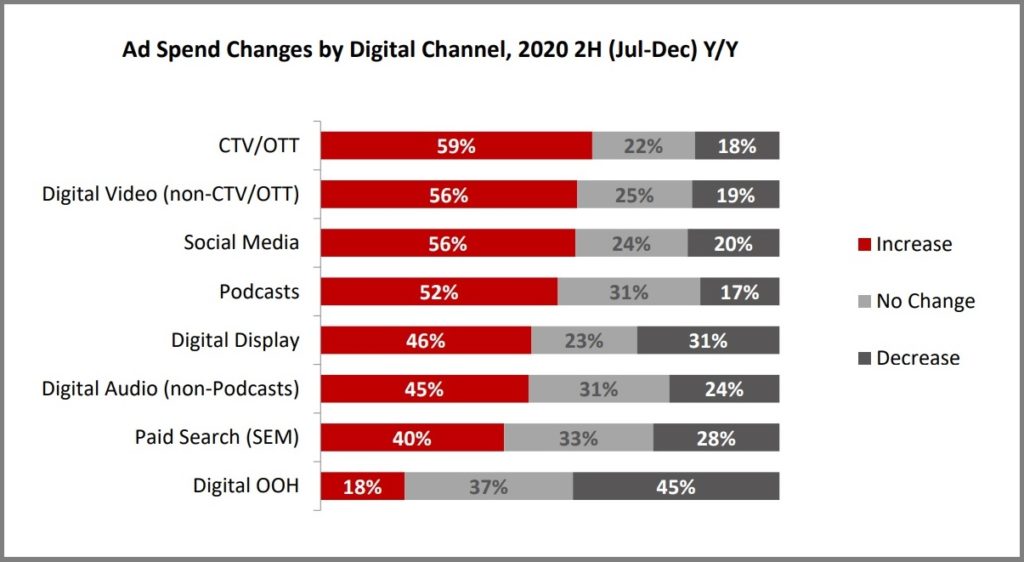
With that in mind, it’s safe to say that your previous marketing results won’t tell you much about how your campaigns will perform right now. Metrics tracking lead generation, conversions, sales, and retention can be drastically different from what they were back in January. The only way to know if your current marketing efforts are effective is by paying close attention to real-time performance trends.
The global pandemic has led to drastic changes in consumer sentiment. If you want your marketing message to resonate with your target audiences, you need to continuously adapt it to their current preferences. You’ve probably seen a lot of marketers already doing this with new advertisements. Businesses are going out of their way to show how they care and help their communities—those in the restaurant and travel industries, for instance, have been highlighting their sanitation practices to ease consumer fears.
As the pandemic continues to unfold, preferences among consumer groups change week-to-week (and almost day-to-day!) The best way to ensure your marketing message is still relevant in the long run is by constantly and maniacally monitoring performance.
According to a recent Media Frenzy Global survey, 47% of US consumers are interested in reading or hearing news that is not related to the pandemic, and 45% also say they want to be inspired by brands so they can be hopeful about the future. Your brand can cater to these changing sentiments, but only if you’re closely observing audience reactions and adapting accordingly.
Just about every business sector has been negatively affected by COVID-19, either directly or indirectly. According to research from McKinsey & Company, it could take more than five years for the most severely affected sectors to return to 2019-level contributions to GDP:
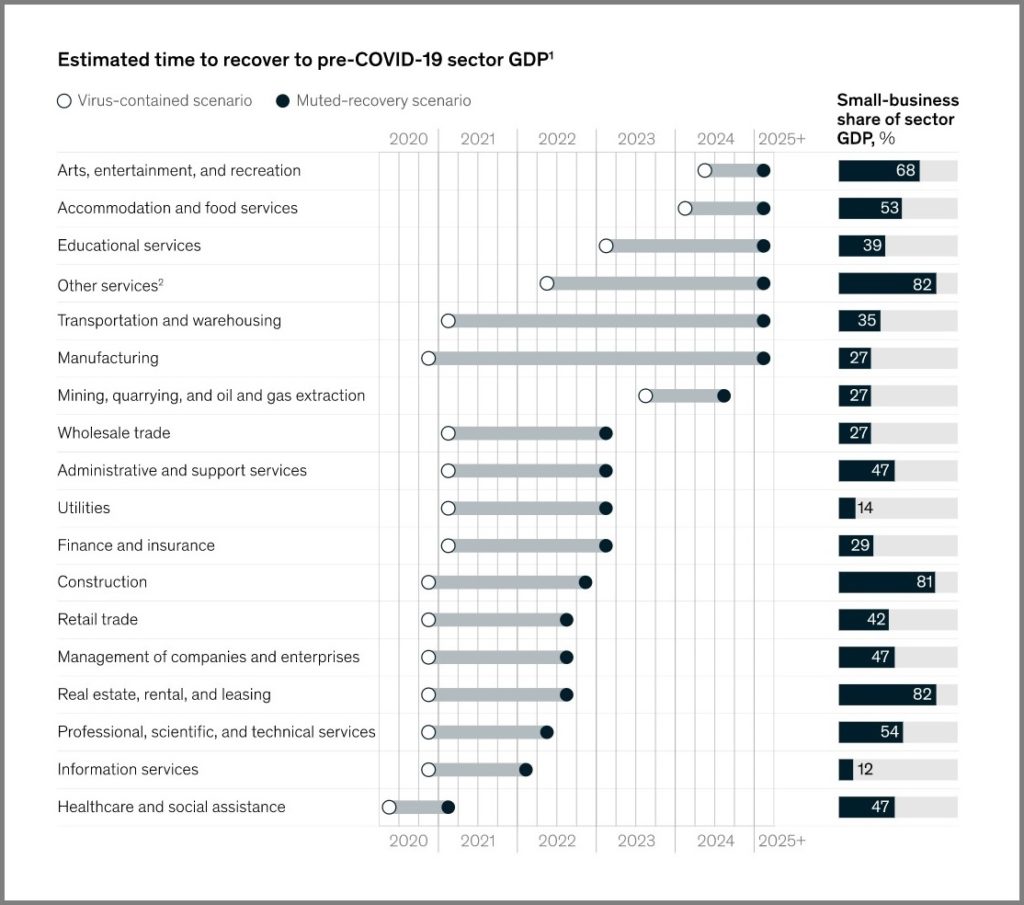
Regardless of whether your industry is set to recover, it could take a long time to reach pre-pandemic levels. Business leaders need to operate frugally while still moving forward with their sales and marketing initiatives.
The best way to do this is by ensuring every marketing dollar counts. The more you check your metrics, the more informed optimizations you can make to your campaigns, ensuring your budget is always spent as effectively as possible.
Just about every day, we are seeing new restrictions, shutdowns, and major events happening around the world in real-time. Many of these events can significantly impact your business and marketing efforts.
For example, many cities in the US and around the world are quickly imposing local lockdowns that include closing select businesses and limiting the opening hours of others. But you don’t want to leave your Google Ads running until 10pm each day when your business is suddenly forced to shut down at 5pm.
It also makes a lot of sense to segment your audiences based on their location and local sentiment. People in certain areas are more inclined to shop in-store or online, and the only way you can figure this out—and take advantage of it—is by paying close attention to how they engage with your marketing message.
Throughout the last few months, certain channels have become significantly more (or less) popular with marketers compared to pre-pandemic times, and this means there are numerous opportunities you can take advantage of. Advertising is a prime example: a recent global advertising investment forecast from WARC shows that 2020 ad spend is expected to decline by 8.1%, rather than growing 7.1% year-over-year as expected.
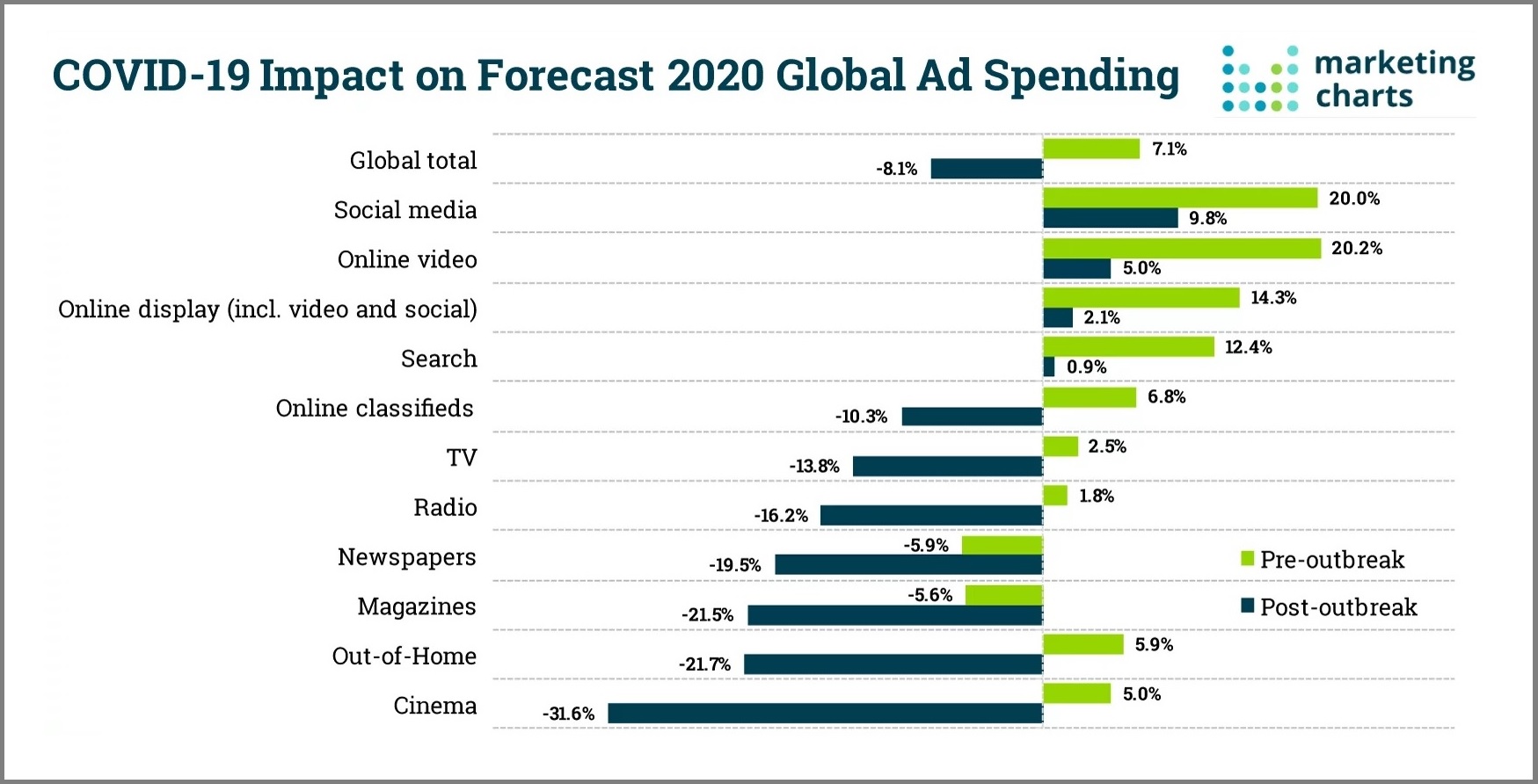
Since businesses are investing less in advertising, competition for ad rank and cost-per-click is decreasing. If you optimize your advertising strategy right now, you can potentially rank well for keywords that were once too expensive to target. That said, diving into this new territory is only going to be effective if you prioritize regularly measuring performance.
In short, there’s no need to be in survival mode. Research from Rakuten recently showed that 87% of global consumers still plan to shop for Christmas and other seasonal holidays. What’s more, 57% expect to buy on key days like Black Friday. Imagine competing for ad space on Cyber Monday with half of your competition out of the advertising game. Businesses that are brave enough to take an aggressive marketing approach right now can set themselves up for significant success.
These are not normal times, which means businesses cannot rely upon a normal marketing strategy. If there was ever a time to start checking your marketing performance metrics several times per week, it’s now. Society, sentiment, marketing platforms, and business strategies are changing faster than ever before. If you don’t prioritize monitoring marketing ROI, don’t be surprised if your performance changes significantly each time you check-in.
The good news is you won’t have to be vigilant forever. Slowly, the world will go back to normal, and it will eventually become easier to predict the marketing landscape. Just keep monitoring performance closely. Once things level out with your metrics, you can start relying more on past performance again.
Paying close attention to marketing ROI may well be a chore, but it does come with many added benefits. Businesses that manage to market effectively through 2020 will have built a strategy that’s much more in-tune with consumer preferences in the long run.