Centro Brand Exchange Accesses U.S Voters on Quality Publishers for National and Statewide Ballots; Centro is Highly Rated for Brand-Safety, Publisher Transparency and Viewable Inventory
Washington, DC – March 21, 2016 – Centro (centro.net), a provider of enterprise-class software for digital advertising, today announced capabilities for political ad-buyers to automate how they reach U.S. voters at scale on brand-safe publishers. Within the Centro Brand Exchange, an invite-only ad marketplace of premium journalistic sites, marketing teams for political campaigns of all sizes can reach ‘Liberal,’ ‘Conservative,’ and ‘Political Enthusiast’ audiences across curated publishers. Centro also protects publishers by screening advertisers before they are allowed to serve ads; implementing advertiser block lists; and reviewing creative to ensure it complies with the standards of the publisher.
The Centro Brand Exchange offers brand-safety at scale for programmatic advertising. Ad security firm Pixalate ranks Centro No. 7 on its Global Seller Trust Index and No. 1 for Viewability Score among the top 10 companies on the list. Trust Metrics, a digital media quality ratings service for brands, shows in its quarterly ad inventory review of Centro Brand Exchange publishers that 96% of the sites in it would be considered brand-safe for most marketers. Centro simplifies the heavy lifting for advertisers and publishers when creating private ad auctions or inventory packages for political marketing. Centro’s ad-buying solution offers:
- Access to voters in high-value, battleground states such as Florida, New Hampshire, Ohio and more – reaching local audiences or audiences that read content specific to a state for gubernatorial and senate races
- Inventory on select sites from top-25 U.S. market newspaper, television and radio companies such as Cox Media Group, E.W. Scripps and more
- Inventory on dozens of political thought leadership outlets including the National Review and Talking Points Memo
- Priority inventory access and customization to target voters based on marketers’ first-party data and other KPIs
- Available through every major ad-buying platform with Deal IDs or through Centro directly
- Seamless integration with third-party political data from Axciom, DataLogix, eXelate, Neustar and more for marketers who don’t normally use digital ad-buying platforms
“With our track record driving winning campaigns for political teams, Centro has the expertise to engage the right voter audiences on the most appropriate channels and sites,” said Grace Briscoe, VP of Candidates and Causes, Centro. “Centro Brand Exchange is consistently recognized for providing superior transparency and quality among all digital ad marketplaces. It ensures that political marketers’ messages are received by audiences clearly on uncluttered, well-lit media environments.”
For nearly a decade, political marketers have relied on Centro to precisely target, engage and drive action from key voters. Centro alleviates the challenges of finding relevant publishers and placements for political marketers. The Centro Brand Exchange uses strict quality criteria to assemble inventory from 2,000 top-notch publishers. These include sites of major newspapers, magazines, television stations, radio stations, news and information publishers, and more.
About Centro
Centro (centro.net) is creating a platform to make digital advertising easier. Its enterprise-class software centralizes, organizes and automates all digital media campaigns across all channels, accessing both guaranteed and biddable inventory, to achieve any objective. Our holistic approach gives marketers a single system of record to fulfill their research, planning, buying, optimization, reporting and reconciliation needs. Since 2001, Centro has successfully planned and executed more than 250,000 campaigns across all digital display platforms and ad format types. Headquartered in Chicago with 32 offices in North America, Centro has received numerous accolades for its commitment to employees and workplace culture.
# # #
Contact:
Anthony Loredo
[email protected]
646-462-4888
At Centro, we know that keeping up with the trade pubs and latest trends can be tough and time consuming. To make that easier, we’ve compiled all the articles, reports, and other bits of awesomeness you may have missed, but should definitely read. Enjoy our latest list below!
What the heck is the difference between ad tech and marketing tech?
What is advertising technology? What is marketing technology? Do the terms overlap and why should ad (or marketing) professionals care? This article has all the answers you need.
Buzzfeed + NBC + American Express = Massive Branded Content Play on TV
This past Leap Day, Amex, with the help of Buzzfeed, created sponsored content that ran on NBC. Supplemental content was added to The Today Show, Blindspot, The Voice and Late Night with Seth Meyers. Buzzfeed is focusing on building its video creative, so adding a major network to their rolodex only helps to bolster their reputation as the leader of branded content creation. The deal came in at a cool $200M, though early reports are unclear about what Amex plans to do with all of those credit card points.
Facebook Reactions Are Here
After years of users asking for a dislike button, they now have a variety of emoji reactions that will allow them to expand their emotional range beyond a thumbs up. Users were quick to adapt and the reaction tally on posts is growing daily. For advertisers, it’s another metric to consider. As of now, all reactions count as a “like” on Sponsored Post (yes, even the negative ones) but Facebook has said that their “Reactions team will continue to learn and iterate, and may incorporate Reactions signals into News Feed Ranking in the future.” This is another reason why brands need to keep creative top of mind when approaching the social space.
Facebook is Now Offering Automatic Captions
Another change comes down the pipeline, as Facebook continues its growth in video. Now, brands posting videos will be offered automated captions, at no additional cost. The intention is for the caption to encourage users to watch brand videos instead of just scrolling past them. Cue the clapping and cheering from marketers everywhere!
Facebook's Atlas Struggles To Serve Its Market
Have you heard about the promise that Facebook’s new Atlas is the next big thing, from a multiscreen attribution standpoint? AdExchanger provides an update highlighting some of the key struggles that marketers have been facing from the highly-touted first-to-market attribution product.
Snapchat Will Use Nielsen’s Digital Ad Ratings
Though the details of the new partnership between Snapchat and Nielsen have yet to be shared, it’s a clear sign of Snapchat recognizing the need to provide more targeting data for its growing advertising offerings.
2016 IAB Video Advertising Glossary
The IAB recently released its 2016 Video Advertising Glossary to provide clarity and consistency in video terminology for buyers and sellers alike. Be sure to check out the IAB’s first Digital Out-of-Home buyer’s guide, designed to provide highlights on the strengths of this video, format distinctions, buying practices, and more. If that wasn’t enough, the IAB also released a new guide on collecting Mobile Location Data for publishers, providing a solid perspective on what pubs must consider when collecting this increasingly important data set.
Unacast Partners With Opera to Let Marketers Retarget Consumers Using Beacon Data
A new partnership between beacon proximity network, Unacast, and mobile network, Opera Mediaworks, will now enable Opera to offer targeting based on beacon data instead of GPS data. According to the agreement between the two companies, advertisers will be able to target by segmenting groups of mobile users, based on the locations that they frequent, at an in-store or even a -department level.
ThinkGoogle: From Search to Store
Google latest report provides some useful insights on consumers’ evolving purchase behaviors, specifically how quickly users are shifting from a search on their mobile phones to taking an action. “Near me” searches are on the rise, where convenience trumps brand loyalty in the moment. The weekends are especially heavy times for brands to take advantage. Restaurants and hotels are have been early movers to experience success.
Thanks for tuning in and be sure to look out for next month’s Digital Innovations Awesome List!
'This is ad fraud that uses real Internet users who are innocent bystanders. It generates site visits from real humans, where the user’s actions are completely unintentional.'
Read more from Centro's Katie Risch in AdExchanger.
Last year, in response to an industry-wide thirst for education, Centro launched the 3T roadshow. Our internal digital experts visited marketers around the country to deliver 3T wisdom: Tips, Trends and Techniques for dominating digital.
This year, we’re bringing back 3T in true digital style. Monthly, online 3Ton30 webinars break down the latest trends in digital media all in 45 minutes or less. The third Wednesday of every month features a new expert unpacking a new digital topic. The 30-minute presentation and 15-minute Q&A format delivers digestible information for busy marketers with tight schedules.
March 16th at 1:30 p.m. EST premiers the next installment of the series, where Centro’s Director of Mobile, Noor Naseer, will give you an in-depth look at the mobile landscape. Specifically, Noor will give you insights into developing a mobile strategy – one that involves inventory across multiple screens, using multiple targeting tactics. The four tactics Noor will elaborate on will help you update your primary approach to mobile and assist you in driving real business impact.
Whether you’ve worked with these tactics before or you’re new to mobile entirely – the webinar on March 16th is full of tips and best practices for every marketer looking for deeper engagement with their audience this year.
Click here to learn more information and to save your spot. Registrants will receive a handy prep sheet to guide them through the webinar. Can’t make it this month? Keep your eyes peeled for 3Ton30 webinars every month in 2016.
I admit it: I am totally a fangirling on #ANAMedia. Often asked for recommendations on the “must attend” events in digital, media and advertising, ANA has topped my list for the last several years.
In an industry glutted with summits and conferences, ANA Media, held this week in Florida, proved it's the far-and-away leader. Here’s why:
- Pinnacle of smart programming. Content is thoughtfully curated and purposefully provocative (more on that in a moment). The agenda is tight and offers the right mix of practitioner case studies, industry research and fireside chats. Thankfully, it also eschews (or at least limits) the tired and often-unsatisfying panel format. Attendees are guaranteed to leave ANA Media with actionable insights about their craft. As I told ANA President Bob Liodice on my way out this morning, their programming team is doing it right.
- Intimacy drives engagement. Don’t get me wrong, I love the spectacle that is Masters of Marketing, the ANA’s flagship event each October. I love the see-and-be-seen-by-the-who’s-who-ness of it all. I love that I can reliably count on being brought to tears within the first thirty minutes (and at least a few more times throughout) as we watch highlight reels of some of our industry’s best and most meaningful work. And, of course, as CMO, I love the efficacy of reaching so many prospects, customers and partners all in one highly productive, three-day span. But. I might be more in love with the smaller size of ANA Media. I heard this reflected by other attendees over breaks and drinks this week. Less overwhelming, less of a zoo, more approachable, more manageable. And also, perhaps, more open dialogue. (And I don’t just mean after “three glasses of wine” a remark used multiple times by keynoters lamenting what it takes to get practitioners to admit just how broken our industry is).
- Catalytic content. Most important, the ANA is surfacing the bellwether topics of this business. For the last three years, ANA Media has yielded at least one seminal speech that galvanized meaningful dialogue and was the impetus for tangible change. Here’s the proof:
- Programmatic is the buzzword of the conference, but viewability dominates the discussion as the Media Ratings Council (MRC) shares the standards and definitions needed to buy display advertising based on viewable impressions. We still haven’t solved for viewability (it remains a topic of concern two years later), but this conference and its resulting media coverage helped place the topic front and center as advertisers realized they weren’t getting what they paid for.
- Jon Mandel’s blistering takedown on transparency is unforgettable. In case you somehow missed it or the firestorm it generated, the former agency exec eviscerated agencies with allegations of kickbacks, undisclosed incentives and rebates. And while the he-said-she-said continues, this presentation had undeniable impact: Reviewmaggedon. Whether you believe those agency reviews had anything to do with transparency or not, Brian Wieser, Senior Analyst at Pivotal Research and arguably the smartest-guy-in-the-room about the state of our industry, commented in his keynote that most of the reviews were announced in the six weeks following the ANA Media event.
- This year’s mic drop moment was the lively, frank, f-bomb-filled keynote by Gary Vaynerchuk: self-made millionaire turned media mogul. Almost nothing was safe from scorn: TV, banner ads, programmatic, attribution, holding company agencies. There were LOLs and outright applause as he called out the industry. The speech was essentially an anti-establishment rallying cry, warning that by “romanticizing” familiar channels, brands and their agencies were not “Marketing in the Year in Which We Live”. Vaynerchuk asserted the new model is “day-trading for attention” with only one metric that matters: sales. The audience was fired up and clearly found the candor refreshing. How much will actually change remains to be seen, though it’s safe to predict a spate of new clients for VaynerMedia. And, perhaps, more willingness for brands to embrace experimentation.
Hats off to the ANA. As the preeminent industry association for brand marketers, it’s clear they take their job as steward, shepherd and advocate seriously. I’d assert that ANA Media can now arguably claim to be doing more to impact our industry than any other event I can think of. It actually earns the adjective "ground-breaking". This programming team has proven, time and again, they can produce an event that not just starts conversation, but motivates actual change.
As an “authentic achiever,” I’m rooted in the belief that we can always, always do better. (My very wise husband would say I can find something wrong with a sunny day.) So here’s my wish list for future ANA events: bring us more B2B content as well as “challenger” brands getting it done without big budgets.
Finally, of course, I don’t attend all the possible events in the industry – I have neither the budget, bandwidth nor desire to do so. But definitely interested in feedback– if for no other reason that I’d love to know what I’m missing!
The verdict is in: mobile is booming. A recent eMarketer study suggests that by 2019, mobile ad spend is projected to increase to 72.2% of total digital ad expenditures. It’s time to re-assess your primary approach because simply buying mobile inventory across multiple screens is no longer enough. To drive real business impact in the current landscape, a mature, robust mobile targeting strategy is imperative.
As a part of our 3Ton30 educational webinar series, Centro is delivering some in-depth information on four mobile targeting tactics on March 16th at 1:30 p.m. EST. In case you missed it, you can find the recording and slides presented here.
In the meantime, here’s a quick list of terms every marketer needs to know in order elevate your mobile strategy in 2016.
Click-Through Rate: (CTR for short) The number of click-throughs per ad impression, expressed as a percentage (American Marketing Association).
Cross-device Targeting: The ability to target the same consumer, from one connected device to another.
Location Targeting: A method for targeting ads to customers based on their vicinity or location. Targeting techniques can encompass a variety of data including geolocation, contextual element of media, user preferences, and more.
Traditional Retargeting: The act of gathering data on a web visitor and then serving an ad to that visitor on another website based on their online behavior. Data for this tactic is derived from the cookie that is placed on the visitor’s computer upon the initial website visit.
Viewability: The Media Ratings Council’s standard states that a viewable impression measurement of ads in mobile web browser environments should follow the existing guidance for viewability in desktop: 50% of pixels in the viewable space of the browser for a minimum of one second (display) or two seconds (video) for a viewable desktop display impression is a minimum of 50% of pixels (of the digital ad) in view (within the browser) for a minimum of one second.
"Understanding the new terms born out of the multi-device world gives brands clarity to achieve their digital marketing goals. Furthermore, brands can use this knowledge to better collaborate with the various industry partners developing technology to execute a cross-channel strategy — which will ultimately deliver business outcomes that matter to any marketer."
Read more from Centro's Kelly Wenzel in Chief Marketer
To distill the topic of ad blocking, below is a primer on the subject and how it may affect advertisers, publishers and tech companies.
Ad blocking is the removal of advertising content on websites via the user’s browser. It is facilitated mostly by installing a third party browser extension (most of this type of software is free). When a page is loaded on a browser (on desktop and mobile), the software determines what part of the page is content and what parts are ads – the ads are blocked by preventing the creative from being served.
Why people block ads
The most common reasons for ad blocking revolve around three aspects for Internet users.
Performance – loading ads on pages requires processing of data. With many ad units on the page (and possibility dynamic creative such as video, animation, etc.), more data is required to load the ad. This potentially creates a bottleneck that could slow the time it takes for content to load on a page.
Privacy – preventing ads to load also prevents ad serving systems from gathering more data on users about behavior. It’s as if that user loading a page didn’t exist because the ad serving system won’t be able to place a cookie on the user, nor determine if the user is someone the ad serving company has seen before.
Security – Ads can be manipulated by bad actors as a gateway to install viruses and malware on browsers. Ad serving companies proactively vet their advertising customers to weed out bad actors, but some make it through the review process and load malicious ads.
Ad blocking stats
Here are the facts according to the yearly PageFair (analytics tech firm) and Adobe annual ad blocking report:
- Globally, the number of people using ad blocking software grew by 41% from 2014 to 2015.
- In the U.S., ad blocking usage grew 48% -- which is 45 million monthly active users in Q2 2015.
- In the U.S., 16% of online population blocked ads in Q2 2015. State by state, Oregon’s online population had the highest blocking rate at 16.4%, with Washington, Vermont and Nevada not too far behind in percentage.
- Blocking behavior is a function of audience demographics and the most active blockers are likely to be young, tech-savvy men.
- Ad blocking on Chrome has increased at a higher rate than on competing browsers.
Mobile
While mobile web browsing activity is increasing (it was 38% of all web browsing in Q2 2015), a very low percentage of ad blocking happened on mobile (roughly 2%) – but that’s mainly a function of availability of blocking software. The recently released iOS 9 could increase mobile ad blocking because it supports ad blocking apps – Mobile Safari represents 52% of mobile browsing.
For users, the nuances of the mobile experience can make it more compelling for users to proactively block content. Less content to load means less use of data (which is finite for most users). Unlike desktop browsing, where the data pipes are wider and device computing power can load sites in a couple of seconds, the experience on mobile is more easily bogged down because of data being processed to load sites.
What happens when ads are blocked
Ad blocking software uses filter lists which can contain numerous page elements including ad serving domains that are commonly associated with companies that place ads (think ad exchanges or ad networks). The software identifies domains to block the ads coming through on sites. This includes ads served on display, video and sponsored content widgets.
Why you should care
If you are a publisher, you lose revenue opportunity – especially if you cater to the demo that has a high propensity of using ad blockers. The revenue impact from mobile users may be minimal right now because the bulk of overall revenue for most publishers come from desktop ads and because mobile ad blocking is still new.
If you are an agency or advertiser, you wouldn’t pay for an ad that was blocked. It’s as if the opportunity to serve an ad was never there. But if your service or product is designed for that demo that tends to block ads, your campaigns may experience lower scale. Because of this, you may need to devise other ways to reach and engage your target audience aside from paid media channels.
What we can do
Tactically, for advertisers, one approach is to determine if ad blocking may impact your media plan. If your core target is young men, you may want to consider ad formats or ad channels that cannot be blocked (page skins, sponsored content, SEM). Make sure you understand your alternative ad options.
Publishers are taking various approaches. Some are re-designing their sites to have less units that are susceptible to ad blocking. Some re-designs are focused on better/faster experiences for users to make sure they don’t even think about installing ad blockers. Other publishers are blocking content from users that have blockers installed. Some have proactively served messages to those users pointing out how ad revenue enables them to provide content for free.
Ad blocking is growing because users are dissatisfied with their Internet experience. They feel that ads clutter the content they want to consume, slows their productivity and exposes them to unforeseen dangers. Publishers can fix this by taking a hard look at their pages and determining if the backend technology and layout is fully optimized to give users a great experience. From the advertiser perspective, tech companies that facilitate serving ads (DSPs, exchanges, ad networks) need to be diligent about the quality (of the creative and the advertiser itself) that goes through their pipes. This is a shared problem in the industry and it is adding up because companies are serving tons and tons of ads -- to the point that users get fed up with our marketing messages. Let’s stop the ad blocking trickle before it becomes a deluge.
Back in December, we talked about digital media emerging as a critical strategy for campaign success. Spend is up, usage is up, and early predictions claim that the candidate who rides the road all the way to the White House will also be the one who best harnesses the power of digital.
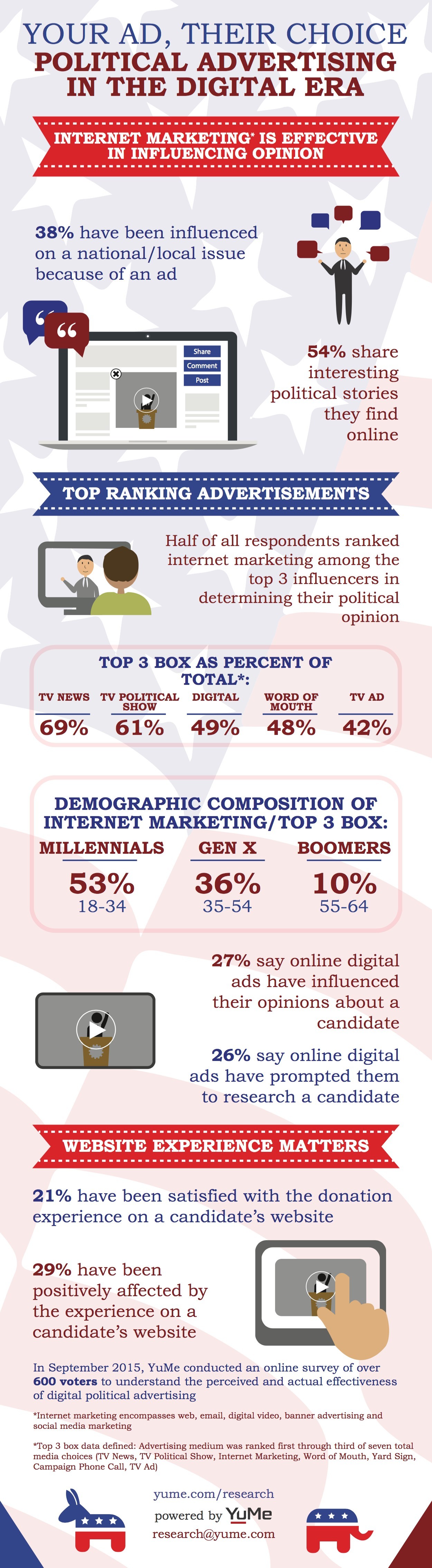
As results from the primaries are rolling in, so too are the stats proving that digital media has moved from the wings to center stage. A study released by the IAB in late January showed that digital media was on par with TV as a primary source of information about the candidates and political issues. But, just like campaigning, effective digital requires a smart strategy - one that takes advantage of the right opportunities at the right moments, all while sidestepping potential landmines. Super Tuesday is March 1st. Will the big winners also be the biggest digital marketers?
Only time will tell.
Each issue of Political Digital Digest brings you the latest news and developing stories about the innovative role digital media is playing in the 2106 election. Everything you need to know is right here, right now.
What You Need to Know
http://www.iab.com/insights/the-race-for-the-white-house-2016-registered-voters-and-media-and-information-during-the-primaries/
Related articles:
http://www.journalism.org/2016/02/04/the-2016-presidential-campaign-a-news-event-thats-hard-to-miss/
http://mms.businesswire.com/media/20160202006558/en/507426/5/Political_2-2.jpg?download=1
What to Watch
http://www.mediapost.com/publications/article/268316/the-top-5-mobile-marketing-trends-for-political-ad.html
http://recode.net/2016/01/21/three-challenges-election-campaigns-will-face-on-digital-and-how-to-solve-them/
http://www.mediapost.com/publications/article/268441/delivering-scalable-effective-advertising-with-cr.html
http://www.campaignlive.com/article/digital-political-ads-offer-direct-line-voters-hearts-pockets/1381804
http://adexchanger.com/politics/how-digital-video-is-developing-in-a-political-world-that-prefers-tv/
Up for Debate
http://marketingland.com/trump-women-isis-social-language-reveals-2016-race-158336
http://techcrunch.com/2016/02/01/as-primary-season-opens-opentext-releases-election-news-tracking-tool/#.bldpu5q:7rhS
http://www.campaignsandelections.com/campaign-insider/2635/will-snapchat-be-relevant-for-political-advertisers-in-2016
http://www.campaignlive.com/article/big-data-better-donald-trump/1383209