
Technology
Basis Platform
Advertising Operating System
Communication Portal
Intelligent Collaboration
All Channel Activation
Activate Media on Every Channel

Consulting
Resources
Every business that engages in digital advertising wants to create engaging PPC landing pages that will connect deeply with their customers and drive conversion rate optimization (CRO). Of course, great landing pages are dependent on a myriad of different factors, including design choices, how and when you convey product value, relevance, and many more. All of these have to be in balance in order for your paid search ads to stand out as a pillar of your overall marketing strategy.
Of course, it’s not actually possible to distill the entirety of paid search marketing into a single sentence, but if you could it wouldn’t be too far off from this: CRO is all about guiding the lead through a compelling and value-added journey. Your search ads, landing pages, and CTAs must illuminate the path for your audience, otherwise they are likely to stray off it, try and build their own path, or travel down it in a way that wasn’t intended.
We all like to think of ourselves as mavericks from time to time, but in reality, people crave and appreciate guidance. This is not just true for consumer marketing; most of our relationships and interactions involve us being led through a narrative. What marketers can do is take advantage of this fact by structuring landing pages around familiar and recognizable touchpoints.
This is why you fulfill the promise of value at the beginning, because buyers are attuned to recognize when someone is giving them something useful and continue the relationship. It’s why you contextualize their pain point in the content, because people recognize and respond to that familiar yearning of wanting something more. And finally, it’s why you introduce that CTA at exactly the right time, as a way of saying, “Hey, now it’s your turn to make a move and continue this partnership.”
No matter how interesting and innovative your product is, people won’t just buy it for its own sake. You have to explain to them why they should listen to you, why it makes sense for them to buy it, and then exactly how they can buy it. That’s what guiding the customer through a buying journey is all about, and it’s what every successful landing page has to accomplish.
Generic marketing has its time and place: think about highly subjective video ads that succeed wildly at creating a certain mood, but don’t do very much to speak to particular buying situations. However, there’s really no room for generality when it comes to PPC landing pages.
For landing pages, specificity is always preferred, whether you’re talking about product descriptions, your CTA, links, or anything else on the page. When you get your targeting correct, then the specific messaging you employ is highly relevant to the users it reaches in a way that more generic material never can be.
The reason is that paid search visitors don’t arrive on a landing page just for the fun of it, except in rare occurrences. They navigate to your page because they have a specific goal or need in mind. Since generality isn’t driving their actions at this stage of their journey, generalized responses from a brand won’t be able to engage them in any meaningful way.
Yes, this means you will have to create different landing pages for various campaigns and categories of buyers. Utilize headlines that let the user know immediately that they’ve arrived at a page that speaks directly to what they were searching for. If hyper locality is a part of your marketing strategy, then put specific geographic information at the top so that it hits the reader’s triggers.
This landing page from IMPACT provides us with a succinct and pitch-perfect example of specificity in action. The headline speaks directly to professionals who want to increase the ROI of their blog and guides them into a solution for doing so.
URLs may live forever as long as the domain remains hosted, but that doesn’t mean that the information contained on them is always up to par. Numerous parts of your landing pages can change over time: Information becomes obsolete, new statistics are published, and links and images can become broken. If you direct a user to a landing page that displays any of these, you are putting up a serious red flag of unprofessionalism.
If you’re utilizing a landing page for a long-term marketing campaign, then checking in on the coding and the content at regular intervals is crucial to maintaining its effectiveness. Test links, make sure images load and are formatted properly, and verify the accuracy of any claims you have made. It’s the only way to ensure that every lead is presented with the optimal experience when they click on your ad.
Landing pages created for shorter-term campaigns also need to be monitored carefully. Once it has ended, you need to diligently remove any links to the customized landing page from AdWords as well as your internal site navigation. Few things will mar the customer journey more quickly than clicking on a broken link or being redirected to a landing page containing an offer that is no longer valid.
Almost every company now uses a site platform that features responsive web design, so there’s not much more to say about mobile, right? Not so fast. Employing responsive web design is an excellent start, but there is more to the mobile experience than simply formatting your landing pages to be readable on a mobile screen.
To understand why it’s so important to tailor the landing page for mobile users, just consider that mobile devices now account for approximately 53% of all paid-search clicks. These users now likely represent the majority of traffic on your PPC landing pages, no matter what industry you are in, and they deserve the same curated journey on your site that desktop users do.
The ubiquity of mobile screens has changed the way our brains respond to the browsing experience. People are now accustomed to content that unfolds vertically, and they expect high-quality images that pop on a mobile screen and fill up most of its space. They don’t want to have to pinch and zoom in order to access the value that was promised by the search ad. According to research from Adobe, companies with landing pages optimized for mobile triple their chances of increasing their mobile conversion rate to a minimum of 5%.
Check out this fantastic mobile landing page from Squarespace, a company you would expect to be on the leading edge of mobile optimization. Beautiful, well-formatted images, a relevant headline, and a clear CTA jump out at you as soon as your eye lands on the page, and they do a great job of layering buyer-specific value vertically.
Conventional wisdom says shorter sign-up forms are better at converting, because you want to get them in and get them out as quickly as possible. It makes sense when you think about it abstractly, because short forms are easy to fill out, and you want to make signing up as easy as possible. However, it doesn’t always play out that way in reality.
Multi-step forms have actually been found to convert more effectively than short forms, by up to 300%. There’s actually some very simple psychology at play that contributes to this dynamic. The first few questions each appear less daunting to answer one-by-one compared to filling out the entirety of a form in order to get what you need. By the time the respondent gets to the final questions, they will already be invested in the outcome, and you can move on to questions that have more substance behind them.
Keep in mind, however, that you can definitely go too far with multi-step forms. Try to stick to seven questions or fewer; when you go higher than that buyers start to feel like they are the target of an inquisition, and that your experience isn’t living up to its promised value.
~
To learn more about how you can build more effective, higher-performing PPC landing pages, connect with our digital media experts today.
Ask the Expert is a blog series from Basis where we break down the complicated tools, tech, and trends you’ve been hearing about in the trade pubs and around the office. We reach out to our in-house experts to ask the tough questions and turn them into bite-sized, palatable Q&As for your reading pleasure. This month’s topic: GDPR. We talked to Chris Coupland, Basis' platform operations manager, for the break down.
In the simplest terms, what is GDPR?
GDPR, which stands for General Data Protection Regulation, is a new law in the European Union governing the collection and processing of personal data of European member state citizens (data subjects). Under the GDPR, personal data that is used to offer goods and services, or to profile users, can only be collected for explicit, specified purposes, and the processing of that data must be compatible with those same purposes. There are only a few very specific legal bases for processing, most notably, through the consent of the data subject. In addition, data subjects have very broad rights, including the right to transparent information about the data collection and processing, the right to be forgotten (erasure of data), the right to object, and others. The intention of the regulation is to give data subjects more control over their personal data: who can use it, how it is used, who it can be shared with, etc. All companies that interact with European end users are obligated to comply with the law after May 24, 2018, regardless of said companies’ geographic location. Those that don't will be vulnerable to harsh monetary penalties.
Is this strictly about programmatic ad-buying?
No. The GDPR is designed to cover personal data regardless of industry.
Who is responsible for ensuring consumer privacy?
All companies that handle personal data should be responsible for ensuring consumer privacy. While the GDPR only relates to EU data subjects, other jurisdictions have their own privacy laws that should be taken into account as well.
How are advertisers going to be affected?
Every company that operates in digital media is unique because of business models, partners, customers, country operations, and many other factors. Basis recommends advertisers review the GDPR and seek legal advice applicable to their unique business model. In general terms, advertisers will need to ensure that their advertising activities are lawful under the GDPR when targeting EU member states in their campaigns. Advertisers that are collecting and processing personal data, and have determined that their activities fall within the GDPR's scope, will need to be certain they have a valid legal basis (such as user consent) for doing so. In regards to personal data shared with advertisers by Basis, we will be making changes to our terms governing the transfer of personal data in accordance with the new law.
How would the Internet user experience change in the E.U. member states?
End users may see an increase in solicitations of consent from companies that are actively collecting data. This may be a publisher, an Internet service provider, a device manufacturer or an app creator. The regulation covers a wide net. We’ll also likely see a variety in the ways for which this consent is asked.
Is this coming for U.S. Internet users?
The GDPR is now considered to be the gold standard in privacy legislation world-wide. It is expected that its principles will be emulated by other jurisdictions. As an example, amid the recent Facebook hearings in the U.S., two senators introduced the 'CONSENT Act' bill, which has very similar requirements to GDPR. Whether or not it is passed, the general industry sentiment points to momentum behind the idea of increased privacy protections. I think there will be a lot more evolution in this area.
What is Basis doing to meet GDPR requirements?
Basis takes privacy seriously and intends to fully comply with the GDPR. All processing activities are under review and we have engaged professional privacy consultants and legal experts to assist with the effort. Existing agreements, terms and our privacy policy will be revised to ensure compliance with the new regulations. Basis is also pursuing membership in the Privacy Shield framework -- a program founded by the U.S. Department of Commerce, and the European Commission and Swiss Administration to help companies facilitate transfers of personal data with their transatlantic partners.
What is my role in all of this as a media professional?
Get educated and get used to operating with transparency and consent-driven advertising. Know what your company practices are in handling data. Regardless of regulation, companies who are collecting data and are serving targeted advertising should be responsible for keeping user data safe and secure.
Interested in other Basis resources that will help you understand GDPR? Reach out to [email protected].
How will that sofa look in your living room? You could just measure it, check the color, and hope for the best – or you could use an augmented reality app to see exactly what your space would look like. Retailers like IKEA are hoping you'll opt for the second choice, and use a digital app that incorporates Augmented Reality, or AR, to see exactly what their furniture and accessories will look like in your living space. By using this emerging technology, the furniture giant and other brands hope to tempt consumers into purchasing items based on how they integrate into the buyer’s existing home and setup.
Augmented reality is not new; the AR-based Pokemon Go had legions of fans and players and allowed users to spot virtual Pokémon in real-life settings. While the game is no longer as popular as it once was (newer AR apps and games have edged this one out of the prime market share it once enjoyed), it is an excellent example of how easily consumers accept and adopt this emerging technology.
As brands feel pressure to be omnipresent, innovative forms of advertising and marketing that incorporate the always-connected consumers' own device continue to be in demand. Traditional outlets like television advertising continue to decline, pacing the way for brands to interact with consumers in new ways and to provide increasingly personalized experiences.
Augmented Reality is a set of technologies and tools that incorporate the real world with an overlay or enhancement of another item or image. From seeing how a new pair of glasses or new hairstyle would look to determining which chair works best in your dining room, AR provides a new way for consumers to interact with brands and items in their own familiar setting. By viewing the home or even themselves on a phone or other device, users can add an Augmented Reality overlay and picture a new item in a familiar setting.
Augmented Reality vs. Virtual Reality
Where Augmented Reality enhances the real, existing environment, a virtual reality setting creates a new world to engage and interact with entirely. For users of AR, only a few select elements are enhanced and added to the physical world or setting. Virtual reality plunges the user into an altogether different setting. While both AR and VR impact the way a user sees and interacts with the environment, AR does so in a more realistic and more seamless way.
Augmented reality can add a virtual overlay to the real world – whether that item is a Pikachu, an adorable Star Wars Porg, or a dining room chair. This allows consumers to see what owning the virtual item would be like or imagine that character or piece right in their own personal setting.
While the best-understood use of AR is to add items to the familiar environment and real world, it can also help eliminate unwanted items from view. AR-equipped glasses or phones can be used to eliminate items from view that do not meet your specifications. A trip through the grocery store is totally changed when only those foods that fit perfectly into your low carb, vegan or pre-diabetes diet can be seen. Looking for gifts for someone specific? AR can be used to filter out those items that do not meet the correct criteria, from price range to target audience or demographic. In addition to selectively highlighting those items that match a pre-specified data set (low-calorie foods, STEM gifts for teens, baby boy toys), AR can also integrate personal shopping data and history, highlighting those items that are most likely to be purchased and even generating promo or discount offers based on the preferences the buyer has exhibited in the past.
As more brands experiment with incorporating their own marketing materials, characters, and products into the existing environment, the ability to highlight specific brands and make others fade into the background is a more complex, but more powerful way to use AR to impact the consumer shopping experience.
What does the ability to highlight a specific feature, product, or character mean for digital marketing? For most brands, it is an additional opportunity to connect with consumers in an original and highly personalized way.
AR products that identify items by sight are making it easier than ever for consumers to get information. One of Google Lens’ most recent innovations allows users to identify items simply by looking at them or snapping an image. Want to know the breed of that cute pup you passed on the sidewalk? Look at it with your AR-equipped glasses and the information will be there waiting for you. Spot a cute pair of shoes? A quick snap or look will allow you to source them instantly. As brands like Google continue to evolve and use Augmented and Virtual Reality in innovative ways, consumers will have more and more options.
Making items instantly identifiable is just the beginning. Once the item is identified, the consumer can be directed to the right place to buy. In the retail setting, a custom incentive offer can be generated to accompany the information. Google is not alone – Apple’s new ARKit software for developers offers the same sort of functionality, providing everything from shopping history to real-time support as shoppers browse the retail store or setting. About 24 million AR-equipped devices are expected to be sold in 2018; this number is expected to increase to over 500 million by 2025, according to Bloomberg.
While AR requires a smartphone or other device to display, brands are launching the AR experience from printed media, online media, and in-app experiences. According to experts at AdAge, Augmented Reality could help revitalize the print marketing industry and further personalize the shopping and buying experience. From offering additional information, pop-up style to the integration of popular or branded characters into the media itself, print and augmented reality technology can be used to create an immersive and cohesive consumer experience.
The applications for using Augmented Reality are limited only by a brand’s imagination and willingness to invest in this still-emerging technology. The display of items and products in the consumer’s own space in the correct scale makes it far more likely that a prospective customer can proceed with confidence. Since they have already seen the item in place or in action, that prospect can purchase without trepidation, knowing they have made a good decision.
Augmented reality removes the barriers imposed by time and geography. If a buyer wants to see what a dress would look like “on” before purchasing from an online retailer, augmented reality allows them to do so. Once the item is seen, it can be purchased, worry-free. For furniture and home goods retailers, the ability to offer consumers a way to see items in their own homes can remove barriers and increase sales. Once the accessory, chair, or table is seen in place, the consumer is far more likely to purchase it with confidence.
Home retailer Lowes is already incorporating AR into its in-store navigation and remodeling programs. By offering consumers a way to explore what an upgraded bath, kitchen, or floor would look like in their own homes, Lowes is making it easier than ever for their in-store and online teams to close the deal.
Retailers like Rebecca Minkoff and Ralph Lauren are already incorporating "magic mirrors" directly into the consumer experience. For shoppers, a different size, color, or item can be viewed in the mirror without having to actually head out to the sales floor and pick out another piece. The clothing itself connects with the mirror and interacts with the image of the customer, expanding their options and in some cases, upselling additional items. This allows for a fully personalized experience – – and keeps consumers in the store for longer periods of time for each shopping session.
Augmented Reality is a natural match for social media, and brands are boosting awareness of characters, entire product lines and specific items by making them available for consumer use. Adding a favorite character to a photo, creating a branded filter that shows off the user’s own image with the branded item overlay ensures that both parties, the sender and the recipient or viewer, interact with a specific brand every time an image is viewed.
Augmented reality also elevates a branded social media image from a static one way experience to something more. When a consumer integrates a branded overlay into an image, the result used to be a singular image that definitely increased awareness but did not do much more than that. By incorporating AR for marketing, a brand can not only have a presence, but offer additional information or options for the viewer to engage with, creating a more interactive experience and allowing that passive image to become a strong call to action.
Incorporating Augmented Reality into an established digital marketing strategy gives brands some powerful new tools and innovative new ways to establish a connection with customers. By engaging in new ways, maintaining a presence right on a consumer’s own device, and offering convenient, try before you buy options, brands can harness the power of augmented reality for marketing.
Big data is like teenage sex; Everyone talks about it, nobody really knows how to do it, everyone thinks everyone else is doing it, so everyone claims they are doing it.
— Dan Ariely, Professor of Psychology and Behavioral Economics, Duke University
Information is the oil of the 21st century, and analytics is the combustion engine.
— Peter Sondergaard, Gartner Research
Everywhere you look these days, machine learning is in the news. A familiar buzzword, most people have heard it enough by now to know it has something to do with computers and algorithms, but that’s about it. But as we noted on this very blog, 97% of marketing influencers are predicting machine learning is the future of marketing. In fact, according to Google Trends, interest in the phrase has been increasing steadily over the last year, and right now machine learning has never been more popular. Other data supports this point. According to LinkedIn's 2017 U.S. Emerging Jobs Report, machine learning engineer is now the fastest-growing position. Furthermore, annual conferences dedicated to either machine learning or AI have now swelled to 243. And if we are to believe Fortune magazine, machine learning is no longer merely a trend, but a veritable revolution “electrifying the computing industry.”
So what’s all the buzz about? Why has machine learning become so popular? More importantly, why now? What is it about this point in time that makes it particularly ripe for a machine learning revolution? In this post, we demystify machine learning not only by defining it, but also illustrating how it evolved over time to fuel some of the most innovative technology today. In short, we show that all the buzz around machine learning isn’t just hype and that a revolution is happening in the computing industry being driven by machine learning.
Almost six decades ago, Arthur Samuel, widely regarded as the father of machine learning, first defined machine learning as a subfield of computer science that “gives computers the ability to learn without being specifically programmed.” While this definition is a good start, Alex Tellez, a self-described “machine learner” and author of Mastering Machine Learning with Spark 2.0, provides a more accessible definition. Alex defines machine learning as the “development, analysis, and application of algorithms that enable machines to make predictions and/or better understand data.”
But let’s unpack this a bit. What do we mean by make predictions or better understand data?
Normally, to solve a problem on a computer, we need an algorithm, which is simply a set of instructions that will transform an input into an output. But for some tasks, we actually lack an algorithm.
Take for example the problem of trying to be able to tell spam emails from legitimate emails. In this scenario, we know what the input is—an email—and we have a good idea as to what the output should be–a yes or no indicating whether the email is spam or not. But this is exactly where it gets more complicated: we still don’t know how to transform the input into the output because spam is constantly changing over time and from individual to individual. More broadly, as Ian Goodfellow, Yoshua Bengio and Aaron Courville suggest in their work Deep Learning, “The true challenge to artificial intelligence proved to be solving the tasks that are easy for people to perform but hard for people to describe formally—problems that we solve intuitively, that feel automatic, like recognizing spoken words or faces in images.” In other words, all of us intuitively know what spam is when we see it in our email inbox, but would we be able to describe it, i.e., draft a set of instructions for how to detect it?
This is where machine learning steps in. At root, machine learning allows us over time to transform input into outputs for tasks and applications for which there is no set of instructions, such as the spam detection task. Specifically, machine learning simply allows computers to learn without being programmed to do so and machine learning focuses on developing computer programs that can self-teach to change and grow when new data is introduced.
To see how this works in practice, let’s go back to the spam detection task. We can safely say that although we may lack algorithms for many tasks, we do however have massive amounts of data to help computers learn. Using data, we can begin to identify patterns or regularities that can help us to generate a useful approximation of the process. Assuming the near future doesn't change drastically, these patterns in data can help us to understand a process or even help us to make predictions that have a higher probability of being correct.
In the case of the spam email detection example, we can solve the problem with machine learning: a simple machine learning algorithm called Naive Bayes can distinguish between legitimate email and spam.
Machines can now perform complicated cognitive tasks that until recently only humans were capable of performing–such as driving cars, beating professional chess players, and even judging a song competition. In this sense, they’ve come a long way since the factory floors and manufacturing plants of the Industrial Revolution. But the history of a complex subject like machine learning, ironically enough, actually begins in many ways begins with a simple game of checkers.
Although Alan Turing had already created the Turing Test to determine if a computer has real intelligence in 1950, it wasn’t until 1952 that the first machine learning program was developed by Arthur Samuel. And by 1957 the first neural net was created for computers that simulated the thought process of the human brain. However, with the publication of his landmark study in 1959, “Some Studies in Machine Learning Using the Game of Checkers” Samuel introduced machine learning as a subfield of computer science.
While there was some progress between 1960 and 1989–such as the “nearest neighbor” algorithm that allowed computers to recognize patterns as well as Gerald Dejong’s Explanation Based Learning which enabled computers to analyze training data and create a general rule from it in 1981–things didn’t start to really heat up until the 1990s, when a paradigm shift occurred in the field, shifting focus away from knowledge and onto data. This is when scientists essentially started creating programs for computers to analyze large amounts of data and “learn” from the results and modern machine learning was born. Indeed, one of the most significant developments occurred in 1997 when IBM’s Deep Blue became the first chess-playing program to beat a reigning world chess champion at both a game and a chess match.
Fast forward to 2006, and Geoffrey Hinton, the man now credited with helping Google make AI a reality, coined the term deep learning to describe new algorithms that finally enable computers to “see” objects and texts in images and videos. Hinton went on to become a lead scientist at the Google Brain AI team and in 2011 developed a neural network that can learn to categorize objects.
Because Hinton’s postdoc students have all gone on to lead AI labs at Apple, Facebook and OpenAi, it should come as no surprise that in 2014, Facebook developed DeepFace, an algorithm capable of recognizing or verifying individuals on photos the same way humans can. And in 2015, Amazon not only launched its own machine learning platform, but Microsoft also launched its open-source Deep Learning Toolkit, which efficiently distributes machine learning problems across multiple computers. This tool kit allows almost anyone with a laptop and an Internet connection to become a machine learning expert, moving us one step closer to the democratization of machine learning.
Interest in machine learning took a dark side in 2015 when the Future of Life Institute published an open letter implicitly suggesting existential risk from advanced artificial intelligence–signed by both Stephen Hawking and Elon Musk along with 8,000 other AI and robotics researchers. However, a second open letter drafted in August of 2017 by Musk and 115 other experts to the U.N. explicitly warned of the dangers of using lethal autonomous weapons that are threatening “to become the third revolution in warfare.”
As Google Trends tells us, machine learning is at peak popularity and has virtually exploded in 2016 and 2017. But why is it so popular now, given that the field of study is at least 60 years old? What factors are converging to make this historical moment especially good for machine learning?
1. Mature Field: Both the identity and the methodologies of the field have matured in the last decade and that maturation has accelerated in the last few years. Although machine learning was once primarily a methodology under the larger discipline of artificial intelligence, it's now become a discipline in its own right because it's come to rely more heavily on the field of statistics. Moreover, the tools and methods used in the field of machine learning have also been maturing for the last 20 years.
2. Volumes of Stored Data: Arguably the single greatest factor contributing to machine learning’s mainstream appeal is the sheer abundance of stored data, which is rapidly growing. Machine learners simply have more data to “play” with, i.e., learn from. You often hear people complain now of “information overload” or “data exhaustion” largely because the systems and tools we use almost every day are generating data. And we’ve never collected data for individuals on this scale before. There are now groups such as QuantifiedSelf who are exploring all the ways you can track the collection of everyday information, such as heartbeats and even breath. If this trend continues, by 2025, we’ll be creating 163 Zettabytes of data every year.
3. Computational Processing Power: The simple answer is that computation is now also abundant and cheap. While only corporations used to have access to large computers with powerful processing, that’s all changed. With hosted infrastructure, you can now rent powerful computers for a few dollars an hour to run large experiments on immense data sets that you could never perform on a workstation or home PC.
4. Affordable Data Storage: And one of the most obvious reasons is that it’s simply become cheaper to store data. Data has to “live” somewhere. And with large datasets, it used to be very expensive to store data. No longer. Cloud-based machine-learning solutions from the big three public cloud providers: Google, AWS, and Microsoft make it affordable for almost any enterprise now to get involved in machine learning.
Machine learning is essentially a solution to more intuitive problems that lack a specific set of instructions, allowing computers to learn from experience and understand the world in terms of a hierarchy of concepts. Computers come to understand the world around them by defining concepts through their relation to simpler concepts. When computers accumulate knowledge from experience, rather than through a set of instructions, human operators no longer need to formally specify all the knowledge a computer needs.
In each case, the computer learns complicated concepts because of their nested relationship to simpler concepts. A graph drawn that would illustrate exactly how these concepts are built on top of each other would have many layers.
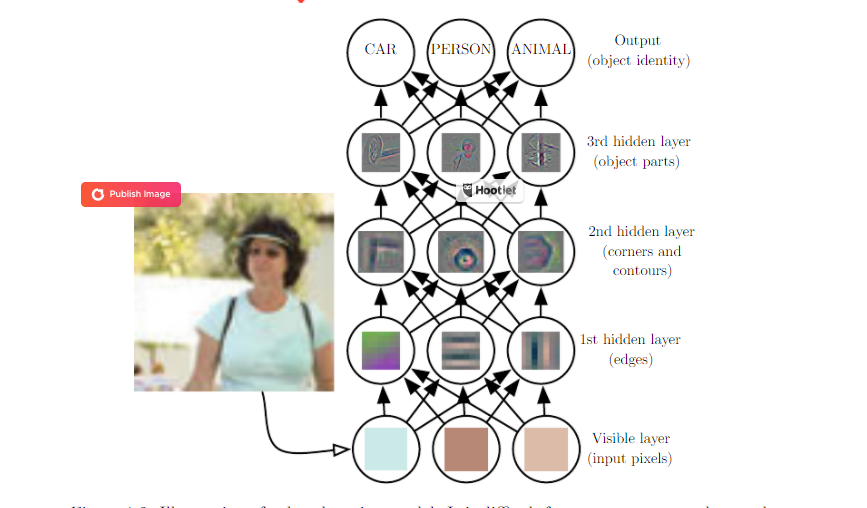
The image above, taken from Ian Goodfellow, Yoshua Bengio and Aaron Courville’s work on deep learning, illustrates just how difficult it is for a computer to understand raw sensory input data. In actuality, although humans are able to easily identify people and their faces, function mapping from a set of pixels to an object identity is very complicated: “Learning this mapping would be almost impossible if handled directly, but deep learning resolves this by breaking the desired complicated mapping into a series of nested simple mappings, each described via different layer in the model.” In this model, the input is called the visible layer because it contains variables we can observe. In between the output layer and input layer are hidden layers that extract abstract features from the image. We label these layers “hidden” because their values aren’t present in the data but must be determined by the model when it seeks to uncover which concepts are best at explaining certain relationships in the data.
This example can help us to see why this particular approach to machine learning is often called “deep learning.”
Machine learning is used in Financial Services, Healthcare, Government, Marketing and Sales, Oil and Gas, and Transportation among others. While there are many applications for machine learning, below I’ve provided three of the most popular:
Learning Associations—Retail Cross-Selling
In retail, a common application of machine learning is basket analysis. Basket analysis involves finding associations between products bought by customers and developing an association rule from statistical probability to enable cross-selling.
For example, if customer X happens to frequently purchase product Y, and if a customer X can be identified who doesn’t yet purchase Y, he or she is an excellent candidate to cross-sell product Y. More plainly, if X happens to purchase beer and customers like X also happen to frequently purchase chips with beer, then an association rule—70% of customer who buy beer also buy chips– can be developed via machine learning to enable cross-selling to X.
Classification—Financial Risk Assessment
Classification in machine learning builds on associations and goes a step further to identify group membership. A common application of classification is when banks try to predict in advance the risk of a bank loan. What is the risk that the customer will default and not pay the loan back? Which applications belong to a high-risk group and which belong to a low risk group? The way the bank calculates the risk is by looking for patterns in data about past customer loans as well as information regarding a customer’s financial history—income, savings, collateral etc– in order to make a prediction about the future. The bank fits a model of past data in order to calculate the risk of a new application, making a decision to accept or refuse the risk.
In this example, two classes are established, low risk and high risk, and the job of the classifier is to assign the input (the customer) into one of two classes:
IF income > 01 and savings is >then low risk ELSE high risk
Once a classification rule has been established the primary application is prediction. Assuming the future is similar to the past, if we have a rule that fits past data, then we’re able to make predictions about new instances in the future. In the case of a bank loan, the classification rule will enable the loan qualifier to evaluate a loan application with certain income and savings and quickly decide if the loan is low or high-risk. As such, a classification rule in machine learning is a tremendously powerful risk assessment tool for financial institutions.
Regression—Medical Mortality Prediction
Unlike classification, regression involves estimating or predicting a response or output value not from a membership in a group, but from a continuous set of training data. In other words, given a set of data, find the best relationship that represents the set of data.One of the most exciting examples of regression being used is machine learning for the healthcare industry. Machine learning algorithms can help medical experts analyze data to identify trends or red flags that may lead to improved diagnoses and treatment.
By analyzing the data from past cases to understand the risk factors that contribute to a certain patient outcome or diagnosis, these algorithms can ingest the data of a new patient and compare it to the models developed with the training set to predict the likely outcome. In the case of predicting clinical outcomes for patients diagnosed with a stroke, clinicians can use machine learning for creating diagnostic scores that will more accurately predict an outcome. According to a recent study, strokes account for “5.54 million deaths worldwide” and are the second commonest cause of mortality. A quick and accurate diagnosis of a stroke is important for immediate resuscitation. Using a free and easy-to-use “exploratory regression technique’, researchers were able to predict a 30-day mortality rate following a stroke in the rural Indian population that was 14% more accurate than existing scores.
It’s no secret: Digital is more complex than ever before. The industry has seen an explosion of tech, vendors, tracking metrics, cost types, and devices in recent years.
Considering our relentless focus on minimizing industry chaos, we partnered with research firm Ad Perceptions to survey more than 150 digital media professionals. We talked to the marketers who are tasked with making sense of it all every day, and we worked to uncover their pain points, expectations, and wish lists for programmatic advertising in 2018.
Want the state of the (programmatic) state? Download our infographic.
At Centro, we know that keeping up with the trade pubs and latest trends can be tough and time consuming. To make that easier, we’ve compiled all the articles, reports, and other bits of awesomeness you may have missed, but should definitely read. Enjoy our latest list below!
Less than 60 days until the new European internet law General Data Protection Regulation – or GDPR as most refer it – goes into effect, and it has already spurred changes in how data is collected and handled. GDPR attempts to standardize data rights across all 28 European Union countries, ensuring that users know, understand, and consent to the data collected about them.
Averaging over a million players per game, HQ Trivia continues to hit new milestones with sizeable sponsorship deals, the most recent being the movie release of Ready Player One. In an age of hyper-targeting, there’s still high value in large, attentive audiences.
As digital advertising has matured, most of the promises made early on have come to fruition, but at what cost? This offers some good perspective on what’s taken place over the last several years, with a nod of hope towards improved digital advertising and how TV will benefit as well.
Looking at data across platforms, eMarketer found that prices for programmatic ads are going up. Prices are seeing an increase across channels such as desktop, mobile web, mobile app, and video. This increase is attributed to a growing importance on both audience and data in the programmatic space.
With more buyers moving into the programmatic space, agencies are using RFPs less and less. Claiming it to be old school process where vendors do not receive feedback from agencies, more partners and agencies are pushing back on them. There’s a growing desire for a more efficient process – particularly with the more custom and complex offerings available.
There’s been a notable rise in the adoption of ads.txt by publishers in recent months – with upwards of 51% of sites that sell their ads programmatically having implemented the verification file. For those out of the loop, ads.txt is a way programmatic platforms can check whether a vendor’s claim to inventory is legitimate or not, offering a greater level of transparency of who is allowed to sell their inventory. Read related Centro articles from last year here and here.
Are you confused by blockchain? Blockchain technology is a new-ish network that decentralizes trade and allows for more peer-to peer transactions. Still a little confusing? Political scientist and blockchain researcher Bettina Warburg breaks down blockchain technology in this video to five different people; a child, a teen, a college student, a grad student, and an expert.
Knowing that over two billion people in the world are not online can be tough to fathom in our non-stop connected lives. This article explores how many of these people are getting connected, though somewhat indirectly, while still benefiting from new services that offer micro-loans, crop insurance, and even more efficient energy sources.
April's DIAL is also available as a PDF.
As a digital media professional, what would it mean for you to have a full set of digital tools at your disposal? Before you start thinking about the answer to that question, let’s start with an analogy.
Imagine you are a renowned artist and you have been commissioned to create a painting of the beach. Your client is going to spend a significant amount of money, and you will spend countless hours on the project. You have your brushes, your easel, and your canvas, but when it comes to paint, you only have the color blue. Sure, you can paint a lovely painting of the water and the sky, but what’s a beach without the sand, the sun, or the small plane flying by advertising local bar specials?!
Now, I have nothing against the color blue. In fact, it’s actually my favorite color. But think of how limiting it would be as the only color on an artist’s palette. All the talent in the world wouldn’t help the artist portray the full breadth of the visual landscape.
The lesson here is very simple. Client happiness and return on investment are paramount to a successful partnership – those are the goods that keep you in business. Without them, a client’s money goes elsewhere. Maybe to different mediums, a different artist, or several different artists who can meet their expectations.
As unrelated as it may seem, digital media agencies are a lot like the commissioned artist in this scenario. The digital landscape is increasingly cluttered and complex. Standing out and creating competitive differentiation requires agencies to create more elaborate stories for their clients and produce meaningful, valuable, and creative executions. The campaigns they work on should provide extensive and layered insights – learnings that impact future expenditures and marketing tactics. Like an artist, the agency needs to provide a specialized service that a brand can’t create on their own.
But that is not as simple as it sounds. Getting from point A to point B means overseeing and orchestrating numerous technology tools to manage granular elements of a digital media buy -- vendors, creative units, devices, cost types, tracking metrics and more. It also means increased complexity, because digital advertisers today work with an average of 4-5 vendors in each of the ‘DSP,’ ‘data provider & data management,’ and ‘other ad tech’ categories.
Considering that most digital advertisers and agencies are dealing with the same above-mentioned opportunities and problems just to meet the minimum that’s expected of them, how is an agency supposed to stand out?
It all comes down to the tools.
The tools at an agency’s disposal, much like the colors on an artist’s palette, have a direct impact on the level of creativity, insight, and performance that can be provided for a client. Agencies cannot afford (literally) to be limited by a lack of access to information, nor can they be burdened by the inefficiencies of having their teams toggle between multiple platforms or dashboards throughout the day to accomplish both simple and complex tasks.
Basis by Centro is more than the color blue! It is the multi-color palette that digital agencies and marketers need. It’s the most robust DSP on the market, nestled inside a single system that provides unparalleled access to data across your entire digital media process. It’s powered with real-time and on-demand information that transforms into actionable intelligence about your client’s business – and your own. Recently ranked as the #1 DSP, according to user feedback on software review site G2 Crowd, Basis is wrapped around must-have features and benefits such as:
Want to unlock your ability to provide sticky, meaningful, and colorful masterpieces for your clients? Learn more about Basis on our website or email us at [email protected].
We continue to release product features, updates, and functionality within Basis to make your day-to-day campaign management more effective and efficient. This week, we introduced an important YouTube campaign enhancement, and we talked to the product guru behind the feature to get the inside scoop.
Let’s start with the basics. What is the YouTube Campaign Inclusion feature?
Good question. YouTube campaigns are now accessible to users that have Google AdWords credentials, which allows users to map YouTube ad campaigns to Basis line items. Historically, YouTube campaigns have not easily been included into the AdWords API. Given our focus on bringing all digital media buying into a single platform, our team felt it was important to build a creative solution to support this.
Awesome. How does it work?
Prior to this feature, users would have to manually download YouTube performance reports from AdWords and upload the performance report into Basis. This feature cuts down the manual work because YouTube campaigns are included as part of the list of ad campaigns associated with a user’s AdWords account. YouTube campaigns are quickly and easily linked as a delivery source to the corresponding line item.
Beyond reducing manual work, which is great, can you break down the other benefits for me?
Sure! There are five really great ones that come to mind:
Will this information be easy to find in Basis?
Once a user maps their YouTube campaign, all of the data is available in the same reports as AdWords data, and a user will see YouTube data in the analytics grid, daily delivery reports, performance reports, and creative performance reports.
Having all of this data in a unified place gives you unparalleled access to reporting across the entire digital media process. That ability to review and optimize across all buying methods and channels is invaluable when making campaign and business-level decisions. It means everyone – from digital ad buyers and media planners all the way up to leadership – is operating informed and in concert with the entire team.
How robust is the reporting data? For example, would it be good for day-to-day reporting or could I share this data with a client?
The YouTube data should be treated like data from any other source. How often you’d present data to a client depends on your client’s needs. This update doesn’t necessarily change how or why you’d share data with a client. It just makes the data easier to get into the platform – and makes your life a little easier.
To see this feature and more of the Basis platform in action, request a demo or email us at [email protected].
Did you know location-based ad spending will reach $32 billion by 2021?
While location-based ads aren’t a new concept in digital, this popular mobile advertising tactic continues to see growth, and there’s a good reason why. By combining heavy consumer phone usage with improved data collection and technology advancements, location advertising has opened up new advertising opportunities for marketers.
What better time than now to get up to speed on what location advertising is and how to keep pace with the opportunities? You’ve got questions, and we’ve got answers. Give us 45 minutes of your day, and we’ll give you:
WHAT: X Marks the Spot: How to Advance Your Location-Based Advertising Strategy
WHEN: Wednesday, March 21 @ 1:30 EST
WHERE: Register here!
Be sure to visit our Centro Institute Resource Center for more educational content, and learn more about the mobile advertising opportunity with Centro, here.