
Technology
Basis Platform
Advertising Operating System
Communication Portal
Intelligent Collaboration
All Channel Activation
Activate Media on Every Channel

Consulting
Resources
The November midterm election may seem far away, but political operatives and marketers have been gearing up for this consequential series of events for some time. Centro tapped these folks for “ears to the ground” takes on digital media for political marketing and elections in 2018.
Respondents showed high optimism for digital budgets to increase. And many have an overwhelmingly high belief that programmatic advertising will be important for their digital campaigns. There was also much enthusiasm about audience data. However, proving ad impact to clients was the biggest concern. Contrast that with the minority of respondents being concerned about, arguably, the biggest general criticisms of 2016 elections – polling data and fake news.
Our survey, conducted in April 2018, spanned progressives, conservatives and non-partisan groups among 50+ agencies, consultants and advocacy organizations who focus on this specialty. Read on to learn about our survey results.

There is lots of optimism that digital budgets will increase, with a modest amount of respondents who “don’t want to guess” and very few who think it will stay the same or decrease. In 2018, it remains to be seen if the majority of dollars will be spent with just a few big platforms or spread across a wider range of sites and channels. A marketing strategy with a more diversified digital mix appears to be supported by responses that follow.

The optimism in the rise of digital budgets looks to be tied closely with the enthusiasm surrounding the role of programmatic advertising. We heard a resounding “Yes” from more than 3/4 of respondents, who say that programmatic advertising will be important to their efforts, and not a single respondent answered “no.”
Programmatic technology fuels many of the key elements in a political campaign’s digital strategy, including voter targeting, hyperlocal (aka geo-fencing), cross-device targeting, and connected TV. And it also brings pricing efficiencies and scale that help maximize campaign dollars, whether through self-serve technology or managed service partners. Ideally, these tactics should fit neatly with other aspects of a campaign such as social and search, so that all function with synchronicity.

When we asked what would be the most promising developments for digital campaigns this year, more than half of respondents selected “Audience data that is higher quality and more readily available.” The second highest response: “Improved technology for connecting offline-online audiences,” also speaks to confidence in data. For political and issue marketers, data is king, despite recent headlines around data usage and privacy concerns. New policies and regulations on the governance of people’s data may pose challenges in certain areas, particularly within social platforms, which might explain why social products ranked last among the choices. Perhaps social is reaching a peak, or maybe it just didn’t make an impression (see what we did there?).

Despite the multitude of headlines on this topic surrounding the 2016 elections, an issue that had the least amount of concern is “polling data accuracy.” Political professionals understand the nuances of how polling works, including its limitations—however, they still have a lot of confidence in its accuracy when applied properly. Interestingly, the choice of “Fake news or fake ads,” another headline-grabbing topic drawing tech giants to Capitol Hill for hearings, does not garner much worry, with less than 1/3 reporting concern.
The issue of most concern (identified by two-thirds of respondents) was “Proving advertising impact to clients,” which is reflective of the age-old desire to undeniably prove advertising works, combined with the underrepresentation of digital audiences in traditional polling, and challenges of measuring impact against objectives like opinion shift. Nearly half of respondents cited “Targeting specific voters effectively and accurately” and “Securing/expanding ad budgets” as the other top concerns. These top three concerns may go hand in hand, as the ability to prove effective and accurate targeting, and its impact, are essential to increase digital spending in this cycle and the next.

Nearly 80% of respondents believe that the current political environment will impact their ability to achieve outcomes, but most aren’t sure if it will have a negative or positive effect. Sometimes, despite the data science, resource and smarts, a campaign may be at the mercy of political climates that can shift gradually or quickly. As we all know, a lot can change between now and November.

The majority of respondents are focused on independent and swing voters more than turning out the base. This is understandable given the continuing surge in registered independents, up nearly 30% over a decade ago. Independents are critical to most campaigns; and while targeting them is easy, messaging that persuades them can be trickier – understanding the key issues and varying partisan leanings among independent voters is crucial. Now apply that with the challenges of understanding local issues, and one can see why this is top of mind for political marketers.
When we asked respondents to pick the best presidential candidate between Oprah, Dwayne “The Rock” Johnson, or themselves, more than half (36% for Oprah and 17% for The Rock) chose a celebrity over themselves. Though Oprah and The Rock have the immense wealth, visibility and business operations acumen to win a campaign, a little less than half of the respondents still believe they’d be better suited for the position than these celebrities. That’s a lot of self-confidence among marketing professionals.
--
Centro offers advertising solutions unifying programmatic and direct media buying, along with workflow automation, cross-channel campaign planning, universal reporting and business intelligence. For nearly a decade, political and advocacy groups from all sides of the spectrum have relied on our technology to boost media, team and business performance by enabling advertisers to plan, buy and analyze real-time bidding (RTB), direct, search and social campaigns in a single platform. To learn more, send us a note at [email protected].
# # #
If you’ve been searching for a comprehensive, intelligible introduction to machine learning that doesn’t read like it was written by Einstein for Einstein, we’re here to help.
Because, come on. There was only one Einstein, and no one has had enough coffee to be on his level right now. Or ever.
Given how saturated our media landscape has become with mentions of machine learning, however, we felt the need to explain the topic as well as clear up some of the misconceptions between it and AI. Moreover, it’s incredibly important if you’re a marketer or business to understand machine learning and what it can do for you.
Ready to learn … about how machines learn? Read on.
Today’s average marketer already has an almost unmanageably full plate. Not only are you supposed to create meaningful campaigns, understand the difference between and select the best search engine marketing strategies, and somehow find time for that cup of coffee – now you’re supposed to understand machine learning too?
Before you give this a pfft and head to the nearest monastery to resign from your worldly way of life, be comforted: Machine learning isn’t actually that complex a topic.
In a nutshell, machine learning is a way of helping machines access information. It’s a complex world, and to give an algorithm all of the information it needs to perform a certain task – for instance, predict consumer behavior and design ad strategies accordingly – would be nigh impossible. The rate at which humans can feed information to our exponentially faster machine friends is laughably slow.
Instead, we feed sample pieces of information to machines. Given enough samples (we’re still talking in the millions), the machine can then learn what it’s “looking for.” Calum McClelland uses the example of a cat: Give a machine enough pictures of cats/not cats and tell them which is which, and it can eventually build a model for recognizing whether or not an image contains a cat.
So when the robots come for us, we can at least rest assured they will not be confused by cats.
Seriously, though, if machine learning is all about an algorithm teaching itself to do stuff, then how is this different from AI?
Good question. No introduction of machine learning would be complete without a quick look at the difference between it and artificial intelligence.
In a nutshell, artificial intelligence is any intelligence that can mimic human behavior to perform a complex task: say, recognizing human speech or faces (or cats). Machine learning leads to artificial intelligence. Machine learning about the difference between cats and non-cats >> the AI ability to recognize cats in the future.
This is one type of AI, recognizing cats, and as such is classified “narrow.” Once AI can do most or all of the things humans can, that’s general AI. We’re not there yet.
Where are we? At the point of a machine learning explosion in business.
Lest you think machine learning is some nebulous future endeavor, know that it’s not. In fact, smart companies are already using it to build ever-more-sophisticated digital marketing campaigns. It is officially changing the customer journey.
So how can you use machine learning for marketing? Well, for instance, you could use machine learning to teach an algorithm which of your products consumers have historically searched for on a given holiday sale weekend, then use the sophisticated algorithm it builds in your campaign strategies going forward.
You can also use it to predict retail cross-selling, financial risk assessment, and medical mortality. The leg up this will give you over your competitors is substantial – although it’s worth noting that more and more businesses are jumping on the machine learning bandwagon, so you won’t stay ahead of the curve for long if you don’t start leveraging it today.
At Centro, we know that keeping up with the trade pubs and latest trends can be tough and time consuming. To make that easier, we’ve compiled all the articles, reports, and other bits of awesomeness you may have missed, but should definitely read. Enjoy our latest list below!
The much anticipated Internet Trends report is now available, clocking in at 294 slides. Check out some of the key takeaways that range from the slowing growth of mobile and internet users due to market saturation to a fascinating look at global adoption and innovation.
Once, Mad Men ruled advertising. They’ve now been eclipsed by Math Men—the engineers and data scientists whose province is machines, algorithms, pureed data, and artificial intelligence – but at what price to consumer’s privacy (and the advertising industry) today and in the future?
Take your ad fraud knowledge to the next level by reading through what still causes it and what you can do to prevent it. Highlights - ad fraud is still at an all-time high and insane profits still come from ad fraud.
Header bidding enabled ad spend continues on the upswing thanks to mobile. Publishers are becoming increasingly more interested and experimenting in this area but some ad networks have been slow to adopt as they are comfortable with the secure spot in the waterfall.
Now that the GDPR has taken effect in Europe, take a look at what is happening within the U.S. Later this year, California will vote on a privacy law that has already eared the ire of Facebook and Google. This act gives people the right to know what information companies collect about them but it does not require companies to get people’s permission to collect that information.
The IAB released a disclosure framework to help buyers evaluate the attributes of audience segment data. If this is adopted, digital media buyers will receive information about sourcing, age and any modeling used for third-party audience segments, data transacted through a co-op or first-party data old directly by a retailor or media company.
As one of the world’s largest data management platforms with approximately 65 data partners and over 4 billion cookies and mobile device IDs to date, Lotame recently rolled out 4 ways to test the quality of PC cookies and similarly also mobile-based data. The 4 components of data collection they are measuring are, ‘labelling’ (knowing where the data is coming from), ‘provenance’ (knowing how the data is collected and how it will be used), ‘accuracy’ (confirming that data points are in fact what they say they are) and ‘efficacy’ (knowing whether the data works).
Amazon is testing a new display ad offering that is threatens companies like Google and Criteo. The tool will let merchants selling on Amazon’s online marketplace purchase spots that will follow shoppers around the web to lure customers back to Amazon to buy. Amazon is an ideal place to advertise since visitors that come to the site are there to shop, rather than to browse like they would on Google or Facebook properties.
While Stories themselves may be ephemeral, the format continues to live on and grow. The 9:16 aspect ratio has given rise to the vertical format for content (and advertising), and does not look to be going away any time soon.
Still not sure on what all the hype around blockchain is for? A recent eMarketer report breaks down why there’s so much interest by digital marketers around blockchain, what it is, and how it’s bring solutions (or a lack thereof) to various aspects of the programmatic advertising space. Topics covered include supply chain transparency, programmatic payments and identity management in a post-GDPR world.
June's DIAL is also available as a PDF.
Prioritizing investment in SEO vs PPC is far from a new challenge for marketers today. Each technique is a valuable way to reach your target audience. However, both require careful attention to optimize so that your marketing can start benefiting from them.
If you want to improve your SEM strategy overall, here’s everything you need to know about prioritizing SEO vs PPC.
PPC has its strengths and so does SEO, but very few businesses can invest 100% in both from day one. Here are a few reasons why your business might want to prioritize SEO first:
You probably already know search engines (especially Google) are one of the most common platforms people use to access information on the internet. If you fail to have a presence in search engine results, you’re missing out on a huge potential channel to reach your target audience.
Sure, using PPC ads is an easy way to jump to the top of search results without investing in all that organic optimization. But consider: between 70% and 80% of users completely ignore paid advertisements when they use a search engine. There’s a growing number of consumers who don’t put any stock in advertisements. SEO is a way to reach them without direct promotion.
Most search engine users today understand that Google considers the authority of domains when delivering search results to users. If a page appears on the first page of search results for a query, users trust the content is truthful and from a source that people have a lot of confidence in.
That’s why getting your pages to rank well in search results is a great way to increase your brand authority. In fact, 50% of visitors are more likely to click a result if the brand appears multiple times in search results.
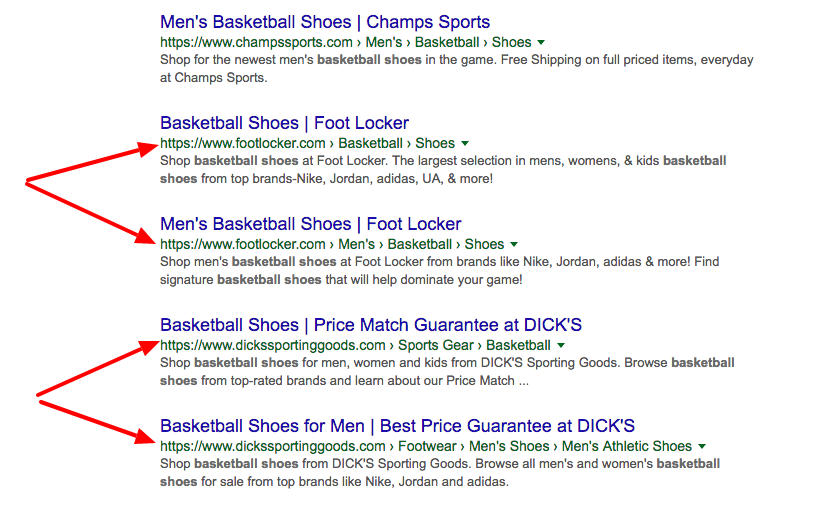
Unlike PPC advertising, where you have to pay for each click to your content, SEO is completely free. Create quality, relevant content and build up the right ranking signals for it to get search engine visibility without spending a penny.
That said, the efforts you make to optimize for SEO can cost a lot of money in and of itself. The only difference is there’s no minimum threshold to get visibility, like with PPC ads. If you’re working with a lean marketing budget, SEO is the obvious choice to start with because you can limit your financial investment and still start getting results.
PPC ads usually target very specific search queries to drive sales or encourage searchers to click through and become leads. That seriously limits your keyword targeting opportunities compared to SEO.
If you host a blog on your website, you can target long-tail keywords related to questions people ask about your industry. Considering that 50% of search queries are four words or longer, targeting long-tail keywords with SEO gives you more opportunity to appeal to the needs and interests of search engines users.
It takes a lot of time and effort to build up an effective presence in organic search results, but once you do, it’s going to keep on delivering results. Building up your domain authority through link building and other tactics makes it much easier to get new content you publish to rank well quickly. Meanwhile valuable cornerstone content you published years ago can still bring in a steady stream of traffic every month, with no extra effort on your part.
PPC, on the other hand, is like flipping a light switch. You either invest money and get results or you don’t. There’s no opportunity to benefit from long-term residual traffic like with SEO.
SEO might seem like the obvious choice to prioritize in the beginning, but PPC has some unique traits and benefits that make it appealing for certain kinds of businesses and marketing goals. Here are a few factors to consider:
There’s no denying that PPC ads get prime real estate in search results. They appear above the fold, above organic results, and are often the first thing people see after hitting “Enter” on their search query. It’s no wonder that search ads can increase brand awareness by 80%, according to Google.
Even if users don’t click on your PPC ads, your message can impact what they click on in organic results below, or impact their next query search. Getting your brand name and products/services in front of people’s eyes is an important digital marketing strategy for just about every kind of business.
Google AdWords provides you with all the information you need to better optimize your ads through your Quality Score. Quality Score looks at your ad relevance, landing page experience, and click through rate and tells you which ones are negatively impacting your ad quality.
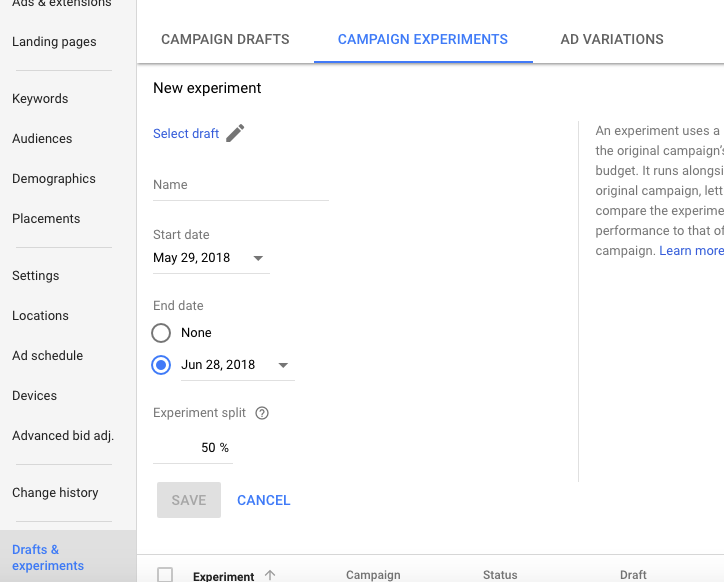
When you use Campaign Experiments, AdWords also makes it easy to A/B test different ad elements (Headline, CTA, extensions, etc.) so you can identify exactly what kind of message resonates with your audience. There’s even options to rotate your ad variations and auto-optimize by displaying the most effective ones.
Optimizing for SEO isn’t as intuitive as PPC ads. People create quality, compelling content all the time but can’t get traffic to it because of domain authority, keyword targeting, or other issues they can’t identify. Optimizing for SEO takes a lot of troubleshooting and long-term analysis to identify the best content elements for your audience.
If your main goal is to get visibility for your products and increase conversions, PPC is an obvious choice. Paid ads get 65% of all clicks for high commercial intent searches.
While people often ignore ads when searching for information online, they have no qualms clicking when they’re making a purchase soon. Targeting search engine users who are already looking to buy is a great way skip organic competition and drive more sales from PPC ads.
While there are certain factors that work together to determine organic pagerank, it’s really more of an art than a science. That’s because Google changes its algorithms 500 times per year, so the strategies you use to optimize today can become irrelevant tomorrow.
With PPC ads, you have much more control over performance. You can choose what keywords you do/don’t want your ads to appear for, how much you want to bid for various keywords, what your ad will look like in search results, etc.
With organic search, you’re often left wondering what factors will help your pages improve and maintain rank long term.
It’s true that optimizing for PPC requires some upfront financial investment. Especially if you work in a competitive industry, getting ad visibility can be quite expensive. But as long as you target relevant keywords with quality content, you should be able to quickly realize a return on your investment. PPC site visitors are 50% more likely to purchase something than organic site visitors.
After you invest in creating and promoting your SEO content, you have to wait for it to start ranking. And even then the revenue you drive from organic traffic might not match what you could achieve with PPC in much less time.
So if you want to maximize your PPC ROAS, you should focus on product promotion to see quick results.
Now that you understand the pros and cons of each strategy, hopefully you have a better idea of which is the most valuable for your business at this point. It mostly boils down to your industry, budget, and goals. For example, if you’re an ecommerce seller looking to drive sales quickly, PPC is the obvious option to start with. If you run a startup with a shoestring budget, SEO is the more economical strategy to start with.
The final verdict for the majority of businesses is that they need a little of both. Despite their differences, SEO and PPC actually complement each other quite well. In fact, marketers that use both SEO and PPC ads average 25% more clicks and 27% more profits than those who use one technique.
That said, very few businesses can hit the ground running with complete SEO and PPC strategies at one time. It’s best to pick and prioritize how you invest in the beginning so you can grow and improve results long-terms.
Here’s how you can make the best of both worlds with SEO vs. PPC:
Assuming you’re not marketing a brand new site, it’s quite likely you have pages that already rank well for certain keywords. Instead of starting from square one with your organic optimization, boost the SEO of pages that are already ranking well. This will free up more of your budget and time for other SEM activities.
To see what keywords you’re already ranking well for, you can use SEMRush. Go to their main page and type in your domain name. Then it will return an overview of your domain analytics.
If you don’t have a SEMRush subscription, don’t worry. You can get 10 free reports by creating a free account. Once you’ve done that, scroll down to where it says “Top organic keywords” and click “View Full Report.”
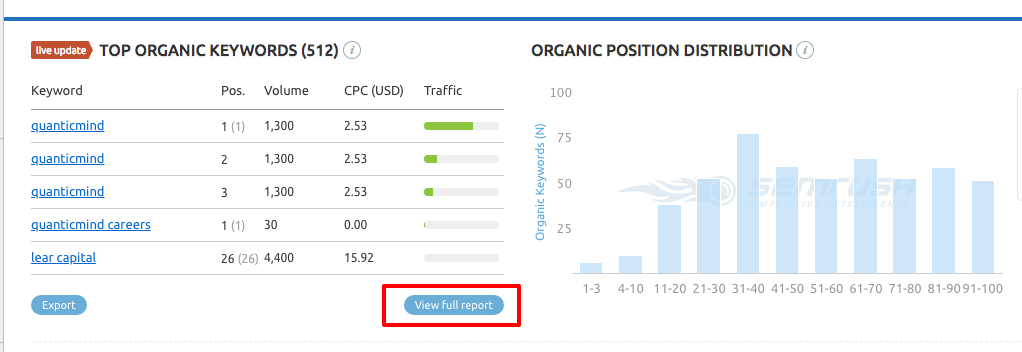
Then it will return a full report of your pages’ rankings for various keywords in search results:
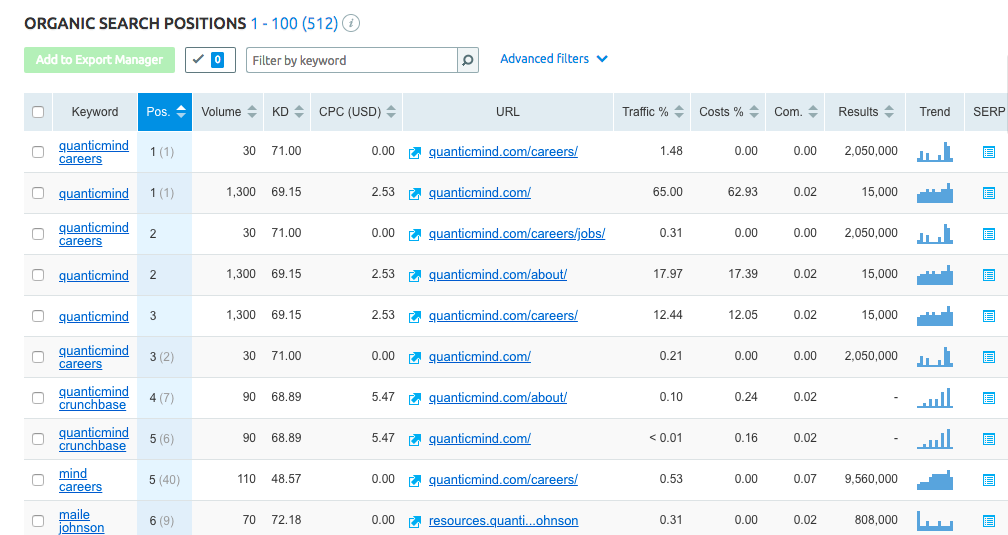
Sort the data by “position” and you can see what keywords and associated pages already appear on the first page of search results. Look past these to the ones that appear on pages 2-10 of search results for a given keyword.
These are your opportunities. Since the vast majority of people never go past the first page of search results, doing anything you can to bump these listings up to page 1 can have a big impact on visibility and traffic.
Look for ways to improve this content to rank better. For example, you can promote it to get more non-search traffic and high quality backlinks, update the content so it’s fresh and relevant, or make efforts to improve your page speed or other user experience factors.
While the low hanging fruit keywords might not always be the most important ones for your marketing goals, taking the time to optimize for them is one way to get quick results while you work on creating new content around keywords you don’t rank for at all.
Of course you should be targeting your most financially valuable keywords with SEO, but most businesses can’t afford to wait to build organic rank to start driving revenue from their site pages. That’s where PPC can help.
Save your PPC budget to focus on the keywords that are most likely to drive revenue for your business (that you can then reinvest in better SEO and PPC). These are going to be your bottom-of-the-funnel keywords.
Bottom-of-the-funnel queries imply users have already done their research and are ready to convert/buy. Say you just launched an ecommerce store that sells water shoes but don’t yet have the budget to target all the relevant product keywords. You could skip over top-of-the-funnel awareness keywords (e.g. “water socks vs water shoes”) and focus on keywords that imply a readiness to buy (e.g. “buy water shoes” or “water shoes best price”).
Here are a few more examples of keywords/modifiers that imply purchase intent:
That said, which keywords are most financially valuable to your business really depends on your unique products/services. If you’re a consultant trying to sell tickets to your annual workshop, then any keywords related to your workshop would be important to target.
Besides targeting keywords your pages already rank for, you can also target low competition keywords to expand your SEO efforts. Low competition keywords should be easier to rank for, while you target high competition ($$$) keywords with PPC.
Long-tail keywords are usually ultra-relevant search queries that have much lower competition than keywords with high commercial intent. To find some relevant ones for your business, you can use AdWords Keyword Planner to start.
Type in a base keyword related to your niche (e.g. “motorcycle repair”), and Keyword Planner will return a list of relevant related keywords, including helpful information like search volume and competition:
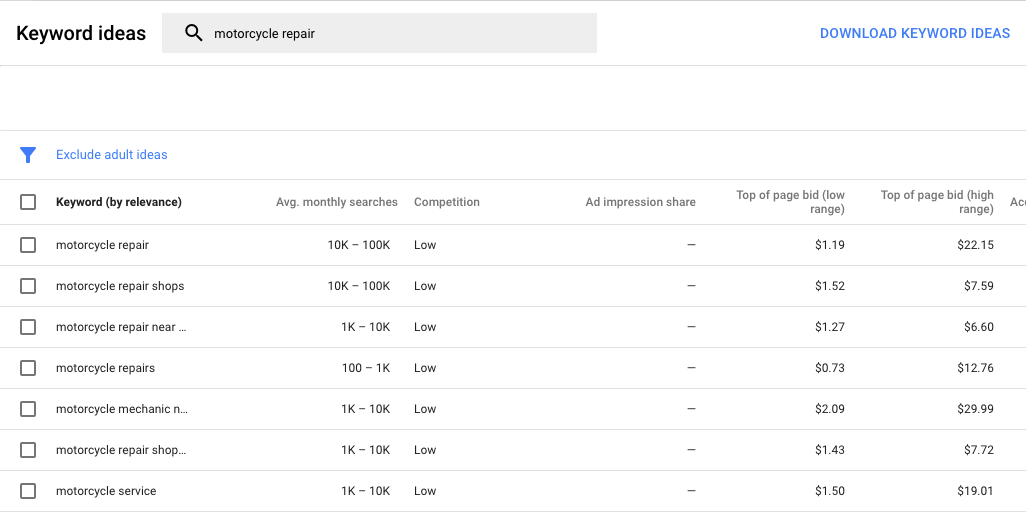
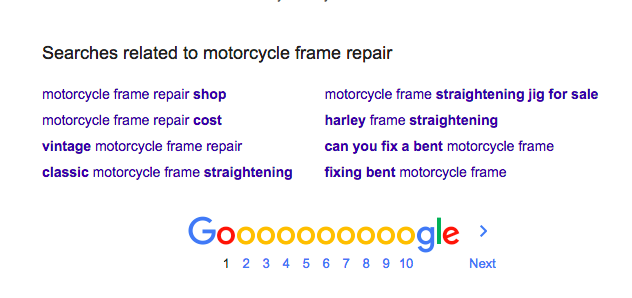
Once you have a list of relevant keywords, you can turn to a long tail keyword research tool to expand on them for SEO. Keywordtool.io, Answer the Public, and Longtail Pro are popular options. Or you could rely on Google’s native Auto Suggest. Type a root keyword you got from Keyword Planner (e.g. “motorcycle frame repair”) into Google then scroll down to related searches to get ideas:
Lastly, you can use your SEO and PPC strategies together to nurture leads at various touchpoints. Say someone finds your blog through a search engine and consumes some top-of-the-funnel content. You can use PPC to remarket to them through the Google Display Network, Facebook, or another third party advertising service.
Use these ads to only target people who have visited your site and/or consumed specific content and it shouldn’t take up too much of your advertising budget. That’s the beauty of PPC — you can control exactly who sees your ads and how much you spend. And since you’re focusing on warm leads with your remarketing ads, there’s more opportunity to drive revenue from your investment.
Don’t have the budget or resources to invest fully in PPC or SEO ? You don't have to pit them against each other. Both strategies have their strengths and weaknesses. Smart marketers use both in unison to fill in the gaps and develop a robust search engine marketing strategy overall.
Rely on your business model and unique goals to inform what to invest in first. Then employ the tips above to get the best of both worlds using PPC and SEO.
In June, we kick off another summer of our internship program. As we get ready to welcome our new “Centerns,” let’s take a look at what our 2017 Centerns have been up to! We talked to a few of them that were hired full-time following their internships.
Matan Horenstein, Digital Media Associate in New York
Matan was a Centern on the Media Services team in the New York office last summer. He was hired on full-time as a Digital Media Associate. Centro’s Giving Tree program was a big reason he knew he wanted to be hired full-time. The New York interns organized a fundraiser for a program that gives school supplies to children in the city, and Matan had an amazing experience working on it. Matan is passionate about the intern program, and advises this year’s Centerns to reach out to people on and off their team—schedule 1:1s, ask questions, and learn from others. The door is open and it’s up to you to take advantage!
Maggie Nemoy, Strategic Insights Associate in Chicago
Maggie interned on the Strategic Insights team in Chicago, learning research tools and putting together research decks. After her internship, she joined the same team full-time. During her internship she learned the “Centro Way,” and it has stuck with her. Everyone at Centro is so friendly and outgoing, they changed her way of communicating and helped her relax. Maggie recommends that Centerns get to know departments outside their own and learn about what everyone at Centro does.
Caroline Nugent, Analytical Operations Associate in Chicago
Caroline joined the Analytical Operations team in Chicago as a Centern last summer. During her internship she learned to use software tools like Datorama, LiveRamp, and DoubleVerify, all of which she uses now in her full-time position. She loved the “snack and learns” where Centerns learned about different departments throughout the company. Plus, the trainings gave her a chance to get to know other interns. Caroline encourages future Centerns to get out there and mingle, don’t be intimidated because everyone here is nice. Soak it all in!
Kelsey Brockett, Digital Media Associate in Dallas
Kelsey interned in Dallas and joined Centro full-time as a Digital Media Associate. As a Centern, she learned all about media strategy and client communication, knowledge she now uses every day. Joining the company as an intern allowed her to find her place in the office and gain confidence to ask lots of questions. Kelsey wants incoming Centerns to know that they shouldn’t be afraid to make mistakes (everyone does!). She also encourages everyone to meet their coworkers, as she has loved getting to know others and their experiences.
This year, we are hiring 17 interns across the U.S. and Canada. For more information on more career opportunities at Centro, visit: https://centro.net/careers.
Online advertising has been popular since the inception of the internet. But advertising has also changed a lot, and it keeps changing as new and more innovative adtech appears. One of the best new technologies is outstream video, which allows advertisers and website owners to give clients and readers excellent content without the standard video players like YouTube. It’s somewhat ironic that it took until 2018 for the industry to get here, but with the rise of video advertising content, relevance, and consumer interest, there’s now an easy way to syndicate this high-engagement content to reach greater audiences beyond just Youtube. Outstream video will give brands more opportunities to engage their customers, and grow the importance of video content at an even more rapid rate. That way people can see what they should be seeing, and what they want to see, without a lot of the extras that cause site visitors to click away and choose another site. Here's what to consider when it comes to learning about and using outstream video.
When you use outstream video to reach people on your website or to reach people on other websites through the use of ads, you can research your own keyword and choose one that's going to resonate with your target market. Then you know you have a good chance of saying (or showing) something that matters to the people you're trying to reach out to. When they see what you have to offer they may be interested in it, but if they can't see it through all of the other issues that come with video players they may choose to ignore it.
Through the use of the outstream video options, though, video ads come up and play as a person moves through the content. These ads can be scrolled past, and they'll stop playing as soon as they're off the screen. Most of them also autoplay without sound, so the audience you're targeting won't be blasted with noise or music as they scroll through content. Having that happen can really turn people off to the kinds of information you're trying to give them through the ads, and that might mean they won't come back to the site or buy the product the ad is offering to them. It's not always easy to avoid those kinds of problems, but outstream ads reduce the risk. By leveraging outstream and targeting the right people, your chances of advertising success will be on the rise.
One of the benefits of outstream video is choice. You can pick where your ad goes, how it is placed, and what it offers to the people looking at the site. Some people use these ads to place their information on other sites, but many people are using them to give readers more information about the content they're already reading. In other words, they're placing embedded video on their own site to sell products or services. For those who want to use ads from others, though, some companies are paying a lot of money to have their outstream video ads placed.
It depends on the site where the ad is being placed, of course, and the type of video that the advertiser or company wants, but there are companies that are paying $45 CPMs. That's a big deal for those who are looking for good advertising revenue, and also for those who want to really monetize a site in a way that people who come to that site can appreciate. It's not always easy to get good advertising for a site, and it's also not always easy to get a site where advertisers want to put their information. No matter whether you're a site owner, another company, or an advertising agency, understanding the value of outstream video is important for your future.
In early 2017, most people had never heard of outstream video. By the middle of 2018, a lot of companies are using it. Agencies that help companies place ads are saying that outstream video is the next big thing, and 77% of those agencies believe this type of advertising could actually be crucial to the success of their clients. As someone who wants to see your company and your internet presence succeed, it's time to look at outstream video. New concepts are very important, and when they quickly take hold like this one has, you want to make sure you're a part of that.
If you avoid outstream video because it's new or because you're not familiar with it yet, you could really be missing out on everything it has to offer. But there's more to the equation than that. Your customers will also miss out on what it has to offer, and by extension what you have to offer. That's unfortunate for everyone involved, and makes it harder to build a strong business that customers can find, trust, and rely on. The more you know about new concepts and the more you employ them in your marketing strategy, the better off you'll be when it comes to staying at the forefront of your industry and keeping your advertising fresh and new.
With so many ad agencies predicting that companies are going to move rapidly to this type of advertising, understanding outstream video and getting involved with it now can put you ahead of the curve. Getting behind your competitors isn't a good thing, and it can be hard to catch up. You at least need to keep up with them and get ahead of them if possible. By starting to work with outstream video now, instead of waiting for more companies to begin to use it, you have the unique opportunity to really get ahead of others in your industry.
Not only can that make it better for your company to build a strong internet presence, but it can also help reach more and more people who may potentially be interested in buying from you at a later date. Even if they aren't customers right now, they may be customers in the future. Helping them see everything you can offer them, and giving them ads that work for them both in information and placement, can be extremely valuable as a marketing strategy and to be sure that you're doing all you can to keep at the forefront of your industry. Doing what's needed to keep customers interested often means trying new things, and getting your foot in the door before others do.
One of the best things about outstream video is that it's less intrusive than other types of advertising. For example, nearly everyone hates pop-ups. That's why there are so many pop-up blockers available today, and why so many companies' websites ask that you turn off your adblocker when you visit. Some will let you see content anyway, and some will refuse to show you their site if you don't let them advertise to you. Either way, you have options for how intrusive you want to allow ads to be. As a site owner, you also have that option. But your customers need to have some control of them or they might not come back.
Because the outstream video offered on a number of sites is less intrusive, more companies are starting to use it to reduce the number of visitors who leave the site because of ads. When a video ad auto plays without sound, and when scrolling past it makes it stop playing and disappear, there are fewer complaints from site visitors. That's good news for the visitors, the site owner, and the companies advertising on that site. When everyone benefits, the ads are more effective in the long run than some other choices.
With the advertising space on quality websites at a premium today, brands’ advertising spend is skyrocketing. But it's important that those advertising dollars are used wisely. If they aren't used the right way, they aren't going to be effective. At that point, the advertising dollars are simply being wasted and could be put to better use. But with brands paying high prices for outstream video space on high-level sites, advertising agencies, companies that want to advertise, and companies that have websites where advertising is allowed all need to work together to the benefit of everyone. Of course, that benefit includes the customers and clients who will visit the sites, see the ads, and potentially buy from the companies that are advertising.
Overall, outstream video is one of the best ways to advertise on the internet, and it's only going to become more important as time goes on. But that doesn't mean it's perfect yet, or that every company is focused on it. Because of that, now is a good time to get involved with it while it's still new. It's a bit unique at the moment, instead of being something that everyone has seen. That uniqueness can go a long way toward making your company stand out, and anyone who's advertising like this will start to see that it's adding to their revenue in a big way.
With the lack of intrusion into the website browsing experience and its ability to offer ads that customers really relate to, outstream video can be an excellent way for any company to move toward a higher level of advertising at a fair price. Reaching more customers in a way they can relate to is important, and companies that spend their advertising dollars carefully can reach more potential customers, as well.
As Centrons, we have a multitude of reasons to be proud of ourselves and our company – from our constant community-improving endeavors, to the awards we win for being one of the best places to work in the U.S. Our culture plays an enormous factor in everything that we do, and there is definitely a difference when our employees are no longer surrounded by fellow Centrons. Don’t take my word for it; just ask some of our Boomerangs! Nell McGann, one of our customer success managers, earned a great opportunity which led to her leaving Centro - only to realize at heart she remained a Centron. And that led her way back to the Centro family. Nell opened up to us about her thoughts and decision making processes:
Q: What did you find attractive about your new opportunity that made you want to leave Centro and pursue this opening?
Nell: “I was looking to pursue my passion for health and came across this startup in the health and software space. Its mission is to bring more data to physicians to help with treatment options for cancer patients, which was very interesting to me.”
Q: What were your expectations when starting your new opportunity? Were your expectations met?
N: “I expected to be working in a software system and training hospitals and educational institutions on how to best use the platform. I also was going to be managing partnerships with hospitals and educational institutions. Unfortunately, my expectations were not met. I spent my days working in Google sheets and managing cancer patient’s tissue from receipt of lab all the way through processing. The role was very in the weeds and I had little contact with the hospitals and educational institutions that I was told I would be managing.”
Q: What did you miss about Centro after you left?
N: “The culture and people. There is nothing that compares to Centro and the way employees are treated here. I did not expect to have the same culture at my new job, but I didn’t realize how much the culture of a company could affect every aspect of my life. I missed the opportunities I was presented and the trust and respect I received from my team and everyone at Centro. I did not realize how much support I had here until I left. At Centro I have so many people rooting for me and wanting me to do well. Centro trusts me with big accounts and creating new processes. No matter what mistakes were made along the way, I always have people to go to if I need help or advice. This is invaluable and not something you can get everywhere.”
Q: What were the driving factors for your return to Centro?
N: “I quickly realized the culture at my other company was negatively affecting me. I was constantly stressed and unhappy. I went to bed every night dreading going to work and woke up feeling the same way. I was not valued and I knew long term this would never work. I wanted to be part of a company that is forward thinking, challenging, and truly cares about their employees. Centro is all of these things. I wanted to work for a software company and not living in Google sheets every day; I wanted to be surrounded by smart, humble, and supportive people. Most importantly, I wanted a voice at the table and my voice to be heard no matter who I am talking to within the organization.”
Q: What did you learn from this experience?
N: “I realized I was really good at my job here and that I was being challenged even after 6 years of working here. I learned I have team members, directors, VP’s who value my work and enjoy working with me. I learned that Centro is home for me and the vision and mission of Centro is not something we put on our website, but something that is put into practice every single day by even the highest level employees. I learned that I still have a passion for health, but I don’t need my career to be in that industry in order to be happy and successful. I learned how to check my ego at the door, and make decisions that are right for me. Coming back to Centro is the right thing for me.”
Centro’s culture is something that is imprinted within each of us and is something to be incredibly proud of. Welcome back, Nell!
The AdWords experience has changed a lot over the years, but one feature remains important for PPC advertising success: Quality Score. AdWords Quality Score is an aggregate metric Google uses to determine the relevance of your ads to the search queries they’re optimized for. To improve their own user experience, Google wants to ensure the results you’re paying to deliver also match with the searcher’s intent. They use Quality Score to ensure only the most relevant ads appear alongside search results, regardless of how much you’re bidding for a specific keyword.
Quality Score ensures that irrelevant ads aren’t even able to enter an auction to appear for a user’s search query. It also helps determine ad rank for those ads that do enter an auction, along with CPC bid.
Ad Rank = CPC bid x Quality Score
While some marketers think of Quality Score as an advertising challenge to overcome, it’s actually a positive thing. Striving to make your ads more relevant will ultimately make them more effective at driving your marketing goals. A high Quality Score also gives advertisers with limited budgets the opportunity to outrank high bidders for competitive keywords.
Here’s everything you need to know to optimize your AdWords Quality Score.
The first thing you should do to improve your Quality Score is check it. Who knows? You could already be performing quite well.
In the new Adwords experience, just go to the Keywords tab from the side menu. Here you’ll see a list of all your keywords. Hover over a keyword’s status in the “Status” column. Then you’ll see your Quality Score for that keyword:
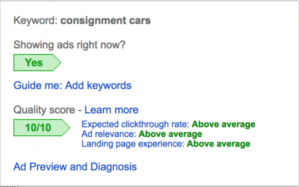
You’ll see there’s a Quality Score for each individual keyword you’re targeting with your ads. Scores range between 1 and 10 — the higher the score, the better. When your keyword has a low Quality Score, you’ll need to pay more to achieve the ad rank you want. When you have a high Quality Score, you’ll need to pay less.
Google uses 3 main factors to determine the Quality Score of your ads: click-through rate, ad relevance, and landing page experience.
Click-through rate
This is the percentage of people that click on your ads. For example, if Google displays your ad for a specific keyword 1000 times and searchers click on it 5 times, that’s a 0.5% click-through rate. So getting a lot of impressions in search results isn’t necessarily good if people don’t click on your ads.
Click-through rate is probably the most important factor in determining your Quality Score as it is also an indicator of ad relevance.
Ad relevance
The next factor affecting your Quality Score is ad relevance. That’s how well your ad content matches up to the intent of users when they search for a certain keyword. Ad relevance can be below average, average, or above average for an individual keyword.
Landing page experience
Landing page experience is what happens after users click through on an ad. If your landing page isn’t at all relevant to what they were looking for, they’re likely to immediately bounce, thus hurting your landing page experience score.
This can happen if your landing page is irrelevant to the keyword or has user experience issues that cause people to navigate away.
Now that you know what factors make up your Quality Score for a certain keyword, you’re ready to take steps to improve them. The strategies you can use are largely interconnected and can help improve more than one Quality Score factor at a time.
Here are 7 steps you can use to boost your Quality Score:
Step 1: Evaluate Your Ad Relevance
If Google doesn’t think your ad is relevant to the keyword you’re targeting and lowers your Quality Score as a result, then you need to look into and diagnose the problem yourself. Luckily Google has something just for that called the Ad Preview and Diagnosis Tool.
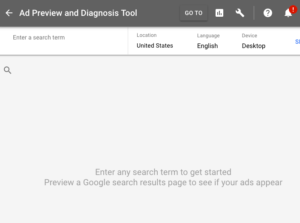
All you have to do is enter your target keyword and it will show you how your ad looks in search results. This is better than actually going to Google to find your ad because that would mean more impressions that can negatively impact your Quality Score even more.
Now you should take a long hard look at your ad and try to diagnose why people aren’t clicking on it. Maybe your ad copy isn’t very compelling. Are you missing a unique selling proposition or a proper CTA?
The other potential reason is that your ad isn’t really relevant to the keyword in question. For example, say you’re doing PPC for an online tax software, and you’re targeting a keyword like “tax advice.” Displaying an ad for your software wouldn’t really deliver what they’re looking for (a tax professional).
In this case, the solution would be to either stop targeting that keyword or create an ad that does deliver what people want. Directing people to a tax advice lead magnet or your in-house tax professionals would do the trick.
Step 2: Analyze Competitors’ Strategies
A great way to get an idea of what works and what doesn’t is by analyzing your competitors’ ads. Head to Google and see who’s ranking in the top 3 spots above the fold for a specific keyword.
Of course, part of what achieves this ad placement is high bidding. But the other part is Quality Score. You can bet ads appearing above the fold have top Quality Scores for that keyword.
Start by looking at what kind of ads are appearing in the top spots for a certain keyword. Are they offering the same kind of content/products/services that you are, or something different?
For example, if the top ads appearing for “tax advice” aren’t recommending software, it suggests you have a relevance issue. They could also be targeting a keyword in a more specific way than you are.
The next thing you can look at is ad copy. Maybe the top ads have a punchy CTA or other elements that help them get more clicks and a higher Quality Score. See what effective elements you can incorporate into your own ads.
You can also take a look at the organic results right below and compare your ad copy to that content to get some idea of query relevancy.
Step 3: Tightly Target High Volume Keywords
Aside from improving your current ads, you can also create a new tightly focused ad group with the main goal of improving your ad relevance. You’ll want to target high-volume keywords here.
Go through your existing Adwords keywords and find one with a poor ad relevance score. Pause the keyword within the ad group, then create a whole new ad group for the keyword.
The new ad group you’re creating is just about targeting one keyword with a poor Quality Score. So create your new ad copy with that one keyword in mind. So make sure your ad headline and copy use that exact keyword (e.g. When targeting “tax advice,” your headline can be “Get tax advice today”).
When creating the ad group, include your target keyword and only the most closely related keywords (e.g. free tax help online, free tax advice). Don’t go too broad here because you’re going for relevance.
Once you’ve created this ultra-targeted ad group, go back and check your Quality Score for the keyword. If your ad relevance goes up, then you’ve successfully created an ad that better matches the keyword.
A big mistake that a lot of PPC marketers make is trying to catch all with their ad groups. Using one ad to target too many possibly related keywords at the same time can lead to a bad Quality Score. Conduct experiments like this to see if that’s what’s driving your Quality Score down.
Step 4: Check Your Landing Page User Experience
The next thing you can do is go through your ads and improve your landing page user experience. This is worthwhile if you find you have a below-average landing page experience in your Quality Score for a certain keyword.
Go to the ads tab, hover over one of the ads with your cursor, then click through to the landing page associated with the ad. You very may well find your destination URLs don’t work, which is the root of all your Quality Score problems.
Often symbols are the culprit. Here’s a list of common symbols that can break your destination URLs:
If your destination URLs work just fine, then some other user experience issues could be the culprit. Are all your landing page elements working properly? How about your site speed?
It could be that your landing page is simply too slow to load. You can get an idea of your overall site speed using PageSpeed Insights.
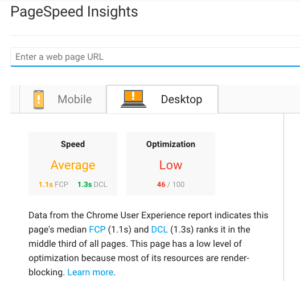
If your site is too slow, then make efforts to speed it up using Google’s suggestions.
Step 5: Optimize Your Landing Page Relevance
If your landing page doesn’t have any user experience issues, then it could be a problem of relevance. Now you need to ask yourself:
Does the landing page match peoples’ search intent?
Does the landing page match the ad associated with it?
It could be that your ad copy is misleading and sends users to a landing page they weren’t expecting. Or your landing page doesn’t do a good job of appearing like what they’re looking for.
You know what your landing pages are about (you did create them), but try to approach them from the eyes of an outsider. Something as simple as not including your target keyword in the page title, or forcing visitors to scroll past a large header to reach the page content is enough to make people bounce.
You should also ensure your landing page is sufficiently specific to what people are searching for. For example, if someone searched for “free tax advice for seniors,” and you send them to a general tax Q&A page, that’s not very targeted. Your landing page should be specifically about seniors (and hopefully have a picture of older people on it so they know they found the right place!).
Step 6: Change and Test Your Ads
Whatever new strategies you use to improve your Quality Score, make sure you test the changes. Instead of making blanket changes to all your ads for a specific keyword, create ad variations so you can test and see what works.
Make sure you have at least 3 or more ads in each ad group. Then AdWords will automatically rotate them so you can see which ones lead to better click-through rates and conversions.
In the new Adwords experience, go to settings, click on your campaign, then scroll down to “Additional Settings.” Here you can set up your ad rotation preferences to rotate indefinitely or automatically optimize to show the best performing ads over time:
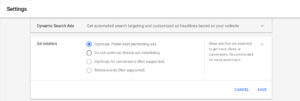
Once you have some hard data, go through and delete the ad with the lowest click-through rate. Over time, you can keep creating new ad variations to test against your highest-performing ad. Keep rotating and removing your bad ads to improve your click-through rate and Quality Score long term.
Step 7: Use Other Strategies to Improve CTR
Adwords is coming out with new features and tools all the time that are designed to help PPC advertisers improve their ads, targeting, and click-through rate. Take advantage of these features and you’re bound to have a better Quality Score in the process.
Here are some examples of other tools and strategies you can use to improve CTR:
Ad Extensions
Ad extensions have been around for a long time, and marketers who aren’t taking advantage of them yet should start. Ad extensions offer additional information related to your ad, such as a call button, location information, links to specific parts of your website, etc.
Not only do ad extensions give you more real estate in search results, they’re also an opportunity to create even more relevant copy for searchers. This can help improve CTR and in turn, your Quality Score.
Dynamic Keyword Insertion
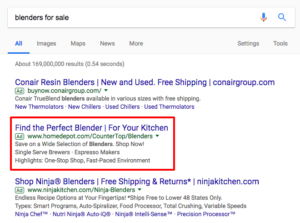
This is a newer AdWords feature that makes it possible to customize your ad copy based on the specific query someone searched for. For example, look at the Home Depot ad copy that comes up when I search “blenders for sale”:
Versus what comes up when I search “smoothie blender”:
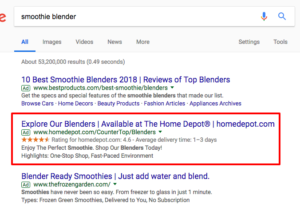
They don’t need to create different campaigns to display targeted ads for each of these keywords. It’s possible to use Dynamic Keyword Insertion to change the ad headline and/or body text to include the exact keyword someone was searching for.
Dynamic Keyword Insertion automatically makes your ads more relevant and can improve click-through rate as well.
Other AI-powered suggestions
Over the past 2 years, Google has been launching all sorts of AI-powered Adwords features that use your own campaign insights and machine learning to help you optimize your ads.
With Dynamic Search Ads, AdWords will help you come up with search targeting and ad headlines based on your website copy. Automated suggestions can help you improve your ad headlines, descriptions, extensions, and landing page elements. You can even automate the process so that Google will make these changes for you whenever new suggestions come up.
A metric like Quality Score is good for Google, searchers, and advertisers alike. It helps ensure PPC ads really match up with what searchers are looking for, and encourages advertisers to create more a relevant (and effective) marketing message.
Luckily, your Quality Score gives you all the information you need to make necessary changes to improve your ads. Just pay attention to the three main quality score factors, and how they change when you experiment with different ad copy, targeting strategies, and landing page elements. Over time, you’ll have a better understanding of what’s important to improve Quality Score in your PPC niche.
How do you ensure your programmatic ads are running in a quality environment?