Technology
Basis Platform
Advertising Operating System
Communication Portal
Intelligent Collaboration
All Channel Activation
Activate Media on Every Channel

Consulting
Resources
Financial services businesses have many opportunities to build brand awareness and attract new clients through search engine marketing (SEM). But search engines are constantly changing, making it difficult to keep up with the best optimization tactics without enlisting professional help.
According to Brandpoint’s State of Content Marketing for Financial Services report, the biggest challenges for financial services marketers are:
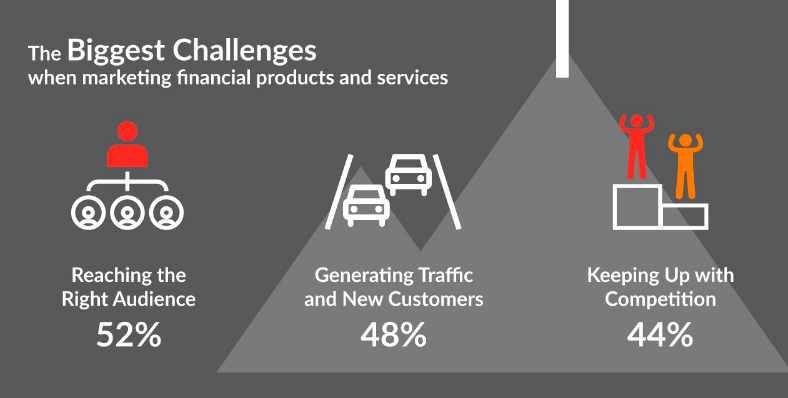
These challenges can all be addressed when you develop a targeted, comprehensive SEM strategy.
There are two main approaches financial services businesses can take to search engine marketing: search engine optimization (SEO) and Pay-Per-Click advertising (PPC). With SEO, you create and keyword-optimize your website content to rank well in organic search results. With PPC, you pay to have ads appear in search results using the Google Ads (AdWords) advertising platform.
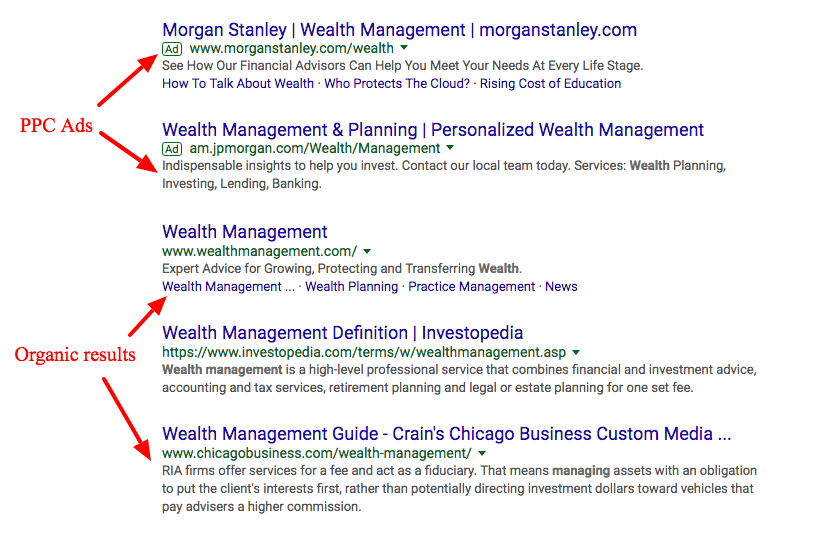
Besides optimizing for the right keywords, there are many factors impacting your ability to rank well in organic search results. Google prioritizes older domains with more authority on the web. So while it’s technically free to optimize for SEO, it is a long-term strategy that won’t deliver fast results in the beginning.
PPC can deliver immediate results if you have a big enough advertising budget. Budget-conscious financial services businesses have to balance keyword targeting and ad relevance to attract profitable traffic for the right amount of ad spend.
Read through this entire guide, and you’ll walk away with a clear idea of how to use SEO and PPC to build a comprehensive SEM strategy for your financial services business.
Optimizing your blog and site content for search engines is a great way to grow a steady stream of organic traffic over time. Here are a few important SEO factors that financial services businesses should pay attention to:
It doesn’t matter what keywords you target or how great your content is, you can’t succeed at SEO unless you first take care of the technical aspects. This is mostly about making sure your website is easy for users to navigate and easy for search engines to crawl and understand.
At a minimum, you should:
The first thing you should do is audit your site for technical problems that could affect user experience. You’ll want to identify and fix broken links, remove/fix 404 pages, and fix any other technical errors. You should also find and minimize the redirects on your site, as they can affect site speed.
There are plenty of diagnostics tools out there that you can use to perform a site audit. Screaming Frog and SEO Crawler are two examples.
Taking steps to improve your site speed is essential, as it’s a very important rank factor in search engines. As little as a 1 second delay in page speed can equal an 11% loss of page views.
Google has a Page Speed tool that evaluates your site speed for mobile and desktop. It also offers actionable advice on steps you can take to improve performance:
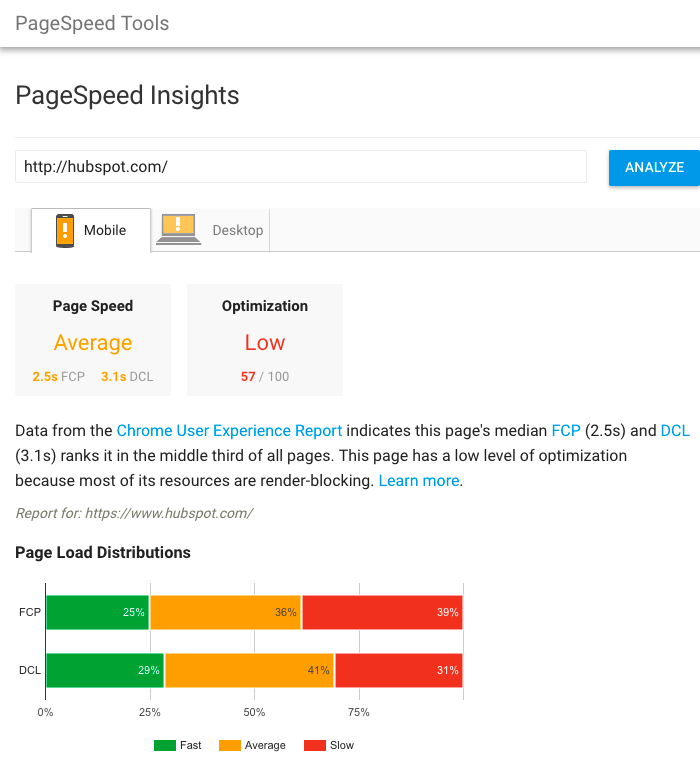
Once you’ve made changes to improve your site performance, create and submit a sitemap to Search Console. A sitemap is a XML file that makes it easier for Google bots to crawl and index your pages.
You can make a sitemap for free using a tool like XML Sitemaps. Then log into Search Console and submit it there.
There are tons of relevant keywords that financial services businesses can target for SEO. However, since 75% of users never click past the first page of search results, the real challenge is finding keywords that your pages can realistically rank well for.
The key here is to identify relevant keywords to target that don’t have very high competition. For example, say you’re an accountant. Many businesses and magazines target keywords like “accounting services.” It’s better to identify equally relevant but less searched-for keywords like “What to look for in a business accountant.”
Keywords like these are called long-tail keywords. Long-tail keywords often answer common questions your audience asks search engines.
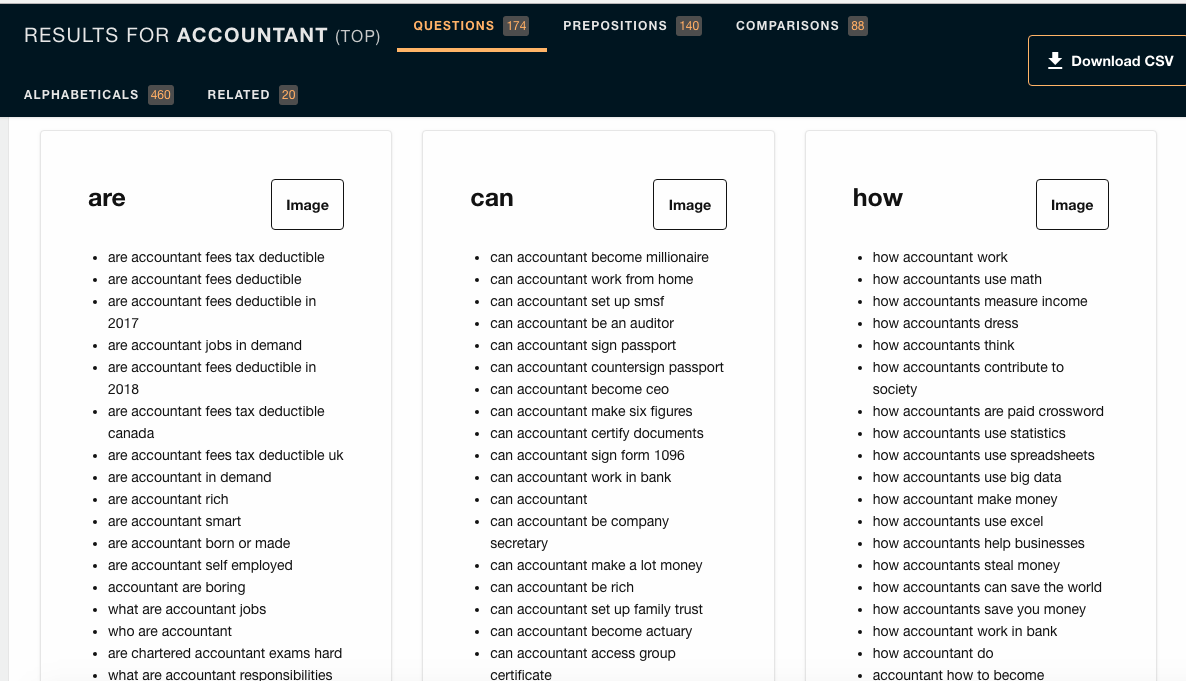
There are plenty of tools out there that can help you brainstorm long-tail keywords. Answer the Public is one free option. Just type in a root keyword (e.g. “accountant”) and it will return a list of questions related to that keyword (e.g. “are accountant fees tax deductible?”):
Start a blog on your financial services site. Your posts can target keywords that are easier to rank for, like these long-tail keywords.
Once you have a list of keywords you want to target, you’re ready to start creating and optimizing your content. You can, and should, keyword optimize the landing pages for your services. However, most of your SEO traffic potential will come from the long-tail keywords that you target on your blog.
So make sure you take every opportunity to create relevant, quality content around these keywords. The average length of content on the first page of search results is 1,890 words. So invest in your content and create something comprehensive with supporting images.
Here are the main areas where you should incorporate your target keyword:
The last thing to consider when creating and optimizing content for SEO is your disclaimers. Make sure your content is only providing financial advice on topics that you’re legally qualified to speak to. Otherwise you need to have a clear disclaimer that your content constitutes your opinion, and is not to be taken as financial advice.
Financial advice is what Google considers your money or your life (YMYL) content. Search quality guidelines offer more scrutiny for YMYL content. So don’t offer advice you’re not qualified to offer, as it has legal implications and could affect SEO.
Creating and optimizing your site content for specific keywords is only the first step in getting search engines to rank it. Google’s algorithms rely on a wide variety of other factors to help determine page rank. One of the most important factors are links.
First work on building internal links between the various pages and blog posts on your site. Google looks at internal links to help understand what your site content is about. So make sure the anchor text you use for your links helps describe the content it’s linking to.
For example, say you have a blog post covering tax deductions for the self employed. A relevant anchor text for an internal link to this content could be “self employment tax breaks” or “small business tax deductions.” Just make sure you don’t use your exact target keyword too much in anchor text, as it can actually negatively affect your page rank.
Next, you should work on building external links from other high authority domains back to your site pages. The more high authority links there are pointed at your pages, the more potential for page rank.
If your business is location-based, try to get links from other local domains, like your city’s chamber of commerce, local news outlets, and local .gov addresses. The best way to build links naturally from these domains is by distributing press releases and sponsoring local events to get mentioned in the news.
Using Google PPC ads is a great way to attract immediate traffic and drive conversions on your financial services website. Here are a few important PPC factors that financial services businesses should pay attention to:
Your keyword targeting strategy for PPC can and should be different than your SEO strategy. With PPC ads, you have the opportunity to get your ads to appear for higher-competition keywords that you couldn’t reasonably target for SEO. That said, targeting financial keywords can be quite expensive, so it’s important to do your research and discover keywords with the most potential value for your investment.
AdWords has a keyword research tool called Keyword Planner that can help with this. All you have to do is type in a relevant keyword such as “wealth management” and click Get Started.
Keyword Planner will return a list of related keywords along with relevant information like search volume, competition, and bid range. For the keyword “wealth management,” the bid range for top of the page results is $15-$50.
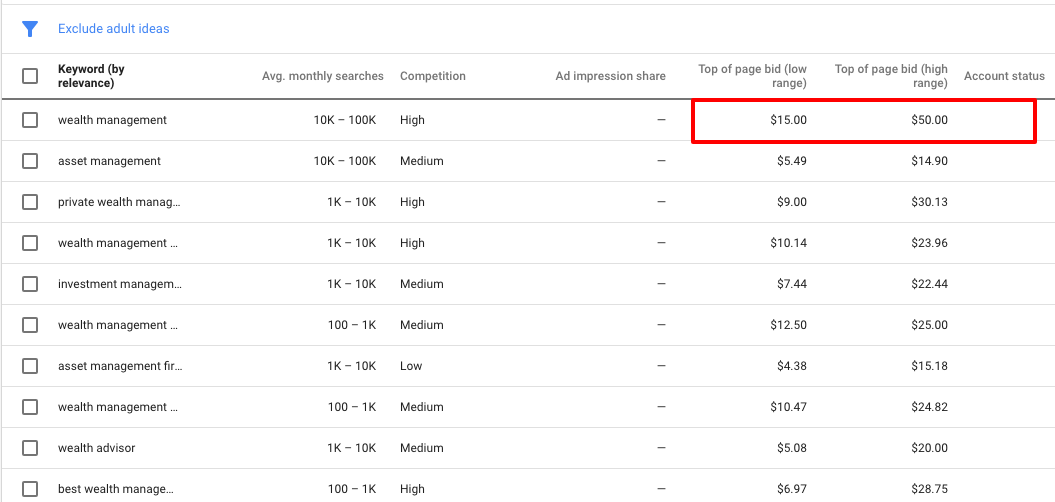
If your target keyword is too expensive, you can browse the other related keywords to find ones with a lower bid range. Or you can go back and search for a new query to get an idea of cost.
Since you’re paying for clicks, it makes sense to target bottom-of-the-funnel search queries that suggest the user is looking to convert. “Financial advisor Kennewick” is an example of a bottom-of-the-funnel query. A query like “What is a financial advisor?” would be top-of-the-funnel, as the user is likely just doing initial research.
Keywords aren’t the only way you can target your audience with AdWords PPC ads. It’s best practice to use demographic targeting as well to ensure your ads reach the most relevant audience.
Demographic audience targeting allows you to target ads based on user location, age, gender, and device type. If you offer localized services in a specific city, it’s very important to define the geographic location range for your ads to appear. This is also important for location-based credit unions or banks.
It might also be worthwhile to target using other demographic factors to reach your target audience. For example, if you’re a financial advisor specializing in retirement planning, you can narrow down who sees your ads to people in the retirement age range.
When creating your ad groups, it’s important to use negative keywords as well to help make sure your ads reach the right audience. Say your ads are targeting a broad match keyword like “business accountant”. You’d want to narrow down the queries your ad can potentially appear for by using negative keywords. If someone searched for “business accountant salary” for example, they’re not looking to hire an accountant, they’re probably hoping to become one. So “salary” would be a good negative keyword to include.
It doesn’t matter how well you target your ads and keywords, your ads won’t get clicks unless the copy is compelling and effective. Even minor changes you make to your headline or ad text can have a huge impact on click-through rates.
The key is to identify a unique value proposition for your financial services business and illustrate that in your ad copy. Take a look at these health insurance ads, for example:
Affordable plans, free quotes, and $89 health insurance are all examples of value propositions the advertisers use to drive clicks.
When creating your ads, you should explore all the optimization options available to make your ads more relevant and valuable for users. You can use ad extensions to include more relevant information with your ad, such as location or call extensions.
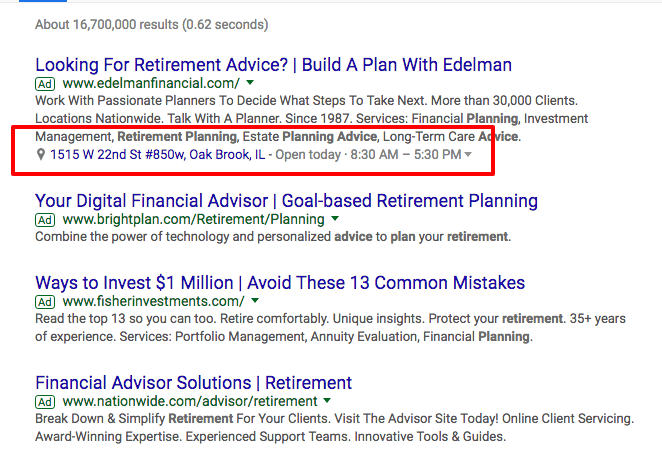
These extensions make it easy for people who are searching from their mobile devices to call or find your business location in their maps application.
Encouraging clicks on your ads is one thing. The next important thing to consider is what users do after they click through to your site. You’re paying for the click, whether visitors convert or not. So if you want to ensure you have a high return on ad spend (ROAS), optimize your landing pages to drive conversions.
Start by creating your landing pages with your overall SEM goals in mind. If your main goal is to generate leads from your PPC ads, then use your landing pages to illustrate the value of your financial services and include prominent calls-to-action to get more information.
The biggest mistake to avoid is using just a few generic landing pages for every ad type. It takes time and effort, but it’s worthwhile to develop unique targeted landing pages for every kind of ad you display.
Think about the value proposition that you use in your ad copy. If you highlight offering a free insurance quote, the call-to-action on the associated landing page should mention this as well. Ensure your ad and landing page copy line up, otherwise site visitors may get confused and navigate away.
While many financial services businesses take the time to carefully set up a targeted PPC campaign, it’s a common mistake to set it and forget it. But creating and targeting your ads is really only the first step. Once you start gaining insights into how people react to your ads and ad placement, you have new opportunities to optimize your strategy.
Over time you’ll realize that certain ad copy and extensions are more effective than others at getting clicks. AdWords makes it easy to test this by rotating ad variations and discovering the most effective ones for you.
Over time you’ll also want to evaluate the Quality Score of the keywords you run ads for. You can find your Quality Score in the Keywords tab from the side menu of AdWords. Hover over the status of an individual keyword to see the Quality Score:
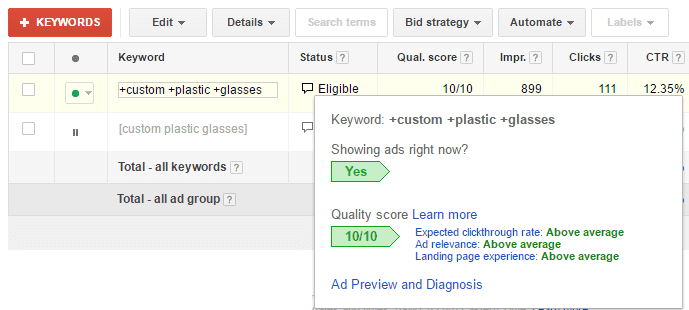
A low quality score can suggest that your ad copy or landing pages aren’t relevant enough, or that you’re targeting the wrong keywords for your content. Make changes to address these issues and then monitor changes in your Quality Score to measure results.
Lastly, there is bid optimization to think about. You don’t want to spend more money than necessary to get the ad placement you need to drive your marketing goals. While you can make manual adjustments to your bidding as opportunities arise, the most effective strategy is to use a bid management tool to automatically make changes based on ongoing insights from consumer data.
Financial service businesses have so many opportunities to attract leads and grow when they develop a comprehensive SEM strategy. Just remember to target the right keywords when focusing on SEO and PPC. Then use these strategies together to maximize your presence in search engines. As long as your content is relevant and valuable to search queries, you should be able to grow a healthy stream of web traffic from SEM for financial services.
If there's one thing that's true about advertising, it's that everything changes. From subtle suggestions to in-your-face demands and info-speak to peer pressure, the shifts in advertising over the years have been many. But what about the changes in advertising as virtually every industry goes through digitization?
The evolutions we are seeing today will continue to spiral into a bold new future as we learn to embrace the Fourth Industrial Revolution—a dynamic, all-encompassing transformation of our society. It will change how we work, how we play and how we connect with one another.
Is your advertising plan up to the challenges this brave new world will present? Here's a look at how these aspects will change us and how to keep on top of those changes so your business can remain competitive.
The current digitization of business assets is being referred to as the Fourth Industrial Revolution. If you're not familiar with some of the other revolutions, you are not alone. The first Industrial Revolution is the one most people think of when they hear the term, when steam and machinery came into play to boost productivity significantly. This started the shift to urbanization and factory work for much of the world's agricultural and craftsman backbone.
At the turn of the last century, electricity drove production to even higher levels while making everyday life even easier with the Second Industrial Revolution. Factories grew as concepts such as the assembly line came into use, while housewives everywhere cheered at the invention of more tools to break the drudgery of everyday life.
Following WWII, the computer moved from military use to helping businesses around the world, culminating in the Third Industrial Revolution, which put a computer in almost every home (and pocket) in America.
Today, the Fourth Industrial Revolution is upon us: digitization. It's different than the Third because the rate of change we're seeing now is significantly higher in terms of speed, scope and impact on our production systems and society. Much as the addition of electricity expanded factories and computers automated these electrically-driven factories, digitization is creating a massive change in our society.
So, what exactly is digitization capable of doing for our businesses? It's incorporating machine learning into a wide range of areas, allowing analytics to change how we work by making us deal with exception handling instead of day-to-day drudgery. It's automating workflows as systems that can more easily integrate with each other, reducing the time spent moving information from one system to another. It's adding 3-D printing to eliminate shipping time, using the Internet of Things to predict machine failures, biotechnology to improve disease treatment, and so much more. It's also changing how the general population perceives their role in the purchasing process, which is why we've seen such a strong drive to improve the consumer experience. And it's considering new business models and services that help keep our businesses competitive against disruptions in the market. This means we're also changing how we do business as a whole, and that includes how we advertise our goods and services.
What changes can we expect in the future that we can use to adapt our digital advertising plans? We may see additional changes in the middle class, as society divides into high-skill/high-pay or low-skill/low-pay sectors, or possibly as we all come together closer to the middle. Will this lead us to that promising tomorrow in Star Trek where Federation citizens are virtually without need and allowed to instead pursue their greatest passions instead of work that pays the bills? We don't know yet. The push towards efficiency, sustainability and minimalism suggest that we could be headed in that direction as a people. Hopefully, instead of working harder, we'll learn to work smarter. Mankind's ever-present drive to innovate, invent and create will grow, including how we'll develop advertising to reach this new society.
One area of change is focusing on specializing while outsourcing other tasks, including advertising. Our social lives are becoming increasingly digital, and appealing to people through snappy customer response, a truly memorable ad or programs that reward customers for sharing advertisements with their friends are all potential directions to consider.
The Fourth Industrial Revolution is also changing how we perceive ourselves. Privacy, ownership, work, security, consumption, personal development: all these concepts are going through massive changes as people discover new and better ways of living their lives. Advertising must speak to these issues, whether it's how your newest purse blocks RFID signals to protect chipped credit cards or how your university is offering new options to MOOCS courses that combine at-your-own-pace learning with degree programs. Products or services that provide customization to make consumers’ lives easier or gives them more personal time will drive industry change. Focusing on benefits and solutions provided by these new developments will drive advertising well into the future as consumers find the best options for their lives and needs. These changes are being driven by the catalyst of the new ethical, moral and social changes of the Fourth Revolution.
Another way that advertising is changing is using storytelling to personalize a brand. An exceptional example is Carhartt's video featuring Jason Momoa, tying Hollywood giants to their Midwestern farming roots, Pacific Northwest loggers, mechanics and families around the world. Through his personal story and images of his family at play with their products featured in all states of repair, Carhartt shows the personal side of their products and how they haven't changed from their original dedication to durability in tough situations. It wonderfully connects the products to a wide range of environmental circumstances.
Digitization is also driving how we interface with technology. We're heading to 5G, allowing people around the globe access to markets that would have been virtually impossible in the past, letting them compete on a more level playing field. Video is hot, making us even more connected than ever before. VR is no longer the thing of dreams, but takes school children on field trips, consumers into a 360-degree view of products or construction workers into the building they're creating.
An excellent example of how this is changing our society was a popular meme from a few years ago, that went, "Explaining a smartphone to someone who has time-traveled from the 1950s. I have in my pocket a device that allows me to access the entirety of human knowledge. I use it to get into arguments with people I don't know and watch funny animal videos." Just as the massive change of the Third revolution took us from sock hops to AOL, the Fourth will connect us together in ways we can't even imagine.
Products and services that perfectly personalize to the consumer require these stories to show that the advertising isn't just speaking to the crowd, they're genuine and adaptable to that specific person's needs and desires. Yesterday's practice of dropping change into a jar to provide water filters for children in Africa has adapted to the point that we can buy products that provide equal number of those filters or even connect with people in Africa to determine the best way to solve the problem for their village and their needs. As our world's population heads towards 8 billion, humanity's primal need to connect and be recognized one individual at a time is being driven further on through these changes.
Because we have this level of connectivity and information, we can no longer simply sell our products on the concept that our brand is simply better than the others. Giants like Apple and Samsung have grown through their dedication to innovation while recognizing that disruptors such as LG are nipping at their heels should that innovation fall. Telling brand stories, providing VR options and having hot, memorable videos will only work as long as we remain dedicated to what has made our companies great in the first place. If the Fourth Industrial Revolution has done nothing else, it has solidly returned us to that dedication to quality, customer service, and communication that we must retain to survive the predations of industry or market disruption.
There can be no doubt that our world is changing, and as with past industrial revolutions, those who do not embrace that change will be left behind. The Fourth Industrial Revolution will bring our entire world together as a people even as we embrace our own individuality.
No matter how much data you have about your clients or customers, you can always use more. How do they like to receive information? When do they peruse the web? When do they make decisions? What subject lines appeal to them? Are they more emotional or analytical in nature? Do they respond better to humor or statistics? There's just so much you want to know, and this is especially true with responsive search ads.
On a more general level, of course, you probably already know much of this about your audience. But to what extent? If you’re like most companies, you could stand to get significantly more granular. For instance, if you send out an email with two different subject lines with a one-word difference, can you predict which one they’ll choose? Probably not. Yet it could be the difference between getting a click and not, making a sale and not, gaining a client for life...and not.
In a nutshell, A/B testing lets you find the optimal approach in any situation so you can replicate those results next time and refine them for ever-greater conversion. When you do this over and over again, for every campaign—while simultaneously optimizing bidding and analyzing your results—the outcomes are pretty amazing.
Yet sadly, according to a survey of 800 digital marketers, less than 40 percent of companies use A/B testing in their campaigns.
Well, we should clarify: it’s sad for them. Really, it’s a positive for you. It means your competition is seeking "good enough" results, making it easier for you to seek the absolute best ones and rise to the top of your field.
But running A/B tests is hard, not to mention time-consuming. When you include writing new ad copy, loading those ads, optimizing them and analyzing them, there’s a lot more to do. Even writing copy can take its toll. Once you write several headline and body copy versions, then you have to mix and match them to create multiple combinations, load them in, etc.
If you’re getting a headache right about now, take a deep breath. Now, what if we told you that this approach won’t be necessary for much longer?
Enter Google’s new responsive search ads, an answer to the prayers of any dedicated online advertiser. Responsive search ads are Google Ads newest ad type, launched alongside their latest overhaul of the interface. Meant to help further automate A/B testing and PPC ad optimization, responsive search ads are adaptive, delivering a more relevant message to searchers based on their queries.
With this ad type, you provide multiple headlines and descriptions when you create the ad. Then Google Ads does the heavy lifting, adjusting your ad’s content to match search queries, testing different combinations of text and discovering which is the most relevant for your audience.
Let’s talk about what these ads are and what they can do for your business. We’ll also take a look at how you can use them to automate ad copy creation and A/B testing, as well as several best-practices tips for integrating these into your marketing routine.
So if you’re ready to save time, learn more about your audience, outstrip the competition and increase your conversions, get ready to take notes. Responsive search ads are about to be yours.
In the past, Google suggested advertisers create multiple expanded text ads for each ad group to help advertisers test and identify the most effective ad copy for your marketing goals. It was time consuming, but worthwhile if you wanted to get more reach for your ads and understand how your audience reacts to different messages. Now, responsive dynamic ads are positioned to make this “best practice” obsolete by allowing you to test ad copy variations all in one place.
While they’re similar to expanded text ads, responsive ads have some key features that set them apart:
By providing a series of headlines and description options to Google Ads, users save time A/B testing different ad element combinations. This also has a secondary effect of giving you more opportunities to compete in auctions as your multiple headlines and descriptions can be relevant to more search queries. Over time, as Google Ads shows your different ad text combinations, it will identify and automatically prioritize the best performing variants for you.
If those benefits aren’t enough to convince you to try responsive search ads, just remember they’re allowed more real estate in SERPs than any other ad-type. What’s not to love?
Like with every ad type, there are of course some limitations when using responsive search ads. Advertisers who are already less inclined to give over full optimization to the Google Ads machine won’t be chomping at the bit to try out this ad type. It appears that responsive search ads also don’t fully support ad customizers, a feature many advertisers love to use to manually tailor their ad message to user search queries. But this might change in the long run.
With all that in mind, it’s still clear that responsive search ads can almost certainly help increase your ad group performance overall...if you take full advantage of the benefits.
Ready to start realizing the many benefits of responsive search ads for yourself? Here are seven tips you should follow to ensure your responsive search ads meet qualifications, help you automate your ad text optimization, and more.
When creating your first responsive search ad, you’ll need to provide a minimum of three headlines and two descriptions to rotate. But Google Ads recommends you provide at least five different headlines for your responsive search ads to increase the chances that your ad shows. The more options you provide, the more opportunities there are to appear for search queries and optimize your ads for the most relevant message. Using as many as eight or 10 headlines would be ideal to get the most benefit out of this ad type.
No matter how many headlines you include, make sure the variants are sufficiently different from each other. If you use too many of the same or similar phrases in your headlines, the system will have more trouble generating ad combinations.
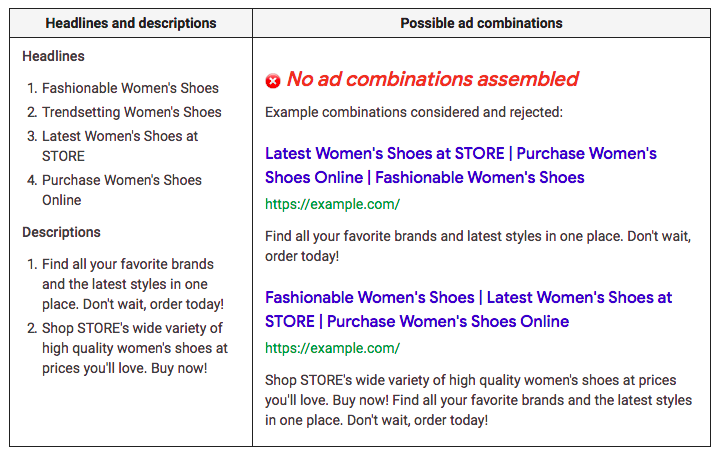
Here’s an example of a poorly optimized responsive search ad because of redundancy issues:
Similar headlines like “Fashionable Women’s Shoes” and “Trendsetting Women’s shoes” make it hard to generate ad combinations and ultimately limit the benefits of this ad type to reach a larger audience with your diverse ad descriptions.
Try varying lengths of the headlines you create and add at least two distinct descriptions. It is possible for responsive search ads to show up to two descriptions at a time, making it even more important to avoid redundancy.
It’s possible for your headlines and descriptions to appear in any order, so you need to make sure all combinations make sense when viewed together. Google Ads recommends writing your first three headlines assuming they would appear together in your ad. Does the message make sense/avoid redundancy?
Here’s an example of a responsive search ad that’s well optimized:
All headlines and descriptions are unique and make sense no matter how you pair them up.
Your responsive ads shouldn’t be about using different words/phrasing to deliver the same message for your headlines and ad description. Instead, focus on illustrating different features and benefits of your product/service to see which are the most effective at driving clicks.
For example, let's say you’re advertising international health insurance. “Free quote,” “global coverage” and “Plans start at $199/month” are all examples of benefits you can test as part of your description variations.
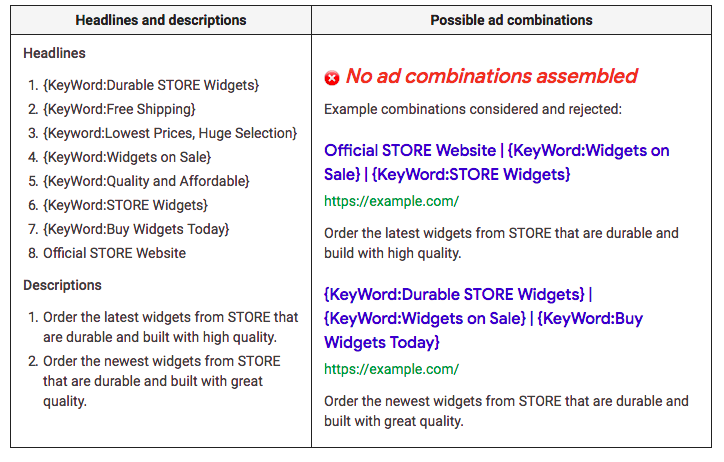
Google Ads recommends you include a target keyword in two of your headlines, but also that you have at least three more that don’t include any keywords. This has to do with (you guessed it) redundancy issues. Including keyword insertion in too many headlines can lead to redundant text in the ad.
Here’s an example of a poorly optimized responsive search ad because of this problem:
There may be some important information that you want to appear in every ad text combination. In order to include this text while avoiding redundancy, you’ll want to pin it to the ad. You can pin text at Headline position 1 or 2, or Description position 1. Make sure the text you pin is less than 80 characters long.
For example, if you need to include a disclaimer in all your ads, just write it in one of your descriptions then pin it to Description position 1. This will ensure that every ad includes the disclaimer in that part of the description.
That said, you should only pin information that you really need to appear on every ad—otherwise, it limits the number of headlines or descriptions that can appear for a search query. For that reason, Google Ads doesn’t recommend pinning for most advertisers.
Google Ads may use automation to help advertisers create, show, and optimize their ads, but that’s no reason to not monitor performance metrics yourself. On the Ads & Extensions page, you can see performance metrics for each of your responsive search ads, including all the standard stats you receive for other ad types.
These statistics are performance totals of all the combinations of headlines and descriptions for that particular responsive search ad. Unfortunately, there’s currently no way for advertisers to see how individual ad text variants perform against each other within the ad. They’ll have to trust that Google Ads is doing a good job of optimizing them.
One thing you may want to look at is how your responsive ads compare to your regular text ads. Assuming you’re fully utilizing the features of responsive search ads, Google Ads should help you create a more visible and effective ad based on query relevance and audience behavior.
Google Ads has changed a lot in recent years, and continues to roll out new features and ad types that rely heavily on machine learning and automation for optimization. Responsive search ads are just the latest addition that require users to relinquish more control in order to benefit from insights and optimization capabilities.
There will always be traditional advertisers among us who love nothing more than to analyze performance and manually tweak ads themselves to perfection. There’s no denying the power of the human touch to create a highly targeted ad that speaks to audiences on a granular level.
But the truth is most businesses today don’t have the time or resources to manually target and optimize their ads at scale. And as more big data insights are available to help improve ad targeting in real-time, it would be unwise to overlook this resource and risk falling behind the competition as an advertiser.
There are already a number of bid management tools and predictive advertising technologies that make it simple to synthesize and automatically derive insights from consumer data to optimize your bids and minimize wasted ad spend. Advertisers who embrace the power of machine learning and automation are already benefiting from these technologies to outbid and outperform their competitors.
Google Ads’ machine learning and automation features are no different, and they are coming at the perfect time for most busy advertisers. Responsive search ads are just an example of the direction things are heading for ad creation, optimization, and bid targeting. Advertisers who choose to embrace and fully utilize these technologies are the ones who will best illustrate their benefits early on. In the long run, automation and machine learning are the way of the future in advertising.
At Centro, we know that keeping up with the trade pubs and latest trends can be tough and time consuming. To make that easier, we’ve compiled all the articles, reports, and other bits of awesomeness you may have missed, but should definitely read. Enjoy our latest list below!
While mobile advertising sustains momentum as a critical means of targeting consumers, shady players continue to exploit the channel through various forms of ad fraud. MarTech Advisor highlights the top categories of mobile ad fraud that advertisers must continue keeping an eye out for. And if you didn’t know, now you know.
Snapchat has rolled out the ability for advertisers to book ads in specific shows via their self-serve ad tool. Publisher partners include Vice, BuzzFeed and ESPN, amongst others. Until recently, advertisers needed to use the very manual and traditional IO system in order to work with premium content partners. The social platform is looking to bank on the fact that the Discover section is a gated community that is only is available to professional publishers, an angle that can bring a sense of security to clients who have concerns about the less rigorous parameters set around other social environments like Facebook and YouTube.
The mass exodus of Americans leaving traditional TV services is expected to accelerate through the rest of 2018. According to eMarketer, the number of cord-cutters in the US is expected to reach 33 million adults, a 32.8% YOY increase in those cutting out traditional services from the year prior. Conversely, Americans continue to flock to more affordable OTT services like Netflix, Hulu, HBO Now, amongst others, where consumers see more value. Advertisers can expect the trends to signal improved opportunities for improved targeting in the connected TV world.
In Q1 2018, The Guardian worked with Google and MightyHive to determine how much of the inventory on ad exchanges purporting to belonging to the Guardian was legit. They found that when ads.txt filters were applied to their ad buys, there were no discrepancies between what they bought and what ended up coming back to the Guardian. However, when ads.txt filters were not applied, 1% of digital ad spend and 72% of video ad spend went to unauthorized programmatic platforms.
A new trade organization has been developed with a mission of helping advertisers, agencies and publishers get smart about managing brand safety issues. This organization plans to create a certification program that will tackle issues such as brand safety, ad quality, how to vet partners, ad placement and content analysis and understanding ad fraud and malware.
More than 3 out of 4 US consumers said they see too many retargeting ads from the same retailer. And 78% of senior marketing executives worldwide said it is “inexcusable” for consumers to keep receiving ads for products they already bought. One big reason for this displeasing déjà vu is that advertisers utilizing multiple retargeting and programmatic buying vendors, which have their own ways of identifying and retargeting consumers.
With 90% of marketers of retailers saying personalization is a top priority for their marketing, it’s surprising that only 15% of those companies believe they are doing a good job at it. Especially, when research shows that personalization at scale can drive between 5-15% revenue growth for companies not just in retail, but also travel, entertainment, telecom, and financial-services sectors. This McKinsey article provides recommendations for marketing leaders on how to transform their organization so consumers are no longer stalked by irrelevant ads or bombarded with outdated offers.
In the next 18 months, it’s expected that there will be 1.6 billion digital assistants in use and that half of all searches will be voice-based. With strong growth in voice-activated usage and more marketers interested in assessing voice opportunities, brands and advertisers need to start planning how to take advantage of the space. AdAge outlines 4 key principles on how to do so based on how the platform is most commonly utilized.
August's DIAL is also available as a PDF.
Every company has unique digital marking projects. Budgeting and planning for online advertising costs will depend on your industry, company size, and overarching business goals. While company goals may differ, Centro can offer you a tested framework to create the optimum marketing budget for your business. Develop your plan, and consider your priorities, marketing channels—and even the average advertising cost of your competitors.
A typical mid-sized business puts about 35 percent of their overall marketing budget towards online advertising costs—some industries allocate quite a bit more. Below are some estimates for the average budgeting percentages allocated to digital marketing in industries that tend to rely on online ads the most:
Spending also varies by advertising type. Email, display ads, search and social media advertising costs have increased exponentially over the last few years. These figures show that costs vary by project, company, and industry.
You don't necessarily need to utilize every available marketing channel to enjoy success. In fact, marketers with smaller budgets should focus on developing a good plan with one or very few marketing channels, to ensure optimization and allow them to receive maximum value. Avoid stretching your dollars or attention too thin.
With that in mind, take these steps to right-size your company's online advertising cost:
Of course, your digital marketing goals should support your overarching marketing goals. For instance, a B2B company may hope to improve sales and brand awareness. After you know what results you desire, you can set measures that will demonstrate how well you're doing.
For example:
Your past performance can indicate how you should act in the future. Notice where your dollars have translated into sales in the past, and of course, which marketing investments did not help your company grow at all. At this point, you may want to allocate money based on past performance or determine why certain channels did not produce any positive returns.
Research anticipated costs for various types of online ads before you calculate how much money you will need to support your goals. Use tools and observation to explore marketing channels your competitors use to estimate the amount they spend. In addition, keyword research should uncover the search terms you plan to target and the average costs for ranking well on these terms.
If your initial plan requires an unrealistic budget for your company, you may need to develop another plan. Try reducing the number of channels or find cheaper related or long-tail keywords with which to start. If your initial efforts help support your goals, you may be able to utilize a larger budget later to expand your efforts. Average B2B companies spend about 5 percent of their overall revenues to promote products—however, B2C companies tend to spend about twice that amount.
Finally, use the previously set measures, or metrics, to assess how well each piece of your marketing plan is performing. If certain channels or campaigns within those channels don't produce, revisit them to figure out if they need tweaking or even discarding.
Take the best course by developing a plan with metrics to track your progress and avoid the pitfalls of trying to market in the dark.
How do you know if a self-service buying model is right for you?
At Centro, we know that keeping up with the trade pubs and latest trends can be tough and time consuming. To make that easier, we’ve compiled all the articles, reports, and other bits of awesomeness you may have missed, but should definitely read. Enjoy our latest list below!
AT&T purchased AppNexus on June 25th. Combined with existing publisher relationships this allows AT&T to tie together the demand side and supply side publishers and challenge Google’s dominance of this space. The end-to-end solution is expected to allow AT&T to onboard their data in a powerful fashion with much less risk of leakage. And that’s always a good thing.
A growing number of brand advertisers have set up their own in-house agencies in recent years. Many large brands have claimed substantial cost savings in more effective use of their media dollars, but it is not just media functions that brands have brought in-house. This has led to a critical opportunity for collaboration with other agencies and partners involved in the marketing initiatives.
Facebook is testing a new feature where publishers can monetize their content and presence on the platform. Publishers are invited to make money through advertising on driving subscriptions natively on Facebook. Early tests have shown that people are 17% more likely on average to subscribe to participating publishers.
With the popularity of mobile location targeting, it’s perhaps not a surprise to see that the tactic drives successful results for marketers. A new report from Lawless Research found that of 700 in-house and agency marketers surveyed, 87% reported using location-based targeting with most respondents reporting positive results. As one would expect, ad targeting was the main use of location, but personalization and improved customer experience were close behind.
Digital voice assistants, smart speakers and other connected, voice-first devices are already having a dramatic impact on consumer behavior, and represent the next phase in the evolution of human-machine interaction. As adoption continues to grow, from 91 million this year to nearly 106 million voice assistant users in 2020, the industry will turn its attention toward monetization models.
Nine out of 10 US households had access to a VCR in 2001, fast forward to today and that number has fallen to less than 0.2%. Consumer devices and services introduced within the last decade have gained wide acceptance by consumers: smartphones (89%), personal computers (79%), tablets (63%) and subscription video on-demand (SVOD) 62%. What’s more is others, such as internet-connected devices (36%) and smart TVs (35%) are growing at a significantly fast clip. This increased fragmentation has led to more ways for marketers to reach consumers with video content.
Roku released its Audience Marketplace which is designed to let publishers use it’s first-party data based on how consumers interact with the OTT device. The type of first party data available include what type of content Roku users search for or how much time they spend streaming content.
Five key tactical trends that can fuel your next winning product, service, campaign, experience, platform, business model and more. From consumers expectations of brands to automating the customer journey, these are trends that retailers can put into action, and see some impressive examples.
July's DIAL is also available as a PDF.
75% of agencies are breaking down buying silos. Are you?
Agencies of the future are converging buying functions. Hear how from Forrester & Centro.