Technology
Basis Platform
Advertising Operating System
Communication Portal
Intelligent Collaboration
All Channel Activation
Activate Media on Every Channel

Consulting
Resources
September is not only the start of the new school year at colleges and universities, but it’s also the start of the new fiscal year, which means marketers in higher education need to start rolling out new marketing strategies. But which strategies and tactics should they use? For universities looking to succeed in an increasingly competitive environment, more and more the answer to that question is search engine marketing (SEM). In fact, according to a recent survey, 97% of students will initiate contact with a university and it is absolutely critical not only to build and maintain a relevant digital presence, but also a “robust search functionality.” In general, an overwhelming number of students have reported using online search to discover colleges and universities.
So while it’s easy to grasp why for-profit businesses need to invest in search engine marketing (SEM) to get more reach and drive sales online, until recently it was unclear if SEM really is a necessary investment for higher education institutions. In this blog post, we not only suggest that search engine marketing should be a go-to tactic for every marketer in higher education, we also provide 10 tips for super-charging SEM campaigns for higher education.
SEM is actually a blanket term used to describetwo different marketing approaches, organic search engine optimization (SEO) and Pay Per Click (PPC) search advertising. Both are very valuable ways to promote your school to search engine users.
PPC requires a direct financial investment — you bid on placement to get your ads at the top of search results. On the other hand, it’s technically free to optimize your website pages for SEO, but doing it effectively requires a lot of time and investment.
Simply put, search engines remain the most popular way people search for and find information on the internet. Researching potential educational institutions is no exception. Investing in SEM can help you get more visibility for your school, build prestige, attract new web traffic in the process, and help you on the path to increasing enrollment.
SEM is a multifaceted marketing strategy that can’t be learned overnight. But if you start out by following important best practices, you’ll be well on your way to deriving ROI from your investment.
SEO is a long-game strategy that can build you a strong, long-standing presence in search engine results. Do it the right way, and SEO can bring you a steady stream of new traffic long after you optimize your pages. Here are the best practices you should follow:
Your educational institution’s website already has an organic presence in search engines, whether you’re optimizing for it or not. So the first step is to take a look at your current performance.
You’ll want to invest in a tool like Screaming Frog, Ahrefs, or SEMRush to get a deep look at your website performance for various SEO ranking factors.
These tools will also help you find issues with your website that you should fix, such as 404 errors and broken internal links.
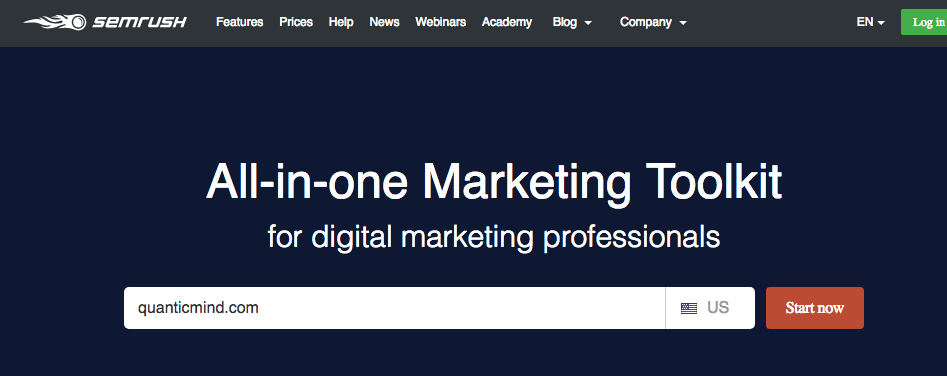
Most importantly, you’ll get a look at what keywords your pages are already ranking for in search results. You can actually do this for free when you try out SEMRush. Just go to their home page and type in your domain name:
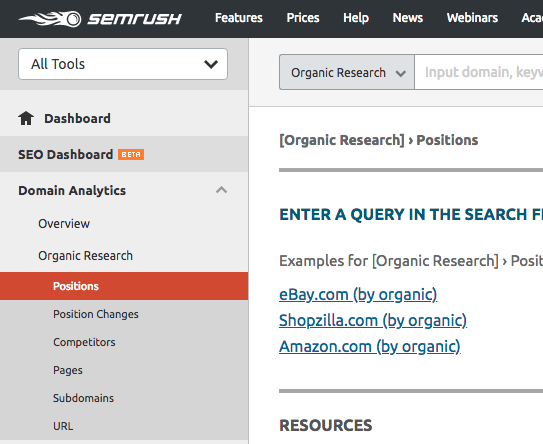
On the next page, under “Domain Analytics” from the sidebar, go to Organic Research>Positions:
SEMRush will prompt you to sign up (it’s free) to get 10 free queries. Do that, then you can see the report showing your rank position for various keywords.
SEO is a long-term strategy — it takes time for your new content to rank well for keywords. So it’s best to start by identifying what keywords you already rank for, then make efforts to optimize these pages even more.
It’s a common misconception that SEO is all about putting keywords in your content. There are also a few technical aspects you need to get out of the way that relate to your site’s user experience. At a minimum, you should:
Page speed is a very important rank factor for search engines. It can also have a big impact on your bounce rate, as site visitors have low tolerance for slow loading pages.
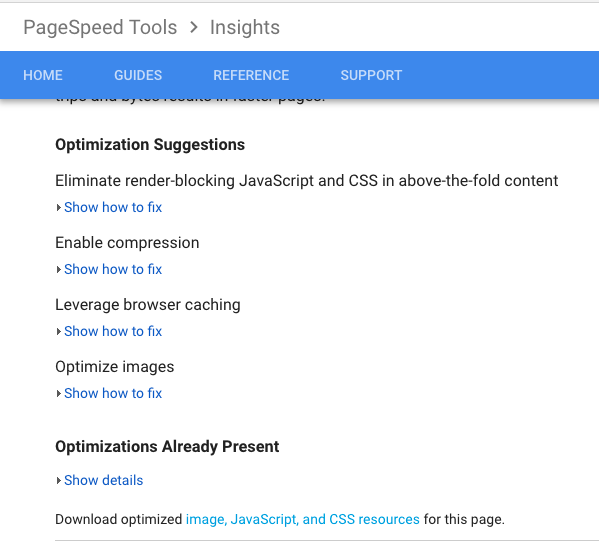
Google has a free page speed tool you can use to test your site speed. It also offers suggestions for improving your pages’ load speed that you can follow:
Google prioritizes pages in search results that are mobile-optimized. Providing a mobile-friendly site experience is also good for the many users who will visit your site from their mobile phones.
If you have a responsive site design, it should adapt automatically to the size of the device people are using. Just go through and ensure there aren’t any legacy pages on your site that haven’t been updated to the responsive design.
Google doesn’t like duplicate content, so much so that they will manually penalize sites that have too many similar pages.
That tends to be a big problem for higher education sites. It’s easy to end up with a lot of duplicate content if your various departments have their own blogs or news sections. Student blogs, professors’ blogs, and/or university publications can all end up under your domain, publishing the same press releases and announcements.
You can avoid the duplicate content penalty by (1) eliminating unnecessary pages, and (2) telling Google which pages to prioritize. Again, using a tool like Screaming Frog or Ahrefs will help you identify your duplicate pages so you can delete the superfluous ones. Some duplicate content is necessary, however. In this case, you should use canonical tags to indicate to Google bots which pages to prioritize in search results.
Once your site is all cleaned up and optimized, you should create and submit a sitemap to Google Search Console. This provides a guide for Google bots, making it easier for them to crawl and index your site pages. It’s easy to do — just follow Google’s instructions for building and submitting a site map.
When developing your keyword strategy, targeting your competitors is a good idea. If you already use Ahrefs or SEMRush, they can help you discover what keywords other educational institutions are optimizing for. Use that as a starting point.
But most importantly, you should take your value proposition(s) into consideration when brainstorming keywords to target. Here are some examples of value propositions that users might search for:
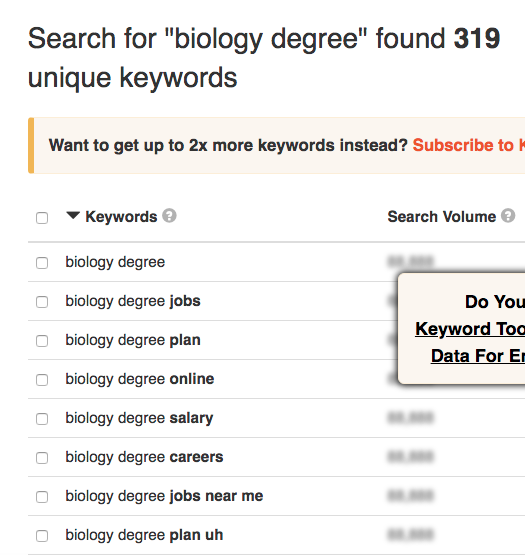
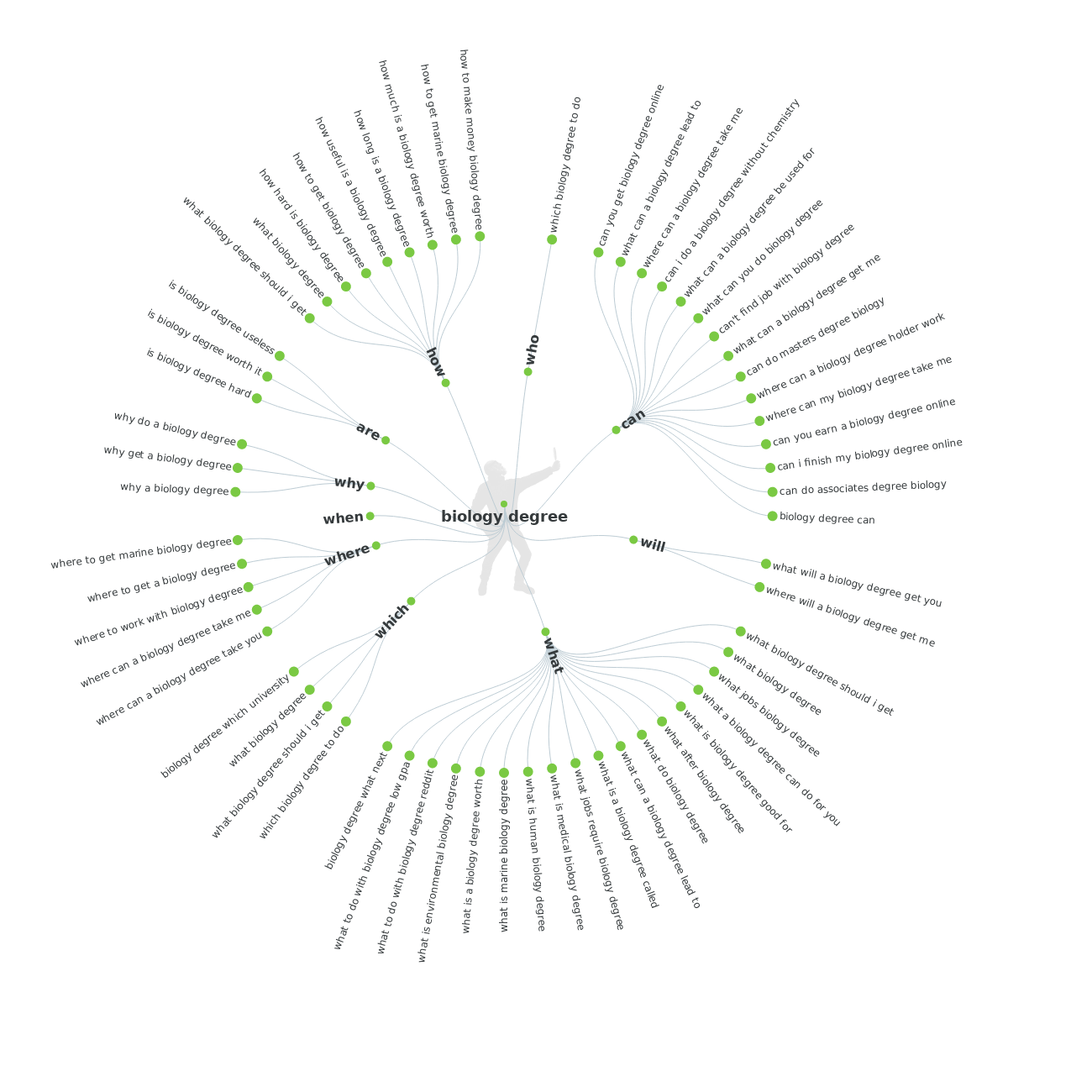
There are also a variety of free and paid tools out there that can help you brainstorm new keyword ideas. Keywordtool.io and LongTail Pro are examples of tools that can help you find long-tail keywords to optimize for. Just type in a root keyword and they will return suggestions for other long-tail keywords:
Targeting long-tail keywords is worthwhile because they have less competition than base keywords, but can help you reach a very targeted audience.
Once you’ve developed a list of keywords to target, you’re ready to start creating and optimizing your site content. You’ll want to start with your major site pages first, like department or program pages.
But if you want to really make the most out of long-tail keywords for SEO, you need to develop more related content for departmental blogs and/or resources. You can use these pages to answer common questions people have about the subject/program. Use a tool like Answer the Public to get even more keyword and blog topic ideas. It will help you come up with questions related to a root keyword you ender:
Make sure with each site page you also follow on-page SEO best practices. Here are the main places your target keyword should appear on-page:
Try to distribute your keyword naturally throughout the content wherever it fits and makes sense to use it. Never sacrifice the quality of your written message to fit in more keywords. That’s called keyword stuffing, and is actually bad for your SEO.
Link building is just as important as keyword optimization for SEO success. Your first initiative should be internal linking. Build a healthy web of links connecting your various site pages to each other. The anchor texts for these links should be descriptive, helping Google bots understand what your content is about.
The next step is to start building external links from other high quality websites. Getting your institution and its educational programs listed in high quality directories is a great place to start. You should also seek out as many links as possible from other prestigious educational institutions with a .edu web address.
Building links from .com domains is good as well, as long as they have high domain authority. Quality online magazines and news sites are great options. If your school is a research institution, it should be easy to get new studies mentioned on high authority sites. Try to get those links pointing back to your faculty and/or department pages, instead of the journal publications themselves.
Google Ads PPC is a great complement to organic SEO as part of your SEM strategy. It not only helps you get instant visibility in search results while developing your organic SEO, you can also target conversion-related keywords to reach people at the most important points in their school decision process.
Here are a few best practices to remember when launching your Google Ads PPC campaign:
One of the first things they teach you about PPC keyword targeting is to bid on your branded terms (e.g. your institution name). That strategy makes sense for ecommerce businesses that are trying to attract traffic from potential shoppers. But it can actually be a huge waste of money for higher education institutions.
While some of the people that google your school name might be prospective students looking for information, the vast majority will be your current students, faculty and staff using Google as a quick way to navigate to your homepage. They click on your ads because they appear at the top, then you have to pay for the conversion.
In the same vein, you should avoid targeting your competitors’ branded keywords as well. That strategy makes sense for a business that offers competitive products or services, but not for a university. You’ll end up attracting a lot of traffic from your ads that didn’t mean to navigate to your website at all.
So what kind of keywords are valuable to target for PPC? You want your ads to appear for users who are interested in joining an educational program, like an undergraduate environmental science degree or executive MBA program. So you’ll want to target keywords that reflect the right points in their journey to conversion.
The more specific and relevant the keywords you target, the more likely you’ll be able to reach users who are almost ready to choose a school to attend. Think about the undergraduate environmental science degree example. You could target “environmental science,” but then your ads might appear for a 9th grader working on a science essay. Targeting more specific long-tail keywords like “environmental science degree” or “environmental science bachelors” will help ensure your ads appear for the right target audience.
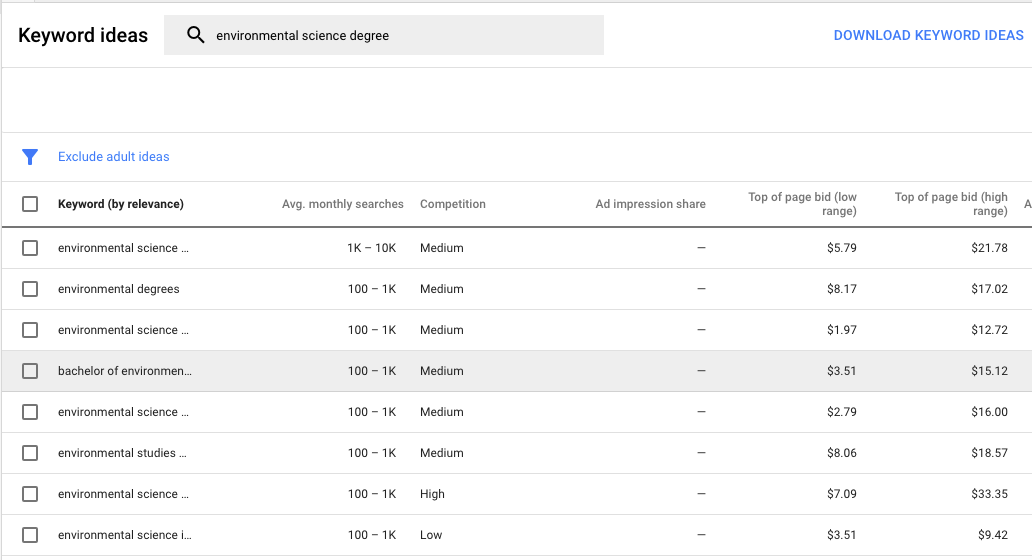
To start brainstorming keyword ideas, Google Ads has a Keyword Planner tool that can help. All you have to do is type in a base keyword related to the program you want to advertise (e.g. “environmental science degree”).
Keyword Planner will come back with a list of related keywords, including important information like their average monthly searches, PPC competition, and bid range:
Deciding what keywords to target is a balance between relevance, search volume, and competition. You want to target the most relevant keywords possible. But if they don’t get a lot of search volume, you’ll be limiting your ad visibility. At the same time, relevant keywords with high search volume tend to be more competitive and expensive.
Use Keyword Planner to get an idea of what kind of keywords you could reasonably target with your budget.
Getting traffic to your website pages is one thing. But if you want your PPC ads to actually lead prospective students to apply for your programs, you need to consider the path they take after they click on your ad.
Say you’re targeting the keyword “accelerated nursing program.” Don’t allow that ad to link back to a generic landing page or the homepage of your nursing program. The whole point of paying for clicks is so your website content can convince prospective students to sign up.
So take the time to create a unique landing page that caters to the interests and needs of the person who clicked on the ad. A landing page for the “accelerated nursing program,” for example, could highlight details about the fast-track course option.
Offer a clear overview of all the program details, then include a prominent call-to-action asking visitors to inquire about the program. Do everything you can to encourage visitors to convert after clicking on your ad to ensure your PPC strategy works effectively towards your overall marketing goals.
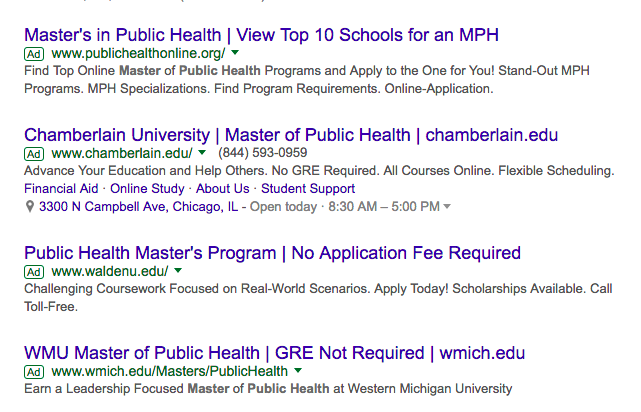
You’d be surprised how even the most simple changes in your ad copy can have a huge impact on click through rate. Take a look at these top ads that appear for “masters public health”:
Phrases like “No application fee required” and “GRE not required” are examples of unique selling propositions that higher education institutions can use in their ad copy to stand out and drive clicks.
Chamberlain University’s ad also makes use of ad extensions to display their phone number, address, related links, and more. These are powerful ways to stand out as well.
Whatever information you do decide to include in your ads, just make sure you test it with your audience. Google Ads makes it easy to create ad variations where you change the headline or call-to-action, add or remove ad extensions, etc. Google Ads will automatically rotate these ad variations for you so you can identify the most relevant ad copy for driving clicks.
When running your first Google Ads PPC campaign is that it’s easy to set it up and forget about it. But letting your campaigns run themselves isn’t going to be worth your financial investment in the long run.
If you pay attention over time as your ads run, you’ll start to realize there are certain keywords, ad types/copy and bid strategies that do a better job of helping your get inquiries into your educational programs.
For example, say you have ad groups targeting your MBA program vs other masters degrees you offer. MBA-related keywords tend to be highly competitive and very expensive to bid for as a result. After distributing your ad spend equally, you might discover that bidding more on keywords related to your other masters programs does more to drive your marketing goals. You can then reduce your investment in expensive MBA-related keywords and reallocate that spend.
Optimizing your bid strategy is another important factor that can help you minimize your financial investment in PPC ads without affecting ad performance. Wasted ad spend is granular and often difficult to track as ad competition comes and goes. But there are technologies you can use to automate the process. Centro, for example, offers a machine learning technology via Basis that uses data science to predict keyword performance and optimize your bid strategy for you.
No matter if you’re targeting the “back to school” crowd or the next generation of students, SEM is simply the best way to reach them with your marketing message. Everyone today uses their mobile phones to research and discover educational programs like those you offer.
Use the best practices explained in this post as a starting point to launch successful search engine marketing campaigns. As you start to illustrate results from your efforts, garner more buy-in so you can invest in tools to optimize and automate the process even more.
Keeping up with the trade pubs and latest trends in the ad tech world can be tough and time-consuming. We took it upon ourselves to declutter the space, and compiled a list of articles, reports, and other bits of awesomeness you may have missed, but should definitely read. Enjoy the latest list for September 2018 below!
In-house Agencies on Rise as Advertisers Seek Services Closer to Home [3-minute read]
According to a new study from Forrester, benefits ranging from knowledge of the brand and business to speed and cost-effectiveness—the number of advertisers with in-house agencies has increased to 64% from 42% a decade ago. The majority of the respondents claimed that an uptick in internal agencies does not pose a threat to external agencies.
Google Tracks location data even when users turn service off [2-minute read]
The Associated Press found that Google’s smartphone services store user location even when privacy settings designate the feature off. Although Google halts tracking services when sharing location with apps, it doesn’t prevent collection with Google-specific products like Google Maps where it instantaneously grabs user location when the app is opened. This conflicts with Google’s official messages on how user location history is supposed to be entirely opt-in and changeable at any time; the fallout from the findings will continue to develop (and include a class-action complaint).
Mobile apps are Stalling on the Way to GDPR Compliance [5-minute read]
The GDPR deadline was this past May, but many mobile apps have struggled to become compliant. Read more detail on what that looks like, and how some are managing the data they’ve collected, as well as 3rd party data via SDK partnerships to meet GDPR compliance standards.
Under GDPR, Publishers Are Adopting CMPs For Fear Of Losing Out On Ad Revenue [3-minute read]
More publishers are feeling a need to adopt CMPs – consent management platforms to be compliant with GDPR. While many publishers have built their own CMP, some worry that implementing them could cause a drop in personalized advertising.
Are Targeted Ads Stalking You? [6-minute read]
NYTimes highlights the prevalence of stalkers ads while sharing some tips and tricks on how digital consumers can avoid them. The article highlights the well-established retargeting ad for digital media professionals and the generally observant web user alike. Advertisers need to be judicious in the use of retargeted ads by limiting the number of exposures to any user (frequency capping) and the number of days that a user should be exposed to minimize concerns of feeling stalked. Not doing so will not only upset users and knock down performance, but can also lead to increased adoption of ad blockers, which eMarketer estimates to be utilized by 1/4 of all US internet users.
Bundle Up!: Traditional TV Providers Offer OTT Packages to Head Off Subscriber Freeze [5-minute read]
Traditional TV providers have little choice but to quickly find desirable alternatives as the rise of cord cutters outpaces earlier projections –a 32.8% increase, with 33 million individuals no longer paying for traditional cable or satellite. This report highlights a number of critical stats on TV and OTT consumption trends including a sharp decline in paid TV viewership, which is expected to decrease by nearly 4% down to 186.7 million in 2018. In response to an accelerating population of cord cutters, traditional TV providers are seeking to retain their customers by partnering with OTT video services like Netflix, though it is too soon to tell if Pay TV-OTT partnerships will be effective in reducing the current pace of subscriber churn.
Audience for Connected TV Grows, but Ad Spending Has Lagged [2-minute read]
While TV households now are increasingly using Connected TVs, ad spend has not quite caught up—yet. In a new forecast package, eMarketer estimates 71.6% of households have a connected TV, but CTV only accounts for 12% of overall TV ad spend.
Here’s What’s Needed To Scale Behavioral Targeting In OTT [3-minute read]
Behavioral targeting is still in the early stages when it comes to OTT due to a few challenges. The solution to this problem includes further development of cross-device maps that tie the devices used to research products and services, such as desktops, tablets and mobile phones, to OTT and CTV devices.
Amazon To Merge Its Ad Businesses Into One Platform [3-minute read]
Amazon is streamlining its ad business so advertisers will be able to buy campaigns from the same place. This will include the consolidation of Amazon Media Group, Amazon Marketing Services, and Amazon Advertising Platform—big things for the big(gest) man on campus.
Augmented-Reality Ads Are Headed to Your Social Media Feed [4-minute read]
In an effort to take advantage of new consumer tech available on smartphones and brands’ desire to encourage more consumer engagement, Facebook is testing AR ads similar to what Snapchat has been offering for some time. Virtually trying on a new pair of Michael Kors sunglasses or testing various eyeshadow shades from Sephora are early examples that have shown increased brand interaction. Meanwhile, other companies like Ikea and Pottery Barn are looking to expand what they’ve offered via their app and website, by stepping directly into consumers’ feeds to allow for virtual experiences that don’t require shoppers to walk into their brick and mortar stores. Basically, they took out all of the leg work. (See what we did there?)
The old production adage has held true for many generations. Faster, better or cheaper: you can only choose two. However, Google's introduction of their new Ad Strength tool is helping marketers and advertisers around the world achieve all three by reducing poor-performing advertisements on Google. In an age when consumers are demanding a more personalized experience in less time than ever before, Google’s new Ad Strength tool provides you with the means to deliver quality advertising with less risk using Google's algorithms and artificial intelligence (AI) assets. Here's a quick look at this new tool and how you can put it to use to improve your campaign performance.
With an estimated 91% of consumers purchasing something they saw on a mobile device in an advertisement they felt was relevant, producing an advertisement that really speaks to your target audience is important to succeeding in your digital advertising efforts. But with the number of differences between people, the expectation that an ad be relevant is a huge challenge. A large number of different ads must be produced, then tested for effectiveness. If done in a traditional fashion, this can be an extremely expensive proposition. Enter Ad Strength.
Ad Strength is a tool developed by Google Ads that leverages the power of AI to evaluate potential ads. The tool's AI evaluates each ad and determines which one will be the best fit for your target audience, providing you with real-time feedback on your ad design while allowing you to more quickly add the advertisement to your online portfolio of options. Experienced marketers who have studied the tool expect a boost in the number of clicks by up to 15%, a significant uptick in activity and profitability potential for most businesses.
One of the typical ways to handle testing different ad types is through A/B testing, which provides a viewer with one of two different ad types. You can then study the results of the testing to decide which ad is more effective, allowing you to focus your investment where it will do the most good. The problem is, that process can take time - time that your company may not have in today's fast-paced, competitive world.
Ad Strength automates that process by using machine learning and AI to study multiple forms of the advertisement, then recommend which one is the strongest. It will even deliver additional feedback on how to improve upon the best ad design that was provided. This can include adding more headlines to evaluate or making the headlines or descriptions more unique to better reach your specific demographic.
Ad Strength uses a number of different factors to determine a numerical value metric to rate a Ranked from 1-100, with 100 being the best, it looks at three primary factors at this time.
If you're looking at setting up a display ad, there are some other areas to consider as well due to the graphic nature of the advertisement.
The Google Ads update also includes a few other tools that may be helpful for marketers. It provides the option to preview the completed ad as you work on it, allowing you to make quick tweaks to the design as you go. Take the time to learn how to reach and use the reports that are generated by the entire process, allowing you to more carefully hone the next set of ads before you get into the process.
The tool also requires options to be able to process which combination works best. Though there is a minimum, the more that you can provide will help you to determine the best possible combination for your business' situation, your demographic and your position in the industry and market. For that reason, you'll want to stick to the minimums above to ensure that you get fabulous results.
The tool will be available to advertisers and marketers in column format in early September, but in the meantime, what does Google itself have to say about its new tool and how to get the most out of it? It recommends coming up with at least three, possibly five, and as many as ten different headline combinations so that it can choose the best possible one out of the lot for a responsive search ad. If you're looking at display ads, it requests 15 images, and five each of your logos, headlines, and descriptions for each ad you want to create. It will then use the onboard AI to study each aspect and determine the best possible combination of features to create the best overall ad.
When Apartments.com stuck to these recommendations in a test, it saw a 10% uptick in the number of clicks their ads received. ForRent.com used a similar array of techniques and saw a 16% upswing in the number of clicks it received. Both sites inserted their ads at particular points in the search process to maximize their results, and both saw excellent improvements in their returns due to the changes that they decided to make. This change makes sense given that a recent Adobe study found that 42% of viewers became annoyed when ads weren't personalized or relevant.
By using Google's AI resources to improve your campaign ads, you can increase performance and boost your company's bottom line, without having to invest in these sometimes expensive assets yourself.
Keyword research is the foundation of pay-per-click advertising. It’s impossible to run a PPC campaign if you have no terms to target. Thus, growing a keyword list is the first step to launching new campaigns or expanding existing ones. If you’re looking for new keywords to target, the following ideas will help you find a variety of potential terms.
The initial place to look for keywords isn’t in some keyword-generating tool but rather right on your own site. Any terms you discover while reviewing your site’s current traffic will be the most promising of all terms, for they’re already generating a little traffic and you can mine the data for more detailed information. There are several ways to glean keywords from your site’s current traffic.
Using Current PPC Campaigns and a Thesaurus
To get new keyword ideas from your current PPC campaigns, simply look over the campaigns with a thesaurus in hand. What terms are used in the ads, and what are you bidding on? Write down the successful terms you come across and then, open the thesaurus. You might come across some related terms you haven’t previously thought of.
Using a thesaurus may seem like an antiquated way to do keyword research in today’s era of online tools, but it’s the uniqueness of this tactic that makes it useful. With a thesaurus in front of you rather than a keyword tool, you’re forced to focus on the terms rather than the metrics. You’re freer to brainstorm, and you can always later check the viability of terms that you find.
Checking Google Analytics for Occasional Ideas
Ever since Google made SSL Search its default mode back in 2011, Google Analytics has not been the goldmine of keywords that it once was. Nevertheless, it’s still possible to find a few keywords through analytics.
To garner what ideas Google Analytics can provide, check the Organic Search section of Channels. You’ll see how many visitors are finding your site organically, and below the chart, there’s a list of the keywords that visitors are searching for when they click on your site’s listing in the search engine results. The vast majority (likely more than 95 percent) of terms will be “(not provided).” You may see a few terms that are visible, though.
Any terms you see are potentially viable keywords, for at least one person found your site through organic search by using the terms. If they work for search engine optimization, there’s a decent chance they’ll also work for PPC marketing.
Looking Up Search Terms in Google Webmaster Tools
Google’s Search Console (formerly Webmaster Tools) is a much richer source of potential keywords. The data is aggregated from multiple users, so privacy is less of a concern and Google displays lots of terms on the platform’s reports.
In the Search Analytics section, you can view what terms are generating impressions for your site. There are also reports for positions, clicks, and click-through rates, and you can filter by search type, device, and/or country.
This information is widely used by SEO specialists. The Queries reports that show the aforementioned details, however, are also useful in PPC planning. Any terms that are generating high impressions or clicks might be worth building PPC campaigns around.
Asking Your Customer Service Representatives
If you run a site that receives lots of customer inquiries, the people who respond to these inquiries may be valuable sources of keyword ideas. They’ll know what customers are asking about and what terms they’re using in their questions. If you ask, customer service representatives will be happy to share this information.
Most of the questions that customer service reps field won’t be directly related to sales, so you’ll hear lots of responses that aren’t appropriate for PPC. Any questions or terms that are related to your marketing funnel might be good for PPC ads, though.
Should you come across a pre-purchase inquiry that people are asking a lot, you might even be able to use some of the customer service department’s budget to create a resource and campaign around the question. If people are able to easily find the answer on your website through a PPC ad and associated landing page, the company may save labor by reducing the number of questions that customers ask.
After going through your own website, the next place to turn is your competitors’ sites. There are a few quick ways to see what keywords they’re targeting. Any term that a competitor is targeting is probably one you should be targeting too.
Seeing Competitors’ PPC Ads
Anytime you come across a competitor's PPC ad, that’s an obvious time to check for keywords that they’re running a campaign around. How you find the targeted term depends on why the ad is appearing:
You don’t want to go searching for these ads, as there’s no efficient way to discover all competitor PPC campaigns by just using the internet. Whenever an ad appears, though, take note.
Finding Out Competitors’ Tags
Some basic sleuthing on competitors’ websites will reveal what keywords each individual page is designed for.
You can open the HTML source code of any page on a competitor’s website, generally by right-clicking and selecting “page source.” Among the HTML elements revealed, you’ll find the headers (including H1, H2, and others), page title, meta description, keywords tag, image title tags, and image alt tags.
Not every site uses all of this schema, but any terms you discover might be worth running a PPC campaign. Terms can be especially promising if the competitor isn’t currently running a paid campaign for them.
Researching Competitors’ Keyword Ideas
After you’ve completed some initial research on your competitors, take their URLs over to Keyword Planner. Input the URLs into the “Find New Keywords” function, and you’ll soon have a list of possible terms, including the traffic they generate and how competitive they are.
You’ll likely already have campaigns running for many of the terms shown, and manually filtering through duplicates is time-consuming. To efficiently discover new ideas, download the report generated as a spreadsheet. Then, copy-paste the terms you’re currently targeting into the spreadsheet and remove duplicates. You’ll soon have a list of potential keyword ideas that you aren’t currently targeting.
Utilizing Third-Party Tools
There are also a number of third-party tools you can use to discover what keywords your competitors are targeting. Some are paid and others are free. One popular tool is SEMrush, which shows paid and organic details along with other information.
Once you’ve reviewed what’s working for your own site and those of your competitors, it’s finally time to begin using other tools and platforms that can give you brand-new ideas.
Perusing Keyword Planner
Already mentioned, Keyword Planner is a powerful tool that can do much more than merely show you ideas based on competitors’ websites. You’ve likely already used the tool if you’re currently running PPC campaigns through Google. If it’s been a while since you looked for ideas in Keyword Planner and you've been using another advertising platform thus far, spending some time perusing the tool might be helpful. Put a few ideas in and see what terms are generated.
Getting Terms from UberSuggest
UberSuggest is a go-to tool for long-tail keywords. Enter a keyword or phrase, and the tool will soon suggest a plethora of related multi-word terms. Each term comes with volume and seasonal trend information, along with a Keyword Difficulty that’s helpful with SEO and a Competitive Intelligence that’ll help you determine how expensive PPC campaigns will be. The Competitive Intelligence section even shows you the ad copy competitors are using for selected terms.
Shopping on Amazon
To glean potential keywords from a different perspective, head over to Amazon. Amazon has grown from the company’s initial days as an online retailer into the largest search engine for product-related searches.
Amazon doesn’t have the same keyword-finding tools as Google does, although the company's tools are growing as Amazon Ads develops. The real usefulness of Amazon, however, lies in its abundance of creative phrases and ideas for terms.
To find creative keywords, search for products related to your website’s focus. See what terms people are using both in their listings and discussions of products. What are the book (and Kindle) titles and subtitles? What’s being used in the product descriptions and reviews? Any of these terms might help you incorporate more creative phrases into your current PPC keyword profile.
A similar tactic can be used on eBay, although Amazon is now the larger of the two companies.
Searching with Soovle
Soovle is unique among keyword research tools because it's not limited to any one platform. Instead, Soovle aggregates data from Google, Yahoo, Answers.com, Bing, Amazon, eBay, Overstock.com, Buy.com, YouTube, and Wikipedia. Don't expect the same level of detail as you get from Keyword Planner or UberSuggest, or by personally reviewing a site like Amazon. If you want a selection of results from a number of sources, however, this is an excellent tool.
Because Soovle combines several sources and provides basic information, you might want to use it early on in your research. Conducting a cursory search via Soovle might yield a few terms that you can look further into via the other tools. Also, don't be afraid to take words found on one platform (e.g. Wikipedia) and see if a PPC campaign on a search engine will work.
Reading on Quora and Yahoo Answers
Content strategists sometimes go to question-and-answer sites like Quora and Yahoo Answers when they need ideas for pieces. These sites are occasionally also useful for conducting keyword research.
Don’t expect to find specific terms on Q&A sites, as they aren’t easy to search for keyword ideas and normally don’t have optimized text. Instead, look around to see if there are any completely new ideas you can create PPC campaigns around. A long line of comments around a product or service your website offers might be the spark for an entirely new PPC campaign that has several ads. Once you get a few ideas, you can return to the other tools to refine the exact terms that should be targeted.
Monitoring Hashtags on Social Media
Hashtags are largely confined to social media, but there are some instances where hashtags that first grow on social platforms may be useful to SEM managers planning PPC campaigns. Any hashtag that becomes popular on Facebook, Twitter, Instagram, or another platform might be incorporated as a new keyword in a PPC ad.
To see how you might capitalize on a trendy hashtag, assume #exampletoo was trending on social media. You could:
This tactic can’t be your only keyword research strategy, since you never know when a hashtag related to your website will start trending. Should this good fortune strike, though, being able to quickly execute a PPC campaign could provide a good return on investment. Hashtags aren’t regularly targeted, so PPC costs for these terms are often lower -- especially when the hashtag is kept as a single phrase without spaces. The site that can put out a quick ad might see a nice and low-cost boost in traffic.
Finally, just staying up-to-date with developments in your site’s industry is a great and natural way to discover new terms without actually doing keyword research. There’s no better way to learn technical jargon than by reading industry publications and talking with professionals in the field, after all.
Staying Current on Industry News
Keep up with industry news so that you know what’s going on and learn new terms as soon as people start using them. Any news that’s at least indirectly related to your industry may provide low-cost PPC terms that generate traffic. If a topic is fresh, people will be searching for it and many search engine marketers won’t yet have discovered it.
If you do include news-related terms in your PPC campaigns, carefully monitor them on an ongoing basis. News has a lifecycle, and the return on these terms will change as the news progresses. Once more marketers start running campaigns, costs-per-click will go up. Once the news is passed over, campaigns will generate less traffic.
Reading Trade Publications
Reading trade publications will show you how people are using your industry’s technical jargon, and you’ll see new terms as soon as it’s coined. Any new term or slang that you read is definitely worth investigating further as a potential keyword, and just the act of reading will help you use terms more naturally in ad copy.
Items published in trade journals sometimes have a lifecycle, but their lifecycles tend to be longer than what the general news reports. You'll, thus, want to monitor any campaigns centered on terms that come from journals or other trade publications. You don't necessarily need to watch them as closely, though.
Just remember that there are lots of resources available to help you with keyword research. When you need new terms, look to:
Use a variety of these resources, and you’ll have a rich and varied collection of new keywords that can form the foundation of growing PPC campaigns.
~
To learn more about how you can build better, higher-performing keyword lists, connect with our digital media experts today.
A search engine marketer doesn't have to be the best marketer on the internet in order to be successful. You simply need your SEM strategies to be more effective than your competitors.
I know what you’re thinking right about now. Something like, “Well, if I could read minds and know exactly what moves my competitors are making next, it would be simple to be more effective than my competitors. Duh!”
What if I told you that there is a relatively easy way to get into the minds of your SEM competitors? What if I told you that learning exactly what your competitors are up to and what tricks they have up their sleeves in search engine marketing can be accomplished painlessly by executing a few bullet-proof tactics? What if, in other words, someone handed you the SEM playbook for crushing your competition?
Do I have your attention now?
Yeah, you read that correctly. This post is jam-packed with practical tips and tactics to discover the SEM strategies your competitors are using. You can duplicate their SEM strategies and employ other, more effective ones to outperform your competition.
Read on to get the most comprehensive SEM playbook for crushing your competitors.
The initial step in any meaningful competitor analysis is choosing the best sites to analyze. No amount of research yields helpful insights if you’re looking at sites that are irrelevant or have ineffective SEM strategies.
You likely already know what competitors you’d like to analyze;it takes just a few minutes to confirm your suspicions with data that shows which competitors are most worthy of study. Checking ensures you use resources efficiently; the data helps address any questions that others raise about why you chose the sites you did.
First, perform a quick search to see what sites are showing up in search engine results. Pay attention to sites that rank in the top positions and just above your site. Also, pay attention to any site that’s using pay-per-click campaigns for your chosen terms. Any of these might warrant investigating.
Second, use a service like RankWatch to discover additional competitors and see how competitors are trending. After logging into RankWatch, click on the “Competitors” section and select the ones you’d like to compare. You’ll see a few details on how each competitor appears in search engine results. More importantly, the display will show how each of the chosen competitor’s rankings is trending. Focus on those competitors that are trending upward as opposed to those that are falling.
At this point, you should have a shortlist of the best competitors to analyze. Try to keep this list to a handful or less so that you can perform a deep analysis on each. You may even want to look at just the one best competitor.
Before looking at search results themselves any further, first spend some time on each competitor’s site. Explore them as a typical visitor would, paying attention to both on-site optimization strategies, user experience, and conversion strategies. Only the on-site strategies are directly related to SEM, but the ultimate goal of SEM is conversion so the other two areas should be kept in mind at least.
Regarding on-site strategies, simply look at the items that you keep in mind when setting up new pages.
For example:
For example, a cursory review of seminariesandbiblecolleges.com shows that the site uses the key phrase "seminaries in [state]" for its state-oriented pages. Likely thanks in part to this tactic, the site ranks well above the Association for Theological Schools' geographical search. The Association for Theological Schools is the official accrediting body of seminaries. However, its geographic search page has a URL of "...geographical-search" rather than one with a key phrase. (Rankings were accurate at the time of writing.)
Most of these items are fairly basic. However, sometimes reviewing a competitor’s website reveals strategies that your site currently doesn’t use. Even if you don’t discover new SEM strategies, you may come across more user-friendly ways to include certain ones (e.g. more natural ways to include key phrases in copy).
After perusing their sites, you probably have a good idea of what primary key phrases competitors are targeting. The phrases should appear in headers, copy, and other places. You might not know all of the key phrases that are generating traffic for each competitor, though.
In order to get a more comprehensive view of the key phrases that competitors are targeting, turn to a tool like SEMrush. After logging in, entering a competitor’s URL, and selecting a country, you’ll have access to an array of information:
The backlink profiles and display advertising information is interesting. But the most helpful data are the lists of organic and paid keywords that a competitor is targeting.
SEMrush is a third-party service that has access to lots of data, but even its data is limited at points. Thus, the display advertising details and backlink profiles are only nominally helpful without supplemental sources. These reports can be pulled and filed for use at a later stage.
What’s needed now is the list of key phrases. Combine the lists that SEMrush provides with key phrases you’ve already discovered, and prioritize them.
Use the prioritized list of key phrases to see what methods your competitors are using to show up in search results.
Enter a few of the highest priority phrases into the major search engines, and note what types of listings show up for each competitor. Is the main organic listing being supplemented with other organic listings from social media, external blogs or review sites? Are display ads being used in addition to the organic listing?
All of these additional listings help build a site’s authority and reduce how much space is available for other sites to be listed. Even if they don’t improve organic rankings, they increase the likelihood of searchers clicking through to the competitor’s site.
You don’t need to do this for a full list of key phrases, as the same strategies are likely being used for all major phrases. You should, however, check several search engines. Competitors may be using slightly different strategies or getting different results in Google, Bing, and the other search engines.
Naturally, this is a point where you can take action as a search engine marketer. Any SEM strategy that you see a competitor using is one that you can employ for your site. If a competitor's Facebook page is ranking, invest time in cultivating your site’s corresponding social media pages. If a competitor is using PPC ads to appear multiple times in the same results, you can start PPC campaigns for the same key phrases.
Regardless of whether you see a competitor’s social media profiles in search results, you ought to quickly see how each competitor is using social media. Check what platforms competitors are on, whether they have multiple accounts on a single platform and how they use the accounts.
A case study of Home Depot and Lowes on Facebook shows how similar small alterations in activity can have significant impacts on social metrics.
Lowes posts to their Facebook page almost daily, usually between 6:00 and 7:00 a.m. EST. Home Depot tends to post every two or three days, and the company varies the time its posts between morning and afternoon. Both companies respond directly to comments on their pages.
The two companies have similar followings on Facebook: Home Depot has 4.6 million likes and Lowe's has 4.5 million. The difference between the two companies' engagement rates is stark, though. Home Depot saw 4.1 million visits at the time of writing, and Lowe's had only 2.7 million visits.
Exactly what is the reason for the vast difference in the number of visits and how that difference impacts SEM is difficult to say. The posting patterns would certainly be an area to explore if these were your competitors, however, and the payoff could extend far beyond social media marketing. Search engines consider social activity and a 1.4 million difference in visitors is bound to have some impact on search engines' rankings.
Your social media efforts should at least match, and ideally exceed, those of your competitors. Social platforms themselves can be valuable sources of traffic, and social activity has been positively correlated with higher rankings in SERPs.
For a detailed picture of competitor’s off-site search engine optimization efforts, perform a thorough backlink profile analysis using Ahrefs, Moz’s Link Explorer, and the SEMrush's backlink report.
None of these third-party reports are complete on their own. Together, however, they create a fairly comprehensive picture of a competitor’s linking domains and pages. You can see linking domains, linking pages, how many backlinks a site is gaining and losing, whether a linking site is spammy, and much more. Creating a master spreadsheet with referring domains makes it easy to remove duplicates and sort domains by chosen criterion.
In theory, your competitors' backlink metrics are the ones you need to beat. If you have more links from higher quality sites and everything else is equal, then your site should outrank competitors’ sites.
Of course, this isn’t always the case because there are many other factors that search engines consider. Backlink profiles are one of the major factors considered, though, and your site will be in a good position to rank well if it has a better profile than the competition.
During your research, make note of any referring domains that might be willing to link to your website. Any webmaster who’s already linked to your competitors is likely willing to give you a backlink if you offer the same benefit. Figure out how your competitors got the backlink, and make a similar proposition to the webmaster. Along with helping SEO, some of these domains might also provide referral traffic.
The final step to fully understanding your competitor’s SEM strategies is analyzing their PPC campaigns. To do this, you’ll need the cursory information offered by SEMrush and more specific details from Google Ads and Microsoft Ads.
Step 7a: Google Ads
First, run any new key phrases that you’ve discovered through Google Keyword Planner. While this provides only a broad overview, the traffic volume estimate, average cost-per-click, and overall competition level are helpful when deciding whether to pursue new key phrases.
Eliminate any key phrases that don’t appear to be profitable, for your competitors don’t necessarily always pick the best phrases to target. Continue researching any phrases that do appear profitable.
Second, take your shortened list of keywords over to Google’s Auction Insights report. Auction insights will show you:
This information has obvious benefits when you’re trying to discover which key phrases offer the best ROI and set budgets. You’ll learn how much you should be bidding to have an ad visible, and from there can calculate the required investment and resulting return.
To refine campaigns even further, Auction Insights also offers options to drill down by device type and/or time. This type of segmentation lets you adjust your PPC campaigns for the maximum ROI by targeting devices and times based on cost-per-click or overall activity.
Step 7b: Microsoft Ads
Finally, take everything you’ve learned thus far and put the same key phrases into Microsoft Ads’ Campaign Planner. Similar to Google Ads’ reports, Campaign Planner will give you:
Sometimes this information is almost identical to that found through Google Ads. Other times, there are great discrepancies between the two platforms’ information. When there are differences, they usually arise not from inaccurate data but from competitors’ PPC strategies.
Competitors frequently favor one platform (usually Google Ads) over the other. This is because there’s more activity on that platform or because they aren’t as familiar with the other. Any such imbalance, such as higher and lower costs-per-click, can be exploited to get a higher ROI on PPC.
For instance, assume you run a website that specializes in mobile phone repair services. You would expect to target most PPC campaigns toward mobile device users who might need a screen repaired or another issue fixed. This research might show, however, that competitors aren't targeting desktop users. While the conversion rate for desktop users is probably lower, the cost-per-click might be so affordable that it makes sense to run a small desktop-focused campaign.
Alternatively, think about running an e-commerce business that sells expensive jewelry. Your data might show that people who own Apple computers are more likely to purchase items from your store than those who have PCs. Based on this data, you may choose to show ads to Apple users and not PC owners if the cost-per-click is identical when segmenting by device. Back in 2012, the Wall Street Journal reported that Orbitz was using just such a strategy. The site showed Apple users more expensive getaways by default.
For an example that involves time, consider a synagogue that holds services on Saturdays and uses PPC advertising to reach potential attendees. Most people looking for a synagogue to worship in are likely going to search on Friday or Saturday; you want to make sure your ads have good coverage during this time. By researching what competitors are paying and how much coverage they're receiving, you can determine what your synagogue must bid to have ads show on these days. You can then set you maximum bid to the appropriate amount for Friday and Saturday, and bid much lower (or not at all) on the other days of the week when people aren't looking for a place to worship.
Once you’ve completed a full analysis of your competitors' SEM strategies, incorporate your insights into an actionable plan. Meet with your team to draw up a budget and define next steps to outperform the competition. Then, execute the plan and monitor your site’s performance.
Conducting a comprehensive analysis of competitors' SEM strategies is resource-intensive; it takes time to identify competitors, and check their sites, social activity, search rankings, backlink profiles and PPC campaigns. However, at the end of the process, you know exactly what SEM strategies you must use to succeed in search engine marketing. If you invest the time and other resources, the ROI can last for a long time.
So what are you waiting for? It's time for you to go out and crush your competitors.
Are you ready?
The path to bringing programmatic software in-house isn’t always linear. When it comes to programmatic buying, there are typically four different options:
How do you know which path is the best for you, your company, and your team? The path forward may seem daunting at first, but don’t worry—we broke it down for you. Read our 10-step checklist below, and get ready...set...grow!
Establish business goals.
Set campaign KPIs to track and determine success.
Assess the skills, digital acumen, and expertise of your existing teams.
Seek out the right talent. Culture is key.
Gain buy-in from primary stakeholders in all levels of your organization.
Get to work! Create a vision and start planning.
Sift through your toolbox. What tools and processes do you have or need to establish the right infrastructure?
Determine a budget.
The future is...here. Prepare your organization for ‘what-ifs’.
Find the right programmatic technology partner.
Now that you’re prepped and ready to go, dive into our Programmatic Readiness Guide as you continue to assess the ideal solution for your digital buying needs. Learn more about the different programmatic buying options; use our 10 Questions to gauge your readiness and spark action!
It’s all about the journey.
Facebook has been popping up a lot in the news lately with regard to its data collection and distribution methods. The recent Cambridge Analytica data scandal has called into question the way Facebook uses its customers’ personal data to help advertisers with precision marketing on the platform. Not to mention, new data privacy regulations like GDPR are changing the way that companies worldwide approach gathering and sharing private consumer data.
In light of these recent events, Facebook is making some adjustments to the way it collects and uses customer data. If you advertise on Facebook, you may be wondering how changes to the social media platform will impact your reach and ad results. Below, we’ll explain which Facebook ads targeting options are changing and what these changes mean for your social media and paid advertising strategies.
Unless you’ve been taking a hiatus from the news recently, there’s a good chance that you’ve heard about Facebook and the Cambridge Analytica scandal. Without going into too much detail, this data scandal involved a political data firm that accessed and used Facebook user data to map out personality traits. Then, the organization used that information to target specific audiences with digital ads that were political in nature.
After this information recently came to light, Facebook founder Mark Zuckerberg appeared before regulators to explain Facebook’s user privacy practices. The social media platform found itself under fire from both government organizations and the public, who, understandably, were concerned about how Facebook user data was being collected, shared, and used.
Though the data scandal has certainly impacted the public’s opinion of Facebook, this isn’t the only recent event changing the climate for the Facebook advertising platform today. The General Data Protection Regulation (GDPR), which started on May 25, also has an impact on Facebook ads targeting. GDPR is a European Union regulation that aims to give citizens control over their own personal data through stricter privacy regulations for consumer data.
Under GDPR, Facebook will no longer be able to collect or use data for behavioral ad targeting. To become GDPR compliant, Facebook will need to find a form of ad targeting that doesn’t use personal data unless it has explicit consent from its users. This change in Facebook's data privacy rules may cause some alarm for businesses that rely on Facebook’s sophisticated targeting features to reach the right consumers for their products and services.
Before you can understand how changes to Facebook ads targeting will impact your social media ad strategy, it’s important to know how Facebook collects data from its users for advertisers to use. There are typically four different places from which Facebook collects data – advertisers, the voluntary information users put on their profiles like their birthday or location, interactions on posts, and data supplied from third-party data brokers.
Facebook is eliminating the data it collects from third-party brokers, or advertising partners as the company refers to them. The data that comes from partner categories allows advertisers to target Facebook users based on their offline behavior. This offline behavioral data can include consumer characteristics such as owning a home, being loyal to a specific brand, being in the market for a new vehicle, or belonging to a particular income bracket.
Essentially, the data that comes from these advertising partners is any information that isn’t provided by users in their profiles or gathered through their engagement habits on the platform. This third-party data comes from a variety of sources, including public records, surveys, and loyalty card programs. It has become beneficial for advertisers on Facebook, especially for smaller businesses that may not have access to large quantities of their own customer data.
With Facebook facing a lot of scrutiny over its mishandling of third-party data along with a need to comply with GDPR regulations, the company has started making changes to its privacy policies. After evaluating its data collection and privacy practices, Facebook has decided to eliminate third-party data from its ad targeting platform. This change means that advertisers will no longer have access to offline behavioral data that came from third-party data brokers.
Though these changes to the Facebook ads platform may sound significant, the truth is that businesses will still be able to leverage rich data through Facebook ads targeting. Even after getting rid of offline behavioral and demographic information that was provided by third-party advertising partners, Facebook still has a wealth of data on its users. And all of this information is more than enough to help your business better understand and reach your target audience.
As of the first quarter of 2018, Facebook reported over 2 billion monthly active users. Every time one of these users does something such as like a friend’s photo, watch a video, or share a post, Facebook has this data. Any time a user messages a friend or makes a purchase or donation through the platform, Facebook has this data too.
Facebook has collected all of this information from users interacting on the platform to build a complex data profile. This data profile has a section that focuses specifically on advertising interests. (If you’re interested in learning more, you can download your own personal user data profile to see just how extensive this profile can be.)
Even though you won’t have access to data from third-party advertisers, your business is still able to leverage all of the data that Facebook pulls from its users’ interactions and engagements on the social media platform. This information alone is enough to help you build a significant customer profile by bringing together interest, locations, and specific keywords.
It’s also worth mentioning that Facebook often makes updates and improvements to its advertising platform to keep its advertisers satisfied. Advertising accounts for a significant portion of the company’s revenue, and they can’t afford to lose advertisers. In fact, advertising currently makes up 88% of Facebook’s total revenue. That’s why the social media giant continually works to improve their advertising platform over time.
What this means for your business is that even with the removal of third-party data from the ad platform, there will most likely be updates in the near future that help account for the lost targeting options. With technologies like artificial intelligence and machine learning advancing at a rapid pace, more algorithms and data capabilities will continue to pop up, some of which will no doubt become valuable for improving ad targeting. These advances in technology bring some exciting new possibilities for advertisers.
Even if after all this, you may still feel that you just can’t live without the data you were getting from Facebook’s advertising partners. Just because Facebook has eliminated partner categories from its targeting options does not mean that you can’t contact the data firm directly to get the in-depth analysis you want on your target consumers. If you feel that your business is unable to launch a successful social media ad campaign without this data, then you can work directly with these third-party data brokers to access it.
If you relied on third-party data through partner categories for your Facebook ad targeting, you will need to start making changes to your Facebook ads strategy to account for this shift in data usage. Here are a few things to keep in mind while adjusting your Facebook ad strategy:
1. Use the information that you have at your disposal
When it comes to updating your Facebook ads strategy to account for the lack of third-party data, you’ll need to consider what types of information you still have access to that you can work with for targeting. Then, you can create a targeting strategy around this information.
For one, you will still be able to target user interests. Consider what your target buyers like and what interests they may have indicated on the social media platform. Though a home services company may not be able to target homeowners directly, the business can still dive deep into their own information about consumer interests to deliver targeted ad content.
For instance, the home services company might target Facebook users that like certain magazines or television networks like Better Homes and Gardens and HGTV. This type of media indicates an interest in home improvement. The company could also target users that like specific pages about home improvement such as brands like Home Depot or influencers like Bob Vila.
To find connections like these that are relevant and helpful for Facebook ads targeting, you’ll need to make sure that you have done your target audience research. Buyer personas come in handy here because they may give you new insight into your customers that you might not have considered before.
2. Get creative with your ad targeting options
With third-party data eliminated from Facebook’s advertising platform, you may have to get a little more creative with your ad targeting. Let’s use the example above of the home services company that used to target homeowners on Facebook. What else might this business be able to do to reach their target audience besides interest targeting?
Well, you could target consumers who have shown an interest in your competitors. When a consumer likes a competitor’s page, this is a good indication that they are interested in the same types of products or services that your business offers. By targeting Facebook users who like competitor pages, you can expand your reach in the target market and give consumers another option.
Another Facebook ads targeting option is retargeting or reaching back out to customers who have visited your site. Retargeting is one of the most successful ways to reach and convert qualified leads on Facebook. After you have placed the Facebook pixel on your company’s site, you’ll be able to reach back out to customers who leave your site without making a purchase and deliver targeted ad content that encourages them to convert.
Yet another option is to use Facebook Lookalike Audiences to target relevant consumers on the social media platform. Lookalike audiences are groups of people on Facebook who are very similar to your current customers. Using Facebook Lookalike Audiences can help you take advantage of connections that you may not have even thought of by reaching customers that share similar interests and traits as your best customers.
3. Collect more of your own customer data
With these changes in the Facebook ads targeting options, it becomes all the more critical for businesses to collect their own data from customers. Though you can work directly with third-party data brokers to recover some of the data lost in the Facebook ad platform changes, this just isn’t an option for most small to medium-sized businesses with limited budgets.
The best way to make up for this lost customer data is to gather it yourself. Though this can be a time-intensive process, it is worthwhile in the end because it helps your business learn more about the people you serve. The more you learn about your customers, the better you will be able to provide them with the information and insight they need to make more informed purchasing decisions.
The first step in this process is to work on building long-lasting relationships with your customers. By providing a valuable customer experience, you can build trust with consumers in your target audience. This trust will go a long way in helping you build stronger relationships with consumers and encourage them to engage with your brand and opt-in to provide you with more information.
Once you have a group of happy customers that your brand has worked to establish a strong relationship with, it will be easier for your business to get insights and information from these consumers. Whether you are getting their contact information in exchange for valuable content like gated e-books or simply sending out a survey that asks questions about their interests and buying behaviors, your business will be on its way to building complex data profiles in no time.
4. Consider shifting some of your advertising budget to other ad platforms
Remember, Facebook is not your only option for reaching new leads online. Though social media advertising plays a vital role in your overall digital marketing strategy, it is only one piece of the puzzle. If your business relied heavily on Facebook partner categories for your social media ad targeting, it might be time to consider shifting some of your ad budget to other channels.
Businesses today have a wide variety of effective avenues available to them for online advertising. If you find that despite your best efforts, your Facebook ads are just not as successful as they used to be, then it may be time to use some of that ad budget on a channel that offers a more significant return on investment.
With these changes in Facebook ads targeting, it has become more critical than ever for businesses to take an integrated approach to online marketing. In the end, the goal is to reach as many of your target buyers online as possible while making efficient use of your advertising budget. The most effective way to do this is to leverage data from both the Facebook ad platform and your search engine marketing (SEM) campaigns to improve your targeting, relevancy, and reach.
Aligning Facebook advertising and SEM efforts helps advertisers deliver more personalized and relevant content to consumers while maximizing their budget. By looking at both search engine marketing and social media ad campaigns, your business can better understand useful targeting options for your audience like geo-targeting and targeting by device. You can use the data and insights you gain from your social media and SEM campaigns to enrich the other.
Though the Facebook ads targeting options are changing, there is no reason for businesses to panic. Even if you rely on Facebook ads to reach your audience online, you will still have access to a wealth of data that will help you understand and connect with your target buyers. Not to mention, you can leverage data across your social media and SEM ad platforms to get more out of your advertising budget.
To date, 2018 has been a year of massive change in the digital space. 2019 seems set to bring just as many challenges to online retailers, brands, and internet marketers alike. The intense volatility of this time makes it difficult to predict what will happen next and how to leverage each event for maximum profit. Any business leader that hopes to succeed in coming years must take note of these trends and develop a future-proof growth strategy accordingly.
What kinds of challenges are we talking about, exactly?
Think tectonic shifts in global markets, which make it difficult for brands to set marketing goals that will remain meaningful amid the shifts. Future performance on marketing spend is tough to predict given some of the changes happening right now. New online regulations that, while creating necessary protections for citizens, also create challenging hurdles that we must overcome to succeed online.
Smart digital leaders, the ones who will ride out the coming years in style – or perhaps even benefit from these changes – are working hard to spot such challenges and develop growth strategy that can handle current and future online shifts.
Let’s take a look at a few of the coming challenges, as well as some examples of online leaders doing it right.
Uncertainty is the new norm in marketing, giving rise to both creativity and constraints.
Leaders in the digital marketing economy are planning a future in which major technology players hold a share of political clout that has thus far been unimaginable. This future comes with risk, uncertainty, lack of predictability … and opportunity. Author, entrepreneur, and product strategist Azeem Azhar elaborates on this idea in a recent article for the MIT Technology Review:
“The massive global platforms – Facebook, Google, Amazon, and the like – are defining a new political economy. Their corporate sovereignty will chafe with states’ own sovereignty. Those same nations will curry favor with the platforms to win the putative economic benefits provided by them.”
Meanwhile, he explains that the AI software stack will continue to diverge from traditional software. He points to recent trends around novel interface methods—including voice inputs and outputs, images as large-scale inputs to machine-learning software, and specialist hardware and frameworks such as Google’s TPU and TensorFlow.
What gives technology such power is its ability for platforms to keep up with the pace at which people, goods, and commerce move – and will continue to move, given that goods are moving more rapidly through supply chains. Digital leaders understand that this power serves as a form of currency that cannot be bought out or controlled, at least not entirely, by states and nations. Therefore, the most intelligent are linking their advertising strategies to Google, social and other media that promise big returns in future.
Prevailing changes in how people shop and from whom they’re buying also poses uncertainty to brands.
For instance, the passage of General Data Privacy Regulation (GDPR) in Europe imposes new regulations for express consent of what data a company can collect – and how marketers within an organization can subsequently use it. Simultaneously, the imposition of new trade regulations and restrictions in the United States creates a lack of predictability for some industries as to what shoppers will buy. A state of increasing retail fragmentation means that established brands no longer have the same foothold that they once did.
Intelligent digital leaders resist the despair that may temporarily accompany declining sales, and instead see this as an opportunity to test. There’s always a market somewhere; now is the time to create a far-reaching growth strategy that plays with audience, product, ad creative, bids and more.
Meanwhile, advertising economies are maturing across the Asia Pacific (APAC) region, which means that the timing is right to launch campaigns that help you expand into new markets.
Also on the radar of intelligent digital leaders: Cryptocurrencies. These offer the opportunity to help digitize cash-based economies, whose citizens are only recently gaining access to smartphones, but they also bring with them serious security risks and the dangers inherent in any method of payment unregulated by a central banking system.
Understanding you need change is one thing; knowing how to implement a future-proof growth strategy is something else entirely. Here’s how two industry innovators are preparing.
Domino's Pizza
Domino’s is the second-largest pizza chain in the United States, with sales in fiscal year 2015 hitting more than $4.7 billion. Today, this global franchise leader is focusing on speed as its competitive advantage, according to Innovation Leader. Accordingly, the company is implementing technology that makes “order now” possible at every advertising touchpoint, giving customers much-desired control over their buying choices.
“When you place an order online, you have ultimate control,” explains Domino’s CDO Dennis Maloney. “You get to see the entire menu, you get to browse, you get to add products to your cart. It’s just a much more controlled experience if you’re shopping online than if you place a phone call to the store.”
It’s a simple vision that employees ranging from the CEO to retail store associates can align towards—use digital touchpoints to make ordering straightforward. This capability is future-optimized and platform agnostic, i.e. no matter which digital platform ends up succeeding in future, this growth strategy will continue to perform.
Sierra Club
Innovation Leader shared another story from grassroots environmental nonprofit Sierra Club, which has grown to a base of 2.5 million supporters across 52 volunteer-run local chapters. The company has maintained an active community base, despite significant market competition. Among its two most important foci: preserve community relationships over the long-term and expand its influence.
Better data is important for both objectives, because retention campaigns are built on understanding audience behavior. Luckily, lookalike audiences on Facebook and Google (among other platforms) pave the way to an excellent growth strategy. In collecting their own data through various platforms, they can aggregate it to create a picture of their members, then use that picture to advertise out to future members with the same attributes and interests.
“The ability to capture member activity, such as participation in trash clean-up at a local park, means that the Sierra Club could publish how many pounds of trash were collected that week and how many people participated,” explains the Sierra Club’s chief innovation officer, Chris Thomas. “The Sierra Club can also use this information to track its most active members, and recruit them for participation in events or as local chapter leaders.”
This is another powerful example of a growth strategy whose creators have girded it against future market changes. No matter which platforms end up most popular, no matter what other changes occur in the market, there will remain the ability to gather data from one’s own audiences and craft marketing campaigns targeted toward similar people.
The future of marketing is ever-changing, which makes the process of building a marketing stack a challenge. By selecting tactics that are bound to be with us in several years – e.g. lookalike audiences and customized online shopping experiences – you’re bound to set your company up for success.
Now it’s time to leverage market changes by choosing technologies that align well with your growth strategy. In this ever-changing world, machine learning is the most powerful way to keep up with market changes, analyze new opportunities and take advantage of niches that pop up faster than your competitors.
Ask a Centro Expert is a blog series from Centro where we break down the complicated tools, tech, and trends you’ve been hearing about in the trade pubs and around the office. We reach out to our in-house experts to ask the tough questions and turn them into bite-sized, palatable Q&As for your reading pleasure. This month’s topic: blockchain. We talked to Ben Bring, Centro’s VP of client services, for the break down.
What is blockchain?
A blockchain is a digital, undisputable ledger that chronologically records transactions in near real time.
Large amounts of information that can be recorded securely. Not one entity can destroy it or artificially manipulate it.
How could it be used for digital media?
Blockchain has the potential to impact how media professionals do business and deliver results. The biggest fundamental point is that it has the ability to provide transparency and accuracy to a chaotic digital framework. It could solve for decades-old processes involved with matching contracts with delivery. And it could be applied to issues such as ad verification, fraud mitigation and data quality.
How could a blockchain affect media contracts?
In a typical contract between an ad buyer and an ad seller, the buyer only pays for what it contracted. Having an indisputable record could remove our industry’s reliance on having multiple parties reporting and then working through discrepancies to come to an amendable billable unit or value. The industry would work off Smart Contracts where all parties have the ability to see what actual digital events took place and then cross reference the contract. There would be no doubt as to what was requested for purchase (audiences, impression counts, clicks, etc.) and what was delivered. Media buyers would be protected from waste and potential fraudulent activity by their partners. No single party has the ability to tamper with these digital records, contractual or otherwise. The math is there for everyone to see. No conversation is necessary.
When squaring away contracts, do we pay by bitcoin or any other cryptocurrencies?
All of the reconciliation opportunities in blockchain require some level of tokenization similar to Bitcoin or Etherium. There needs to be an agreed upon value of media and new currency with which to buy it. The challenge is that digital media is bought in a very fragmented way.
I’m not bought in yet. What else can blockchain do for me?
Another major challenge that the blockchain may be able to help solve is payments. It takes between 90 and 120 days for publishers to receive payment for their inventory. A blockchain and tokens could act as an escrow of sorts for pre-payment so that when the media is run, the token are immediately transferred and converted to cash. This also relates to transparency because blockchains could show what entities receive a portion of the payments.
What if I’m an advertiser and I don’t care about payments to publishers?
Advertisers could also benefit from higher quality data. Data continuity and quality are two issues that plague our industry. Both facets are affected by numerous obstacles such as 3rd party mediation, lack of direct connections and data loss. Blockchain has the potential to help solve for all of these moving pieces. Because the ledger is distributed, connections can be more direct, not only removing mediation ad fees but also decreasing data loss.
Ok, I’m interested. Can my campaigns be recorded in blockchain now?
Not just yet. As with every new applications to technology, implementing a blockchain for campaigns is cost-prohibitive currently. And its capacity for processing data may not be enough in a programmatic buying environment, where DSPs are transacting in the millions every minute of the day. The possibilities are worth noting because it takes planning, vision and collective thinking to bring to market commercially viable solutions. Even if I believe the media industry is not ready for mass adoption of blockchains, I am cautiously optimistic about how our professionals could utilize it. It’s important to keep an open mind and continue following the advances made and how they can impact your business.
The key will be adoption. Ad tech players are going to have an impactful role in creating applications for the technology that every company could use.
Are you interested in other Centro resources that will help you understand blockchain? Reach out to [email protected].