
Technology
Basis Platform
Advertising Operating System
Communication Portal
Intelligent Collaboration
All Channel Activation
Activate Media on Every Channel

Consulting
Resources
In the digital world, technology and trends are constantly in flux—some are so powerful, they become best practices, while others never should have existed in the first place. Read five digital media trends that won't make the cut in 2019.
E-books established themselves as the go-to way for companies to showcase authority in their industries several years ago. Over time, they've become one of the most popular lead-generating elements, as businesses offered them free in exchange for that oh-so-valuable personal contact information.
Due to the number of smartphone users expected to hit, companies have to switch the way they offer information to their audiences because wordy e-books simply don't translate well on the small screens of mobile devices.
What should agencies/brands be offering instead? Scrollable, shareable content, such as:
White papers and e-books still have value, but they'll no longer be the standard way to share information.
Organic reach has been on the decline for several years now. In fact, in 2016, organic reach on Facebook was estimated to be around—a drop from 16 percent just four years prior. Now, with several years’ separation since that near-nothing number was reported, organic reach on Facebook will likely be immeasurably small in 2019.
Back when it was acceptable to simply have words on a webpage to rank well with search engines—keyword stuffing and blogs that didn't offer any value were fine. If you're still doing this in 2019, you will be killing your chances of ranking well on SERPs (search engine results pages). You will also probably be irritating your audience to the point of no return.
To remedy this, don't focus on the quantity of content you're putting out to the world, but rather, the quality. Every post you create should mean something to your audience—otherwise, it shouldn’t take up valuable real estate on the internet. One post every week or two weeks that's filled with a substantial amount of relevant, useful, information is worth far more than a bunch of meaningless words every few days.
Words are important, but they're not the only things that make you rank well in the land of search engine optimization. You have to reduce bounce rates, decrease load times and increase backlinks to reputable sites. If you’re only focused on words, your SEO will surely fall in the rankings.
Let’s face it, fake reviews are just bad for business. Consumers can sniff them out a mile away, and big brands like Amazon are doing their due diligence to ensure they don't infiltrate the true meaning of honest reviews.
If you’re considering employing a fake-review strategy, we implore you to put your energies elsewhere.
Sticking with outdated digital media trends can be incredibly detrimental to the reputation of your business or brand. Refine your reach with a comprehensive digital media platform and request a demo from our Centro team. We can't wait to show you how we're changing the world of digital media!
In the world of SEM, your campaign strategy doesn’t stay the same from quarter to quarter, month to month or even week to week. Like the weather and tide schedules, your paid search campaigns change with the seasons. And as a Paid Search Marketer who has lived through numerous Black Fridays -- and countless promotional SEM campaigns -- you know that some seasons are, well, busier than others.

Safe to say, you might feel like you spend all of your time, bandwidth and energy gearing up for the holidays only to do it all over again with President’s Day promotions or spring sales. To say the least, this can be exhausting, labor-intensive and mentally draining for your Paid Search team. After all, these aren’t just fun-one-time campaigns, but an integral part of your campaign strategy -- as well as the key to higher revenue and conversions. Ignore them or let them slide, and you lose out to competitors more on top of their promotional game than you.
So what’s essential for easing your campaign strategy woes, freeing up bandwidth and ultimately setting you up for success?
We’ll let you in on a little secret: it’s your data. Your data about past promotions and seasonality is the ultimate secret weapon to future campaign success.
In Part II of our Enterprise Paid Search Pain Pain series, “Having Trouble Optimizing Your Seasonal and Promotional SEM Performance?” we talk about just that.
Look, we know that, like many advertisers, you spend a lot of time making these changes manually -- and probably wish that you could easily access centrally located data to make informed and strategic decisions on your next campaign.
We feel you. So in our next installment, we discuss some of the pains from this lack of insight, whether it’s hours of manual work to make necessary adjustments or continually being forced to override your bidding solution.
But, true to form, we don’t present any problem without presenting some kind of corresponding solution. (glass half full, right?) We also explore what non-negotiable features you need to stay competitive, relevant and profitable in today’s market (psst...think strong data integration). And in doing so, we ask you to think hard about what you need, answering questions like:
We know this is not an easy problem to solve. Every organization’s seasonal promotions differ with their unique business objectives, revenue goals and performance metrics.
But on our end, we want your promotion calendar to be armed to the teeth with powerful insights and tools so you can apply the right changes to create a strong, repeatable revenue driver for your business that allows you to take profits and ROI to their full potential.
You can find questions -- and answers -- around this complex challenge here in the latest of our Enterprise Paid Search Pains series: “Having Trouble Optimizing Your Seasonal and Promotional SEM Performance?”
To your success!
In light of the proliferation of ads on Facebook, Instagram, and other social media, digital practitioners are pretty much required to have a video ad strategy in place -- and one that makes them stand out from competitors.
That said, a good video ad strategy is far more than just another addition to your overarching advertising strategy. Scroll through any social media site, and you’ve likely noticed that video ads these days look a lot less like ads and a lot more like, well, creative posts. And even short movies. After all, social networking platforms like Facebook, Instagram, and even LinkedIn are designed with the user experience in mind -- and the ads shouldn’t be any different. Thus, it stands to reason that you need to tailor your approach to reach new audiences that are looking first to be entertained.
Below are nine video ad hacks to keep in mind to generate user engagement and keep potential customers coming back.
As you do with regular digital ads, Know Thy Audience. While it might seem like Marketing 101, it’s often surprising how many digital advertisers fail to do this. You might have toiled for hours to optimize your video ads. But it might all be for naught if you’re not reaching the right audiences. Your video ad strategy needs to include a deep and comprehensive understanding of your audience and target customers -- and this includes demographics, what they like, and how they’re entertained (after all, video ads do provide an entertainment factor). There’s no guarantee that Facebook or other social networks will direct you to the right audiences -- that’s on you to ensure that your ad targeting is effective.
Helpful tip: That’s where ad performance reports come in. Among other things, they enable you to review performance based on age, gender, or conversion device. They also enable you to see if your ads are reaching the right target demographic or if they are received by the audience you’re trying to reach, or if they’re converting via mobile, desktop, or another device.
Which comes to the next point -- not every consumer will react to a video ad in the same way. Every nuance in your video serves a different function and resonates with a different set of targets. So feel free to adjust the tone and style to cater to the needs and expectations of your audience.
Of course you’ll want to match the tone of your video ad to the message you’re trying to convey. But also get a sense for audience preference -- whether it’s ads that are humorous, dramatic, or more informational -- and distinguish which ones are more effective for simple brand recognition vs. assessing purchase intent vs. generating actual conversions.
And given that distinct styles and tones of video ads elicit different responses when it comes to conversions, don’t be afraid to experiment to get the right message for the right audience.
It usually can’t hurt to reinforce who you are and what your message is to your audience -- and that even applies to video ads. To that end, larger logos help significantly reinforce brand familiarity -- which in turn can serve to boost customer loyalty and conversions. Large logos are particularly helpful for busy video ads, providing a metaphoric anchor against the backdrop of moving parts. And using large and memorable logos especially applies to video ads shown on mobile devices, which need to stand out on the device’s small screen.
To that end, avoid using blue, gray, or other neutral colors in your copy that might blend it with the video screen or Facebook’s News Feed. Instead don’t be afraid to use bright and bold colors like reds, sharp greens, and oranges, or other colors that make a lasting impression on your targets.
If you are eager to embark on your video ad strategy but have no idea where to begin, stock videos could be one viable place to start.
Let’s face it -- you might not have the time, resources, or expertise to make your own in-house video ads -- and that’s okay. You’re in good company. Yet at the same time, it’s no secret that video ads are becoming a bigger part of a digital ad strategy, simply because they experience a significantly higher organic reach than photos. And as such, yours should too.
While the thought of stock anything might elicit an inward groan, it’s an option for resource and time-strapped organizations. Facebook has continually shown that it’s more willing to show video ads over image ads because people are in general more responsive to videos.
Plus, with such a wide array of different stock websites available, it’s likely you’ll find a type of style that fits well with your brand and messaging. No one needs to know that you didn’t spend a small fortune on your own in-house video production.
A lot of thought has gone into examining the best time to mention brand in the video ad -- but studies have shown that when it comes right down to it, it doesn’t matter.
That’s especially liberating for the digital advertiser, who can freely mention the brand throughout the entirety of the ad without fear of any kind of backlash or negative consequences. What’s more, purchase intent remains the same regardless of where the brand is mentioned. So go ahead, beginning, middle, end, or (tactfully) all three -- feel free to be as creative as you want. Consumers care about relevance, not brand placement. So there’s no wrong answer.
Traditionally, video ads typically run between 15 and 30 seconds. And for a good reason -- they work! In short, they effectively provide necessary information and capture the audience’s attention without losing them. And it’s a length that historically has been successful across multiple goals from brand elevation and awareness to actual conversions, and particularly generating purchase intent.
However, there is such a thing as too short -- five seconds, while perhaps enough to spark interest in consumers, isn’t enough to assess purchase intent or many other business goals.
In general, a good rule is to err on the side of 15 seconds, as that generally seems to be the sweet spot that ignites consumer interest and curiosity without putting them to sleep.
When seeing a video ad on Facebook or other social networks, most people are intent on updating their status or checking in on friends -- that is, they aren’t exactly in a buying frame of mind. Instead, their primary focus is to be entertained -- and your video ads should reflect that.
If your ads are overly promotional, chances are you'll be unintentionally repelling potential customers who might otherwise be interested in your product or service. What you want to do is make it seem less like an ad, and more like a fun or creative video post (think along the lines of guerilla advertising).
So tell a story. Introduce humor. Take them by surprise. Or make them feel something. Don’t make them feel like they’re being bombarded or pitched. They’ll be reeled into your ad before they even know it’s one, and if it’s compelling, chances are they stick around until the end.
In the spirit of entertainment, there will be a lot of viewers who will engage with music -- after all, they watch videos of their friends with the sound on. And music can be just the right tool to help set the tone and feel of your ad -- if anything, well-placed, well-timed music can trigger emotions that can put just about any user in a buying mood.
That said, the type of music you choose will depend upon the message and tone of your ad. In general, avoid music that has the potential to drown out your message, distract your viewers or churn up emotions that steer them away from your product. During your testing process, you can experiment with a few types of music, to determine which would be the best fit for your audience while also matching your content.
A/B testing might seem like a no-brainer, but you’d be incredibly surprised at how often it’s neglected or overlooked as overzealous marketers race to get their video content online before their competitors. Of course, as the old adage goes, “haste makes waste,” and in rushing to get content out the door, they often pay a price in the long run when they later find out it’s not reaching the right audiences or is otherwise ineffective.
So a little investment up front to determine what resonates best with your audiences is often well worth it. Create a few variations on a video and conduct some simple A/B testing to see which ones get the best response, measuring for length of viewing, engagement levels, number of leads and conversions each generated. Then place them on the platforms that make sense.
A little testing can go a long way, saving you significantly when it comes to both ROI and your bottom line.
When used effectively, video ads can provide a relatively cost-effective way to elevate your brand and provide a big boost to engagement. But like any other campaign, it has to be executed strategically. Video ads provide almost boundless opportunities for creativity, capturing the imagination of potential customers, creating connections, and lifting engagement. To do it right -- and to achieve a solid ROI -- you have to strike the right balance between emotion, entertainment, and information. And the competition is becoming increasingly fierce. Knowing what works -- and what doesn’t -- will put you a few steps ahead of the game.
~
To learn more about how Centro's technology can help elevate your video strategy, get in touch with our digital media experts.
At Centro, we know that keeping up with the trade pubs and latest trends can be tough and time-consuming. To make that easier, we’ve compiled all the articles, reports, and other bits of awesomeness you may have missed, but should definitely read. Enjoy our latest list below!
Brand winners and losers from Super Bowl LIII [:05]
Digiday breaks down the brands that won the hearts of viewers through commercials (HBO and Skittles)—and those that didn’t. The vast majority of brands marked as ‘losers’ were qualified as such due to lack of diversity inclusion (Sprint, Expensify, and SimpliSafe). Also, the brand noted for featuring the most dislikeable ad of the night, which just happened to be their very first Super Bowl commercial (Mint Mobile). Maybe don’t spend millions of dollars placing an ad called ‘Chunky Style Milk’ next time?
Google is Fined $57 Million Under Europe’s Data Privacy Law [:04]
Google is the first major company to be fined under Europe’s GDPR, after getting slapped with a $57 million fine for not properly disclosing to users how their data is collected across its services for ad targeting.
Econsultancy Marketing and Digital Trends for 2019 [:18]
An annual roundup of digital and marketing trends and developments from Econsultancy’s founder, on what he believes will shape the industry and digital/marketing planning and thinking, in the year ahead across key disciplines.
The Programmatic Marketer’s 2019 Checklist [:04]
Money will continue to grow in programmatic, so find out what you need to do before you move forward. Digiday puts together the best things to keep in mind while working with programmatic ads.
10 Ways Roku Is Growing Its Ad Business [:04]
Roku’s revenue keeps growing as it continues to sell connected TV hardware. However, the new majority of Roku’s revenue is through the advertising over their set-top-box devices. Their ad revenue alone is expected to hit $433 million in 2019 and make a speedy climb to $632 million by 2020.
Basic Private Auctions Are ‘Going The Way Of The Dinosaur’ As Programmatic Cleans Up [:07]
In recent years, buyers have been putting more of their budget towards private marketplaces in hopes to avoid fraud, hidden fees, and low-quality ads often associated with the open marketplace. However, now with third-party initiatives such as Ads.txt, FBI arrests of ad fraud masterminds and Google’s invalid traffic refunds, some parts of the market are beginning to shift with more buyers going back to the open marketplace.
Beyond Marketing: Experience Reimagined [:26]
CMOs are building more experience-focused marketing tools that are powered by emerging technology with a goal to transform marketing from a customer acquisition-focused activity to one that enables a superb human experience, grounded in data.
Throughout the last decade, the rise of new technologies, diverging cultural trends, and the boundless growth of innovative platforms have together helped social networks evolve into the colossal influencers that they are today. According to statistics recently published by global agency We Are Social, the number of social media users worldwide in 2018 totaled almost 3.2 billion, up 13% year-over-year. Without a doubt, it's a phenomenon that has ultimately triggered a great shift in the way the world communicates. And for digital practitioners, social media is a powerful tool to help drive conversions and ROI.
These facts alone should turn the heads of digital practitioners at companies both large and small; cause enough to consider the opportunities that such an influential tool can have on B2B marketing campaigns, and go-to-market strategies in general. But, before you decide to go all in on social channels, it is vitally important that you understand the landscape in your industry. The social media crowd is an ever-changing beast -- never static and always in motion. Users come and go quickly, their interests wane depending on what’s fashionable. The benefits of a well-executed social campaign can be immediate if the right notes are struck with your target audience. That said, if you’re out of tune, a meaningful percentage of your marketing budget could be wasted without much return.
For most businesses, the overarching goals of any social project will be to build brand awareness, boost engagement, and then of course drive conversions. If your bottom line is not moving upwards and right on the metaphorical -- or literal -- line graph, then the investment of both time and resources cannot be justified. With this in mind, we’ve put together a selection of social media marketing strategies that you can implement to drive more conversions and boost your ROI.
Unquestionably the greatest aspect of social media is that you can reach people from Asia to North America, and everything in between, with the simple click of a button. Yet, as anyone who has set up an international virtual meeting will testify, connecting with people across borders can be a challenge in itself. So, unless you want to deprive yourself of sleep and work 24-hour days multiple times a week, you need to be scheduling your posts to beat the distance.
To do this effectively, first take a deep dive into your analytics and research your audience to determine the best networks to use in each region. Are they using Facebook? Most definitely. Are they scrolling through the feeds of Twitter and Instagram? Possibly. Is LinkedIn likely to be open on their browsers? Perhaps. Should you do some digging to learn if they are using networks you haven’t even heard of? Unequivocally, yes. Much of your interaction with your followers should be scheduled according to peak use times within individual time zones -- people trust reliability, regularity, and consistency. If you’re connecting and starting online conversations at the most convenient times during the week -- whether live or through automated tools -- you’re undoubtedly going to start building trust and a positive reputation that will, in turn, lead to long-term brand loyalty and a better ability to drive conversions.
Throughout your initial investigations, you should -- hopefully -- have begun noticing patterns emerging around the type of social content being consumed and shared more frequently in respective target regions. Some may gravitate toward thought-pieces, others might be drawn to e-books and video testimonials -- whatever the trends are, you’ll quickly learn what content needs to be increased and what gaps in your coverage need to be filled.
The key component of any successful B2B content strategy is a cadence of new, informative, and diverse material for your audience to absorb. Your prospective customers want to know that they are dealing with experts who understand the intricate ins and outs of their industry. Every time you publish a fresh blog post, white paper, or case study, you’re showing your current and potential customers how much you know about your space, the everyday challenges they face, and how obstacles can be overcome. Then, when their buying cycles come around, they will remember that your organization had answers to complex questions and provided knowledge that helped them understand and address their pain points -- a critical factor that will drive conversions in both the short and long-term.
Now, this all sounds relatively straightforward; and it is (providing you have the resources). What might seem less obvious is that resharing old, evergreen, content is just as important. Consider these statistics for a second: on Instagram, only 10% of your audience will see your post; on Twitter, the half-life of a tweet is 24 minutes; and on Facebook, organic reach hovers at 2%. These figures underline just how saturated the social media playground is and reveal the small window of time you have in which to reach your audience before your posts get buried under an avalanche of news updates and selfies.
What this all means is that your desired audience may never have even seen your content to begin with. Thus, on most social channels, it simply doesn’t make sense to share your posts just once. Resharing material gives your followers the best chance to read it and also stretches the value of your strongest assets. If you do employ this tactic, though, be sure to tweak your messaging every time you repost: ask a different question, use an alternative call to action, vary the quotes you use, create fresh visuals -- essentially, try to stay original despite the fact that you’re also recycling material. In short, don’t subject your best content to a ‘one and done’ post.
This point is twofold. First, the actual posts themselves. We all know that every social network has its own formatting quirks, each of them handling text, images, videos, and links differently. It is imperative, therefore, that you are knowledgeable about the strengths and characteristics of all the platforms you are utilizing so that you can optimize your output. For example, posts with location tagged on Instagram get 79% more engagement than those without; the best time for B2B businesses to tweet is 3 p.m. on weekdays; and Facebook videos receive 135% more organic reach on average than a Facebook photo -- know what works and where to ensure you’re giving yourself the best chance to capture and drive conversions.
Second, your landing pages. In this context, I’m not simply referring to landing pages in the traditional sense, meaning those containing promotions, advertisements, or access to gated assets. Instead, consider all the pages on which you want a visitor to land, whether they are blog posts, a product page, or a webinar sign-up form. Deliver what you promised -- ensure the copy in your post communicates the value of the page and your visuals convey the primary message. Your social media channels and your website should be very closely aligned so take the time double-check your links and ensure that your messaging is on brand.
Beginning and maintaining an effective presence on social media to increase brand awareness, customer allegiance, and drive conversions will not happen overnight. It takes time, focused research and patience. The social media landscape is constantly and rapidly changing -- and as such, you should continually be analyzing your performance and experimenting with new techniques to engage users, better reach your target audience and ultimately, drive conversions. Social media is the vehicle for reaching billions of people, essential to not only vectoring in on not only your key targets, but entering new and lucrative markets. Putting in the time to execute the right strategy out-the-gate could represent untold benefits in terms of ROI, profits and conversions. And with 3.2 billion people (and growing) to target, the possibilities are endless.
By now, you’ve probably read Part I of this series: How to Identify Root Cause. You went through the steps, identified poorly performing accounts, campaigns, ad groups, keywords, and product groups. But while it was a great exercise, in the end, you likely came to the conclusion that performance was dropping everywhere -- and that includes numerous dimensions.

So you might be wishing you could get the two hours back you just wasted following our suggestions. However if performance is dropping everywhere, as opposed to just one segment of your program, it likely means there is a dimension that is performing worse than others -- and it’s up to you to identify what it is.
What is a Dimension?
At this point, you're probably wondering what do you mean by “dimensions?” Whenever you click on an ad, the click will either come from one of three devices -- a computer, phone, or tablet. This click will always come from a specific location and happen at a specific time of the day. These categories of device, location, and time of day are subsets of all possible dimensions from where clicks can originate.
How Do Dimensions Relate to Performance?
Certain categories within dimensions have more weight than others. When looking at device-level spend, you might see that 90% is attributed to ad clicks from computers. As a result, if performance from computers starts to drop, we would see performance of the whole account dropping in aggregate.
This example might illustrate the relationship between dimensions and performance more clearly: a 26-year-old male living in Los Angeles is searching for a “red shirt” on a Sunday at 5pm on his computer. He is desperate to find one, so he clicks on the first retail ad that pops up, and purchases a red shirt to be delivered to his apartment.
He has a 23-year-old female friend, who lives in New York, and is also searching for “red shirt” on a Tuesday morning at 11 a.m. on her phone. She clicks the same retail ad he did, but chooses not to purchase a red shirt because she didn’t like it.
The keyword from these two clicks are the same, but the following dimensions differ:
Maybe it's possible conversion rates for red shirts are higher on desktop than mobile. Or it’s possible there is a larger variety of red shirts for males than females. It's also possible the inventory of red shirts for this retail store varies by location, time of day and day of week.
The point is, there are LOTS of dimensions attributable to clicks, and it’s likely these dimensions exhibit variance in behavior. Because of this, you need to adjust bids based on dimensions in relation to how they tie into performance.
Now you have to do the dirty work of figuring which dimension is causing a drop in performance. With so many dimensions to choose from, you can potentially waste hours going down the rabbit hole. Prior to diving into exploration, asking the following can help you identify the poorly-performing dimension more quickly: Have any changes occurred recently that could have affected performance for a certain dimension?
Going back to the above “red t-shirt” example, there might have been a drop in available male t-shirts month-over-month due to dwindling inventory that caused Return on Ad Spend (ROAS) to decrease, yet males were still clicking on ads (but couldn’t convert because there was no inventory to buy).
Once you have a hunch about which dimension might be dropping performance, don’t hesitate to explore the data. Set a pre-post period and visualize the data to get a pulse on what is actually going on.
Example: Device Performance
Let’s say from September to October 2018, your ROAS dropped from 200% to 150%:
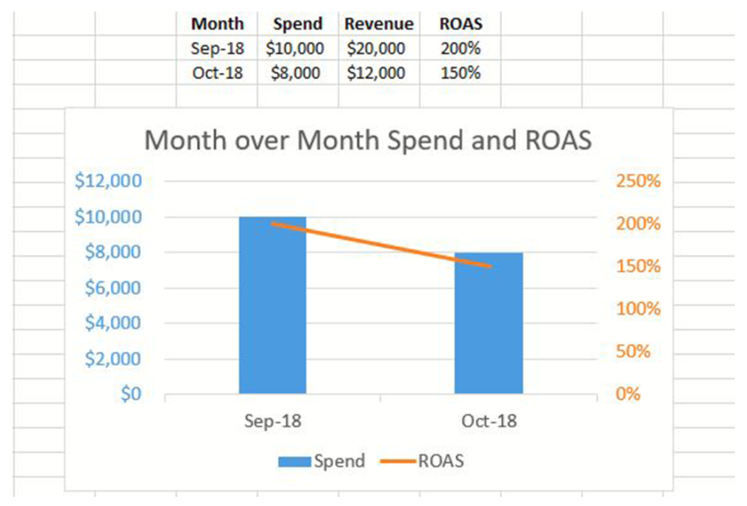
You strongly suspect the drop is coming from a specific device. The next step would be to split this chart by device to assess this theory:
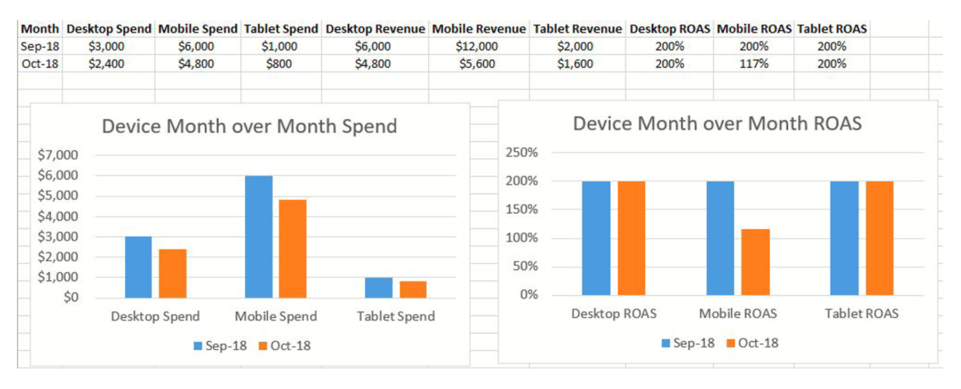
At this point, it's very clear that the drop in performance is coming strictly from mobile devices. From here, you will have to dig one step deeper to figure out WHY performance is dropping in mobile. Maybe you changed your mobile landing page in October. Perhaps load time suddenly started slowing down due to architectural changes within the landing page. There are lots of possibilities, but if you dig deep enough, you’ll likely find a reason.
Dashboards, Dashboards, Dashboards
With so many dimensions, it’s hard to keep track of when a dimension is performing well or poorly. Yet, this knowledge can save you hours of time troubleshooting. This is where dashboards come in - they take a lot of work upfront to satisfactorily establish, yet will save you a lot of troubleshooting time in the long run.
With so many types of dashboard software available, it might be difficult to settle on one that satisfies your needs 100 %. However, at the end of the day, you can’t go wrong with most options. Examples of useful dashboard software include:
Internal Alerts
As useful as dashboards can be, it can be easy to forget to take action on the insights and information they provide. Setting up logic that returns alerts is also a solution that can help you flag poor performance,(e.g. if last week’s ROAS was 10% worse than the ROAS before that, send an alert) These alerts can either be set up locally on your computer or programmed into internal communication software such as Slack.
Although there might be false-positive alerts, if set up correctly, they should provide a net gain in troubleshooting time savings.
Once you determine which dimensions are failing, you need to make adjustments. In the device example above, you saw that mobile was performing worse than other devices. Because mobile was losing efficiency, you shouldn’t drive as much traffic toward mobile. So the next logical step here would be to drive traffic away, which you can do by lowering the bid adjustment for mobile.
For example, there might be an existing mobile bid adjustment of 50% for mobile in all your ad groups. You would want to drop this number down. How much you’d want to drop it completely depends on how much data is attached to mobile; if you're not sure how much to drop it by, drop it in 5% increments, and monitor closely day over day to see how these drops are affecting spend.
The granularity at which you can set bid adjustments varies by dimension. The following table illustrates the most granular you can set your dimensional bid adjustments at:
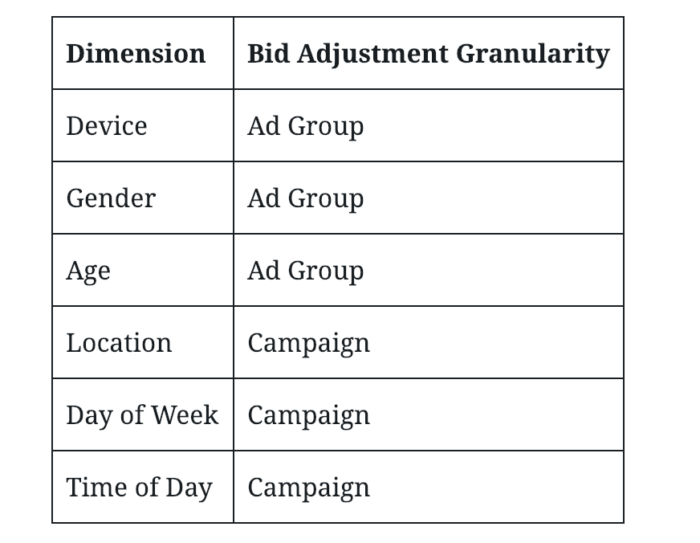
Any of these ad group dimensions can be set at the campaign level. But it’s very unlikely all ad groups will follow the same performance trends by dimension -- which is why you always want to make sure you are setting bid adjustments at the most granular level possible.
Understanding performance by dimensions is important for understanding how your PPC program operates, but more importantly, it’s essential for troubleshooting what might be causing a drop in performance. As we’ve seen in this series, a drop in performance can be caused by a number of different factors; being able to determine whether or not a specific dimension is contributing to this drop will help you determine the best next steps for action, paving the way for you to meet -- and exceed -- your PPC goals.
By now, you have become an expert at identifying the root of problems and what dimensions are failing. However, it still might not be enough to solve the overarching problem of how to bring performance back to expected levels because you might not be optimizing toward the most efficient metric in the first place. In Part III of our series, we cover how to address situations in which you might need to reassess how you are optimizing your program.
As a digital advertiser, you know that PPC advertising is a valuable tool to drive all sorts of marketing goals, such as finding new leads, nurturing prospects, driving conversions, and increasing the lifetime value of your current customers. But in order to be effective and profitable, PPC requires ongoing financial investment, constant analysis and continual adjustments to ensure maximum ROI. As part of that recipe, it’s critical to know how to calculate Cost Per Click -- or your maximum CPC -- and to get it right.
The good news for digital advertisers is that CPC is the one factor over which you have the most control. And CPC has the most significant impact on performance. Maximum cost per click affects:
So it’s a constant balancing act. Set CPC too low and your ads might not even appear or be seen. Set CPC too high and you can end up grossly overspending for ad space.
When you perform keyword research using Google Ads Keyword Planner, it provides an average CPC bidding range that's needed to appear at the top or bottom of the page for certain keywords. PPC advertisers can use it as a guide to what they might spend to reach a certain ad position. But to ensure you have efficient PPC campaigns that maximize ROI, it’s essential to calculate maximum Cost Per Click for yourself.
The reason? You run a unique online business and you need specific profit margins to justify your PPC advertising spend and keep your business growing. Relying on Google’s averages to guess the right CPC leads to mediocre results at best, and negative ROI at worst. You need to evaluate your own market and optimize your PPC strategy to truly meet and exceed your business goals. Read on to learn how to calculate maximum CPC for Google Ads.
In order to accurately calculate Cost Per Click, the first thing you need to know is the value of your customers. How much money do your customers spend with your business on average?
When calculating your CLV (customer lifetime value), don’t forget to first determine the real profit you get from your product. So you need to take into consideration taxes, shipping costs, and the overhead expenses for administrative tasks. Your product can have a list price of $99, but your actual profit is more like $50 after you factor in these internal costs. You also need to consider internal costs when calculating your CLV, or you will end up grossly overspending on ad space.
Depending on what kind of product or service you offer, this can be based off of a single purchase or average of purchases over time. For example:
Because every business has a unique setup and expenses, determining your internal costs is probably the most difficult part of calculating your CLV. But it’s important to include a calculated estimate here, or risk seriously overestimating your CLV. You will use your CLV to help make sure you don’t spend more on advertising than you earn from it.
The next thing you’ll want to figure out is the average conversion rate on your website. Specifically, of the people who visit your website, what percent convert into paying customers? This will help you determine how many clicks are required for a conversion.
For example, if you get 50 sales for every 1000 website visitors your conversion rate is 50/1000 = 5%.
Your conversion rate is a static number. That said, it can change over time. And you can create and optimize targeted landing pages designed to boost your conversion rate, which impacts your CPC.
The best way to calculate your conversion rate is with your existing analytics software. You can use Google Analytics Goal Tracking or eCommerce tracking to see your conversion rate based on current data.
If you already have PPC campaigns up and running, check your conversion rates for specific ads, landing pages, and keywords. The only problem with this strategy is targeting branded keywords: people who type your business name into search are already familiar with your brand and more likely to convert as a result. Including conversions from branded queries in your calculation can artificially inflate your average conversion rate. Avoid including branded keywords or find another method to calculate a more balanced conversion rate.
At this point, you have all the information you need to calculate a CPC that makes you zero profit but incurs zero losses. To be clear, this is not your final CPC. It is a base number you use to decide on the right CPC for your business needs.
Let’s say you calculated your customer lifetime value at $50, and your conversion rate at 1%. Multiplying these numbers together gives you your base CPC: 0.01 x $50 = $0.50
That means you can spend 50 cents per click and spend (on average) the same amount that you earn from sales. Your ROI would be $0.
Of course, this number should not be your maximum CPC. After all, you need to profit! To do this, you’ll want to set your maximum CPC lower than this number, but it needs to be balanced. Set your maximum CPC too low and it limits your ability to drive clicks and conversions from PPC. Because you’re competing for ad space, bidders with a higher CPC will get higher ad positions in search results, which receive significantly more clicks than ads at the bottom of the page. Set your max CPC even lower, and your ads won’t appear in search results at all.
The question for you to answer is how close to your base CPC you should bid to maximize visibility, clicks, conversions and profit. It’s important to remember that your max CPC will never equal your actual CPC. You’re set up to only bid the amount needed to win the auction. So your actual CPC can be lower than your max CPC.
For example, if you set your max CPC as $0.45, your actual CPC could end up being $0.36. With that in mind, you can set your max CPC much closer to your base CPC and still deliver positive results.
The best way to test your market and the bidding landscape is by trying and testing different max CPCs below your base CPC threshold. For example:
Start with one of the percentages in the middle and monitor performance. Then adjust to a higher or lower percentage and see what impact it has (if any) on ad visibility, clicks, and conversions.
If you want to ensure you that maximize ROI from your PPC campaigns, you should regularly recalculate and optimize your CPC. Google uses a variety of factors to determine actual CPC -- improve these areas and you can potentially reduce the costs needed to reach your advertising goals.
Some areas to optimize and improve include:
Google Ads prioritizes relevance and quality over bid amount, determining these factors by using a metric called Quality Score. The higher your quality score, the less you need to bid to rank for a specific keyword. So pay attention to your quality score and the factors that affect it, such as your landing page and ads.
As mentioned before, you can create targeted landing pages designed to maximize on-site conversions. Your conversion rate is a huge factor in determining CPC. Improving your landing page conversion rate from 0.5% to 1% can mean moving your base CPC from $0.42 to $0.85. So create different versions of your landing pages using different headlines, copy, supporting media and calls-to-action, and test and discover which elements are the most effective at driving conversions from your PPC traffic.
Creating more compelling ads can improve your click-through rate and provide more conversion opportunities. This indicates relevance and can improve your quality score. Because you need to ensure your advertising message is sufficiently relevant to the related keyword, using ad extensions and other strategies to make your ad more prominent can also drive more clicks.
Of course, the current state of the market and the bidding landscape can also have a big impact on the max CPC needed. It’s worthwhile and recommended to regularly calculate and adjust your CPC manually. But there’s no way to effectively keep up with the quickly changing markets without relying on automation.
Bid management tools offer a proven strategy to make necessary adjustments to your CPC while reducing wasted ad spend and maximizing ROI. Using data from Google Ads performance and the latest market insights, bid management tools take on the challenging task of ensuring you always set the right CPC. At the end of the day, knowing that you’re on a path to higher ROI frees you up to focus on growing your business, increasing revenue and taking your PPC strategy to new levels.
As a digital marketer, you know by now that not everything goes according to plan the first time around. Sometimes it takes trial and error. Changing it up. Taking a slightly different route. And just doing things differently until you get it right -- or get what you want. That’s the concept behind remarketing. Essentially remarketing is the art of serving targeted ads to people who have already visited or taken action on your website -- an investment that has the potential to significantly increase your advertising costs before driving ROI -- so you have to be judicious about how it’s executed. But, if implemented correctly, it also has the potential to be an extremely valuable advertising strategy. Consider these statistics:Let’s face it, these days, the success of your PPC program -- and your SEM performance and strategy as a whole -- is contingent upon data. Accurate, reliable and applicable data. And nowhere is this more important than in your bidding strategy. In fact, your competitive success and relevancy in the market depend on it.
As you probably know by now, data is the fuel to your SEM engine, enabling you to devise comprehensive PPC strategies, create progressive business goals and drive future marketing decisions. In short, data is critical in driving your business forward toward peak SEM performance. Thus, the best and most efficient strategies will thoughtfully take into account increasingly more -- and higher quality -- data from key sources.
But what if your SEM performance isn’t up to par? Or you’re not meeting critical business goals? Or competitors always seem to be a half-step ahead of you, beating you to the proverbial punch? The other side to this double-edged sword, of course, is that if your SEM performance is suffering, it’s likely sourced to a data problem as well. More specifically, chances are your current PPC solutions are utilizing incomplete or low-fidelity data to power your bidding strategy, which ultimately fails to give you the necessary big-picture of both your customer and competitive landscape. Thus, any bidding strategy you attempt to employ is almost sure to miss the mark or otherwise fall short of expectations.
There are few things more frustrating. By now, you’re likely tearing out your hair, wondering how in the world you’re going to generate required leads, or meet conversion metrics, let alone exceed them this quarter. We feel your pain. That’s why we’re here to help with a new series that takes a hard and thorough look at the numerous pains common to at-scale SEM/PPC programs.
In the first of our Enterprise Paid Search Pains series, we examine some of the reasons Paid Search programs continually suffer from poor data utilization and sub-standard SEM performance. From there, we dive into real-world data issues you have likely encountered with technology solutions in your day-to-day campaign efforts -- everything from solutions that can’t integrate a full set of historical data or have trouble integrating data from third-party sources to solutions that take too long to incorporate bid data.
And of course we provide you some relevant tips for resolving some of your biggest data issues, while directing you to technologies that truly address any one of these data challenges you might be experiencing. We’ll even let you in on a little secret -- finding just the right tool will help you to collect more data, align it to publisher activity, and automate bidding optimization in a way that is sure to result in the best possible performance for your business.
After all, here at QuanticMind, we want to see you reach peak SEM performance in all areas of your SEM program, whether that’s knocking your quarterly PPC metrics out of the park, reaching new customers or achieving higher ROI than ever before.
And we take pride in not only helping others reach peak performance, but taking their PPC programs to new levels. To your success!
[Learn what pains marketers are feeling and overcoming in paid search HERE.]