
Technology
Basis Platform
Advertising Operating System
Communication Portal
Intelligent Collaboration
All Channel Activation
Activate Media on Every Channel

Consulting
Resources
Is your brand important to you? We certainly hope so. After all, you've spent countless hours and innumerable amounts of energy developing a brand that tells the story of your business and conveys everything you want the public to know about your company.
It would be a shame if all the efforts you've put into extending your outreach fell into the wrong hands, compromising the integrity of everything you built.
Programmatic advertising is vital to building your audience and creating an extensive outreach that leads to better customer engagement. Yet, how do you balance awesome exposure without incurring the potential problems that could transpire if someone put your brand alongside content that doesn’t fit company values? Fear not, there is a way!
First, decide what level of risk is tolerable for your company. If you're running brand campaigns that are built to generate awareness, you'll need a higher risk tolerance than if you were just running direct-response campaigns.
Once you've settled on the amount of risk that's acceptable, utilize pre-bid screening tools that will enable you to understand how the safety parameters you've put into place measure in the real world. Centro's partner Comscore offers a tool, for example, that allows you to understand the risk and reward tradeoffs for important metrics such as:
Centro also partners with Peer39—another company built around providing brand safety in digital environments. Of course, the more your campaigns are screened, the more likely your efforts won't reach optimal scale. It’s important to set reasonable expectations of permissible risk first.
Block list sites are specifically prevented from serving your ads. To retain brand safety, you'll want to put websites to your block list if they:
Allowed list sites are the opposite—where your ads would only be served to specific sites that you’ve identified as aligning with your values or deem ‘safe.’ Know that using an allowed list, however, may limit your reach and scale. Generally (and not specifically related to block lists or allowed lists), you can find a list of trustworthy ad inventory sources on Pixalate’s Seller Trust Index, which evaluates multiple criteria in how ad marketplaces source ad supply.
Have you ever wondered if YouTube is safe for your brand? It's a valid concern, but there are precautions you can take to make sure your message stays as intended:
Programmatic media buys are extremely beneficial to any business, but brand safety must be at the top of the list before letting the algorithms go to work. By blocking content that doesn't fit your company's values and utilizing the tools that automate the security process, you'll be able to achieve scale in your campaigns, without putting your brand in a publicly compromising position.
Centro has everything you need to ensure brand safety on every digital media buy. We're here to help you realize positive ROI without sacrificing the integrity of your business.
Learn more about Programmatic Advertising with Centro.
Have your cake and eat it too: adopting a brand safety approach that doesn’t cost you scale.
https://centro.net/blog/centro-ensures-brand-safe-ads
Employing Google Shopping has become a dominant advertising strategy for retail businesses in recent years. Early adoption was slow, but now Google Shopping ads make up 76.4% of retail search ad spend and receive 85.3% of clicks from Adwords or Google Shopping campaigns. There are many opportunities for retail businesses to gain visibility and drive sales of their products using Shopping feed optimization techniques. But it isn’t challenge-free.
Google Shopping has become so popular that the market is already saturated. Every retail marketer has a number of strong competitors they’re fighting against for rank and visibility in search results, and this competition is only set to become harder as more retailers enter the market.
In the past, the most expensive and competitive keywords were bottom of the funnel, suggesting shoppers had immediate purchase intent. Today, though, many advertisers target high-funnel search queries, driving up competition across the sales funnel. It’s no longer possible to save your advertising budget by targeting different points of the buyer journey. Everyone’s fighting for ad space, and it’s not going to get any easier.
Google has done an excellent job in recent years of catching up with Amazon in the retail search-advertising space, and they continue to roll out new features that make it possible to surpass them. A good example of this is Shopping Actions. Retailers who opt into this program can have their ads appear on Google Express, Google Search, and Google Assistant.
As more search advertisers start taking advantage of features like this, the landscape is going to become more competitive. Simply jumping on each new feature bandwagon Google introduces won’t be enough. The one thing that can relieve this issue is developing a feed optimization strategy that outperforms the rest.
The good news is that there is a long list of ways to optimize your Google Shopping Feed, and very few retail search advertisers are taking advantage of them all. The best way to stand out in a crowded marketplace and outperform the rest is prioritizing Shopping feed optimization. Here, we outline some essential techniques you need to be executing.
Your product images are one of the most important Shopping feed optimization techniques to focus on. They appear prominently in search results and can have a huge impact on click-through rate, or CTR. Including quality, relevant images alongside your products is just good e-commerce practice, whether it be on your website or in your Google Shopping Ads.
Here are some quick tips for your images:
You can also try out different kinds of images and test which ones perform better. For example, you can compare the performance of basic white-backdrop product images versus lifestyle shots.
Your product titles are another valuable element to consider. It’s important to include keywords as part of your product title, as this impacts what search queries your product will appear for. Your product title is also the most prominent aspect of Google Shopping results besides your image. Including relevant keywords in the title also helps search engine users feel like they’ve found what they’re looking for.
One thing you’ll want to do is ensure your product title includes a target keyword towards the beginning. But, there are other strategies you can use to optimize your product titles further. For example, you can include your brand name in titles to appear more relevant for branded keyword searches. Or you could include other details people might search for, such as size, color, material, etc.
You need to choose a single strategy here or risk creating long and unruly titles. Use insights from keyword research to determine what information is most important to include in your product titles.
A lot of advertisers don’t see the value in organizing their product types because they don’t have a direct impact on how Google categorizes and ranks products. But they are a powerful tool you can use to understand the performance of the different kinds of products you offer and make changes to your strategy accordingly.
First off, if you use your e-commerce tool (e.g. Shopify or Woocommerce) to generate product types for you, there are going to be some errors. Some products will be miscategorized, or you could end up with duplicate product types. Take the time to go through and fix these errors: it will be worth it for the insights they provide.
Divide your product types into clean, logical categories, then start using this as a factor when monitoring campaign performance. Error-free product categories can offer unique insights into performance improving opportunities that you may not discover otherwise.
Most ecommerce retailers today don’t take the time to create unique descriptions for their products. They stick with manufacturer default descriptions or use the same generalized description for a wide range of product variants.
Just like your product title, the description is another way Google can understand what your product is relevant for. They’ll also highlight keywords in your product description that match user search queries. Ensure that you include specific information here so you can outperform competitors that take the trouble. You should:
Using product categories as a data feed attribute is entirely optional, so most advertisers don’t use it or only select the most general category descriptions for groups of products. For example, a sporting goods retailer selling sports uniforms could categorize their products as:
Or as:
Most search marketers don’t go this granular because it’s a tedious task. But it’s worthwhile if you want to help Google fully understand what kind of queries your products are relevant for.
The good news is if you already did the hard work optimizing your product types, then it will make choosing your product categories much easier. You can download your feed to a spreadsheet, sort by product type, and then start adding in product categories in a new column.
GTIN is the acronym for Global Trade Identification Number. This identifying number shows Google that a product is unique. In some cases, Google requires a GTIN before approving a product for Merchant Center, but not in all cases. If you haven’t been using GTINs for your products up until this point, you might want to reconsider.
Using GTINs opens your products up to new opportunities to gain visibility in search results. If a number of retailers sell the same product, Google can categorize them together in the same auction based on the GTINs. This opens up the possibility for your ad to appear as the sole result for a Product Listing Ad for high funnel search queries. Google also often displays a banner of Google Shopping results for queries like “best of X” or “top X.” Your ads will only qualify for these results if you include GTINs.
One of the most essential aspects of Shopping feed optimization today is automation. Every Google Shopping campaign draws information from your merchant feed, made up of structured data about what products you offer. Managing this information in a spreadsheet only works for the smallest businesses. It quickly becomes unruly when you have more than 20 products, let alone hundreds or thousands.
Google Ads developed automated feeds as a solution to this problem. Automated feeds essentially scrape your web pages to see what products you currently have on offer, then automatically generate relevant feed information based on this data. Automated feeds are extremely important for campaign optimization. For example, you can avoid wasting ad spend promoting a product that’s not currently in stock. Automated feeds can interpret stock information from your website and automatically update your campaigns to reflect this.
Automated feeds are the most beneficial when everything on your website is accurate. Otherwise data feeds can include broken links, improper product titles, and other issues. You can also end up including poorly performing products in your advertising campaign inadvertently.
At this point, you’re well aware that Shopping feed optimization techniques can be operationalized in different ways. There are different ways to optimize your product title, description, product categories, and more. If you really want to create the most optimized feed for Adwords, you should take the time to test different strategies.
Even if your Google Shopping feed is created automatically, it’s easy enough to create additional feeds to compare performance. “Supplemental Feeds” are a unique type of feed you can create to have standalone data on performance. You can’t add or remove products from them, but you can duplicate a primary feed then make changes to that existing data to test feed variations.
Supplemental Feeds are a powerful tool with which to experiment on performance data and understand what elements of your feed are most effective. You can also take advantage of custom labels within your Supplemental Feeds to drive even more insights. For example, you can use custom labels to group products in ways that are significant to your business, such as new versus old products, price categories, sale versus full price, etc. The performance insights you gain from Supplemental Feeds can inform mass changes you make to your primary feeds to improve campaign performance overall.
Put simply, automated bidding is essential for keeping up with the competition. Automated bidding allows you to bid more effectively and take advantage of micro-changes in the market. This simultaneously reduces neccessary ad spend and improves campaign performance.
Google offers automated bidding options for Shopping campaigns that you can set based on your campaign’s historical performance and future goals. Or you can rely on Smart Bidding to target overall performance for you.
Choose an automated bidding strategy that helps you beat out the competition in the areas that matter most for your business. And if Google’s preset automated bid strategies don’t match your current goals, third-party tools can.
Merchant Promotions is one of the Shopping feed optimization techniques with the most obvious performance benefits. Merchant Promotions is a feature that allows you to add special discounts, free shipping, or free gifts to your Shopping ads.
Once you submit a product feed to Google Merchant Center, you can start creating promotions. Create and optimize your Merchant Promotions so you can drive conversions, boost CTR, and attract more traffic.
There are always ways to improve your Google Shopping feed. Every time you add a new product to your ecommerce store, there’s a new opportunity for optimization. There’s no getting around the fact that ongoing feed management is essential if you want to stay competitive as a retail search advertiser.
Advertisers have two options when approaching their Google Shopping feeds: either take on the necessary leg work to create the most accurate and optimized data feed, or use automation technology to stay ahead of the game. Google Ads provides some internal solutions for automated Shopping feed management. But there are also a variety of third-party feed management tools that can provide advanced insights and optimizations. Invest in automation technology and use it to its full potential. This ensures the payoff outweighs the cost and drives business growth through retail search advertising.
‘Ask the Expert’ is a blog series that breaks down the complicated tools, tech, and trends you’ve been hearing about in the trade pubs and around the office. We reach out to our in-house experts to ask the tough questions and turn them into bite-sized Q&As for your reading pleasure.
This month’s topic? Audience Extension. We brought in Centro’s VP of publisher solutions, John Hyland, to give us the breakdown.
Audience extension has long been associated with local media companies who sell off-site inventory based on demand from their local advertisers. The rep at a local media company is uniquely positioned to help their best customers with all of their digital needs – SEM, Social, and all forms of display (mobile, video, desktop, and native). Audience extension is rapidly being adopted by national websites too. National publications are adding incremental dollars to their media plans by helping advertisers buy impressions across the rest of the web to reach their audiences on any site and digital device.
Local publishers want to capture a larger share of the advertiser’s digital advertising budget. Today, nearly all local media companies have scalable operations to service the digital needs of local clients, therefore, no one else is more equipped to understand the needs of local advertisers. On the national side, it is about maximizing yield from their core, proprietary audience. Advertisers buy ads on national websites because of reach, association with media brands, and audience loyalty. If the advertiser has a larger budget than a single site can accommodate with its own inventory, the site needs to extend its audience off-site during the rest of its users’ online journey.
Media companies already place many ads on the page—user-experience is still very important. Many companies use audience extension to stay in front of audiences with frequency, or cross-platform. If a reader goes to a website twice a day for 30-minutes, there is a large amount of digital screen time that the advertiser’s message isn’t in front of the customer.
On the local side, it is the most efficient way to blanket a specific marketplace. Programmatic gives the ability to reach customers within a 30-minute drive of your storefront in real-time. The programmatic landscape empowers local publishers to bid on inventory cross-platform, regardless of device. From a national perspective, it is all about first-party data. National media companies need programmatic advertising to find them across thousands of sites, in order to scale audiences efficiently.
Local media companies have grown incremental revenue for the last 10+ years. You would be hard pressed to find a local newspaper, radio, or TV station that isn’t doing some form of audience extension from SMB rep management, to full-blown agency-style trading desks offering SEM, Social and Programmatic Display. National media companies started adopting this practice in the last three-to-four years. The ones who have adopted it have advertisers that demand more of their audience, and more ways to reach their audience.
The biggest differentiators are service, transparency, strategy, and education. Everyone has access to the same data and the same inventory (impressions). Advertisers want partners that can optimize quickly, in real-time, and who are transparent about what they are buying. For the national side, advertisers are buying the site because they love its brand safe atmosphere and audience. It’s better to work with the site, who will just add a line-item to advertisers’ current plans, and the whole strategy is executed through one point of contact, bill, and holistic strategy.
Centro offers a self-service and a managed service solution. In the self-service option, we train your buyers and sellers to sell and execute campaigns using our platform, Basis. Self-service is a differentiator—it allows for speed, control, and increased margins. For others, it isn’t efficient to build out an internal team. Therefore, they leverage Centro for the strategy and execution of the digital media buys. We power programmatic buying in the open marketplace, private marketplaces and more. Basis also ingests SEM, social and direct buying data to provide a robust agency-style trading desk and a holistic view of their campaigns via one platform.
It’s well established that landing page design impacts many facets of an SEM program's success. While we've previously discussed how to optimize overall design to secure more leads, ensuring your landing page is aesthetically pleasing and clearly articulates your message is only one piece of the puzzle. Before a user even clicks on your ad, various aspects of your landing page are factored into whether your ad is served, the amount of the required bid, ad placement, and, in some cases, ad quality. After clicking an ad, the user flow and prominence of conversion actions impact not only your bottom line but also the bidding insights and optimizations.
Let's dive into each of these.
First, before we dive into landing page relevance, we need to first discuss how Google ranks your ads. Each time one of your ads is eligible to compete in the auction, Google computes an ad rank for your ad and all others competing. The rank your ad receives determines whether it will be displayed, what position it will be displayed in, and the cost per click (CPC). While the exact formula is a closely guarded secret, the key inputs include your max CPC, the ad's Quality Score, search context (e.g. location, device, time, etc.), ad rank threshold (i.e. the minimum bid required for an ad to appear in X position), and the expected impact of ad formats and extensions.
While some of the other inputs are more straightforward, Quality Score is significantly affected by the quality of your landing page. Reported on a scale of 1-10 (with 10 being the most desirable), landing page relevance and experience are two of the components taken into consideration, along with ad and keyword relevance and quality. Thus, as Quality Score is factored in along with your bid and the other inputs to determine ad rank and CPC, you’ll also want to obtain a higher Quality Score for your ads to both improve their position and reduce CPC, all of which will lead to overall efficiency gains.
Now we can focus on landing page relevance. Imagine you are looking to buy a new collar for your dog. You then search for "skulls and crossbones dog collar" and click an ad. How likely would you be to stay on the site and buy something if you were taken to each of the following pages?
Most people would be more inclined to continue through the conversion funnel in experience A and maybe, B versus C or D. This difference in relevancy would then be reflected in the ad's Quality Score.
Outside of relevancy, page loading speed is also another major factor to consider. What if you ended up on landing page A but it took 15-20 seconds to load? Loading times of more than a few seconds are likely to see marked user drop off, even if all other best practices are followed, resulting in a much lower Quality Score.
While difficult to objectively measure, it is also worth considering how very general landing pages with multiple, branching funnels and calls to action can make insights and optimization more difficult. Take, for example, a company that sells enterprise software. They have determined through analyzing past sales performance that filling out a "Contact Us" form is most likely to lead to a follow-up conversation with a sales rep and ultimately a purchase. However, rather than investing in a streamlined landing page experience that has this call to action prominently displayed, all ads redirect users to the website's home page.
Given the clear benefit to the company for prospective customers to fill out the "Contact Us" form, it would make sense to optimize bidding toward that conversion action. However, all too often, the numerous potential paths for potential customers to get to “Contact Us,” and the competing calls to action on the homepage make that difficult, regardless of the bidding solution used. For example, a user located in Los Angeles searched for "keyword A" and upon arriving at the homepage, clicked through a few product pages and then left. Does that mean that users located in Los Angeles are less likely to convert and negative geo modifiers (i.e. decrease bids by 20% for searched from the Los Angeles metro area) should be added? Or is "keyword A" too broad of a term to lead to many conversions and should be bid down? Or are both actually good targets but the lack of a clear call to action (or too many calls to action) led the user down too many or a less-than-ideal path? By introducing the confounding variable of poor design, none of these questions can be answered with certainty, which in turn, can lead to suboptimal bidding decisions and lost potential efficiency gains.
Conversely, imagine if the landing page for the software company mentioned earlier offered a more tailored experience with some basic product info that related to the ad clicked while clearly displaying the “Contact Us” form above the fold. Any insights related to the keywords, locations, or audiences that have a higher propensity to convert would be more reliable and more likely to lead to an overall increase in performance.
While landing page relevance and quality impacts overall PPC efficiency, there are some areas of PPC that have additional idiosyncrasies -- Dynamic Search Ads (DSAs) are a good example.
DSAs, ads which are automatically generated based on landing page content, are a great way to discover additional keyword opportunities and scale creation of highly-targeted ad copy. Rather than requiring you to create a preset keyword list, DSAs instead leverage Google's crawling technology to mine your website for relevant keywords and automatically use them for ad targeting and ad copy. However, as Google typically crawls sites every 2-3 days, frequently changing landing pages can lead to irrelevant traffic and inefficient spend for DSAs.
A common example of this problem, often cited by Google, are daily deals sites. For example, a particular URL that is crawled on Monday may offer a deal on a trip to Europe. However, when a user clicks on a DSA generated from this page on Tuesday, it has been replaced with a trip to Las Vegas. Given that the landing page experience is now unrelated to the ad the user clicked on, conversion is much less likely and often spend becomes inefficient.
While many components go into building a successful SEM program, landing page design is one area that is often overlooked. But as a critical pathway to your site and business, neglecting efficient landing page design will likely cost you leads, conversions and ultimately revenue. Rather than directing users to general areas of your website (like the homepage!), invest time in creating a more relevant, well-designed user experiences. For sites with a large inventory, newer tools like dynamic keyword insertion can be leveraged to make this process less time-consuming.
By making this investment upfront, you can improve your ad's Quality Score, obtain more reliable insights, make better optimization decisions, and understand if particular PPC functionality is appropriate for your use case. And you will also be giving your targets a clear path to entry -- all benefits that will help you to increase efficiency and have the most successful PPC program possible.
At Centro, we know that keeping up with the trade pubs and latest trends can be tough and time-consuming. To make that easier, we’ve compiled all the articles, reports, and other bits of awesomeness you may have missed, but should definitely read. Enjoy our latest list below!
To protect its business, Kroger is building an Amazon-style flywheel [:08]
Kroger is in a race for reinvention, one made more complicated by Amazon—with traditional retail being squeezed and customers slowly shifting online, they’re on a mission to reformat stores and provide pick-up and delivery options. This will allow them to drive more online business, bring in more online advertising revenue, and invest more in online-offline capabilities.
How Can We Move To A Programmatic-First Future? [:04]
What will it take for the advertising industry to take a ‘programmatic-first’ approach to all media buying? This article sheds light on the benefits for agencies, advertisers, publishers—and what the industry must do to make it happen.
LiveRamp Adds Connected TV Identity Solution [:04]
LiveRamp announced that they will be expanding the capabilities of IdentityLink to include Connected TV. Consumers will benefit from a consistent brand experience across TV, over-the-top and digital, while marketers will be able to offer more measurable, people-based CTV campaigns.
A Funnel Thing Happened On The Way To A Converged Video Marketplace [:02]
Advertiser Perceptions is reporting that TV is being valued at the bottom of the marketing funnel due to increases in digital backchannels and data. This report found that marketers and agency executives are utilizing advanced TV platforms for lower-funnel functions such as sales, conversions, leads and other actions.
Advertisers Now Pay More for Facebook Users' Attention [:03]
If time is money, then Facebook is pushing the limits of relativity when it comes to time spent and the revenue they’re earning per user. For each hour that a U.S. adult spent on Facebook on mobile last year, advertising revenue was $0.73—about 35% more than the prior year.
Voice marketing is a looming opportunity, but not without its pitfalls [:06]
Hitting the sale of $1 billion in devices just last year, there has yet to be a smart voice assistant with voice ads on their platform. This article details a variety of key concerns that marketers should be aware of, including customer profile disparity and overreliance on vendors to propel an offering into the market.
Programmatic Audio Exchange DAX Inks Deal To Offer Voice-Enabled Ads [:03]
European radio giant, Global’s digital ad exchange has signed a deal with voice-activated ads company Instreamatic.ai. This partnership will allow Global’s DAX to place ads with verbal prompts in streaming mobile audio apps like TuneIn, Bauer Media’s KissFM and AccuRadio.
Oracle Didn’t See the Data Reckoning Coming [:05]
Over the last five years, Oracle has led acquisitions totaling over $3 billion quickly becoming a massive name in advertising. However, its Data Cloud division has faced challenges delivering on that investment bringing in around 1.25% of the company’s total revenue.
Data Finds Link Between Local Search, DOOH [:02]
Marketers are starting to see connections between digital out-of-home interactive screens and search engine advertising. They are seeing a direct correlation between proximity to a DOOH campaign and an increase in Google My Business interactions, with the use of data.
Machine Learning Is A Key Component In Managing Mobile Advertising [:06]
Mobile advertising highlights its own short list of challenges unique in the digital space relative to desktop. Read about what machine learning can do to address issues related to app-based advertising, updates in location-based advertising, and more advanced ad fraud detection.
As a digital marketer, you might find yourself wishing your PPC bid optimization strategy could always maximize profit margins. Not so you can kick up your feet and watch the money flow in, but because you’ve considered it a potentially meaningful strategy—similar to why you would set revenue maximizing goals with a Return on Ad Spend (ROAS) efficiency constraint. The only way you can know is by constantly testing what’s possible.
Paid search bidding optimization is best done by bidding using your conversions or revenue data to inform the model. Obviously this leads you—or your algorithmic decision engine—to make bid choices that are directly informed by the results you want. But which one is best: revenue or conversions? Well, it depends on your targets and goals, what data is available, and what type of business you run. However, revenue-based goals tend to be the most powerful in driving business results if the data is there. And they are especially powerful (and necessary) if you want to focus on profits primarily in your paid search strategy.
PPC optimization tools have already done a lot to evolve paid search as a marketing channel, and one of the next steps will be to automatically optimize bids against a goal of driving maximum profit from each individual keyword. The availability of this strategy is not seen in many tools, but it’s a very powerful way to transform your SEM program into one that consistently drives peak performance. The bidding strategy is enabled because of value estimation, modeling, and calculation all executed on each individual keyword.
That said, you also need good revenue data. The more accurate your revenue data applied to your keywords, the greater the possibility of getting the best margin results from your SEM program. How? You’ll need clean, organized data and thorough integrations—even to your offline revenue, latent conversions, or LTV stored in CRM or third party database. That revenue data is imperative to driving profit focused PPC optimization.
As the ancient Greek adage goes, “change is the only constant,” and that especially applies to the digital landscape for marketers today. The only way to keep up in this fast-paced and rapidly evolving industry is by continually testing and constant iteration. Adopting a new strategy or technology might seem like a risk, but these steps are often required to become more profitable and take your SEM program to the next level.
One of the oldest and most common ways of storing information is text. Humans have used text for thousands of years to record data long before the existence of Microsoft Excel or databases. Today, most information in an organization exists as text documents, such as emails, Google documents, or even post-its on the wall. That's where Natural Language Processing, or NLP, comes into play.
NLP is a branch of data science. Its main purpose is to turn text (and speech) into structured data to obtain actionable insights. The ‘natural’ in NLP is a contrast to ‘unnatural’ languages used by computers such as C++, javascript, python, etc.
NLP has several applications but can be grouped into two main categories:
Both of which are of incredible use for the largely text-based SEM industry. For SEM, you can use NLP for tasks such as search term reports and keyword expansion tools. Both tasks leverage NLP technology to analyze search queries, detect associated keywords and then suggest related keywords. Other, more complex uses of NLP involve generating audiences based on search term content or forming a baseline bid for long-tail keywords.
Phrase Segmentation
The first step involved in an NLP process is phrase segmentation. Specifically, NLP breaks the phrase down into sections, typically using full stops or commas.
Tokenization
After that comes tokenization, which is a fancy way of saying that we are going to “define the unit of the language”. In the case of English, that means a word that can be easily separated because it is contained between spaces. Then comes a first-grade refresher: deciding what type of word -- verbs, nouns or adjectives -- we are talking about. Tokenization does this easily for certain words such as car. However, it might need context when a word has multiple meanings such as bitter or fair.
Lemmatization
After that, we go to lemmatization, which means drilling down a word to its base form. Some words can vary from the root word, like geese and goose; lemmatization essentially tracks down the base word associated with all of those variations.
Remove Stop Words
From there, we remove stop words or filler words. These are stock words that don't really add any meaning to the phrase itself such as and, is, and, the. NLP removes these words to reduce the noise while interpreting the phrase.
Machine Learning
The following step is perhaps the most complex: using machine learning to understand how each component of the phrase relates to the others.
Noun Recognition
Once we have moved past the grammar portion of this process, the NLP funnel moves into noun recognition, which splits the phrases, but uses nouns as segments to extract information. It works like this: say our NLP system has detected nouns like “EU” “Trump” “California”. Our Named Entity Recognition algorithm (as it is technically called) recognizes that California and EU are geographical locations and that Trump is an American politician.
Coreference Resolution
The final step of the NLP funnel is coreference resolution, which aims to understand pronouns. While humans can determine through context to which noun the pronoun refers, it becomes trickier for a computer.
NLP is not without its challenges. Computer programming is based on understanding the literal meaning of structured languages. Transitioning structured languages to understand unstructured natural language with contextual reference, metaphors, spelling mistakes and all the idiosyncrasies contained in our written and oral communication is a huge leap.
Take, for example, the following headline from a major news publication: “Labor admits Brexit could lead UK to freefall.” A literal interpretation of this phrase is that the physical act of work (labor) has somehow gained consciousness and admits that were Brexit to occur, the entire physical United Kingdom would somehow be sucked into space and dropped off of earth's gravity. Of course, through context and social understanding, we immediately know the real meaning of the phrase. But we only acquire that understanding through years of practice interpreting and reading between the lines. Only context gives the phrase the meaning it really has: that a political party admitted to a potential economic impact were the UK to sever from the EU.
Here’s the problem: the computer not only has to understand the literal meaning of every word (even such terms as UK or Brexit which are acronyms, or terms not present in the English language), but it has to derive the potential contextual meaning from the combination of words in the phrase.
A whole spectrum of new developments are possible thanks to NLP. For example:
NLP also enables a new generation of search engines in which the user searches as they speak, eliminating keywords and topics (this is already present in Apple’s Siri and Amazon’s Alexa). The potential of NLP not only looks to the future but also to the past. Once NLP is sufficiently powerful, researchers can use it to analyze all the text data acquired from past activities, thus creating a sort of backfill for all the unstructured data that we have accumulated.
NLP is a branch of data science that uses a series of steps to segment and extract information from text and speech. It aims to solve limitations in software that understand only formal or structured data. Text or language is ‘unstructured,’ so converting into ‘structured’ allows us to convert a collection of information into actionable insights. And it’s becoming a valuable tool in SEM.
NLP tools are flooding the SEM industry for such functions as keyword expansion, search query analysis, predictive search, and voice search. And this is just the beginning of its many use cases. Going forward, we will leverage NLP in new, innovative ways, further bridging the gap between human language and computer data.
Consumer data is a critical performance factor for digital and search engine marketing. In fact, it’s now practically impossible for businesses to gain visibility in either organic or paid search results without relying on consumer data insights. Yet at the same time, the European Union and other government bodies around the world have continued to introduce stringent regulatory compliance mandates governing how that data can be collected and managed—which, needless to say, has significantly affected the way that organizations treat, store and use their most valuable data.
And while forward-thinking businesses need to make every effort to adhere to these regulatory compliance mandates, these regulatory compliance mandates under a new paradigm universally have had an impact on data practices around the world.
Here are some insights into how you can navigate regulatory compliance in the world of SEM.
In 2016, the European Union passed what's known as the General Data Protection Regulation (GDPR), a stringent and broad reaching law requiring search engines, advertising platforms and individual businesses to do more to protect the data of European citizens—and compelling Google, Bing, and other advertising platforms to place data management and security at the top of their priority list.
Among other things, the GDPR requires any business that uses consumer data to:
While the law only applies to European citizens, its impact is clearly global: any website that collects information from site visitors—even if the business is based outside of Europe—could be subject to these regulatory compliance requirements. And the emergence of GDPR has also inspired similar regulatory compliance mandates elsewhere, including a new state data privacy law in California and several data protection bills gaining traction at the federal level in the US.
So, how does it affect search engine marketing? Simply put, the responsibilities for data protection impact both search engine platforms and the marketers that use them to reach their audience. The extent of your responsibility all depends on who controls the consumer data vs who processes it. If you either control the data and/or process it, then GDPR will govern your regulatory compliance responsibilities.
Consider Google’s in-market audiences, for example. Advertisers use Google’s consumer behavior data to target new audiences with their advertising message. But in-market audience data is both controlled and processed by Google who possess and analyze it for ad targeting—this places the responsibility for GDPR compliance on them.
In another scenario, consider remarketing lists for search ads (RLSA) in which you upload a file of your leads’ email addresses to create a new Customer Match audience. In this case, you are the data controller and Google is the data processor. Thus, both you and Google have compliance responsibilities under GDPR.
Additionally, browsers are also affected by GDPR regulatory compliance mandates. To ensure compliance with this mandate, Apple made significant changes to how cookies are tracked on Safari, now deleting third-party tracking cookies after 24-hours, while making it difficult for marketers to use cookies for different forms of tracking like remarketing. While most advertisers might see this change as a huge limitation in their ability to advertise to their audience, it also helps cut down on low-quality spam ads and encourages marketers to target audiences with a relevant message during the most critical time frames.
While GDPR is working to prioritize the best interests of people, it also creates some new challenges for businesses that market through search engines. But despite the strong potential for inconvenience and challenges, business owners can’t ignore their responsibilities toward user privacy if they want to both effectively reach their audiences and remain within the law.
The GDPR is a complex and extensive piece of legislation governing regulatory compliance. And while this post is aimed at giving search engine marketers an idea of some of their responsibilities under GDPR, it is in no way comprehensive or a means of helping you interpret this document and how it pertains to your business. For any questions regarding your regulatory compliance posture, please enlist the help of legal professionals.
That said, here are some key best practices to follow for regulatory compliance as a search engine marketer:
Because the GDPR is open to almost limitless interpretation, even businesses that attempt to be compliant could end up inadvertently in violation of its terms. This had led to a number of businesses outside of Europe taking steps to avoid being subjected to the law altogether, including more than 1,000 US news sites that chose to block European visitors to their sites instead taking the necessary steps to be compliant or undergoing scrutiny under its regulations.
Don’t be tempted to follow suit. Not only would you be blocking your European audience base, you might inadvertently block US site users when they visit or live abroad. It can also negatively impact SEO if Google’s crawler can’t effectively read your site when you have links pointing at your website from other EU sites.
While blocking access to certain site visitors might seem smart from a financial perspective, it’s really only a temporary solution to a growing global data privacy issue that won’t go away anytime soon. The US has already enacted numerous compliance regulations, such as SOX, HIPAA and PCC DSS, which are all becoming more stringent and financially punitive. Thus, thinking ahead, it’s better to comply to GDPR regulations now with your user experience intact, than wait until you’re forced to make similar changes down the road.
Probably the most significant change search engine marketers need to make is ensuring they obtain proper consent for using tracking cookies on their website. This is a necessity if you use cookies for retargeting in online advertising.
In the past, it was possible to track site visitors with site cookies without asking them to opt-in, usually with an alert that read “By using this site, you accept cookies.” That doesn’t fly with GDPR—these days, visitors must give expressed permission before you can start using their data.
When obtaining consent, you should:
What’s more, there are a variety of tools out there that can help you create GDPR-compliant cookie banners for your site, as well as help you track and manage cookie data:
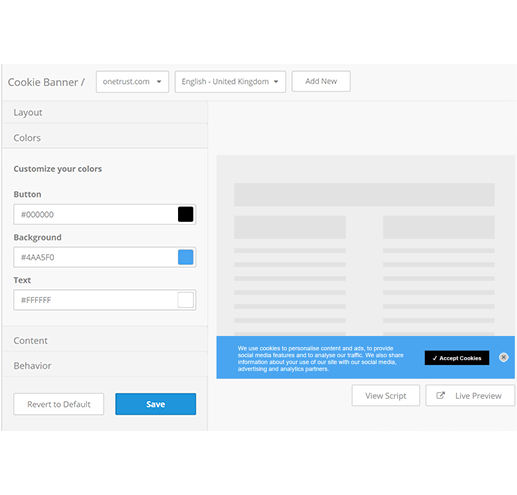
Another important requirement of GDPR is that businesses should only collect the data they need for marketing. Say an individual reaches one of your landing pages from organic search or a PPC ad. If you serve them with an extensive lead form requesting additional information that doesn’t have a direct marketing need, you could be in violation.
Not surprisingly, your landing page lead forms also need a lot of the same wording as your cookie agreement in order to comply, so use clear language to explain how the data they provide will be used by yourself and third-parties.
You should also design your lead form so users can provide clear consent about what you can do with their data. For example, one good practice is to have seperate boxes for users to agree to the Terms and Conditions vs. signing up for your mailing list. You also need to be clear if you plan to use lead form information to build your Google ads remarketing lists.
What’s more, you can also provide options for what kind of communications they can opt into receiving from you, such as email, phone, or SMS messages.
Essentially, it’s better to err on the side of being transparent on your landing pages about data use. As with your cookie consent, avoid being long-winded on your lead forms by providing prominent options for users to “read more” about how you might use their data for search engine marketing or other purposes. You can then direct visitors to your data security policy.
Optimizing how you collect consumer data for search engine marketing is only the first step in GDPR compliance. An equally important task is implementing and updating a data security policy that details exactly how you will handle the data you collect.
Many businesses simply update their existing privacy policy to comply with GDPR standards, while others create a dedicated data security policy for the regulation. Whatever path you choose, make sure it's thoroughly reviewed by your legal team.
At the very basic level, a GDPR-compliant security policy should include:
This should be a clear, complete explanation of who you collect personal information from (e.g. your site visitors) and what type of data you’re collecting. This includes cookie information, user device and IP address data, what browser they used, search queries they used to reach your website, information about on-site behavior, and geolocation data, among other things. The more detail you can provide about the type of information you can potentially collect, the better. You should also explain how the data is collected, including any third-party tools you might use.
Next, in order to ensure you’re only collecting necessary data about consumers under GDPR, you need to explain the various circumstances in which you might use personal data obtained from your site users. Essentially you need to justify why you’re collecting certain information by explaining your potential use of it. For example, you can use consumer data to define an audience that is most likely to respond to your marketing content, evaluate usage of your website, or market information about your products and services.
Under this stipulation, you should also disclose any third-party vendors or individuals with which you share consumer data, such as affiliates, advertising networks, or cloud service providers.
GDPR mandates prohibit you from retaining consumer personal data indefinitely without reason. Thus, you need to have standards in place that explain how long you will retain data and under what circumstances.
For example, if you collected cookie data from site visitors for the purposes of remarketing, you might retain it for a maximum of 12 months, although the amount of time you hold onto the data really depends on the length of your sales funnel. If you run an ecommerce business that sells leather boots, it makes little sense to retain cookie information for more than a month, as the sales cycle is short. If you collect other kinds of data, such as lead contact information, you can specify another timeframe for data retention.
Under GDPR, data subjects (consumers) have certain rights that businesses must adhere to, including:
This, of course, should be reflected in your data policy that should include details about how people can make these requests, and how long they should reasonably expect to wait before receiving a response.
There’s always the possibility that your consumer data could inadvertently be used in a way outside of your data policy definitions. It could be misused by your own employees, or compromised by hacking, for example. GDPR acknowledges this potential, and requires organizations to have a process in place to notify consumers about data breaches and take efforts to minimize negative impacts. Specifically, you’re required to report necessary information regarding a data breach to all consumers and other relevant bodies within 72 hours of discovery.
GDPR is, to date, the most extensive and comprehensive regulatory legislation addressing data privacy online. But it’s not the first, and it won't be the last. But it anything, this privacy mandate sets a new bar, raising it ever higher, for data security, compliance and consumer data protection.
For many businesses, it has already created countless headaches and compliance woes. And it is sure to create more challenges down the road. But like any challenge, it also entails opportunity. For you as an SEM professional, that means you have the opportunity to get ahead of the game by adhering to its set of data privacy laws. Ultimately, that will mean your consumer data will be more secure, and your customers’ privacy will be protected—all of which go a long way to building trust and loyalty, both within your audience and in new markets.
Ignoring it is not the answer—this reinvigorated focus on consumer privacy isn’t going to go away anytime soon. But with a little time, effort and foresight, you can navigate it successfully and even use it to your advantage.
These days, if you’re shopping online, you’re probably also doing other things—which means chances are strong that you’re also shopping on your mobile device. Yet surprisingly, many businesses today often don’t consider differentiating their marketing strategy across devices.
But mobile marketing isn’t just about delivering the same message on a smaller screen. People have different needs and intent when shopping on mobile devices than they do on desktops. Businesses that create specialized mobile marketing strategies that cater to these distinct differences can stay ahead of the competition, uncover new areas of profitability, and lift ROI to new levels.
Here are seven key tips to follow if you want to cultivate and sustain a strong mobile marketing strategy:
When creating a website, designers must consider how it appears and functions on desktop computers, tablets, and mobile devices. Consider these statistics:
There are two ways businesses can address this issue:
Most businesses prefer the responsive design method to investing in a separate mobile website. That said, not all responsive designs are created equal. While your website elements may shrink to fit mobile devices, they’re far from optimized for those screens.
In light of the notable shift to mobile web browsing, most businesses need to prioritize mobile web design over desktop appearance as part of a comprehensive mobile marking strategy. If you rely on responsive design, that means, among other things, you need to ensure that your site elements look good—and not cramped—on small screens.
Your web developer can also use HTML frameworks to hide extra sections of your page on mobile devices to give it a simpler look. As long as you prioritize mobile site experience over other devices, you’re on the right track.
Slow websites have long been a problem for mobile users. If you want your site pages to rank well in search results and drive conversions, improving mobile site speed is a must.

According to Think with Google, the average time it takes for a page to fully load on mobile is 15.3 seconds. This can take a huge toll on marketing performance—especially conversions. In fact, a one-second delay in mobile load times can impact mobile conversions by up to 20%.
To combat this issue, Google made several algorithm updates that include mobile site speed as a major factor in pagerank. Among other things, Google offers free tool called Page Speed Insights that evaluates website load time on mobile and desktop devices. It also offers suggestions on how to improve your page speed.
What many marketers and web designers don’t realize is there are a variety of factors that can slow down your site on mobile; using extra plugins, large images that are hard to render, or other fancy design elements all can negatively impact your user experience and increase your page load time. To minimize impact, be sure to test how these elements affect site speed whenever you add new elements to your web pages.
Prioritizing mobile in your web design is just the first step in mobile marketing: you must also consider it with each site page, landing page, blog post, or lead magnet you create.
The search intent and content needs of individuals vary based on the devices they’re using. People searching from mobile devices aren’t looking to read an ultimate guide or a 3,000-word article. They want quick, easy-to-consume answers to their questions, and this need has to be prioritized with the content you create. A few easy tips: summarize the most important points at the beginning of a long blog post, and use descriptive subheadings and bullet points to make your content scannable. Regardless of the device your audience is using, it’s best to be concise with your content. Get to the point using the fewest words possible.
The same thing goes with any mobile marketing sales funnels you create: the shorter, the better. While a multi-field lead form might work on desktop devices, people don’t want to type out a lot of information on their phones. Instead, try to minimize form fields or even create one-click signup where possible.
SMS messaging is an often overlooked marketing strategy. And since it’s an underutilized channel, it’s a huge opportunity for mobile marketing to reach its audience. Compare SMS to email, for example: email open rates hover around 20%, while SMS open rates average 90%.
In addition, there are a variety of popular messaging apps that businesses can leverage, such as Facebook Messenger and Kik. It’s easy to create a branded chatbot for these messaging apps that can field customer service inquiries and help people shop, among other things. Ebay, for instance, has a chatbot that serves as a personal shopping assistant for users:
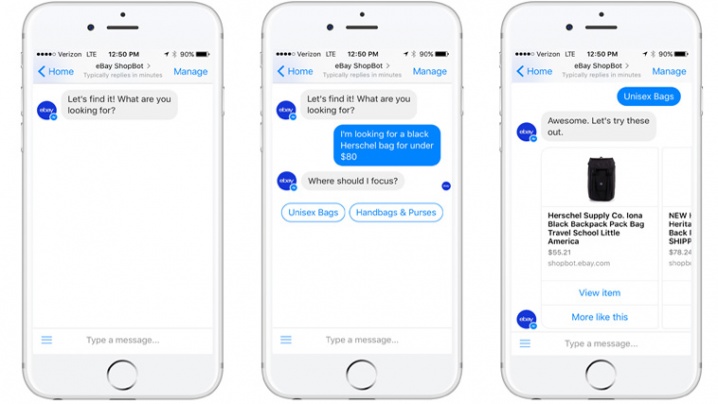
Chatbots are also a great tool for collecting important information about your audience that you can later use for mobile marketing. With a Facebook Messenger chatbot, for example, you receive the contact information of every user who interacts with the bot, and you can leverage this information to remarket to them using Facebook ads.
Smartphones provide a wealth of contextualized consumer data. Mobile marketing campaigns should take full advantage of the insights this data provides to create more relevant, timely, and personalized messages for their audience.
The type of device a consumer is using can help you garner a wealth of information about your audience. You can also use geolocation data to create ads or marketing collateral specific to certain regions, states or cities.
Brick-and-mortar stores can even use mobile data to attract in-store visits. For example, they can create targeted advertisements to appear in Google local search results or even Google Maps, promoting products or special promotions related to a user’s search query.
Here’s an example of a Promoted Pin Google Maps Ad that attracts in-store customers with a discount on products they’re looking for:
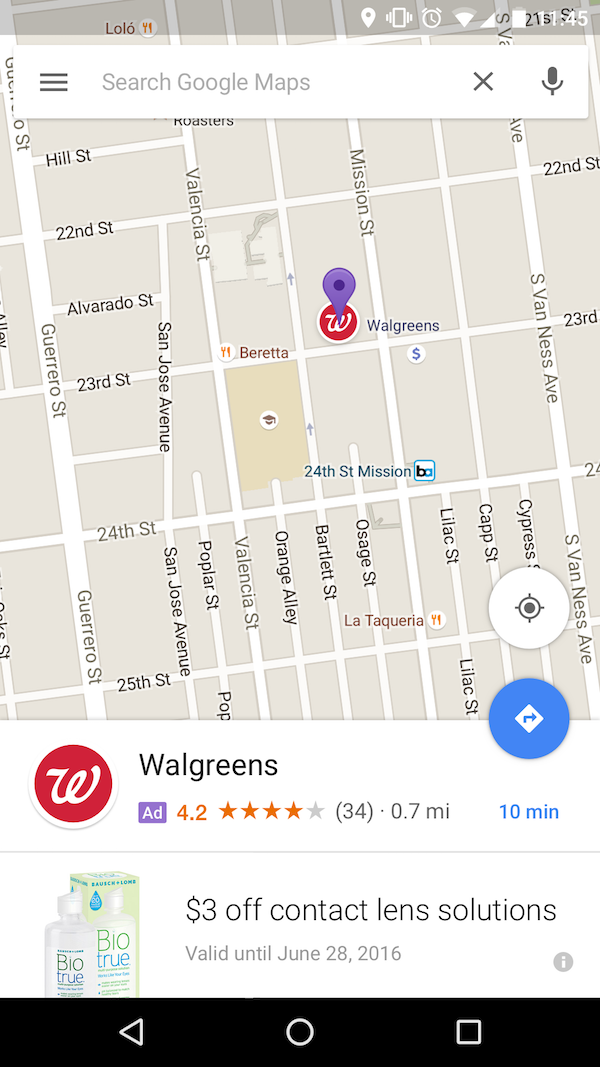
How people use their smartphones to search for information can indicate a lot about their needs and purchase intent. Use as much of this data as possible to create a more relevant mobile marketing experience.
Google Ads, social media platforms, and other advertising networks are constantly coming out with new ad types designed for mobile devices. Instead of creating generalized ads for any device type, start creating ads that prioritize audience targeting on mobile.
Here are some of the many mobile advertising options available today:
YouTube video ads
Watching YouTube videos is one of the most common mobile device pastimes, so creating YouTube ads that target your demographic audience to gain visibility puts your campaign efforts a few steps ahead. YouTube also offers TrueView ads where you can advertise products in your own video, and Shopping ads so you can display products on other relevant videos. These ads will either disrupt a video or appear as an overlay while people watch.
Full screen mobile ads
Full screen mobile ads are popups that cover mobile device screens, created by using Google Ads or another third-party advertising network. Banner ads on small screens are less effective than full screen mobile ads when it comes to grabbing audience attention. Full screen mobile ads also have better engagement rates. Just make sure your full screen ads don’t come off as annoying by disrupting people in the middle of a task.
Mobile app ads
Creating ads that appear within apps is a great way to target mobile audiences, as they’re designed to blend in with the native app content while not disrupting user experience. Target your audience demographics and online behavior carefully to ensure your ads appear in the most relevant apps available.
Instagram Stories ads
Instagram just recently rolled out Story Ads so your message can appear alongside the Stories users watch from their friends. And they work: according to Instagram, one-third of the most viewed stories on the platform are from brands.

Businesses can use Story ads to broaden their reach, build brand awareness, and attract traffic back to their website. It's just the latest example of the many mobile ad types businesses can use to target audiences through Instagram, Facebook, Snapchat.
Lots of businesses don’t bother creating mobile apps because they seem like a big, labor-intensive investment in development and app maintenance. However, the benefits can greatly outweigh the costs.
Here are a few ways a mobile app can help your mobile marketing strategy:
Build your brand and improve visibility
People spend 89% of their mobile media time on apps, and only 11% on websites. Having an app is a strategic way to reach your audience and build an identity around your brand.
Improve customer engagement
Having a mobile app is a great way to interact with your audience. Businesses can use apps to provide services, help users shop, and recommend products. Mobile apps can help you communicate with your audience in ways that a regular website can’t.
Improve customer retention
Once you get someone to download your mobile app, it’s much easier to retain them as a recurring customer. Having your business' app just a click away on their phone keeps you on the front of their mind. You can also promote special offers through push notifications, attracting users back to your app to make repeat purchases.
Stand out from the competition
Developing an app today is easier than ever, but many businesses still don’t bother to do it. Creating an app that’s actually useful for your audience will help you stand out from competitors who don’t have one.
Smartphones and other mobile devices have become integral to the online shopping experience. And thanks to responsive web design and social apps like Facebook and Instagram, it’s possible for any business to reach its target audience on mobile devices.
For digital marketers, the ability to expand marketing campaigns and endeavors to the mobile world opens up new and lucrative audiences and markets. But it also gives you more things to consider—and more strategies to execute.
By taking the time to prioritize mobile marketing, you can better and more accurately reach audiences while opening up new possibilities in terms of ROI and profitability. And that's an investment well worth making.