
Technology
Basis Platform
Advertising Operating System
Communication Portal
Intelligent Collaboration
All Channel Activation
Activate Media on Every Channel

Consulting
Resources
Centro just attended the ANA In-House Agency Conference in March—and we learned a lot. What was our main takeaway, you ask? Agencies should not be afraid of brands bringing marketing capabilities in-house. The good news is, there are still ways that agencies can work with those brands. Review the themes and findings discussed at the conference, below.
The in-housing of marketing is not abolishing of the agency model by any means—the brands we spoke to at the conference expressed their favor of agencies. Yet, agencies are realizing that they have to change their behavior towards brands in general. They need to build a trusted relationship with the brand’s marketing team to have a strong influence in its direction, and that ultimately, will translate to more work with the brand in the future.
For deeper insights about brands and in-house agencies - Centro's director of client development, Genny Drennen, explores the topic further in MediaPost.
A common headache for any account manager is a decrease in budget. It seldom feels that we’re faced with extra ad dollars, but every once in a while, miracles do exist. While it may seem like an answer to account limitations, there are some things to look out for concerning budget increases. Any large change to an account can require a secondary ramping up period. Much like when a new campaign launches, larger account changes need to build a history with Google to find a sweet spot in performance. Account managers often look at budget increases as a major change requiring special attention. This issue is magnified if the account was already struggling to spend the budget it had been allocated in the first place. In this article, we list four tips for increasing SEM spend without taking a hit, ensuring your performance stays profitable.
The first step to increasing campaign spend is to expand your keyword focus. Auditing the search queries report is the best place to look for new keywords to add to your campaign as it shows you exactly how people are searching for your business. If you’re not regularly auditing the search query report, you could be missing out on potential keywords, and phrasing of keywords, that would add great value to your program. Long-tail keywords are also a great way to broaden your keyword list, as well as increase traffic, for they typically have a slightly lower cost per click and the quality of traffic is higher. This report can further be utilized as a way to find new negatives that can help you avoid acquiring ad impressions for searches that won’t lead to sales. Implement these tactics and you’re a step closer to fully maximizing the effectiveness of your PPC spend.
When setting up any new search campaign, you must enter a target geography to serve your ads. If your account is limited by budget then your geography might reflect that by choosing only the most important radii, cities, or states. If your focus is niche, even when limited by budget, it’s best practice to start with a larger target area, then reduce as needed. Just be sure that you don’t let this run for too long without checking spend.
In cases where budget is not an issue and you have the freedom to leverage national targeting from the beginning, be aware that more isn’t always better. When given the opportunity to expand your geography to other desired areas, keep in mind your goals and needs, avoid adding cities and states you cannot serve just to ensure the budget is spent. You can also take into consideration geo modifiers. These give you the control to increase coverage on areas that have shown positive results and you can also add negative geo modifiers and area exclusions when expanding. Before adopting this method, though, have in mind the regions you do not want, or are unable, to market to.
Whether given a limited budget, or a sudden budget surplus, it is important to remember the goals of the campaign. Setting a campaign’s geography to national is a great way to gain traffic and increase your spend, but may not be what is best for your needs.
After a campaign has been running for a few months and it has hit its sweet spot in performance, you likely have enough data to begin a remarketing list. This is a strategic way to improve campaign performance and hit your spend goals. In essence, remarketing can help close the gap between customers that completed a conversion and those who dropped off in the process. The main benefits of remarketing include control over who sees your ads by use of remarketing to your audience list, improved brand recognition, improved ad relevancy, and, in many cases, higher conversion rates.
Audience lists are created in Google Ads or Google Analytics to help find people that have visited your site, or abandoned the shopping cart of your site, for example. Advertisers can utilize remarketing ads in either text ad or display ad format to communicate to their custom-created audience.
Brand recognition is important for any business, particularly smaller companies with a strong competitor base. By utilizing remarketing ads, you’re able to show your brand to browsers that have visited your site before, putting you top of mind. Display ads that match the look and feel of your website are especially helpful in capturing attention from previous visitors as well as new prospects. Remarketing with display ads can serve as an ongoing reminder of your brand.
Remarketing has proven to work well because it gives advertisers the control to create ads based on visitor behavior. If a visitor has shopped on a particular product page, then leaves before converting, you are able to show ads from that same page to that same prospect. By tailoring ads to previous site visitors, your ad relevancy will increase by communicating similar messaging, or images, from your site.
In many cases, remarketing ads produce higher conversion rates. While display ads may not be a good fit for every company, the option to utilize text remarketing ads with tailored verbiage to your target audience is a very powerful tool.
A mixture of brand recognition, compelling ad copy and/or display images have proven to increase conversions. However, it’s important to keep in mind that when setting up a remarketing campaign, it takes time to see an uptick in performance. It’s also worth noting that remarketing ads often have a higher cost per click than regular search ads, and it is strategic to set bids higher for better positioning. When looking for ways to optimize your account, keep remarketing ads in mind!
Bing is often overlooked by advertisers and eclipsed by Google Ads in the world of search. While Google Ads is still the clear leader, Bing has made big moves to bring value to advertisers in the space. Oftentimes, Bing is brought into the picture when advertisers feel they have hit the ceiling with Google, or when budget goals are not being hit. It’s important to look at Bing as an asset, and not a last resort.
Currently, Bing is responsible for approximately 30% of the search market, meaning if you’re not running your ads program on Bing, you are potentially missing out on 30% of ad traffic. A meaningful number. Besides opening your program up to new potential browsers, a significant benefit of using Bing is that the user demographic is older, more educated, and more affluent on average.
A common mistake advertisers make when launching a Bing program is treating their Bing account like Google. While it is easy to import your Google campaign straight into Bing, it is not best practice to mirror bids from Google. Typically, CPCs with Bing are lower, and so if you copy the same bids from Google, you could be setting yourself up for higher than necessary CPCs. If you do not have the same budget flexibility for Bing as you do with Google, it is recommended that you only add the main campaigns over to Bing.
When looking to expand on your traffic potential and spend goals, it is safe to consider the Bing engine as a quality over quantity solution. Do not expect the same volume as with Google, but if you optimize Bing appropriately, the traffic you do get will likely be high in quality.
Budget problems are a common issue in any search marketing program. Typically, the issue is not having enough budget, but occasionally the opposite is true. If you’re in the position of managing a program that is struggling to spend, or has recently been granted a higher budget, consider expanding on your keywords, increasing your geography, adding remarketing, and launching a Bing campaign to meet your account’s spend goals while simultaneously keeping performance trending upwards.
If you work in media, chances are a good portion of your day is spent on a computer, cell phone or tablet. Due to many years of exposure, my brain usually skips past banner advertisements on the top or sides of webpages, because I know that’s where they're typically placed. This is where the concept of Native Advertising comes into play - and what makes it so impactful. Explore native advertising and learn why it can be so effective, below.
Native advertising first came into fruition via magazine and print articles—remember those?! Think back to flipping through pages and finding an interesting “article,” only to notice the word “Sponsored” plastered on the page in very tiny, faded letters. That’s basically the thought behind a native ad; an advertisement that fits into the original content and doesn’t break the consumer’s flow of consumption. However, the evolution of the internet has led to a plethora of digital native advertising opportunities. Brands can now place advertisements within a news or social feed, a list of recommended stories and videos, or within the copy of an article—and they will appear as if it were a part of the content the consumer is already looking at.
Compared to traditional banner ads, native ads take the cake.
In the U.S. alone, millennials currently make up over a quarter of the overall population with $200 billion in annual buying power and $10 trillion to spend within their lifetime.** The kicker? According to Hubspot, 84% of millennials (note: that’s a lot of them) don’t trust advertising—they don’t enjoy feeling pressured into purchasing something. How do intelligent advertisers combat this and avoid the overwhelming impersonal approach taken by most?
Based on those numbers alone—native advertising may be the way to millennial hearts and pocketbooks.
Banner advertisements and pop-ups dominated the first phase of the Internet, but as consumer and advertiser mindsets have shifted, so has the need for innovative, digital, advertising options. Native advertising has a large projected growth over the next three years—its transition to the digital space and the visible growth that has followed is a perfect example of the digital advertising industry’s transformation in general. Don't let consumers skip over your ads—fit in (with native), in order to stand out. Create high-impact and thoughtful messaging as you cater to millennials—or request a demo to see how it’s done.
Learn more about Native Advertising with Centro.
Over the course of the last few years, marketing automation has become so sophisticated that it’s essential for success in today’s digital landscape. The benefits of automation are many: time savings, better audience targeting, better performance attribution, the elimination of wasted spend, driving increased revenue… the list goes on. The key to success in Google Adwords automation today is less about what you should automate, but how. In this article, we offer a complete overview of the best solutions for automating SEM in 2019.
Google AdWords (recently renamed Google Ads) is a frontrunner in developing solutions to automate and optimize advertising. They continue to roll out new tools that help marketers automate their PPC and display advertising efforts. While the key decisions are best made by PPC managers, the internal automation features of Google Ads can empower you to discover new targeting opportunities, improve ad performance, optimize bid strategies, and more. The growing list of Google Adwords automation features advertisers can take advantage of in 2019 include:
Responsive Search Ads
Responsive Search Ads, or RSAs, are a major new form of automation Google Ads rolled out in 2018. They’re still in beta and only available in a handful of countries. However, you can expect they’ll grow in use and importance in 2019.
RSAs can be likened to messaging optimization technology. For each ad you provide, multiple headlines and ad descriptions can be used in combination. Google automatically displays and tests different versions of your ad, using up to 15 headlines and four descriptions for each ad. This allows them to identify the content most closely matched to the search queries your target audience uses.
Smart Campaigns
Smart Campaigns are the new default campaign type when you sign-up for Google Ads. They’re designed to help small, location-based businesses optimize their advertising campaigns.
With this campaign type, you create your ad text and set a budget, then Google helps you with targeting. Smart ads appear when people in your target geographic area search for phrases related to your business on Google or Google Maps. They can also appear for people who search for terms related to your business and business location. Advertisers can forgo the default Smart Campaign option to choose which aspects of their strategy they want to handle manually or through automation.
At the time of writing, Smart Campaigns automate targeting and goal-based bidding. In the future they will also automate landing page generation based on Google My Business (GMB) data. This will be a valuable feature for businesses that don’t have landing pages on a native website.
Goal-Optimized Shopping Campaigns
The second major automated feature Google Ads launched in 2018 was goal-optimized Shopping Campaigns. This new campaign type automates ad creation and bidding, saving advertisers time on campaign management and optimization. All you have to do is set a specific marketing goal and Google will optimize your campaign to achieve it. Using automation and machine learning, Google can predict which search queries are the most relevant to your products. Google then presents your ad accordingly in search results, on the display network, YouTube, or Gmail.
Their algorithms take a number of signals into consideration simultaneously, including product characteristics, time of day, browser, geolocation, past search habits, and more. Realistically, goal-optimized Shopping Campaigns are able to make targeting decisions that would be impossible for a PPC manager.
AdWords Automated Bidding
Automated Bidding has been the most valuable AdWords automation feature for advertisers since its launch. Day-to-day practitioners don’t have time to manually adjust the max CPC for individual keywords to optimize their campaigns. Automated Bidding can take care of this task, optimizing max CPC based on specific goals. Google ads offers six major bid strategies based on different marketing goals:
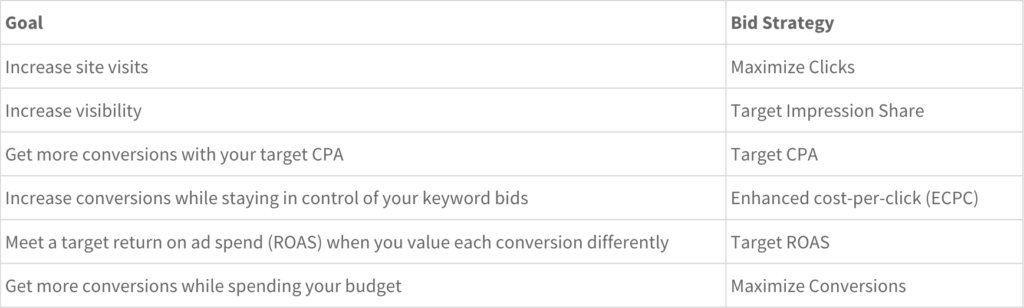
Smart Bidding relies on machine learning and your chosen bid strategy to set the right bid for each auction. It also factors in important signals at auction-time, including location, time of day, device, remarketing list, and more.
Local Campaigns
Local Campaigns is another new automation feature that helps location-based businesses promote their stores and products in search, Maps, YouTube, and on the Display Network. Advertisers provide ad copy, a bid, and a few assets and the rest is automated. With the singular goal of driving in-store conversions, Google automatically optimizes ad placement, bids, and asset combinations. When people use Google Maps or local search to find businesses, your ads can appear based on your location and relevant queries. Local campaigns can even automatically display product discounts or other assets to maximize conversions.
Universal App Campaigns
Universal App Campaigns have been around for a while, and they’re one of the few fully automated advertising options on AdWords. With these campaigns you can choose between two goals: drive more app installs or more in-app conversions. App campaigns can automate:
Ad creation - It pulls information from your app store listing to create text ads. Google systems automatically create different ad versions and test to see which perform better.
Targeting - Google automatically displays your ads on different networks for the right audience based on your goals. They match your ads to relevant search terms and ads can appear on Google Search, Google Play, YouTube, the Display Network, AdMob, and more.
Bidding - Google will optimize bidding based on your marketing objectives: more installs, driving in-app actions, or driving in-app action value.
Other Features
These are just a few examples of the many Adwords automation features that advertisers can employ this year and beyond. Others include:
Dynamic Search Ads - Create targeted ads using Google's index of your website.
Automated Rules - Make account changes automatically using conditional settings. Change your ad status, budget, bids, and more.
Google Ads scripts - Use JavaScript code to automate changes in your Google Ads account, such as adjusting bids, pausing ad groups, and adding keywords.
Recommendations - These suggestions to improve your campaigns automatically analyze performance and derive insights for you.
The list will continue to grow. The options your business should choose depend on your niche, strategy, and many other factors. Businesses that take full advantage of Google’s automation features are well-positioned to optimize performance in 2019.
Google is encouraging automation as a default setting across the platform. However, as more businesses employ these features, it will become more difficult to stay ahead of the competition. What many advertisers don’t realize is that there are various automation technologies beyond what Google Ads has to offer. These unique solutions make it possible to better optimize ad creation, targeting, bidding and a whole lot more.
Here are some of the many benefits of using third-party tools for AdWords Automation in 2019:
Comprehensive Data Analysis
Google AdWords automation utilizes all the relevant PPC data in their arsenal to automate insights and optimize campaigns for their advertisers. However, consumer digital footprints reach far beyond Google properties. There’s so much more data relating to market trends and audience behavior that advertisers can use to create and optimize their advertising campaigns. It doesn’t matter how great your automation algorithms are if you don’t have the deep, quality data to analyze.
There are a great deal of internal and external factors that can impact the value, relevance, and targeting of your PPC advertising campaigns. If you want to truly maximize campaign performance based on data insights, you must be able to analyze and automate decisions on a centralized platform. Third-party automation technologies can use unified data analysis to make smarter bidding decisions for your efforts on Google, Bing, and other advertising platforms. Powerful solutions can use third-party data, offline information, and other deep funnel metrics, such as:
Unified data analysis empowers you to get a clear picture of the whole customer journey, the state of your business, and other important market factors. You can use this information to accurately infer the likelihood a click will lead to a conversion, and the value of that conversion.
Nuanced Bid Automation
Google already has sophisticated bid automation capabilities, leading many advertisers to ignore the third-party solutions out there. Yet while Google does allow you to customize your automated bidding by choosing one of six strategies, third-party solutions go the extra mile and offer more nuanced options that you can customize to your complex business goals.
In the real marketing world, there’s no single key performance indicator (KPI) that fully illustrates your progress in achieving a marketing goal. Instead of choosing a single metric for bid automation, the best third-party solutions allow you to use a custom combination of KPIs such as conversions, profit, or revenue.
You can also choose exactly what data you want bidding algorithms to utilize to calculate adjustments. Use integrations with other business tools or database upload to incorporate any relevant data into the system, including all publisher data regarding costs, Campaigns, Ad Groups, Keyword Type, historical revenue, deep funnel or offline revenue data, and more internal metrics.
Real-Time Adjustments
Google stress the importance of targeting micro-moments with your marketing message. Micro-moments are, they say, “intent-driven moments of decision-making and preference-shaping that occur throughout the entire consumer journey.”
In order to deliver the right marketing message to the right audience at the right time, you need to be able to act quickly on your data insights as they come in. Advertising automation technologies with machine learning capabilities can understand the intentions behind audience behavioral data and make quick changes to take advantage of them.
Solutions that take one or two days to incorporate new data into your bid calculations are going to fall behind. If you want your advertising strategy to stay competitive, you need to use best-in-class technology that identifies and acts on data insights in real time. Making instant adjustments to your AdWords campaigns greatly improves the efficiency and precision of your efforts. You can gain more opportunities and make your ads more timely. These quick decisions also help reduce wasted ad spend because you never operate without the latest data insights on hand.
Historical Performance Insights
Maximizing AdWords performance isn’t just about acting on changes and opportunities in your recent market data. How your advertising campaigns have performed in the past can provide major insights to improve your current efforts. By aggregating audience and performance data in a centralized platform, you can identify patterns in market behavior and advertising strategy.
You’ll be able to answer questions like:
Historical performance data is particularly valuable for bid optimization. Using the data and context of your past performance, automated bidding platforms infer future performance and make changes to maximize business value.
There are many solutions that keep and utilize a limited amount of historical data that can inform strategies moving forward. To gain the most value, though, it’s important to store and fully utilize all the past performance data available. Using machine learning technology, automation can improve progressively when it comes to understanding future bid optimization opportunities and make necessary adjustments to take advantage of them.
This is called predictive analytics, and it’s nothing new. The finance industry has been using statistical models of past historical data to effectively predict market changes for decades. Applying it to the advertising industry allows you to effectively see around corners and make quick decisions to maximize performance and stay ahead of the curve.
Full Automation Capabilities
Most advanced AdWords advertisers understand that they cannot automate certain aspects of their optimization strategy. They pick and choose which aspects they want Google’s automation features to handle, then make manual changes when necessary. For example, they can make manual bid adjustments after considering historical performance data that Google’s automation technology doesn’t factor in.
But when you combine a complete, quality data set with a decision engine based on machine learning technology, it’s possible to fully automate a much larger number of processes. The volume of actionable data available today greatly exceeds what a marketing manager or a whole team of data scientists can humanly process. That is not to say that PPC managers are being rendered obsolete. It simply means they can spend more time identifying new opportunities for growth. This makes full automation capabilities even more essential for SEM success.
Google Ads continues to develop a wide range of new automation capabilities that smart marketers will take advantage of. But all the useful data insights you need to drive automation success can’t be found on Google properties. If you want to stand out from the competition (who are also adopting automation at an alarming rate), you need a technology that can maximize data insights for nuanced campaign optimization.
Did you know location-based ad spending will reach $32 billion by 2021?
While location-based ads aren’t a new concept in digital, this popular advertising tactic continues to see growth, and there’s a good reason why. By combining heavy consumer mobile usage with improved data collection and heightened expectations from the industry, location advertising offers elevated advertising opportunities for marketers.
When it comes to improving quality of life and work, most think about reducing stress and increasing productivity. But how? Keeping a diverse exercise routine is a fantastic way to ‘kill two birds with one stone.’ Below are five exercise activities that can significantly improve your work/life blend.
Group classes are a great way to try something on to see how it feels and connect with your community while contributing to your health. Grab a friend and hop into a yoga, martial arts, or kickboxing class—all of these activities boost the immune system, foster positivity, build self-discipline, and clear the mind. Cycling, aerobics, and HIIT are some other great examples that will increase your heart rate.
Get outside! If you live in a big city, you know just how refreshing it can feel to take a break—whether you take a long walk or play frolf (frisbee golf) in the park, or just step outside—whether that’s for a quick few minutes of fresh air or a week-long trip, it is always a good idea. Create a team or join a league—softball, kickball, flag football, you name it! Live in the Rocky Mountain area? A group trip into the hills, trees, snow, and sun on a board or ski can also provide peace of mind and a great workout.
Save time and money – by working out from the comfort of your own home! Whether you invest in P-90X, an online yoga video subscription, a set of free weights, or – go big – and spring for a Peloton, you can bail on that 40-minute round-trip commute. All too often, the hardest part of going to a gym is actually attempting to get out the door—working out at home takes out an additional layer of morning stress, and makes the whole process that much easier.
Is there anything more exciting than accomplishing a challenging feat? Ask anyone who has scaled a 14,000 ft mountain or run a marathon—devotion to a goal that pushes your limits further than you could’ve ever thought possible, is usually a goal worth pursuing. Joining a 5K for a cause or running a marathon in support of a friend or family member makes it all the more rewarding.
When it comes to workout form and spinal alignment, a personal trainer can be your new BFF. Target and activate different muscle groups and learn new methods or variations. Keep an open mind, and then bring that mindset into the workplace! Your self-discipline, clear mind and broad vision and will take you far in both lines of interest.
We understand that taking care of employees goes far beyond a paycheck. Centro’s ‘Buff to Get Buff’ Program reimburses employees for fitness-related expenses such as online/offline exercise programs, personal trainers, group classes, and race and team sports fees—ski passes are included too! What new types of fitness can you add to mix-up your routine? Learn more about Centro’s other benefits and current open positions here.
At this point, you should be a wizard when it comes to troubleshooting PPC performance issues. Identifying root cause and pinpointing dimensions that are dropping your numbers should be second nature. However, you might find that there are no large-scale problems and yet you still aren’t meeting your business goals. You’re starting to get pressure from your superiors to figure out a way to turn things around. So what now?
If you find that root cause and dimensional analyses aren’t leading to actionable insights, the issue might be bigger than you realize - you might not be optimizing to the correct metric altogether.
An optimization metric is a metric you use in order to determine what bid you would like to place on a keyword, which bid adjustment you would place on a device, etc... Optimizations will always, to some degree, be related to your business goal. As an example, if your business goal is to achieve a monthly ROAS of 150%, revenue should be a part of your optimization metric, meaning you would increase bids on keywords generating more revenue, and decrease bids on keywords generating less revenue. If your goal is to hit a CPA of $20, conversions would be a part of your optimization metric. Taking the same principles as ROAS, you would bid higher on keywords generating more conversions, and down on keywords generating fewer conversions.
These are low-funnel metrics, which sometimes aren’t enough to get you where you need to be. For example, if your goal is CPA, and you only sell a small portion of conversions per month but have tens of thousands of keywords, you would only be able to effectively bid on a handful of keywords, when realistically, there are a plethora of keywords that might give you similar, or better, opportunities to capture cheaper conversions. Utilizing higher-funnel metrics would help uncover these keywords, which could potentially be cheaper in the long run, increasing your efficiency.
Revenue and conversions. These are the metrics that matter. In a perfect world, these should be the only numbers worth optimizing towards, but in reality, your program might have a very low-volume, low-funnel metric, such as a low volume of conversions. In this case, you need to dig a bit deeper.
Hybrid metrics are a mix of high-funnel and low-funnel metrics. These are extremely valuable when your lower-funnel metric is what you ultimately care about yet too low volume for it to make sense to optimize toward.
For example, let’s say you’re selling a computer game, and your goal is to hit a certain number of conversions efficiently each month (i.e. you want to spend x amount monthly for someone to purchase your game). However, you have tens of thousands of keywords you are bidding on, and historically you only sell 100 computer games each month. This means that at most, only 100 keywords in a given month will lead to someone buying this computer game. It’s more likely that there are only a handful of keywords driving conversions, and they might be doing so inefficiently.
Now let’s say your click to conversion path is the following:
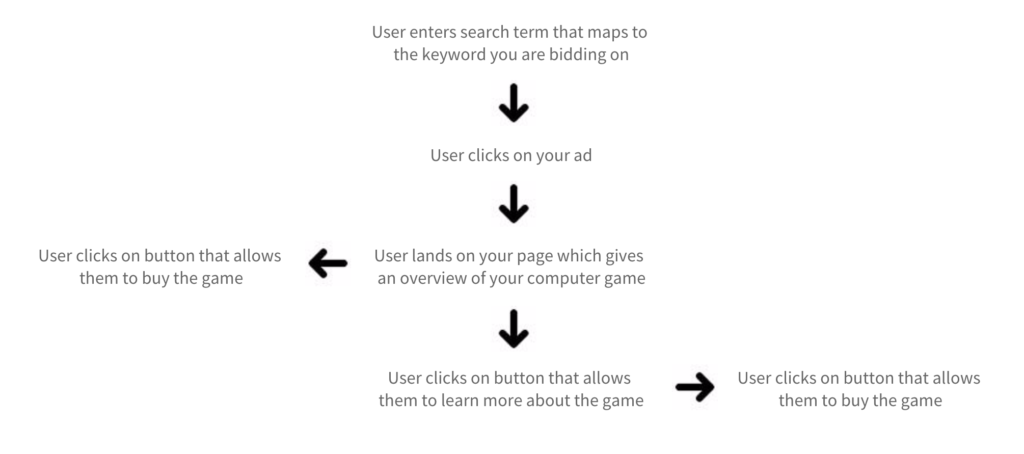
From this, you can see there are actually two ways a user can make the journey from a click to conversion:
In this case, the higher-funnel metric is the button that lets you learn more about the game (let’s refer to this as a lead) and there is a lower-funnel button that is directly responsible for your purchase (let’s refer to this as a sale).
If you were to collect data on ad clicks over a long period of time, you would likely see that a subset of all sales came from leads, and a large proportion of your leads drove zero sales. This information should be enough to give you an indication of what ratio of leads to sales you would expect, and this should help you determine a hybrid metric that you can apply to all the other keywords in your account.
To illustrate: you might find on average that for every 40 leads you generate, you make a sale, and there are a great many keywords that are generating leads for a cheaper sum than some of the keywords you are currently bidding higher on that are generating little to no sales. With this information, you could do two things: first, start bidding higher on cheaper keywords that historically generate high lead volume and have a good chance of leading to a sale; and second, spend less on keywords that generate low sales volume. By employing this tactic, you’ll achieve the same number of sales, but at a lower price, ultimately improving your CPA with the same sales volume. Alternatively, you could use this as a springboard to maintain efficiency at a higher sales volume to grow your paid search business effectively.
If you set up the hybrid metric correctly, you should still be bidding high enough on keywords that have solid sales volume, to a point that sales themselves weigh more in your optimization strategy than leads, while also preventing you from spending too much money on keywords that led to a sales by random chance.
When looking at the users who interact with your website, some will be inherently more valuable than others. Users who buy certain products might be more likely to come back and make further purchases in the future. As an example, if you are selling a subscription-based service, and someone buys a certain subscription that lasts three months with certain features. This user might be likely to come back three months later and buy a six month subscription.
Ideally, you’d like to spend the majority of your budget targeting people more likely to consistently buy products from your website. If you collect this type of information in your CRM, you can create a Lifetime Value (LTV) Model to determine what types of users are more likely to buy a product from your website again in the future, and consequently spend more money targeting them.
In terms of keyword-level bidding, if your CRM attributes a user’s purchase to the last click, you can tie values of your LTV model back to the last click of the keyword and subsequently use the LTV metric as a tool for bidding.
The only caveat to this type of bidding is when assessing the value of a keyword, you are more prone to bid too high or too low on a keyword if the LTV model isn’t accurate, so you would have to recalibrate your LTV model on a consistent cadence, especially if seasonality plays a role in the LTV model.
What type of metric you optimize to is dependent on how much data you have readily available, how your click to conversion operates, the behavior of your users, and so on. Questions you should ask yourself when determining which type of metric to optimize towards are:
Asking these types of questions will guide you towards the best optimization metric you can utilize in terms of giving yourself the best shot of reaching your overall business goals for PPC.
This article brings to a close our mini-series looking at the intricacies of why your PPC performance may not be at the desired levels. In Part I, we touched upon the need to understand all aspects of your program including your weaknesses and how, with the right approach and the right tools, you can effectively identify the root cause and begin making effective changes to ensure your numbers are back trending in the right direction. Part II delved into the specific dimensions (device, location, audience, etc…) that might be causing problems and how to troubleshoot them.
Addressing the weaknesses in your program by understanding which campaigns, ad groups, keywords, and product groups are driving bad performance can help you not only resolve your performance issues in the short-term, but help you determine which segments need more attention in the long-term to help achieve - and exceed - business objectives year over year.
Advertising has been around since the beginning of time. While it’s evolved as technology has come into the forefront of our lives, its intent has always been the same: to convince people they need something so badly, they can't live without it. As time has passed, though, consumers have caught on to marketing tricks.
Due to increased consumer knowledge, companies have been forced to adjust the ways they approach their audiences. After all, if brands don't listen to buyers' needs, rest-assured - their competitors will.
When the General Data Protection Regulation (GDPR) came into play in May 2018, it was a game-changer as far as advertising was concerned. This was the first time a unified set of strict rules was put in place to govern how people's data was used. The regulation also offered ways for consumers to easily opt out of communications if they disagreed with marketers' intentions.
Ad blockers simply weren't enough for online audiences anymore. They called for greater security with less effort and demanded control of the way their personal data was being used. Only a month before GDPR went live, the famous Cambridge Analytica scandal occurred. It was discovered that some 50 million Facebook users' personal information had been facilitating marketers' tactics for years, unbeknownst to the social site's users.
This was a turning point for consumers and advertisers alike. Consumers stopped allowing their personal data to be used as marketers began implementing more secure measures of protecting their privacy. Businesses worldwide were forced to respond by formulating new marketing strategies, driven by transparency. Reputable companies own the responsibility of keeping users' data safe and secure.
Advertising is built on emotional responses to certain images, phrases, or actions. It's not inherently bad, but some manipulative tactics are so subliminal, people don't even realize their decisions are being swayed.
When you were little, the candy at the checkout counter elicited an emotional response and made you feel like you needed that sugar right then and there. The same is true for trinkets strategically placed at the register, that are meant to incite impulse buys. This is similar to what happens with digital advertising, but online marketing takes a layer deeper.
Manipulative advertising is intended to take rationale out of the picture. Instead, it relies solely on emotions to justify buying behavior. When you're not prepared to think, decorative words can go a long way in convincing you to do something.
People need to think logically rather than emotionally. Once people recognize the tricks used to elicit feelings instead of thoughtful buying processes, they can break the cycle of bad advertising behaviors.
Consumer expectations in today's world demand more. People want increased personalization in their advertisements, but they mandate better privacy in their interactions with companies with which they consider doing business. As a marketer, your job is to instill confidence in your audience while finding ways to use online data the right way.
Quality vs. quantity. Nowhere are the tradeoffs more important than in the world of search engine marketing. Specifically, with the data that we use to measure performance, set goals, and drive the decision-making for our paid search programs. As a fellow SEM professional, you know that data is everything. It measures our value. It allows us to define strategies and boost our performance. It is the driving force behind the work that we do. But data on its own is not -- in and of itself -- an automatic key to higher value, better performance, and data-driven PPC. The operative piece is actually quality data.
Consider this: an athlete is dependent on quality food to help create and maintain energy, increase endurance and build strength. If that athlete indulges too long or too much in foods that are high in sugar, contain simple carbohydrates and other additives, their performance will inevitably suffer. Chances are they’re going to be slower and weaker -- and even micro-seconds of lost time will inevitably benefit their competition.
The same applies to how key decisions are made for running a large-scale SEM program, of which no decision is more important than defining and executing on a bidding strategy. Quality data is the key requirement to enabling advanced optimization strategies, fueling accurate forecasts, and activating key insights -- insights that allow you to have visibility into your sales funnel and the entirety of the customer journey. In turn, this not only enables you to provide a more relevant and valuable customer experience, but allows you to drive the optimization techniques that can boost conversions, gain an edge over competitors, and ultimately increase revenue and ROI.
Perhaps not surprisingly, missed performance goals often boil down to incomplete or low-fidelity data that drive misguided decisions. Simply put, if you don’t have quality data, it doesn’t matter how sophisticated the algorithms or optimization techniques you try to apply to your program, your performance will fall short of its peak potential. To put this in perspective, the lack of a complete and unified quality data set represents a significant challenge for most SEM programs.
However, solutions that can capture and leverage the right quality data can have a very meaningful impact on the success of an SEM program. Here are a few ways:
Now more than ever, data has the ability to directly drive increased business performance. By measuring, tracking, and analyzing data on past performance, smarter and more effective decisions can be made to deliver improved results moving forward.
In fact, certain core categories of data that most businesses already have can be directly applied to increase SEM ROI and drive higher revenue. By tying analytics data from web and mobile tracking solutions, offline data from call centers or CRM platforms, inventory and/or capacity systems that track real-time supply constraints, and contextual data like micro-weather signals that influence conversion rates back to SEM data, search teams can empower smarter and more profitable bidding decisions. Few, if any, large scale SEM programs can achieve peak performance without leveraging data from these types of sources.
In addition, a unified data set will not only offer insights into how deep your prospects are in the funnel, but also illustrate the various milestones of the customer journey to which value can be attributed. If you don’t typically have conversions for at least 30 days after an initial click, for example, a unified data set can provide insight into other stages along the path that can serve to predict not just whether a click is likely to return value, but how much.
Conversely, if your SEM program isn’t achieving peak performance, this likely means you should evaluate your SEM data mechanics. At the highest level, you should ask if your current bidding solution is capturing and leveraging all the critical data that measures and influences your funnel, regardless of where that data resides. For example, if your solution is having trouble integrating data from third-party sources, offline locations, and/or deeper funnel metrics -- or simply can’t do this -- you may be forced to use a sub-optimal strategy of optimizing bids to metrics that don’t actually measure business performance.
Here are some other questions worth asking to evaluate your data mechanics:
Achieving peak performance is hard. But more than anything, the foundation to achieve it requires investing in a platform that collects the right quality data and then allows you to unlock its potential by applying sophisticated algorithms to automate bidding optimization at scale. Being data-driven in paid search demands it.
And what if you’ve just deployed a new bidding platform? If you want to minimize the all-too-common and expensive “bidding learning period,” the quality of data you feed into the new platform is of paramount importance. At a more tactical level, if you don’t integrate historical data, you and your team may struggle to see patterns, garner key insights and make the most profitable strategic decisions until you build a new history. Here you would have a much more manual process of finding out, for example, whether May was a stronger month than June, and for what reasons. So when it comes time to set budgets and give forecasts for next Q2, they will be more difficult to prepare and less informed.
Why else might historical data matter? In the world of SEM, almost every business experiences some sort of seasonality, whether it’s based on promotional events, holiday periods, or a combination of both. Ideally, your future promotions and seasonal strategy will be driven by lessons from past successes and failures. Likewise, your bidding strategy should also be able to leverage data from past promotions and seasonal periods to intelligently guide future bid calculations and adjustments. With the right platform, strong historical data can provide the context and insight necessary to make proactive decisions to maximize business value.
Thus, it’s not only important to access and leverage your historical data, but also to be confident in the fact that the data set feeding your platform will be put to full use. That is being data-driven in your PPC. If your platform only uses 30-60 days of historical data for bidding, for example, how can it account for a once-a-year event like Black Friday? What ends up happening all too often is that paid search professionals are forced to completely override their bidding platform and control the bids themselves in order to be confident the decisions being made will best align with business objectives during such volatile periods.
While it might be a lofty goal to achieve “full automation,” today’s paid search marketers need a solution that provides robust data integrations and the capacity to fully leverage that data in a proactive way to win in a competitive ecosystem and achieve peak performance. Among other capabilities, this should include the ability to integrate and report on promotional and seasonal data from the past, along with ongoing revenue and performance metrics all in one pane of glass.
Remember how we talked about the quality of the food that athletes consume, and how it directly impacts both their potential and performance? Quality data operates the same way in terms of powering advanced techniques and capabilities in your bidding solution. These are the features that ultimately enable you to differentiate yourself in a competitive market and can take you to the level of achieving peak performance.
Take forecasting and scenario modeling -- while the concept of predicting the future isn’t new to the industry (and is something Accounting and Finance teams never stop asking for), it’s a far more accurate science to do when fueled by reliable and comprehensive data sets. The output of algorithms that make such calculations within a bidding platform will be empowered -- or limited -- by the depth of data that the platform ingests from the sales funnel and customer journey. But make no mistake, capturing all available data points will provide a richer understanding of a click at any given point in the process and better enable modeling as to how that click’s future will transpire, even when accounting for a delay of days or weeks to mature into a deeper funnel sale.
Similarly, automating audience bid adjustments is another example of advanced bidding techniques that enable you to outperform your competition. Status quo would mean relying on humans to define segments, collate and analyze the data, and then attempt to determine the appropriate audience bid adjustments to make and when. On the other hand, by automatically tracking all the audience attributes of each click and understanding how those attributes impact conversion rate and monetization, a bidding platform can be empowered with the raw fuel to be able to drive an automated approach. And rest assured that with proper data science methodologies used to model this data, it is possible to unlock higher performance and garner the greatest value from customer audience data. That’s a key requirement to achieving peak performance.
Humans vs. machines. It’s an age-old question. Historically, SEM teams have been responsible for not just the performance of their advertising spend, but also coming up with the tactics, processes, and tools to achieve it. Today, technology now offers the ability to go well beyond what humans can accomplish on their own or even with the assistance of first-generation bidding platforms. This means the best of all worlds: humans plus machines. Being data-driven in paid search isn't possible without this machine side.
What’s the alternative? Regardless of the size of your organization, at scale, there aren’t enough humans to review all the relevant data and execute all of the necessary decisions to manage a program with hundreds of thousands or even millions of keywords or products -- you simply can’t scale your team to accommodate all of that data. And if you try, you certainly won’t achieve peak performance. Enter technology, which can do both the blocking and tackling of keyword-level bidding, as well as more advanced strategies like device, location, ad schedule, or audience bid adjustments. But as we’ve discussed, that automation can only begin with strong, reliable quality data.
High-powered SEM platforms have the ability to provide a critical link to understanding where your business derives its value while also forging a path to increased ROI and higher revenue. They also provide historical context that enables you and your team to identify patterns and make strategic and informed decisions quarter to quarter, week to week, hour to hour, and even minute to minute. It enables you to have truly data-driven PPC programs. But, like the fuel that drives a sports car or the food that fuels a professional athlete, performance doesn’t come without the right inputs. In SEM, that means peak performance can’t be achieved without reliable and accurate quality data.