
Technology
Basis Platform
Advertising Operating System
Communication Portal
Intelligent Collaboration
All Channel Activation
Activate Media on Every Channel

Consulting
Resources
Adwords bidding strategies have changed a lot in recent years. PPC advertising has always been keyword-focused, but audience targeting features are now more advanced when it comes to improving campaign performance. Google themselves are even taking the focus away from keyword targeting, rebranding from Google Adwords to Google Ads in 2018. This shift towards audience targeting is great news for advertisers looking to optimize and grow their efforts, especially if they utilize Google’s audience bid adjustments. Here’s everything you need to know about the role audience bid modifiers play in Adwords bidding strategies.
Bid adjustments are a Google Ads feature that can help you optimize performance by displaying ads more or less frequently based on where, when, and how people search. Through performance analytics and audience insights, you may discover that clicks are more profitable when they come from a certain device, location, audience, or at a certain time of day. Bid adjustments let you take advantage of these insights to target the most valuable clicks for your business.
Types of Google Audience Bid Adjustments
Bid adjustments (also known as bid modifiers) make it possible to increase or decrease your bids based on certain circumstances you choose. With Google Search Ads, there are several types of bid adjustments you can use:
Device - Show your ad more or less frequently for searches on computers, tablets, or mobile devices.
Location - Show your ad more or less frequently to customers in certain countries, cities, or other geographic areas.
Ad scheduling - Increase or decrease your bids for campaigns that show only on certain days or during certain hours.
Remarketing lists for search ads (RLSA) - Set bid adjustments to show ads to people on your RLSA lists. (Example: Increase your bid by 25% for people who viewed your website in the last 30 days.)
Interactions - Increase your bid for mobile devices to show call interaction ads more frequently for mobile phone users.
Demographics - Adjust your bid to target potential customers based on gender and/or in certain ranges of age and income.
How Bid Adjustments Work
Bid adjustments are set by percentages. Say you set a max CPC bid of $1 for a campaign, but you discover your ads perform better on desktop than mobile devices. You can increase your bid by 20% for searches on desktop, resulting in a final bid amount of $1.20.
Bid adjustments can be set at the campaign or ad group level. If you set more than one bid adjustment in a single campaign, they are usually multiplied together to calculate an overall bid increase or decrease. Combined bid adjustments can’t exceed a 900% bid increase.
To target audiences within your search campaigns, Google allows you to use several major audience types:
In-Market
In-Market audiences include people who are actively researching products or services similar to yours. These audiences are great to target if your main focus is to drive conversions. Google has a long list of relevant in-market categories to choose from, examples of which include:
Remarketing
Remarketing audiences include people who have engaged with your company in the past by visiting your website, downloading your mobile app, or watching your videos, etc. You can build remarketing lists using snippets of code on your website or app. You can also set rules for which site visitors should be added to the list, and how long they should stay on it.
Affinity
Affinity audiences are built for businesses running TV ads who also want to expand campaign reach online. Affinity audience targeting is a good choice if you want to build brand awareness in the digital space. Google provides a list of curated Affinity categories for advertisers to choose from. Some ideas:
Custom Affinity
Custom affinity audiences are audience categories that are tailored to your brand. Custom affinity audiences are created using a number of factors, including:
Custom affinity audiences are much more specific and relevant than general TV audiences. To illustrate, a running shoe company could target Sports Fans as an affinity audience, or they could target Avid Marathon Runners as a custom affinity audience.
All bid adjustments are valuable to advertisers to improve targeting, performance, and ROI from Google Ads. Audience bid modifiers, though, have arguably the greatest potential when talking about improved performance, especially when used in combination with other bid modifiers such as location and ad scheduling.
Here are some of the main performance opportunities:
They help you target very specific groups of people
Google’s audience targeting options allow you to show ads to very specific groups of people. You can target based on interests, online behavior, what they’re actively researching, where they are located, how they’ve interacted with your business in the past, and more. Targeting audiences with the right combination of characteristics makes it easier to reach the right customers with your advertising message.
They’re highly customizable
There are a number of ways to define target audiences based on specific behaviors and characteristics of your target market. You can use audience targeting to create, exclude or combine different lists in a way that’s infinitely customizable. The only requirement is that the number of people in a list reaches 1000 for 30 days.
They help you prioritize different buyer personas
Most businesses today have several target audiences who would be interested in their products and services. But some audiences are more likely to convert and drive revenue than others. Audience bid modifiers can help you target multiple audiences simultaneously, while also prioritizing the more valuable ones.
For example, say a software company offers a product that is relevant to both freelance sole proprietors and start-up businesses. Their analytics show that when a startup CEO clicks on their ad, they’re more likely to purchase the premium product version. The company can increase bids for this audience to drive more conversions and revenue, while still targeting all relevant audiences overall.
They help you promote niche products at scale
If your ad groups reflect your product categories, then it’s possible to use audience bid modifiers to effectively promote niche products at scale. For example, say a video game company wants to promote a series of sports video games. They want to target gamers as well as sports enthusiasts. It’s possible to use bid modifiers to prioritize promoting these products to gamers who also like sports.
Advertisers who take full advantage of these performance opportunities will find that audience bid modifiers can:
There are many ways to benefit from audience bid adjustments to improve campaign performance, but doing so manually comes with some issues. Most advertisers begin by adding certain audiences to their campaigns at a 0% bid modifier, then monitoring performance. If the audience is more responsive to their ads, then they start increasing audience bids to improve targeting. This strategy is problematic for several reasons:
Improved Performance ≠ Maximum Performance
Say you identify an in-market audience that is more likely to click and convert. You increase bids for that audience by 15%, and drive more revenue as a result. You might think that your optimization work is done, but you really don’t know if that bid adjustment was the most efficient and effective strategy to improve performance. Maybe a 10% bid adjustment was all you needed to drive the same results. Or maybe 20% would drive exponential growth. The only way to find out is to change and test your bids adjustments to discover the perfect strategy.
Markets Change
Audience bid modifiers aren’t something you can research, set, and then forget about. Audiences, competition, and the overall market landscape are constantly changing. It’s possible for an effective bid modifier to start performing poorly over time. Like with most optimization initiatives, you have to systematically monitor the performance of bid adjustments and make necessary changes.
Challenging to Scale
The challenges mentioned above are enough to hinder even the most modest advertising programs from using audience bid modifiers at scale. Now imagine if you’re running a huge account with hundreds or thousands of campaigns. Applying and optimizing audience bid modifiers across campaigns becomes impossible to scale.
Like with most optimization strategies today, the only way to fully benefit from audience bid modifiers is through automation. Right now there are a few different options to automate audience bid adjustments:
Google Smart Bidding
Google’s Smart Bidding is a subset of automated bid strategies that use machine learning to optimize for a set marketing goal. Smart Bidding strategies include Target CPA, Target ROAS, Maximize Conversions, and Enhanced CPC.
Smart Bidding considers audience signals when optimizing campaign performance. It’s possible to add audiences to a campaign or ad group that uses Smart Bidding. This indicates the audience is important for reaching campaign goals.
Here’s how to set up automated bid strategies with remarketing lists:
Google’s Smart Bidding is a great way to apply audience bid modifiers to your campaigns at scale. But the downside is you don’t have any control over how Google uses your audiences to automate audience bid adjustments.
Google Ads Scripts
Another more customizable option to automate audience bid adjustments is Google Ads Scripts. Using simple JavaScript, scripts are a way to programmatically control Google Ads data. There are many scripts available out there, and some can help you automate audience bidding.
Just keep in mind that if you want to make changes to your audience bidding strategy, you’ll have to edit the script.
Automated Bidding Technology
With automated bidding technology, it’s possible to create bid adjustments for all audience types: Remarketing, Custom Affinity, Affinity, and In-Market. The system uses all your relevant business data, statistical models, and machine learning to dynamically adjust bids and maintain optimum performance in real-time. These granular performance improvements maximize the value of all bid adjustments to drive business goals and revenue.
Automating audience bid adjustments is just one step in a complex series of calculations all aimed at minimizing necessary ad spend and maximizing performance:
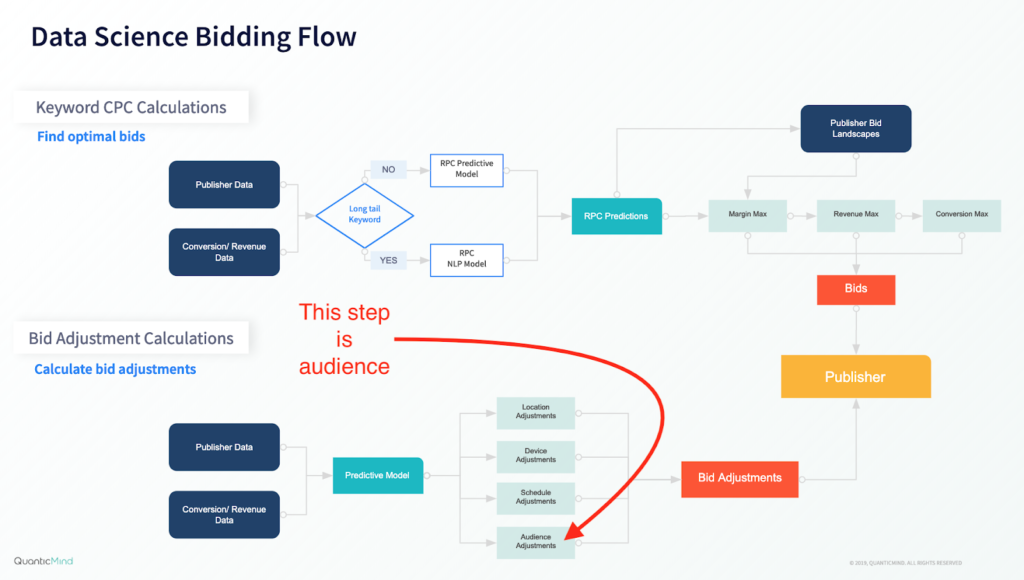
Automated bidding technology solves problems PPC managers face with precision, adjusting to market changes, and effectively scaling their programs with the help of audience bid modifiers.
Most PPC managers today understand the value of audience targeting as part of Adwords bidding strategies. But if you want to maximize the value of audiences to improve campaign performance, you need to use Google audience bid adjustments to prioritize the most valuable audiences.
Manually optimizing audience bid modifiers can drive performance, but is limited in scalability. Selecting a strategy to automate audience bid adjustments maximizes the benefits while freeing up more budget and manpower to pursue new growth initiatives.
Digital audio should be part of your media mix now, or at the very least, be part of the media mix consideration.
But don’t take my word for it. Follow the data and these points should convince any reasonable ad buyer:
People are listening to digital formats. This shouldn’t be a surprise because people have always been listening to something – music, live games, talk shows, etc. Audio offers a way to let users consume media either actively or passively. You can drive and listen at the same time. Try reading a web article or watching puppy videos while merging on a highway.
Digital audio formats offer marketers engaged listeners and high share of voice because the users are served only one ad at a time. Furthermore, mobile devices have personalized audio experiences even more. So the signals consumers give while listening to digital audio enables marketers to precisely target the advertising in this format based on their listening habits.
So let’s talk about what you can do.
On our Basis platform, marketers can activate digital audio by buying ads direct from any major vendor or by buying audiences via programmatic channels. It converges digital audio into a marketing team’s overall ad strategy. Users automate direct buying workflow (RFPs, negotiation and IOs) with any vendor for audio AND other ad formats such as video, native, and more.
This is important because:
When media teams are using digital audio ad buying tactics with their overall digital strategy, they are maximizing a full arsenal of tools to operate well-functioning and high-performing campaigns.
Learn more about Audio Advertising with Basis.
If you’ve been running ad campaigns online you’ve likely heard of Portfolio Bidding, and maybe you’re thinking of implementing it across your program. What you may not yet know are some of the intrinsics of Portfolio Bidding, and how this bidding strategy differs from the traditional Keyword-based approach.
This article explores the strategies and motivation behind adopting a Portfolio Bidding approach, why it can be a good idea to set up on your account, and some potential issues that need to be considered when setting up in this way.
Portfolio bidding is a change in the way bid strategies approach hitting the target goals you set. In a traditional keyword bidding strategy, each individual keyword is bid on in such a way to ensure that each keyword hits the target goal. In essence, each keyword is isolated from the performance of other keywords in the same campaigns or account.
For some automated bidding platforms, this can be a limitation. We all know different keywords have different performance, and as such an automated bidding platform may act inefficiently when presented with a goal that is much too aggressive, or lenient for a given keyword. For example, if we are bidding to a Target CPA, a goal that is set too low for that keyword will likely result in disappointingly low volume.
Instead of manually changing targets at a keyword level, or restructuring a campaign in such a way that similarly performing keywords are grouped together, we can instead use a Portfolio Bidding strategy. With Portfolio bidding, the keywords execute in a manner that ensures aggregate performance across all keywords in a portfolio (typically a Campaign or Bid Policy) hits the target goal.
Put simply, Portfolio Bidding gives the bidding algorithm of your choice more options to optimize. To explain this in more detail, we’ll introduce the concept of the volume/efficiency curve. For each keyword in your account, it’s possible to draw a curve representing the relationship between cost, and the expected volume of your target metric. This curve will ‘taper off’ as spend increases, resulting in a lower marginal return for each additional dollar spent on that keyword. In economics, this is called the Law of Diminishing Returns. A given keyword will have a unique curve, which could be subtly or dramatically different when compared to other keywords in the portfolio. Below is a hypothetical example of a keyword’s volume/efficiency curve.

We can see that an increase in spend will correlate with an increase in expected conversions, but each additional dollar spent at higher costs will have less marginal utility than a dollar spent at a lower cost. Portfolio Bidding can promote an increase in volume where one set of keywords drives volume, and another set will provide a much lower CPA to drive the efficiency target. Take a look at the following simple example to help visualize this.
A given portfolio has a single campaign containing two keywords, and the target goal is to drive volume at a Target CPA of $10. The keyword’s volume/efficiency curves are as follows:

As we can see above, Keyword 1 is more efficient at lower costs but tapers off early. Keyword 2 does not have the ‘low hanging fruit’ available at a lower spend but instead has a lower drop off at higher spend levels.
A keyword-level bid policy will likely take this approach to bidding:

When optimizing to the target we can only bid in such a way that finds the highest spend level achieving the target CPA for each keyword. This is inefficient, as the marginal spend on Keyword 1 would have been better used on Keyword 2. As a keyword level bid strategy does not have insight into the performance of other keywords, this is the only option available. This example shows a spend of ~$650 total would expect to see around 65 conversions.

On the other hand, the portfolio bid policy will work in this fashion:
With portfolio bidding we can find the optimal spend distribution across all keywords, to hit our target goal with the highest volume possible. This example shows a spend of ~$600 total would expect to see around 67 conversions. We can see in this example that we can end up with a higher volume of conversions at a lower cost, resulting in improved account performance.
Logically it follows that where possible, our bidding strategies should consolidate on the smallest number of Portfolios. However, we should keep in mind that Portfolio bidding is not a silver bullet for improving the performance of campaigns. Some of the situations in which discretion is advised when potentially switching over to portfolio bidding are:
For most accounts using automated bidding platforms, switching over to a Portfolio-Based Bidding Strategy makes sense. There is a good chance you will see improvements in volume at your target goal across campaigns, as a Portfolio-Based Strategy can greater leverage the characteristics of all the keywords in your campaign, and not just optimize on a keyword by keyword basis.
Most e-commerce advertisers failed to pay attention to Bing Shopping in the past, but things are quickly changing. Bing has made major alterations to their features and user interface to make it more appealing and worthwhile to businesses. Rather than trying to be different from Google Ads, Bing now embraces similarities. They make it easy for advertisers to import their campaigns from one platform to the other.
As an e-commerce business, you have a prime opportunity to reach new audiences with Bing Shopping. If you’re ready to expand your digital marketing strategy, here are nine tips for success with Bing Shopping ad optimization.
Product attributes are an important factor in Bing Shopping. There are a number of them that must be included for your ad to qualify for the Bing Network:
There are also many optional attributes you can include. Some of these optional attributes have a direct impact on how Bing categorizes and displays your products. It’s good practice to optimize your Bing Shopping campaigns by including as many product attributes as possible. You should also consider including:
Implementing all the relevant product attributes can be time-consuming, but it’s advantageous to do so to give Bing the most pertinent information to categorize your products. For example, a shoe retailer that includes optional size and gender attributes - “women’s size 7 US boots” - can make their products much more relevant for queries.
E-commerce advertisers promote a variety of products that drive revenue for their business. Marketers prioritize promoting high-margin products, and this should be reflected in Bing Shopping campaigns as well. Bing offers an opportunity to do this by allowing you to set priority levels for each campaign:
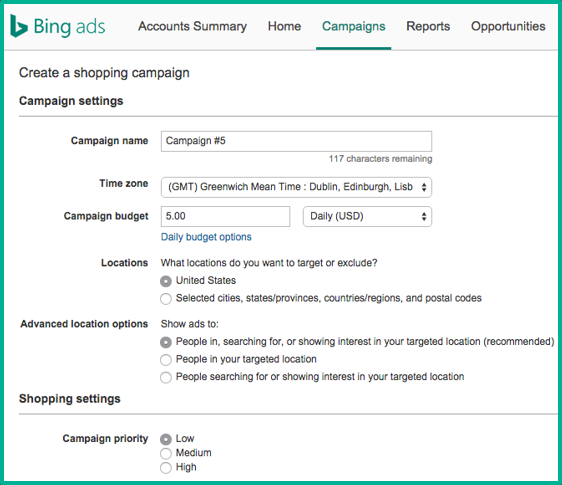
These settings override campaign bid settings. Utilize them the right way, and you can promote all of your products while still prioritizing those that are most valuable. Setting campaign priorities can also help you achieve other goals, such as clearing out excess stock. To maximize the benefits for your business, be sure to set campaign priorities strategically.
Bing makes it easy to set up new shopping campaigns by importing your existing Google Shopping campaigns onto the platform. E-commerce advertisers spend a lot of time optimizing their target keywords in Google Ads while failing to realize that Bing Shopping is a completely separate landscape. You can import your campaigns, but then you must adjust targeting and negative keyword lists to optimize for a different audience.
As a best practice, you should regularly review your search terms in Bing. It can help you to identify important growth areas such as:
Creating your keyword lists and ad groups are not simply tasks for the initial campaign setup. Engage in a constant process of auditing your search terms reports on Google and Bing to reveal opportunities to optimize in the long run.
Generally speaking, you want your ad groups to only include closely related products. Product groups allow you to select products from your Bing Merchant Center catalog to include in specific ad groups. You can organize products into groups using attributes from your catalog feed, namely:
You can also assign multiple attributes to narrow down your group even further:
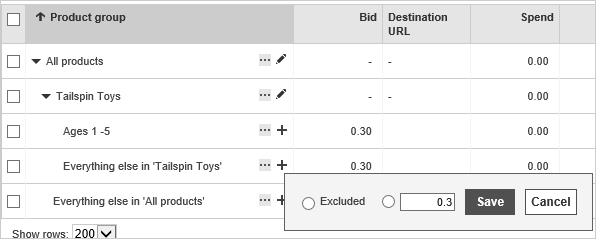
For example, a children’s toy retailer could create a product group based on brand (Tailspin toys) and the custom label of age (1-5). Using product groups makes it possible to quickly create ad groups and optimize bids for products with certain characteristics.
Your product images are arguably the most important aspect of Bing shopping optimization. Quality images of your product can help your Shopping ads stand out from the competition, improving clicks and conversions.
In April of last year, Bing made it possible for advertisers to add additional images to their product offer feeds. Instead of choosing one key image for your product, you can add up to 11 total images. Take advantage of this feature by showing your product from different angles or with different staging elements. Select one to serve as the featured image for the product and the rest will appear as thumbnails. Images must be bmp, gif, exif, jpg, png or tiff; the recommended minimum size is 220 pixels by 220 pixels.
The Automatic Item Updates feature ensures the availability and price information on your Bing Shopping campaigns always reflects your website. Online e-commerce stores can quickly run out of stock on an item, but still end up serving ads for it. This results in wasted clicks and ad spend.
Automatic Item Updates sync your website’s price and availability microdata with your Bing Merchant Center feed. This way, it automatically updates your inventory data throughout a business day without requiring action from your advertising manager. Employing an automation feature like this can improve the efficiency and effectiveness of your advertising campaigns. Bing will never show ads for a product that is out of stock, and listed prices will always reflect real demand. Based on your needs and goals, you can set Automatic Item Updates to update price only, availability only, or both metrics.
One of the most underused and valuable assets for Bing Shopping ad optimization is custom labels. Labels are attributes that let you organize campaigns, ad groups, ads, and keywords into groups that are important to you.
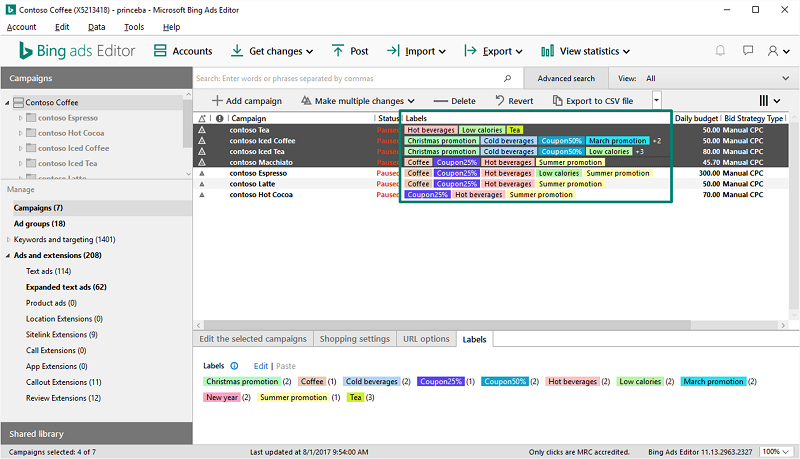
Custom labels have no effect on how Bing categorizes your products, which is why many advertisers ignore them. Custom labels, though, can help you gain insights and improve targeting in many ways:
Using Bing’s shared labels library, it’s possible to create a single label and add it to different keywords, ads, ad groups, or campaigns. This allows you to create groups that are significant to you across assets, and easily access them using Advanced Search. For example, you could create a shared label called “Holiday promotion” and add it to campaigns relevant to seasonal promotions. Then, to increase the budget for all holiday promotion campaigns, you can filter products based on the label and make the changes.
When you create custom labels based on attributes it’s easy to derive performance insights from them. Say you labeled two different holiday campaigns “Holiday 2017” and “Holiday 2018”. You can run a report to compare the performance of the different campaigns or ad groups/ads associated with them. You can also use labels to tag your keywords as brand name vs generic, or other attributes, then run similar performance reports.
It’s also possible to create automated rules based on your custom labels. If, for instance, you discover generic keywords perform better than brand name keywords from your analytics report, you can create an automated rule to change bids on keywords labeled “generic.” When used the right way, custom labels are a valuable tool to improve targeting and optimize your Bing Shopping campaigns.
Optimizing ads on Bing is an art, especially when it comes to bidding. There are a number of minor changes you can make to your budget allocation that have a big impact on campaign performance. You can use bid adjustments to target specific audiences with your ads and prioritize certain keywords or demographics. Your options for bid adjustments include:
Based on performance insights, you should experiment with different bidding strategies and see which help you reach your audience with relevant Shopping ads at the optimal time.
If you’re advertising in the United States, then you can also take advantage of Merchant Promotions to create more effective Bing Shopping ads. Merchant Promotions are a way for advertisers to highlight special offers in their product ads. These ads have a “Special Offer” extension that display a promotional code.
Merchant Promotions can significantly improve your Bing Shopping optimization by creating a sense of urgency for people to act on the promotion. Special offers help your ads stand out from the competition.
E-commerce advertisers today have a big opportunity with Bing Shopping. If you create and optimize Bing Shopping ad campaigns, it’s possible to reach wealthy shoppers in a marketplace that is much less crowded. Optimizing ads on Bing can be a challenge, though, if you don't approach it strategically. Take full advantage of the strategies and technologies mentioned in this post to get the most out of your Bing campaigns.
At Centro, we know that keeping up with the trade pubs and latest trends can be tough and time-consuming. To make that easier, we’ve compiled all the articles, reports, and other bits of awesomeness you may have missed, but should definitely read. Enjoy our latest list below!
Apple Reveals a News Service and Shows Its Ambivalence to Ads [:03]
The announcement of Apple News Plus may have sounded like another win for subscription models and a loss for ad-supported publications. However, the big publishers will not only receive a portion of the subscription fees and increased subscriber numbers—they’ll also be able to run digital versions of their print ads.
Walmart partners with Google on voice-enabled grocery shopping [:03]
In an effort to go head-to-head with Amazon, Google and Walmart are continuing their collaboration to make it even easier for people to add items to a digital cart and order groceries for pick-up or delivery. Powered by Google Assistant, which runs across all Google devices, the new service has been dubbed Walmart Voice Order. Fear not - there is still an opportunity to explore the in-store experience from home!
Kantar Data Reveals Behavior Patterns Of Amazon, Google Smart Speaker Owners [:02]
With continued anticipation in the marketing community for all the advertising possibilities to come from voice search, Kantar conducted a study highlighting how people are commonly using some of the most popular smart speakers, identifying some of the most common uses for Google Home and Amazon Echo, and offering behavioral insights worth noting for future ad strategies.
Domino's Adds In-Car Ordering via Touchscreen [:03]
Domino’s continues its path of pizza innovation—this time, with a connected car app. Connected cars offer advertisers an abundance of opportunity when it comes to location data and brands like Domino's are wading into the space.
Worldwide Streaming Subscribers Surpass Cable Subscribers For First Time [:01]
A new study by the MPAA (Motion Picture Association of America) based on 2018 data found that for the first time ever, more people are subscribing to streaming services online, than traditional cable TV services worldwide. Unsurprisingly, the study also found that transactional home entertainment (DVD and other digital copy sales) are down 5% over last year and subscription services have risen nearly 30% YOY.
Agency ad buyers say there isn’t enough addressable TV inventory [:03]
Despite massive improvements from a technological perspective with buying and targeting households, addressable TV advertising continues to be challenged, due to issues with scale. Only one-eighth of the 65 million U.S. households that could be served addressable ads are actually able to be served. Despite numerous media partners looking to expand offerings including AT&T’s Xandr and NCC Media, they all continue to struggle with the limitation of the two-minute inventory allotment available for addressable ads.
Sizmek Files For Bankruptcy And Faces An Uncertain Fate [:02]
Integrating companies is hard, but integrating them into an ad tech stack seems to be even harder. Last week, Sizmek filed for bankruptcy protection as it looks to work through debt repayment and company restructuring.
A short time after the advent of the Internet, early search engines set the stage for search engine marketing, commonly known today as simply SEM. OpenText Corporation debuted the first pay-per-click ads paving the way for an early form of SEM, but it wasn’t called that yet. In fact, it didn’t even have a name. It wasn’t until technologist and entrepreneur, Danny Sullivan coined the term search engine marketing in a 2001 article on Search Engine Land that the field became recognized in its own right.
A few years after the first PPC ads were launched, GoTo.com began an auction-based system that operates in a similar fashion to how the search engines of today run their paid advertising business. As more devices capable of browsing the Internet came into our pockets and into our homes, people began spending more time on the web, guided to the content they wanted by search engines. These cultural developments allowed SEM to explode in popularity.
But how did we get here? There were many steps along the way. In this article we dive into the history of SEM; how it came into existence and how it has developed into the billion-dollar industry it is today.
To better understand the history of SEM, it’s important to first understand what it means. Over time, the definition has changed: where once SEM was an umbrella term that incorporated search engine optimization (SEO) and paid search, it now stands alone. The term today is used solely in reference to paid search and includes marketing areas like display, shopping, and pay per click (PPC). SEO contrarily is all organic and is based on making changes to websites, specifically content and architecture, on the backend to help ensure web pages rank higher on the search engines.
Upon the invention of computers, the first question was how to connect them. The Advanced Research Projects Agency Network (ARPANET) began working on what we now know as the Internet in the late 1960s. According to History.com, on January 1, 1983, researchers began to assemble the “network of networks” that became the modern Internet.
A need quickly arose of how to search through all the information available. The first well-documented search engine was originally named Archives, later shortened to Archie, debuting in 1990. Created by Alan Emtage, a McGill University student, Archie was used as a way to index FTP archives and it worked by curating a database of webfile names that it would match with queries.
Archie was soon followed by new search engines created at other schools in the United States, namely Veronica which focused on plain text files and a Jughead which worked similarly. These two got their names from characters in a widely popular comic book, Archie Comics. Later in 1990, computer scientist Tim Berners-Lee invented the World Wide Web, and throughout the years that followed websites increased in number and became more prevalent in everyday life.
With the Internet growing by content and reach, more and more information was readily available and people wanted better ways to search and access it. Early search engine companies were working to monetize their businesses and this fueled OpenText, a search engine based in Canada, to run the first pay-per-click ads in 1996. The ads sold showed up on the search results page and were called preferred listings.
Fast forward two years to 1998 - a big year for search - and enter Larry Page and Sergey Brin, two graduate students studying at Stanford and the founding fathers of Google. GoTo hosted a TED presentation about the first auction-based PPC program, discussing their move to auction their results to the highest bidder of a word or phrase. Those paying the most would top the search rankings while lower bidders would be displayed further down the page. GoTo changed its name to Overture in 2001 before eventually selling to Yahoo! in 2003.
In little over a year, Google was processing 500,000 queries per day and at the turn of the Millennium growth skyrocketed when Google became the client search engine for Yahoo! Google Ads were on Google search results beginning in 2000, at first selling as a monthly service to advertisers. In 2004 Yahoo! ended the engagement with Google at a time when it was being searched 200 million times per day.
Google’s advertising system, Google Adwords was launched in 2000 with 350 customers. In 2018 Google rebranded this offering to Google Ads to better encompass the types of ads they work with, and it is today the leading publisher in the search space.
In 2005 Google, Yahoo!, and Bing Ads supported manual bidding which increased SEM’s popularity. According to an old article published by The New York Times, SEM was growing faster than traditional advertising as early as 2006. With new personal computing devices added to our lives and the introduction of the iPhone in 2007 and iPad in 2012, the web became more accessible to an increasing number of people. SEM was no longer tied to the desktop but open to people on the go via mobile or tablet.
SEM began changing as the way people were searching evolved, allowing segmentation between devices and geo-targeting. To assist advertisers, bid automation platforms like Google Smart Bidding were launched and this was later followed by bid optimization platforms. The next trend was incorporating big data in bid adjustments in 2015.
Today, at $40.6 billion, paid search holds the largest share of digital ad spend in the United States and it’s showing no signs of slowing down any time soon. Google’s market dominance in the search space is still maintained today, with more than 70% of worldwide online search requests being handled by Google, making it a significant part of how many people find content on the Internet.
Search advertising has become so pervasive it was even apart of crafting this article. As I write, I have been fact-checking and confirming information by using Google. It was written across three different devices and you can bet I encountered search ads along the way.
An increase in digital advertising spend is projected for 2019 with projections rising from $45.81 billion to $48.49 billion. If recent trends continue, spend will continue rising. While we don’t know exactly what is next for SEM there are some pioneering new techniques in the field such as applying predictive engagement, machine learning, and data science methodologies including natural language processing and bid-landscape data to the bidding process.
One thing is for sure, our devices are here to stay and, with them, SEM. SEM will continue to grow and evolve as our technology does.
During the employee lifecycle there comes a point where it’s time to move on—whether that’s to a new challenge within your current role, a new role within (or out of) your current company, or a totally new career change—is completely up to you. Too often, those discovery conversations are external interviews, versus networking within a current company. How great would it be if you could take a leap or make a career change, without the added risk of starting with a new team or company that doesn’t know your added value?
When employees focus on self-improvement, companies succeed. Review a few tips to consider before changing companies, below.
Chances are, you will not enjoy 100% of what you do every day. It’s always going to be a give and take. However, there are important considerations to assess—are you learning? Do you enjoy the people you work with? We have found that many of the employees who leave Centro have an average tenure of 1.5 years at their next job, with many returning as “boomerang” employees after reflecting on the above questions. Before making moves to see if the ‘grass is greener’ elsewhere, explore your options within your current company first! Making a move within can sometimes be a step in the right direction towards long-term career goals, even if it’s a lateral move instead of a promotion.
We don’t know what we don’t know. Not sure what that next move looks like? If you’re unsure of a particular role and are thinking of switching careers, consider reaching out to other colleagues or team members who have done it, or are doing it currently. Search your company intranet or directory—look for titles that pique your interest and reach out to those people; set-up a time to connect via phone or over coffee. Ask them about their position and what it entails; what do they enjoy or find challenging? Discuss the day-to-day, so you can determine if it may be a fit for you.
Every role requires some kind of subject matter expertise. Find a subject you enjoy that pertains to the role and learn more about it! For example, if you decide you’re interested in HR—take an online course about employment law, read articles about employee engagement and retention, or attend an event that caters to that specific industry. Ask questions, learn from peers, and reflect on your new skillset. Did you find the subject matter engaging? Or did it make you want to take a snooze? Pay attention to those insights, as they could potentially lead you to something great.
Once you have reflected, networked and done your research—make a mental commitment. If you decide a career change is what you need, then raise your hand; talk to your manager or executive leadership to express your interest in another opportunity at the company. Stay engaged in your current role to ensure consistent performance, and work with leadership to see what options may (or may not) be available at your current company—make an informed decision.
If you’ve determined that you’d like to stay on your current career path but are feeling unfulfilled in your current role, identify what it is that is making you feel disengaged. Are you not learning at the speed you were hoping? Is your manager not accessible? Take change into your own hands—seek out the challenging work and collaborate with those that bring you positive energy. Talk to your manager to see how they can better support you in this journey.
There may come a time where you and your manager decide that your current company may not be able to bring you what you’re looking for. In this case, you can feel secure and confident in knowing you’ve assessed all options to determine the best path forward and move into the next endeavor with a clear mind and fresh slate.
What happens when display advertising is freed from traditional ad placements, and instead, intertwined in the content or feed of a site? Enter the newest generation of display—native advertising, which connects with consumers in more meaningful, relevant, and less disruptive ways. While native ads have matured in functionality, driven by technology and industry adoption, these ads have also increased in scale with availability across every major site and app.
Native advertising is expected to grow over 25% this year (topping $41 billion) and enabling publishers to discover new sources of revenue, while marketers notice performance unrivaled by any other current display ad type.
In our March webinar, we share the various innovative opportunities that exist with native today and reveal how programmatic is driving increasingly effective media results.
Quality customer support for PPC optimization platforms is becoming increasingly important. Consider the impact of paid search programs on your revenue stream and the role bidding optimization tools play as key middlemen. Large amounts of money are relying on the flawless execution of PPC marketing, but we all know technology isn’t always perfect on its own.
Paid search has high stakes - and huge potential - for constant incremental improvement, particularly at scale. SEM is not your average marketing function: it’s a healthy mix of advertising expertise, copywriting, selecting business goals, statistics and analytics, big data, and the customer journey. It’s at the intersection of creative and technical skills. The keywords matter, the data matters, the integrations matter, and the budget matters. With the complexities that exist in the space, paid search technology needs a Customer Success partnership model – not simply a reactive support model. Advertisers need to be closely aligned with their PPC support team.

There is more to purchasing PPC bid management software than just the technology; it also benefits the advertiser to invest in a partnership. This works at two levels: the benefits of urgent problem solving when issues arise, plus strategic planning and execution based on knowledge of your business and goals. One is about quality customer service for PPC; the other about strategic alignment and insight. With these advantages, advertisers find much more success running at-scale programs in SEM.
The first level is all about the actual dollar costs. In an instant, on any day, you may open Google Ads to suddenly find a huge PPC performance drop. It could be your competition, it could be landing page or URL changes, it could be a broken data integration, or something else entirely unknown. Whatever the cause may be, paid search teams are familiar with this feeling, and the frantic auditing that follows. The costs associated with SEM performance drops like this can be substantial. Overspending can lead to paying thousands without understanding why. A drop in volume can cut your forecasted revenue by 10, 20, or 30%.
If that sounds bad, imagine introducing a third party PPC bidding technology into the mix; one that may introduce new power and data, but with additional complexity. When auditing, you need to be able to reach the vendor’s support team immediately to help troubleshoot. With the added complications involved, you may not be able to figure out what the problem is for an extended period of time, if at all. At that point, the dollar costs can really get painful. You need a relationship based on alignment around business goals and metrics, data integrity, and technical transparency. Not only do you need a support rep, but your dedicated PPC support rep – your Customer Success Manager.
The second level of importance lives in the opportunity cost. When you partner with an organization, you share goals; you understand the in’s and out’s of the data; you’re aligned on the tactical execution as well as the strategic planning; you’re mutually benefiting from one another’s experience and expertise. What is the potential opportunity cost of running a program without a partnership with experts?
Partners take risks for you, provide recommendations that address your business needs, and put in effort to transform those recommendations into action and results. They work alongside you, digging deep and caring as much about your business as you do. This is the kind of relationship you should have with your PPC optimization vendor. Weekly meetings and close alignment creates a proactive engagement that catches, or prevents entirely, the problems we’ve already discussed. It determines changes in strategy ahead of time with a team who knows the software, the data, and your business. It creates a platform to bounce ideas around with like-minded professionals.
Ask yourself a question: if you called up your provider now and asked them to explain your business to you, could they do it? Could they explain what business issues keep you up at night? Do they understand your personal goals?
As a company focused on big data and artificial intelligence, stereotypes would position QuanticMind as wanting to remove people from the equation. In reality, we’re working to get the best out of people and machines working together. AI and Machine Learning are powerful tools, but they need to be fed the right information and pointed in the right direction. That means partnering with subject matter experts to understand your business model, key goals and metrics, data structure and relevance, and the priorities of individual team members.
We discuss this topic further in the fourth installment of our Enterprise Paid Search Series: Is Poor Customer Support Undermining Your PPC Success? This download can help you learn what quality partnerships around SEM look like, and remind you of past engagements that had some pains or weren’t so successful. It pays dividends to invest in a strategic partnership with your PPC optimization vendor.