
Technology
Basis Platform
Advertising Operating System
Communication Portal
Intelligent Collaboration
All Channel Activation
Activate Media on Every Channel

Consulting
Resources
Manual PPC bidding versus automated PPC bidding. It’s not really an age-old question, but there are certainly plenty of people on both sides of the discussion who have passionate views. But… let’s call it an important dialogue, one that can have a meaningful impact on business results. (It certainly shouldn’t damage any relationships!)
While tactically there are breakdowns of each automated bid strategy available for advertisers - from Google and plenty of others - with pros and cons, we aim here to join the conversation from a different angle. Let’s take a look at the needs and the philosophical goals of search engine marketing and PPC bidding.
With Manual bidding, what are the core byproducts we should extract for discussion?
The first is control. One of the most powerful ideas behind manual bidding is that control falls into the hands of the advertiser, and not into the hands of a search engine ad-publisher or a third party tool. The advertiser has control and visibility into the decision making, the data, the performance, and the outcomes.
Why is control important? There are two primary reasons:
The second byproduct of manual bidding: effort. The other primary idea inextricably coupled with manual bidding is that effort is required, and often a lot of it. Time investment is needed. Continuous analysis, review, and mental energy must be applied on the same set of tasks. By definition, manual bidding takes time and effort!
Why is the effort discussion-worthy? We’ll dig in:
What are we really after here? We want to merge the best that “control” can offer with the best that “effort” can offer.
Obviously our underlying goal is to set and accomplish business outcomes: to have program results be acceptable, or better yet, excellent. We believe control is powerful. We should have the right amount of control. However, we are also limited in the amount of effort we can meaningfully exert.
How do you accomplish this balance?
Well, it starts with reflection (or analysis - whichever word you align with more). Spending a bit of time evaluating your desired level of control (for you personally, and for the programs you manage) and your current versus desired level of effort and time investment.
If you’re reading this article, you’re probably the type of person who is interested in learning and improving the way you operate, and thus likely to take a meaningful shot at reflecting on your present methods (which is a great thing!).
This reflection and analysis should help you to identify options for automating sections of your program: First, where you can take advantage of the elements of control (tactically or strategically). And second, where you can invest effort into places it best serves you, your goals, and your business goals.
No article or blog post can tell you that exact mix of manual versus automated for your specific program, but it can act as a catalyst to begin that reflection process!
Where does automated bidding fit into this type of conversation?
Control has psychological elements, but ultimately the aim is to understand and control performance. You feel and know that you are getting the best performance possible because you are seeing the inputs, “turning the screws” yourself, and seeing the outcomes. Performance and results are ultimately the goal of having all this control.
The reality in many, many cases is that performance will be better when automated processes and calculations take care of the bidding. There are times when automated use cases may not apply as much (when thinking about impression share, or page position, or match type benefits, etc), but where there is data on conversions or revenue, the right strategic goal, and enough volume to merit it, automated bidding will optimize PPC campaigns better than manual human efforts ever could.
The second point, effort, is completely flipped on its head when using automated bidding. The day-in and day-out effort and time investment to manually analyzing performance and making bid adjustments is removed. Yes, you’ll still be reviewing your performance often, but in the world of at-scale paid search, that’s a given.
You create time savings by removing the pain of manually managing countless ad groups and keywords and products, and can use that time on more strategic activities to grow your business. Time and effort will be required, and required in abundance. However, those hours will be worth more. Assuming one doesn’t thoughtlessly apply a single automated bidding strategy to an entire paid search account, the campaigns and portfolios that have specific bid strategies will be operating at a much higher clip, creating time for people to focus on the other parts of the program that need the human touch.
Automation in SEM goes far beyond just doing a process automatically, it gets deep and complex quickly with optimization techniques. This is where artificial intelligence, machine learning, and other engineering and statistics innovations are attacking the process of improving performance in paid search. Automating some campaign management and workflow tasks are helpful to save time - but from a dollars-in, dollars-out perspective, big data applied to bid management has the most potential.
There are obvious places where a human’s manual thoughtfulness is better suited than any sort of machine or automation. Some of those are:
In the past, other items would have been on this list (like where device and audience bid adjustments should be made), but those specifically are now being automated fully by automated providers (from data ingestion, modeling, calculation, and execution). “Machines are taking our jobs” is real; but in the best of ways. You (the human, I presume) get the job of thinking, planning, and deciding, then the robot gathers the data, performs the calculations, and executes hundreds of thousands of actions for you.
Machines (a fun way to name any automated software or system) are obviously better at the niche, nitty-gritty analysis, calculation, operating at scale, and executing at ridiculous speeds. Bidding is one of the best places for automation to take over; it’s a problem that’s based in statistics and numbers that correlate directly from higher funnel (position, impressions, and clicks) to lower funnel (conversions, LTV). The machine’s platform will have a U.I. to make big or small tweaks and test the performance, providing control to the PPC bidding optimization effort.
Then, there’s the data...
Data is the other element that takes the benefits of automation and exponentially amplifies it. With an increase (almost every week, it feels) in the amount of data we can capture about the customer journey, there is so much more to feed the machine! That statistics problem can be worked with a much more robust data set, over a longer and more nuanced customer journey. The requirements from a human to piece that data together to make meaningful decisions for optimizing performance at scale just isn’t feasible.
Automation applied to huge data sets is a beautiful thing.
But how do we maintain control; the type of control described early on in this article? There are three points to make clear at this stage:
Clearly the stance offered here is that automation can add significant value. Nothing works without humans captaining the vessel, but we do believe that the cooperation of humans and machines is the best way to achieve (and exceed) goals in paid search. Machine learning PPC algorithms and automated bid management have tremendous potential, but shouldn’t be unleashed without preparation and thoughtfulness.
Now is as good a time as any to reflect on where it makes sense to invest your time, effort, and hours. In smaller programs where the overhead isn’t enormous and there simply aren’t many huge strategic decisions to make, the decision to proceed manually is likely a great option.
Alternatively, working with a program with over five hundred thousand keywords and a monthly budget around that $500,000 range as well may have much more to gain from automating bidding, and putting that manual, human effort in other areas that allow the machine to perform better at automating, and ultimately allow the business to prosper.
Try to maintain the optimal control and get the best return on effort, but don’t fall into a false sense that full control by a person is better than joint control with an automated solution.
Digital went from just a sliver of the media mix a decade ago, to a majority of ad spend today.
This shift in the advertising industry’s focus can be largely credited to a heightened programmatic mindset, and with that—a pressing expectation for more automated processes in advertising. Centro’s Founder and CEO, Shawn Riegsecker, discusses the impact that automated systems have had on the way advertisers buy media, client expectations around transparency, the advertising job market, and predictions for the future of digital advertising.
Most business leaders today know the importance of investing in search engine marketing (SEM) to reach target audiences and desired goals. But what they might not realize is how much PPC budget they need to succeed, or the value of their ad spend. Whether you’re an independent marketing agency pitching to clients or an in-house SEM manager, you need accurate PPC forecasting to succeed in your role.
It’s simply impossible to build a solid PPC strategy without buy-in from your leadership team. And you won’t get a lot of investment if you’re asking them to allocate funds based on guesswork about future revenue. PPC forecasting gives you hard numbers to prove the value of ad spend to those controlling the finances.
Google Ads forecasts can also help SEM managers understand the impact of different campaign adjustments on future performance. Creating accurate forecasts empowers marketers to evaluate new optimization opportunities before testing them out in the real world. This will ultimately reduce wasted ad spend and maximize the efficiency of SEM efforts overall.
In this article, we present everything you need to know to forecast CPC and project other important PPC performance indicators.
The amount, and quality, of data you have is the most important aspect when it comes to creating an accurate PPC forecast. Using just a few key data points to extrapolate future performance greatly increases the chances that your forecast will be inaccurate. If you’ve already run PPC campaigns in the past, you’ll have a wealth of valuable data that can help you. Important data to include in your forecasting reports includes:
Much of this data can be downloaded from your Google Ads account. Just go to the Account > Export menu, where you can select whether to export your whole account, selected campaigns, or ad groups. There’s a lot of information here, so narrow your selection down to the data points and time ranges most relevant to you.
If you’re creating a brand new Google ads forecast and don’t have any historical data to work with, then you’ll rely on impressions and suggested bid data to make your calculations. Determining your cost per click (CPC) is an important PPC forecasting task, especially when working with new clients or launching campaigns for new products. Getting an accurate estimation of your CPC will inform the necessary budget and monthly ad spend needed to reach business goals.
Forecasting CPC is easy using new features Google added to Keyword Planner last year. Go to Keyword Planner and rather than clicking “Find new keywords,” chose “Get search volume and forecasts.”
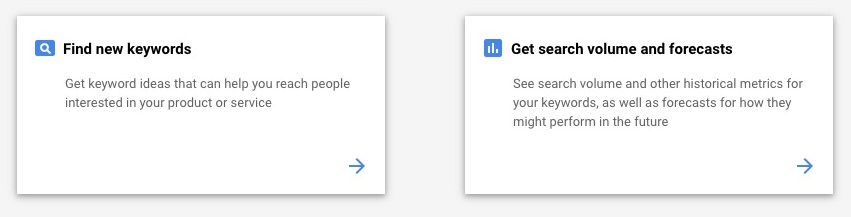
You’ll see an option to add in, or upload, new keyword terms you want to target. Simply import them, click “Get Started,” then Keyword Planner will give you a detailed forecast and your average CPC:
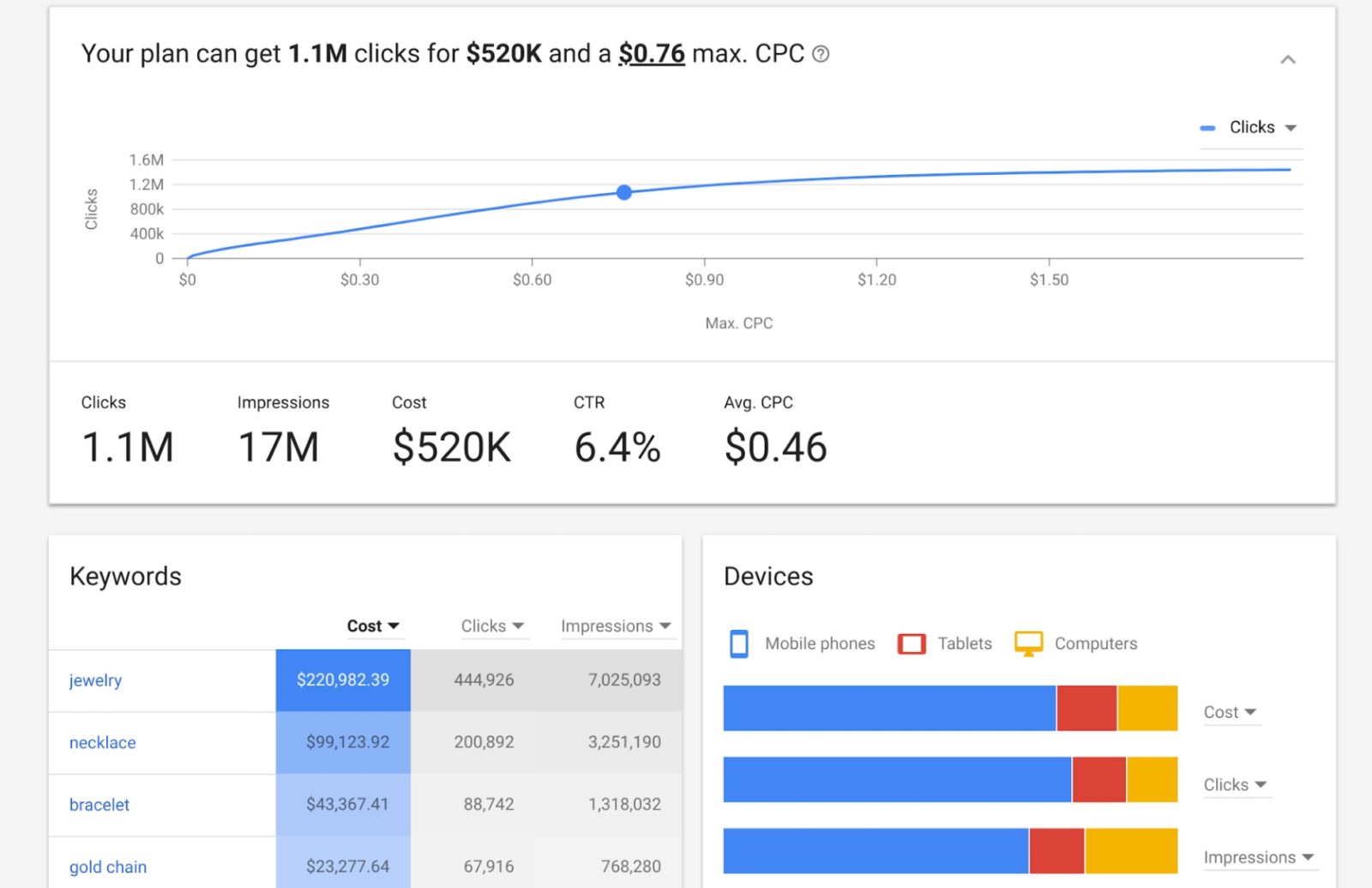
The report shows you details of how certain keywords impact performance. Once you create a campaign, you can also adjust max CPC and see how that affects future outcomes. This is a powerful tool to gain insights into how your ads could perform given a certain budget.
One major issue with PPC forecasting is that calculations are based on static market performance. You can only expect your bidding approach to play out exactly as forecasted if your competitors make zero changes to their own strategies. PPC optimization involves auctions. There’s no accounting for how strongly competitors might bid on the same keywords as you. This can have a huge impact on performance.
While there’s no way to predict how your competition will act, it is worthwhile to consider their past behavior as part of your forecasting efforts. Comparing competitor campaigns to yours can help you make necessary adjustments to optimize your campaigns. A helpful tool for this is Google’s Auction Insights. This report details how your previous campaigns performed compared to your competitors. Auction Insight metrics include:
Impression Share: The percentage of impressions you receive versus the total amount of impressions your ad was qualified for.
Average Position: The average position of your PPC ad compared to others.
Overlap Rate: How often another advertiser’s ad received an impression in the same auction that your ad received an impression.
Position Above Rate: How often another advertiser’s ad in the same auction shows in a higher position than your own when both of your ads were shown at the same time.
Top of Page Rate: How often your ad (or a competitor’s ad) was shown at the top of the page in search results.
Outranking Share: How many times your ads outranked your competitor’s ad in the auction.
Google Auction Insights can give you a good idea of how aggressive your competitors are in the auctions and reveal patterns in their strategies. Run frequent reports and see how they change at different times of the day or days of the week. When you’re able to observe certain tendencies in your competitor’s ad schedule or bidding strategy, you can reflect this in your forecasts.
Seasonal trends can have a big impact on bidding, CPC, and ad performance overall. They’re also important to factor into PPC forecasting. For most businesses, seasonal factors can include holidays (like Black Friday shopping), or, they could be related to the weather, such as a towing business wanting to increase bids during the snow season.
There’s no reason to assume that seasonal changes will remain static year after year. Say, for example, you run an e-commerce business that sells bathing suits, and you saw interest quadrupled in “tankini swimwear” between April and June of 2018. Factoring this spike into your 2019 forecasts might lead to inaccurate predictions about future performance. That’s why it’s important to factor in long-term seasonality data for SEM forecasting.
Google Trends is the only tool you need to consider this. Just type in a relevant keyword you’re researching, then you can visualize both short and long term search volume (2004 - present):
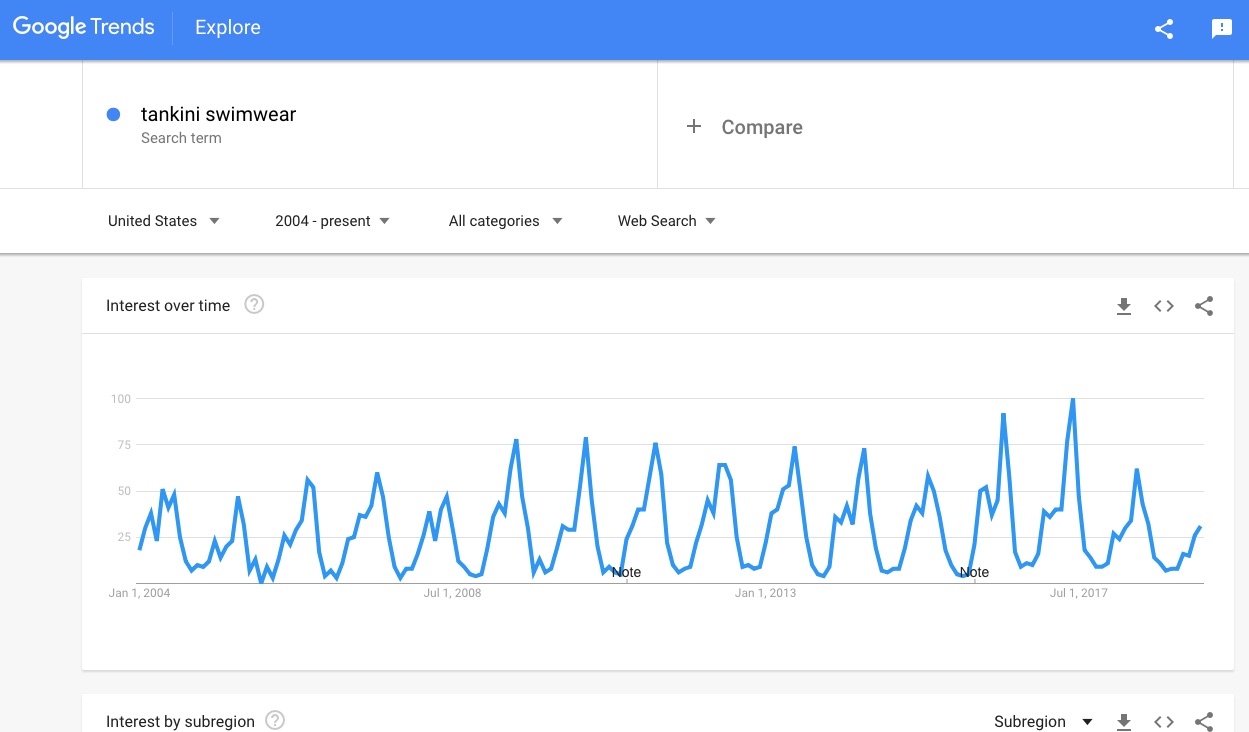
This will show you if a seasonal trend is predictable enough to factor into your PPC forecasting calculations. If a seasonal spike looks abnormal compared to previous years, then you’ll need to use contextual information to decide if it’s a fluke or a new trend that’s here to stay.
Gathering important data inputs is the easy part of accurate PPC forecasting. The hard part is analyzing and developing your projection. There are a few different ways to approach SEM forecasting. Each has its own benefits.
Manual Reports
Undoubtedly the most difficult way to forecast CPC and spend is by creating manual reports. PPC forecasting is possible with nothing more than a data set, a spreadsheet, and a few calculations. At a minimum, you’ll need impressions and bid data to create your own reports. If you have no previous campaign data, you can rely on suggested bids and cost per click from Google Ads. If you have previous campaign data, you can also include historical click-through rates, conversion rates, and conversion value.
With your manual report, you should be able to project:
All these calculations will depend on what ad groups, placements, targeting, and budget spend you allow to drive conversions. If you’re presenting projections as a proposal to business leaders, you’ll want to adjust all these factors to determine the best possible combination to drive conversions given your allowance.
An important adjustment to make for your PPC forecasting is impression share. You can’t assume you’ll buy all possible impressions. So calculate impression share to avoid overestimating projected performance. You can use past impression share from Google’s Auction Insights as a guide.
The biggest benefit of manual reports is that they’re completely customizable. You can include whatever data inputs you want, create projections the way you want, and adjust projections based on qualitative insights you gain about your business, market, seasonality, etc. The challenge of creating manual reports is sophistication. If you’re not a statistics whizz, it’s difficult to create highly accurate projections using just a spreadsheet. You can enlist the help of data scientists to do this for you, or turn to other SEM forecasting solutions.
Third-Party Reporting Tools
If you don’t have the skills or resources to create your own reports, then you can use a third-party reporting tool. There are a variety of options out there that will automatically import past performance data from Google Ads as well as consider other relevant data to summarize performance. This is beneficial because you don’t have to continuously download and analyze historical data to forecast spend and CPC. It automatically does this for you.
Third-party reporting tools also come with a variety of SEM report templates designed by PPC professionals so you can create customized forecasting reports beyond what basic spreadsheet analysis can provide.
PPC forecasting will always be a challenge for SEM professionals. There’s no way to really predict future performance with complete accuracy, regardless of how much relevant data you use. That said, if you invest in creating a sophisticated Google Ads forecast, the benefits are many. The better you predict future performance, the more confidence clients will have in your strategies.
Understanding how strategy changes impact future performance also helps you create more effective campaigns overall. With that in mind, investing time in creating manual PPC forecasting reports is a minimum requirement. Taking advantage of advanced tools to automate insights and adjustments can do even more to maximize the value of forecasting for SEM success.
From the podcast on your morning commute to asking Alexa to replenish your dish soap—we are shifting from an onslaught of screens to a new world of digital media powered by audio. Nearly two-thirds of the U.S. population has tuned in to digital audio, with podcasts commanding the largest share—followed by Spotify and Pandora.
In April's webinar, we explore the paid media opportunities that exist for audio today and share how programmatic advertising is driving growth and enabling smarter ways to target desired audiences.
How do you determine a search keyword’s value? Are you making data-driven bid optimization decisions based on keyword data? Should you be focused on keyword revenue-per-click in your PPC campaigns?
Search keywords. They’re valuable. Some are really, really valuable! Others have little to no value. Others you simply don’t know the value of for one reason or another.
What we do know is this: keywords are the lifeblood of paid search. Building a keyword list and then collecting data about keywords is paramount in search engine marketing, especially if you’re looking to optimize PPC campaigns.
If a keyword is generating a lot of traffic and clicks, it’s seen as important - but it may or may not be valuable to your business. You need to understand if it actually drives revenue and conversions.
If a keyword is a “monetizer” - or a high-revenue driving keyword - you’ll want to evaluate how much impact the keyword has on your business. You would look at it and say: “If we pause this keyword, how much will revenue decrease? By how much? If we decrease the bid, will we lose a lot on conversions - or if we increase bids, will we still only generate the same number of conversions?” There are many questions to ask to determine how valuable a keyword can be to your paid search program.
Evaluating a keyword’s value can be a challenging task. Some methods are more simple; some get deeper but may not be actionable; some are totally automated and drive action automatically! What we’re really after is the revenue-per-click metric that truly informs a bidding strategy.
Your keywords drive impressions, they drive ad-clicks, they drive conversions… and hopefully repeat purchases! They’re obviously worth quite a bit, and qualitatively and quantitatively are one of the most reviewed areas within SEM ad campaigns.
The dollar value of a keyword is, in short, the amount of money you can expect to generate from each click from a given keyword. A keyword may have only generated one click, or it may have generated hundreds of thousands of clicks; zero conversions, or dozens per day!
Conversions lead to dollar-driving outcomes. Dollars are our interest here. How much revenue can we earn from each click on each keyword?
Some of those dollar-values are actual and calculable (online or offline purchases for goods; lead form fills that lead to purchases), while others may need to be understood in aggregate based on metrics within your company (subscriptions or lead forms that don’t have a purchase, but create other dollar value).
Google Ads makes it easy to report on keyword performance and rank by impressions, clicks, costs, conversions, and even the aggregate revenue for certain conversions that can be tracked and directly tied back to the Google Ads platform. However, estimating the value of a keyword for a more specific use case (such as using that value for PPC bid optimization) requires a different view of keyword value, which we’ll dig into shortly.
To analyze a more nuanced value of each keyword on your business, you may need to do some serious spreadsheet wrangling. Why? To understand the impact of historical bid changes on conversions over time! (Those time-dependent reports are always hard, aren’t they?)
A method we’ve witnessed involves exporting large change history reports and large historical keyword performance reports, and then stitching them in Excel to look at the trend analysis. To do this, you would map the dates of bid changes on specific keywords to the keywords historical performance on given days on or after that bid change. Then you can get a historical understanding of the impact of that keyword’s bid on revenue, and see how changes impact your business.
Now, is that actionable? Depending on your team’s level of sophistication, it may or may not be - but with sufficient analysis you should have an understanding of how increases or decreases in bids create more efficient CPA or ROAS numbers on your keywords.
The keyword’s value can be understood in many ways, but ultimately you want a keyword valuation model that gives you something actionable to work with. Even more ideally: something that can drive action without you needing to apply all those changes.
In a large program with many keywords, the data export we’ve described may be fairly arduous. Without a program or tool to calculate these keyword values for you automatically, you would need an internal process for calculating the revenue per click on each keyword, which is a significant investment.
Keyword value estimation requires data. Having your conversion data (with revenue numbers) tied back to clicks and keywords is a prerequisite to being able to meaningfully calculate an “estimated keyword value”. However, with more and more data tied back to those keywords, on multiple dimensions, and over time, the true value estimation gets more and more accurate!
When you map all the data about costs and clicks and conversions back to each keyword, you can build a graph of revenue values–what we call “revenue-per-click” (RPC). The RPC graph provides a visual representation of the clicks vs revenue for that keyword. Automated bidding automation tools calculate RPC graphs for every keyword regularly to review data and discern if the value has changed enough to merit a bid change. The RPC calculation at scale enables a mechanism for taking that estimated keyword value and immediately putting it to work in a bidding calculation process.
Revenue-per-click is calculated in a meaningful way only because of large data sets and machine learning models. Without a machine learning powered process, these calculations - and the actions they drive - would lack serious optimization potential.
What is significant about a very granular and specific keyword value? So glad you asked!
When all the conversion data (whether immediate click-to-sale, or LTV from latent and repeat purchases) is used to model a highly accurate keyword value, then acting in a “data-driven” way naturally follows. The data provides a story of how much this particular keyword is worth across other variables, so that the information can be plugged into cost, volume, and bid landscape data to model the optimal bid calculation for any conceivable segment.
For instance, when person A from North Carolina searches for your exact match keyword in the morning on a Tuesday at work using a desktop computer and makes an immediate purchase… the bidding decision made for other similar search queries are valued in a similar light. On the other hand, person B from Los Angeles searching for your keyword in the late evening on a Saturday using a mobile device, and then purchases the next week, has a completely different value. The similar attributes should be accounted for in bidding decisions based on the dollar value calculated from those correlations in the data points.
Estimating the value of a keyword is an important and fundamental step in the process of calculating optimal PPC bids on keywords.
At the start of the process for any bidding optimization solution, the dollar value of each keyword must be determined. There are two notable pieces at play here: the “machine” that builds the model, and the data you feed that machine.
In the highest caliber optimization tools, the calculations for this revenue-per-click model are generated using various types of machine learning algorithms. Clearly processing at this magnitude is an issue with any standard approach (a multitude of keywords x a multitude of data points), so the infrastructure and scalability of the tool is important.
The data fed-in is likely even more of a secret weapon than the algorithms and modeling. The more sources the better, particularly as they relate to stages of the customer journey and revenue. (Imagine not only online purchases and lead forms, but also delayed transactions and CRM information being utilized).
Your customers’ digital journey is a gauntlet. From the initial search to the ad click and all the way down to payment, each checkpoint whittles through all but a dedicated minority. In SEM, we often encapsulate these customer checkpoints discreetly into what we call the “Conversion Funnel”. Lots come in the top and few go out the bottom.
The Conversion Funnel is a useful conceptual model only in that it serves to maximize what goes out the bottom. But any purpose short of that is misguided - it doesn’t matter how many people are interested in your applesauce if no one buys your applesauce. As with any model, though, we have to operate under some educated assumptions. In SEM, we assume:
These beliefs are obvious (and generalizable to all sorts of fruit sauces, and beyond). And they’re the same ones, of course, that all marketing is founded upon. Nobody is going to give you money for anything if they don’t first have the intention to do so. Thus, marketing aims to create that intent in someone and nurture it until they actually give you money. There are, however, some pitfalls lurking in these assumptions. They can be expressed as questions of measurement.
Where everything is quantifiable, as in SEM, these complications double down. A number measured correctly by the wrong metric is tantamount to a number measured incorrectly. And since how you measure determines how you optimize, you might peddle insistently to someone who prefers mango chutney, while neglecting the person who doesn’t know that your applesauce is the cure for what ails them. Misapplying the Conversion Funnel comes at an enormous opportunity cost.
The first step in effectively applying the Conversion Funnel to your SEM program is understanding the traits of the various points along it. The Upper Funnel is the wide-brimmed top half of the upside-down pyramid where potential customers enter. The Lower Funnel is the half towards the pointed tip at the bottom where your company ultimately monetizes those customers. In terms of their usefulness as points of measurement, the two halves of the funnel have inverse tradeoffs.
Upper Funnel Metrics:
Lower Funnel Metrics:
*Note: “Monetization Rate” is defined as the percentage of the time a potential customer at a particular conversion point eventually monetizes
As you move from the top of the funnel downwards, the number of potential customers tapers while their presumed interest hones. For example, more people are going to fill out a web form to be contacted about applying for a loan than are going to actually apply for loans. But a greater percentage of the latter group will actually end up enrolling in loan programs than the group that has so far only filled out a contact form.
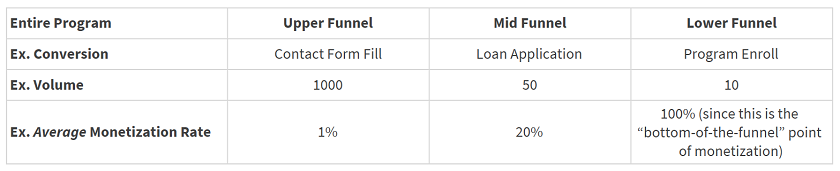
Think of the Average Monetization Rate as a measure of predictive power towards future revenue: the higher the rate, the more power-packed. One ‘Program Enroll’, then, holds a lot more weight in this department than does one ‘Contact Form Fill’ (by, on average, a factor of 100). Similarly, one ‘Loan Application’ averages 20x the predictive power of one ‘Contact Form Fill’.
On the other hand, the absolute volume numbers can be viewed as a barometer of the statistical significance of each conversion point: the bigger the sample size, the more likely that information is to tell us something about the future.
For example, let’s say a keyword has 100 clicks. On average, I expect 10% of clicks to become a ‘Contact Form Fill’ and 0.5% of clicks to mature to ‘Loan Applications’. If we see that said keyword has just 5 ‘Contact Form Fills’, it’s probably a below-average keyword. If, however, we instead see that this keyword has 0 ‘Loan Applications’, can we confidently say the same thing? We can only reasonably expect 1 ‘Loan Application’ for every 200 clicks. So, if we’re using this conversion point to measure the worth of that keyword, we’re going to have to wait until we get more clicks before we draw any conclusions. Responsibly untwining noise from signals like this is especially critical when we start to think about optimization, as significant data volume is a prerequisite to all but the most sophisticated bidding solutions.
Now comes the predicament. Assume the below keywords both benefited from the same amount of ad spend input to achieve their historical results. Which of the below keywords would you invest more money in today? Which is more likely to bring you back more money in the future?

Don’t wrack your brains too much - there isn’t an obvious answer. Doing the simple math of applying their monetization rates would suggest that these two keywords are not terribly different in value. Distinguishing further between these two keywords with any significance would require machine-learning algorithms with access to deeper contextual data.
Now let’s see how our decision-making would change if we were only to look at one metric or the other. Bear in mind that these two keywords have already revealed themselves to be of roughly equal value.

If you were to size up the success of your program using only ‘Contact Form Fills’, you would invest more money in Keyword B. You might even invest twice as much in it, ignorant of the fact that it likely won’t result in any more revenue than Keyword A. When we instead evaluate our program against only ‘Loan Applications’, the story flips.

So, if we were looking only at ‘Contact Form Fills’, we’d divert our entire budget to Keyword B. And if we were only looking at ‘Loan Applications’, we’d drown hefty sums in Keyword A. How do we reconcile that?
Well, it’s not quite the landslide that the ‘Contact Form Fills’ would have us believe. Only when we take both conversion points together do we realize that - even though they might average out to 1% or 20% in aggregate - the Monetization Rates can differ wildly across more granular program segments. Some keywords are naturally more conducive to generating higher-funnel conversions but nothing more, while other keywords might drive better advancement deeper into the funnel. In the end, the ‘Contact Form Fills’ and ‘Loan Applications’ tell a story of two similarly lucrative keywords.
To illustrate these keyword-level disparities, let’s return once more to our table, this time adding the bottom-funnel ‘Program Enrolls’ back into the picture. Remember that these are the point of monetization in this example. And since we’ve already established that these two keywords have similar chances at revenue, we shouldn’t be too surprised to see that manifest in their ‘Program Enrolls’ totals.
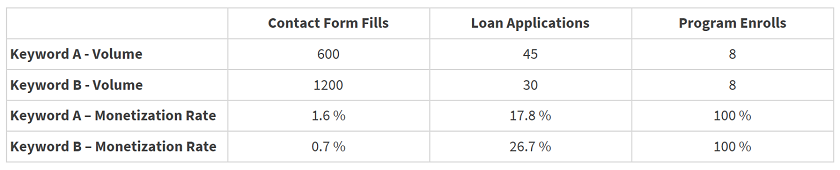
While the average monetization rates for the entire program are 1% and 20% for ‘Contact Form Fills’ and ‘Loan Applications’ respectively, these keywords are just two of many that go into that average. In actuality, Keyword B is great at getting potential customers just over the doorjamb while Keyword A caters to a more committed bunch.
While this may seem an extreme example, it’s hardly far-fetched when you consider a program with thousands or even millions of keywords. In the most simplistic case, consider two keywords with the same number of ‘Contact Form Fills’. Should we treat them equally? Does our answer change if we happen to know that one has a few more ‘Loan Applications’ than the other?
Each and every keyword is unique: they will all defy the average. The goal of any measurement is to understand those differences, using all the signals available and discarding all the noise. The goal of any optimization is to react to that.
Learn how to create Hybrid Conversions for a more revenue-oriented optimization in “Hybrid Conversions, Part 2: How You Can Utilize the Whole Conversion Funnel”.
Data is every marketer's best friend. There was a time, not long ago, when "advertising" simply meant utilizing the creative side of one's brain to come up with interesting spots that would pique audiences' attention. That's certainly no longer the case. Today's advertising is driven by data, analytics, and everything marketing experts can use to truly get to know their consumers.
This is why programmatic advertising has taken the lead with successful companies that know how to get their brands in front of people who will take notice.
Programmatic advertising employs the use of software to determine optimal ways marketers can utilize their digital advertising real estate. Essentially, machines buy ad space because they understand buyer behavior, so they're able to put ads in front of the people who are most likely to pay attention to them.
The machines that drive programmatic advertising understand where your customers came from, how they found you, and which keywords or ads were deemed most relevant. It's all about embracing the power of data science to learn how to better target your campaigns. Sure, humans are pretty good at managing data analytics, but when you put machines in the driver's seat, there's an entire world of digital behavioral data that will allow you to personalize messages in completely new ways.
For starters, programmatic advertising is effective. You don't need humans monitoring your campaigns because the robots do the dirty work for you. Efficient ad buys are more cost-effective, which means you're not only making money — you're simultaneously saving money, too. Machines don't get tired; they don't take vacation days or need time off on the weekends. They're always "on," which means you can enjoy the benefits of real-time ad bidding, no matter when the optimal time occurs.
Programmatic advertising enables you to answer your customers' questions before they even ask them. Thanks to the machines that are constantly scanning your audience's behaviors, you're now able to place ads directly before consumers who are looking for the exact solutions your company offers in real time. In return, you'll receive a virtually limitless set data that helps you home in on various segments of your audience with more personalized messaging.
Real-time behavioral data is a beautiful thing. The more data you have, the more individualized you can make your campaigns. Programmatic advertising enables you to reach a wider audience with more personalized messages.
Let's say a woman was browsing your site for designer shoes. Thanks to programmatic advertising, you'll know the price range she considered reasonable based on the shoes she viewed. You can also derive other essential information, such as:
Now, you have a lot of information that can be used to build a detailed buyer persona. The women who fit this persona are more likely to respond to certain targeted messaging than a retired male who's shopping for shoes to give his daughter for Christmas.
Since programmatic advertising takes into account the entirety of consumers' behaviors, it would be able to distinguish these two subsets of shoppers based on the way they interact with your site (and others).
Despite programmatic advertising's dramatic impact on the marketing world, there remains a major disconnect between media buyers and marketers. Media buyers have built the greatest understanding of this technology, while many marketers don't even know such a tool exists. This disconnect causes certain obvious obstacles, which can be overcome with the right strategies in place.
Twenty-nine percent of organizations claim they're not using programmatic advertising because they don't have a staff in place with the skills to use it properly. Obviously, since only 22 percent of marketers are using programmatic advertising, there's a huge opportunity for education to bridge this gap. Increasing awareness of this option means more people could begin to gain the skills necessary to execute successful campaigns.
Often, it's not that organizations don't have money available to allocate to programmatic advertising. Instead, they don't see the value in this tool when budgets are being created, so they allocate those funds elsewhere. The initial costs can seem intimidating to decision makers. Yet the increased efficiency and improved ROI, resulting from better-targeted campaigns, have early adopters of this technology experiencing strong competitive advantages in their markets.
Media buyers and sellers in the digital space have traditionally maintained human-to-human relationships. Some companies fear the integration of programmatic advertising would harm the existing trust between these two entities. To overcome issues related to transparency, both sides of the buying universe will have to work together.
Centro is where outstanding programmatic advertising begins. If you want to enhance your audience's experience while targeting the people who are most likely to pay attention to your brand, learn more about Programmatic Advertising with Centro.
PPC bidding optimization has come a long way over the years. The bid calculation process for at-scale programs has many moving parts and can be intimidating for data scientists, let alone the day-to-day users, managers, and stakeholders in paid search programs.
Bidding calculation in the modern era has many flavors, but we’re interested in the best and most optimized version; the type of process that is designed to drive peak performance. Our new Guide, Machine Learning Powered PPC Optimization, walks through both the prerequisites of a thorough bidding process and the bid calculation stages that modern SEM optimization tools are utilizing to unlock the most from large PPC programs. Its focus is on machine learning PPC.

The infrastructural foundation to the best possible bid calculation starts with the data architecture to capture brand interactions as a series of events happening in real-time. The system must be flexible enough to ingest all of the data sources that track, measure, or influence the customer journey.
Once that infrastructure is in place, that data can be utilized for execution; for action; for the modeling and calculation that turns a data set into dollars.
Our new guide to modern bidding, using QuanticMind’s calculation stages as a model and exemplar, explains the concepts and process of fully optimizing PPC bid management. The optimal bidding platform leverages the latest advances in Data Science, including machine learning algorithms, Bayesian modeling, predictive performance methodology, and natural language processing, to optimize SEM performance toward specific business goals.
There are six high-level steps.
One: Understand and Estimate Keyword Value
Stage one looks at the modeling that estimates the dollar value of each individual keyword. This process involves ingesting revenue data from any conceivable source and applying that back to the keywords in such a way as to estimate a dollar-value for each. This involves powerful machine learning models generating revenue-per-click graphs, and results in a dollar value that can be used in later steps to calculate optimal PPC bids.
When keywords lack sufficient data to make a meaningful model of the potential value, deep learning text recognition models are used to map semantically similar data-rich keywords to data-poor keywords. As a result, even low-click or low-conversion keywords still get the most accurate possible value assigned.
Two: Understand Click and Cost Elasticity
Stage two aims to understand click and cost responses to CPC changes, with the goal of generating a map of costs and the expected volume. This is where Bid Landscape Data from Google is highly useful, and applied at scale to an optimization practice.
Three: Calculate a CPC that Promotes Your Goals
Stage three combines the estimated dollar value determined from stage one’s artificial intelligence-powered PPC calculations and the cost ecosystem analyzed in stage two. The decision engine applies the advertisers targets, bidding strategies, and goals and then runs through and selects the best bids to maximize performance, given the data, calculations, and goals. Often, a Portfolio approach is used to bid against a target while maintaining an efficiency metric. This is the modern approach to PPC bid optimization that most bid management tools utilize - if they’re designed for medium to large SEM programs. QuanticMind differs in some ways from legacy tools, discussed further in the Guide.
Four: Calculate Bid Adjustments
Stage four repeats nearly the same process completed in the first three steps, but on a different set of data and with a different purpose: calculating and automatically applying bid adjustments. QuanticMind’s model shines at this point, using machine learning to optimize bid adjustments at scale. Device Bid Modifiers, Geo Location Bid Modifiers, and Audience Bid Modifiers can all be automatically calculated and applied, based on their relative successes in the SEM program. The data science algorithms used here are another advantage when attempting to calculate optimized bids at scale.
Five: Anomaly Detection
Stage five moves into the often understated - but highly important - anomaly detection. This is one of several areas where the infrastructure discussed at the top can “flex” its strength. When designed for effective capturing, cleaning, and piping of data from any source, the system provides better data for better execution. However, the opposite has negative effects: when data is missing or seems different than forecasts would suggest is reasonable, the performance can take a hit. Fully optimized bidding platforms prevent these problems by using multiple anomaly detection and issue-prevention steps, ensuring bids aren’t pushed based on bad data.
Six: Bid Push
Stage six is the execution! Push the bids and bid modifiers through the publisher and go live. Data collection is ongoing and fed back into the system. Other uses for more variable aspects of a program, like inventory management or a “maximum capacity of leads” per day or location, can be applied and fed to make decisions even quicker. Ultimately the process is repeated to create a virtuous cycle of optimized PPC bidding.
This guide will walk you through the modern solution to optimized bidding automation. It is a powerful tool to learn the leading process in paid search bid calculation and optimization. It helps paint the picture for how machine learning PPC is actually applied, how well-integrated data feeds the model, and how bid management decision engines step through the process of calculating and pushing bids. It helps answer the question: how can I optimize PPC bids?
‘Ask the Expert’ is a blog series that breaks down the complicated tools, tech, and trends you’ve been hearing about in the trade pubs and around the office. We reach out to our in-house experts to ask the tough questions and turn them into bite-sized Q&As for your reading pleasure.
This month’s topic? 5G. We brought in Centro’s senior director of media innovations and technology, Noor Naseer, to give us the breakdown.
What is 5G?
5G refers to the network that mobile data passes through. There is no set definition on what it is, in terms of standards and tech specifications. However, the general consensus is that it means data uploads and downloads on mobile devices whole lot faster - The type of speeds that consumers are really going to notice. Think: downloading a whole movie via your wireless network in seconds. With 5G, users could reach 10Gbps speeds. Most U.S. users are using wireless services that are on 4G networks, but major carriers have been busy testing and touting faster technologies.
What does this mean for digital advertising?
Similar to how broadband Internet fueled digital media consumption on desktops, and a subsequent rise in digital advertising, even greater advertising opportunities will be seen in apps, media and advertising on mobile devices. I see the most potential in improved ad quality and delivery. One aspect of this is the enhancement of location capabilities. Higher data speeds, better sensors, plus continued improvements in the geo-capabilities space, will give marketers very precise views of the user. The rollout of 5G will enable seamless sourcing and delivery of location-based data to millions of devices simultaneously. Another exciting potential is high-resolution video ads. Expanded capabilities under 5G include 4K video, with dynamic and personalized messaging, served in real time. More complex video ads will play with little to no latency issues.
Does 5G affect programmatic advertising?
The most significant foreseeable impact will be the serving of video ads on mobile devices through programmatic buying. Opening up the opportunities to serve video ads that render fully, are viewable, and are measureable, will drive marketers to spend even more significantly across this channel. As the demand increases, publishers will utilize more of these types of ad units, and DSPs will see more and more impressions from their supply-side partners. The bidding mechanism behind programmatic channels wouldn’t see significant change, as most major DSPs are already evaluating opportunities and churning through real-time bids at a rate of billions per second.
Beyond paid media, how could marketers capitalize on 5G?
A benefit with evaluating 5G at this point is that the possibilities are vast. The opportunities are whatever creative minds can think up. And it would rejuvenate ideas that were challenging to implement previously. We all remember the widely popular, mobile-driven, Pokemon GO that utilized augmented reality. I see 5G emboldening marketers to think and develop more of those types of VR, AR and XR (extended reality) experiences for their customers. 5G makes it more seamless to offer greater immersion and engagement to users.
What am I not thinking of when it comes to 5G?
It comes down to cost for the user. Broadband Internet on desktops took off because the costs were manageable, or it was bundled into other services (enabling the ease of adoption). Initially, 5G is looking like a premium upgrade, where it is an add-on cost to an already premium mobile plan, or extra equipment is needed. There will be early adopters, but there may not be scalable audiences for marketers to reach. Worth noting is that broadband started as a premium service. Millions of consumers at the onset of broadband had lower cost options (dial-up, anybody?). So, history shows that so-called “premium services” in the present could morph into widely-popular essentials for the normal consumer, especially as more companies enter the market and release competitive offerings. Chances seem likely that 2020 will be the debut year of many exciting opportunities with 5G.