
Technology
Basis Platform
Advertising Operating System
Communication Portal
Intelligent Collaboration
All Channel Activation
Activate Media on Every Channel

Consulting
Resources
How is your latest campaign doing?
Are you driving traffic to your site? Are you increasing conversions? Are your social shares increasing your presence on the web? If proper metrics aren’t established in advance, you won’t be able to answer these questions. Numbers are needed to gauge success but know that numbers alone aren’t going to tell you everything.
Establish a baseline for the metrics you’re looking to measure and interpret the analytics that represent the various elements of your campaign. There a lot of elements that can be measured—but how do you know which metrics are most important to track for your business?
Review important metric considerations for ad campaigns below:
How are you being found on the web? If you’re mindlessly putting ads out into the universe in hope of gaining clicks—chances are, you're spending too much time and effort in places that aren't driving your bottom line. Regardless of the industry—knowing how consumers are finding you will enable you to optimize your outreach and focus on the channels that are actually driving traffic.
Programmatic technology was created for this very reason; robots track consumer behavior and learn where your traffic is coming from. Basically, it allows you to monitor performance easily so you can see which channels are most productive for your messages.
Are people leaving as soon as they arrive on your site? If so, that’s probably costing customers. Your bounce rate is indicative of the percentage of people who navigate away from your site after they look at the first page on which they land. There are many things that can cause your bounce rate to hit alarming figures but knowing what's causing people to leave will give you the power to remedy the situation.
The following are a few common reasons companies experience high bounce rates:
This metric tells you how many people have actually clicked on your ads, versus the number of people it was put in front of. In an ideal world, you’re putting ads directly in front of the consumers who are most likely to be interested in your products or services. A low CTR may indicate that you're bidding on the wrong keywords, or that your messages are in the wrong places.
Page value tells you where you’re making money in terms of transactions. For example, are people purchasing your products from the homepage or via individual pages? Knowing which pages are most valuable to consumers will help engage your audiences in more meaningful ways.
At Centro, data and analytics are what we do best. If you're ready to automate and optimize your campaigns in a brand new way, let's talk! Request a demo today.
As a mom of two young kids, I am very passionate about providing them with great experiences. I take them for hikes, biking trips, long drives, multiple vacations, and, of course, to any new food joint that opens up in downtown Palo Alto or Menlo Park.
My kids, like every other kid (and many adults too!), love ice-cream. But when it comes to flavors, their choice is simple: chocolate for my boy, strawberry for my daughter and between my husband and I (occasionally we try something new) we end up with vanilla. If you look at ice cream flavors, I bet these three outperform sales of all others.
In the summer of 2017 when we were in Portland, Oregon for a vacation (yeah, weird Portland), we tried Salt and Straw and for some reason, that Ice Cream experience stuck with my kids. So when we heard that they opened up a storefront in downtown Palo Alto, we just had to go back.
So now at Salt and Straw, our new favorite flavors of ice cream are “Strawberry Tres Leches”, “Freckled Mint TCHO-colate Chip” and “Double Fold Vanilla”. Ah well, you would think we didn’t go too far from our regular, favorite flavors. That got me thinking creatively about how we manage our keywords.
If you are a performance marketer (like me) you would agree that we often pay too much attention to our set of top keywords. We are ready to bid and pay Google, Bing, and Amazon any amount to get our ads in the top positions for that keyword or set of keywords. Why? Because we spend a lot of time trying to understand the full funnel view of those keywords to know how they are converting from prospects to customers. We know that those queries/keywords, i.e. chocolate ice cream and strawberry ice cream, have topped our sales charts over and over again.
However, many marketers are still relying on the bid optimization tools that Google and Bing provide, even those with decent SEM budgets (~$50k). These publisher optimization tools and best practices like “Estimated first-page bid recommendations” and “Smart bidding” end up increasing our CPA and thinning our margins on those top keywords.
The good news, though, is that marketers have options now. This eBook - SEM Optimization Techniques: Are You Overpaying Google? - touches on how using revenue-based bidding can help us achieve our goals without overpaying for certain keywords.
We all have thousands of keywords in our SEM PPC accounts. Although these keywords are grouped together per product or common theme in each folder or campaign, many of them suffer from a “low-quality score”. Quality score is a black box and many of us have been working day and night on the prescribed recipe to get the best quality score for our top keywords. Think about it for a second! If the keyword doesn’t have an appropriate bid, it won’t appear in top searches and won’t get clicked. And if it doesn’t get clicked, Google’s algorithm will mark it as “bad quality”. It’s a chicken and an egg problem that we’re all dealing with.
The other set of keywords (a.k.a. long-tail keywords like Freckled Mint TCHO-colate Chip and Strawberry Tres Leches) are like many flavors in the ice cream shop that have not turned around (i.e. optimized) for months. They are often ignored because they don’t sell well or it takes too much time to optimize them. After all, we’re all humans and have limited time in our day to improve our SEM performance. But we often ignore the fact that there could be a strong following of these long tail keywords, i.e. if someone searches for Freckled Mint TCHO-colate Chip, they have a strong intent to buy and eat it. You don’t want to miss this opportunity.
With developments in data science, it’s possible to work on both sets of keywords (top converting and long tail keywords) and achieve the best performance for SEM PPC campaigns.
In this eBook, we touch upon the power of machine learning algorithms and how they can empower optimal bids across your entire portfolio. The QuanticMind algorithm integrates multiple sources of data (CRM, Business Intelligence, Revenue Intelligence, Inventory, Weather, and Publisher data like keywords, clicks, impressions, audience, etc.) and churns out the best possible bid for “ALL” keywords at that point in time to achieve a goal of conversion. Kind of a no-brainer and it works.
QuanticMind’s technology was previously only made available to a handful of premium customers, until now. Since many enterprises like 1-800-Dentist, Windstar Cruises, Moz and Hot Topic have seen great success with this technology, we’re now making it available to other performance marketers too. You could save time and focus on more strategic planning rather than manually changing bids and engaging in “busy” work.
And, of course, don’t forget to visit Salt and Straw Ice cream with your entire family. Now, my monthly ritual is to try their new and seasonal flavors 🙂
Accurate attribution is likely more important for search advertising than any other marketing initiative. PPC managers target hundreds or thousands of keywords to reach their audience on search engines. Paid search attribution helps them understand the role each keyword plays in driving key performance indicators (KPIs).
Other marketing initiatives simply don’t have the same volume of attributable data points to work with. As a result, even slight changes in your paid search attribution strategy can have a huge impact on the return on investment (ROI). Industry research and the personal experiences of PPC practitioners are more than enough to prove this. Here’s an overview of the different tools and models marketers can use to maximize insights, performance, and marketing ROI from paid search attribution.
Google Ads offers several different attribution models as features advertisers can implement for conversion tracking and bidding insights. Right now, attribution modeling is available for Search Network and Shopping ads, but not Display ads. It can be used for website, Google Analytics, phone call, and import conversion actions (but not for app and in-store conversions).
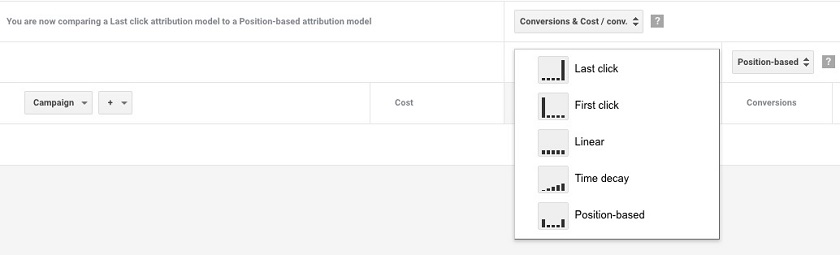
Google Ads attribution models include:
Last Click - All credit for the conversion goes to the last-clicked ad and corresponding keyword.
First Click - All credit for the conversion goes to the first-clicked ad and corresponding keyword.
Linear - Distributes the credit for the conversion equally across all clicks on the path.
Time Decay - Gives more credit to the clicks that happen closer in time to the conversion.
Position-based - 40% credit to the first and last-clicked ads; 20% spread across other clicks.
Data-driven Attribution - Assigns credit for the conversion based on past data for the conversion action.
You might like to think that any attribution model you use is “data-driven.” But data-driven attribution is actually the name Google gives to a special model reserved for accounts with sufficient data. This model calculates the contribution of each keyword across your conversion path based on previous data, then distributes credit for the conversion action.
If your account has enough data, then the data-driven model is definitely the best choice for paid search attribution. It’s more likely than any other model to reflect the real value of different touchpoints in your funnel. It considers all clicks from your account (both converting and non-converting) in order to assign value to an ad or keyword.
When using Google Ads to build a paid search attribution strategy, it’s important to compare the different modeling options to determine which one is best for you. Google allows you to easily do this from your AdWords account:
1. Click the “Tools” button from the top menu
2. From the drop-down menu, click Measurement, then Search attribution
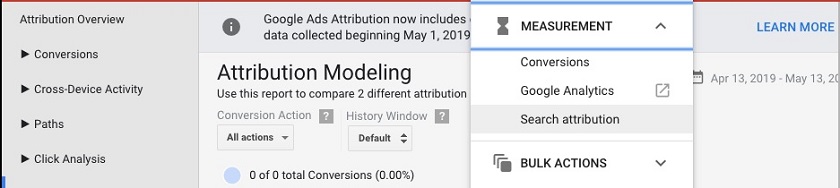
3. On the side menu of the next page, click Attribution Modeling
4. From the dropdown menu, select the dimension you want to view attribution models for
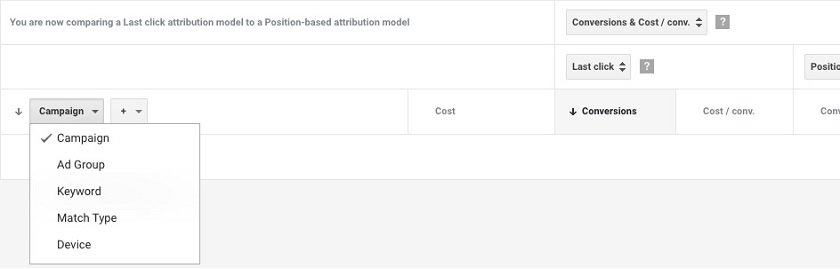
5. Then use the other dropdown menus to select which attribution models you want to see and compare
Google Ads attribution models are a great free resource you can use to build your paid search strategy, but it has some limitations compared to more advanced tools out there.
Search Ads 360 is a paid alternative to Google Ads. It has a lot of features that empower improved paid search performance and track your overall marketing efforts. Their advanced attribution models are just one of many reasons you might consider investing in it.
By default, Search Ads 360 uses a last click attribution model. You can, alternatively, import a different attribution model from Campaign Manager or Google Analytics. Search Ads 360 also offers data-driven attribution modeling that can include several different interactions. This is valuable since a great many conversions are driven by a series of clicks on display ads, paid search, shopping campaigns, generic or brand keywords, and other biddable items.
Data-driven attribution can help identify frequent conversion paths within a campaign, then compare these paths with other interaction patterns to accurately assign credit. You can also compare the difference between a model built on data-driven attribution calculations and the traditional last click model
Unlike Google Ads, Search Ads 360 can analyze clicks from a variety of channels, including:
This data integration is able to paint a more accurate picture of the path to purchase so you can successfully attribute credit to different touch points across paid search and other advertising initiatives.
If your priority is building a cross-channel attribution model, then Google Analytics 360 is a powerful option for PPC attribution. It’s designed to work together with Search Ads 360 to help you track, optimize, and automate your marketing efforts across varying channels.
Key features of Google Analytics 360 include:
You can use performance data from Analytics 360 to drive search campaigns, bid strategies, and rules in Search Ads 360. Analytics 360 gives you a full picture of marketing performance, while Search Ads 360 can help you act on these insights through automated bidding.
Investing in third party attribution technology is a good idea for businesses looking to get more accurate and nuanced results from their attribution strategy. There’s no denying that using a tool like Google Ads for cross-channel attribution could have an inherent bias issue. Marketers who have explored third party attribution tools and compared their results to Google Ads often find Google Analytics shows a larger number of conversions from Google channels than the third party tool.
Third party attribution technologies should (in theory) eliminate this bias and offer more opportunities to customize your attribution model. Some examples of notable third party attribution tools include:
Facebook Attribution is a relatively new option and not one that most paid search advertisers consider. It is, though, a compelling option because it integrates with a lot of other tools, including Google Ads, Campaign Manager, and Search Ads 360. It further assigns credit where it’s due for conversions across marketing channels:
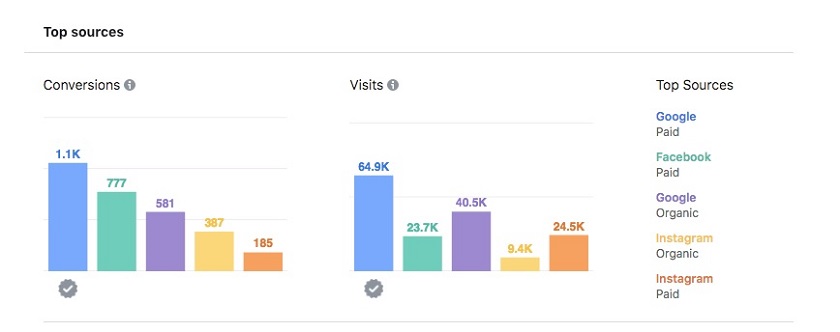
VisualIQ is another alternative that offers multi-touch attribution across channels, collecting audience and attribute data to created customized attribution models. Professionals use it to learn which publishers, campaigns, placements, keywords and other tactics drive their KPIs.
Marketers wishing to build a strong paid search attribution strategy should consider the features of third-party tools based on their unique needs. Make sure they have the right integrations as well as sophisticated reporting needed to make bidding decisions. Understanding the role PPC plays in driving conversions only matters if you can also see which dimensions are driving performance (campaigns, ad groups, keywords, etc.).
Marketers today dedicate a great deal of time and energy to finding the most accurate PPC attribution model to understand the value of different touchpoints for driving conversions. Attribution is supposed to provide performance insights you can use to further optimize your marketing efforts. In paid search, that means adjusting investment in different keywords, ads, and ad groups based on their conversion value.
So, while it’s important to choose the perfect attribution model, it’s equally imperative to ensure that you use it quickly and efficiently to optimize your campaigns. Google Ads offers a solution for this, helping advertisers automate bidding decisions based on paid search attribution performance. But their solution comes with some inherent limitations that only advanced bid optimization technology can help with.
Unifying Data Sources
The customer journey is complex but largely trackable, thanks to the growth of MarTech. Today, there is an overwhelming amount of relevant data about audience behavior and the factors that impact their purchase decisions. Most marketers are in no position to harness it all to drive performance-enhancing insights. And the popular attribution tools Google offers only paint a partial picture, focusing heavily on data from Google properties.
The solution is a platform flexible enough to capture all relevant brand interactions. Advanced bidding technology does this, factoring in important data types such as:
The more data your attribution technology uses to understand the path to purchase, the more accurately it can attribute conversion value to different marketing assets.
Taking the Guesswork Out of Bidding
Third-party paid search attribution technologies have more data integration options than Google Ads or Google Analytics. They can help you build a more accurate attribution strategy, but lack the features to implement changes to your PPC campaigns based on these insights.
Automated bidding technology uses historical performance data, statistical modeling and artificial intelligence (AI) to accurately estimate the value of each keyword in your campaigns. It’s then able to make necessary changes to your max cost-per-click (CPC) and bid adjustments. By using all relevant performance data and adjusting bids in real time, automated bidding technology can improve campaign efficiency and performance, freeing up marketing managers to explore new growth initiatives.
More Precise Attribution
Top-of-the-line bid automation tools have features that ensure more precise attribution than what basic models and technologies can provide. Such technologies use multiple data sources to map locations with higher precision (zip codes, cities, metro areas, etc.). This allows the tool to better attribute cost and revenue data to the correct location, improving the efficacy of automated location bid adjustments.
The more sophisticated solutions also use decimal conversion values, attributing a single conversion to multiple clicks throughout the customer journey. This better illustrates the real impact of each keyword on the path to conversion. The algorithm can then use this more accurate data to calculate click value and bid more accurately.
Accurate paid search attribution is key for success in today’s competitive PCC world. There are a variety of free and paid tools with different modeling capabilities to choose from. No matter if you’re investing time, money or both in PPC attribution, you must ensure it brings positive ROI for your marketing efforts in the long run.
Advanced automated bidding technology is one solution that offers nuanced insights into what biddable factors drive conversions, and allows you to make changes to your campaigns efficiently and at scale.
Thought leaders, assemble! We recently hosted a roundtable discussion with the Centro Industry Advisory Group (CIAG). The CIAG is aimed at gathering valuable input from thought leaders to help shape the future of advertising technology and services. Read on for four key takeaways:
1. Expect unexpected staffing issues
Recruiting and retaining talent is an issue for agencies in all markets. In large markets, intense competition for talent leads to higher turnover, and in smaller markets, qualified candidates can be hard to come by.
On top of that, staffing needs are unpredictable. Team needs change day-to-day due to sick days or unexpected departures. Events such as an acquisition, a change in management, or a big account win or loss can have long-term impacts on staffing plans.
Whatever the reason, be proactive. Use platforms and implement processes that help you prepare for a staffing gap before there’s an issue. Make it easy for team members to pick up where others left off by preserving institutional knowledge during a departure. Use tools that retain campaign histories, log all relevant communications, and store critical documents where they can be accessed by the rest of the team.
Finally, when hiring, lean into your network to find great people. Be open-minded and resist the urge to make a checklist. Instead, focus on a candidate’s adaptability, culture fit, and capacity to learn.
2. When it comes to CPMs, you get what you pay for
In the media world, if something seems too good to be true, it probably is. Cheap CPMs may mean more impressions—but not all impressions are created equal. For the middle 70% of the CPM range, quality and rate are reasonably scalable.
On the other hand, low-end and high-end CPMs can be out-of-whack; for example, $50 CPMs rarely produce 10x the benefit of a $5 CPM. Conversely, winning inventory at $0.25 per thousand can be wasteful and damaging for brands if their ads are running on the wrong sites.
Be sure to monitor your campaigns to balance the quality and price equation. Viewability is a good place to start, but also look for reasonable frequency, comb through domain reporting for excessive impressions on unknown sites, and turn off exchanges with reputations for excessive non-human traffic.
Additionally, depending on your set KPIs, set up testing opportunities to compare different CPM ranges.
3. Strategic thinking makes a comeback
With so much focus on ad tech, data, and execution in the last few years, deep strategic planning has taken a back seat—but don’t lose sight of the fact that a solid strategy is critical to a campaign’s success!
Rather than channel-based planning, flexible categorical planning may help media professionals and brand managers freshen their approach. Planning categorically means that groupings are tailored to each specific initiative based on business goals and marketing positioning.
For example, digital planners traditionally use buckets like search, social, and programmatic. Instead, consider groupings that align with your business goals and build tactics to serve those goals. This could include simple buckets like “engage, close, retain” or more customized frameworks such as “buzz-building, event support, post-event reengagement.”
This kind of creative thinking can create a more unified experience for consumers, help brands break through the noise, ultimately, produce more effective campaigns.
4. Narratives are more valuable than numbers
We are currently in an era of ‘data bloat’ where whatever can be measured is measured. It’s easy to get lost with all the numbers flying around, but two elements need to remain at the forefront: KPIs and effective narratives.
First, before any performance data is gathered, establish a KPI that aligns with your strategy. Once data starts coming in, maintain focus on the KPI and make optimizations to improve that singular metric. Recommend actions to take based on the campaign data, anecdotes from non-competitive parallel brands, and industry trends. Actionable insights are more valuable than reporting.
Second, find the most effective way to tell the story. Every audience is different, and you may need to change your approach to communicate effectively. That may be via data visualization, digging through the data together in a working session, or creating a sample user journey to illustrate your theme. Every report should have a narrative and a next step.
At Centro, we can help you implement these insights to keep your business at the top of its game. Whether you’re ready to plan and buy on your own or if you need additional guidance—we have a solution. Learn more about Basis and Centro services today!
In paid search programs, the levers you can pull to improve results come in many forms: landing page optimization, ad copy testing, program structure efficiency, automated workflow, and reporting functionality. The most powerful tool, though, is unquestionably keyword bids.
SEM bidding optimization is the most significant way to achieve peak performance in paid search. A number of techniques and tools are available to help advertisers take on this challenge, but there are strengths and weaknesses among these. Over time, innovative transformations have sprouted up, but there is an apparent divergence between what benefits smaller versus larger search programs.
In this article (and more thoroughly in our new eBook) we explore some of the transitions, strengths, and weaknesses of different PPC bid optimization techniques - all to help performance marketers like you find success in improving paid search results.
Today’s landscape is varied, and many of the tools are provided by our beloved search engines - predominantly Google and Bing.
Manual bidding is a powerful technique that gives the advertiser control, but at the expense of effort. Like some of the other native tools, it can work well for smaller, local programs, yet any sizable program (in terms of budget or keywords) will quickly hit a problem of scale where true optimization, frankly, can no longer happen.
Google’s Smart Bidding options are the clear stand out for cheaply and easily applying real optimization tools to your PPC bids, but even these have limitations. Restrictions arise when it comes to the amount of your business data that can be used for optimization (outside of the Google tracking ecosystem), or when it comes to long-tail keywords without enough traffic or conversions to get any optimization.
Scripts on Google and Bing, or other “out of the box” tools, provide some functionality to optimize, but many of these are made for problems of simple logic, programs without many keywords, local businesses, or businesses that collect meaningful lower funnel data. Third-party tools are outperforming native tools in many instances due to differences like these between simple, small programs, and large, complex build-outs.
Methodologies have also transitioned over time. The old folder model was a great way to optimize PPC bids in the past, but it has since become outdated. A folder would optimize for a given goal in a simple and direct way: higher-performing keywords would be bid up, and lower-performing keywords in the folder would be bid down. This, unfortunately, resulted in some keywords becoming lost after being bid down so regularly - not the ideal outcome.
Aggregated bidding leads to inefficient bidding as it does not reveal or eliminate hidden waste at more particulate levels. In general, aggregating simplifies the task at hand (which is great in some ways!). However, when we’re talking about SEM programs that are core revenue producers in your business, this mindset promotes just-above-average results.
With the current data environment we live in, PPC marketing creates massive troves of click-level data that follows the customer through their journey to multiple purchases, sometimes offline sales. This data is the key and the fuel to unlock and boost SEM.
Granularity is of massive importance in the modern age of bidding optimization. Click-level information leads to click-level correlations, which result in the ability to optimize at very granular and specific levels for different audiences and keyword queries.
The tried-and-true SEM optimization technique known as portfolio bidding is actually still one of the best possible ways to make PPC bid decisions for programs that have revenue or conversion goals, but still need to stay within a cost efficiency limit. Most bid optimization tools utilize this technique, but there are some key differences that will separate the good performers from the greats. The three key aspects are:
SEM teams looking to optimize PPC bidding face a number of challenges and blockers. There are some obvious ones, such as insufficient budget or already averaging position one, but we discuss some of the blockers that are hidden at first glance, including:
Our new eBook, SEM Optimization Techniques: Are You Overpaying Google? looks at the landscape of bidding optimization techniques (from tools to methodologies), some blockers teams may face, and the variability between average versus great third party PPC optimization tools.
Why is portfolio bidding for PPC the best methodology for many large advertisers? Why - for others - is there an even better way than portfolio bidding? Is infrastructure that important for fully optimized PPC bidding? How does more granularity and more data create better results? Read the eBook to learn these answers and much more.
![SEM Optimization Techniques: Are You Overpaying Google? [eBook]](https://centro.net/wp-content/uploads/2019/04/Blog-BiddingGuide-CTA.png)
Happy Mental Health Month! We’re taking time this May to examine how we can better promote mental wellbeing in ourselves, our workplace and communities. Like anything else worth doing, maintaining mental health takes effort, diligence and a certain level of honesty—both with ourselves and the people around us.
When it comes to maintaining mental wellbeing in the workplace, it can be a struggle to strike a healthy balance. Work can be fast-paced and demanding, and with these demands come anxiety and stress—it’s inevitable! One thing that sets Centro apart from other companies is the variety of resources available to employees that help address and manage these emotions.
Think about it—if we were to walk into work with a fever and a runny nose, there would be no hesitation to let peers know that we weren’t feeling well—maybe we’d even stay at home and rest, or make an appointment with a doctor, depending on the severity of symptoms. Why shouldn't the same apply to mental health?
Anxiety and depression are common mental health struggles. According to Assurance (Centro’s insurance provider), nearly 6.8 million Americans live with Generalized Anxiety Disorder (GAD), which is characterized by “persistent and excessive worry.” Anxiety disorders alone affect 57 million adults in America, while depression affects more than 300 million worldwide, according to the World Health Organization (WHO).
Here’s why Mental Health Month is so important: Although anxiety and depression are considered "highly treatable" by WHO, only 36.9% of individuals suffering from them reported seeking treatment in 2016. On the other hand, according to the CDC 77.8% of people diagnosed with sinus infections sought treatment by a medical professional. Interesting, right?
So, why is it that when our physical health needs attention we're comfortable seeking help, but when our mental health is suffering, we're less likely to reach out? Unfortunately, the stigma surrounding mental illness has a lot to do with it. Luckily, we know how to combat that stigma—by having open conversations that normalize mental health and mental health treatment.
Part of what makes Centro so great is the company’s consideration for our employees’ mental health and wellbeing. For example, Centro offers the option to take “Ferris Bueller Days”—a personal day (or two) to use however you see fit, with the intention of taking space from work, to relax and find time for yourself. Centro also provides on-site (and remote) yoga and meditation services to provide an additional outlet, and help employees manage stress and anxiety. Our robust benefits package also allows employees to seek affordable mental health care as needed.
Over the course of May, we will continue to highlight the significance of mental health and wellbeing, and how we work to manage it in our daily lives. It’s important to acknowledge mental health in our workplace and is just one of the many ways Centro is always striving to cultivate a better you.
Big things are happening at Centro in 2019! Learn more about our unique culture and check out our careers page, to see how you can grow with us.
Balancing your SEM budget is one of the major challenges of marketing management today. You put a lot of effort into PPC budget forecasting to secure the funds you need and so the last thing you want is to mismanage it through overspending or underspending.
Poor Adwords budget management can lead to missed performance targets. It can also frustrate the leaders who put you in charge of SEM in the first place. That’s why it’s important to balance optimizing your campaigns for budget caps as well as performance goals.
Numerous factors can contribute to poor SEM budget spend. And even the smallest inefficiencies in your maximum cost per click (CPC), targeting, and overall bid strategy can add up to serious budget management issues down the road. Here’s how to address some of the biggest problems that cause Adwords overspending or underspending.
Setting Your Budget Too Low
The most common reason for SEM budget underspending is setting your budget too low. Small businesses often have this problem, but even larger enterprises are known to set very low budgets when trying out new campaigns and strategies. What they don’t realize is that their cautious approach is the origin of their performance issues.
When you have a small war chest, it becomes more difficult to bid on more relevant (and competitive) keywords. As a result, your impression share will suffer. Bidding low on competitive keywords significantly reduces the chances that you’ll win bid auctions and get visibility for your ads in search results. To see if insufficient budget is your issue, use Auction Insights in Google Ads. This tool breaks down how your ads are performing in bid auctions compared to your competitors.
Auction Insights will show you:
If your ads are performing poorly on these metrics, then an insufficient budget could be the culprit. To fix this, you’ll need to either increase your budget or reduce the number of campaigns you’re running. Then you can reallocate more of your budget to make the remaining campaigns more competitive.
Low Conversion Rate
Another common reason you might underspend your SEM budget is if your conversion rate is too low. Failing to use your full allocation doesn’t mean you’re saving money, it means you’re missing out on clicks and conversions.
If your ads appear to be performing well in Auction Insights but your conversion rate is low, then that means there’s something wrong with your targeting or ad copy. You’re spending budget for your ads to rank well in search results, but nobody is clicking on them. Maybe your ad copy isn’t relevant enough to the keywords you’re targeting, or, maybe the keywords you’re targeting aren’t relevant enough to your business.
Take a look at keyword performance as well as your ad copy. Then you can pause certain ad groups or remove keywords that aren’t generating enough clicks. You may also want to adjust your bids to prioritize spend for keywords or audiences that get the most clicks.
Seasonality
Seasonality is a factor that can influence both budget overspend and underspend. Seasonal changes in the search volume of certain keywords impact performance and spend for most PPC advertisers. In order to prevent poor Adwords budget management, it’s necessary to factor seasonal variations into your PPC budget forecasting and budget pacing month-to-month.
Marketers can use Google Trends to see how, and to what extent, seasonality affects the SEM landscape for their business niche. If you type in target keywords, you can view trends in search volume each month of the year as well as long-term trends since 2004. For example, the keyword “snow tires” shows a predictable spike in search volume during the winter months over the past five years:

An increase in search volume means more opportunities to get impressions and spend your budget. It also marks a time when PPC advertisers will bid more competitively, just like e-commerce businesses do during the holiday shopping season. Failing to make adjustments to these changes can cause Adwords budget management issues.
Seasonal decreases in search volume can also lead to budget spend problems. Say, for example, you’re allotted a $5,000 monthly PPC budget with the goal of keeping your cost-per-acquisition (CPA) below $20. This is easy enough to maintain until a seasonal decrease in search volume leaves you underspending by $1500 on your budget.
To fix this, you could include more (less relevant) keywords in your campaign targeting. This could end up attracting less qualified traffic, increasing your CPA in the process. Retrospectively, you should have factored seasonality into your annual campaign forecast in the beginning. $5,000 a month means a $60,000 annual budget. So, you could allocate more budget for high volume months and less budget for low volume months, averaging out to your $5,000 goal.
Google Ads Features
The daily budget you set in Google Ads doesn’t constitute a spending cap. It’s the average spend Google’s algorithms want to shoot for when bidding. Sometimes you’ll end up bidding less, and other times you’ll end up bidding more, but it’s common for PPC advertisers to log in to their account and discover they’ve significantly overspent their daily budget. Campaign settings could be the culprit.
Back in 2017 Google announced a mandatory change to how daily budgets are handled. Adwords daily budgets can now overspend by 200% to reach advertiser goals. This announcement was frustrating and confusing for advertisers because budgets are set for a reason. Now, though, it can still feel like you don’t have control over how much you end up spending daily, weekly, or monthly.
To address this issue, you could just accept the wisdom of Google’s algorithms and rest easy knowing you’re not really overbidding by 200% in the long run. Google will balance out your bids and never charge you if your overall budget is exceeded. Or, you can make some changes to get more control over your budget pacing. Currently, there’s no way to stop Google from overspending your daily budget in the settings, but you can use scripts to control overspend in Google Adwords and Google Shopping.
Poor Ad Rank
If your ads aren’t ranking well, you may find yourself regularly increasing your bids in order to beat out your competitors. Inadvertently, you can end up spending a lot more than necessary to get the ad position you really want. However, the reason behind your poor ad rank might not be the stiff competition, but rather because you’re simply targeting bad keywords or audiences, or there’s something wrong with your ads entirely.
Here are some important Google Ads metrics you can look at to see if poor ad rank is causing you to overspend your budget:
There are many factors that can contribute to poor ad rank. When you target less relevant keywords, it impacts your click-through rate and Quality Score: an important metric Google uses to decide ad rank. So, go through and eliminate problematic keywords from your campaigns that have a low CTR.
You should also look at audiences, other targeting dimensions, and your ad copy as potential factors in poor ad rank. Pause poorly performing campaigns until you can narrow down the issue, and in the meantime reallocate your budget spend to better performing campaigns.
Dimensions with Poor ROI
As a PPC manager, your goal is to keep your average cost per click (CPC) and cost per conversion as low as possible while still maintaining campaign performance to meet your marketing goals. How much you need to spend for a conversion, though, will depend on a great myriad of factors, including dimensions like location, ad schedule, and device. Allocating too much of your budget to dimensions with poor ROI leads to spending much more than necessary to get conversions.
Look at devices, for example. If you analyze past campaign performance, you may find that your average CPC and cost per conversion are lower on phones than desktop computers. Naturally, you wouldn’t want to eliminate mobile devices from your campaign altogether, but you could introduce an adjustment to bid more on searches from desktop computers. This way you can focus more of your budget on getting cheaper conversions and reduce wasted ad spend in the process.
To identify bid adjustment opportunities, check out your devices, ad schedule, and locations tabs in Google Ads. Important metrics to pay attention to are:
You can also reduce unnecessary spend by adjusting your bids for different audiences that have a good ROI. Audiences can be based on demographics, purchase intent, remarketing, and other factors that make them more relevant and valuable for your business to target.
An Aggressive Bidding Strategy
It’s easy for PPC managers to get caught up in the key performance indicators (KPIs) and forget about the underlying goals they represent. Sometimes when you focus on using your ad spend to maximize campaign performance, you end up spending more than you need to meet business goals.
Using an aggressive bidding strategy to maximize impression share or obtain the top ad position is an example of this. You’re going to need to bid significantly higher if all you want is to get your ad in the #1 spot in search results. Ranking in the second, third, or fourth position, though, can still drive a lot of clicks and conversions for your business. Maybe it’s not necessary to target the first position and still get conversions. The only way you can find out is by reigning in your aggressive bidding strategy, and once you do reduce your bids, you’ll have more budget to reallocate to new initiatives.
There are countless ways to accidentally overspend or underspend your SEM budget. The reasons outlined above are just a partial list of the most common causes of budget pacing issues. Addressing them requires paid search practitioners to consistently monitor campaign performance and budget spend. And, even if you follow all the best practices, you’ll still end up with some inefficiencies.
If you want to make SEM budget management a priority, then technology is key. PPC optimization tools provide a comprehensive solution to eliminate Adwords overspend and underspend overall.
Calculating Optimum Cost Per Click
Setting the best maximum CPC to meet your advertising goals with your SEM budget is a major challenge. The value of each keyword varies by relevance and performance. It takes time and a lot of historical performance analysis to set the best CPC for each keyword you target. Even then, the competitive market changes so quickly that your optimum bid settings become outdated very quickly.
Automated bidding strategies are the solution to this problem. Google Ads offers free automated bidding technology powered by artificial intelligence (AI). It’s designed to process Google’s latest market and competitive data, making necessary changes to your bids to maximize performance and minimize unnecessary ad spend.
Automation can make micro-changes to your bids at a rate and efficiency level beyond what a human can accomplish. However, if you want to take full advantage of automation for SEM budget management, you should invest in a third-party bid management tool. Google’s AI only gains insights from data gathered from Google properties. With external technology, it’s possible to include all sorts of relevant data into bid calculations, including historical revenue, LTV data, and other internal metrics that are important to your business.
PPC Budget Forecasting
Using accurate PPC budget forecasting technology is the best way to understand the impact of spending on performance before you implement it. Some PPC managers calculate budget forecasts by hand, but it’s worthwhile to use an advanced technology that can consider seasonality, the competitive landscape, and other factors that impact necessary spending.
Google Ads technology can help you with forecasting CPC. Go to Keyword Planner, then click “Get search volume and forecasts” to see for yourself.
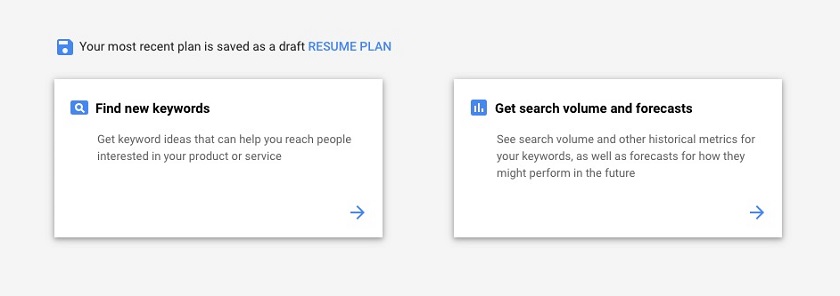
Upload the keyword terms you’re targeting, then Keyword Planner will return forecasting statistics:
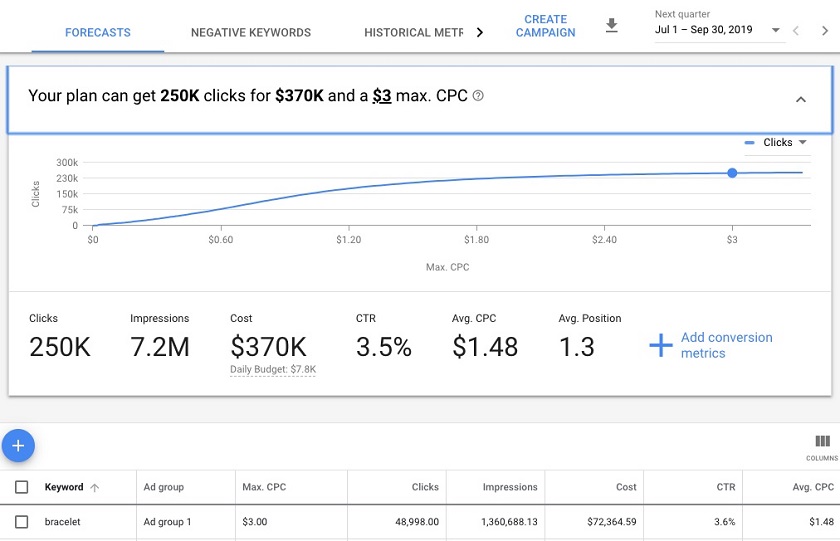
The report includes your estimated average CPC, cost, and other important information. You can break down the cost and performance of individual keywords, devices, and other dimensions. The forecast also automatically considers seasonality and other performance factors based on Google’s own data.
Creating accurate forecasts allows you to evaluate the impact of potential bid changes on performance before applying them. This way you can pinpoint exactly what targeting and spending strategies will help you achieve your PPC goals, allowing you to avoid inefficiencies that lead to SEM budget underspending or overspending.
Some third-party bid automation technologies also have forecasting features you can use. This is beneficial to help you create a more detailed and accurate forecast based on all relevant business data.
Automated Bid Adjustments
As mentioned earlier, improving the targeting of dimensions and audiences is a huge opportunity to reduce wasted ad spend. Even for the most basic PPC accounts, there are countless ways to target and adjust bids to make your campaigns more efficient, so optimization is a huge task to take on.
Setting bid adjustments by hand also leads to some inherent inefficiencies. Say after analyzing your campaign performance, you discover that a 20% bid increase for in-market audiences reduces your cost-per-conversion by 10%. You know that increasing your bid is the right strategy, but how do you know that 20% is the perfect adjustment? What if a +15% bid increase provided the same results? You’d have to test your campaign performance at different bid points to find out.
The best way to ensure you take full advantage of these targeting opportunities is with automated bid adjustments. Bid automation technology uses AI and machine learning to determine the exact bids required to meet your goals. It can also make changes to your bids over time, adjusting to changes in your market, business, and the bid landscape.
Avoiding Adwords overspend and underspend is the key to growth in the PPC world. Securing SEM budget is a challenge, and you want to ensure you maximize spending value to reach performance goals.
Effective Adwords budget management means constantly being on the lookout for opportunities to improve campaign efficiency. Your bid strategy, ad copy, seasonality, conversion rate, ad rank and more can all impact how well you spend your SEM budget. The smartest approach is to manage these factors with PPC budget forecasting and automation technology. This frees up more time and resources to scale your Adwords strategy. Improving efficiency also frees up budget you can reinvest in new advertising initiatives.
Whether your PPC program targets users in many countries or is solely domestic, how to best optimize toward a bilingual or multilingual audience is an often overlooked question. According to the US Census Bureau's 2017 American Community Survey, 21.6% of Americans speak a language other than English at home, and depending on the metro area, that percentage can be much higher. Along with considerations like keyword selection and location targeting, if your campaign's target area has a large population of bilingual or non-English speakers, it is important to consider how your overall SEM program's structure and specific settings you employ could mean missing out on potential revenue opportunities and increased efficiency. This article will provide some best practices for PPC marketing in multilingual areas.
Let's start with the first Campaign setting that likely comes to mind when considering this topic: Language. Which languages should you target if at least some of the people in your market may speak more than one? Only the language that corresponds to your ad copy? Only the languages you know are common in that area?
In general, targeting all languages is the ideal method for any campaign to ensure you’re not missing out on potential impressions. The reason is that the Publishers decide whether or not an ad is eligible to show, per its language settings, based on the user's browser language. However, just because the user chooses a particular language for their browser doesn't mean that's the only language they’re searching in. For example, my browser is in English but I regularly search in Spanish as well. By always choosing all languages, you can make sure you’re capturing these additional impressions from bilingual users.
Depending on the region and demand for your product or services, creating language-specific campaigns can be an excellent strategy for capturing untapped segments of the market. If you’re considering whether this is a good option for your program, checking your search queries for terms in the language you’re considering targeting can be a good first step. When running this analysis consider:
On the other hand, even if there’s a decent conversion rate associated with those keywords, you’re still likely to benefit from increased efficiencies by creating a language-specific ad group. Firstly, having ad copy and landing page that better match the user's search queries will help to increase your overall ad rank. In addition, rather than having search queries trigger translated phrases or broad match keywords, you can include common search queries as exact match keywords, making spend more efficient.
If you decide that language-specific campaigns make sense for your program, creating an initial or expanded keyword list isn't as simple as plugging the list from your English campaigns into an online translator. There may be idioms unique to your target language that would make excellent keywords but do not perfectly translate. In addition, just like British versus American English, all languages have dialects, so the most appropriate translation may vary if one dialect is more common in one area versus another. If possible, leverage the help of someone proficient in the language, ideally a native speaker, to help inform your keyword list.
In addition to leveraging keywords from existing campaigns and input from native speakers, short, controlled tests with broad match keywords (based on the English versions of the campaigns) can also help with keyword expansion. Run your language-specific campaigns for one to two weeks with limited daily budgets (to control spend) and monitor search queries for terms that are generating clicks and conversions. Once you have a decent list, refine your ad group structure to follow best practices with a mix of exact, phrase, and broad match modified keywords.
Moreover, don't forget about negative keywords. Along with adding unrelated search queries in the target language as negatives, make sure to add your English keywords as negatives for the language-specific ad group and vice versa to prevent cannibalization.
Once you have keywords and ad copy for your non-English campaigns, it’s time to consider how far down the funnel to go when it comes to translation and localization. At the minimum, you should implement landing pages in the target language as a mismatch between ad copy and landing page language is likely to lead to user drop-off and may negatively impact ad rank given the disconnect between the ad and the user's experience.
But what about the rest of your website? Or, if applicable, your call center? Should you make investments there? The answer is: it depends. If you’re operating in an area where users are primarily bilingual, for example in Scandinavian countries or Switzerland, offering the initial experience in the user's chosen search language but then having the rest of your site and the customer experience in English is a sound strategy. Monitor your conversion rates closely through each step of the funnel to gauge if your level of localization is appropriate or may be leading to drop-off pre-purchase/sign up. If you notice a large percentage of abandonment once the user arrives at an English page on your website or a support phone line only in English, evaluate whether the amount of potential revenue lost merits further investment in translating your website or even hiring additional resources that speak the language fluently.
Lastly, when creating campaigns for a specific language, make sure not to leave retargeting out of the equation. If a user originally clicked on an ad in a specific language or visited a translated version of your website, any retargeting campaigns you place them in should also be targeted to that language. This is especially true for display retargeting. If any of the URLs you are targeting are in another language, make sure the ad's language matches up!
In summary, managing PPC marketing in areas where more than just English is spoken poses special considerations when it comes to program structure and settings but also potential opportunity in terms of increased revenue and efficiency. By following these best practices and taking a gradual, data-driven approach to rollout, you can implement a multilingual strategy that yields significant returns.
Most PPC marketers today would agree that technology is the key to success in 2019 and beyond. Today, there are countless PPC Martech tools available that can help marketers manage, optimize, and grow their advertising efforts. With the PPC Martech landscape growing year after year, though, the possibilities are becoming overwhelming.
Scott Brinker of ChiefMarTec creates a now-famous annual supergraphic summarizing the number and category of Martech solutions available each year. The 2019 version includes 7,040 options, up from a mere 150 in 2011.
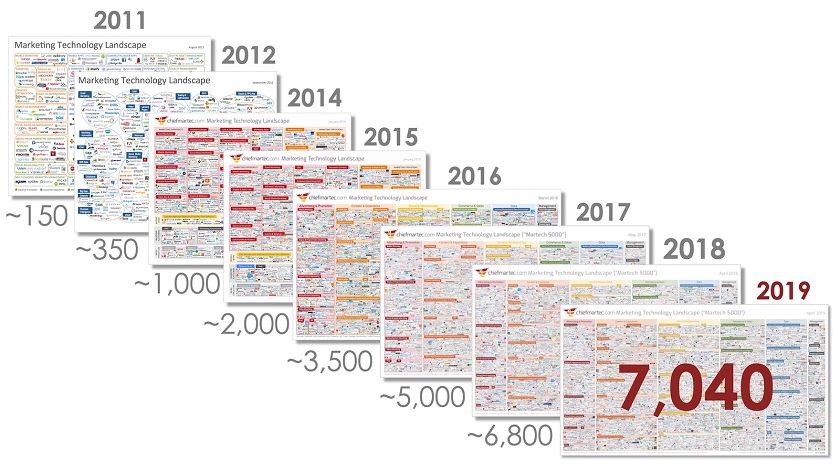
As more Martech solutions become available, the problem is no longer if you should use PPC technology to enhance your efforts, but which solutions you use. Some combinations of tools are likely to be more effective, more valuable, and less costly to businesses, helping them get ahead of the competition.
Even ignoring the rest of your Martech stack and just looking at PPC technology, there are still many tools that could be relevant for success. Categories include (but are not limited to):
All marketers need to carefully build a Martech stack of compatible technologies that work together to help them reach their business goals. PPC marketers, in particular, have some critical choices to make regarding a new category of technologies driven by artificial intelligence (AI). These are poised to change not only the number and type of technologies required but also how advertising efforts are managed overall.
Artificial intelligence has been around as an idea and a technology for more than half a century, while PPC is one of the oldest digital marketing strategies on the internet. So why has AI PPC management only just recently become an important topic?
The answer lies in exponential growth in technological capabilities. When AI was first integrated into PPC management technology, applications and potential were limited. Fast forward to 2019 and AI is now so useful to PPC management that it became essential before many businesses even realized they truly needed it.
Take Google Ads, for example. Google is one of the earlier embracers of AI, actively seeking out new ways to incorporate it into their advertising platform. A few years ago their AI-powered solutions were optional; rarely-used beta features for novice advertisers who needed help to optimize their campaigns. Now, Google’s Smart campaigns are the default campaign type. Many in the industry today argue that AI-driven features easily outperform optimizations a PPC manager could make manually.
To understand just how essential AI PPC management is for your PPC Martech stack, just consider the applications. AI can serve many important roles in PPC campaign creation, optimization, and more:
1. Targeting Audiences and Keywords
AI and machine learning PPC technology can learn from search practices, demographics, web browsing behavior, and other relevant data points to identify which audience targeting strategies are likely to convert. It can also deduce the value of certain keywords to help determine which queries lead to the most conversions. Using this knowledge, AI can automate keyword and audience targeting decisions for you.
2. Automated Bidding
By inferring the inherent value of keywords to meet specific marketing goals, bidding technology can calculate the optimal cost-per-click for keywords and implement this bidding strategy automatically. Using historical performance and market data, it can also surface performance opportunities in real-time, automatically adjusting bids to take advantage of them. Automating bidding rather than relying on manual adjustments from PPC managers reduces wasted ad spend and improves campaign efficiency, freeing up more budget for other advertising initiatives.
3. Forecasting Future Performance
Using predictive analytics models and learning from past performance, machine learning technology can effectively predict the future performance of your bid policies. There are many solutions that can forecast performance up to 100 days into the future. Forecasting is a valuable tool for PPC managers who want to either understand the outcomes of new strategies before testing them out, or illustrate PPC potential to clients and business leaders, or both.
4. Improving Ad Re-targeting
AI can drive insights from diverse sets of data about your audience and prospects, using it to improve retargeting efforts. For example, call tracking and analytics solutions can use call tracking data to identify offline leads and better retarget them online. AI-powered call tracking can also identify when conversions happen in real-time. Then it can automatically stop retargeting efforts for leads that converted, even when the purchase was made offline.
5. Addressing Performance Issues
PPC management technology driven by AI can identify performance issues and make the necessary changes to minimize their impact. For example, if an ad starts performing poorly, AI will flag and pause the ad, giving PPC managers time to diagnose and fix the problem. Continuing to bid on a misbehaving ad, even for a short while, can impact your quality score and waste valuable advertising budget. AI offers a safety net to help advertisers minimize the impact of account or campaign issues on performance.
6. Creating and Improving Ad Creative
AI can automatically improve your PPC ads as well as targeting. Google’s Dynamic Search Ads feature is a great example of how AI can help you create the most relevant and effective ads. Dynamic Search Ads refer to your product landing pages then automatically generate relevant headlines and subheadlines based on your page copy. Machine learning can then test out different headline/subheadline combinations and identify which ad copy combination is most effective when it comes to driving clicks and conversions.
~
These are just a few examples of the growing number of AI applications for PPC management today. AI can also help with competitor analysis, identifying growth opportunities, split testing, scenario modeling, and many other important tasks.
All these AI-enhanced PPC advertising benefits are powerful reasons for PPC marketers to add this key technology to their Martech stack. But it still leaves two important questions unanswered:
The answers to these questions depend on a number of factors and the goals laid out for your business. For many CMOs today, investment in technology is high enough before even considering expensive machine learning PPC solutions. Indeed, according to Gartner's CMO Spend Survey 2018-19, chief marketing officers are spending significantly more on marketing technology year after year. In 2018, Martech made up nearly one-third of CMO budgets.
Google Ads already offers a variety of free AI-powered solutions that PPC managers can take advantage of without breaking the bank. On the other hand, though, paid third-party solutions offer unique value that can improve your PPC Martech stack even more:
1. More Features
Google Ads' AI solutions are more limited in capabilities and scope. Look at Google Ads automated bidding, for example. It draws on market and audience data from the Google network to make informed bidding decisions for advertisers, yet the business world isn’t limited to Google properties. Third-party automated bidding solutions can draw on relevant business and market data from across the web to make smarter automated bidding decisions.
2. More Compatibility
If you prioritize choosing a PPC technology that’s compatible with other key tools you use, you’re able to avoid PPC Martech overload. It’s possible to minimize the number of technologies needed to optimize your PPC campaigns when you use a comprehensive solution. For example, the ability of some third-party bid optimization technologies to aggregate, analyze and optimize based on all relevant business data eliminates the need for additional data analysis tools to derive insights.
3. More Customization
A big challenge advertisers face is deciding how much of a role AI and automation should play in their PPC strategy. Google Ads offers options to partially and fully automate different aspects of PPC campaigns, but when you allow automation to fully run your optimization strategy, you have less control over what kind of goals to optimize towards.
Third-party automation technologies tend to offer more customization options, giving you more control over how you use automation. Advanced analytics and forecasting capabilities give you the control you need to make strategic optimization decisions while benefiting from full automation. You can also set automation technology to work towards more specific and nuanced key performance indicators that are unique to your business goals.
Third-party options for AI PPC management require financial investment, but their benefits and features offer more growth potential in turn. Improving the efficiency of your budget spend and the effectiveness of your campaigns allows you to invest more in new initiatives, growing revenue, and offsetting the cost of PPC Martech in the process.
How much PPC technology advertisers need really depends on their unique business goals and budget. The key to building an effective PPC Martech stack that brings ROI is balancing the number of tools you use and the value they offer as a whole.
If you just keep adding on new PPC technology to a growing list of necessary tools, you’re going to end up spending far too much of your budget on technology without seeing worthwhile results. Instead, always be on the lookout for comprehensive solutions that cover different business needs. And remember that AI-enhanced PPC advertising technology is essential for businesses that want to improve performance, save time, and stay ahead of the competition in 2019 and beyond.
~
To learn more about how you can drive improved PPC performance through Centro’s automated technologies, connect with our digital media experts today.