
Technology
Basis Platform
Advertising Operating System
Communication Portal
Intelligent Collaboration
All Channel Activation
Activate Media on Every Channel

Consulting
Resources
At Centro, we know that keeping up with the trade pubs and latest trends can be tough and time-consuming. To make that easier, we’ve compiled all the articles, reports, and other bits of awesomeness you may have missed, but should definitely read. Enjoy our latest list below!
Brands Are In-Housing And Agencies Are Adapting [:02]
The media in-housing trend is real, but agencies aren’t getting kicked to the curb. It’s a common misconception that in-housing is an all or nothing proposition. More brands are embracing a hybrid model in which they gain more control and also discover economic efficiencies.
Read Marc Pritchard's landmark speech on creating a 'new media supply chain' [:15]
In a speech to the Association of National Advertisers, Procter & Gamble's chief brand officer, Marc Pritchard, challenged advertisers to support a digital ecosystem that prioritizes quality, civility, transparency, privacy, and control.
LUMA’s State of Digital Media 2019 [:10]
Leading AdTech investment firm, LUMA Partners, has put together their annual State of Digital Media, which covers their views on the market, bigger industry trends and the future of the ecosystem—it's always worth checking out!
One year into the paywall, Wired is testing letting advertisers unlock access for readers [:03]
To paywall or not to paywall? That is the question. After a year of A/B testing and experimentation with digital subscribers, emerging tech publication, Wired, is testing the lines between paywalls and added access to content via sponsorship. The piece describes how Wired seeks to discover the balance between gaining and maintaining paid subscribers while simultaneously creating unique and appealing ad opportunities for advertisers.
Musings On Why LinkedIn Bought Drawbridge [:04]
This week the trades dropped surprising news that LinkedIn plans to buy cross-device data company Drawbridge. The announcement begs the question of what the popular B2B social platform looks to gain from a probabilistic device graph. Columnist Allison Schiff shares thoughts on what LinkedIn may have to gain from the unexpected acquisition.
WTF is bid shading? [:05]
First price auction models have led to increased revenues for publishers, but because advertisers have to pay the price they bid (versus slightly more than the second highest bid in second price auctions) they end up spending more than they may have to. Enter bid shading which enables advertisers to predict the highest bid, in hopes of not overbidding
Anti-Fraud Measure Ads.txt Is Coming To Mobile Apps But Very Slowly [:01]
Roughly 4% of the top mobile apps have adopted app-ads.txt. App-ads.txt adoption among mobile apps has been scant because there is not much incentive for app developers to make an effort to adopt it.
YouTube Reintroduces Third-Party Ad Serving In Europe [:03]
YouTube is reintroducing third-party ad serving on reserved buys in Europe after scrapping it last year in anticipation of GDPR. Google says the new third-party ad serving integration is GDPR complaint since it runs through an API-based framework that serves partners’ creatives via Google’s systems.
Snap Makes A Comeback After The Release Of Its Rebuilt Android App [:02]
Snap is heading in the right direction again. While their updated numbers are still 1 million people short of their peak user base since it went public in 2017, they are showing signs of making a comeback. In the latest rebuild of the Android app release, it has been designed to be faster and less buggy. Snap also held its first partner summit recently where they debuted that Snapchat stories would now be coming to Tinder and Houseparty.
Google’s Next Big Money Maker Could Be The Maps On Your Phone [:03]
Google maps has been a big opportunity for Google to monetize on that has been slow playing. While the search business is still profitable but with companies like Amazon rising up in the ranks, Google is looking for new territories to start making a profit. If executed properly, this will be a huge opportunity for local businesses.
Are smart speakers making audio advertising more enticing? [:04]
With global smart speaker usage forecast to grow 82.4% in 2019, rising from 114 million units in 2018 to 207.9 million this year, more brands are looking to leverage the power of audio (and voice) to break through the ad saturated world and effectively deliver messages in moments when users are actively tuned in. But the voice assistant platforms have only just recently opened the door to paid audio ads.
Hundreds of NYC Taxis Are About to Go Programmatic [:03]
Welcome to the next big thing in programmatic, taxi cabs! Urban OOH platform, Firefly, is expanding their footprint of adding digital smart screens on taxis, Ubers, and Lyfts to new cities. Their screens run targeted, geofenced ads based on driver routes, area demographics, and traffic patterns.
Opening day for Major League Baseball came early this year, and similarly the 2020 election cycle has kicked off earlier than ever before. So now is the perfect time for political operatives to hone their skills for the next big game by reviewing the hits and strikes of last season – and when it comes to digital media in the 2018 elections, programmatic advertising is the MVP (Most Valuable Performer).
This is just one of Centro’s takeaways from this past November’s elections, where our software, Basis, was used to manage political digital ad buying for 300+ state and local races throughout the country across display, video, native, search and social media.
The trends we observe point to competitive election strategies – as 73% of the races Centro was part of had winning outcomes. Now that the next election cycle has already begun, it’s imperative for candidates and advocacy groups to plan with these factors in mind order to maximize impact in 2020. Political marketers can study the winning playbooks, project how to use it for the next cycle, and make educated, yet bold, conjectures about how to differentiate campaigns and go the distance.
Let’s unpack what worked to get campaigns across home plate last season.
Programmatic Makes the Big Leagues
Programmatic ad budgets accounted for 60% of overall digital ad spend from political clients.
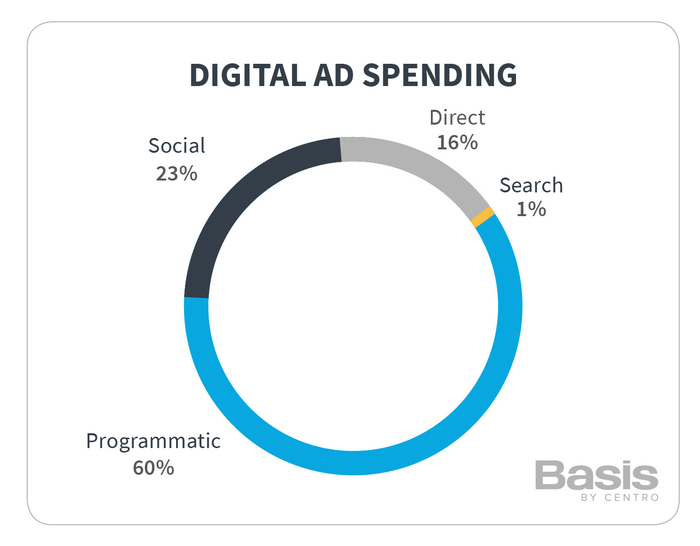
This was a 14% increase over 2016 allocations from Centro’s clients and is a stark contrast to the diminishing amount marketers buy directly from publishers. Even as recently as 2012, direct buying on key local and national digital publishers was a significant part of the overall game plan for proliferating a message among voters in specific parts of America. Now, only 16% of overall digital budgets are being funneled to this tactic.
Programmatic buying offers the speed and agility to launch campaigns, optimize on the fly, and still reach precisely-targeted audiences wherever they consume media. This was heavily utilized during the election cycle, especially as audience attention fragments across multiple digital channels and platforms. It’s a tactic that plays well for politics, where the people who operate in the space want the ability to score runs by moving ad money fast and diverting it quickly to the highest performing media.
Digital Video Remains an All-Star
Video ads made up 56% of digital media political spend.

Political campaigns have long loved the emotional impact of video. As a result, not much has changed in how the elections generate massive levels of TV ad spending. What is changing is how campaigns are complementing and extending TV buys by reaching voters with video ads on digital devices. Hulu and YouTube, which garnered sizable political ad budgets, illustrates how digital video ads can be utilized in powerful ways.
Furthermore, programmatic is a tactic often used to extend targeted digital video impressions across the board. While programmatic hasn’t opened the floodgates of TV budget shifting to digital, it has demonstrated how candidates gain the upper hand by delivering the emotional impact of video with precision targeting and cost-efficient pricing.
Another factor making an impact on digital video is the increasing availability of high-quality video through programmatic channels, including connected TV inventory. The potential win-win of CTV is undeniably appealing: the big-screen impact of television, in a non-skippable “forced viewing” environment.
Hyperlocal Hits a Home Run
Marketers have leveled-up the local advertising strategy.
“Hyperlocal” programmatic tactics, which utilize location pattern data to target residents of a district, or to geo-fence events and/or polling locations – were used by more than 55% of candidate and ballot campaigns using Centro’s technology.
In previous election cycles direct buys on local media sites played a much more prominent role for Centro’s clients. In 2012, 57% of political spend in our system went to local site buys, but that dropped to 30% in 2014, and then lower to 17% in 2016. In 2018, local site direct buying represented just 10% of political spend. This shift in the campaign playbook is largely due to programmatic technology and the available of high-quality local targeting at scale.
Leveraging Utility Players
As digital devices continue to multiply, so do the options for campaigns to reach audiences across platforms.

Political marketers, now more than ever before, have comprehensive options to create multiple touchpoints with a voter. This is due to a myriad of factors coming together, namely the explosive growth in programmatic advertising, improvements in device maps, and the availability of cross-device targeting. While serving ads on desktops and phones still dominate in programmatic ad spend, we experienced significant overall spend shift in connected TVs and tablets, which were virtually nonexistent in programmatic channels during previous election cycles.
One data point to watch is the impression-to-spend ratio, where the dollar multiple on connected TV ads is much higher than other devices, because of premium CPMs in this format. As CTV scale continues to grow, we’re watching to see if costs decline—or if increased demand keeps them relatively high.
Get Your Scorecard; Know the Players
Despite the rapid ascension of programmatic as a priority in political marketing strategy, site-direct buying still garners a significant amount of digital ad dollars.

Top non-programmatic vendors for Basis political campaigns in 2018
Among ad vendors, Facebook, YouTube, Hulu and Pandora were standout players. This was partly due to their limited inventory availability via the open exchanges, and the specialized targeting offered by some. But another significant factor is the sheer national reach they offer in every voting market and desire for premium reserved inventory.
The revenue share drops off a bit after the top tier, but it is made up of the most visible brands in news and media, such as Fox News, Washington Post, Spotify and CNN. Honorable mentions go to local newspaper publishers such as The McClatchy Company, tronc, Gannett, The New York Times and Lee Enterprises, that are closely chasing the top national media organizations on this list. In the middle of those newspapers is a bit of an outlier – ESPN.
If media players want steady site-direct sales, they should enhance data-centric audience targeting and improve speed to market. A compromise may be to shift to more private marketplace products or increase use of second-party data.
Leave it All on the Field
More than half of the advertising dollars spent in the 2018 elections were used during October and the November days leading up to the election.

On Centro’s Basis platform, we saw that 53% of political dollars in 2018 were delivered in the last five weeks before Election Day, and an astounding 21% of ad dollars spent in the last 10 days. It is common for political campaigns to spend more on the home stretch for many reasons—some strategic, such as GOTV (Get Out The Vote) efforts, and some practical, like late fundraising.
Digital media—and particularly programmatic buying – is uniquely suited to handle the need for speed and scale that is affected by rapid budget fluctuations. This activity isn’t caused by last minute discounts. Quite the opposite, the flurry of ad volume in digital media creates higher demand and more competition for the buyers. The upside is that supply is meeting the down-to-the-wire demands of the market.
Bring in the Closer!
Among the 300+ campaigns that utilized Centro’s Basis platform for the 2018 U.S. elections, 73% had winning outcomes.

Centro’s mix of technology and services provides our clients with a digital media home-field advantage in driving voters to take action. Centro’s experience has been honed by more than a decade of work with political and advocacy groups in races throughout the nation, encompassing candidates at all levels and local ballot measures. Our activity during the 2018 election season gives us a wide breadth of knowledge and a diversified view on successful campaigns using digital media.
Post-game analysis
How the game may change in the next two years.
Here are our predictions for 2020 campaigns:
But nothing stays stagnant in politics or in digital media, and an X-factor could still emerge that impacts the next elections. Keep your head in the game.
About Centro
Centro is a global enterprise-class software provider for digital advertisers. Our technology, Basis, is the industry’s most comprehensive and automated digital media management platform. Through a single user interface, Basis converges the entire advertising workflow, enabling marketers to plan, buy, analyze and streamline campaigns for programmatic, direct, search and social. By unifying all major aspects of digital media into one platform, Basis breaks down silos, improves performance, and helps businesses grow profitably.
For more than a decade, Centro’s technology and services have been trusted by agencies and consultants in politics, public affairs, and advocacy. Throughout the years, Centro’s Candidates + Causes group has collectively worked with 700+ political campaigns and independent expenditure committees, and 800+ issue advocacy advertisers. Our proficiency for driving perception in government, in the public sphere, or among specific audiences is a differentiated and valuable asset in this field.
Centro is headquartered in Chicago with 40 offices across North America, including a Washington, DC, hub for its Candidates + Causes team.
This infographic breaks down portfolio bidding as a PPC optimization strategy. This is the modern approach to SEM optimization that looks at shared data across a group to make decisions that benefit the whole portfolio, rather than any individual keyword within.
Google Ads documentation provides a high-level view, but may not answer the questions you have about the value of this type of bidding methodology.
Take your paid search campaigns to the next level with this optimization strategy. Learn more in our other blog posts on portfolio vs keyword bidding, or in our new eBook: SEM Optimization Techniques: Are You Overpaying Google?
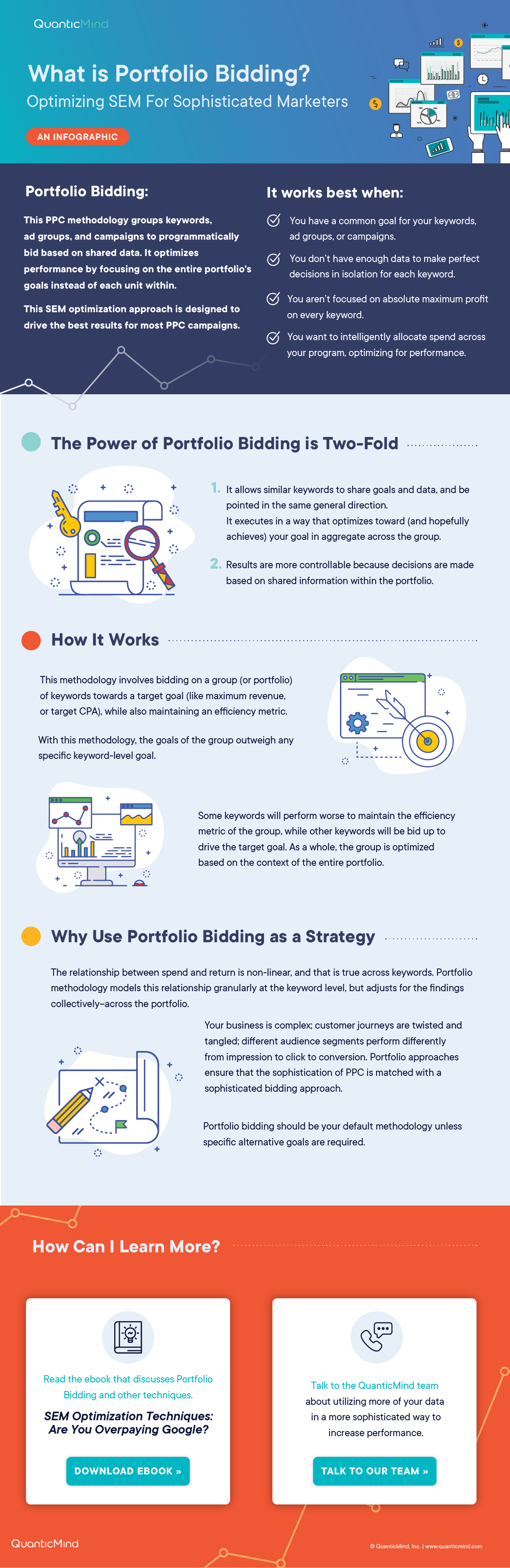
To download this infographic, click here. Alternatively, if you'd like to request a demo with us and discuss all the ways we could drive improved SEM performance for you, get in touch here.
Search engine marketing is constantly changing. Adwords went through a major overhaul last year, rebranding as Google Ads in the process. As Google introduces new tools and features, advertisers must change their PPC strategies and adapt. That makes it hard to keep up with new ways of approaching SEM every year.
One big shift has been an increased interest in PPC automation technology. But PPC automation tools aren’t just the latest trend. They’re a solution that can help advertisers follow the future of paid search without having to reinvent their strategy time after time. More businesses are investing in PPC automation technology than ever before. We take a deep dive into why it will soon be essential for all search engine advertisers.
Most advertisers today know that it’s possible to automate certain SEM tasks using Google Ads or third party tools. But few realize the true scope of possibilities with PPC management tools. Here are some of the applications of PPC automation technology today:
Bid management is probably the most valuable feature of PPC automation technology. Setting the right bids for individual keywords is a huge undertaking that requires constant adjustments. Your ideal cost-per-click (CPC) can change based on a number of factors, including business goals, demand, competition, and other market changes. Managing bids manually is basically impossible when dealing with larger accounts.
Google Ads offers automated bidding features for search and shopping advertisers. Choose Smart Bidding for your campaigns and Google will automatically calculate bids for you at the keyword, ad group, or campaign level.
They offer 5 different automated bid strategies to choose from based on your specific business goals:
Google PPC automation technology can analyze important data in real-time, including device, language, operating system, time-of-day, and other factors. It then uses machine learning technology to set the right bids to maximize your goals.
Third party PPC automation tools are another option to make bid management even more precise. For example, QuanticMind can factor all important business data into bid calculations, such as internal metrics, LTV data, and historical performance. By fully utilizing your relevant data to calculate CPC, it ensures you only spend the minimum necessary budget to reach your business goals.
Creating targeted ad copy is one aspect of PPC management that needs human input. In order to drive clicks and conversions, you need to come up with a unique headline and subheadline that speaks to your target audience. But manually creating ad copy becomes a challenge for businesses with large or quickly changing inventory. Automating the process can save time and help you identify the most effective ad copy for your products.
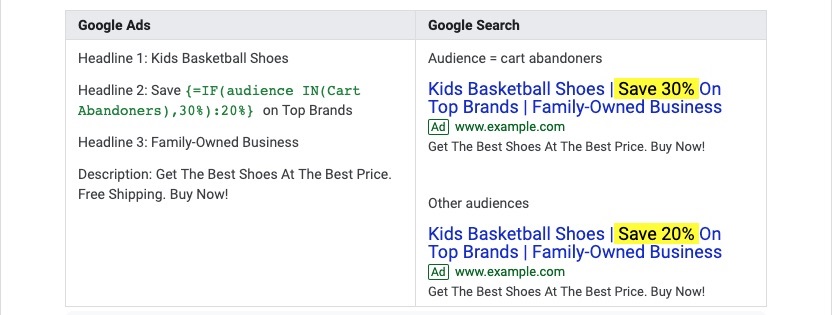
IF functions allow you to insert or change an ad message when certain conditions are met. You can use this Google Ads feature to automatically tailor your ads to be more relevant to your audience. For example, when showing ads to people who’ve abandoned their shopping cart, you can use an IF modifier to increase a discount, encouraging them to finally convert. Here’s what it would look like:
Google AdWords scripts are an option to make automatic changes to your account using JavaScript code. There are lots of ways to use scripts for bidding, reporting, alerts, and more. But you can also use scripts to automatically create ads from product information stored in Google Sheets.
Dynamic Search Ads are a special Google Ads type that can automatically create ads for you based on your website content. With this option, Google crawls your website, then matches your landing pages to closely related search terms. When someone’s search query is relevant to your product or service, Google Ads will dynamically create an ad with a relevant headline. Google now allows you to expand your dynamic search ads to provide deeper messaging that focuses on what consumers care about most:
Advertisers can further rely on automation to optimize their ad creative as well as create it. Google Ads’ option to automatically rotate different ad versions and identify which is most effective is a good example of this.
It’s also possible to use artificial intelligence (AI) and machine learning to generate effective ads. Google’s AI PPC management solution automatically suggests ways to improve ad copy based on prior campaign performance. Ad suggestions are made based on headlines, descriptions, extensions, and information found on landing pages:

Identifying performance issues and quickly fixing them is one of the most important aspects of a PPC manager’s job. But it’s impossible to monitor accounts 24/7. Some issues are bound to pop up that you can’t address quickly enough to avoid some campaign performance issues.
Automation can help with this by detecting issues and pausing problem campaigns or ad groups when necessary. It’s possible to do this using AdWords scripts. You can create a script to regularly analyze an account’s performance then email the manager if it differs from expectations by a set percentage.
PPC automation technology like QuanticMind offers an even more sophisticated solution for this. The technology infrastructure looks for data issues by comparing key metrics to forecasted performance, such as cost, revenue, clicks and CPC. If necessary, it will automatically pause bidding until the issue is resolved or corrected.
Accurate PPC forecasting is essential for securing necessary budget for your campaigns. And knowing how potential strategy changes can impact performance allows you to better allocate budget spend. Creating accurate forecasts is no easy task, though. You could do it manually using spreadsheet data, but it’s time-consuming and gets outdated quickly. Accurate forecasting requires you to constantly update your projections with the latest market and competitive data.
PPC management tools can help with this. Google Ads can help you automatically create performance forecasts using Keyword Planner. All you have to do is upload your keyword terms and it generates a detailed report of potential clicks, impressions, cost, and more.
Bid automation software can also help you automatically create accurate performance forecasts. QuanticMind, for example, creates reports predicting performance up to 100 days in the future. This automatically incorporates all relevant information, including historical performance, seasonality, and bid landscape data. Using PPC automation technology to create forecasting reports helps ensure they’re always up-to-date. Then you can make informed bidding decisions based on the latest data insights.
Most new PPC technologies are designed to address a few problems with your advertising strategy. PPC automation technology is different because it does more than address a pain point. It reinvents how we approach search engine advertising today.
The benefits of PPC automation tools are many, but ultimately it boils down to how it helps you achieve business goals. Here’s why automation is the future of paid search:
There’s no denying that all worthwhile marketing automation tools help you save time. PPC automation technology can save time on both mundane tasks and complicated ones. Anomaly detection and alerts help you spend less time monitoring performance. Bid automation helps you identify performance-enhancing opportunities and act on them. Ad creation technology saves you time creating and testing ad copy. The list goes on.
PPC automation tools are the future of paid search, but not at the expense of marketing managers and their teams. Automation serves as a strong supplement to their efforts, freeing up more time and manpower to focus on new growth and optimization opportunities.
Automation helps you make more precise and accurate campaign decisions based on your unique business goals. And when you use machine learning technology to analyze your business data, it can uncover novel connections to improve audience targeting and performance.
Automated forecasts is another example of how automation can drive insights to improve campaign performance. Most advertisers must rely on experimentation and monitoring results to know how their targeting and bid decisions will perform. Real-time, data-driven forecasting can help you project how various strategy changes might impact performance down the road. This ensures you always make smart decisions to improve campaign efficacy overall.
Anomaly detection can help you stop problems in their tracks before they have the chance to hurt your campaign performance. This ensures you’re never spending budget when you have issues with campaigns, ad groups, keywords or targeting.
More efficient bidding can also help you reduce wasted ad spend immensely. Advanced bid optimization technology uses algorithms that consider the value of each keyword in meeting your set advertising goals. This ensures you only spend the minimum necessary amount bidding on keywords to meet business goals overall.
A combination of saving time, improving campaign performance, and reducing wasted ad spend provide unique opportunities to pursue new growth initiatives. Instead of focusing your energy on maintaining campaigns, PPC automation technology allows you to spend more time and money exploring new audience targeting, ad types, or marketing platforms.
As more and more advertisers start using PPC management tools, it will become necessary to invest in them to keep up with the competition. It doesn’t matter even if you have a whole team of data scientists working to find PPC performance opportunities. Artificial intelligence and machine learning technologies have more computing power to derive quick insights and improve performance. Taking advantage of AI PPC management tools will soon be necessary to stay competitive and scale your strategy overall.
Technologies go in and out of style, even in the world of PPC. Advertisers are already using automated rules and scripts less and less thanks to the features of AI PPC management and automation.
That doesn’t necessarily mean that five years from now everyone will be using dynamic search ads and Smart Campaigns in Adwords. AI PPC management tools are also changing fast, so advertisers can expect many new and better ways to use automation in the near future. What remains true is that automation is the future of paid search, no matter how it evolves in the long run.
New technology has made the consumer journey anything but linear. From finding a prospective car buyer in the market for that new SUV to the middle-aged parents looking to refinance their home, the keyword and geotargeting tactics that once worked are no longer enough to drive conversions. While advertisers continue to adapt across digital channels, paid search may be the most primed for innovative tactics powered by machine learning that drive both efficiency and efficacy.
Leaders in the ad tech space are constantly searching for a win-win-win innovation—something that’s great for clients, employers, and employees alike. Many tech companies turn to their engineers to make these wide-scale improvements. However, data shows that innovating within a company’s employee benefits package is an easy way to bring large-scale, positive change to an organization and its stakeholders.
According to Forbes, the workplace policy employees value above all else is paid family leave. Employees want the option to start a family more than student loan reimbursement, paid time off, or lunch stipends.
Centro agency lead and new Mom, Kristina Boyer, exemplifies the talent a great parental leave policy can attract. When asked whether Centro’s 16-week paid leave policy contributed to her decision to work here, Kristina stated, “It actually very much did. Knowing that Centro has such an amazing maternity leave policy was a big reason why I came, because it fit into the larger family plan that we had.”
Once she got to experience maternal leave at Centro, Kristina reported, “The fourth month was hands-down the most enjoyable, and the most relaxing—it was pretty magical.”
Not surprisingly, data shows that offering paid family leave to both women and men improves a laundry list of employer headaches, including employee retention, productivity, morale, and loyalty. If you think these issues are trivial, think again: Finding and maintaining talent was listed as one of the top challenges facing a majority of tech companies in 2019.
Even more, we’ve all heard the statistic about how millennial workers are expected to job hop up to 20 times in their career. That means that finding and maintaining talent is more expensive than ever! Turnover is estimated at 50% of salary for an entry-level position, 125% of salary for a mid-level position, and for senior executives, rates can rise upwards of 200%.
Since there isn’t a federal law in the U.S. that mandates paid leave, some companies miss out on top talent by offering little, if any, relief for parents. Kristina shared that a previous company she worked for had only offered two weeks to a Mom who requested leave.
In addition to the leave itself, Centro offers a free membership to Sittercity and counseling sessions for the transition into and out of leave. Employees interested in adoption can submit an application for adoption assistance. And, Centro offers four weeks flexible paid leave for Dads as well.
Matt Klaers, Centro’s director of financial reporting, agrees that Centro’s attitude towards new parents is extraordinary. Having returned from his leave in March of this year, he encourages all Centro Dads to take the full 4 weeks: “Having eight hours, 10 hours a day to just stare at your baby is so great. They change so fast.”
Paul Troia, Centro’s director of analytical operations, took advantage of the flexibility of Centro’s parental leave: “I really liked the ability to break [the four weeks] out into different pieces.” Paul was able to split up his four weeks of leave throughout the first year of his baby’s life, so that he could be there when it made the most sense for his family.
Of course, for some companies, it simply isn’t possible to offer this many weeks of paid leave. But leave isn't the only benefit a company can provide to show its new mothers and fathers that it has their back. For instance, Claire Keating, director of client development at Centro, emphasized the impact Centro’s Nursing Mothers Room has had on her life:
“All of my friends have asked, ‘How are you still nursing at 10 months?’ Honestly, I think it’s because of Centro. The Mothers Room is such an easy place to take a 15-minute break and pump in. Being a nursing mother, I feel so supported here at Centro.”
Ultimately, it isn’t just about the benefits package a company offers parents. Rather, it's about parents feeling supported and cared for in and out of the office. As Matt said, “Just knowing that Centro is behind you is such a stress reliever.”
Learn more about Centro’s unique culture and benefit offerings here!
Let’s cut right to the chase: there are various PPC bidding optimization techniques and practices floating around, but portfolio bidding is probably the right one to use, provided you have a large program.
I sold it to you that quickly? Terrific.
But just in case, we’ll go on...
Portfolios are groups of assets, and in search engine marketing, these assets are the keywords and “publisher objects” that you can apply bids and bid strategies to. The power of a portfolio strategy is twofold.
One, it allows similar keywords to share goals and data, and be pointed in the same general direction. Two, it executes in a way that optimizes toward (and hopefully achieves) your goal in aggregate across the group. Results are more controllable because decisions are made based on shared information within the portfolio.
But what really is portfolio bidding? And how do you start using it? We’re about to find out.
If you ask Google Support, you may read a definition for portfolio bid strategy that sounds like this: “An automated, goal-driven bid strategy that groups together multiple campaigns, ad groups, and keywords. Portfolio bid strategies automatically set bids to help you reach your performance goals.” Thanks Google!
Okay, so it’s this thing that automatically sets bids on groups of publisher objects, based on your goals…
But what is it really? How does it work? And why? Is this thing Google is talking about the same thing you’d expect for the core methodology for PPC bid optimization?
Let’s dig in a bit.
Modern Portfolio Theory was an economics concept originally introduced in 1952 and describes the technique for limiting risk and optimizing outcomes by sacrificing individual components to benefit the larger whole. It was first discussed in terms of stock market investment strategy (diversifying investments so some will win and some will lose, but the whole investment portfolio comes out on top). Presently, it helps to describe this SEM bidding optimization technique.
The solution involves bidding on a group (or portfolio) of keywords towards a target goal, while also maintaining an efficiency metric. With this methodology, the goals of the group outweigh any specific keyword-level goal: some keywords will perform worse to maintain the efficiency metric of the group, while other keywords will be bid up to drive the target goal. As a whole, the group is optimized based on the context of the entire portfolio.
The relationship between spend and return is non-linear, and that is true across keywords. Portfolio methodology models this relationship granularly at the keyword level, but adjusts for the findings collectively–across the portfolio.
So by way of example, let’s say you want your keyword group to maintain 220% ROAS while maximizing revenue. The portfolio bidding algorithms would use data from clicks and conversions to bid up the more valuable keywords that drive revenue while simultaneously bidding down other keywords to stay within the ROAS limit. The shared goals and data allows the bidding algorithms to execute towards a multi-faceted goal accurately by sharing the context of all the keywords in the group with each other.
To put it simply, one does not simply “do” portfolio bidding without utilizing an optimization tool.
As a very simple “two-keyword example”, an exercise can be run to look at the volume/efficiency curve and select the values (based on some data exports) where you’ll bid so that a target goal for efficiency is maintained while otherwise maximizing for the revenue metric… however, it’s simply too much to do manually for any real program.
Obviously, Google allows portfolio bid strategies to be applied to groups of keywords you define by using some of the goals available in Google Ads: Target CPA, Target ROAS, and Enhanced CPC, plus some others. How do you apply this to your programs? If you’re using Smart Bidding, you can effectively just follow the on-screen instructions.
But Google’s method is limited in the same way any other bidding method is limited with Google: it’s subject to the same requirements for volume and conversions; it doesn’t utilize any customer journey data outside of what Google tracks; and it’s built as a one-size-fits-all solution, to help small businesses, mid-sized spenders, and big programs all try to accomplish their individual business goals.
Any third-party PPC bid optimization tool (well, any modern one worth using) will utilize portfolio bidding in one way or another. Remember, it is a conceptual approach to solving a problem. However, there is certainly a great deal of variability between different solutions: between the best practices and most robust models, versus standard approaches.
To get started, you’ll want to ensure your conversion data is being tracked and is cleanly integrated into your optimization tool. Data integration is key to making smart decisions.
Next, you’ll determine which keywords should be grouped together in the same portfolios, or ideally utilize a tool that helps to automate this. Whether it’s a handful of keywords, ad groups, or campaigns, you select the best group of objects that share sufficiently similar attributes and goals to put under one portfolio.
Select which goals and strategy you want applied to each group and define the target metrics for each: goals for maximization, and goals for maintaining efficiency across the portfolio. However, be aware that setting goals too extreme up front can cause issues with volume or spend, and lead to disappointment.
Here’s what we see: even with the technology available to automate and optimize with something as complex as portfolio bidding, it still requires human decision-making and touchpoints to thoughtfully structure the program, define goals, and strategize.
Portfolio bidding is a technique that is here to stay. Why? First, because it is conceptual - not some specific tool. Second, it is a concept that aims at what we digital marketers are after: ensuring the aggregate performance across a group of keywords is hitting the target.
However, we must not forget that this technique, like many facets of life, fits in with that old adage from Drake’s song Preach: “Doing is one thing. Doing it right is a whole different story.”
Many PPC automation tools will use a portfolio bidding mindset to optimize SEM performance, but more is involved for great outcomes and peak performance: machine learning involved at every step; infrastructure built for accuracy and speed; data ingestion of customer journey data and other relevant context; and so on.
Influencers have become a lasting fixture of the social media marketing world—but in a loosely regulated space, marketers are wary of jumping into a pool of unknowns.
Catapulting into the spotlight in the 2010s, influencers have become a valuable component of the social media marketing world. Once a niche space targeting younger audiences, influencer marketing is now on pace to reach ad spend levels between $5 and $10 billion by 2022.
These social-first spokespeople market products and services to targeted followings that range from a few thousand to tens of millions. The potential for influencers to reach a variety of ever-expanding audiences remains strong. However, since influencer marketing is a loosely regulated space, agencies may hesitate to jump into a pool of unknowns.
To bring clarity to the haze, we chat with Dalyn Ward, the Director of Product at influencer marketing platform Popular Pays. Dalyn speaks to how marketers should be approaching the influencer space—from measurement options to bots and AI, to the infamous Fyre Festival.
In this post, we’ll be delving into why you should always be segmenting and evaluating your data as often as possible. We’ll share a few examples and common errors in the process.
Most decisions pertaining to PPC are based on data relating to different metrics. For example: if devices are showing contrasting performance, you’ll want to use Mobile and Desktop device modifiers.
Normally, you can rely on Google Enhanced bidding and Google Smart bidding to make most of these decisions, but there are many scenarios where this may not be an option for you. If you have a SEM bidding optimization tool, you can use the segmentation in your favor, but if that’s not the case, then it will always be useful to know some basic rules about how to understand your data.
With the amount of data flying around marketing campaigns in the modern age, it can be difficult to know where to start. Here are a few ideas about how to break up your data in order to be able to make sense of it. Whether you’re evaluating a significant change, troubleshooting underperforming segments, or simply doing an A/B test, be sure to keep these two frameworks in mind:
1) Always check the trend
For any performance evaluation, it’s clear that data will vary over time depending on recent changes and trends. Below we have two data sets with vastly different behavior.
First, let’s take a look at this chart. We’re plotting the profits of a campaign over time and analyzing its evolution. There appears to be a healthy growth at a steady rate over the entire 16-week period:
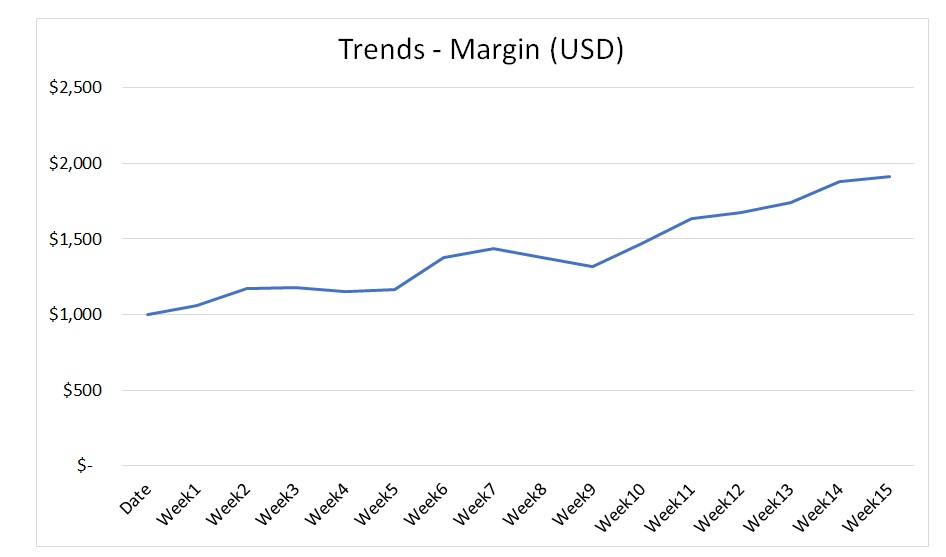
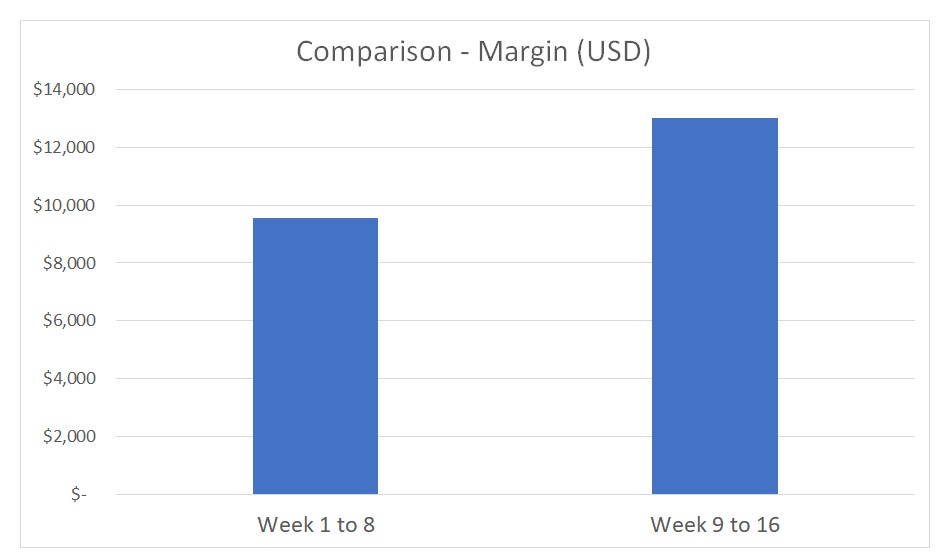
If we break this down into months and do a comparison of the profit realized in the first two months versus the last two, we would report that profit throughout the campaign grew 136% period over period:
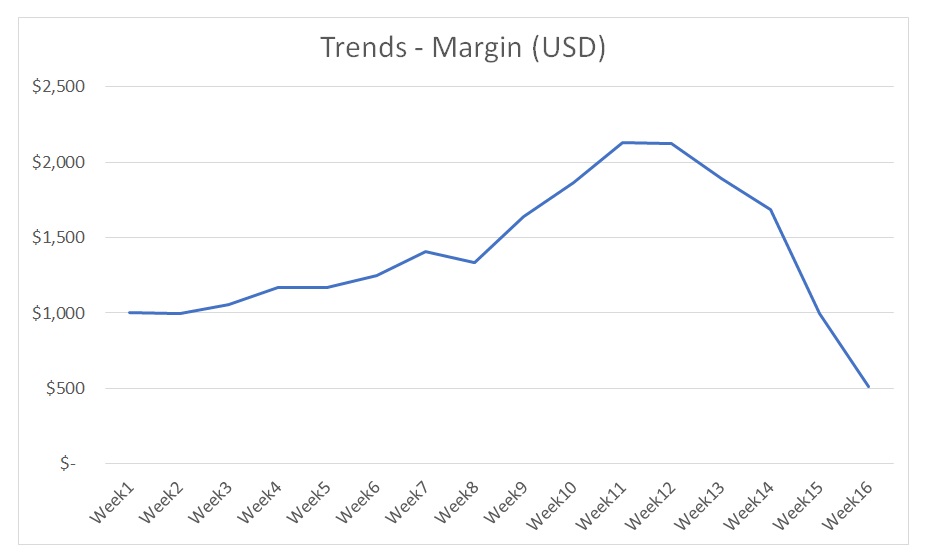
Now, let’s assume this campaign had a different result. After having two solid months, the campaign started to suffer some changes. Around week 10, what seems to be a dramatic increase in profit preceded a drastic collapse:
If we evaluate the high-level picture of this data set and we repeat the same report, we will see the following comparison:
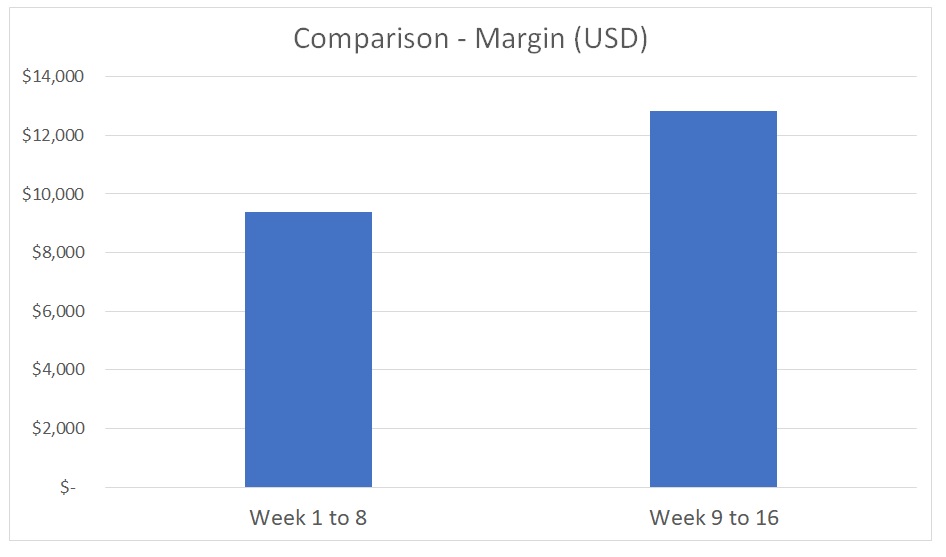
The campaign once again shows a rise in profit period over period. It further reports a 1% lift—137%—compared to the previous example.
In both cases, then, profit grew by more than 35%. The period versus period charts show identical performance. If we dive into trends and behaviors, though, we see two very different scenarios. The first showed solid and steady growth, while the second indicates that performance worsened severely and there is an underlying issue that requires immediate attention. Remember to always look at trends when assessing performance evolution.
2) Always Check the Relationship Between Metrics
There are times where you would evaluate a variable against another variable. A typical SEM case for this is plotting the relationship between volume and efficiency—for example, by comparing Revenue (in dollars) and ROAS (in percentage). These analyses are very useful when looking to verify a correlation or when we want to understand how two metrics are connected.
Below, we will plot four different data sets, each of them containing the same number of observations:
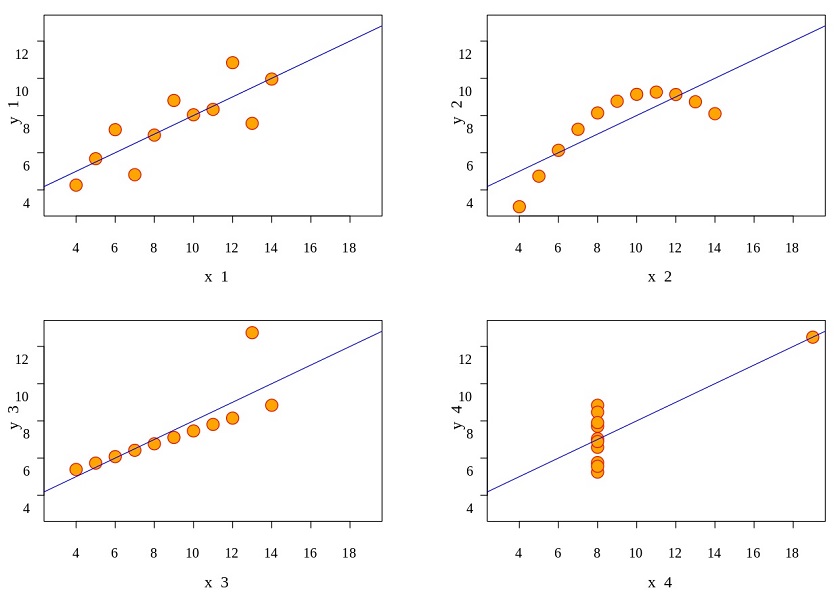
A quick scan of them reveals that these four charts have no connection at all. Data Set 1 has a simple linear relationship between metrics; Data Set 2 has a non-linear correlation between metrics; Data Set 3 is an almost perfect linear correlation; and Data Set 4 appears not to have any identifiable relationship.
These four charts probably describe four different metrics and behaviors. However, if we pull out the main KPIs for these data sets, we will always get the following for all four cases:
This example shows the importance of always looking at the data graphically before jumping into performance conclusions, metrics, and interpretations. This exercise was developed in 1973 by the statistician Francis Anscombe and is called the ‘Anscombe’s quartet’ (and yes, this could well be the name of a folk band).
Understanding your data can be challenging, and adopting the right approach to it will save you time and will help your decision-making process. We can always trust KPIs and metrics, as long as this is reinforced by a thorough process of data interpretation. Segmenting your data graphically is a key tool that will help you in the process.