
Technology
Basis Platform
Advertising Operating System
Communication Portal
Intelligent Collaboration
All Channel Activation
Activate Media on Every Channel

Consulting
Resources
There are about 3.2 billion social media users worldwide, and that number continues to rise daily. That statistic alone showcases the reach that social media has when it comes to digital marketing. Social media marketing allows companies to connect more closely with their clients and customers, whether it’s through wide-reaching Facebook or influencer-dominated Instagram. Now is the time to utilize the platforms that matter!
When it comes to B2B marketing, however, LinkedIn reigns supreme. The professional networking site remains the most used social media platform by Fortune 500 companies. But it’s not limited to high-profile company executives—millennials are flocking to the site as well. Out of over 590 million current LinkedIn users, 87 million are millennials.
How can you use LinkedIn to your advantage? Read on to find out.
LinkedIn users are looking for valuable content filled with insider knowledge, so it’s important to inform and educate rather than promote. Target your content to what your audience and connections want to see, because even sponsored content will appear organically in their newsfeeds. Tell an engaging story and make sure to include videos and photos in posts—62% of LinkedIn members interacted with platform content because they found it educational or informative.
Don’t be a faceless brand! Show your followers that your company has a team of real people behind it. Despite the professional landscape, LinkedIn is still a great place to tell stories and show your followers that you’re more than just a product or service provider. Not every post has to be business oriented—it’s also worthwhile to highlight company values, share thought leadership content, and celebrate employees.
Centro’s Basis now has an API integration with LinkedIn, making it even easier to advertise on the platform. Basis pulls daily delivery, performance, and spend data from LinkedIn directly into its dashboard. This eliminates the need for additional CSVs and spreadsheets to be manually downloaded from LinkedIn and uploaded into Basis.
Basis rationalizes delivery data from major ad servers, various social and search vendors, and its integrated demand-side platform (DSP). The LinkedIn integration drives productivity for media professionals by:
Basis improves revenue margins, controls costs associated with technology platforms, and lifts team productivity by automating the most manual and redundant tasks in digital media buying and operations. Don’t wait—visit our site to learn more.
Thought leaders, assemble! We recently hosted a roundtable discussion with the Centro Industry Advisory Group (CIAG). The CIAG is aimed at gathering valuable input from thought leaders to help shape the future of advertising technology and services. Read on for key takeaways:
Want to become priceless to your agency executive? Become a T-shaped person.
We recently asked the Centro Industry Advisory Group (CIAG) what they look for when hiring and promoting within their teams. There was one common theme from executives when it comes to staffing for the success of a business: Finding T-shaped people is critical.
T-Shaped People? What?
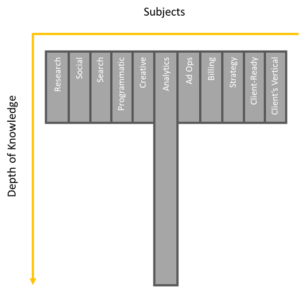
Also known as generalized specialists, T-shaped people have a thin slice of a broad set of skills, but can also go deep on one or two specific areas. Agency executives are looking for this type of person to work on their most important accounts—someone who brings a deep expertise to a situation, but also understands enough context to make smart decisions.
In our industry, this could look like an analytics expert with a solid base of the other aspects of digital media:
Context Is King
In our example above, even the best analytical mind still needs context about the strategy and goals of a campaign—we work in a complicated industry!
Imagine hiring Paul DePodesta, the brain behind Moneyball, and asking him to analyze your campaign. Sure, he could do some amazing work right off the bat (baseball pun intended), but to fully unlock the genius of DePodesta, you’d have to share context with him. What is the KPI? What are the benchmarks? Why did you choose this media mix? What’s the creative call-to-action? What does the landing page look like? You get the idea.
Context is someone’s breadth of knowledge about a subject. Building context helps you move faster, catch critical nuances, and make better decisions. Adding just a little context also increases the impact of your expertise exponentially.
How to Become a Jack of All Trades, Master of One
The first step is recognizing where you are.
If you have the breadth and context, begin to think about where you’d like to specialize. Good places to start your search are passions and industry trends. Are you already a political junkie? Specialize in political advertising. Do you recognize the importance of data science in media? Look into continuing education programs or certifications to deepen your knowledge.
If you are already an expert in an area, but need the context, start talking to people. Set up coffee chats and be curious about their roles. Build connections, then ask to work on small projects with those teams to get a working knowledge of the landscape.
Centro’s software, services, and resources can quickly help you get what you’re missing, whether that’s depth or breadth. Check out Centro Institute to take advantage of our educational resources!
Throughout the past few years, as a relentless wave of new digital technologies continue to push the boundaries of how brands market their services, PPC advertising has become the most effective tool in a marketer’s arsenal for reaching potential customers at the right moment across multiple channels and devices. A dynamic, successful paid search campaign has the power to generate profit faster than any other traditional marketing outlet being utilized today.
The caveat, though, is that it requires a serious amount of hard work to run and constantly monitor. With so many nuanced opportunities to capitalize on and so many industry developments to stay abreast of, one of the most valuable skills to develop as you grow your career is performing regular PPC program audits across Google Ads, Bing, and Google Analytics et al. It’s a lamentable fact that whether you’ve just inherited PPC accounts at a new company or you’ve been running a single program for an extended period, at some point you’ll experience performance that is somewhat less than stellar and the causes could be numerous. A comprehensive audit will help you understand what is happening throughout your entire paid search program, surface areas that can be optimized more rigorously, and uncover any keywords or campaigns that are simply not moving the needle in your favor.
If your current PPC program is dipping below expected ROI targets the good news is that no account is perfect. This, hopefully, shouldn’t come as a surprise to you. Unexpected declines in PPC performance are perfectly normal and are not cause for alarm just as long as you know what actions to employ to right the metaphorical ship.
The bad news? Pretty much every aspect of your campaigns can have detrimental effects on your business outcomes. Out of the gate you’ll want to ask yourself these questions: Am I using the right keywords? Are my landing pages and ad copy optimized? Have we made any business model changes that could affect ROAS? Could seasonality be a factor?
In our newly released advanced PPC auditing guide, we cover what it takes to determine root causes, identify poorly performing dimensions, and then ensure you’re optimizing to the right metrics. In what can be viewed as an overwhelming process, we break down how to move through the stages into handy, bite-sized snippets that can quickly empower PPC practitioners like you to get back to driving improved advertising investments. #smalldetails #biggains.

To give you a taster of the gold that can be found inside, here we offer a short overview of the troubleshooting steps you need to take to turn your failing PPC program around.
From the outset, the process of rectifying poor PPC performance needs to be measured and systematic. Take a wrong turn at the beginning and you could end up wasting valuable time and resources taking a deep dive into something irrelevant. To begin, you’ll need to identify the root cause of the issue that is skewing your numbers. Your program may well contain hundreds of campaigns, thousands of ad groups, and tens of thousands of keywords or product groups. With so many potential rabbit holes to go down, you might be wondering where on earth you start.
The answer lies in the fact that you’ll want to treat your analysis like you would your PPC account structure. First, identify poorly performing accounts, followed by campaigns, ad groups, and finally keywords and product groups. In most scenarios, you’ll find that your campaign structure adheres to some variation of the 80/20 rule; 80% of spend will come from 20% of campaigns. It goes without saying that it’s not the best use of your time to spend hours exploring poor PPC performance in campaigns that only form small segments of your total spend. Sort them by descending order of dollars spent and handpick those that are not meeting desired levels of expectation. Filtering out these campaigns early on will set you on the right path to diagnosing the underlying problems that are hampering your paid search performance.
The second part of our PPC auditing guide concerns the tricky business of dimensional analysis. Via part one you should have (hopefully) pinpointed the source(s) of your performance deficiencies, or, alternatively, you may well have discovered that results were dropping everywhere and that includes numerous dimensions.
“What does this guy mean by dimensions?” I hear you ask. Good question. Whenever a user clicks on an ad, the click will come from one of three devices – a computer, a phone, or a tablet. Said click will always come from a dedicated location and happen at a specific time of the day. These categories of device, location, and time of day are subsets of all possible dimensions from where clicks can originate. Naturally, certain categories within dimensions have more weight than others. Figuring out which one is responsible for your poor PPC performance can take a substantial amount of time if you let it, but it’s better to use a methodical strategy to uncover and fix the problem. You can do this by:
1. Following any changes you recently made to your PPC optimization strategy.
2. Taking a look at overall performance for your most important dimension.
3. Flagging and tracking your dimensions through custom dashboards and internal alerts.
Once you have a hunch about which dimension might be dropping PPC performance, be sure to explore the data. Set a pre-post period to visualize the information and get a pulse on what’s actually going on. Ultimately, understanding performance by dimensions is a crucial component of your PPC program audit as it helps to surface areas of immediate opportunity that can promptly get you back on track.
If your PPC performance analysis isn’t leading to actionable insights through investigations into simple root causes and dimensional analyses, the issue might be bigger than you first anticipated – your PPC bidding strategy might be focused on the wrong optimization metrics altogether.
So, what is an optimization metric?
Glad you asked. In short, it is a measurement you use in order to determine what bid you would like to place on a keyword, which bid adjustment you would place on a device, etc. PPC optimizations will always, to some degree, be related to your business goals. To give you a tangible example, if you’re looking to achieve a monthly ROAS of 150%, revenue should be factored into your optimization metric – ie. you would increase bids on keywords generating more revenue and decrease bids on keywords generating less revenue. Some examples of optimization metrics to use include:
- Low-Funnel Metrics – revenue and conversions
- Hybrid Metrics – a mix of high-funnel and low-funnel metrics
- Lifetime Value Metrics
Whatever type of metric you optimize toward is, ultimately, dependent on the wealth of data you have at your fingertips, what your click to conversion funnel looks like, the behavior of your users, and a great many more factors. The questions to ask of yourself are:
- What is my overall business goal? (Profit Maximization, CPA, Brand Presence, etc.)
- Do I have enough data directly related to my business goal that I can optimize towards?
Finding answers around these themes will guide you in the direction of the best optimization metric you can utilize to ensure you are anticipating and executing best PPC advertising investments.
Our comprehensive PPC auditing guide presents an in-depth approach to reviewing and identifying areas in your program responsible for poor paid search performance. It’s vitally important to the success of your marketing efforts that you don’t let your accounts simply cruise on autopilot as there’s always more you can be doing to improve campaign efficiency. Follow the systematic steps we outlined in our guide, though, and it’s possible to fix the most problematic performance issues first. Getting better results with less time investment makes it possible to focus on other areas of opportunity that can really drive your business forward.

Our mission is to improve the lives of the people working in this industry. And when we first launched Basis—our comprehensive platform that converges digital media planning, buying, operations, campaign analytics, business intelligence, and billing reconciliation—we did it with media professionals in mind.
Although Basis has been on the market for less than two years, its swift adoption shows that advertisers agree with our emphasis on automation. Consider some of the features and updates we rolled out in just the past few months:
We’re not done yet! Stay tuned as we release new tools and options for forecasting, audience targeting, campaign optimization, social advertising, billing reconciliation, and moreover the next couple of months.
Itching to see—or hear—more? Learn more about the audio advertising opportunity with Basis.
There are lots of ways to improve PPC campaign performance by changing your keyword targeting strategy. You could get results by optimizing bids and audience targeting for broad match search terms with a high search volume. But it’s also possible to attract more traffic and optimize your ad spend by targeting long-tail keywords in Adwords.
Here’s everything you need to know about using long-tail keywords effectively to improve PPC performance.
Long-tail keywords are keyword phrases used to search for something very specific on the web. They usually contain at least three keyword terms derived from a head term. For example, a broad search term could be “marketing automation.” A long-tail keyword could be “marketing automation for Adwords PPC.”
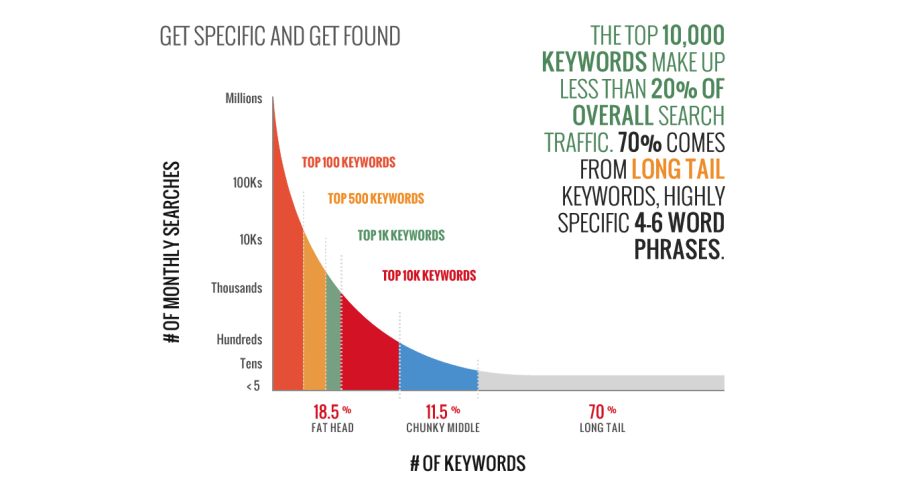
Most paid search advertisers focus only on targeting broad search terms. But a huge portion of Google searches are long-tail queries. In fact, 70% of search traffic comes from highly specific four to six-word phrases:
Targeting long-tail keywords is a very popular strategy for organic search engine optimization (SEO). Marketers tailor their content creation efforts to optimize for long keyword phrases.
Marketers who invest in both SEO and PPC often balance their long-tail targeting efforts by targeting competitive head terms with paid ads. This is a worthwhile strategy, but completely overlooks the opportunity long-tail keywords offer for PPC targeting and optimization.
Long-tail keywords are valuable in PPC for several reasons:
Long-tail keywords are more specific phrases, and end up having lower search volume as a result. Lots of people shopping online will search for the head term “wireless router.” Very few will search for “wireless router with USB 3.0.” Because long-tail phrases have a lower search volume, most PPC advertisers won’t bother to target them. So, if you do take the time to identify and target relevant long-tail keywords, you’ll have much less competition to rank in search results.
Google Ads calculates cost-per-click (CPC) for a keyword-based on demand. Highly competitive keywords with a high search volume will have a high CPC, while less competitive keywords will have a lower CPC. Targeting keywords with lower CPC and competition means you won’t have to pay a premium price to get your ads to rank highly. This also frees up more of your budget to pursue other advertising initiatives.
Long-tail keywords are highly targeted and specific, suggesting a searcher is close to the point of purchase. Look at the “wireless router” vs “wireless router with USB 3.0” example again. People who search for “wireless router” are likely hoping to learn more about the technology, or are at the beginning stages of understanding what kind of wireless router they want to buy. Someone who searches for “wireless router with USB 3.0” has already done their research. They know specifically what kind of router they want and are likely ready to make a purchase.
Targeting long-tail keywords is also an opportunity to optimize for voice search. Voice search has changed the kind of search queries people use to find the products and information they need. Several research studies have shown that voice search queries are significantly longer than text search:
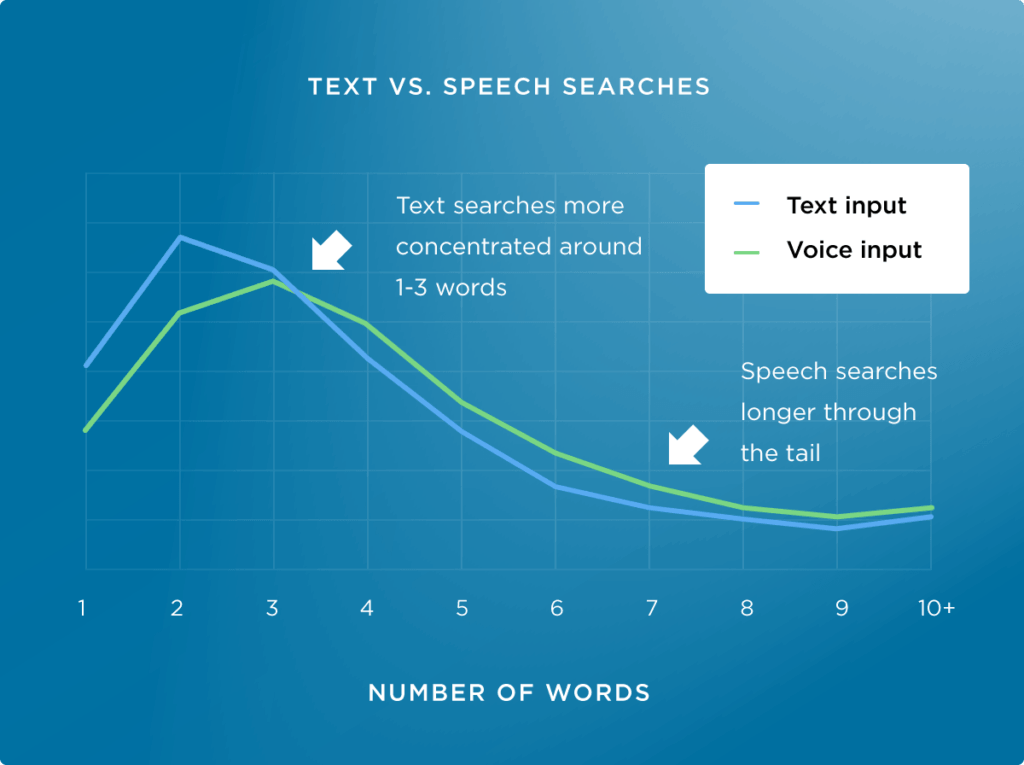
Considering that 20% of all Google mobile queries are voice search, it’s already a valuable strategy to optimize for.
The key to success is finding keywords that imply high purchase intent. Sticking with the wireless routers example: with your marketing content, you can target top-of-the-funnel keywords like: “will a new wireless router improve internet speed?”
These long-tail keywords suggest searchers are just starting to learn about marketing automation and aren’t ready to buy yet. If you want to drive high ROI from your PPC ads, then you’ll target bottom-of-the-funnel keywords like: “wireless router with parental controls and time restriction”.
Always consider searcher intent when researching long-tail keywords. Some keywords are great to target for SEO, while others are relevant for PPC. The types of long-tail keywords you want to target will also depend on your industry. If you sell e-commerce products, you’ll have many long-tail keyword opportunities with your product variants and specifications. You can include keyword terms such as:
For example, a retailer who sells children’s clothes could use a head term like “Polo shirt” and create a long-tail keyword like “Boys blue striped polo shirt.” Service or location-based businesses will target different kinds of keywords entirely. If location is important to your business, then you can use it to create long-tail keywords. A photography business located in Tacoma, WA could target “Tacoma, WA photography services.”
You can also create long-tail keywords using descriptors related to your industry or service. A marketing agency that specializes in promoting dentists, for instance, could target “dental practice marketing services”. Using these suggestions, you can brainstorm long-tail keywords then see if they have good search volume using Keyword Planner. There are indeed lots of ways to find new long-tail keywords to target using various tools.
Here are some options:
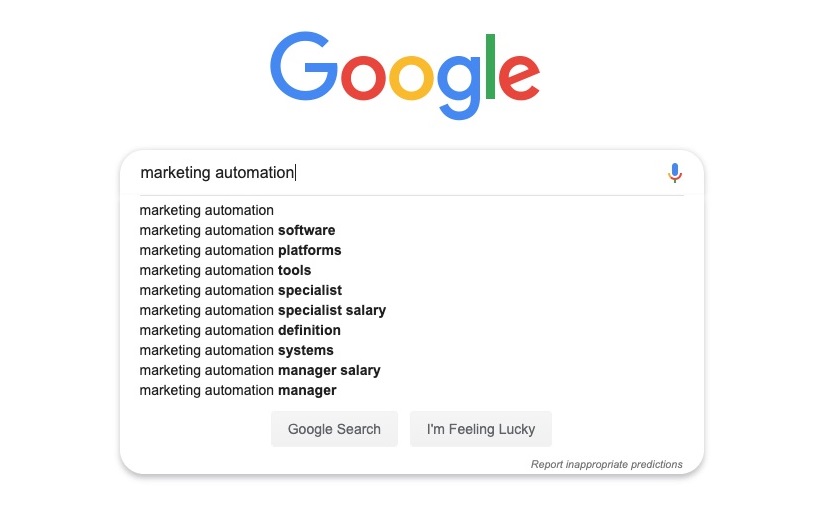
Google search is a great tool to help you find relevant long-tail keywords to target. Start out with Google’s autofill feature. Go to Google.com and type in a base keyword. Google will then suggest longer phrases based on your head term:
Google search also provides long-tail keyword ideas from related searches. Search for a root keyword related to your niche, then scroll down to the bottom of the search results to find it:
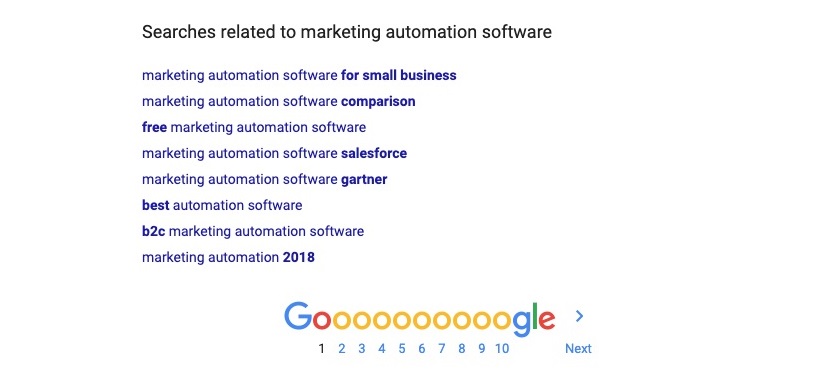
You can also dig deeper by taking Google’s suggested keywords and re-enter them into the search engine to find new ideas.
If you’re already running PPC campaigns, your current ads can be a goldmine of long-tail keyword ideas to target. The Search Terms Report will show you the actual search terms your current ads are showing for. Most of the search queries you’ll find here are simple variants of your main keyword. The report includes columns showing your target keyword, the customer’s actual search term, and the search term match type:
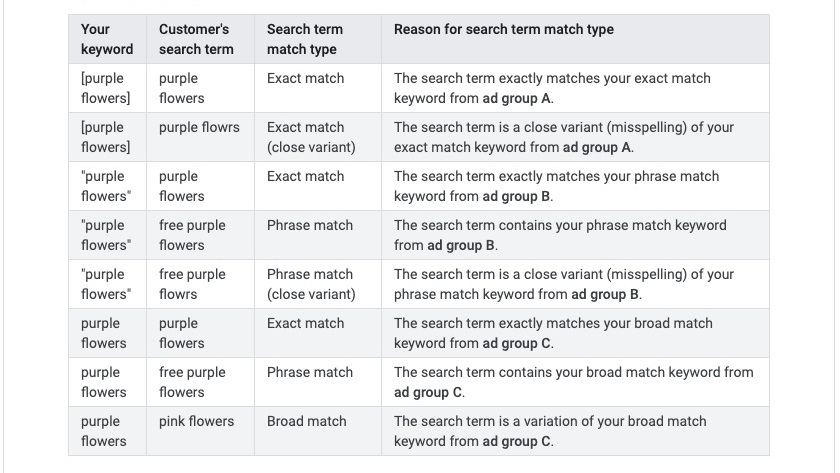
You can go through the Search Terms Report and look for any long-tail queries that are bringing up your current ads. As long as they’re relevant, these queries could be good to target directly.
Here’s how you find the Search Terms Report:
Keyword multiplier tools are a great option for e-commerce retailers who offer products in a variety of sizes, colors, models, etc. It’s an easy way to build a comprehensive list of long-tail keywords related to your product. There are a plethora of free keyword multiplier tools you can use out there. Just type your head term into one box, then any product variants you want to target in the other boxes (e.g. size, color).
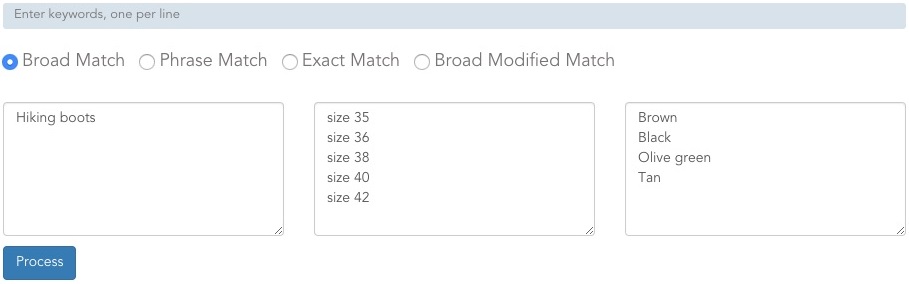
The tool should generate a complete list of all the keyword variants you can target. You won’t want to target every keyword on your new list, but if you take the list to Keyword Planner and run a forecast, you can identify keywords that get enough searches per month to target.
KeywordTool.io is specifically designed to help you find all potential long-tail keyword variations for a base keyword. It utilizes Google’s autocomplete data to generate results, and you can also get suggestions from YouTube, Bing, Amazon, eBay, and more. All you do is type in a root keyword and select your language/location targeting, and it returns keyword suggestions:
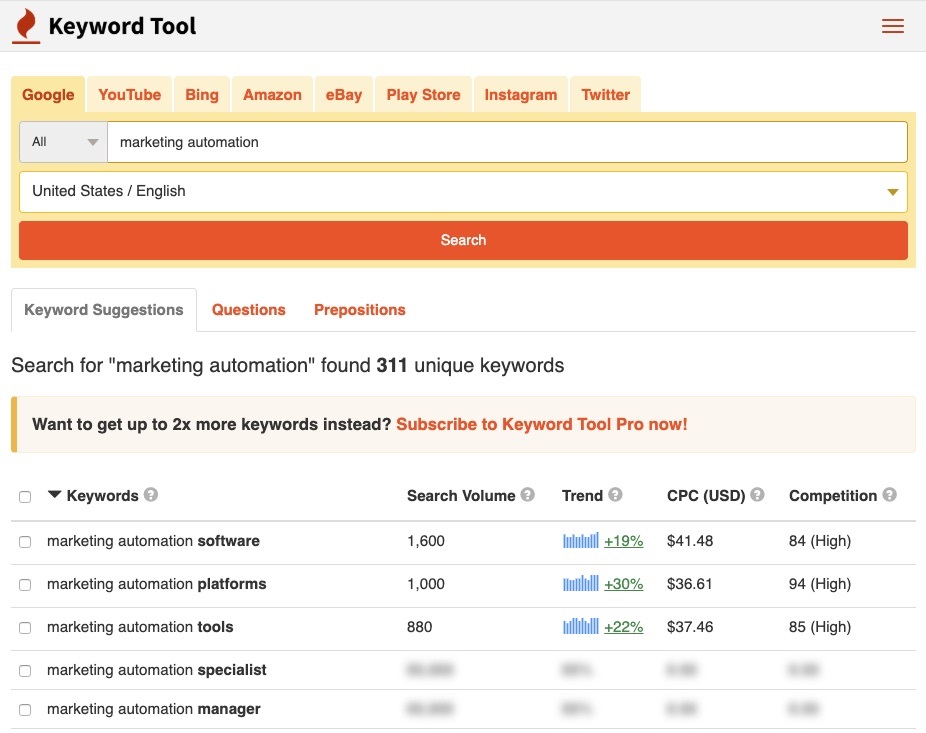
The paid version of KeywordTool.io also provides search volume, trends, CPC, and competition information.
Answer the Public is another free long-tail keyword research tool you can use. It focuses on illustrating what kind of questions people commonly ask online related to a root keyword. Most of the results you get from Answer the Public will be super long tail. These are top-of-the-funnel questions from people who are just starting to research.
Say, for example, you type in “wireless router” as your root keyword. You’ll see a lot of results like:
These keywords are great to target for SEO, but far too long-tail and top of the funnel to target with PPC. Answer the Public also returns prepositions and comparisons in addition to questions. Dig deeper into these and you’ll find relevant long-tail keywords for PPC targeting.
Answer the Public creates a cool keyword visualization:
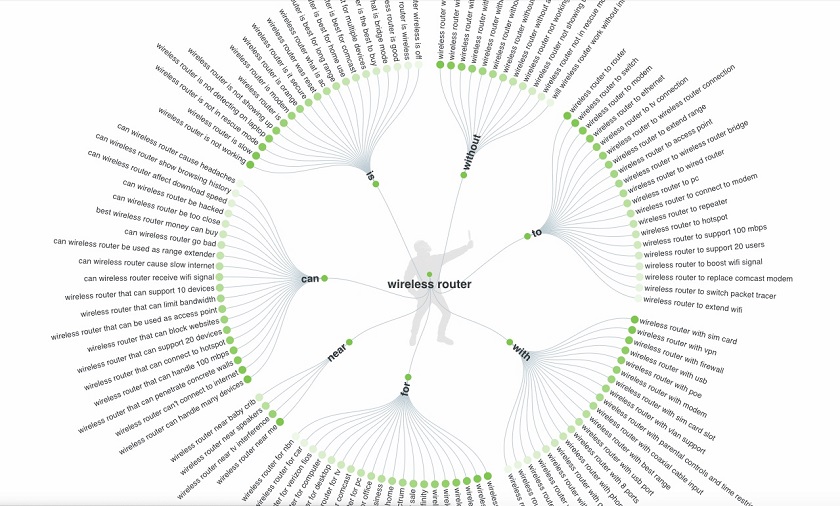
Or you can look at lists and export them:
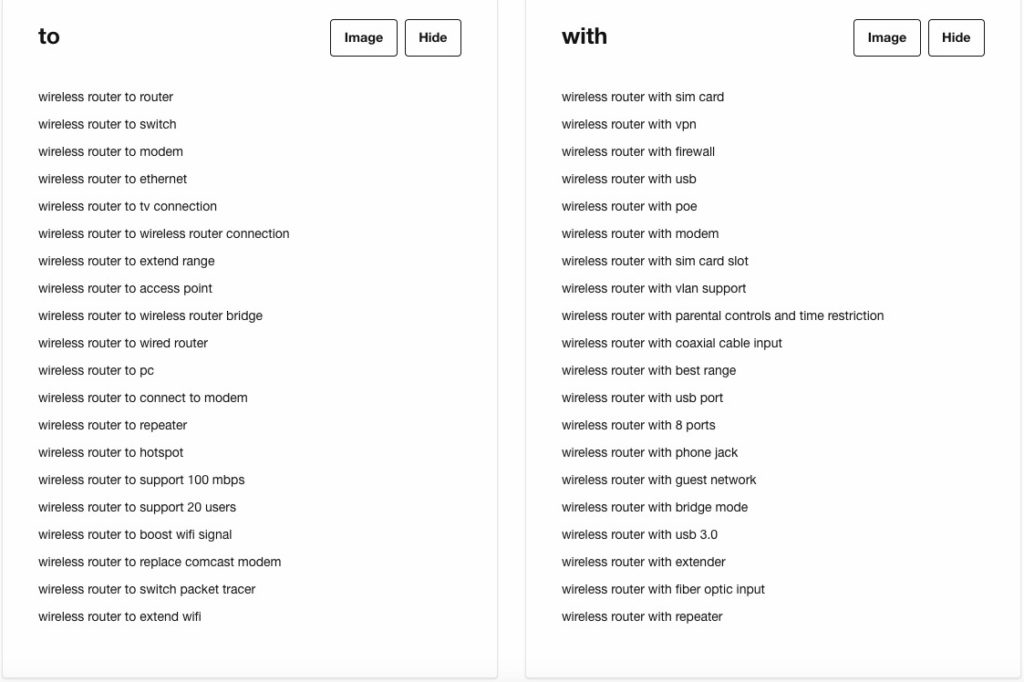
There are so many relevant long-tail keywords to target, it’s easy to clutter your Adwords account with them. Once you build a list of potential long-tail keywords to utilize, make sure you run them through Keyword Planner to ensure they have enough search volume to be worth your direct investment. Removing low search volume keywords from your list doesn’t mean you’ll have to miss out on this traffic. Make sure your ads qualify for all relevant long-tail keywords by creating two campaigns:
This way you can prioritize long tail through campaign bidding, and keep referring back to your Search Terms Report from your General Campaign to find new long-tail keyword opportunities.
Relevance is key to maximizing the value of long-tail keyword targeting for PPC. Optimize your ad copy by including your full keyword. With Google Shopping ads, include images relevant to your keyword targeting as well. For example, an ad targeting the keyword “olive green hiking boots” shouldn’t have an image of brown boots.
Targeting long-tail keywords in Adwords is a great way to optimize ad spend and attract more paid search traffic back to your business. By creating separate campaigns, it’s possible to measure the performance of long-tail keyword targeting against broad match keywords. Monitor performance, then add and remove keywords as necessary. Building an optimized long-tail keyword targeting strategy can bring you long-term returns from relevant, targeted ads.
Memorial Day has passed, schools are out for summer, and (in Chicago) we’re finally breaking free from the rain and cold. Summer vacations are on the minds of employees everywhere.
However, for those lucky enough to have a flexible or unlimited time off policy, the question often isn’t “where should I go?” but “is it OK for me to go?” For some employees, the flexibility of these policies creates uncertainty that results in the policy not being utilized to its full extent.
What can companies do to ensure that their flexible time off (FTO) policy produces the return on investment (ROI) it was intended to provide? We believe that communication at every level is the key to success. Read on for four ways company members at all levels can optimize the ROI of FTO within a company.
Take the time that’s offered to you. Ask yourself what’s stopping you from taking advantage of FTO, and have an open conversation with your manager to address any concerns.
Avoid added stress by communicating and checking in with your team regularly.
HR can get a bad reputation for being the “Policy Police,”—but if the shoe fits, wear it! Make sure you’re educating the company to ensure that FTO is being used in the way it’s intended.
Are you taking time off? Or are you burning the midnight oil seven days a week? You are in a leadership role because you’ve been identified as someone the rest of the organization looks to for direction. The words you speak are not the only thing individuals are looking at—they’re also watching your behavior.
Learn more about Centro's employee benefits by checking out our Culture page here.
In Part 1 of this series, we harped on the importance of measuring value by a metric that accurately represents it. “Each and every keyword is unique,” we concluded, “they will all defy the average. The goal of any measurement is to understand those differences, using all the signals available and discarding all the noise.”
And the goal of any optimization is to react to those differences. Part 1 demonstrates how the way we optimize is inextricably linked to the way we measure - we can only optimize as well as we measure, and no better.
For a summary example, say we have a set of 100 keywords and our task is to rank them in order of value. But we have two metrics, both of which purport to at least partially denote value. If we rank the keywords by one metric we’ll have a very different list than if we rank by the other. Maybe we wise up and put the two metrics together, but that only results in a third and different list entirely. How do we know which one to use to inform our budgetary direction?
There is no greater service you can do to your SEM optimization than understanding your business. In fact, this is the only way to answer non-arbitrarily the question of “which list has the right rankings?” It matters very little whether you calculate thrust, fuel requirements, and trajectory if you don’t know which planet you’re aiming for. The scientific approach is pointless if you don’t first know your goals.
To start, here are some questions to think about before voyaging for the perfect metric…
1. Does my website have one funnel or multiple? How many unique flows are there?
2. What are all my tracked conversions within these funnels? How do they relate to one another? Which are in parallel and which are in series?
3. What are the relative “Conversion Rates” (conversions / clicks) and “Monetization Rates” (instances of monetization / conversions) for each conversion point?
4. What are the relative frequencies (i.e. Volume) of each conversion?
5. Are any two conversion points mutually exclusive? Redundant?
6. What are your goals for your SEM program? What are you trying to maximize? What are your constraints?
These questions are just to get you thinking - you don’t need to know exactly the conversion rate of every point along your funnel. But it is helpful to have an idea of how that knowledge might change the way that you prioritize your optimization inputs.
By now, you have a pretty good understanding of your conversion funnel. You know the various points along it and how they relate to each other. You recognize that they all tell limited parts of a grander story: the truth but not the whole truth. Now, how do we turn these insights into something useful?
The perfect Hybrid Conversion balances two criteria:
1. Frequency
2. Accuracy
To illustrate these, let’s return to our simplified example from Part 1. Suppose your conversion funnel is comprised of ‘Contact Form Fills’, ‘Loan Applications’, and ‘Program Enrolls’, in that order.
Click --> Contact Form Fill --> Loan Applications --> Program Enrolls
Let’s then take a snapshot of 1000 clicks and look at the sample data that results.
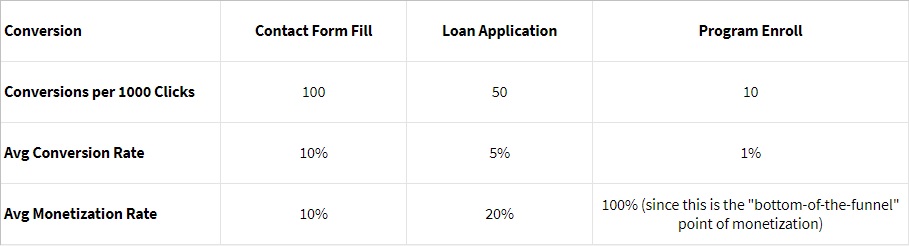
In terms of our criteria, “Conversion Rate” is a measure of Frequency whereas “Monetization Rate” is a measure of Accuracy. Notice that they’re inversely proportional (but we’re used to such tradeoffs in SEM, where the only maxim seems to be “what goes up… must cause something else to inconveniently go down”.) The better the lead of any leading indicator (like an upper-funnel proxy conversion), the worse the indication. For this reason, the operative word is “balance”.
Armed with this knowledge, we can now concoct the perfect Hybrid Conversion. But first! A detour into the importance of Frequency.
The long-tail is a much talked about topic in SEM. But how long exactly is it? Where does it end and the body begin? And where does the body meet the head terms?
Well, where you draw the line depends entirely on which metric you’re looking at. In the upper funnel, there's more volume so fewer keywords are long-tail. In the lower-funnel, the inverse is true. Generally, the deeper down into the funnel you go, the longer the tail gets.
When it comes to optimization, the long-tail is notoriously difficult for all but the smartest data sharing techniques. But what we’ve shown above is that you can finagle your metrics to squeeze or shrink the tail to your advantage. This is the very reason we use upper-funnel proxy metrics in the first place: they give us information where we might not otherwise have any. And where there’s more data, there’s more potential for action.
“Statistical Significance” is the point at which we have enough information to act. What is that point for your program? There’s no surefire answer, but the below formula offers a simple rule-of-thumb. Plug in the Conversion Rate for a high-level segment and out pops the click threshold at which the conversion data of particular objects within that segment is actually meaningful.
Statistically Significant Click Volume = ln (0.005) / ln (1 – Conversion Rate)
Let’s try it out! We’ll calculate click thresholds for the conversion points on either end of our example funnel.
Contact Form Fill | ln (0.005) / ln (1 – .10) = 50 clicks
Program Enroll | ln (0.005) / ln (1 – .01) = 527 clicks
So, on average, it takes over ten times as long to reach significance with the lower-funnel ‘Program Enroll’ than it does with the upper-funnel ‘Contact Form Fill’. Hence the volume edge of the upper funnel. For an intuitive explanation of this concept, see the section headed “The Volume & Monetization Rate Tradeoff” from Part 1.
The above calculator can also be extended to roughly quantify the percentage of your program that classifies as long-tail. The first step is as above: to calculate the “statistically significant click volume” for your program at large (or some subsets of it). Next, for the program (or those subsets individually), count the number of keywords with historical clicks above and below that threshold. Divide by the total number of keywords and there you have a good enough estimate of long-tail proportion for most practical purposes.
From Part 1 of this series (with a few edits to fit our sample data)…
“Think of the Average Monetization Rate as a measure of predictive power towards future revenue: the higher the rate, the more power packed. One ‘Program Enroll’, then, holds a lot more weight in this department than does one ‘Contact Form Fill’ (by, on average, a factor of [10] Similarly, one ‘Loan Application’ averages [20x] the predictive power of one ‘Contact Form Fill’.”
The more likely something is to turn into revenue, the more we want to preference it. Nice and simple. Time to put it all together.
In pursuit of the perfect Hybrid Metric, let’s start simple and then layer in complexity based on what we’ve learned.
Attempt 1
What if we just added the three conversions together? How would that sway the value rankings of our keywords?
Hybrid Conversion = Contact Form Fills + Loan Applications + Program Enrolls
Per 1000 clicks = 100 + 50 + 10 = 160 Hybrid Conversions
Here we must introduce the idea of an effective weighting. Doing a simple sum like this means that we’re weighting each conversion point equally (i.e. 33%). The volumes of each conversion, however, make the effective weighting very different: ‘Contact Form Fills’ account for 63% of the total whereas ‘Program Enrolls’ only account for 6.3%.
Effective Weighting = Individual Conversion Volume / Total Hybrid Conversion Volume
Well, given that ‘Program Enrolls’ are a lot more accurate to revenue than ‘Contact Form Fills’, we probably want them to factor in more heavily. As is, keywords that get us a ton of upper-funnel but not much beyond that are still ranking too high.
Attempt 2
If the Monetization Rate is a direct measure of accuracy to revenue, shouldn’t we incorporate that? If a ‘Program Enroll’ gets us ten times more money on average than a ‘Contact Form Fill’, then shouldn’t it be weighted ten times more?
Hybrid Conversion = (1.0 * Contact Form Fills) + (2 * Loan Applications) + (10 * Program Enrolls)
Per 1000 clicks = 100 + 100 + 100 = 300 Hybrid Conversions
All we’ve done here is directly applied our relative Monetization Rates as coefficients: 10%, 20%, and 100% become 1, 2, and 10. But remember, what’s important is the effective weighting. That comes out to 100 / 300 for each, or 33%. So now, we’ve inadvertently created a Hybrid Conversion whereby all three conversion points are effectively weighted evenly!
Attempt 3
We want our Monetization Rates to align with our effective weighting, so that – if a ‘Program Enroll’ is worth 10x a ‘Contact Form Fill’ – we’re treating them accordingly.
Hybrid Conversion = (0.25 * Contact Form Fills) + (1.0 * Loan Applications) + (25 * Program Enrolls)
Per 1000 clicks = 25 + 50 + 250 = 325 Hybrid Conversions
Sure, you can use coefficients less than 1. And scale them up or down all you want, as long as do so for all of them together – the relative amounts are all that matter. This time when we calculate our effective weightings we get:
25/325 = 7.7%
50/325 = 15%
250/325 = 77%
Notice: 77% is ten times 7.7% and about five times 15%, while 15% is twice 7.7%. Or, exactly our Monetization Rate differences!
Attempt 4
The final check here is to balance it out with our Frequency considerations. Is our new Hybrid making the long-tail too long? How long will it take to reach statistical significance? Our new metric might be a near-perfect representation of value, but is it too bottom-heavy to be useful?
We can gauge this by calculating the effective conversion rate of our new Hybrid Conversion, and then plugging that into our Statistical Significance Calculator.
Effective Conversion Rate = Sum of (effective weightings * conversion rates) = (.077 * 10%) + (.15 * 5%) + (.77 * 1%) = 2.3%
Statistically Significant Click Volume = ln(0.005) / ln(1 – .023) = 228 clicks
So, by our new Hybrid Conversion, it will take 228 clicks on a given segment before we know anything useful about the performance of that segment. Is that too many for tolerance? You’ll have to assess that in the context of your own program. If you want to slide the click threshold down, simply weight the upper-funnel conversion points a dash more relative to the lower-funnel ones.
Maybe you decide that looks like this.
Hybrid Conversion = (0.5 * Contact Form Fills) + (1.0 * Loan Applications) + (20 * Program Enrolls)
Perfect!
The only trouble in all this is that there’s no such thing as a perfect Hybrid Conversion anymore than there exists a perfectly predictable funnel. In lieu of precisely knowing the Conversion Rates and Monetization Rates of every keyword in our program, we speak in averages. We can say how much of our program is long-tail, but we can’t say if that’s too much or too little. And all those questions about your business? Those can get a tad mushy… For these reasons, Hybrid Conversions will always be a bit of an exercise in try, check, and revise.
In Part 1, we learned that Hybrid Conversions allow us to smartly differentiate between the values of program segments. Here in Part 2, we learned how to try them, how to check them, and how to revise them, so that you can start putting your SEM spend where it will make you more money.
After almost 10 years in the marketing and tech industries, I’m familiar with the struggles that digital marketers face day-to-day.
For instance, I know that based on all the tasks I have to get through each day, I don’t have time to switch between ten different platforms to do my job. My team needs the ability to plan, buy, analyze, and optimize everything in one place.
I also understand the frustration of working in tools that fail to evolve at the same pace as the industry. My team wants to spend their time planning and implementing strategies, not creating workarounds for tools that can’t keep up!
Ultimately, marketers are looking for a holistic platform that increases productivity, keeps up with industry trends, and executes better performing campaigns across all formats and channels. In short, we want a tool that allows us to work smarter, not harder.
But don’t take my word for it—check out the latest ranking updates from G2, a site that aggregates hundreds of thousands of unbiased user reviews to rank software and services.
For the past two years, users have ranked Basis as the #1 DSP on the market. As of Spring 2019, Basis also ranked as a Leader in the Cross-Channel Ad Software and Video Ad Software categories.
What qualifies a piece of software to rank in these G2 categories? Read more details below:
Best Demand Side Platform (DSP)
Best Video Advertising Software:
Best Cross-Channel Advertising Software:
Centro’s mission has always been to provide software and services that improve the lives of the people working in digital media—and Basis’ Spring 2019 rankings are a great reminder of why we do what we do!
It goes by many names, but you're paying money for it and it’s driving a lot of value to your business. Pay-per-click (PPC), search engine marketing (SEM), paid search, search advertising, Google Ads, etc… it’s the marketing channel that has the biggest opportunity to truly optimize, and do so based on hard statistics. Why? Because the big data it generates enables very accurate statistical analysis and computation.
Paid search optimization. It’s the practice of making the most effective use of advertising budget towards your SEM goals. More specifically, it’s identifying trends and opportunities based on past performance data in your search engine marketing campaigns, and applying those learnings to drive better results. Whether by eliminating waste and cutting costs where they aren’t leading to revenue or conversions, or (of course) investing more on the keywords, segments, and topics that have better results.
But you’re not here for that high-level overview, and neither are we. PPC bid optimization is a rigorous and technical field, and the goal of this article is to discuss the approach to automation and optimization of SEM campaigns with big data.
You and your business are likely using Google Ads (et al) in a very sophisticated way. Large SEM programs not only pay a lot of dollars to search engines and gather a lot of dollars from ad-conversions, but they are generating massive amounts of data as a byproduct.
For example, every search query that leads to a click and subsequent conversions has numerous elements along that entire journey that are being tracked inherently by Google… and then by Google Analytics, tag managers, “3rd party” pixels and analytics tools, and conversion tracking tools… and then deeper funnel data points about latent conversions, offline sales, and lifetime value that may live in a CRM or data warehouse. Plus you can collect browsing behavior and seemingly unrelated data on the sidelines that ultimately may correlate to some future value.
The point here is that when your organization uses PPC as a primary channel to generate revenue, you are (or should be) collecting a very, very large–and very powerful–dataset.
Alright, so what?
I'm glad you asked!
Big Data may be a buzzword that gets thrown around a lot lately, but let’s take a look at it in two manners:
1. The definition from Wikipedia: "Big data" is a field that treats ways to analyze, systematically extract information from, or otherwise deal with data sets that are too large or complex to be dealt with by traditional data-processing application software.
2. I like to simplify it into a simple concept: When nearly everything is tracked, you do get a lot more noise, but you also end up with a much more complete picture of associations and correlations. With big data, correlations trump causation.
Big Data removes the necessity of understanding cause and effect (the "Why?”) and turns the problem into a game of correlations. You see that when “A” happens, then “B” happens very frequently. To make that information actionable, we needn't make a claim about cause nor reason. There is a correlation. And that correlation has power.
Nowhere in marketing does this type of correlation have more easily accessible power and immediate actionable application than large paid search programs. SEM is the “rocket science” of marketing. Bold claim? Yes. Accurate? Probably.
Your data, much of which is simply a natural byproduct of running your program and having tracking set up in a healthy way, has enormous potential to optimize and automate results in your SEM campaigns. Of course when you add in the other tools, tracking and analytics providers, and your offline data (CRM, data warehouse, historical results, etc), then you've got yourself a gold mine of data.
But you need to activate it. You need to turn that potential and make it kinetic. (Thanks, Physics.)
How do you take that fuel, that tinder, that coal, and turn it into a humming machine driving optimal results and performance? It’s similar to how a car does it: you need an engine.
Manually parsing, sorting, and analyzing data to make decisions is out of the question. You don't have to be an Excel pro to realize that hundreds of thousands of clicks on your copious keywords and all the accompanying data from publisher attributes, conversions and revenue data, and analytics data won’t be easy to draw insights from in a spreadsheet.
Maybe you’ve been there too, with 20 tabs in Excel, trying to stitch, pivot, and analyze. Hitting “Save” is precarious by itself.. you might waste 15 minutes waiting! Besides the speed and infrastructure constraints of spreadsheets, statistical models need to be run on all that data, and preferably on a very frequent basis to make sure that the insights drawn from all that data can be applied to your program via bidding decisions.
The point is, you need something more robust if you’re going to use that data for a meaningful approach at optimizing your paid search campaigns.
At this point, it’s noteworthy to mention that an SEM Agency could be the next step. Give the agency access, and ask for results. Here’s the issue: unless that Agency is employing some additional technical solution, the optimization efforts are still manual and simply can’t hit optimal performance.
Big data, as noted by the Wikipedia definition, requires different methods and tools because you’re dealing with “data sets that are too large or complex to be dealt with by traditional data-processing”.
So, what are your options?
All jokes aside, hopefully you’re here reading to learn about how to truly optimize PPC programs with big data, automating this revenue-driving channel for your business. (So, let’s count out the cyborg option.)
Building a script is taking the responsibility into your hands to figure out that relationship between all your data and the results you desire. It’s a big undertaking, but can be very fulfilling.
Frankly, building any script for any job feels good, and makes you proud. In fact, if you’ve been involved in building anything (from a coding or programming or even process-driven perspective), let’s take a minute to realize you’re driving innovation in the small and immediate ways that help to make humans more efficient; the virtuous cycle of ever evolving and improving! (Pause and smile!)
Okay, back to action. Scripts are definitely a good first step if you’ve mastered the programming methodology, bidding methodology, and the syntax and logic. Most often you’ll have to hire the resources to build and maintain that solution.
The benefits? You have total control. Your engineering resource will know all the inner workings, the inputs and outputs, and logic for making bidding decisions based on the data. At a minimum, you’ll need someone with a very strong data analytics background, or better yet a data science background. Needless to say, it’s a lot of work. It’s the classic control versus effort challenge.
There’s another option we noted: purchase a bidding optimization tool.
PPC bidding software automates and optimizes your SEM program through a few steps, starting by integrating all of that big data: online and offline data sources. It models the relationship between the data on keyword performance, predictive data from publishers, audience and attribute segments, and revenue and conversion outcomes. It uses those machine learning-based models and projects the impacts of bids versus revenue. The big data comes into play heavily when estimating the keyword value from a Revenue-per-Click standpoint. Throughout the bid calculation process, PPC optimization tools will crunch your big data sets into accurate, actionable bid decisions.
Taking a step further than just the keyword-level bids, the front-runner PPC tools are able to use a slightly different set of your big data to calculate and automate bid adjustments for attributes like device, audience, or geography. The correlations seen between audience segments + the keywords they clicked and converted on in your data sets provide this.
I’ll paint the picture with a bit more color. Your revenue funnel can be sliced and diced into incredibly specific niches based on your big data. The performance outcome of each slice informs the bid that should be set. Layer in all the keyword data with your contextual data, and audience segments, time-of-day, day-of-week, geography, device, seasonality, etc etc etc: the venn diagram overlap of each of those various attributes will each have a different “worth” to your business. Processing that data with a data science based approach in an SEM optimization tool will figure out which of those segments have value (or not) and adjust bids based on the expected return of each.
Further, tools like these can provide other functionality that is built off of your data–such as forecasting ROAS or ROI. The more data there is to ingest, the better.
There are some tools and vendors designed for smaller programs without as much data, while some designed for bigger programs with the types of data and scale we’re discussing here. These must have the infrastructural underpinnings that enable clean integration, fast processing, and actionable outputs.
Ad management platforms that “sit on top of” Google Ads (Adwords), Microsoft Advertising (Bing Ads), and Yahoo Ad Manager have a few flavors. Some focus on campaign management and easing up workflow. Some help to cater to multiple channels beyond just paid search. And others are in-line with our current discussion: focused on big data ingestion and activation for peak performance. All of them should do a variation of what we’re talking about here: using performance data to make bidding decisions. However, there are multiple depths to traverse.
Let’s introduce another word: predictive. Predictive bidding optimization tools approach the problem from a slightly different angle. While fundamentally the same, there are nuances that stand out:
With big data and optimizing PPC performance, the underlying problem is one of scale. The amount of data we’re talking about isn’t easy to process. There are two solutions that the best SEM bidding optimization software will employ: infrastructure and lower space machine learning.
From an infrastructure perspective, distributed cloud servers with in-memory processing and anomaly detection help to manage the load and manage the scale with speed. Reporting on millions of rows can take a couple of minutes instead of the better part of an hour. These infrastructural elements also prevent problematic data from interfering with bids through bias correction and anomaly detection.
Machine learning strikes again to manage the scale. Specific algorithms can allow the interactions between millions of interactions to be simplified in a different “lower space” to remove the load issue, and reduce the problem into one that’s more practical. This class of algorithms is similar to those used by companies like Netflix, who is also dealing a scale problem: millions of users interacting with thousands of shows and movies.
Big data is difficult to deal with and make work in your favor without the right tools. However, with the right methodology, technology, and incentives (ROI!), all that data your collecting about your customer journey is the perfect weapon for optimizing PPC performance.
Bid optimization is very serious and technical business. It gets deeper and deeper the more you look at it. It’s not easy to manage with only our human brains (until we become cyborgs), but the modern suite of automated bidding software for paid search is doing a great job at extracting peak performance from programs with lots of data.
When you’re losing potential revenue from campaigns that aren’t performing at expectations, it’s painful. Some of us work just to live our lives on nights and weekends. However, others are looking to really get ambitious about how to add more value at work, and turn our profession and career into just that: something we are professionals at!