
Technology
Basis Platform
Advertising Operating System
Communication Portal
Intelligent Collaboration
All Channel Activation
Activate Media on Every Channel

Consulting
Resources
Expectations that are not said are expectations that are not set. As managers, we often find ourselves holding people accountable for things that they may not even know they are accountable for! It’s important to ask ourselves, “am I withholding feedback? Is there something I'm leaving unsaid?” and course correct accordingly.
Going into the second half of the year, we've compiled a few best practices on how to conduct effective check-ins. Read on for the when’s, where’s, and how’s of employee feedback!
When?
Annual performance reviews are a thing of the past. At Centro, we encourage managers to continuously provide feedback to their teams, and to schedule a formal check-in at least twice a year (we call them "development check-ins.") Whether or not your company has a system like this for you to use, it’s important to check in with your employees as you turn the corner into H2.
Where?
When you do check in with your employees, make sure you meet in person whenever possible! This conversation is too important for it to live in emails or performance management tools alone.
How?
Have the employee start by asking them to tell you how they think they’re doing. Use questions like these:
Make sure you take the time to be thoughtful and respond to their answers. Then, provide your honest feedback—both constructive and, even more importantly, positive! It’s important to reinforce the behaviors you want to see.
For instance, if your employee thinks they’re exceeding expectations, but you think they’re simply meeting expectations, give them specifics as to why you think that. You could say:
“You’re doing a fantastic job, and I marked you as meeting expectations. I did that because based on the expectations I have of this role, including X, Y, and Z, I feel you are doing really well.
If I were to mark you as exceeding expectations, I would look for you to be doing things that are not included in your role—really going above and beyond and stretching into that next level on this team.
I imagine in the next 12 months I’ll start to see you doing more of those things and I will help you to identify what those opportunities are. But right now, I am extremely happy with the work you’re providing for the team.
Do you understand how I view those differently? What questions do you have?”
Our CEO, Shawn Riegsecker, has always said “if you think something three times, then say something.” It's important to remember that if your employees are not aware of your feedback, they cannot improve—and it’s your job to help them be successful!
If you have thought about something three times, no matter if it’s big or small, find an opportunity to communicate it. We can all agree that this isn't an easy task—it's often incredibly difficult—but with practice, it will become more comfortable for you and your team.
Cheers to a successful second half of the year full of candor and feedback!
Whether or not you think you do, you actually do need health insurance
No matter how healthy you are, you will always be prone to catching a cold, falling victim to the flu, spraining your ankle, etc… As a result, you will have to visit a doctor at any given moment. The expenses associated with visiting a doctor can be high, and because of this, it’s wise to invest in health insurance, which covers, at the very least, a portion of a person’s medical expenses. Most companies will provide health insurance plans for employees. For everyone else, they have to find a health insurance provider that gives them the most value for as little money as possible.
Whether or not you think they do, health insurance companies need people who need health insurance
On the flip side, if you are a health insurance company, your goal is to maintain fair ownership of the available market for health insurance. With only a finite number of people at any given time who are eligible for your health insurance plan, you need to make sure you are optimizing your bids in such a way that you give yourself the best chance to maintain the highest amount of market share you can. However, with the ever-changing bidding landscape, along with the constantly changing competition, it can be difficult to scale your program from year to year to ensure your bids are optimal every single day. This is because every day, you need to:
Although the first bullet point above can be hard to address at first, it can be handled through proper audiences and demographic bid adjustments. The second bullet point is a bit harder to fulfill, given not only do you need to maintain optimal bids on your current set of keywords, but you need to regularly expand your keyword list to expand your program. On the surface, this can be a daunting task since you need to guess the starting bids on these keywords with zero historical data.
The future will happen, and it's getting closer. Fast.
2020 is rolling around, and you need to start thinking about expanding your keywords to keep up with search demand. There are likely a lot of keywords you won’t think of at first, however, you do know you will need to generate keywords specific to the year 2020. A sample of keywords you will create might include:
[best health insurance for 2020]
+2020 +health +insurance
+why +is +health +insurance +so +expensive +in +2020
While a bit arduous, the easy part of ramping up for 2020 is figuring out which 2020-specific keywords to add to your accounts (this can be done in a multitude of ways, with the easiest way being to take your top-performing 2019 keywords and replaying ‘2019’ with ‘2020’). The hard part comes in estimating what the starting bids should be.
Considerations for setting bids on new keywords
With bid landscape tools available, you might be able to figure out which starting bid gets you a certain amount of clicks. However, you need to understand the value of the keywords to get a sense of which starting CPC will help you meet your overall business goal; whether that’s maximizing profit, hitting a certain ROAS, CPA, etc... This is where natural language processing (NLP) comes in, which will help you estimate the value of a brand new keyword, and help you jumpstart your bids and get you ahead of the competitive landscape curve.
NLP will help you enjoy the future faster than ever
To estimate a keyword’s worth (whether that’s revenue per click, conversion rate, etc…), you will need to use its historical data to calculate its value. For brand new keywords with zero historical data, you will need some sort of data aggregation method to use outside data to estimate the value of these keywords. One such aggregation method is NLP, a method used to calculate the similarity score between two strings of characters. There are lots of different flavors of NLP (TF-IDF, Cosine, etc... ), and you’ll have to find the correct method for your particular use case.
Once you figure out the correct NLP method, you can use this to find semantically similar keywords to the brand new keywords that you can use in order to estimate the values of the new keywords.
Example: [2020 health insurance]
The following chart shows a handful of keywords, and their similarity scores (on a scale of 0.00 - 1.00) relative to [2020 health insurance]:
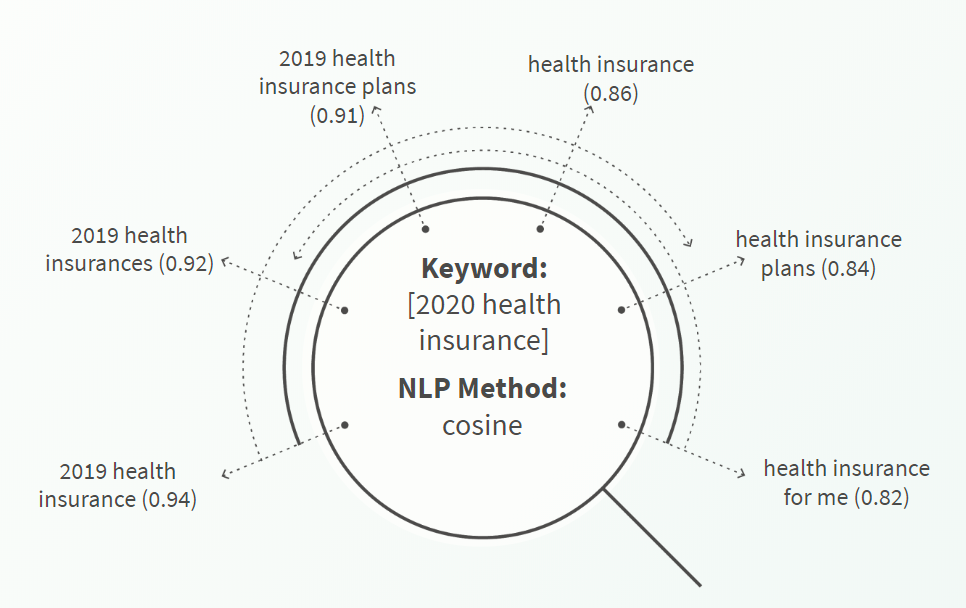
The keyword ‘2019 health insurance’ has a relatively high similarity score to [2020 health insurance], while ‘health insurance for me’, has a relatively lower similarity score.
Factors to take into consideration when utilizing NLP
NLP can be powerful, but only if used on the correct data. When determining which higher-volume keywords to compare to keywords without data, you need to:
Only use high-volume keywords for the NLP calculation
The higher volume a keyword is, the more representative its known value will be. Because of this, you only want to base NLP on keywords you are VERY certain have accurate known values. You don’t get this with low-volume keywords so you wouldn’t want to use low-volume keywords to predict the bid for a brand new keyword.
Make sure the keyword you are estimating the bid for is grouped in an apples to apples manner with the keywords it will use for NLP
You need to make sure the keywords your using to estimate the brand new keyword are a fair representation of how that keyword SHOULD have its bid calculated For example, if your campaigns are segmented by county, the high-volume keyword [2019 health insurance near me] might behave differently depending on which county this is being searched, i.e. it might be a more expensive keyword in San Francisco relative to Fresno.
Natural Language Processing was built for Health Insurance paid search marketers who are trying to get an edge
In the paid search marketplace, health insurance is a tough field to compete in. With tools such as NLP at your disposal, though, you can give yourself a clear edge by getting the most value out of your new keywords before your competitors do.
At Centro, we know that keeping up with the trade pubs and latest trends can be tough and time-consuming. To make that easier, we’ve compiled all the articles, reports, and other bits of awesomeness you may have missed, but should definitely read. Enjoy our latest list below!
Mary Meeker’s Most Important Trends on the Internet [:20]
The annual report from Mary Meeker is a must read every year. Chock full of trend data across the internet from a savvy VC perspective, the report covers a focus on particular business categories, and of course online advertising. For the first time last year, the time spent with mobile and share of media investment reached parity.
But while digital advertising is growing (primarily through increased programmatic buying), it is not growing at nearly the rate seen previously (though there was some acceleration from last year). Watch for privacy concerns continuing to impact targeted advertising, and for more traditional media to blur the lines with digital. Bonus—check out eMarketer’s top 5 trends from the report.
Magna Global + IPG Media Lab + Pandora Present: Ad Receptivity, Deconstructed [:03]
New research from IPG Media Lab points to factors that drive our willingness to see ads before we’re exposed to them as audio listeners and video watchers.
Why Pernod Ricard favors the hybrid in-house model [:03]
Beverage company Pernod Ricard takes a slower approach to creating an in-house team.
WTF Is The ICO? (And Why Ad Tech Should Worry) [:06]
Data protection is becoming an ever important conversation as more companies are having to familiarize themselves with all the data regulations. The ICO is one of the biggest and best-resourced data protection authorities in Europe. People who work in ad tech should worry because the ICO will set the bar for how strictly it will enforce GDPR.
New York’s Privacy Bill Is Even Bolder Than California’s [:08]
The New York bill is different than the California bill in some major ways. While the California law leaves enforcement to the state’s attorney general, the NY Privacy Act would give New Yorkers the right to sue companies directly over privacy violations. This will most likely set up a slew of individual lawsuits.
83% Increase in Customers Due to Location-Based Advertising, According to Factual's 2019 Report [:04]
Location data continues to be an effective tool for marketers — almost 9 in 10 marketers said location-based advertising and marketing resulted in higher sales, followed by growth in their customer base (86%) and higher customer engagement (84%).
Three Things DTCs Have Learned As They Get Into TV [:03]
eCommerce and Direct to Consumer brands are driving in droves towards ad spending on TV while bringing a new data-focused angle to their buying strategies.
How Walmart Is Building A Delivery Operation To Rival Amazon [:04]
Walmart is testing out new delivery capabilities that will rival with Amazon’s grocery delivery subscription service. This adds to the already lengthy list of delivery initiatives Walmart has undertaken over the past year, which includes delivery partnerships with Ford, Udelv and Deliv, and the announcement of next-day delivery.
The Smart Audio Report [:07]
With more than 53M smart speaker owners in the United States, new research from NPR and Edison Research reveals how smart speaker owners are settling in with their devices and the factors the industry will have to solve for in order to grow further.
What Advertising Means in the Age of Spatial Computing [:06]
Advertisers today are starting to look towards technologies such as virtual and augmented reality (VR and AR) as a way of getting closer to their customers and delivering those all-important immersive experiences. See also YouTube’s new AR offering announced last month.
Paid search automation has become increasingly popular in the past few years, striking a huge debate over the merits of manual versus automated bidding in Google ads. Advertisers have managed PPC optimization manually since the beginning of Google Adwords. As a result, many push back against automation technology as a tool for people who don’t know how to optimize campaigns themselves.
On the surface, manual bidding would seem to give advertisers the most control over their accounts and campaigns, allowing them to make any necessary changes to improve performance. But paid search automation technology has a lot more to it than providing shortcuts for campaign optimization. You can automate ad creation, market research, bidding, and more. The truth of the matter is that automated bidding is likely the most valuable and necessary feature for search advertisers in 2019 and beyond. Here are some of the benefits it brings.
There’s a wealth of data out there that advertisers can leverage to improve campaign performance. First, second, and third-party data can tell you more about your target audience, their needs, points in the sales funnel, and more. Data can also help you discover new audiences and understand how campaign elements are performing.
Market data provides valuable insights that advertisers use to adjust bids for different audiences and ensure their max CPC is optimized for every keyword. But there’s simply too much relevant data for PPC managers to work through manually.
Automation solves this problem completely. Paid search automation technology can process large amounts of data and make necessary changes to bids in real-time. Google’s Smart Bidding technology considers your historical performance data and competitor bid strategies to make the optimum bids to maximize campaign performance. Third-party PPC automation tools like QuanticMind by Centro can take this benefit even further by utilizing all relevant market data you provide, such as first and third-party data.
Even if you had a team of data scientists working around the clock to make manual changes, they wouldn’t be able to keep up with automation capabilities. This leads to inherent inefficiencies in campaign optimization that weren’t a reality before bid automation was invented.
Even modest advertising campaigns include a long list of keywords to target. Calculating the optimum cost-per-click (CPC) for each keyword is time-consuming, to say the least. If you work in e-commerce or have a lot of product groups, the task becomes even larger.
Advertisers that rely on manual bidding can simplify things using keyword filters or automated rules to make changes when necessary. But these are limited in scope and are still dependent on manual changes from a PPC manager.
On the other hand, paid search automation technology can calculate the best CPC for every keyword in real-time. The ability to make changes quickly and at scale ensures you don’t spend any time under or overbidding. Instead, you receive the best margins for each conversion, improving your cost per acquisition (CPA) immensely.
Paid search automation not only saves you time but also saves your budget. By calculating the best CPC for each keyword based on the latest market data, PPC automation tools can reduce unnecessary ad spend.
When you use Google Ads Smart Campaigns for PPC management, you select a bidding strategy based on your specific advertising goals. Some strategies include:
Google’s Smart Campaigns use artificial intelligence (AI) and machine learning technology to bid towards the goal you select. Their algorithms can also make strategy changes based on past performance data to better allocate your budget spend.
Say, for example, your goal is to improve return on ad spend. Through manual bidding, you set a higher max CPC for high converting keywords and a lower CPC for low converting keywords. By analyzing historical performance data and the competitive bid landscape, automation technology could discover that actually increasing bids for more low converting keywords brings better ROAS than your original strategy.
Rather than optimizing spend on individual keywords, automated bidding algorithms consider keyword performance overall to improve budget spend. Advertisers who traditionally rely on manual bidding for Google Ads can see the improvements themselves when they try out paid search automation. Improving spend efficiency, in turn, frees up more budget that you can reallocate to new advertising initiatives.
Paid search automation isn’t just about optimizing budget spend to meet advertising goals. You can also improve audience targeting with automated bid adjustments. As you may know, bid adjustments allow you to optimize performance by showing ads more or less frequently based on where, when, and how people search. Most advertisers set bid adjustments manually, increasing or decreasing bids based on relevant circumstances.
Google currently offers the following bid adjustments:
For example, you could infer from your performance data that click-through rates from mobile devices are higher. So you create a +20% bid adjustment for mobile in order for your ads to show more often.
Optimizing bid adjustments manually is often about trial and error. Advertisers create an experiment, increasing bids for a certain audience to see if it improves conversions or other campaign goals. But this can all be automated using technology for PPC management.
Google Ads allows you to apply bid modifiers to Smart Campaigns with automated bidding. It will automatically make the necessary bid adjustments to prioritize an audience and target your set campaign goals.
Third-party PPC automation tools can also handle automated bid adjustments. QuanticMind by Centro allows advertisers to create bid adjustments for all audience types, including Remarketing, Custom Affinity, Affinity, and In-Market. It also uses all your relevant business data to create granular bid adjustments to improve performance and maximize the value of audience targeting to drive advertising goals.
Manual bidding for Google Ads gives advertisers complete control over their accounts, but also the responsibility of fully managing them. Analyzing performance and making necessary campaign improvements is a never-ending task for PPC managers.
On the other hand, paid search automation can handle the majority of bid optimization tasks for you. Rather than eliminating the important role of account manager, it provides them with an opportunity to focus more on strategy development. When advertisers aren’t spending all their time executing campaigns, they’re able to search for and pursue new growth opportunities. They can discover new keywords or audiences to target, create better ads or ad groups, or make other account adjustments to improve campaign performance.
PPC managers need to forecast future performance in order to secure and optimize their budget spend. Creating accurate forecasts can seem like a challenge when you use paid search automation. You can’t predict what changes your automation software will make and can’t factor them into your forecasts.
But you can actually avoid this problem altogether using PPC optimization technology with forecasting capabilities. You can create automated reports that are more accurate and actionable than those you’d create manually.
QuanticMind by Centro is one example of bid automation software with internal forecasting features. It considers historical performance, seasonality, bid landscape data, and other important data to create an accurate forecast of predicted performance up to 100 days into the future. The tool’s algorithms also rely on these forecasting insights to make informed bidding decisions automatically.
Paid search automation can outperform manual bidding in a lot of ways. But if you want to get the most out of the technology to meet your business goals, here are a few tips for starting out:
Try Experimenting with Automated Bidding
If you’re still not sure if automated bidding is the right choice for your advertising efforts, there’s no need to take everyone’s word for it. Test out the technology yourself and see if it brings better results.
Instead of switching an entire campaign over to automated bidding, you can create an experiment to compare the performance of automated vs manual bidding for Google Ads.
For example, you can spend a month comparing how your manual bidding strategy performs versus an automated strategy targeting ROAS.
Here are the steps to create an experimental campaign:
1. Go to Drafts & experiments from the side menu bar
2. Select + NEW DRAFT
3. Select the campaign you want to duplicate
4. Name your campaign draft
5. Hit SAVE
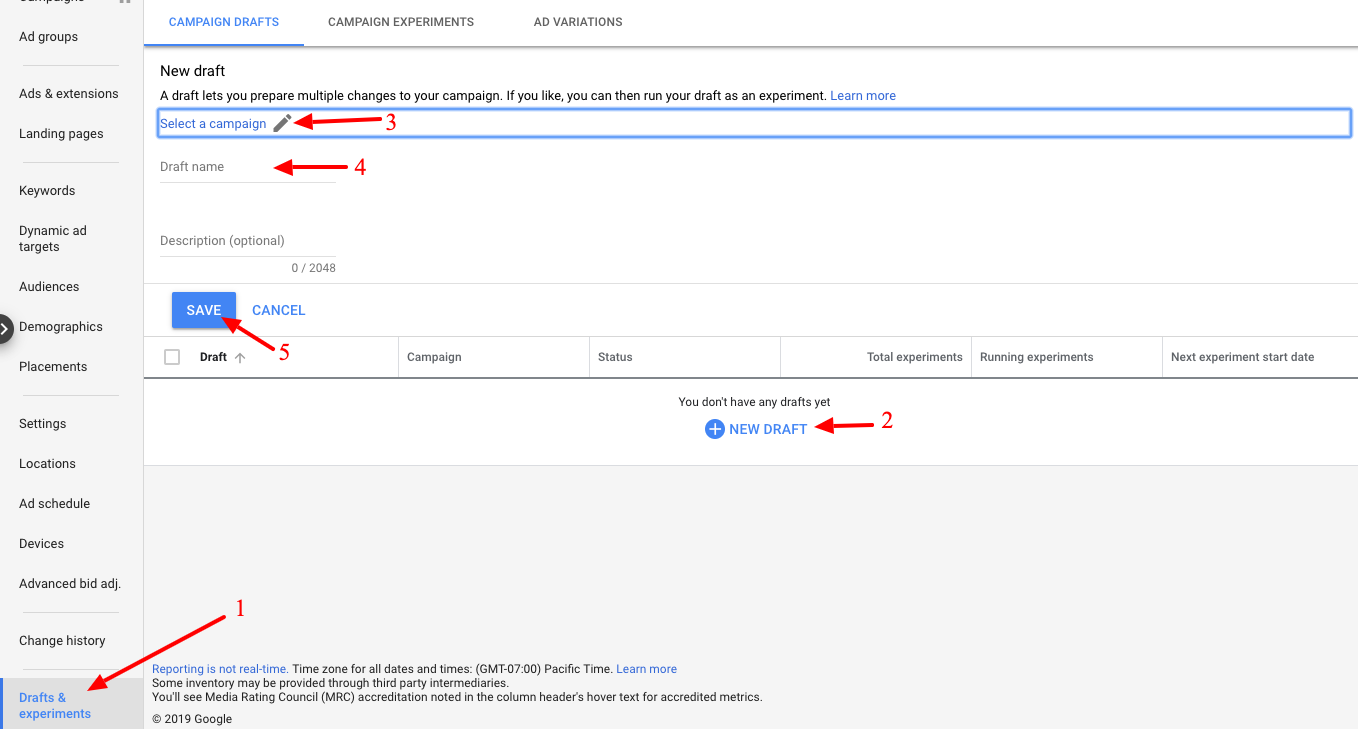
Then go back to Drafts & experiments and click +NEW EXPERIMENT.
On the next page that comes up, you can name your experiment, select what date range you want it to run, and how much traffic you want to direct to it (e.g. 50%).
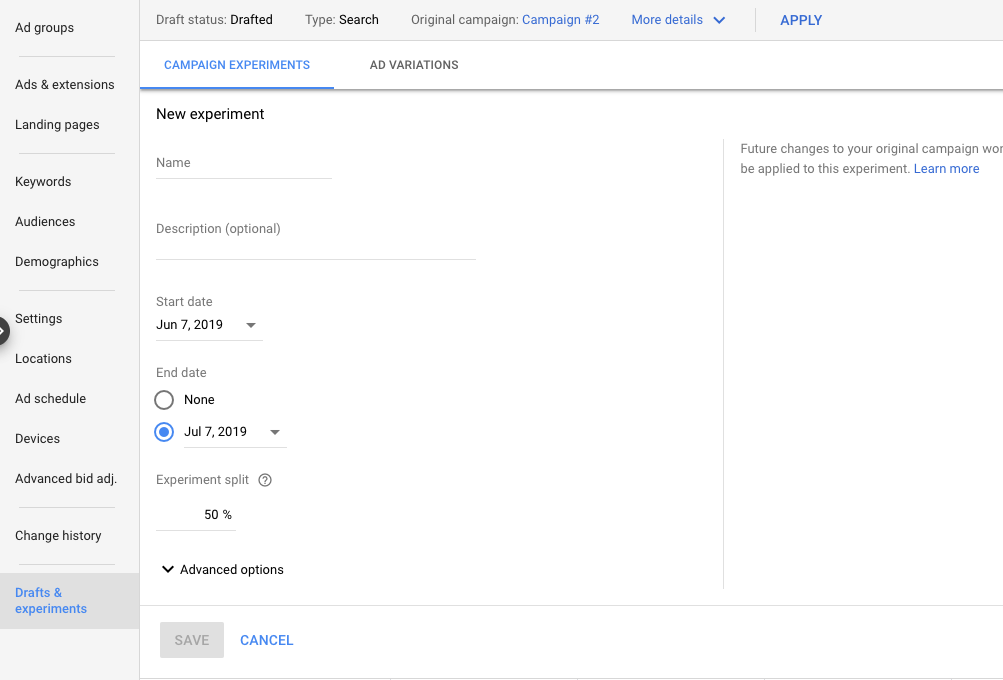
Once you set this up, you can make any changes you want to your experimental campaign without affecting your original one. So you can test out an automated bidding strategy for a short time to see if it drives the results you’re looking for, and with more spend efficiency than manual bidding.
Choose the Right Bidding Strategy
Another very important thing to consider in the beginning is which automated bidding strategy you should choose. All seem to shoot for valuable campaign performance goals, but they approach bidding very differently.
Different bidding strategies will be more valuable for you depending on your current campaign performance and composition. For example:
If you’re not sure which bid strategy is most valuable to reach your business goals, you can also experiment in creating different automated campaigns to test and compare performance.
Use Scripts to Expand Your Automation Capabilities
Google Ads offers a lot of internal automation capabilities for PPC management. But there’s a lot you can do beyond these features to automate and improve campaign performance. Google ads scripts are a way to make custom automated changes to your accounts using JavaScript code.
There’s a wealth of premade scripts available that advertisers can use to automate actions in their Google Ads account, such as adjusting bids, adding keywords, or pausing ad groups. Scripts can also address some of the challenges of automated bidding, giving account managers the control they need. For example, Google’s automated algorithms are able to overspend by up to 200% in order to reach campaign goals. Advertisers who want to cap or control overspending can do so using scripts.
Scripts can also prevent poor campaign performance due to data quality issues. If there’s a problem with your campaign data and automated algorithms refer to it to make bidding decisions, it can hurt performance without your knowledge. But a script can automatically pause problem ad groups or campaigns when performance deviates too far from forecasts. This gives account managers the chance to address the issue.
Consider Third-Party Tools to Improve Precision
Advertisers who use manual bidding in Google Ads find it easy to switch over to automated bidding options on the same platform. Google has a strong solution that continues to introduce new features, but it’s not the most powerful solution for automated bidding. Third-party tools are uniquely capable of considering all relevant business data in calculating bids, giving advertisers an important advantage over everyone using Smart Campaigns today.
Third-party tools like QuanticMind by Centro can also integrate an array of automation features to work in unison to improve campaign efficiency and efficacy. Automatic built-in forecasting, performance reports, and anomaly detection technology eliminates much of the manual optimization necessary with Google Ads automation.
There’s no denying that automating paid search offers many more opportunities to improve campaign efficiency than manual bidding. It allows you to utilize all relevant market data to make quick, accurate changes to improve CPA, reduce wasted ad spend, and more.
Still, some advertisers cling to the idea of manual bidding because it offers one thing: complete control over campaign decisions.
But once you learn about how automation works and the flexibility of options available for utilizing it, the choice becomes more clear. Automation offers all the control you need to utilize the power of artificial intelligence and machine learning to meet your business goals. Meanwhile, the number of advertisers adopting paid search automation continues to grow, making it more of a necessity than an option to keep up with the competition in 2019.
Centro commissioned Forrester Research to assess the economic impact of implementing Basis across digital ad agencies. The results were transformative across multiple areas of the business, including media performance, time savings, agency income, and more.
In June's webinar, we were joined by Forrester’s Principal Consultant, Jonathan Lipsitz, to learn how agencies are automating business processes, increasing revenue, and boasting happier clients and employees. Learn how agencies are seeing a 35% increase in their digital team efficiencies by using Basis.
This infographic provides an overview of running through a root cause analysis on your SEM program, plus touches on two other types of audits you’ll want to keep in mind when assessing and solving PPC performance troubles.
While auditing poor performance isn’t anyone’s dream job, it’s simply a requirement for SEM managers–and can really make a big difference if caught early and addressed correctly. Regular audits are a healthy part of program maintenance.
Sometimes an issue is truly from a “root cause”: business changes, landing page issues, competition in the market, or culturally irrelevant keywords. However, often you’ll find more holistic drops that can be better explained by dimensions or segments that may just need to be adjusted with bid modifiers. Beyond that, sometimes your entire optimization strategy may be built on incomplete data or metrics, or just missing a key step in the customer journey that could drive value.
Addressing PPC issues isn’t fun, but this infographic can help you look into a few elements. However, you can learn even more about all of these topics in our new eBook: Advanced PPC Auditing Guide: Determining Root Causes, Bleeding Dimensions, and Optimization Strategy.

To download this infographic on solving PPC performance issues, click here. The full eBook is also available, digging into all aspects of the infographic. Alternatively, if you’d like to talk to our team about how to improve performance on some dimensions, or get more out of the metrics you’re optimizing towards–get in touch here.
In 2019, businesses are investing more in PPC performance marketing than ever before. Advertisers must constantly be on the lookout for ways to improve Adwords performance if they want to stay ahead of the growing competition. There are a lot of changes advertisers can make to improve performance and an equal number of ways to hurt it. PPC managers can no longer afford to experiment with changes and learn from trial and error. They need to invest in strategies that optimize while avoiding performance issues altogether. Automated PPC bidding technology is the key. Here's why.
Quality data is essential if you want to develop an effective optimization strategy, create accurate forecasts, and make the most of key insights to improve visibility and campaign performance. The better the quality of data you’re able to access and analyze, the more opportunities you’ll have to boost conversions, beat out the competition, and drive revenue from your ads.
One of the biggest reasons for missed goals in PPC performance marketing is low-quality data. Even if you’re using the most advanced optimization techniques, low-quality data can drive misguided decisions, causing PPC performance to fall short of expectations.
Advanced bid optimization technology is uniquely positioned to address this issue by analyzing a unified data set to make profitable bidding decisions. On the basic level, Google’s bid automation technology utilizes bid landscapes, historical performance, and other quality data to drive performance-enhancing insights. Advanced PPC automated bidding tools like QuanticMind by Centro can also consider additional categories of business data, such as offline data from call centers or CRM platforms, data from the web and mobile tracking solutions, inventory systems that track supply constraints, and other contextual data.
By taking advantage of all relevant categories of data, bid optimization technology is able to make informed changes to achieve peak performance. If you rely on a manual strategy or bidding solution that doesn’t capture and leverage all critical data, then you may have some inherent performance issues as well as missed opportunities.
Fully utilizing a unified data set that includes deep funnel metrics will unlock insights into where your prospects are in the sales funnel when you reach them. It can also help you understand which steps in the customer journey are most valuable for your advertising goals. Certain milestones of the customer journey can serve to predict whether a click will lead to a sale, and how much revenue that sale will return. Bid optimization technology is uniquely positioned to make bidding decisions with driving revenue in mind.
Manual bidding is no longer a default strategy in PPC performance marketing. Even for smaller accounts with just a few campaigns and ad groups, there are simply too many important factors that impact bidding decisions to be handled manually, including:
These factors are, of course, always changing. In order for PPC managers to avoid performance issues from under or overbidding, they need to constantly recalculate and update their strategy as the bid landscape and other factors change.
Bid optimization technology has advanced algorithms and data processing capabilities that can accurately calculate the best CPC to maximize campaign performance. Through automation, it’s also able to make constant changes to your bids based on the latest data insights. When you make full use of bid automation technology, it’s possible to avoid performance issues that come from outdated or sub-optimum bidding decisions.
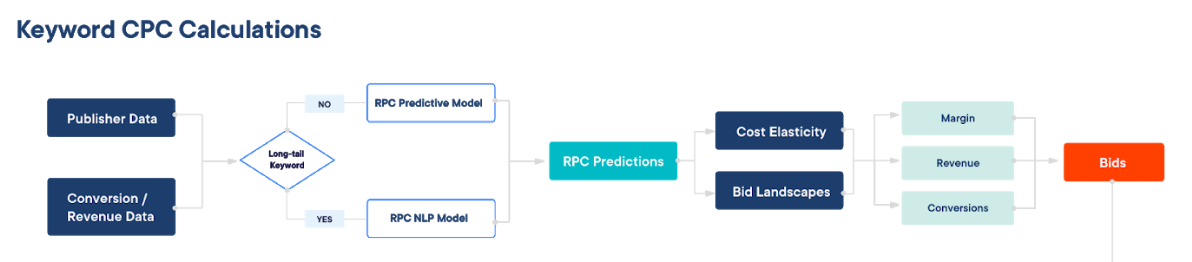
Google’s automated bidding features respond to real-time data signals to make changes to your bids on variables such as device, language, operating system, and performance. QuanticMind by Centro can also optimize bids when data is scarce, for example in the case of long-tail keywords with few conversions. The software uses Natural Language Processing (NLP) to estimate the value of long-tail keywords/product groups.
Here’s a breakdown of the data and process used to calculate CPC and minimize wasted ad spend for PPC:
If you’re having performance issues, it could be because you’re optimizing towards the wrong metric. Every business has unique goals they want to prioritize when optimizing their PPC campaigns. In order to measure performance towards a goal, they need to choose the right key performance indicators (KPIs) to track. Most PPC marketers rely on so-called “vanity metrics” such as impressions, clicks, clickthrough rates, and conversions to measure success. But they often fall short of painting a full picture of how your ads are helping your business achieve your goals.
For example, say your main goal is to achieve a monthly return on ad spend (ROAS) of 150%. In this case, you’d want to include revenue as an important KPI to monitor. It would also inform your bidding strategy, as you’d want to bid more on keywords that generate more revenue and less on keywords that generate less revenue. Bid optimization technology can prevent PPC performance issues that arise from targeting the wrong KPIs. With Google Ads, you can select the right bidding strategy based on specific business goals, such as:
Automated bidding automatically considers all-important KPIs for your business goals when making bidding decisions. Third-party bid automation tools can also help you target a wider range of goals based on a hybrid mix of KPIs, such as maximizing profit margin. This ensures you avoid performance issues from optimizing towards metrics that don’t fully reflect your goals.
Bid adjustments are opportunities to optimize targeting by increasing or decreasing bids in certain situations. You can create bid adjustments based on factors like:
You can also make bid adjustments for certain audiences, such as remarketing lists for search ads (RLSA) or in-market audiences. It’s common for account managers to make bid adjustments manually in PPC performance marketing. This, though, can inadvertently lead to some efficiency and performance issues. A marketer could, for instance, increase bids for mobile devices by 15% because they know conversions are higher on mobile devices. But what if a 10% bid adjustment could achieve the same results? Or what if targeting in-market audiences (who are often searching from mobile anyway) yields better results than a mobile bid adjustment?
The only way to ensure your bids are optimum is through experimentation. But if you automate bid adjustments, machine learning technology can discover the ideal bid changes for you. It can also make constant adjustments to bids to keep up with market fluctuations. The ability to make thousands of granular bid adjustments at scale can significantly reduce wasted ad spend and improve campaign performance overall.
Contrary to popular belief, bid automation technology can be used for a lot more than optimizing keyword bids. Top-of-the-line tools have many features to help you improve Adwords performance, such as advanced reporting and forecasting capabilities.
Google Ads offers internal forecasting features from Keyword Planner so you can see how different keyword targeting and max CPC affect long-term performance. Bid optimization technology can also forecast future performance based on important factors like bidding strategy, historical performance, seasonality, bid landscape, and more.
Accurate, data-fueled forecasting is important if you want to improve Adwords performance and avoid efficiency issues. Most marketers create an initial forecast to secure a budget and plan how to spend it. But as they make changes to their bid policies and targeting strategy down the road, the forecast becomes inaccurate. And even if they don’t make changes, the competitive landscape will shift. So, having an automated, up-to-date forecast at all times is incredibly valuable to avoid performance issues. Any changes you make to your account that inadvertently hurts performance will be instantly visible with forecasting. The forecasting feature available within QuanticMind by Centro allows users to view the predicted performance of bid policies up to 100 days into the future.
It’s primarily the job of a PPC account manager to ensure that campaign performance keeps up with forecasted projections. If your CPA or other performance metrics vary widely from expectations, then an error in your account or data could be the problem.
Whenever an anomaly occurs, PPC account managers need to act quickly to pause problem campaigns and address the issue before it causes too much damage. This task becomes a problem with PPC automated bidding because bidding algorithms are constantly making changes. They also calculate bids using much larger datasets than what account managers using manual bidding would normally handle.
But there are certain features you can use to automatically detect anomalies and minimize their impact on PPC performance. Google scripts are one option you can use to automate this process. For example, there are scripts that can regularly scan your account performance and automatically email the account manager if statistics vary too far from projections. There are also scripts you can use to automatically pause problem campaigns or ad groups, giving PPC managers time to address the issue.
Effective anomaly detection also involves assessing the quality of low fidelity data and making necessary changes to avoid performance issues based on it. For the most part, more data input is always good, unless it’s low-quality data that keeps performance below peak potential and wastes significant ad spend. Often these data quality issues are hidden in the sub-segments of relevant data, making it difficult for marketers to discover by hand. Advanced bid optimization technology is uniquely positioned to address this issue.
QuanticMind by Centro includes an array of anomaly detection techniques to identify potential data issues. In a complex automated bidding process, anomaly detection is the last check before new bid calculations are pushed to publishers:
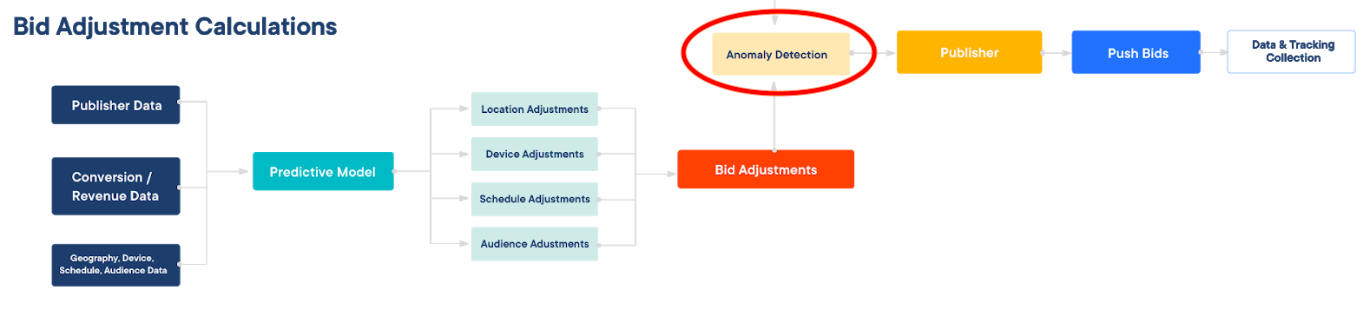
It monitors all key metrics, including cost, revenue, clicks, CPC, and more, then compares their daily performance to forecasted expectations. If results vary significantly, the tool automatically prevents bidding from being updated from deviant data and sends out an alert for account managers. Once the potential data issue is solved, bidding is resumed.
Bid optimization technology is a powerful tool for improving Adwords performance. But it also has important features that help advertisers avoid problems with their accounts and campaigns. Manually diagnosing PPC performance issues is time-consuming, and account managers may never fully identify the extent of the issues. That’s just one of many reasons why bid automation tools are essential for succeeding with SEM.
Dynamic Search Ads in Google Ads have long been a powerful digital tool to expand the reach of an advertising program and discover new, relevant search keywords. Still, they often remain underutilized and misunderstood. Every advertiser should consider Dynamic Search Ads as a part of their advertising arsenal. Here’s a guide on the what, why, and how to maximize the potential of these keyword-less campaigns.
First, what are Dynamic Search Ads, abbreviated as DSAs? Since October 2011, DSAs have allowed paid search advertisers to target customers without having keywords. Google’s web crawling technology indexes your website, much like it does to produce search results, and Google automatically creates an ad when a search is relevant to the content of your website. If that sounds like magic, that’s because it is. Magic in the form of dynamic ad creation. DSAs utilize the very same technology that makes Google a valuable search engine in the first place; it’s ability to index websites and direct search results to relevant content.
DSAs fit the following framework:
[dynamically generated headline]
Yourwebsite.com
Ad description
The ad headline that is shown when a DSA appears on the search results page is dynamically created from Google. The information that populates a DSA headline is pulled directly from the site. You still need to write a description line for the ad, but that is the only thing that can be adjusted. As you can imagine, having a specific and tailored headline that is about the actual product searched is a best practice, and is something that DSAs can help you achieve.
Since DSAs do not have keywords, bids are applied at the ad target level, called dynamic ad targets. DSAs use content from your website to target your ads to searches. There are a variety of targeting options:
Category - Sets of landing pages organized by theme. You decide which sets of pages to target.
Page Content - Descriptive content on the page contains a certain word or phrase.
Page Title - The title of the page contains a certain word or phrase.
URL - The page URL contains this word or phrase.
Each DSA campaign has one or more ad targets, and ad targets can be defined as any combination of the targeting options. Ad targets are typically broadly defined to help increase incremental search traffic.
Ad target bids otherwise function the same as a keyword bid, and DSA campaigns and ad groups have the same bid adjustments available (device, location, etc) as any keyword-based object.
A critical component to achieving success with DSAs is signaling when not to show ads. This can be managed via exclusions and negative keywords.
Exclusions - Exclusions come in two forms, the exclusion of a category, and the exclusion of specific webpages. When your website contains pages that you do not want to direct traffic to, those pages should be excluded. A common example of this is to exclude pages that contain the words ‘sold out’ to prevent customers from seeing ads for products with no inventory.
Negatives - Negative keywords can be added to DSAs just like with any other campaign. Despite DSAs having no keywords, negatives will prevent ads from showing in the case that a search query contains the negative keyword. For example, add ‘used’ as a negative keyword for a campaign dedicated to new car sales.
Create a new DSA campaign with a single ad group. Set a single ad target that targets webpages containing your homepage URL. This ensures content across your entire website is contributing to ad creation and potentially showing for relevant search results. Next, include exclusions and negatives that overlap with content for which you already have keyword campaigns. From there, get more granular, try creating more precise advertising targets, and review the search queries generating traffic and conversions for new opportunities to expand your keywords.
DSA setup is easy, but to have continued success advertisers should routinely reassess their exclusions and negatives to ensure not only that traffic is flowing to the appropriate pages on their site, but also that the traffic is relevant. The other major benefit of DSA campaigns is the opportunity to generate site traffic that would not have been generated via your existing list of keywords.
Most advertisers know what keywords contribute to the majority of site traffic, but reviewing search queries that lead customers to your site via a DSA campaign could help you discover valuable alternative search terms you can then add as keywords. This process should be performed periodically over time to generate additional program growth.
Bing Ads offers DSAs as well and they function the same as with Google Ads. Bing explicitly recommends duplicating your Google Ads DSA campaigns in Bing, which tells you just how functionally identical they are to Google. The same successful practices you administer on Google are equally applicable to Bing.
What industries or verticals stand to benefit the most from DSAs? Short answer, eCommerce, and online retailers. Reason being that DSAs will segment your website content into specific categories, such as product categories, to trigger highly relevant ads and landing pages. Advertisers who have a large catalog of webpages and products are ideal users of DSAs and will save time from needing to specify ad text and landing pages for every product.
Pros
Cons
The good far outweighs the bad, and bad is an overstatement, there really is no bad. The diminished control found using DSAs can be mitigated with a comprehensive set of traditional keyword campaigns. The best search programs are using DSAs in addition to keyword-driven text ads.
DSAs are a valuable ad type that every advertiser should consider. When managed properly, including thorough reviews of exclusions and negatives, DSAs offer a low-risk way to boost search traffic that may otherwise have gone untouched.
~
To learn more about how you can create better, higher-performing ads that drive peak performance, connect with our digital media experts today.
Whether your media budget is big or small, it’s always worthwhile to review how efficiently your campaigns are spending media dollars.
For vetted tips on how to spend more effectively, we turn to Centro’s expert, Laura Perritte. As National VP of Client and Media Services, Laura is a pro when it comes to maximizing client investments and pushing working media to the max.
Listen in, as she dishes on how to get scrappy by using data sources, personalizing creative messaging, developing custom audiences, considering geography, executing across social channels, and more! Don’t miss out on these tips from the field—with so many media options to choose from, assessing whether you’re getting the best bang for your buck is now more important than ever.