
Technology
Basis Platform
Advertising Operating System
Communication Portal
Intelligent Collaboration
All Channel Activation
Activate Media on Every Channel

Consulting
Resources
Advertisers have always prioritized position bidding over targeting impression share. Recently, though, Google Ads introduced a number of new metrics to help advertisers better understand the role of impressions and position in ad performance.
Forward-thinking advertisers can take advantage of this data to improve their bidding strategies and campaign performance. Here’s how to view and harness impression data for better search engine marketing.
Adwords provides a wealth of data about impression share performance, but most advertisers don’t look at it. To see if targeting impression share is an important performance goal for your account, you’ll want to get a clear picture of how many impressions your current ads are getting.
To view impression data in your Google Ads statistics table, you’ll need to modify columns in Adwords. Here’s how:
1. From the main page menu of Google ads, click Campaigns, Ad groups, Product groups or Keywords.
2. Select the column icon:

3. Then click "Modify columns".
4. Expand "Competitive metrics". Then you can check the boxes next to the different metrics you want to see.

5. Click Apply. Now the impression share data will appear in your statistics table.
Google offers a number of impression share metrics that can give you a deeper understanding of how your ads are performing. Here’s an overview of the different ways you can view impression share:
Search impression share: Search Network impressions divided by the number of impressions your ads were eligible for (campaign level).
Display impression share: Display Network impressions divided by the number of impressions your ads were eligible for (campaign level).
Search Lost IS (budget): Percentage of time your ads weren't shown on the Search Network due to insufficient budget (campaign level).
Display Lost IS (budget): Percentage of time your ads weren't shown on the Display Network due to insufficient budget (campaign level).
Search Lost IS (rank): The percentage of time your ads weren't shown on the Search Network due to poor Ad Rank in the auction.
Display Lost IS (rank): The percentage of time your ads weren't shown on the Display Network due to poor Ad Rank.
Search Exact match IS: The impressions you've received divided by the estimated number of impressions you were eligible for on the Search Network for search terms that matched your keywords exactly (or close variants of your keyword).
~
In the past, advertisers would rely on average rank to understand ad position, but that metric isn’t truly meant to describe where an ad appears on a page. In 2018, Google Ads also rolled out four new metrics that can help you understand where your ads appear on the search engine results pages:
Impr. (Absolute Top) % - Percent of your ad impressions that are shown as the very first ad above the organic search results.
Impr. (Top) % - Percent of your ad impressions that are shown anywhere above the organic search results.
Search Absolute Top Impression Share - Impressions you’ve received in the absolute top location (the very first ad above organic search results) divided by the estimated number of impressions you were eligible to receive in the top location.
Search (Top) IS - Impressions you’ve received in the top location (anywhere above organic search results) compared to the estimated number of impressions you were eligible to receive in the top location.
Google provides this illustration to distinguish between absolute top and top impression share:

Having a clear understanding of ad positioning can help you diagnose campaign performance issues and make decisions to increase your bids and quality. For example, knowing what percentage of eligible top impressions your ads capture helps you determine if you should increase your bids. Search absolute top impression share and Search top impression share are valuable indicators of available opportunity to show your ads in more prominent positions.
Impression data can tell you why a keyword may be performing poorly. The granularity of impression share lost due to budget or rank explains exactly what changes you need to make in order to improve ad position.
Bidding too low on keywords can prevent your ads from appearing on the first page. In turn, this can lead to low impressions and conversions. Paying attention to impressions and position metrics can help you make sure your ads get enough visibility to meet your advertising goals.
Analyzing impression metrics and average position together can also tell you a lot about campaign performance issues.
There can be a number of reasons behind poor impression share. Key metrics provide insights into which factors are impacting performance. Then you can make the necessary changes to combat it. Here are the main areas you can focus on to improve targeting in Adwords:
Increase your budget
Your budget controls how often an ad is shown. If your daily budget is too low, it can reach its limit early in the day. This means missed opportunities for ad impressions. Experiment with increasing your budget to see if this fixes the problem.
Decrease regional targets
If you’re targeting a large regional area, it’s difficult to get your ads shown as much as possible. But, if you restrict your location settings to a smaller area, you have more control and potential to dominate impression share. Restricting your targeting to a smaller region will, of course, lead to fewer impressions overall, but it allows you to gain the impression share you need to drive clicks and conversions for your ads.
Improve ad quality
An important factor impacting rank and subsequent position is ad quality. If your ad is poorly optimized or irrelevant for your target keyword, this can negatively impact your Quality Score. Google details a number of strategies you can use to improve ad Quality Score.
Re-adjust your budget
If for some reason you decide to increase your regional targets, this can negatively impact impression share. To combat this issue, you can re-adjust your budget to cover the cost of targeting more potential impressions with your ads.
Increase bids
Probably the biggest opportunity to target impression share is through strategic bidding. Raising bids can improve the chances your ad will show in an auction. Advertisers can make these changes manually by increasing bids for keywords with poor impression share. Or they can use automated bidding strategies to target impression share overall.
Today there are lots of ways to target impression share as a bidding strategy in Adwords. Each has its unique features and benefits to automate account bidding optimization.
Scripts
Google AdWords scripts are a way of controlling changes in your AdWords account using JavaScript code. They can be used to automate all sorts of tasks, including controlling your bidding strategy.
Here’s an example of a script you can use to bid to impression share instead of ad position. It automatically finds keywords whose impression share is too low, then increases their bids. Next, it finds all keywords with a clickthrough rate better than 1% and impression share that’s too high and decreases those bids.
Scripts are a great way to operationalize a bidding strategy to target impression share. Just make sure the script you use has all the capabilities you need to control your account in the right way. For example, a script could completely disregard the budget constraints you need.
Automated Rules
Automated rules are another easy way to target impression share as a bidding strategy. Google’s automated rules can be used to automate all sorts of processes, such as ad scheduling, pausing low-performing keywords, controlling budgets and costs.
It’s also possible to use automated rules to target an average position with your bidding. But since Average Position doesn’t really reflect ad position on a page, you could instead target other impression share metrics, such as Search Absolute Top impression share or Search (Top) IS.
Here’s how to create automated rules targeting impression share metrics:
1. Click Keywords
2. Click the three-dot icon and select Create an automated rule
3. Under "Type of rule", select Change keyword bids
4. In the "Apply to keywords" section, choose All enabled keywords.
5. Under “Action”, select Increase bids.
6. In the "Condition" section, set an appropriate impression share metric.
7. Set a target percentage for your condition.
Here’s an example of what automated rules settings look like for Search lost abs. top IS:

Automated Bidding
Google Ads automated bidding offers a number of strategies to optimize toward specific business goals, such as maximize clicks, target ROAS, target CPA, and maximize conversions. In 2018 they introduced a new strategy: target impression share.
You can use Target Impression Share to automatically set bids to reach a specific visibility goal:
For example, if you set an Impression Share target of 70% on top of page, Google’s automated bidding technology will set CPC bids to ensure your ads appear on top of page 70% of the total possible amount of times they could show. You can use this automated bidding strategy at the campaign level, or apply it as a portfolio strategy across multiple campaigns.
Over the past year or so, Google has been making changes to depreciate the value of ad position metrics and encourage advertisers to focus on targeting impression share. Now that there’s a wealth of granular impression share metrics available, it’s easy for advertisers to use them to drive campaign goals.
At the very least, PPC managers should start paying attention to these metrics and how they’re impacted by campaign changes. Targeting impression share as an automated bidding strategy is the best way to maximize the value of this metric for PPC performance.
Before the days of digital everything, it was impossible to time advertisements in a way that targeted audiences at the moment that would make the most impact on their buying decisions. Today, it’s virtually impossible to realize success from campaigns that aren’t built to touch consumers at just the right time and place.
Get a leg-up on your competitors! Take a look at the reasons the clock should be an essential part of your campaigns, below.
Consumers are more inclined to make purchasing decisions on certain days of the week and during certain times of the day. Sending your messages into cyberspace without adhering to your audience's particular habits is a sure way to miss out on ample opportunities to be seen. On the other hand, utilizing tools that will talk to consumers when they’re most likely to pay attention, will allow you to optimize ROI and drive brand awareness.
Data analytics provide the insights needed, to ensure you're speaking to consumers when they’ll actually be listening. It’s all about understanding consumer behaviors and adjusting your outreach in a way that resonates with them. Pay attention to daily, weekly, and seasonal trends that affect your own unique business, as well as general best practices that will help bolster campaigns overall.
By understanding how consumers interact with your advertising, you’re optimizing marketing efforts without wasting interactions or compromising your bottom line.
No matter what your company does—business has certain ebbs and flows. Acknowledging these trends allows you to capitalize on consumers’ attention. Ignoring them means potentially leaving money on the table, regardless of the elements incorporated into your campaign.
Improperly timed messages put your brand at risk by:
Learn more about timing in relation to your campaigns, and more! Request a demo to see how you can automate and optimize your digital media with Basis! We're excited to show you all that Basis can do.
‘Ask the Expert’ is a series that breaks down the tools, tech, and trends you’ve been hearing about in the trade pubs and around the office. We ask our in-house experts the tough questions and write up the answers in bite-sized pieces for your reading pleasure.
This month’s topic? Amazon search. We brought in Centro’s national director of paid search, Lindsay Martin, to give us the breakdown.
How does Amazon search advertising work?
Amazon search advertising provides paid opportunities within the results that show up when a user searches a keyword on Amazon. Ads can be served on desktop and mobile browsers as well as on the Amazon mobile app. Unlike Amazon’s programmatic ad offerings, advertisers must sell products directly on Amazon if they want to use Amazon search ads. It is like paid search on Google, where campaigns are targeted through a combination of keywords and bids.
What ad formats are included as part of Amazon search?
Amazon search is inclusive of three different ad formats.
Should a brand create an Amazon store?
An Amazon store provides a more immersive experience for consumers to interact with your brand. Creating one is free and can be done based on templates within the Amazon search console. It’s like going to Target and looking at an entire display for a makeup brand.
What is ACOS?
ACOS is the advertising cost of sale. The goal of Amazon search campaigns is typically to drive the lowest ACOS. This is the inverse of return on ad spend (ROAS) and can be calculated as a percentage. ACOS = total ad spend / total ad sales x 100.
How much do Amazon search campaigns cost?
Ads are priced based on cost-per-click (CPC). Amazon search is a real-time bidding atmosphere. Demand is created by a combination of user interest (search volume) as well as the competitive auction. Sponsored product ads must also win the buy-box to be shown within the search results.
What’s imperative to success on Amazon search?
Advertisers need a strong handle on inventory to see success with Amazon search. If inventory is a challenge, it is easy to lose your spot in the buy box to a third-party seller. Ratings, reviews, and content are also important factors to consider. It is recommended that all advertisers have at least 3.5 stars and a minimum of 15 reviews before choosing to advertise an individual ASIN (product). High quality content integrates product descriptions, images, comparative charts, and copy to help customers make informed decisions. All of these impact ad campaign effectiveness on Amazon.
How would Amazon search ads synchronize with other advertising a marketer uses outside of the Amazon ecosystem?
Amazon search complements a full funnel digital strategy. Amazon campaigns focus on “in aisle” purchases. Users can filter for product features such as reviews, pricing, etc. Google is focused on exploration, where to buy, and perhaps pricing. There’s a strong case to be made that these platforms should complement each other, rather than be viewed as either/or.
While you can’t pixel an Amazon page, you can understand attribution of your other digital media by:
I’m sold. How does Centro help with Amazon search advertising?
Centro offers full-service management of Amazon search. This is inclusive of keyword research, copywriting, bid strategy, and campaign optimization, as well as reporting and insights around campaign performance.
Dynamic search ads, commonly referred to as DSAs, have been around for quite a while now, but they’re still not widely used by the majority of advertisers. Both Google and Bing offer DSAs as an option to automatically generate PPC ads for search campaigns, but contrary to popular belief, the feature offers many additional benefits beyond just automated ad creation. In this article, we provide a comprehensive guide to DSAs and insight into their value for performance marketers.
Dynamic search ads are ads automatically created by Google based on a user’s search query and the content on your website. Creating targeted ads is time-consuming, especially for businesses with a large inventory. DSAs can help you find customers on Google and present them with the most relevant offer for their needs.
When you opt-in for dynamic ad targeting, Google bots crawl your website, match search terms to your site content, and then create a dynamic ad. This ad type is ideal for advertisers with a well-developed website or a sizeable portfolio of goods or services. When someone searches on Google for terms related to your landing page titles and content, Google Ads selects the most relevant landing page and generates a related headline for your ad.
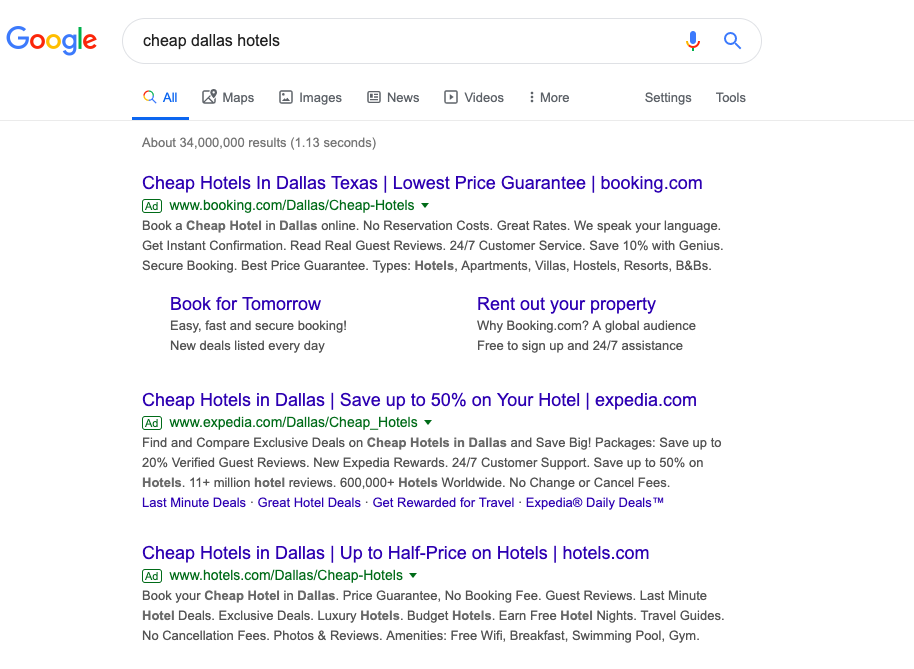
For example, say an advertiser owns a hotel chain and someone searches for “luxury hotel New York.” Google then creates a relevant ad with the headline “Luxury hotel - NYC” and links to the appropriate landing page. There’s no way to tell the difference between dynamic search ads and regular PPC ads in Google. They look exactly the same in search results:
DSAs, though, have the potential to deliver more relevant messaging based on search queries and your landing page content.
And Google isn’t the only search engine offering DSAs as a campaign option: Bing does the same with a few additional features to maximize ad targeting relevance.
All sorts of marketing initiatives are automated. This leaves some advertisers wondering if ad copy creation should be one of them. But using DSAs has many benefits beyond automating a time-consuming task:
Accurate keyword targeting is a powerful way to reach audiences through paid search, but even accounts with the most comprehensive keyword lists are bound to miss some relevant search queries. Since DSAs involve independently scanning your landing pages for suitable terms to target, they can fill in any gaps that come up in your keyword-based targeting campaigns.
With traditional ad targeting, there’s no way to create a headline that’s optimally relevant for every target keyword in an ad group. DSAs offer a unique opportunity to create the most relevant headlines every time, based on both your landing page copy and the exact search term people used to find your ad.
A major challenge for advertisers who sell many products is keeping their ads updated when inventory changes. DSAs address this issue by regularly crawling your website and adjusting your ads accordingly. As a result, Google will never show ads for products that are temporarily or permanently out-of-stock. Clicking through on ads for out-of-stock products is frustrating for users and results in wasted budget spend for advertisers. Using DSAs helps you automatically minimize campaign performance issues from inventory changes.
In the same vein, if you make changes to your landing page copy or product descriptions, DSAs will consider this in the new ad copy it creates. This ensures your headlines are always maximally relevant to your landing page content.
While DSAs are automatically generated, you still have complete control over who you target and with what content. Google’s DSAs offer several options for targeting:
Dynamic search ad targeting helps advertisers create more relevant ads that reach a larger audience of people beyond traditional keyword targeting. Automatically creating ad copy that optimally matches user search queries increases clickthrough rates on ads and ensures they’re directed to the most relevant landing pages, encouraging more people to convert on-site as well.
Keywords don’t always match search intent in the way advertisers expect, leading them to unintentionally target low-quality leads that aren’t interested in their products or services. By considering both your landing page content and search query relevance, Google Ads can help improve the quality and quantity of leads you attract from PPC ads.
Lastly, like with most marketing automation technologies, DSAs save significant time. Creating comprehensive keyword lists and matching them to relevant landing pages is a major undertaking for even the smallest Google Ads accounts. The same goes for creating relevant headlines that best match your keyword categories.
DSAs take on both of these tasks, freeing up account managers to focus on campaign optimization or pursuing growth initiatives. Automating tedious tasks empowers advertisers to spend more time improving budget spend, campaign targeting and performance, driving important business goals in the process.
Interested in trying out DSAs for yourself? Here’s how to create dynamic search ads in Google Ads. (For Bing dynamic search ad instructions, read this article.)
That’s all you have to do to create a DSA campaign and start seeing the benefits for yourself!
Dynamic Search Ads are automated, but there are still many campaign optimizations you can make to improve performance. Here’s how to create DSAs that maximize campaign performance from the beginning:
Google Ads offers expanded text ads as an option to add more descriptive text to ads on Search and Display. At first, this feature was only available to traditional ad types, but in 2017, they rolled it out for DSAs as well. Using the expanded description field gives you an opportunity to deliver a more relevant and meaningful message to your audience. It’s also the only part of your ad that isn’t dynamically created.
Expanded text ads is an important feature for advertisers who want more control over their ad messaging than what basic DSAs have to offer.
DSAs aren’t for every kind of business, but many can see positive results using this ad type to better target their audiences. To get an idea of how DSAs might perform, try targeting a specific audience to experiment. For example, you can use dynamic search ads to target Re-marketing Lists for Search Ads (RLSAs). If the campaign improves ad visibility and clicks, then you can expand to target more of your audience.
You can also experiment with different ad targeting strategies, such as landing pages, categories, or page feeds. Create exclusions for pages that might not perform well, and see how it impacts performance.
Lastly, you can also set bid adjustments to increase or decrease your ad target bids. This gives you more control over when you use dynamic ads to target your audiences.
One issue some advertisers have with DSAs is a lack of control over what search queries their ads are shown for. They have to depend on Google’s interpretation of their site content for keyword matches. There’s always the possibility Google will misinterpret meaning, showing ads for irrelevant search queries in the process.
One way to prevent this problem and improve DSA performance is by creating negative keyword lists. If you’ve run traditional ad campaigns in the past, you’ve probably already built a list of negative keywords that are equally relevant for DSA campaigns. Otherwise, you should take the time to consider how Google might misinterpret your landing page content to create negative keyword lists. If that’s too challenging, then the best option is to launch your DSA campaigns then closely monitor your Search Terms Report to see what kind of queries your ads are showing for. Then you can add negative keywords to your list when necessary.
You can use manual bidding with DSA campaigns, however, automated bidding and automated ad creation work quite well together. When both processes are automated, Google Ads can use auction-time signals to set bids and improve performance. For instance, it’s possible to set bids based on the exact wording of a user’s query to better match your bid strategy to what people are actually searching for. Target CPA, Target ROAS, or Enhanced CPC are good automated bidding strategies to use with DSA campaigns.
Apprehensive advertisers might think this is too much automation to really drive meaningful results from your ad campaigns, but automated bidding combined with DSAs allows Google to make more optimizations than even the largest PPC management team could manage.
Google conducted a case study illustrating the impact of combining DSAs with automated bidding. Trivago, one of the world’s largest hotel search engines, adopted this strategy with conversion-based automated bidding. The results were:
Of course, if you’re still not sure if combining DSA with automated bidding is the right choice for your business, you can always test it out with a new campaign experiment. Use automated bidding and DSAs to target a small portion of your audience, monitor performance, then see the results for yourself.
You can automate all sorts of marketing processes nowadays. But many advertisers agree that creating relevant ad copy is one thing that will always require human insight to optimize. It’s true that advertisers have a keen understanding of what kind of marketing message drives clicks and conversions. DSAs, though, offer a powerful option to combine great ad copy with ultra-relevant headlines tailored to the search queries of individual users.
Create a compelling message for your expanded search ad description and allow Google bots to create the right headlines for your landing pages. Make efforts to maximize the benefits of DSAs for your business to realize the value of automated ad creation for yourself.
Whenever Google rolls out a new feature to the search space, Bing is not far behind with almost identical functionality. This case is true with Bing Shopping Ads. When you’re seeing great results from your Shopping Ads in Google, why test out Bing and look to “fix something that isn’t broken?” In this article, we offer an answer and explore the main benefits of utilizing Bing Shopping.
We’re all familiar with the pros and cons of Bing Search that make opting in an easy choice. A couple of the most notable perks are lower CPCs and more affluent and typically higher education users, while some aspects that could be viewed as negative include an older demographic and only about 30% reach in the search space. Bing Shopping features all the same pros of PPC advertising, however, some of the Bing attributes seen as potential cons could actually be considered benefits. Let’s dive in to why.
One aspect that typically concerns those using Bing Ads is the user demographic skews older. Bing users have proven to be in an older demographic likely due to the default Bing settings on Microsoft devices. It is assumed that older users are unable to change the default web browser setting from Microsoft to Chrome as an example, or simply do not care which search browser they use, so long as the information is valid.
So how can an older demographic be considered a pro? Due to the simplicity of shopping ads showing actual product images, versus text descriptions, the decision to convert is easier, which is why shopping ads have proven to yield higher click-through rates and conversion rates than text ads. Skipping out on Bing Shopping ads because of the age demographic can be a costly mistake when considering the performance benefit of an older user base.
A common reason to pass on Bing for both traditional paid search and shopping is that Bing only accounts for roughly 30% of the search market. This percentage may seem insignificant in comparison to Google, but since the competition is much lower in Bing compared to Google, the average cost per click is also much lower. If budget is limited, Bing is a low-risk option for many advertisers. Lower reach is often a big disadvantage for brands and can be hard to sell as a positive, especially for those with a niche offering. It can be argued that even though the traffic is lower with Bing, it is still worth testing out because in most cases the overall spend is less on Bing. A huge selling point for Bing shopping is the lower cost per click, with on average, better conversions. Lower levels of competition will also allow you to stay online longer throughout the day. Higher impression share, or share of voice as it is called on Bing, is also something to consider as a benefit of Bing Shopping.
Referring back to demographics, another positive characteristic of the audience base in Bing is that the users are higher educated and more affluent than with Google. One new feature for dynamic search ads, text ads, and shopping ads through Bing is LinkedIn Profile Targeting. Utilizing LinkedIn Profile Targeting will give you higher control over your audience as you’re able to filter by company, job title, and job function. This feature builds upon the higher educated demographic. The tradeoff with Bing versus Google is that Bing has less traffic, but the traffic is of higher quality - given the more affluent audience, higher dollar conversions are typical of Bing, and yield a higher return on investment. If you are looking for quality over quantity, Bing is your best bet.
Bing Ads is now Microsoft Advertising. More than just a new name, Microsoft Advertising also comes with new advertising products and features as well! One new product worth mentioning is the Microsoft Audience Network, which uses AI and machine learning to better match customer intent and target a more relevant audience to improve performance. Microsoft also rolled out Sponsored Products to help advertisers boost traffic to their top products in shopping campaigns. Sponsored Products include new consumer experiences that help shoppers filter, suggest, and visually search and find relevant products, giving you more control over your bids and campaign structure.
With all of Bing’s new features and products, deciding to work with Bing Shopping has become a strategic necessity rather than an afterthought. Utilizing Bing Shopping is easier than ever, especially since Google shopping campaigns can be imported directly into Bing. With Basis, strategies and reporting across the two publishers sit directly in one single source of truth, allowing for a more holistic overview of performance.
~
If you’d like to learn more about how we can improve your performance on Bing and indeed drive better outcomes across your entire digital media program, get in touch with us today.
Can you believe the year is half over? Our team has accomplished a lot in the past six months to grow Basis into an even more comprehensive, automated, and intelligent solution for our clients.
Read on to learn how these accomplishments will serve Basis users—And stay tuned for all that’s coming in the second half of the year!
Native and Audio Ads
Early in 2019, our team announced enhanced programmatic advertising capabilities for native and digital audio that push marketers toward complete automation for all media buying and execution.
Audio ads are a powerful addition to any advertising strategy, allowing brands to reach consumers while they’re walking to work, sitting at their desks, or working out at the gym.
Native ads align themselves with the look and structure of the site or content in which they are displayed. They create a less disruptive advertising experience, making native ads a useful layer in any campaign strategy.
Basis’ ability to serve native and audio ads directly from the platform also unifies performance reporting for comprehensive campaign management and optimization.
Privacy and Security
Privacy and security have been a focus at Centro this year. Our biggest accomplishment in this arena is Basis’ newads.txt publisher verification on both web and mobile.
With these upgrades, Basis filters all unauthorized and undetermined inventory identified by published ads.txt/app-ads.txt files. In other words, Centro only bids on authorized and unavailable traffic for open market bidding.
If you’re interested in learning more about ads.txt, check out this article in Ad Age, written by Centro’s own Director of RTB Platform Operations, Ian Trider.
Universal Pixel
With universal pixel, one pixel—or string of code—captures all actions! A single pixel is scattered throughout a site with predetermined parameters, which means that media buyers no longer need to create individual pixels for each tracked action, or manually place every pixel on multiple pages.
Universal pixels facilitate the overall management of first-party audiences, allowing advertisers to track multiple independent or correlated events.
LinkedIn Integration
Basis users are now able to pull all their LinkedIn campaign data directly into Basis, enabling them to analyze and manage their digital media campaigns comprehensively. By planning and analyzing all social buys in conjunction with direct and DSP buys, users can plan a more holistic, optimized campaign.
Reporting
We've also improved Basis’ reporting capabilities to ensure that scheduled reports are sent directly to whoever needs them. This means that recipients are now armed with up-to-date information on their:
Looking Ahead
We've got big plans for the second half of the year! New forecasting and pacing capabilities, additions to our suite of artificial intelligence solutions, and more are on the horizon for Basis.
If you don’t have a digital media management platform that enables and informs your entire business, it’s time to meet Basis.
As business leaders, you face an array of challenges every day. How can you put marketing at the forefront of other responsibilities, let alone make time to manage multiple digital platforms simultaneously? We’re here to tell you that—it is possible! The biggest challenge is to start now, and not let it fall to the wayside.
Multi-channel marketing might seem overwhelming at first, but when it’s set-up correctly from the beginning, each channel will feed into one another—which automates the process and effectively, does most of the heavy lifting for you. Getting started is the hardest part.
In short, multi-platform marketing creates several touch points between the brand and consumers, optimizing engagement along the way. It allows you to meet your audience(s) where they “live” online and tap into the communication channels and social media platforms that facilitate that conversation most effectively.
Many consumers engage with multiple social media platforms in one sitting—meaning, copying and pasting the same message across several sites doesn’t work. It's not only boring, but it can also decrease credibility. Instead, home in on the specific posting specs (i.e., optimal number of characters and/or hashtags) in each platform to deliver visually appealing and engaging content that meets audience expectations.
It’s important to note that not all platforms will generate engagement for your business/brand, which means you should only focus on the ones that really matter. Once you figure out where your customers are “living,” (i.e., the platform(s) with the most engagement) refine your focus to those few platforms. This will enable your voice to be heard and allow you to create the most impact.
For example, a cross-platform marketing strategy may include the following:
It’s important to understand each of these platforms in order to build on strengths and opportunities—and avoid weaknesses and cutting into valuable time.
Set goals in order to measure progress. Know exactly what you’re trying to achieve before you begin the multi-platform journey. For example, some goals may involve:
Start with a baseline. From there, set metrics and analyze how well campaigns are performing.
A campaign isn’t a ‘set-it-and-forget-it’ marketing tool. They require constant attention and analyses to ensure the audience reach is in the right place. If the idea of testing and adjusting makes you nervous, consider hiring a team of digital marketing professionals to do this work for you. Once you find the sweet spot, you'll be able to converse with consumers on the platforms that make the most sense for your unique business.
Basis is your go-to place for all things that make digital marketing less confusing. From programmatic ad buying to solutions that enhance consumer engagement, we’re excited to show you all that our automated and comprehensive digital media platform can do. Don't hesitate to reach out today!
PPC competition is a huge factor when it comes to advertising performance. Most advertisers perform paid search competitor analysis when first setting up their campaigns, but few revisit it as a long-term consideration in campaign performance. When you only focus on your account strategy, you overlook opportunities to adjust to competitor changes. If your campaigns aren’t performing the way you expected, changes in your PPC competition could be the cause. Here’s how to consider this in your Google Adwords audit, and make the right changes to optimize.
Google Ads provides free internal tools you can use to see how your ads are performing compared to the competition. To access these reports:
The Auction Insights report includes valuable data such as:
If changes in PPC competition are responsible for your performance issues, these metrics will likely show it. Impression share data shows how much visibility your ads are getting compared to your competitors, including Search Impr. share, Search Lost IS (rank), Search Lost IS (budget) and Search. If your budget, Quality Score, or bids are preventing your ads from getting impressions, they’ll perform poorly on these metrics.
For example, if your Search Impr. Share is 80%, that means you’re capturing the majority of impressions. If your Search Impr. Share is 40%, then there could be a lot of competitors bidding on the same terms, or your budget is too low. Search Lost IS (rank) and Search Lost IS (budget) will help you understand which of these issues are responsible for low impression share.
Overlap rate will show you how often you and your competitors are appearing in the same auction for search results, while Outranking share shows you how often you outrank competitors when you appear in the same auction.
Auction Insights allows you to segment these statistics by Device or Time as well. So if competitors are performing better in auctions on mobile devices, that gives you a clue as to their device targeting strategy. Same applies to performance differences at different times of day.
Bid strategy and keyword targeting could be responsible for performance issues with your PPC competition, but it could also easily be your ad copy message. If their ad copy is more relevant and better at driving clicks, this can affect your relative ad rank and performance immensely.
One way you can evaluate competitor ad copy is using Google’s Ad Preview and Diagnosis tool. It shows you what ads are appearing for a keyword you’re targeting. There are also many third party tools that can show you competitor ad copy and give insights into their strategy. Spyfu and SEMrush can show you competitor ads from as recent as a month ago.
Here are some important points to pay attention to with your competitor ad copy:
While landing page content isn’t an element of their ad copy, it does have a huge impact on bounce rate. This is an important metric Google Ads uses to calculate Quality Score, which in turn affects ad rank.
Most marketing managers ignore PPC competitor keyword targeting when building their own keyword lists. They focus on including all the most relevant terms that align with their ideal customer’s needs. But often the best keywords have a lot of PPC competition, and targeting too many highly competitive keywords will use up your budget quickly, leading to a high cost per acquisition (CPA) and poor performance overall. Auditing PPC competitor keywords is important when building keyword lists and when evaluating campaign performance down the road. As competitor targeting strategies change, keywords can become more or less difficult to effectively rank for.
The metrics mentioned in the Auction Insights report can help you determine if a lot of other PPC marketers are competing with you for the same keywords. Third party tools can also provide more insights into the competitive landscape of keyword targeting.
In addition to ad copy insights, Spyfu shows you which keywords your competition is bidding on and how they perform. All you have to do is type in a competitor URL and it will bring back their Google Ads budget, paid keywords, ad position, and clicks per day. If you use the paid version, you can also see keyword overlap and other advanced statistics. KeywordSpy is another helpful tool that shows you competitor keywords, domains, and ad copy. It also suggests new keyword and ad combinations based on competitor analysis.
Having some idea of your competition’s strategy and targeting can provide valuable insights to improve your own campaigns. It’s a bad idea to simply copy competitor strategies - instead use paid search competitor analysis to inspire new ways to optimize.
For example:
There are lots of ways to use your knowledge of PPC competition to improve paid search performance. Here are a few examples:
If competitor ads are consistently outperforming yours, it could be because they have a better, more targeted campaign structure. In general, the more specific your campaigns are to promoting different products or services, the more relevant your targeting.
It makes sense for even the smallest businesses to have more than one campaign to target audiences. Having too many ad groups and targeting too many keywords within one campaign makes it difficult to prioritize promoting your most valuable products or services.
Creating separate campaigns also makes it easier to optimize for different audiences you want to target. For example, having different campaigns for different countries you target allows you better control over country-specific bids. You can also include relevant location-based keywords for each campaign.
If your account currently only has one or a few campaigns, consider how you could create more. Is there anything you would change about your bidding or targeting strategy if some of your current ad groups were in different campaigns? This could be the key to outperforming the competition with more relevant, targeted ads.
If you find PPC competitor keyword targeting is a problem in your Google Adwords audit, then you need to make changes to your keyword lists and targeting strategy. Start by identifying your highest cost keywords. Are they driving a good number of acquisitions? Is their CPA acceptable for your marketing goals? Outliers could be pushing your overall CPA up, and should be removed from your keyword lists.
You can also beat out the competition with keyword targeting by creating better ad groups. If all the keywords in an ad group are closely related, they’ll also be more relevant to the ad copy your PPC ads deliver to audiences. Creating intelligent ad groups can improve click-through rates, ad rank, and overall performance.
One aspect of competitor strategies that changes most is bids. Thanks to automated bidding technologies, advertisers can make many micro-changes in their bidding strategy to take advantage of the market.
As mentioned earlier, the Auction Insights report can give you some idea if competitor ads are outranking yours because of their bidding strategy. If they’re using time of day, device, or audience bid adjustments to outperform your ads, you can adopt a similar strategy to beat out the competition. Say competitors are outperforming you on mobile, for example. Create a campaign experiment, then create a +15% bid adjustment for mobile.
Use this bid adjustment with a portion of your audience to see if it improves your search impression share or conversions. If it doesn’t, then likely ad quality and relevance are a problem.
If you can’t identify any clear patterns in how the PPC competition is outbidding you, it could be because more of them are adopting automated bidding. Bid automation tools can process large amounts of relevant business and bid landscape data to make informed changes to your bidding strategy. To see if this is the case, you can create a duplicate campaign in Google Ads and choose an automated bidding strategy to see if that improves your ad rank compared to the PPC competition.
If competitor ad copy outperforms yours, then making changes to improve ad copy targeting could fix your PPC performance issues. Here are some important areas to focus on when assessing your own ads:
The goal here is not to emulate your competitors, but to take advantage of opportunities to stand out from them. Is there anything you can incorporate into your landing pages to improve conversions that your competitors haven’t thought about?
You should also make sure you’re using ad copy elements to their fullest extent to drive conversions. Clickthrough rate is another important factor impacting Quality Score and ad rank.
Consider what ad elements your competitors are using, and which ones would be relevant to your business:
Ad extensions is one area where you really should emulate the competition if they’re outperforming you. For example, if your competitors have a higher impression share on mobile devices, it could be because they’re using call extensions or other copy elements to optimize their ad for mobile. You should test out using the same extensions with a unique call-to-action to stand out from the competition.
It’s easy for account managers to forget about paid search competitor analysis after launching a new campaign. But if you want to stay ahead of the PPC competition, it’s important to conduct regular audits of their changing strategies. Understanding how competitor strategies affect your own campaign performance offers invaluable insights to improve targeting and budget spend efficiency. So incorporate competitor analysis into your campaign audit routine overall. You can also take advantage of bidding technologies to automatically make adjustments based on constant changes in the competitive landscape.
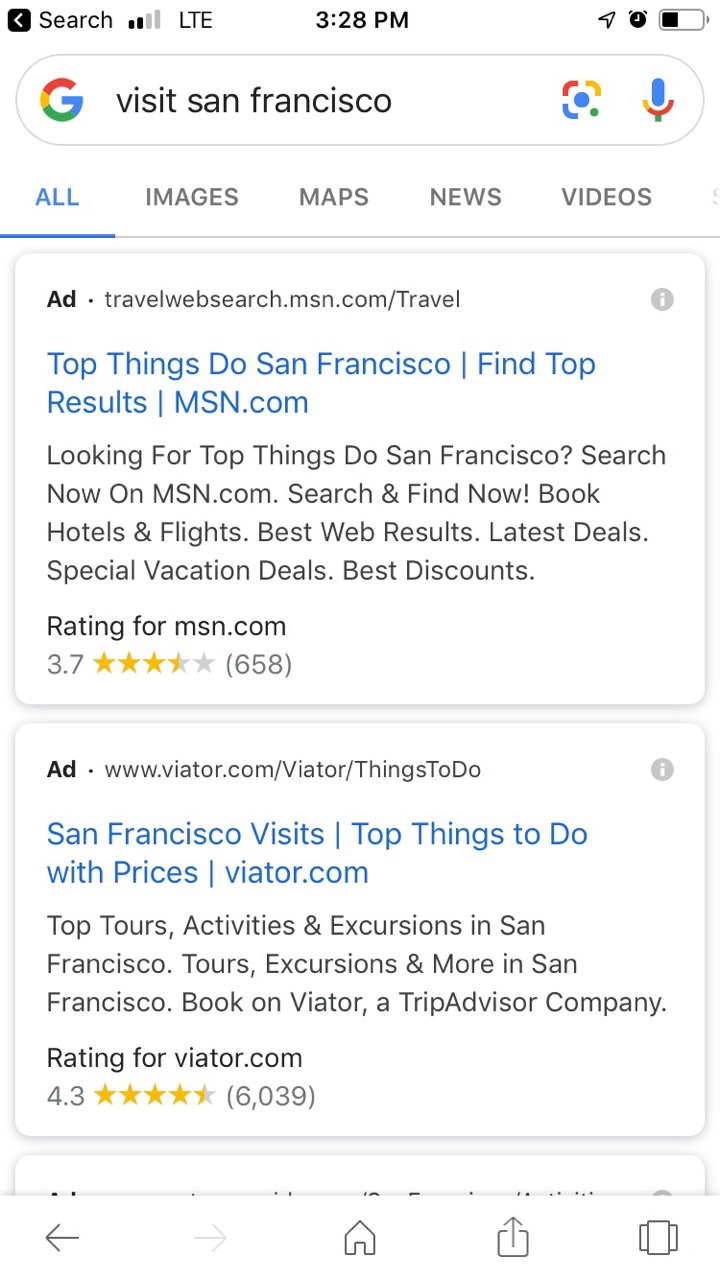
Google’s mobile search has a new look. They have rolled out a mobile search redesign with a black ad label replacing the previous green ad label. You can see the official announcement here.
Search results for “Visit San Francisco” taken on 6/6/19 on both mobile and desktop. Mobile shows the new black mobile label in contrast with the current green ad label on the desktop. The green ad label you see on the desktop was previously used on mobile up until this change. If you take out your phone and do a search on Google you can see it for yourself.
Mobile Search Results
Desktop Search Results
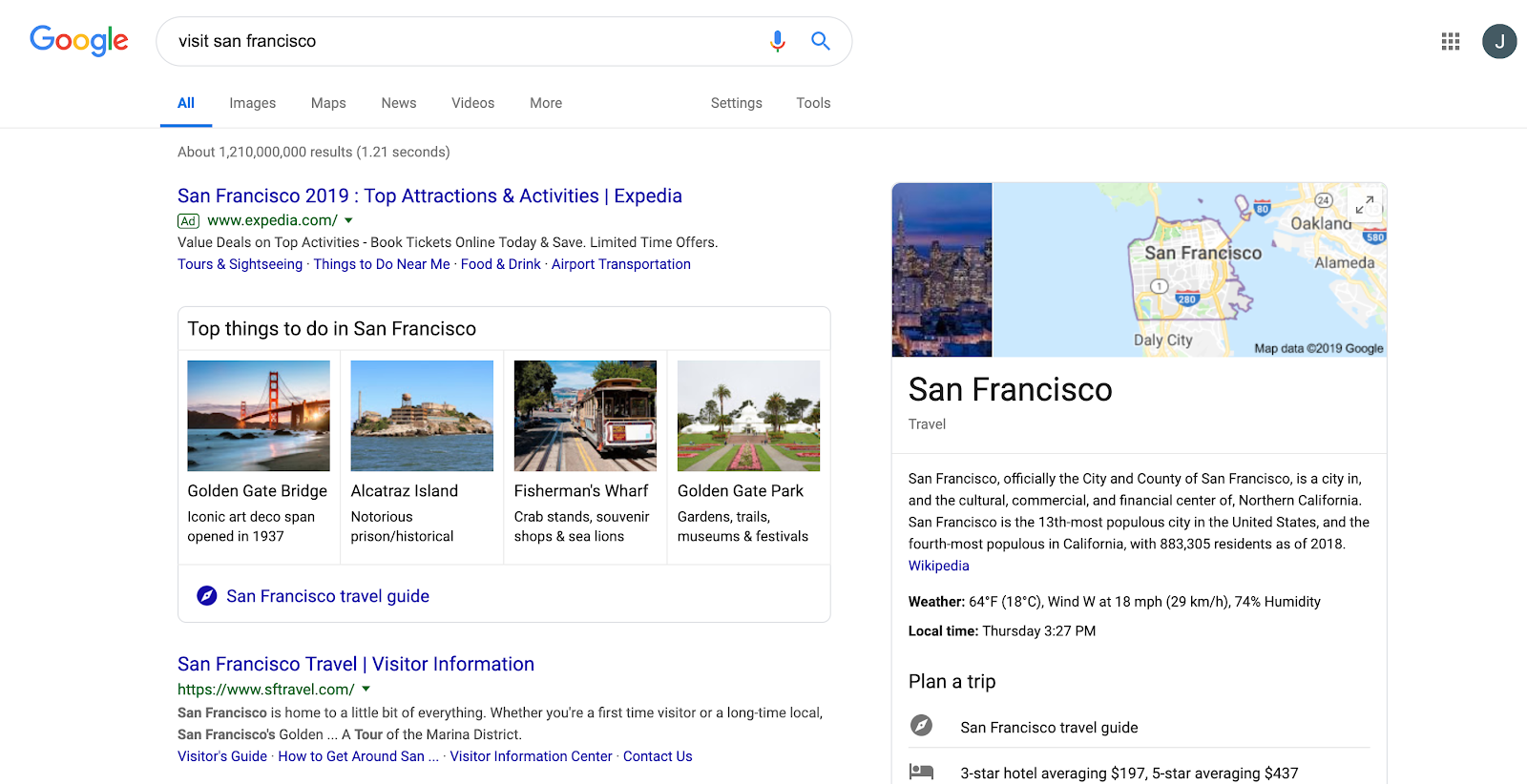
For paid search, the word “Ad” appears bolded and in black. Before the word “Ad” appeared in a green box. The box has been removed and black is the new green. This change provides a more modern look in line with recent web design trends. It is also intended to make it even easier to read and ingest the search results.
This new look brings some branding to the organic search results such as the website icon and the publisher gets top billing. To get your organic search icon or favicon updated, follow Google’s instruction here. Be sure to follow their guidelines so your favicon has a better chance of being displayed.
According to TechCrunch, the branding may even help users better understand where the results are coming from such as identifying if it’s from a well-knowing site or news site. Overall, providing a better search experience.
Advertisers should be watching carefully over the next few months, monitoring mobile click-through rates (CTRs) for any changes, positive or negative. When looking at performance on mobile, keep in mind this recent change.
While there has been no mention of desktop yet, if the mobile rollout goes well, you should keep an eye out for similar tests and changes on desktop.
While it’s still early, Google has reported that a majority of users found it easier to identify websites, and more than two-thirds said it was easier to scan results more quickly.
It’s been reported that some advertisers are already seeing an increase in CTRs. However, it's still too early to know if these early results are sustainable or seen across the board for all types of accounts.
According to the FTC’s business blog, in 2013 they sent a letter to search engines reiterating the original guidance they set in 2002 and updating the guidelines.
In the 2013 letter, the Federal Trade Commission (FTC) mandated search engines to clearly and prominently differentiate between natural results and advertisements. This resulted in removing the shaded boxes around ad and making moves towards the green ad labels that were introduced in 2017 and were in use until this new change in spring 2019.
The guidance provided by the FTC in 2013 states, “visual cues, labels, or other techniques to effectively distinguish advertisements, in order to avoid misleading consumers, and it makes recommendations for ensuring that disclosures commonly used to identify advertising are noticeable and understandable to consumers.”
The FTC’s goal is to make it clear when content is an advertisement and when it’s an organic result. When search engines make changes to results they have to ensure they are compliant with the FTC guidelines. This change does fit within the guidelines and goes above and beyond, particularly since it is easier to identify websites than it was before. Companies using competitors' names in their ad headlines, which you're not supposed to do, will have a more difficult time fooling users into thinking their ad is from someone else. This will make the user's experience better, which is the whole point.
For a more detailed history with images check out Search Engine Land’s Updated: A visual history of Google ad labeling in search results. They have images of Google Search ads from 2007 to the present.
As mentioned above, this change could expand to include desktops. Google is an industry leader and other publishers may follow.
Since this is a change to both paid and organic listings, it's assumed Bing will copy but maybe not right away. As technology continues to develop, the search advertising landscape will develop along with it. The history of search and its relationship to advertising confirms this. For more on SEM history check out our blog on A Brief History of SEM.
Looking to the future, Google has mentioned including Augmented Reality 3D models in search results as well as indexing podcasts so they can be included in search results based on content, not just title. One thing is for sure, search and the associated advertising will continue to evolve with technology to create an even better experience for the user.