
Technology
Basis Platform
Advertising Operating System
Communication Portal
Intelligent Collaboration
All Channel Activation
Activate Media on Every Channel

Consulting
Resources
Driving online purchases is typically a high priority for mobile advertisers with e-commerce sites. There are many tactics available to help reach and engage online audiences and guide them to your website. Depending on your industry, brand, or product, it can also make sense for some brands to incorporate mobile advertising that will bring foot traffic into your physical store, as well.
Even in the digital age, the majority of purchases are still made in a physical store. According to Statista, if the migration toward e-commerce continues in line with current trends, only 14% of purchases will be made online in 2021.
For larger purchases, the majority of consumers do some research online before making an in-store purchase. This allows for efficient shopping, and also for any remaining questions to be answered by a subject matter expert. If a potential customer is shopping between several different brands, a conversation with an in-store representative can increase the odds that you will win the sale.
Bringing consumers from their mobile phone and into a physical location is an opportunity for staff to help to create a positive experience that promotes brand loyalty. Having a second touchpoint can help to solidify a brand in the user’s mind as the go-to source for a product or product category.
Centro’s Basis makes it easy for any mobile advertiser to partner with vendors who specialize in driving and measuring in-store traffic.
Learn more about mobile advertising with Centro here.
Centro’s Candidates and Causes team has been at the forefront of political advertising in digital media since 2006. In our Election Advertising 2020 series, they share insights for advertisers ahead of the U.S. 2020 General Election.
As discussed in part one of our Election Advertising series, this election season will be anything but normal. Overall, political spending will be focused on the upcoming debates, the start of early voting, and finally, Election Day.
Read on to learn how advertisers can leverage the most important dates counting down to November 3rd.
A series of Presidential debates will begin on September 29th in Cleveland. Additionally, 23 states plan to begin mailing ballots 45 days before the election (September 19th). These states include:
Arkansas, Kentucky, Minnesota, North Carolina, Pennsylvania, South Dakota, West Virginia, Wisconsin, Alabama, Delaware, Georgia, Idaho, Indiana, Louisiana, Michigan, New Jersey, Oklahoma, Rhode Island, Tennessee, Texas, Vermont, Virginia and Wyoming*
*Bolded state names signify swing states
Implications: With voters officially receiving ballots this month, advertisers should expect to see an impact on rates in the key states listed above. Overall, and outside of early voting states, political spending will progressively ramp up throughout the month, with higher spending across channels—connected TV in particular.
Geographies: While the most notable impact will be felt in battleground (or swing) states, earlier impacts may be seen in any of the 23 states listed above.
October will be a key period, with two Presidential debates scheduled for October 15th and 22nd. Mail-in voting and in-person absentee voting will also start across the majority of states.
Implications: With the projected uptick in early voting, no longer will demand spike in just the final few weeks of the cycle. Instead, noticeable rate pressure is expected begin in October across much of the country. For those states that do not offer early or absentee voting, expect spending to spike in the final 2-3 weeks before Election Day. Centro recommends planning for a 15-20% increase in traffic across channels.
Geographies: Impact will be felt nationally, but particularly in swing states.
Check out part one of our Election Advertising 2020 series to get an overview of the advertising landscape. Happy bidding!
Writing an effective audio ad is challenging because writing for the ear to listen is different than writing for the eyes to see. A person cannot stop and re-read what was just said to them, so the opportunity to lose the listener is far higher within an audio advertisement. However, that does not mean it isn’t possible to have effective streaming audio advertising that captures the listener’s attention and pulls them into your message. Read our top five tips for effective audio advertising, below:
The longer your message, the more airtime you need to speak it. The average attention span of the average adult America is somewhere between 8-15 seconds—the goal is to capture the listener within those first few seconds. A good rule of thumb is to keep sentences under 25 words each.
A strong CTA is key—ideally, it should be repeated within the script at least two times. An example of a good CTA has a clear and direct action that the listener can immediately take. If the intention is for the listener to come into a store, make sure those exact words are said within the CTA.
Sometimes it is not what you’re saying, but how you’re saying it— one study found a connection between audio advertising and the features of phonoaesthetic function (vocal pitch, timbre, intensity, etc.). Voice is a crucial component of an audio advertisement because there is often no image alongside it to capture the listener’s attention. Read the script out loud a few times to see how things sound!
Play with inserting short pauses after each sentence—these allow the listener time to digest the first thought, before jumping into the next. Frequent pauses also make it easier to edit the audio file later.
Consider words that sound alike or similar and pay attention to context. Remember, listeners cannot see the words you’re saying—watch out for words like “two” and “too” because this can sometimes be confusing to the listener. Also think about the way people talk in everyday conversation and avoid formal structuring (i.e., that of a formal written paper)—keep it conversational!
Ready to learn more? Check out the audio advertising opportunity with Centro, here.
Centro’s Candidates and Causes team has been at the forefront of political advertising in digital media since 2006. In our Election Advertising 2020 series, they share insights for advertisers ahead of the U.S. 2020 General Election.
From the predicted uptick in early and absentee voting, to ever-changing publisher policies and restrictions, to shifting media consumption habits, there’s a lot for advertisers to keep track of this election season.
Understanding timing and key battleground geographies will help provide guidance to both political and non-political advertisers on how to plan for the inevitable rise in ad spend ahead. Read on for part one of Election Advertising 2020, and keep an eye out for parts two and three later this month!
With the move to allow for early voting access across many states, political advertisers will no longer wait for the final 2-4 weeks to execute high-frequency Get Out The Vote (GOTV) messaging.
At least 3 in 4 US voters will have access to mail-in voting this fall, meaning political ad spending is no longer only working towards an Election Day, but rather an Election Month. As a result of this:
While national advertisers may feel minor effects from the ramp of political ad spend, local campaigns running in battleground states or key congressional districts should expect some degree of impact in these final 60 days.
With many publishers restricting political messaging (i.e. Google, Spotify, Twitter, LinkedIn, Pinterest, and TikTok), advertisers will lean heavily into programmatic, Facebook, and premium site-direct. To help minimize the pressure and remain proactive:
Check out part two of our Election Advertising 2020 series.
How can advertisers continue to target audience segments while planning for a privacy-friendly, cookie-free future? In this webinar, we discuss the current state of the targeting market, as well as where it's headed in years to come.
Mario Diez, CEO at Peer39, joins us to discuss the current tactics that are at risk, the rise of contextual and semantic technologies, strategies for transition, and more.
In the modern world of digital advertising, marketing analysts must adopt a scientific and almost artistic approach to exploring and dissecting campaign performance. With businesses today compelled to invest in more channels than ever before - paid search, social, email, PR, SEO - it has become increasingly difficult for those working daily with data to expose truly valuable insights and precisely measure the effectiveness of their strategies.
Marketing dashboards offer a simple solution to this problem, pulling data together from disparate sources and providing dynamic visualizations of performance - from a high-level down to channel-specifics - all in one single location. The ROI gained from dashboards is greatest when you set-up defined components that empower you with all the information you need to move the needle for your business. Ultimately, the more refined and insightful your custom dashboard analytics are, the more actionable intelligence your evaluations will yield.
In this blog post we delve into four dashboard components that every digital analyst should utilize in order to facilitate more penetrating examinations into performance. Each of the four examples we highlight is designed to help analysts report performance findings easily to all stakeholders and serve as a compass for charting a path forward on the marketing roadmap.
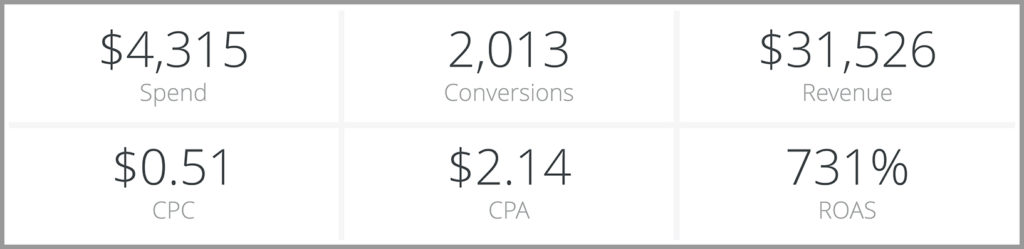
Overview:
Arguably the most important component you should have on your dashboard is a snapshot of campaign performance from the previous 24 hours. When it comes to digital advertising, the competitive landscape is forever shifting and it is therefore imperative to have a succinct birds-eye view of the return on investment your campaigns are bringing in. This simple summary does the job, empowering you with a quick understanding of aggregated investment, volume, unit economics, and campaign efficiency, and, essentially, whether your campaigns are performing as projected or if any unforeseen issues have arisen. Having this uncomplicated at-a-glance visual aid at the top of your dashboard will help you swiftly identify any performance changes as they happen.
Common Variations: Duplicate and segment widgets with added filters by publisher, channel, campaign, product/service, etc.

Overview:
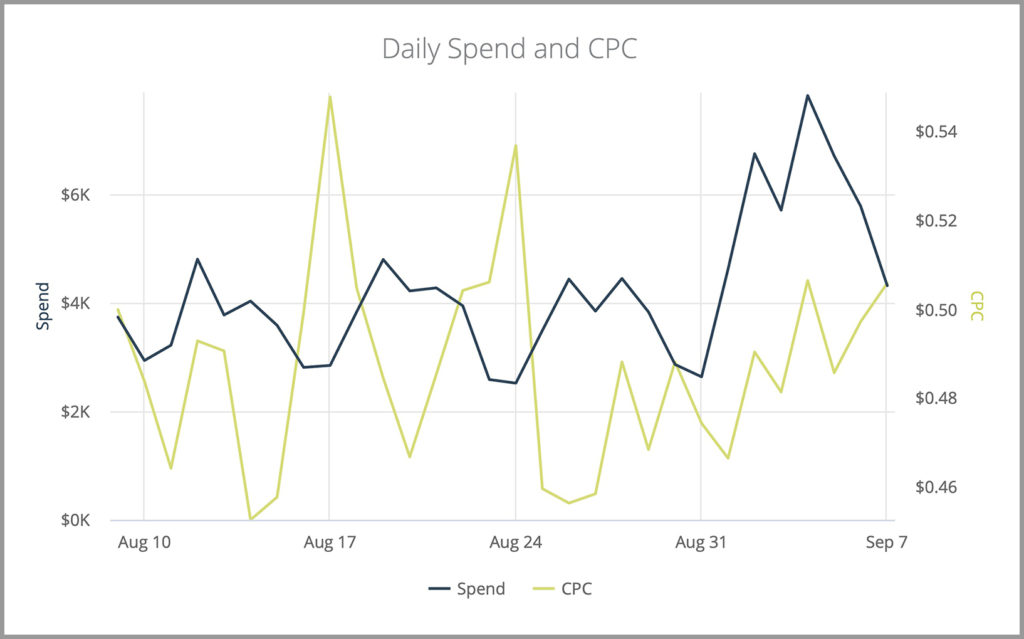
As all analysts will affirm, campaign performance varies widely by segment, whether it be channel, publisher, or any other dimension. Focusing on the example of publisher segmentation, this dashboard offers clear insights into how each of your publishers performed the day prior and which, if any, has been the driving force behind any unexpected changes in performance, positive or otherwise. Search engine marketers using Bing as an additional advertising channel will find this snapshot particularly beneficial. While reach and impressions on Bing tend to be lower compared to Google Ads, it could be more valuable in terms of cost and ROAS. The only way to test this hypothesis is by paying close attention to how these key metrics differ per publisher.
Overview:
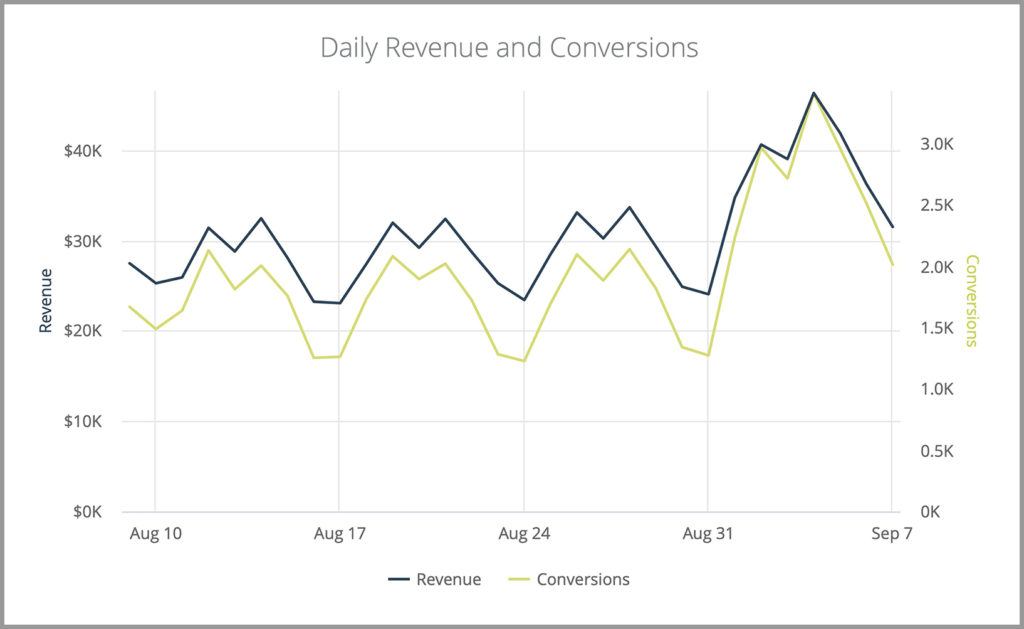
While your most recent performance snapshot offers a flying summary of campaign execution, there are also other important trends you’ll want to stay abreast of in order to maintain perspective and provide more informed insights to your C-level executives. You can do this by creating a component that includes line charts that detail swings and movements in key metric performance over the past 30 days.
Monitoring trends over an extended period such as this allows you to understand the daily fluctuations within advertising investment and revenue generation. Line charts illustrating 30-day changes make it possible to expose performance tendencies as they begin to reveal themselves. Quickly discovering negative shifts in conversions and revenue affords marketers the opportunity to diagnose and fix issues before they develop and hamper campaigns in a significant way.
Common Variations: Duplicate widgets and create additional graphs with other relevant metrics. You can also filter by publisher, channel, campaign, product/service, etc.
Overview:
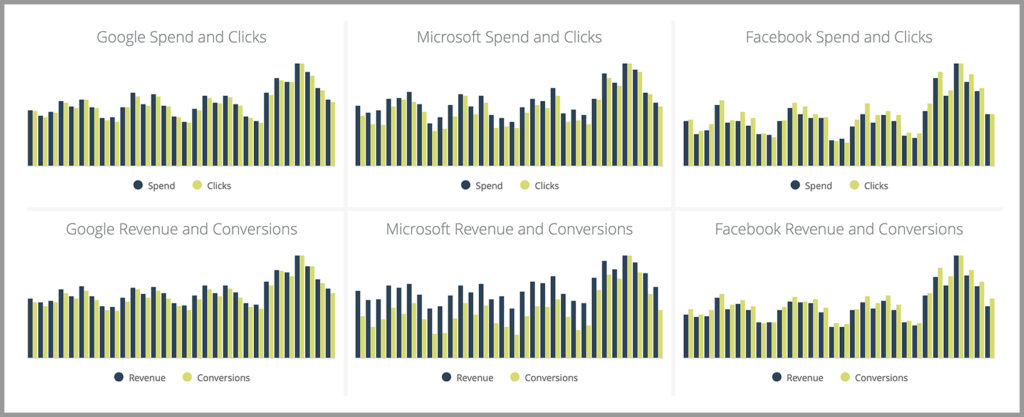
Continuing with the model of segmenting by publishers, this dashboard component is essential for monitoring trends over a one-month period. A whole host of factors can impact advertising performance by segment almost overnight and thus collating all this data together allows you to quickly recognize the daily fluctuations in advertising investment and revenue generation for Google, Bing, Facebook, and other publishers. This can help you understand how search advertising performs compared to social, which publishers bring in the most conversions and revenue overall, and how consistent your advertising campaigns tend to perform across the 30 days. If the performance for one publisher starts trending differently, you can swiftly determine the root cause and make optimization changes.
Common Variations: Duplicate and segment by channel, campaign, product/service, etc.
Every business has unique goals and key metrics that drive marketing performance. By leveraging expertly designed dashboards, whether from a library of templates built with components like the ones discussed in this article or by building your own, digital marketing analysts can become empowered to maximize the performance insights they need. Dashboards offer a quick overview of daily advertising performance, help you follow recent trends, or break down performance by publisher and other segments to unlock opportunities for improvement.
At Centro, we know that keeping up with the trade pubs and latest trends can be tough and time-consuming. To make that easier, we’ve compiled all the articles, reports, and other bits of awesomeness you may have missed, but should definitely read. Enjoy our latest list below!
Nielsen Total Audience Report [:09]
The Nielsen Total Audience Report dives into the world of working from home—how consumers feel about their productivity, engagement, challenges, and the impact this new lifestyle is having on media and device usage. Overall media consumption jumped significantly in the first quarter of 2020, and video streaming increased from 19% in fourth-quarter 2019 to 25% in second-quarter 2020.
US Digital Display Advertising 2020 [:06]
Digital ad growth is taking a serious hit this year from the coronavirus and related recession. But display ad spending will still post 5.5% in annual growth, thanks to increased investments in video ads, mobile, connected TV (CTV) and programmatic transactions.
Consumers Want Brands To Reference Current Events, COVID-19 In Ad Messages, NBCU Study Finds [:01]
A new study shows that consumers wants brands to advertise at about the same level as before the pandemic, but that messaging should acknowledge current events. 69% of consumers want to see brands referencing current events and 81% say they are more likely to buy from and use brands that "help others when it’s needed most." 72% said they are being more thoughtful about brands they support post-crisis.
2020 International Report on Programmatic In-Housing [:28]
The IAB’s Programmatic and Data Center conducted a survey in the US, Europe and Latin America that found that programmatic advertising has been on a meteoric rise, that brands desire more control over programmatic buying and that when it comes to bringing programmatic in-house, most brands and agencies are taking a hybrid approach. More than a fifth (21%) of organizations have completely moved this function in-house, and almost half (48%) have partially moved programmatic buying in-house.
Brands Continue to Lean Heavily on Programmatic Advertising, IAB Says [:03]
IAB's latest report follows years of growth in the programmatic category and comes as the pandemic accelerates consumer digital consumption and changes marketers' data-related needs in the face of growing regulations and third-party cookie degradation. Almost one-fifth of U.S. brands had moved programmatic buying completely in-house in 2019, while more than half had transitioned to doing so partially—up 4% from the previous year—according to a new IAB report.
Streaming Viewing Up 74% Annually, Disney+ Has 4% [:02]
A new report that speaks to Nielsen’s streaming meter panel found that average weekly streaming minutes are up from 81.7 billion in Q2 2019 to 142.5 billion in Q2 2020, representing a 74% increase.
What The Rise Of At-Home Cinema Means For Connected TV [:04]
The at home cinema experience was already expected to grow between 2019 and 2025. However, as coronavirus shut cinema and theater doors down, this number has grown more than expected. First-party data from Samsung smart TVs shows that linear TV is making a smaller portion of people’s total TV viewing habits. This new trend is opening up new, innovative ways people experience film and the commercial opportunities along with it.
How The Death of Digital IDs Will Reshape The Marketing Mix [:04]
The demise of cookies, IDFA, and likely all 1-to-1 identifiers available to third parties will change the ways buyers approach the marketing mix. While the industry will develop new ways to target audiences, none of the solutions will be the 1-to-1 targeting buyers have become accustomed to. There will be 4 main ways the industry tackles this–advertising scale, audience engagement, media cost, and brand safety.
Apple Killed The IDFA: A Comprehensive Guide To The Future Of Mobile Marketing [:15]
Apple just changed the mobile ad tech ecosystem with their recent announcement. According to one expert, IDFA access will fall between 10-20%, and this article goes deep on what the impact may be for marketers.
How Covid-19 is Destigmatizing Virtual Life [:07]
A Collective Virtual Experience can be defined as an experience where a group of people simultaneously participate in a live event or experience online. From Zoom happy hours to meetups in Minecraft, we continue to find new platforms, forums, and feeds to connect with each other and our passions, all in the virtual space. How will these behaviors have a lasting impact as folks start to see each other IRL?
Designing Deeper Fan Experiences [:05]
Sports are back…kinda. Leagues and teams are rethinking the experience, exploring how fans can interact with each other and the game in real time. Technology enables experiences that have never been possible before. Now more than ever, people are willing to try new ways of doing things.
SECTION 1: DIGITAL MEDIA EXCITEMENT
In April 2020, Centro surveyed 65 progressive, conservative and non-partisan agencies, consultants and advocacy organizations specializing in political marketing. According to their responses, connected TV and programmatic advertising are poised for a big election year. Of the respondents, 63% consider connected TV (CTV) as one of the top five most promising developments for their digital campaigns. CTV had the highest vote total by a wide margin, whereas in our 2018 survey it ranked as the fifth most promising development, selected by less than 40% of respondents.

As enthusiasm for CTV rises, excitement around programmatic advertising is holding steady—and was selected by 53% of respondents this year, and 42% in 2018.
The use of programmatic ad tactics is still new for many marketing professionals—however, the use of data will continue to be a key element for any digital campaign. In our 2018 polling, the top five developments that received the most votes were audience data, technology for connecting offline-online audiences (no longer in the top 5 this year), digital media confidence spurring more spending, programmatic advertising, and CTV. One consistency from two years ago is that social ad products ranked last again. While social channels undoubtedly play a role in most campaigns, their ad offerings don’t appear to enthuse political marketers.
SECTION 2: HOW MUCH IS ENOUGH

When asked what portion of overall media spend goes to digital, a majority of respondents said that digital budgets make up less than half of total media spend, with 62.5% reporting digital allocations under 40%.
This is in line with industry predictions that digital will account for 19-30% of total political ad spending in the 2020 cycle. This also confirms that political investment in digital still lags well behind other industries, as digital is expected to make up more than 50% of all US ad spend in 2020 according to various studies.
However, in our survey there were a significant number of respondents (30%) for whom digital makes up the majority of their ad spend.

While no one believes digital is getting an outsized share of spending within their budgets, respondents were nearly equally split between feeling their digital budget allocations are ‘too low’ and those who say it’s ‘just right,’ while the remaining 11% are ‘just guessing.’
A majority (65%) of respondents who had 24% or less budget allocations felt this is too low. For the group that indicated a budget of 25-39%, it was evenly split between those who said it is ‘too low’ and those that say it’s ‘just right.’
A majority (68%) of respondents who had a 40% or more digital budget allocation said it was ‘just right.’
SECTION 3: CASHING IN ON CONNECTED TV
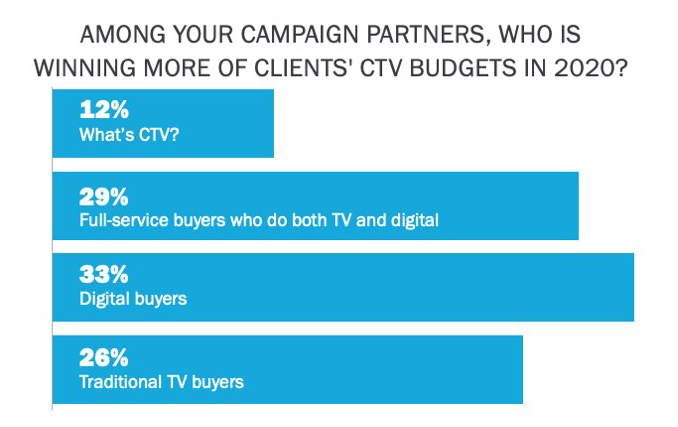
The growth of CTV (consumer use and ad dollars funneled through it) is leading to battles to win budgets. A continuing industry question is who is best equipped to manage CTV budgets—is CTV digital or TV?
According to Centro’s 2018 election ad spend data, only 5% of political spending was channeled to CTV. But allocation is projected to grow dramatically this year.
Although there is perceived parity in winning CTV ad dollars, respondents from advertising agencies (vs Political consultants, Public Affairs Communications, Media Buying Agency, or Non-profit Organization) strongly believe (70% of them) that digital buyers were winning more.
SECTION 4: PROGRAMMATIC IS A POLITICAL AD STAPLE
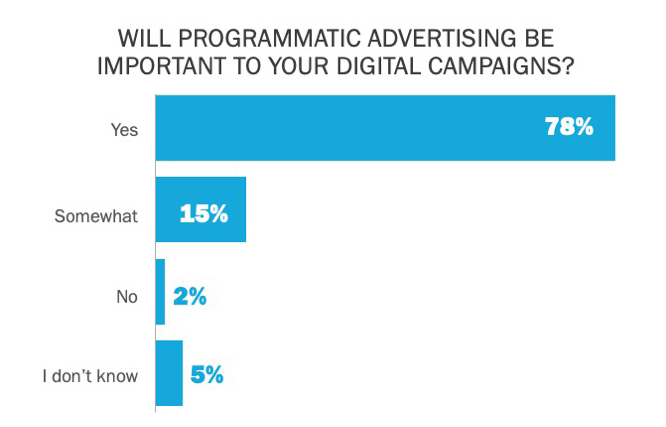
The overwhelming majority of professionals feel that programmatic advertising has some level of importance to their campaigns this year. Overall, 78% said ‘Yes’ programmatic will be important, which is consistent with the response to our 2018 survey, when 77% chose Yes. The shift over the last cycle was that ‘I don’t know’ responses dropped to under 5% this year (from 13% in 2018), and respondents selecting ‘Somewhat’ important increased from 9% to 16%.
Presently, programmatic is how most digital impressions are transacted. The question is how political operatives choose to access this, whether it’s through self-serve platforms or contracted as a managed service from a partner.

In programmatic buying channels, the importance of data (whether it’s 1st or 3rd party) for an election campaign is evident because of the need to scale impressions with precision, to reach the right people.
Illustrating its general popularity, CTV (along with other forms of digital video) looks to be a highly utilized programmatic channel for political marketers.
More than half of respondents are excited about hyperlocal ads—a coincidence, with Centro’s 2018 numbers showing that the same percentage of political clients used this tactic for election campaigns.
Holistic reporting, a new concept, is not specifically associated with programmatic (because programmatic is normally activated in a silo); but 40% of respondents added it their top five list.
Notable laggards are native advertising and private marketplaces.
SECTION 5: THE COVID-19 FACTOR
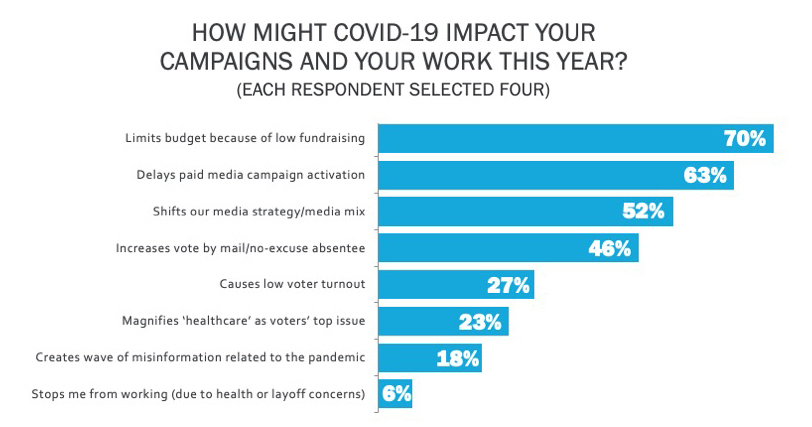
Political marketers are not concerned about job loss or inability to work during the COVID-19 pandemic.
Regarding the pandemic, the biggest concern is campaigns running and ad budgets, because there’s only one event and only one desirable outcome.
Vote by mail and education around it is a new concern brought on because of the current state of the country.
SECTION 6: AREAS OF CONCERN
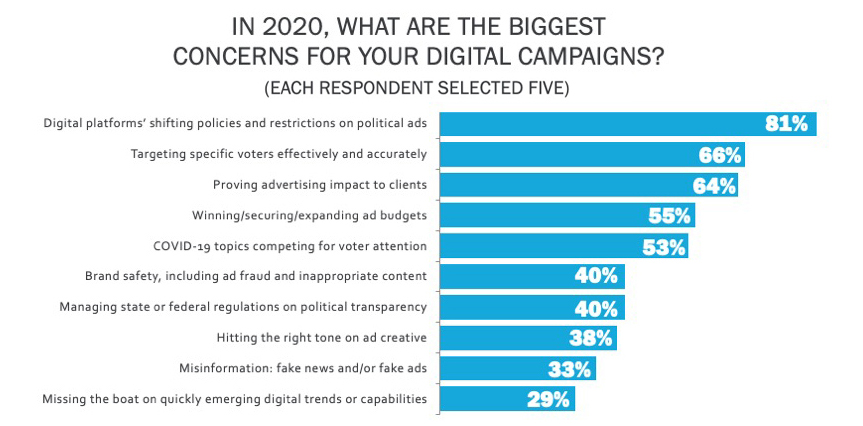
When it comes to overall concerns in digital media for political campaigns, 53% of respondents think COVID will distract from key issues.
The shifting policies of digital platforms is the biggest concern – they take up most of the spend while causing more complexity and confusion for the industry.
Targeting voters, proving ad impact, and winning budgets are also top of mind for marketers.
Misinformation and the factors around it are not much of a concern.
SECTION 7: UNCERTAINTY
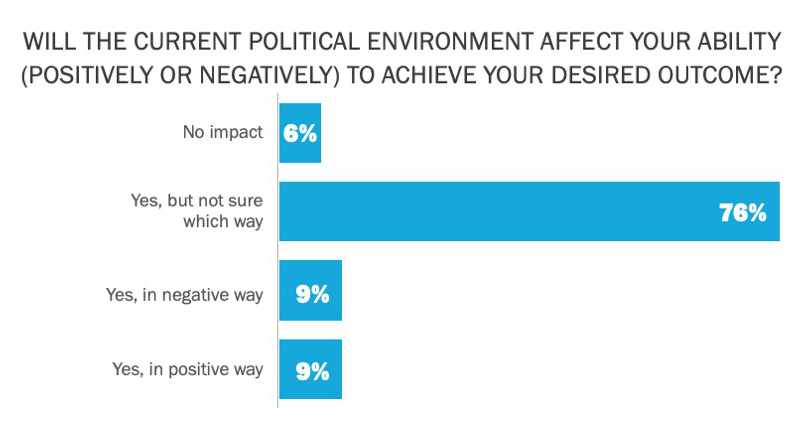
Uncertainty is a common theme for 2020 and that is reflected in the outlook for political campaigns.
76% say the political environment will affect their desired outcome but are not sure whether it will be positive or negative. This is up considerably from 2018 when only 50% of respondents answering this way.
In 2018, 21% guessed that the political environment would have no impact, but this year, only 6% feel this way.
Acknowledgments
As a thank you to our industry peers and partners, Centro is donating $2 to Feeding America for each respondent of our survey.
About Centro’ Candidates and Causes Group
For more than a decade, Centro’s technology and services have been trusted by agencies and consultants in politics, public affairs, and advocacy. Throughout the years, Centro’s Candidates + Causes group has collectively worked with 1000+ political campaigns and independent expenditure committees, and 1000+ issue advocacy advertisers. Our proficiency for driving perception in government, in the public sphere, or among specific audiences is a differentiated and valuable asset in this field. Centro is headquartered in Chicago with 43 offices covering North America, South America and Europe, including a Washington, DC, hub for its Candidates + Causes team.
In reaction to the current movement against racial inequality, many companies are scrambling to audit and improve their diversity, equity, and inclusion (DEI) strategies. Professionals of all levels are simultaneously determining how they can contribute to a more equitable future.
In this episode, DEI executive and educator Veronica Appleton shares her perspective on addressing DEI in the greater advertising and marketing landscape.