
Technology
Basis Platform
Advertising Operating System
Communication Portal
Intelligent Collaboration
All Channel Activation
Activate Media on Every Channel

Consulting
Resources
For as many digital years as I can remember, we’ve been discussing the “future” of video advertising. Most of that conversation revolves around two topics:
To be sure, these are both critical considerations for a modern media strategy. Broadcast is a stubborn (and reliable) dinosaur, but digital channels have been capturing more eyeballs and ad dollars for years now. If you aren’t producing mobile-optimized and short-form video, and you haven’t expanded your media mix to include OTT, or perhaps even live streaming, you’re being left behind.
So, get to it! You’re not alone—we have a great team of strategists to help.
On the other hand, if you’re one of those forward-thinking advertisers who’s already mastered the sponsored Instagram story and streaming video, you’re likely wondering what else you can do to guide your digital video strategy into 2021 and beyond.
Here are two modest predictions for the future of video.
The days of the third-party browser cookie are numbered. We’ve known this for some time, but with Google announcing a 2022 cookie sunset date for Chrome and its 66% browser market share, contingency planning is in full effect across the industry.
The death of the cookie, combined with looming privacy regulation, opens the door for an old friend—contextual targeting. This may seem like a throwback to Centro’s early days of local news ad buying, but we’re not just talking about sports-section takeovers anymore. Contextual 2.0 offers a host of machine learning solutions for discerning page sentiment—these solutions recognize images and dynamically insert creative alongside appropriate subject matter.
With the adoption of improved alignment technology, a contextual-first strategy could be a cost saver and performance driver, not just Plan B. Past studies have already suggested that contextually relevant advertising can improve ROI by 30%, compared to cookie-based targeting.
Plus, one of the most compelling use-cases for advanced contextual targeting is video!
Brands invest heavily in crafting video to evoke a specific emotional response among an audience in a specific mindset. Poor video placement (below-the-fold, in-banner video, anyone?) can undermine this desired effect, and at high CPM’s, waste your ad spend entirely.
Precise contextual alignment, with user-friendly ad formats, presents an opportunity for video ads to be more topical, viewable, and delivered to a receptive audience—all benefits that make this strategy arguably more valuable than user targeting.
Next steps:
As traditional retailers struggle just to survive 2020, the shift to e-commerce has accelerated dramatically. Social platforms are seizing on the opportunity.
If you’ve spent time on Facebook or Instagram recently, you’ve probably noticed how easy it is to make an impulse purchase through well optimized shopper ads (guilty!). And, to simplify the process even more, Facebook introduced Shops in May, allowing brands to sell products directly through its platforms.
And then there’s the Gen Z favorite, TikTok. TikTok’s growth has been explosive, with an addictive interface that drives massive numbers of views. To understand its long-term potential, take a look at how its parent company is approaching e-commerce, and how e-commerce and social video companies are collaborating in China.
TikTok and Shopify just announced a partnership that cements e-commerce as the real game plan. Not only will purchases from Shopify merchants be easier through TikTok, businesses will have access to TikTok’s ad platform directly through Shopify–something in-house marketing teams should be aware of. With its video-first, early adopters from Gen Z (a population that controls a growing $140 billion of spending power), TikTok is in a position to fundamentally change how people shop.
So with social media giants transforming into digital malls (and potentially making a run at Amazon), what does this mean for advertisers?
First, marketers can now use video to speak directly to consumers at the digital point of sale. With an audience that’s literally one click from conversion, brands should be developing a new class of video assets tailored to the actively engaged shopper.
To move the needle from impulse to purchase, consider an immersive, educational approach, including AR/VR and other interactive tools, as well as authentic testimonials or product demos.
Second, the shopification of social media increases the value of influencer- and fan-generated content exponentially. If Douyin (TikTok’s Chinese counterpart) is any indication, in-video search is on the horizon and will allow users to purchase products simply by tapping them in a video.
With every view representing an organic shopping opportunity, imagine the impact of your product appearing in tomorrow’s viral sensation. If content and influencer marketing haven’t been a priority in the past, now may be a good time to determine if they’re a fit for your brand.
Next Steps:
Learn more about video advertising with Centro.
Converge your direct and programmatic buying functions, and improve performance while you’re at it.
Every year, Centro hosts a wellness event called Wellnesspalloza. Wellnesspalooza is centered around free health screenings for all employees, as well as their eligible spouses. Centro sets a goal of 100% participation for all employees.
These screenings run over 30 tests, ranging from anemia, infections, and certain cancers to heart disease and stroke. Additionally, employees and their spouses can use their screening results to discuss with their doctors, assess their year-over-year health, and work towards being the healthiest version of themselves.
Each year these wellness screenings are complemented by a week of events promoting many aspects of wellness, including mental, physical, and financial health. These events have included cycling classes, cooking classes, on site manicures, massages, financial webinars, etc.
Every year the events change based on the needs of our employees, but the goal every fall is to provide an opportunity for employees to step away from their daily work and focus on themselves. It’s a time for employees to come together, have fun, and learn more about their health.
Even though all Centro employees remain working from home this year, we knew we still needed to offer this opportunity for our people. All events took place over two weeks, were hosted 100% virtually, and allowed for friends, family, and roommates to join in the fun and learning.
Employees volunteered to teach classes around fitness, cooking, and card crafting. External vendors and partners provided expert knowledge around 401k, RRSP, meditation, home buying, saving for the future, etc. The virtual setting still provided all employees and their families the opportunity to join in and learn something new to better themselves during a stressful time for many.
Apart from Wellnesspalooza, Centro strives to offer the best benefits to employees year-round. Centro’s health insurance plan for employees and their families includes medical, dental, vision, and preventative healthcare. All employees receive Headspace memberships, free and confidential access to our Employee Assistance Program, Rocket Lawyer legal services, student debt contributions, and more.
By offering these programs and initiatives, Centro follows through on our commitment to putting our people first, no matter what.
Learn more about life at Centro!
Are you ready to make your move to a self-service buying model? Find out with our handy guide.
Mobile advertising is no longer just beneficial—it's imperative!
Advertisers know that mobile ads are one of the most effective ways to reach consumers. Ranging from text, video, and banner ads, to interstitial and gamified ads, there are a variety of formats available for grabbing people’s attention.
One of the main benefits of mobile advertising is that it gives advertisers the ability to target audience segments. Advertisers can reach consumers in a place that travels with them to many different environments, using mobile capabilities like GPS that create a variety of options for targeting.
However, the mobile advertising space can be tricky—marketers need to progress beyond mobile clicks, conversions, and app installs data, in favor of more complex behaviors and KPIs in order to engage more effectively with customers.
Audience Targeting Tactics for Mobile Advertising
While there are a variety of ways to target mobile consumers, the tried-and-true tactics include:
The Future of Mobile Advertising
As the first 5G networks ramp up, and privacy regulations become the new standard, mobile advertisers will need to remain agile in order to make the most of mobile advertising.
Check out our Centro Institute Webinar, The Future of Targeting: Contextual, Semantic, and Cookies for more information.
Learn more about Mobile Advertising with Centro.
The first thing to know about choosing a new DSP—is that you need more than just a DSP. We know the idea of transitioning to a new digital media platform can be very intimidating. There’s an incredibly daunting process of direct and programmatic integration, media convergence, and many other moving pieces. Where and how do you start? Below, review the evaluation process to ensure a solid and confident investment that will meet the expanding needs of your organization, now and into the future.
Know your “why.” Why? Setting business goals and looking at the big picture will allow you to see where there is room for improvement down the road.
Ensure buy-in from the executive team and stakeholders. Break it all down—education may be needed to help company executives, shareholders, and members of your tactical team understand the reason(s) for this large transition, as direct and programmatic integration is no small feat. Educate yourself about the entire process first, so you’re able to answer their questions to the best of your ability. Also, identify the questions you aren’t sure of to come back to at a later date.
As mentioned, you need more than just a programmatic buying platform. Determine the components that are critical to your business, by identifying the specific initiatives and goals the platform will need to support. Assign a project manager to track progress, tasks, and deadlines.
Arm your team and stakeholders with the necessary considerations and questions needed to craft a well-thought-out Request for Information (RFI) or Request for Proposal (RFP). Our Digital Marketer’s Guide to Choosing a DSP takes you through the entire evaluation process and is chock-full of questions to ask potential vendors.
What are you waiting for? Get started today!
Whether it’s enhancing Basis’ capabilities, creating educational resources, or providing Raving Fan Service, Centro is always working to help your organization grow and succeed.
New updates. Every week.
Did you know that we update Basis every week? From an enhanced dashboard to smaller design improvements, our technology team is constantly finding creative ways to improve your experience with Basis.
They also connect you with partners to increase the options you have for building tactics. This year we:
All our 2020 features and integrations can be reviewed at BasisUpdates.net (there’s a lot!)
When the world changed, so did we.
Our award-winning training program Centro Certified went fully virtual this year. The best part? 652 participants across North America, South America and Europe have been able to join us to learn as a group. You can boost your knowledge of the media space by registering in one of our courses:
The Centro Institute also offers on-demand education. Our monthly webinars feature industry experts that give us their perspective on topics such as:
These, and many others, can be viewed anytime on our website.
Providing Raving Fan Service is in our DNA.
If you aren’t raving about our people and our products, we have not achieved the level of customer happiness for which we strive. There are over 400 Centrons dedicated to helping you maximize your experience with Basis and navigate the complexities of digital media.
Acting as your digital advocate, your CSM and Account Lead work to understand your requirements and priorities, make sure both are being met, and provide seamless communication and connection between you and Centro. Many of the enhancements and programs we create result from conversations with our clients: your needs and ideas are our priority!
We aren't done yet.
2020 isn’t over, and in the next months you can expect to see visual changes implemented to make Basis more interactive, new partners added for campaign targeting, and more stimulating conversations published for you to tune in.
Always evolving. Always innovating. For you.
Digital marketing activities don’t just play out on one channel. From advertising publishers and social management tools to mobile analytics portals and call tracking solutions, the modern marketing organization is tasked with juggling a matrix of disparate systems to map and refine their customers’ increasingly complex paths to purchase. With the number of marketing avenues open to businesses continuing to grow exponentially, the predominant challenge facing marketers is managing the sheer volume of data they are collecting via these siloed platforms. The success of any marketing strategy today has thereby become hinged on being able to effectively track and report on all this data to uncover how every channel is working in harmony to drive revenue.
That is where marketing dashboards come in, replete with all the mechanisms needed to empower marketing teams to turn a pile of fragmented statistics into dynamic visualizations that offer an interconnected overview of how marketing investments pay off. Dashboards have the power to tell countless different stories, and consequently how they are modeled and displayed will depend entirely on the role of the user. Digital analysts and those more closely involved with the day-to-day management of data should place a focus on visual aids that drill down into recent performance over short time periods. A marketing executive, by contrast, will be primarily concerned with big picture trends and analyses, as opposed to the intricacies of how campaign X performed on channel Y. “How much have we been investing? Where have we been investing? How does that compare to our budget planning?” These are the questions a Chief Marketing Officer will want answered in a dashboard.
This blog post highlights five dashboard components essential specifically to marketing leaders. Collectively, the snapshots depicted here provide the high-level data a decision-maker needs to measure campaign efficacy quickly and ultimately determine strategic objectives moving forward.

Overview:
Dashboards need to tell a story. This component does that both immediately and effectively. By headlining the dashboard with this succinct executive summary against high-level goals, CMOs can identify within the first 10 seconds of viewing whether something is amiss. These metrics quantify the overall impact that an organization’s marketing approach is having on their market and illustrate if there is a need to scrutinize particular areas of their program more acutely. These numbers inherently only demonstrate value if the data is recognizable to the user and they know what to expect. “By now, I anticipated having spent 2.48 million and therefore this makes sense. However, I was forecasting a ROAS of 650% and we’re noticeably short of that. Why?” Quick, penetrating insights are what this visual aid is designed to induce.
Overview:
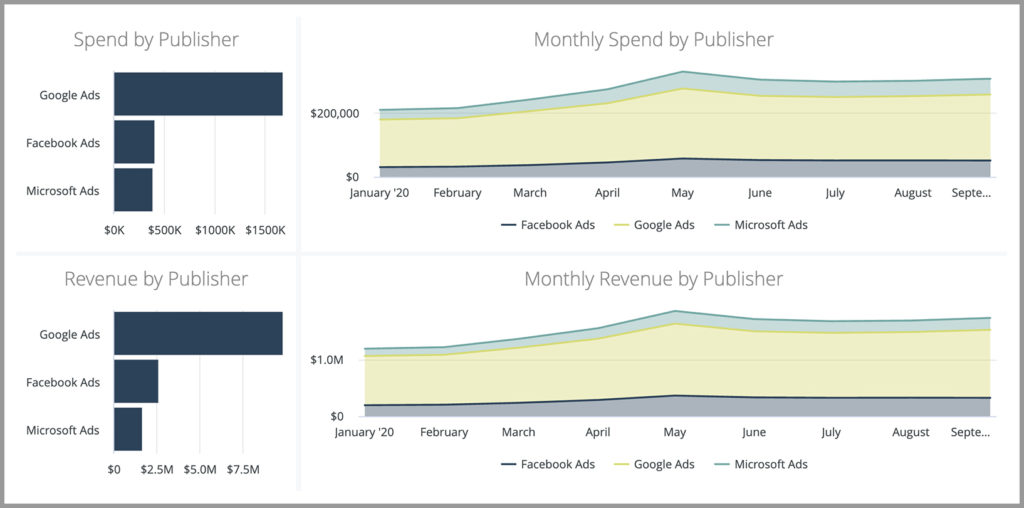
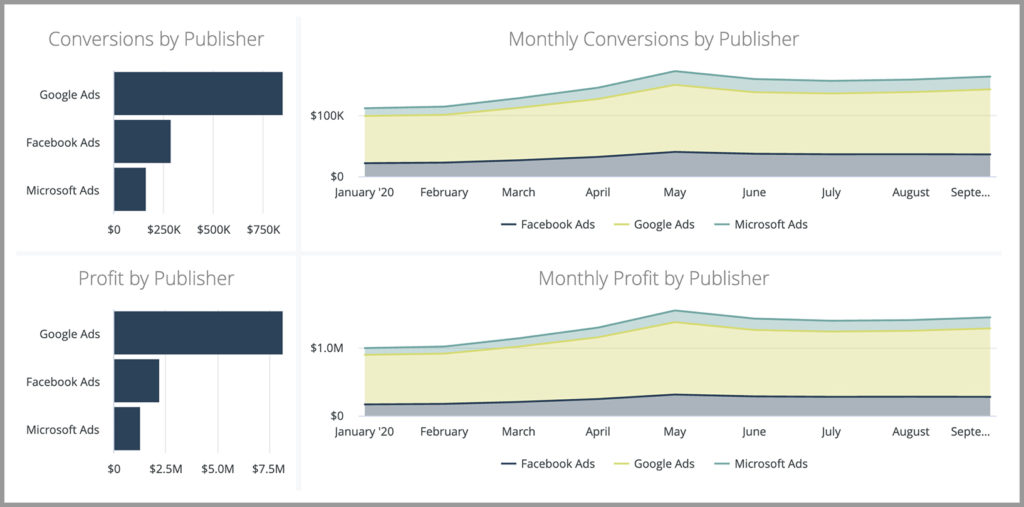
Pictures equal a thousand words, and that should certainly be true for CMO dashboards. While the headlining component above details the hard-core marketing metrics in aggregate, these eight simple visualizations handily break down those numbers to showcase how each channel is performing independently. For businesses and CMOs to continually outpace their competition, marketing teams need to be driving replicable growth month-in and month-out. Boosting revenues and profits relies on a constant process of identifying areas for optimization across marketing channels and swiftly responding to market movements. This component empowers marketing executives with the information they need to do just that.
Looking at the charts, one can observe that spending is at similar levels on both Facebook and Microsoft ads, yet revenue and conversions are both higher on the social channel. Seeing this, a CMO can then instruct their team to assign more budget to Facebook and monitor how the change in approach works out. That’s ultimately the nature of the information an executive can extract here: big picture trends for the year to date. Utilizing stacked charts - with the total value at the top and the breakdown in between - is particularly valuable in this context as they fluently expose swings and smooth progression from one month to the next as opposed to displaying each channel’s performance individually as distinct entities.
Overview:
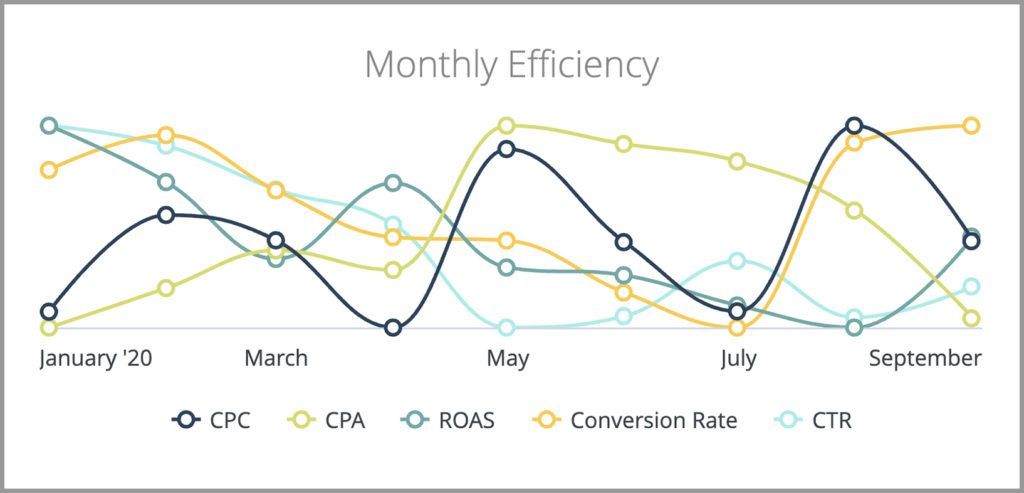
Data by itself can be incredibly dry, and it is the job of a dashboard to bring numbers to life. This dynamic line graph unpinned from zero is a great example of that. It’s a visual aid built without a y-axis to highlight that the most important piece of insight here is the correlation between efficiency metrics rather than the actual value themselves. This chart is not modeled to reveal whether you’re hitting your CPA goal, for example - that data is in the headline component - but instead what the overall trends are in terms of relationship to one another over the course of the year.
Driving efficiency is shaping up to become the top priority for CMOs over the next few years. In a recent study titled The Modern CMO conducted by Forbes Insights, it was found that 46% of CMOs named efficiency as being top of mind. The study - which surveyed more than 200 CMOs in global companies - revealed that efficiency was more significant than other areas of marketing including customer experience, brand awareness, investing in technology, reaching younger generations, and global expansion. With CEOs progressively looking to marketing chiefs to connect investment to revenue and enterprise value, showcasing consistent improvement across these efficiency metrics is going to become table stakes for marketing teams. It is vital, therefore, that CMOs have a pulse on how they are swinging and shifting.
Overview:
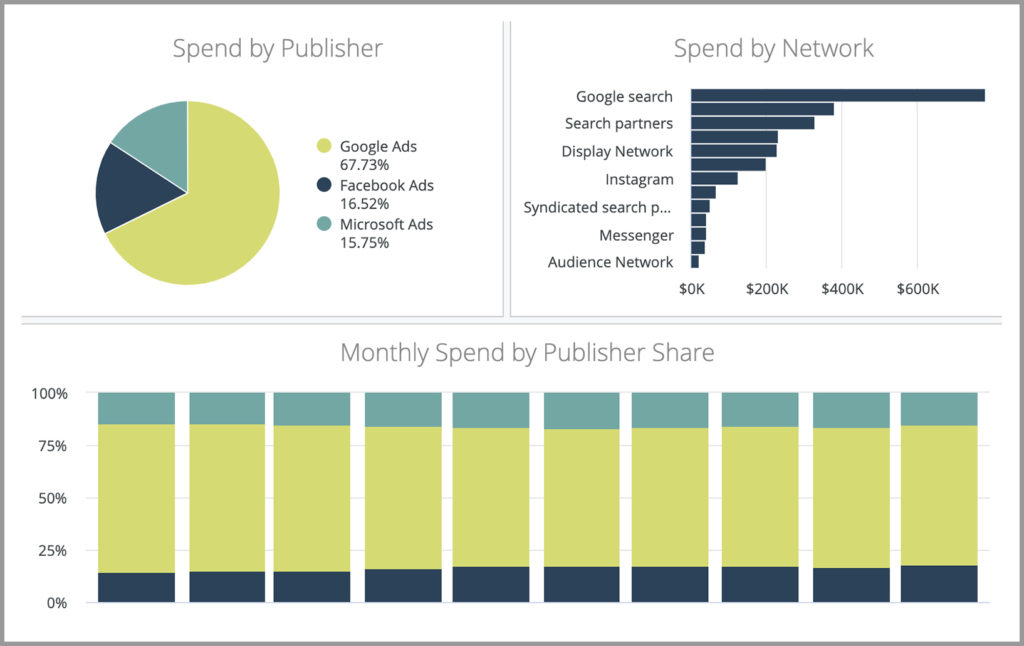
CMOs are directly accountable for marketing performance and so they must be able to demonstrate clearly where budgets are being spent. With marketing campaigns today more multifaceted than ever before, these pie charts and stacked bar charts provide a birds-eye view of how a strategy is evolving and how an investment portfolio breaks down. If one publisher begins trending against expectations, or if certain investment criteria are not being met, these visualizations will expose that and afford marketing teams the opportunity to rectify the problems before they escalate.
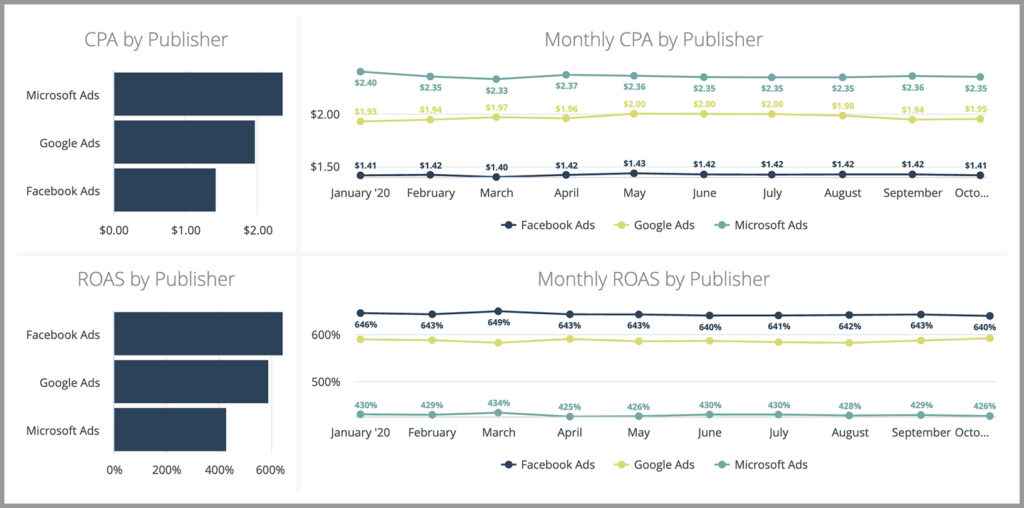
Overview:
The goals of digital marketing teams vary significantly from company to company, but what unites them all is a desire to make the most of every single dollar they invest. To understand how strategies are unfolding, CMOs are principally looking at their Cost per Acquisition and Return on Ad Spend; two metrics that are critical in determining campaign health and authority. These two line graphs together offer a baseline of how CPA and ROAS measure up on each channel and essentially communicate what’s working and what isn’t in terms of advertising spend. Marketing leaders armed with this information are then empowered to design a more robust investment blueprint that doubles down on the most lucrative advertising outlets and iterates on the others accordingly to drive improved outcomes.
The most effective CMO dashboards simultaneously answer executive-level questions about performance, tell a logical story, convey a hierarchy of priority, simplify comparisons, and avoid reporting overload. Their fundamental objective is to provide a CMO with the data required to make smart decisions, course correct, and improve planning and forecasting for the months and quarters ahead.
Recent numbers by Statista show that the average person consumes upwards of 5 hours and 57 minutes of video content per day. There’s no doubt about it, we are watching more videos and spending more time screens—and there are no signs of slowing down. In fact, by 2022, online videos will make up more than 82% of all consumer internet traffic – 15x higher than it was in 2017 (Cisco, 2020). So why not tap into this growing advertising opportunity? In order to hit your key consumers, it's crucial to understand the basics of the digital video advertising landscape, as well as four essential video ad formats.
Review a quick list of basic terms every marketer must know in order to master digital video advertising in 2020:
In-Stream: The ad format most commonly connected to digital video and similar to a TV commercial viewing experience. It is often used synonymously with pre-roll, mid-roll, and post-roll.
Interstitial: Particularly popular in the mobile space, these units most frequently appear in-app and are served between app activities or gameplay. On desktop environments, they appear between page loads. These units will typically have a countdown or the ability to skip the video ad after a few seconds.
In-Banner: Served in IAB standard display sizes on a website, most commonly 300x250. The pricing for these units is more in line with static banners or rich media formats.
In-Feed: typically, the video ad will begin once a user scrolls to the placement within a web content feed online or within a mobile device. This format can also go by the name out-stream, in-page, or in-article, depending on the publisher partner.
Pre-roll: A video ad unit that runs in-stream before video content or as an interstitial ad.
Mid-roll: A video ad unit that runs during video content within a video player environment.
Post-roll: A video ad unit that runs after video content within a video player environment.
Reach your desired audience at the right time and the right place with video advertising. Video ad campaigns powered by Basis by Centro can scale and streamline content creation and distribution, and ad campaign analytics. Centro's experts are here to help!