
Technology
Basis Platform
Advertising Operating System
Communication Portal
Intelligent Collaboration
All Channel Activation
Activate Media on Every Channel

Consulting
Resources
Centro has always focused on the wellness of the people who work here. The energy and resources we apply to our team directly affects the energy our team puts towards Centro’s customer, partners and peers. This is a key reason we’ve been able to grow year-over-year and maintain business momentum.
Investing in employees has been part of Centro’s essence since the onset of our company. And after celebrating our 19th anniversary in October this year, it is clear that Centro’s approach towards employees is also manifesting into gratitude they are showing outwardly for the company.
Most recently, Centro was named by Fortune as the No. 52 Best Medium Workplace nationally in 2020. In the month before that, Fortune named Centro the No. 15 Best Small & Medium Workplace for Women. The lists are part of a series of rankings by Fortune and Great Place to Work, a people analytics and company culture research firm, and are based on employee feedback. Earlier in the year, Great Place to Work named Centro the No. 4 Best Small & Medium Workplace in Chicago.
Despite the numerous business challenges we faced in 2020, Centro was bestowed by other organizations with recognition for our workplace. These include:
Centro is prescriptive in supplying our team with resources they need to grow and develop. As we look towards 2021 to envision the future Centro ‘workplace,’ we recognize that the many factors that contributed to positive employee experiences (team engagement, benefits, office perks, etc.) are changing. Continuing to build energy and enthusiasm from our team will require imaginative adjustments while we all stay physically apart. Our challenge is to deliver on the new requirements that professionals are calling for.
Nevertheless, Centro is more than workplace awards and recognition—there are humans behind our technology, and we wouldn’t be able to function without them. We offer flexible digital advertising solutions built on our technology, Basis, that unifies planning and buying across programmatic, direct, search, CTV and social.
We’re hiring! Learn more about our culture and current open positions here.
As you may know, social media platforms are some of the most popular websites and apps people use online today. With 3.6 billion people worldwide logging into social media networks currently, and an estimated increase to 4.4 billion by 2025, it’s safe to say that social media isn’t going away anytime soon.
Paid social advertising consists of any advertising across platforms such as Facebook, Instagram, Twitter, LinkedIn, Pinterest, Snapchat, TikTok, Reddit, and more. When placing an ad on these social networks, you can optimize your campaign toward media goals that align with your business objective, such as:
Social media ads are effective and efficient in allowing advertisers to reach current and potential customers with engaging messaging. With over 3 billion users engaging and sharing via social channels, you can imagine the level of audience data and insight available for advertisers to tap into with just a press of a button.
The meteoric rise in social media usage has also increased the level of sophistication these advertising platforms offer advertisers by way of more in-depth conversion tracking, detailed targeting segments, and integrations with 3rd party data providers.
Leveraging experience with over 350 brands to date, Centro’s Social team is comprised of subject matter experts across the country who are well-versed in advertising across any and all social media platforms.
In addition to being certified through programs like Facebook Blueprint and Twitter Flight School, Centro’s Social team has premium agency partnerships with some of the largest social media companies. Through those partnerships, Centro has access to dedicated platform account managers, premium alpha/beta opportunities, and early access to product updates and consultations.
To learn more about social media advertising with Centro, take a look at our managed service solutions.
When it comes to online advertising campaigns today, there are countless metrics that could be monitored, and if you’re a marketing manager drowning in a sea of Google Analytics jargon and social media buzzwords, then you’re certainly not alone. As both the number and consumer adoption of digital channels continues to grow apace, so, too, does the number of tools a marketing organization needs to accurately map the routes and experiences that drive revenue. We’ve jumped from only 150 tools as of 2011 to over 8,000 in 2020 according to Scott Brinker’s now renowned MarTech supergraphic, equating to an extraordinary growth of 5,233%.
The fastest-growing category in this technological explosion is Data. This makes perfect sense, of course, as more channels ultimately mean more data. With the global datasphere predicted to grow to 175 zettabytes by 2025, increasing percentages of that are becoming accessible to marketers who own the right tools and mechanisms to manage and parse it. The fundamental organic signals of page views, unique visitors, session duration, email open rate, and more are joined by paid signals including impressions, click-through rate, conversion rate, and revenue per click. All of this has recently been augmented by location data from mobile and wearable devices. Then you have preference data from social media and enriched personal data that comes from first-party sources such as account and purchase history.
Everything considered, modern marketing is all about metrics and numbers. But which numbers provide the real value? We’ve reached a point in marketing where the focus is shifting from data collection to data consolidation. For marketing managers, it’s time to double down on the ability to bring together the right data - the kind that provides actionable intelligence to fuel next-level growth.
That is why dashboards are critical today. With meticulous curation, marketing decision-makers can utilize them to remove any irrelevant data from their line of sight and really hone in on the key parameters at stake in a campaign that can be evaluated conjointly for better forecasting. This guide looks to help marketing managers understand the increasing importance of using best-in-class dashboard frameworks with examples of data sets that can expose real areas of opportunity.
Yearly big picture trends interest executives and daily performance fluctuations concern analysts. Midway between, looking at campaign numbers at a monthly level ultimately delivers more insights than anything else and therefore represents the perfect timeframe for middle management. Weekly reporting is certainly important as well, but the channel bringing in the most traffic is not necessarily the one capturing the best quality leads in the end - that you cannot understand until a number of weeks have passed.
Monthly overviews present a broader feeling of how campaigns are fairing and with a rolling review, marketing managers are afforded access to data that can empower them to adapt future forecasts to reflect the very latest industry, economic, and business changes. This, subsequently, enables decision-makers to reduce risk and allocate resources more optimally in pursuit of financial objectives.

Overview:
Format: Single Value Tiles
Time Period: Trailing 30-days
Metrics: Impressions, Clicks, Conversions, Cost, Revenue, Profit
The most valuable dashboard component a marketing manager can have is a snapshot of the metrics most important to their business. This simple table brings together all the pertinent digital marketing performance metrics from the past 30 days and enables the user to quickly see and understand aggregated advertising investment, volume, unit economics, and campaign efficiency. The layout here is also designed specifically in this way to help the eye move from left to right seamlessly: Impressions lead to clicks which lead to conversions. Cost leads to revenue which results in profit.
Overview:
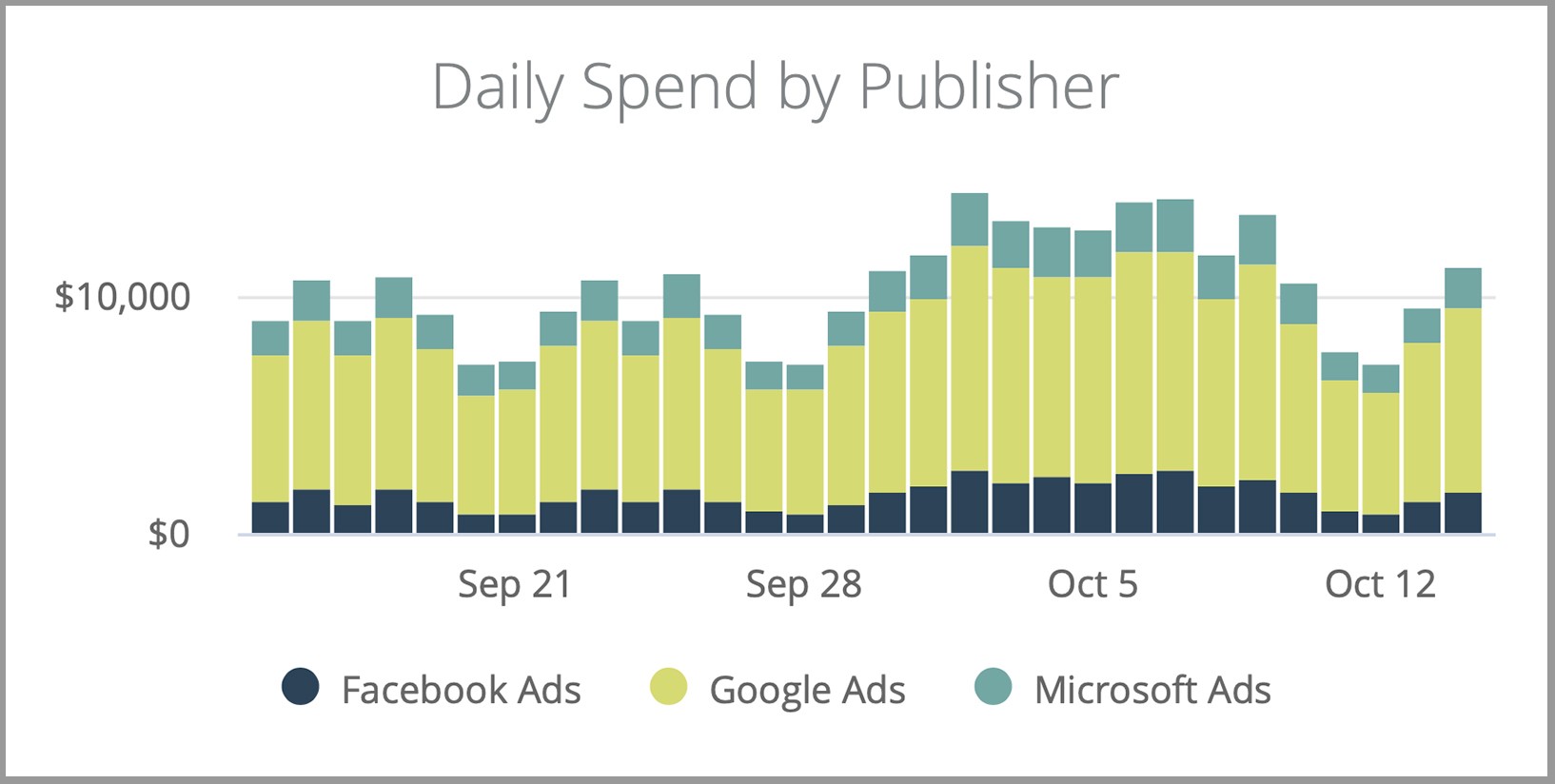
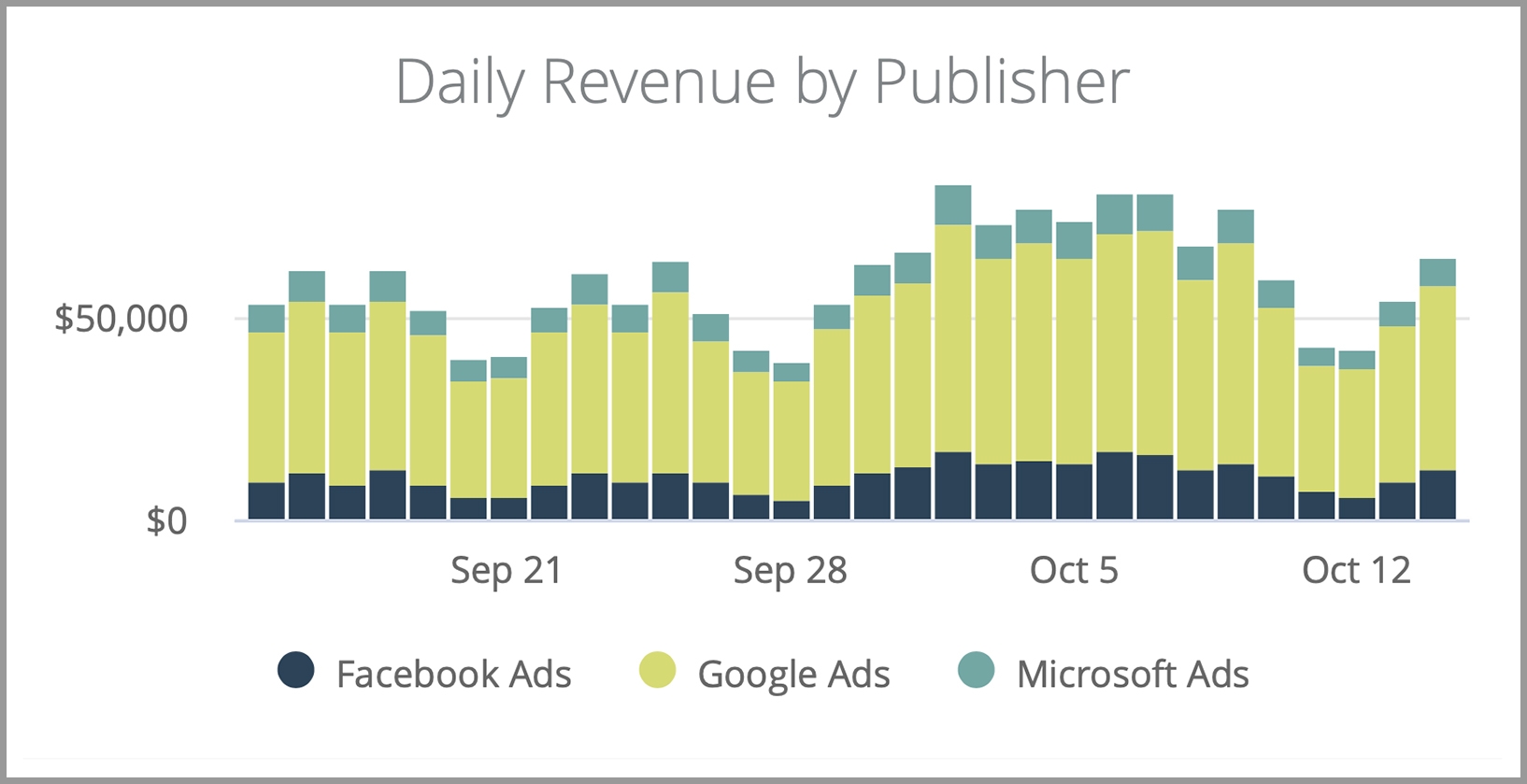
Format: Horizontal Bar Charts by Area
Time Period: Trailing 30-days
Metrics: Daily Spend and Daily Revenue by Publisher
For marketing managers interested in monitoring performance trends for different marketing segments, then this component is a must. Here’s a sample set of dashboard widgets showing top-level metrics trending segmented by publisher. With marketing campaigns becoming increasingly complex, these stacked bar charts offer a birds-eye view of how strategies have been playing out over the last 30 days and how an investment portfolio is breaking down. If any one of Facebook Ads, Google Ads, or Microsoft Ads start to trend against expectations, or if certain investment criteria are not being met, these visualizations will expose that and afford marketing teams the opportunity to rectify the problems before they evolve.
Overview:
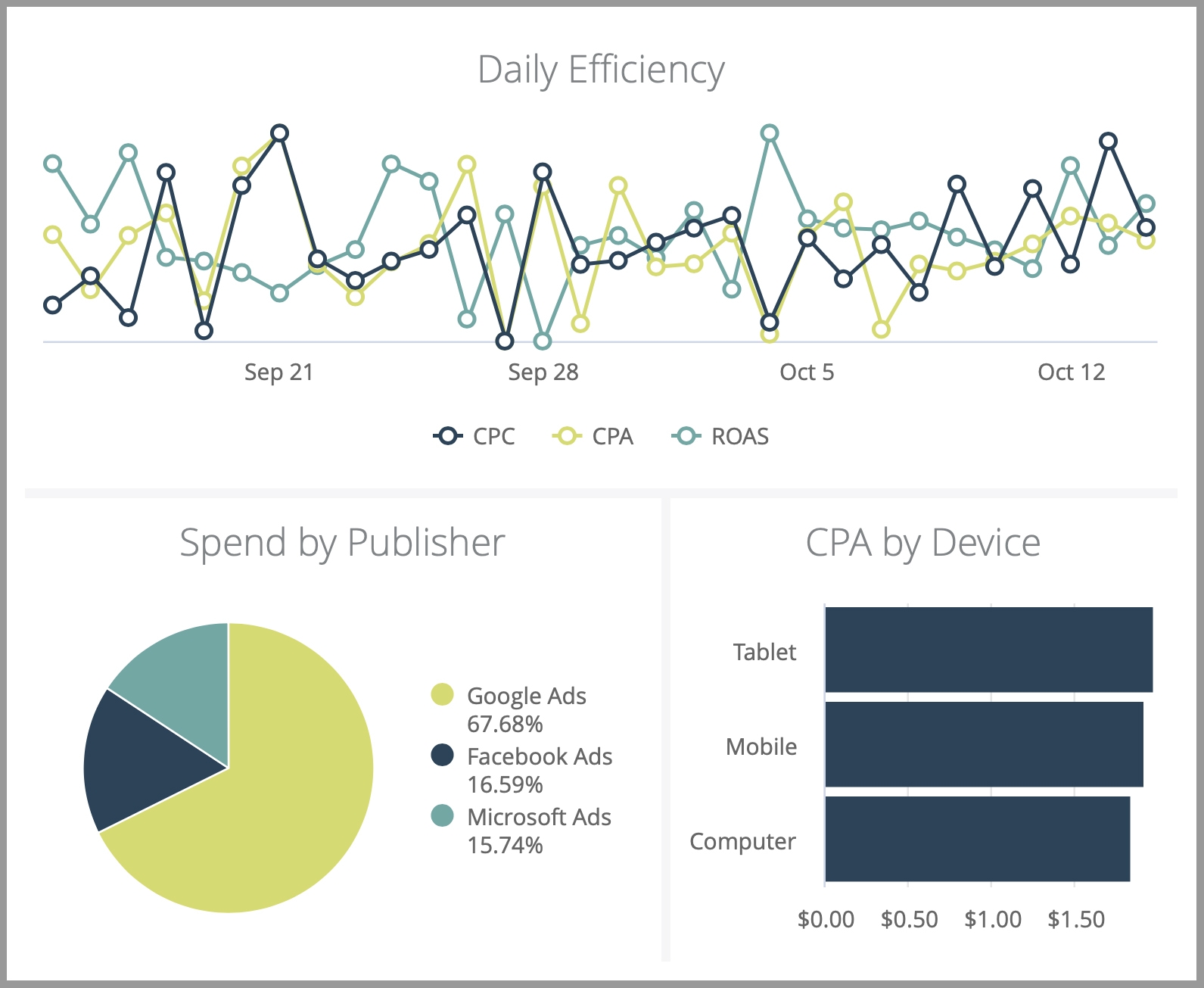
Format: Line Graph, Pie Chart, Horizontal Bar Charts
Time Period: Trailing 30-days
Metrics: Daily Efficiency, Spend by Publisher, CPA by Device
While your most recent performance snapshot gives you a fast summary of performance, there are also some important efficiency metrics you’ll want to pay close attention to. You can do this by creating a component that includes line charts detailing trends in key metric performance over the past 30 days.
Every business has unique goals and key metrics that drive marketing performance. Custom dashboards offer a flexible solution digital marketing managers can utilize to maximize the performance insights they need.
You can get access to these dashboard templates and a dynamic framework to build your own from every marketing data source you have using the reporting and analytics tool available within Centro’s intelligent automation platform, Basis. Our easy-to-set up, easy-to-use technology helps marketing organizations unlock the power of their data and extract deep insights into the behaviors, and needs, of their target audiences.
After weathering a significant drop in marketing spend, the loss of thousands of agency jobs, and radical shifts in production and remote work, agency and technology professionals are seeing a comeback.
But don’t expect agencies and clients to get back to business as usual. Agencies will swarm their talent with more technology and automation to make smarter marketing decisions and facilitate stronger partnerships.
Join guest speaker, Forrester Principal Analyst and former agency executive Jay Pattisall, for a conversation about how agencies and marketers will evolve their relationships and performance in 2021 and beyond.

4A's (American Association of Advertising Agencies) and 614 Group, a digital advertising consultancy, recently assembled forward-thinking industry leaders via a Think Tank to tackle the most pressing challenges in advertising and marketing—automation solutions and identity management. The guidance from the group was published as white papers (download here). This is the second phase of a large-scale initiative by The 4A's to understand and shape the future of programmatic and automation.
Participants in the Think Tank included Sony Entertainment, RPA, Horizon, Cramer-Krasselt, Fitzco, Starcom, and Geometry, Matterkind, UM Worldwide, Canvas Worldwide, AKQA, Hearts and Science, 451 Degrees. The work of the group is underwritten by Centro, Media.net, Facebook and IBM Watson.
The first phase of this project started in 2019, resulting in an in-depth examination of programmatic advertising and agency automation. Centro also showcased the work in our Future of Automation webinar.
The recent white papers help brands and agencies with media teams navigate two important issues that they are facing now and will likely face throughout in the next 12 months. Noted below, are important points and main takeaways from these companion papers:
‘Moving to Simplicity and High Value: A Call to Action for Workflow Automation and People Augmentation’ gives guidance on what aspects of an organization could be automated. From the report: “The Think Tank determined that one of its priorities is the development of guidance on how best to achieve workflow automation. Lack of automation hinders speed and efficiency on the part of marketers, agencies and publishers. Automating workflow will permit simplicity, speed and efficiency in how digital media and audiences are planned, activated, measured, analyzed, optimized, post-analyzed and billed.”
This paper notes that,
‘The State of Identity Management: How Did We Get Here and What Comes Next?’ provides an update of industry efforts to manage user identities for targeted advertising amid the loss of third-party cookies. The report states, “Identity management lies at the heart of digital advertising. Accurate and reliable identification enables relevant, one-to-one communication based on a host of recipient attributes and actions. Conversely, an inability to correctly identify ad recipients in many cases leads to a poor user experience and wasted ad dollars. …by initiating an honest discussion about the pros and cons of identity management, we will be able to create a more positive and beneficial environment for advertisers, publishers, and consumers alike.”
This paper notes that,
Centro has already taken action to address these challenges. Our Basis platform automates all the major aspects of an agency’s business or media team’s functions—we’ve also been exploring alternatives to cookie-less targeting with customers. As we near the end of a tumultuous year and prepare to enter a new one with plenty of uncertainty, our customers can be rest assured knowing that Centro is actively collaborating with the industry to keep a pulse on the needs in this space.
At Centro, we know that keeping up with the trade pubs and latest trends can be tough and time-consuming. To make that easier, we’ve compiled all the articles, reports, and other bits of awesomeness you may have missed, but should definitely read. Enjoy our latest list below!
eMarketer Revises its Digital Ad Spend Forecast Upward [:03]
According to revised stats from eMarketer, US digital display spending will grow by almost 10% this year, while overall digital spending is set to grow 7.5%. CTV, ecommerce, and even audio are contributing to this growth.
Study Shows Consumers Notice OOH Ads More Amid Shift Toward Hyperlocal Travel [:03]
45% of American adults say they’re noticing out-of-home (OOH) advertising more than before the pandemic began, according to the results of a survey the Out of Home Advertising Association of America (OAAA) and The Harris Poll fielded from September 21-23.
Quibi Calls it Quits: Key Takeaways From a Lesson in How Not to Build a Streaming Brand [:06]
While the app became a punching bag well before announcing plans to shutter, the news is still likely to disappoint marketers hungry for an ad-supported premium mobile video platform. A decisive failure to capitalize on the high consumer demand for mobile video speaks both to the difficulties of jumpstarting a new media venture in the crowded digital age, and also what many critics perceived as hubris from the people running the show, with the service failing to deliver on critical fronts like content and distribution strategy.
TikTok Enters The Ecommerce Game With Shopify Team-Up [:03]
TikTok announced a global partnership with Shopify earlier this month. This will allow TikTok to reach new audiences and drive sales on the app. This integration will mean that it will be easier for merchants to create in-feed shoppable ads, which can be viewed in the app.
How AI Can Deliver Targeted Ads While Ensuring Brand Safety [:05]
As the world reels from the effects of the coronavirus crisis and other world events, more brands are turning to digital platforms and as such, seeking greater accountability for their media spend.
AI systems enable marketers to look beyond using just the usual social media platforms. They not only offer precision targeting of ads, but can also perform real-time volume data processing to self-adjust and optimize campaigns. This ability to process huge amounts of data including real time reading and assessment of sites for content and context, can also provide a more enhanced safety net to the entire targeting and ad-buying process.
Earlier this year, Walmart rolled out Walmart+ and was using a tailored ad approach with the data they collected on how people shop at Walmart. They are now adding experiential marketing to the mix and bringing in ‘special moments’ that have been canceled in 2020. The benefit of experiential campaigns is that they let consumers interact with a brand and then share it on social, giving the brand additional reach without additional spend.
As Oculus Unleashes Ad Blitz, Is It Time For Marketers to Believe in Virtual Reality? [:07]
The moderately-priced Oculus Quest 2 is getting strong reviews and ad support, signaling that virtual reality may finally be taking its long-awaited next step. Is it time for marketers to start seeing the world through rose-colored goggles?
If you ask the average person, they would say they don’t care for advertising. But they probably would say that they like free content, they like learning about new products and services, and they appreciate the economy growing. Advertising has value, especially when it is done right.
Optimizing campaigns is considerably more than just setting the right bid on your keywords. It’s about making sure that you have the right ads, the right campaign and ad group structure, and landing pages that convert well and match up nicely to your ads and keywords. Core to all of this is the process of verifying and corroborating you have all the right keywords in the first place. That’s where a lot of time is spent when it comes to optimizing campaigns and extracting the most out of your marketing dollars. Here, we explore three ways you can find the terms that are not working for you and explain how you can utilize smart reporting to make the task infinitely easier.
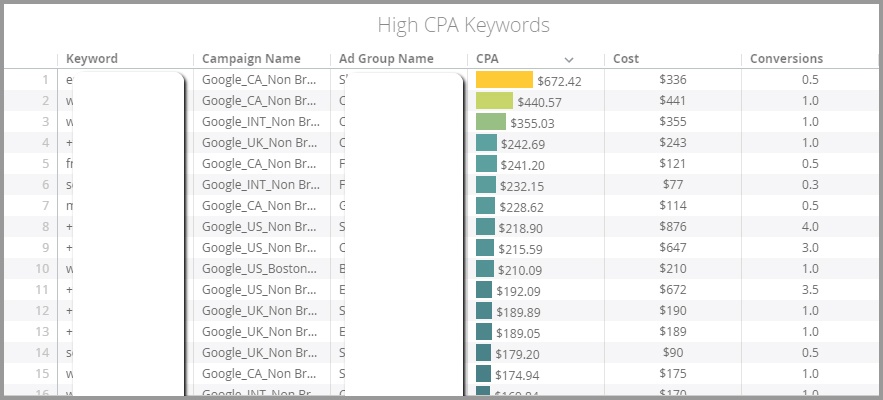
Let’s first talk about high CPA keywords. These are terms that are driving traffic and conversions, but at too high a cost according to your goals. Identifying these terms, and then acting on them, is the purpose of this dynamic dashboard component. The chart itself is a simple one, whereby you generate a keyword report and filter for any active keyword that is above a certain CPA, ROAS, or similar goal. This assumes that you already have a CPA/ROAS target in mind, of course.
It’s best to start at the top, and either lower bids or pause the terms that are doing the most damage. You can download the data and then immediately upload it into Adwords Editor for a quick fix. The filters in this chart are for active keywords, above a CPA target. Note that cost and conversions are included as they help to provide more context around the keywords. For example, partial conversion (such as the 0.33 above) may make the CPA look inflated, or perhaps the keywords you’re reviewing are just low volume. Campaign name and Ad Group name are also visible to make it easier to upload into Adwords Editor, but also to offer extra perspective.
Additional Considerations
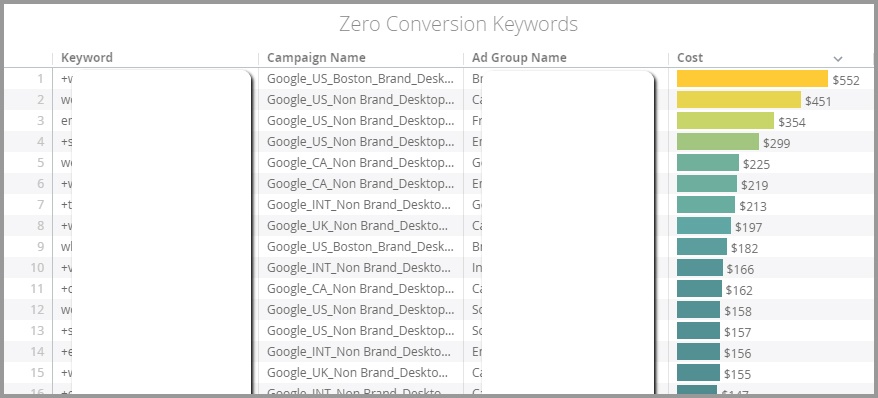
These are the terms that are getting traffic but not converting at all. They are usually a low hanging fruit for optimization, but automating the reports helps to make this task more regular, and catch terms more quickly. This chart filters active keywords for zero conversions, sorting the cost highest to lowest. Generally, these are great terms to plainly pause out as they can immediately save quite a bit of money.
Additional Considerations
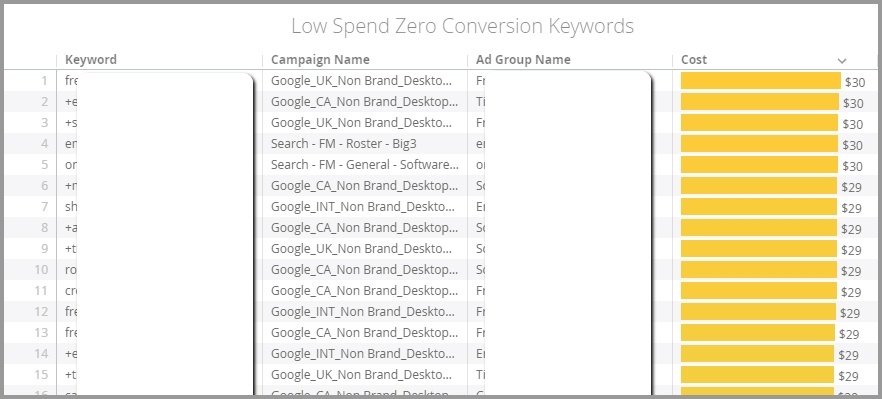
It’s a general, albeit old, rule that you let a keyword garner a certain threshold of spend or clicks before deciding if a term is working or not (I’ve generally seen this number at as little as 100 clicks). However, there are a lot of search terms that are rarely searched on, and may take a long time to collect enough data or statistical significance. These can still cost you money, but slowly bleed your campaign of funds over time, negatively impacting your performance.
This chart looks at keywords that have no conversions, but also low spend. In this case, we’re filtering for active keywords with zero conversions, but also less than about $30 of total spend. There can sometimes be thousands of terms that fit in this category, and this report makes finding these terms effortless. Plus, the simple act of downloading the data and then uploading it into Adwords Editor makes fixing this incredibly easy.
Additional Considerations
In addition to looking at just keywords, it’s also recommended to review search terms. It’s easy to recreate or duplicate your charts to look at search terms instead of keywords. Doing this could provide some more terms that are irrelevant or poor performers to add as negatives. It’s also possible to set up your filters to focus on particular campaign sets. For example, looking at Non-Brand versus Brand, or International versus Domestic campaigns.
By tweaking the filters on search terms, you could further create charts that find search terms that could be added to campaigns. And all of this is automatic, without the need to download those pesky CSV files.
The possibilities really are endless here, but carefully set up reports are going to be more essential as marketing continues to become more complex.
~
If you’re looking to replicate any of the analytical tools you see here, our universal reporting technology can take your data and recreate these views in a matter of minutes. As with any report, though, be wary of blindly following the data. With each of these charts, and intended uses, there are also some cautions, or additional considerations to keep in mind.
It’s been a historically rough year for the travel and tourism industry. Travel has experienced a greater decline in digital ad spending than any other industry due to COVID-19, and U.S. digital travel sales are expected to decrease by 44.7% in 2020.
Despite these challenges, there’s still an opportunity for brands and agencies to advertise in a less competitive environment and take part in the $100+ billion of digital travel sales expected in 2021.
Effective targeting, messaging, and measurement will always be key pieces to successful tourism marketing campaigns, but efficiency is more important than ever while digital media budgets are limited.
There’s an overwhelming amount of third party data available to tourism advertisers, especially when it comes to travel display advertising. From in-market segments for flights, hotels, and car rentals, to weather triggers and historical location data, the options are endless.
However, the most powerful targeting available still comes from first party data. Take advantage of CRM lists and place site pixels to create segmented retargeting audiences and lookalike models. As the digital advertising industry moves toward a cookieless world, this data will prove to be more and more valuable.
The best travel ads take both the target audience and timing of the campaign into consideration. Use everything you know about potential tourists and their motivations to create impactful ads. Here are few examples:
It’s also important to react to any negative situations in the destination(s) you’re promoting. If there’s a natural disaster or COVID-19 outbreak in the destination, consider shifting to a more inspirational or uplifting recovery message rather than putting forward an immediate call-to-action. This keeps your brand top of mind without coming off as insensitive or putting the public in danger.
To prove the success of tourism marketing campaigns, it’s essential to set digital goals and KPIs that align with your business priorities and then implement the proper tracking to measure against those goals. Brands that handle direct bookings—like airlines, car rentals, and hotels—may be able to back into a CPA or ROI goal needed to stay profitable.
For destination marketing organizations or tourism boards that have a broader objective to increase brand awareness or overall tourism, key pageviews and site content can be tracked to make sure the target audience stays engaged after being exposed to digital advertising.
In situations where tracking sales or website content doesn’t align with the goals of the campaign, brand lift studies or verified walk-in lift studies can be helpful in evaluating the success of a campaign.
With a thoughtful strategy, brands and travel advertising agencies that keep a strong presence in 2020 can position themselves well for 2021 as digital travel sales start to rebound.
Connect with us to learn more about Centro’s travel marketing services!
These days, professional development can feel more challenging than ever before. Many professionals are experiencing fatigue from working remotely for many months, yet still understand the need to develop their careers in uncertain times.
Accomplished tech leader, speaker, and author Jeffery Smith joins the podcast to discuss finding new ways to grow during COVID-19, what authentic tech leadership looks like, and how to not let the pandemic—or your mindset—hold you back from career growth.