
Technology
Basis Platform
Advertising Operating System
Communication Portal
Intelligent Collaboration
All Channel Activation
Activate Media on Every Channel

Consulting
Resources
While few brands remain untouched by the impacts of COVID, healthcare marketers have been uniquely challenged to repeatedly adapt their digital strategies over the course of 2020.
At Basis, we’ve tapped into our years of experience in the healthcare vertical to support our clients through strategic shifts in messaging, campaign goals, and investment strategies. No two initiatives are the same, but a few key channels and ad variations can position any brand as a trusted voice in the healthcare conversation.
If you’re working with a budget that can support multiple channels, be discerning about maximizing that channel’s key offering, and play to its strengths. Here are a few ideas:
Maintain an evergreen brand presence with paid search. If any channel should be keeping the lights on all year round, it’s this one. Ensure that anyone searching for the brand or related services will be able to find yours.
Search learnings can also be invaluable. Keyword volume can tell you when people are most likely to be looking for certain content. For example—is January really the best time to run a weight loss campaign, or do people start looking for dieting tips in December? Spoiler Alert: Start that campaign in December!
Search traffic can also be a valuable tool for audience insights, showing you the age, gender, and interests of your most engaged audience(s).
Consider social—specifically Facebook—to increase your scale with lookalike audiences. CRM data and lookalike modeling can be especially difficult to maneuver in the healthcare space, where privacy is even more paramount. Facebook can be an incredible asset in that sense, allowing you to easily create lookalike audiences based on engagement with the landing page or ad variants.
Bolster your social learnings by including at least 3-5 variants of each creative. This doesn’t have to mean a significantly higher lift in creative production – instead, consider one image with a few different headlines, or a single headline with a few different images.
Once you’ve got a strong set of ads, let Facebook test them in every nook and cranny of their network – Instagram, Messenger, Stories, Marketplace – to find out which part of the platform your audience is most engaged.
Reach niche audiences at scale with Programmatic Display and Native. By partnering with leading healthcare data partners like Crossix, Adstra, and Pulsepoint, Basis can implement behavioral targeting for your most niche audiences with Basis DSP. We’re talking segments for people with “grass allergies” or “osteoporosis of the knee”–incredible specificity!
All of Basis' data partners are entirely CCPA and HIPAA compliant, and trusted leaders in the audience data ecosystem. Learn more about our partnership with Adstra here!
Access to a wide range of audiences means you can more confidently test out-of-the-box audiences, and pivot quickly based on performance. For example:
Oh, and remember that lookalike audience targeting we mentioned before? That can also be done programmatically, using your landing page!
Now that you’ve got a few channels in the mix, make sure they’re working together. Ask your media strategist to download a list of top-performing keywords from your Search campaign and use them to identify relevant content for your programmatic buy. If a specific behavioral segment is delivering the best performance on your Display campaign, consider testing similar interests on Facebook.
Our most successful clients don’t have the magic touch when it comes to finding the right words—they test and learn! There are so many cost-efficient and low-risk ways to test copy and imagery without going all the way back to the drawing board. Start by running a few versions of your headline or sub-copy and go from there.
Once you’ve started to gain an understanding of which ad formats resonate most with your audience, become an active participant in the conversation by swapping content regularly.
Many brands positioned themselves as thought-leaders in April, May, and June, informing their audiences of COVID regulations and news. Over the summer, they pivoted that messaging to begin encouraging patients to keep their regular appointments, advertising the health and safety precautions they’d instated to inspire confidence in the minds of patients and families.
Again, the best brands don’t get lucky by writing one headline that works all year long – they pay attention and promote consistently relevant, trustworthy content.
Want to learn more about how Basis can help take your healthcare initiative to the next level? Get in touch!
Subset Media, formerly known as Variant, is different by design. As an end-to-end digital agency, Subset specializes in creative and media services and ties them together with the thread of meaningful human connection. To Subset, “meaningful human connection” is more than a marketing strategy—their modern business model is founded on making a positive social impact and the agency donates hours, media, and money to community initiatives.
After founding and subsequently selling his first media company, Matt Parker set out to build something different in the media world—an agency whose margins yield social good. He put together a team of passionate media and creative experts, but Matt needed a platform that could enable Subset to live up to their potential and make the impact they were capable of.
Subset had specific needs for their future digital ad tech:
Basis has enabled Subset's team to get out of the weeds and deliver on those meaningful human connections. “Basis has literally everything. We have third-party data lists, a massive amount of different vendors, private marketplace deals, and a ton of partnerships that are available from day one. We don’t have multiple ad tech vendors—it’s all in Basis.”
~
~
Matt Parker, Founder, Subset Media:
"Basis was just a complete system. It was easy to use. At the time, all I wanted to do was put a piece of software in front of team and have them say, ‘we love it.’ Fortunately, we didn’t to go through tons of options to figure out that Basis was a great fit for us."
~
At Centro, we know that keeping up with the trade pubs and latest trends can be tough and time-consuming. To make that easier, we’ve compiled all the articles, reports, and other bits of awesomeness you may have missed, but should definitely read. Enjoy our latest list below!
The Evolution of Global Advertising Spend (1980-2020) [:04]
As consumer behavior has changed over the last 40 years, advertisers have constantly adapted their media strategies. These adaptations have included shifting their advertising spend across the media landscape. No big surprises, but with the decline of print, and then more recently TV, digital has definitely won out. This article visually showcases that massive transformation.
Streaming Will Soar in 2021 and The Retail Landscape Will Never Be the Same [:04]
Normal doesn’t exist anymore and the shifts that will happen in 2021 are about more than COVID-19. The trends for 2021 won’t be a revision or edited version of 2020 but instead worthy of a fresh new take. With everything going online due to the pandemic, the world of brands being born & thriving has changed. Take a deeper look to learn what these changes are predicted to be.
Audience Isn’t the Only Solution to CTV’s Transparency Issues [:04]
The allure of CTV advertising is that it marries the promise of granular targeting (via programmatic digital advertising) with the engaging power of TV. Programmatic advertising in CTV is the future, but getting there remains a challenge with the complex, fragmented ecosystem which has created confusion about the inventory available, how ads can be targeted, and what kind of data is available. Centro partner Peer39 makes the case for content contextual signals serving as a counterbalance to audience.
YouTube Touts Audio Ad Results in Shot Across Spotify's Bow [:03]
YouTube's tests of a new audio advertising format drove a lift in brand awareness among 75% of brands that participated, according to a company blog post. The Google-owned platform has moved from alpha testing into beta testing the format, which inserts 15-second audio ads into music playlists and marks YouTube's first endeavor into radio-like ads.
Telenor Sells Tapad to Experian for $280 Million [:03]
Norwegian telco Telenor sold cross-device company Tapad to Experian in a transaction advised by LUMA Partners. Experian is acquiring 100% of Tapad for a cash consideration of roughly $280 million. It was less than five years ago that Telenor bought Tapad for $360 million in February 2016, amid much fanfare about telcos being able to take better advantage of their first-party data to inform real-time advertising. So, what does Experian get out of the deal?
The Restrictions On IDFA will Shift Mobile Budgets to TV [:04]
Apple’s planned changes for IDFA that require opt-in will force advertisers into other channels–most likely, connected TV. Working with a TV identity partner that can connect multiple IDs at the household level will help marketers reach their goals.
Nielsen to Launch Identity Graph ID Measurement System in 2021 [:02]
Following the trend of other ad-technology and media measurement companies, Nielsen is starting up its own identity graph product–an ID resolution system–for cross-media measurement. The trend in using ID measurement comes as more media companies move away from device-based digital cookies.
What Does the CPRA Mean for Behavioral Advertising? [:04]
The CPRA was touted as legislation that would fill in the blanks that CCPA left open and further CCPA’s consumer protections. Significantly for online advertisers, the CPRA more specifically addresses businesses’ obligations when engaging in behavioral advertising.
Under CCPA, some businesses engaged in behavioral advertising interpreted “sales” as excluding the exchange of personal information, such as cookie data, for targeting and serving advertising to users across different platforms, arguing that no “sales” were involved because no exchange for “valuable consideration” had occurred. The CPRA’s introduction of the concept of “sharing” closes this potential loophole.
Pepsi Says ‘Start Backwards’ to Create Ads Fit for Modern Culture [:04]
Cracking open the can to unlock consumer understanding, Pepsi has discovered that tapping into social as a springboard can help to quickly develop marketing that pops. They’re listening to the earned, social and digital media channels to inform, respond and position the Pepsi brands into the mainstream. Will even more brands look to adapt to fit in current culture? Related: Do the best memers build on popular culture or do they make pop culture? Sneak a peek into the life of the CMO (Chief Meme Officer).
Audio consumption is one among many consumer habits that have transformed in 2020. Audio content is booming, with 62% of listeners streaming more audio, and 29% streaming more podcasts, than ever before.
Join Spotify's Brad Grealy to hear the latest listening insights from 2020, and find out how to innovate with audio in 2021.
Personalization has long been a valuable aspect of marketing, particularly in the digital age. It can help marketers resonate with - and target - their audiences more effectively, improve user experience, and ultimately deliver better customer service. New advancements in artificial intelligence and automation have further made it possible to personalize the customer experience in real-time to help marketers drive more sales and grow revenue.
As personalization capabilities develop in sophistication, utilizing such a powerful weapon across different channels becomes more of a necessity. Here’s how prioritizing personalization through the use of marketing intelligence platforms is the best way to approach this challenge.
Personalization shouldn’t be a marketing tactic that’s part of your arsenal. It should be the driving force behind how you interact with each potential customer at every touchpoint.
Especially among the younger generations, there is an expectation of brands to deliver a personalized experience. Consumers won’t pay attention to inbound marketing messages that fail to cater to their unique interests, needs, and preferences. They’re also easily frustrated when their experience with a brand isn’t personalized. Once consumers understand the various ways businesses can serve their unique needs, they expect nothing less than that all the time.
While consumers today are worried about data collection and their privacy, they also greatly appreciate how personalization improves their experience as shoppers. According to Gartner’s Maximize the Impact of Personalization report, here’s how consumers say personalization helps them:
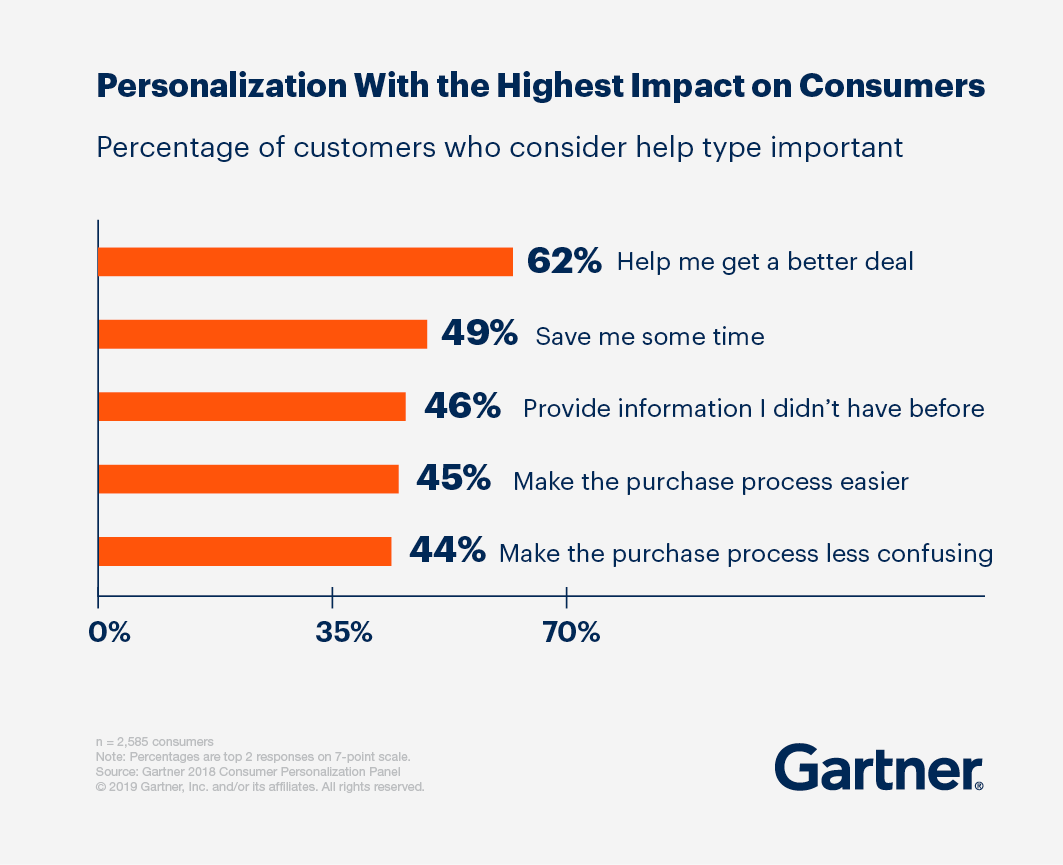
Businesses are smart to do everything they can to meet consumer expectations. The benefits go both ways. Research by McKinsey outlines that personalization can help brands:
There are already numerous basic things marketers can do to personalize their initiatives using their existing systems and data. For example, a clothing store (eCommerce or brick-and-mortar) can utilize a shopper’s past purchase history to send them customized emails featuring clothing with similar styles, colors, and price ranges. They can even create special discount offers for individual customers to encourage them to purchase again.
Even the most elementary personalization strategies are powerful, but the potential goes far beyond this. Through technologies built on automation and artificial intelligence, it’s possible to swiftly respond to consumer behavior with personalization. Rather than segmenting audiences and creating customized marketing content for them after the fact, your strategy can change dynamically. This is a valuable tool for targeting the countless online shoppers who make quick decisions after expressing initial interest.
All marketers today know that personalization is important, though there’s often a struggle to keep up with consumer expectations and competitor strategies. According to a survey conducted by Forbes Insights and Arm Treasure Data, 46% of marketing executives are not where they want to be in terms of delivering personalization. Here’s what respondents say are the top challenges holding them back:
These issues are a massive challenge today because there has been a huge amount of change regarding what kind of data businesses need for personalization and how they employ it. There’s simply too much relevant audience data marketing organizations can use for personalization, namely:
Organic marketing data - Social signals, web traffic, email opens and clicks, mobile app usage, and in-app behavior, etc.
Paid marketing data - Impressions, clicks, conversions, engagement, etc.
Third-party data - Preference information from social media, demographics, interests, and other third-party consumer information.
Offline data - In-store behavior, call center data, location data from mobile devices, intelligence from wearable devices, etc.
If marketers want to get ahead with their personalization strategy as opposed to simply trying to keep up, they need to be ready to harness all this data. It’s no longer enough to focus solely on how consumers interact with your business. You need insights into their full behavioral profile on all channels to truly understand what’s relevant to them.
This is not just so you can market to them better, but also satisfy their expectations as customers. Consumer sentiment is largely against corporations tracking their every move across the web. However, the exception is personalization. People want a customized experience with your brand regardless of what device they’re using. If you can’t deliver this with some amount of immediacy, they’re more than happy to turn to competitors who will.
The key to keeping up with competitor strategies while catering to consumer needs is fully investing in data-driven personalization.
In order to use all relevant audience insights for personalization, having the right data management technologies is critical. All of the data types mentioned above are easily trackable using various tools that are likely already a part of your MarTech stack. However, analyzing different types of audience data in isolation limits its utility for cross-channel personalization.
Using technology on the path to personalization isn’t about monitoring all behavioral metrics across channels and personalizing your strategy for each in isolation. Having a full understanding of the customer journey won’t be very helpful if you’re unable to connect the dots with your messaging.
Marketing intelligence platforms (MIPs) are the solution uniquely positioned to offer a comprehensive perspective of audience behavior across platforms, devices, and channels, all while empowering you with the tools you need to act on these insights.
Here’s how.
Marketing intelligence platforms make it possible to unify all your marketing data in one place, whether it be first or third-party data. MIPs integrate with a vast plethora of data systems, including advertising, marketing cloud, and CRM platforms, eCommerce systems, and call center technologies. They also have the ability to read and process any native offline data you want to provide.
MIPs can piece together your marketing puzzle based on behavioral data from various platforms and empower you to better understand cause and effect. Reporting capabilities also offer unique ways to look at and analyze data, such as calculating cost per acquisition based on creative assets. This makes it possible to understand which types of marketing messages resonate the most with audiences so you can maximize their performance.
Having a comprehensive and integrated perspective can help you see which members of your audience first engaged through Google search then go on to convert on a Facebook ad, for example. With new intelligence capabilities from mobile and/or wearable devices, businesses can now understand how customers begin their shopping journey online and eventually convert in-store. It’s not possible to do this using traditional analytics tools and siloed behavioral data.
One of the most beneficial features of marketing intelligence platforms is customizable dashboards for reporting and visualizations. Your audience data is only valuable if relevant teams can access, analyze, and understand it. MIP dashboards offer at-a-glance analytical summaries that internal organizations throughout the business can easily view. This can include reports, visuals of audience composition, cohorts, competitive intelligence, and more.
Dashboards allow decision-makers to gain performance-enhancing insights from personal data derived from demographics, behavior, and consumer information, as well as account and purchase history.
MIPs can reveal cross-channel audience insights businesses can utilize to optimize their marketing investment and nurture leads effectively throughout the customer journey. However, these insights are only worthwhile if you can act on them.
The best MIPs make this possible by integrating with the marketing automation platforms you use to manage your campaigns. Rather than just collecting performance data, communication is two-way, so you can utilize insights to drive optimization decisions. At the highest level, some MIPs have intelligent automation capabilities that can help you create audiences for segmenting, retargeting, look-alike campaigns, etc. As an alternative to just overwhelming your marketing team with personalization opportunities, a MIP can help you effectively execute them across channels.
Consumer data holds all the keys to understanding the needs and preferences of your audience. Failing to utilize these insights to their fullest extent means a lot of potential revenue is left on the table. Comprehensive personalization efforts can help you create more relevant marketing campaigns, improve targeting, optimize customer experience, and cater to audience expectations overall.
Marketing intelligence platforms offer not only a universal view of all relevant consumer interactions but also the tools you need to execute your personalization efforts at scale. There’s simply no other solution out there that overcomes the siloing of insights and efforts when marketers really need to deliver a consistent and customized experience across channels and platforms.
Native advertising allows brands to put themselves in front of their desired audiences while fitting in with the rest of the content on the page. Once you have grasped native advertising, it’s time to understand how it fits into your channel mix. Below are three use cases where native drives performance:
When the campaign goal is to drive traffic to a landing page, native advertising is a great format to include, as it is a strong click driver. Running native display improves CTR by an average of 2.5X compared to a standard display ad. Native is used to complement other traffic-driving tactics within campaigns, usually with the aim to increase website visitors.
B2B audiences respond well to ads that look reputable and fit the look and feel of the site they’re on. Native advertising provides more real estate (i.e. headlines, copy, etc.), to convey your offering and key differentiators. Another implementation strategy is to run native advertising alongside contextually relevant content to reach customers in the research phase.
In a conversion-focused campaign, native advertising is best used as a mid-funnel tactic. Native assets provide key information for users and are used to drive them to the site to learn more. It's recommended to retarget this audience with another asset that includes a strong call to action in order to drive the user to the final purchase or desired action.
This works well for both display and video native advertising assets. Plan to retarget users who click on the native ad with another unit. By implementing this strategy, you will continue to get in front of users who have shown interest in your product or service.
Native advertising as a creative asset drives performance when used correctly. Native ads are best used to reach site traffic goals, B2B brands, and for conversion campaigns.
Learn how Centro can help incorporate native advertising into your campaigns.
Determining how to set appropriate budgets for social media advertising is not as simple as it sounds. Every social campaign strategy varies based on individual business goals, desired target audience and creative messaging plan.
All of these factors play a role in setting budgets, as do related elements like seasonality, competitive share of voice, other marketing promotional schedules, whether or not this is your first time investing in social ads, and inside business data such as sales figures or profitability. In short, depending on the circumstances, social ad budgets can vary from hundreds of dollars a day to hundreds of thousands (and then some.)
When your company begins budgeting for social media advertising, it's important to set the business goal and KPIs you are trying to accomplish first. For example, if you want to sell 100 widgets a month, the average price of a widget is $100, and you need to maintain a positive ROAS (return on ad spend): a starting goal of $10,000 a month might make sense.
However, let’s say your overall digital marketing budget for the month is only $10,000 in total and that also needs to cover creative production or campaign management assistance (in other words, it can’t all be considered ad spend). In that case, you'll need to adjust your paid media budget down to accommodate those fees.
While doing so is certainly possible, it will mean the performance of the media strategy is even more important than before, in order to meet your goal of selling widgets for under their $100 price point. A good strategy starts by identifying the right platform for the job.
While many social networks offer advertising opportunities, it’s often best to invest your time, resources, and budget into a select few. Select the platform that is most likely to be frequented by your target audience and the one that you have the capacity to design ads for. (For example: if video is not your strong suit, you might want to avoid TikTok for now.)
Speaking of target audience, it’s important to consider them before setting your paid social budget. Finding a very small, niche group of potential customers might cost more than if you’re targeting a very broad base of national users.
Those people could be in high demand from other advertisers (or competitors), who will drive up the price required to win an impression from them in the ad auction—however, in some cases, it may be worth it. If the only people likely to buy your widgets are within that target audience, it’s probably worth paying more to get in front of them.
At the same time, you’ll want to avoid spending money on cheaper impressions if they are wasted (meaning those individuals are not converting as you’d hoped). Take elements like reach and frequency into account, to project out how much budget will be needed in order to create impact within your target audience or market. Many of the social networks offer reach estimates for certain audiences in their planning and buying tools.
Finally, one of the most important factors in a successful social media campaign is the creative. Designing mobile-first ad formats that encourage engagement and action on the first go-around can be tough! By A/B testing different versions of ads within your campaign, you can gain insight into what motivates your audience to act.
While it’s important to brainstorm and test several options for each ad, if your overall paid social budget is limited, you’ll want to be thoughtful about keeping the volume of creative you run at any one time to a controlled amount.
This is important to avoid overwhelming the real-time algorithms that these platforms use to determine which ads are likely to generate the best response. While A/B tests are great, too many ads with too little budget behind them will produce little learnings for your creative team and could potentially damage the performance of your campaign.
Ultimately, the best formula you can use to set a paid social advertising budget is the one that takes into account general market conditions, business goals, target audiences, creative strategy, and additional fees you may need to cover as part of your advertising investment.
Interested in using native advertising as part of your social advertising strategy? Learn all about Native Advertising with Centro.
Retargeting ads use data to reach customers who leave your website without converting. They're highly effective because the potential leads they target are already engaged. Retargeting ads can help you reach your campaign goals by engaging potential customers with highly-relevant ad content.
It’s best to utilize retargeting ads when you have a well-defined KPI (Key Performance Indicator). Cost per click (CPC), cost per acquisition (CPA), and click-through rate (CTR) are all measurable KPIs that are well-supported by retargeting campaigns. In each of these cases, there is specific user behavior that can be easily tracked in order to measure the success of the campaign.
E-commerce campaigns can also benefit from retargeting ads in cases where online sales are driven by promotional messaging. For instance, Basis DSP can help you reach customers who have abandoned a shopping cart, and might come back to complete the sale if offered a discount.
It can be difficult to determine a reasonable ROI for a retargeting campaign.
For retargeting ads running against a CTR goal, ROI can be expected at between .08% and .12%
For retargeting ads running against a CPA goal, ROI will vary depending on the desired conversion. To maximize ROI on CPA campaigns, it’s best to optimize the website so that the conversion activity requires as little as possible of the customer once they’ve arrived at your website after seeing the ad.
Finally, there is no blanket benchmark that can be universally expected for an e-commerce campaign where return on ad spend is the KPI, as spend levels and product costs can vary widely.
It’s important to keep those factors in mind when planning and evaluating the success of a retargeting campaign. To learn more about retargeting with Centro, click here.
When it comes to changing the position of your website in search results, SEO (Search Engine Optimization) is a long game. Changes made for optimization can take months to bear fruit and start showing ROI via click-throughs and conversions. When I began my career as a SEO manager, I leveraged an Excel template to document changing search engine results. Over time, I migrated this template to Google Sheets and added custom components that made sense for the goals of specific clients. At one to two hours a month per client, SEO reporting isn’t as onerous as that of fast-moving PPC campaigns, but those hours quickly add up with a full client roster. The introduction of an automated SEO dashboard that gives accurate results on demand is time-saving and eliminates data-entry errors.
In this blog post we delve into four key dashboard components that every SEO manager should use in their dashboards to track their progress.
Overview:
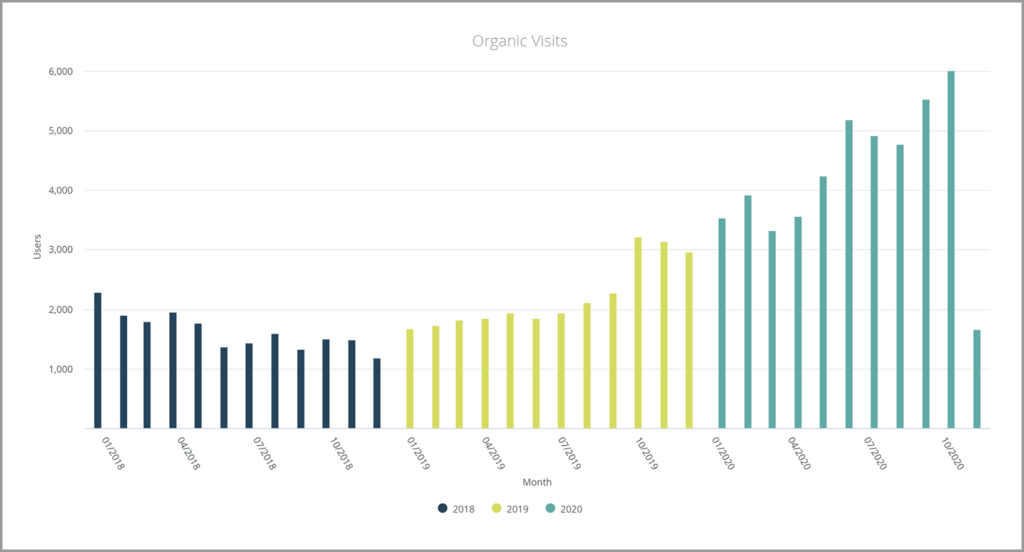
The most essential component you should have displayed on your dashboard is a snapshot of the historical monthly organic traffic for the website. When it comes to organic traffic and SEO, slow, steady change is common. However, when a major shift happens due to an algorithm change—for example, Google’s October 2019 BERT update—you can see the gain or plummet in traffic clearly.
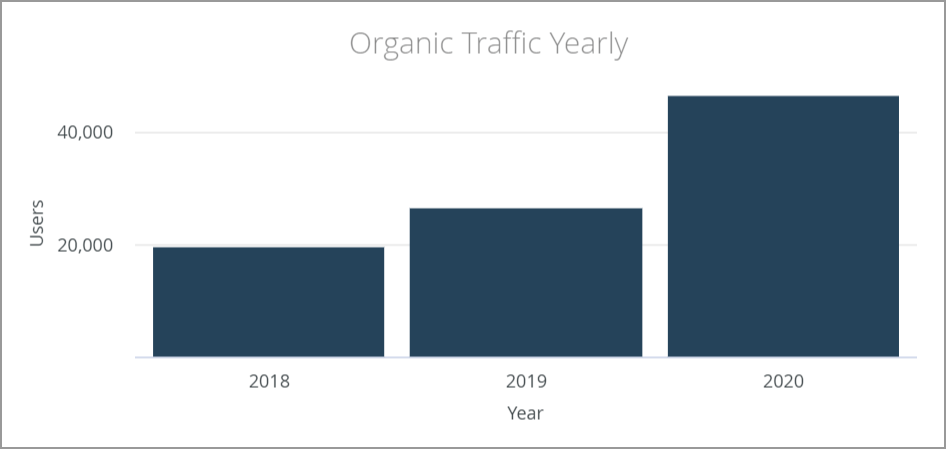
This simple month-by-month bar chart helps you swiftly identify organic traffic trends and changes as they happen. Additionally, a simplified bar chart can provide an overall, year-to-year view of SEO campaign effectiveness:
Overview:
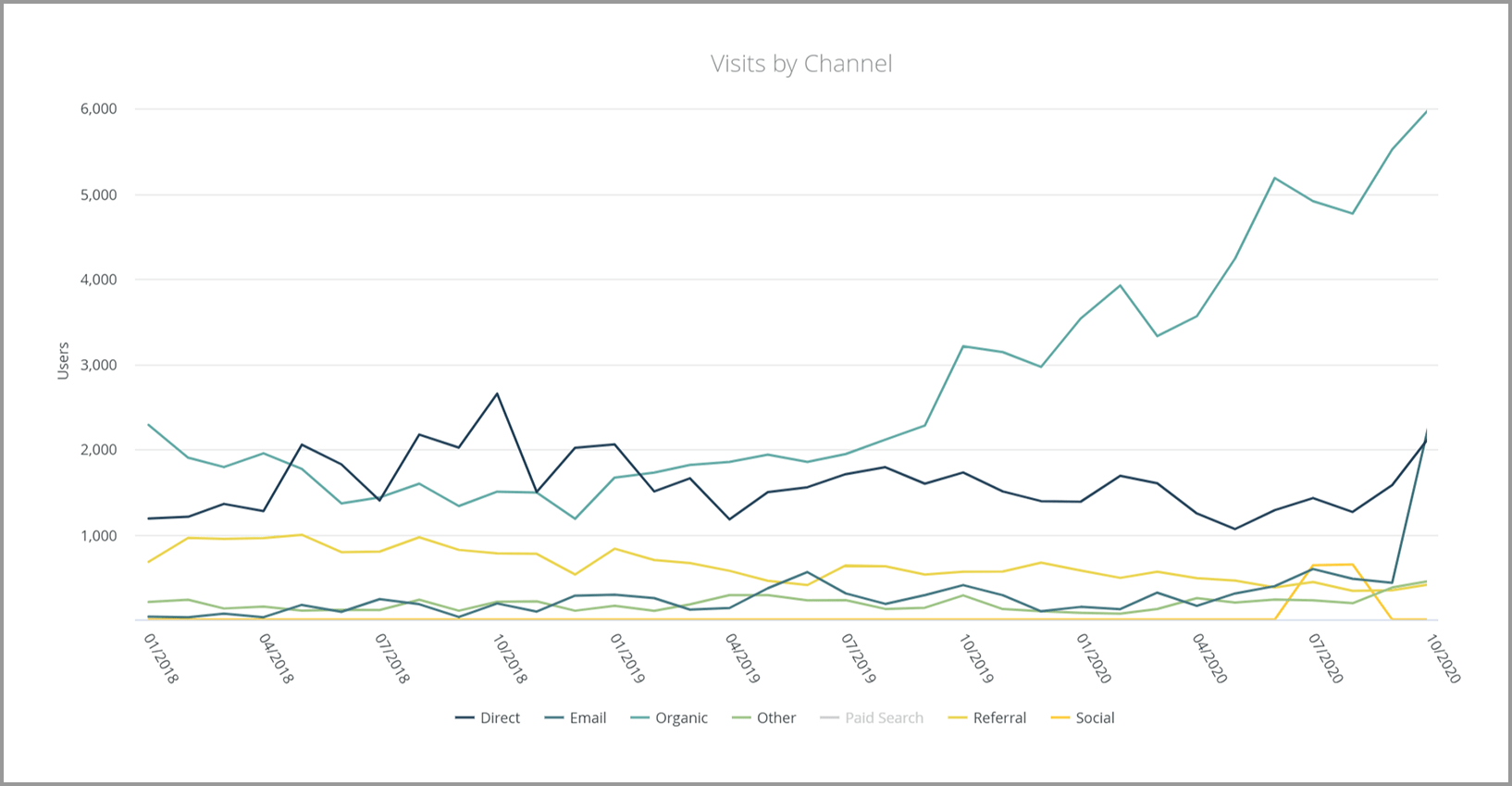
Focusing on channel segmentation, this dashboard offers clear insights into the volume of traffic for each originating method. It allows you to see, at a glance, how well different promotion methods have resonated with your audience.
For example, a large social push bumped the yellow Social line significantly in July and August 2020, illustrating the effectiveness of that campaign. The teal Organic line shows considerable traffic gains over the three-year period, as the content gains position and popularity in the search engine results pages (SERPs).
Overview:
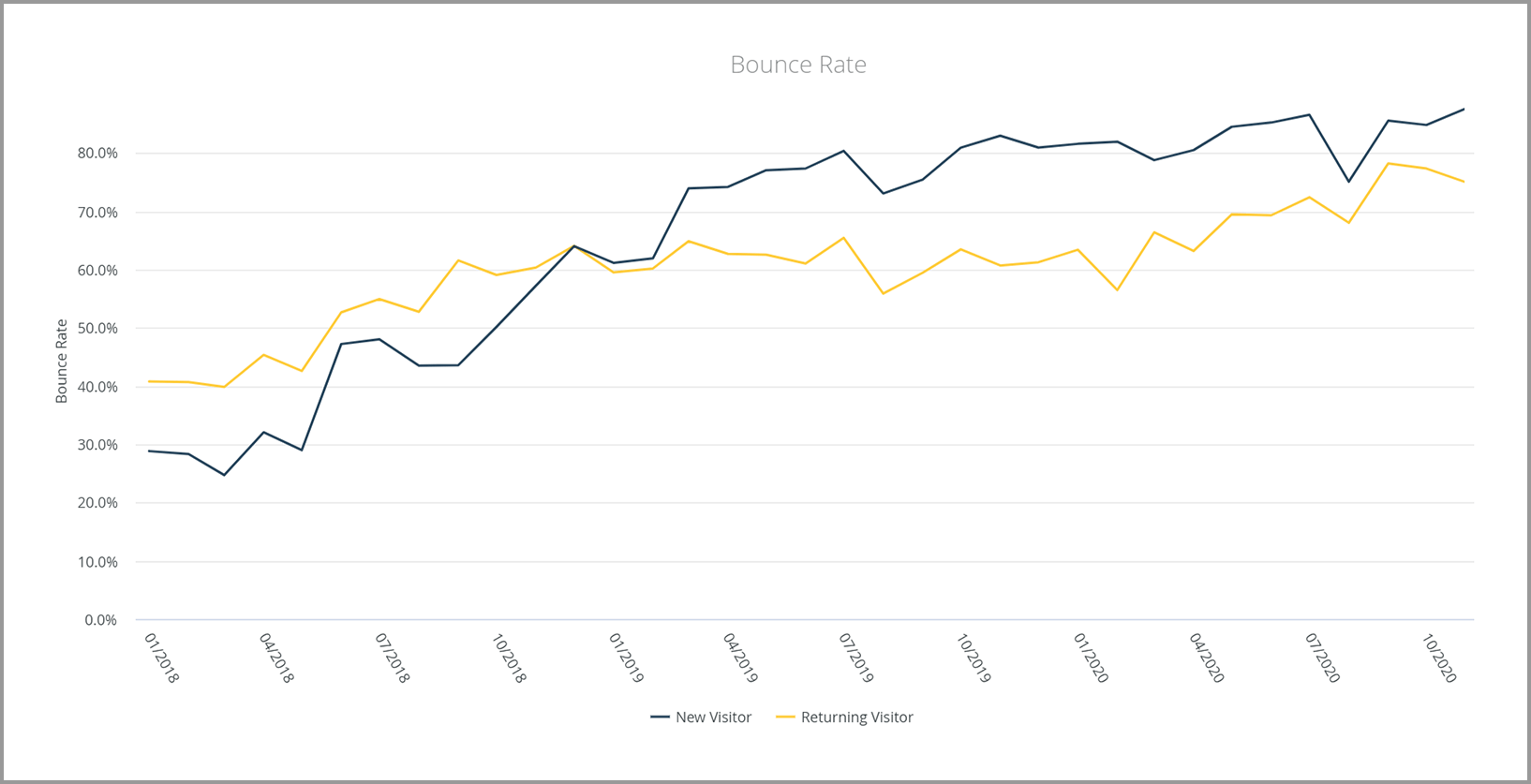
This dashboard component often causes panic because the common perception of Bounce Rate is that higher rates are bad. Yoast’s Annelieke van den Berg explains that having a high bounce rate can mean one of three things:
In this particular dashboard example, Bounce Rate increases with the amount of content on the blog that ranks in search results. Since we know from our other SEO dashboard components that the site is well-regarded in the SERPs and gaining in authority, option #3 (the page answers the visitor’s query) is the most likely conclusion.
However, this dashboard component also indicates where your team can make user experience improvements to the site to increase the interactions and lower the Bounce Rate.
Overview:
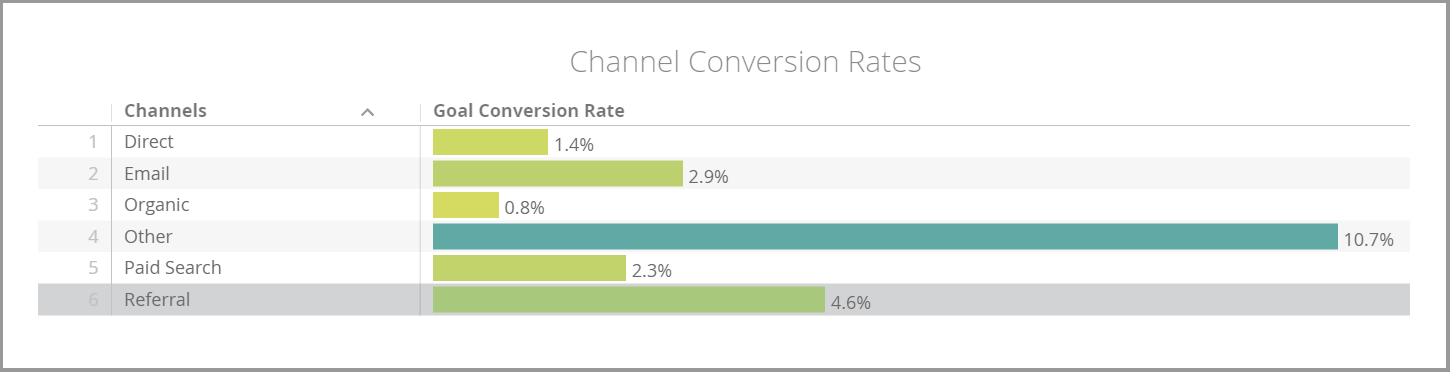
As illustrated by the first two SEO dashboard components, the organic traffic for this example site is quite healthy. This visualization, though, reveals that the conversion rate for organic traffic is at 0.8%, which indicates there is work to be done with regards to calls-to-action.
While Conversion Rate Optimization (CRO) isn’t necessarily a part of a SEO manager’s day, the two jobs do go hand-in-hand. What is a good conversion rate? It varies significantly depending on your industry and the type of content. However, Neil Patel says it best:
“What is a good conversion rate? One that’s better than the rate at which you’re converting prospects today. It’s that simple.”
Many people frequently ask me if SEO is worth pursuing. The slow turnaround and amount of effort SEO requires often gives it a negative reputation. This negative spin is why I advocate the consistent use of a SEO dashboard: it takes long horizon reports to show the trends, trajectories, and ROI.
(It should also be noted that, thanks to tailored search results, typing your keywords into a search engine and judging its position is inconclusive.)
It is especially important for SEO managers to document a starting point for their work, and continuously track and record the trajectory of their search engine results. This is where an automated SEO dashboard becomes a key reporting tool for SEO managers.
~
Our universal reporting and analytics technology is instrumental in driving consistent growth for marketing teams large and small. See for yourself how powerful it can be.