
Technology
Basis Platform
Advertising Operating System
Communication Portal
Intelligent Collaboration
All Channel Activation
Activate Media on Every Channel

Consulting
Resources
In recent years, many advertisers have considered bringing programmatic media buying in-house. For others, a lack of infrastructure and support make it difficult to take the plunge.
In this episode, Centro's EVP of Media Services and Operations shares the different ways advertisers can approach in-housing, as well as how to best prepare beforehand. Finally, she shares how advertising professionals can enhance their careers in today’s crowded and fast-evolving media environment.
As marketers - and media buyers, in particular - a lot of money flows through our digital hands. Depending on company size and program ambition, it can be a daunting amount. The larger the budget, the greater the impact even the smallest mistakes can make.
This is where reporting and budget pacing comes in, playing an absolutely critical role in ensuring you avoid any spend disasters and stay on course to meet performance targets. In this article, we explore the extensive improvements you can make to your program and day-to-day processes by monitoring pacing effectively, and, more importantly, how you can do it.
Budget pacing dashboards are arguably the most valuable that can be made. Understanding precisely how much you’re going to spend is equally as important as knowing how much has been spent. The manner in which you can expose such insights can be done in myriad ways, but the most straightforward (and therefore most common) is a linear calculation. It’s simply total spend, divided by days passed thus far in the period you’re reviewing, multiplied by the number of days remaining. Exposing this in visual form is an ideal way to learn if you’re on the mark, or if adjustments are required. If you’re managing multiple budgets, it’s easy to break these out by duplicating charts and filtering for the various accounts/campaign categories that you have.
In the chart below, spend and forecast are showcased together in one column. It’s an essential visualization that quickly reveals how much you’ve spent, how much you’re forecasted to outlay, and where that forecast sits in comparison to your budget. It’s a simple graph, but it conveys a lot of information instantaneously.

An alternative way to look at this would be via a running total. The line graph here provides an indication of how much you’ve spent, how you’re trending against your target budget cap, and whether there have been any major spend swings - or surprises - day-by-day in the budgeting cycle to date.

Aside from uncovering the progression and direction of spend, it’s also vitally important that marketers know where their investments have gone. There are a couple of visuals to help with this that can additionally double-up in functionality and help expose any issues that need to be resolved.
The first is a simple pie chart that shows the overall percentage of spend coming from the main advertising channels, for which search is dominant. However, while this succeeds perfectly in telling a good story about where the money is going, there could be lurking issues that will go undetected due to the volume of data usually in play. A suspicious spike in spend on a single day, for example, may not necessarily be displayed clearly here as it becomes lost in the overall percentages.

For that reason, I also like to show the total spend across the given time period. As this chart is intended to look for immediate issues, it’s focused on just a short time period. These are stacked line graphs, which will clearly show peaks and troughs that may warrant further investigation.

Both of these visualizations can, and should, be duplicated for the major areas of spend. Device, network, advertising channel, and publisher are all good starting points. If you’re running display or RLSA campaigns, an audience, or even demographic, set of charts would also be valuable to have on hand.
With the how and the where covered, I also like to have straightforward lists showing the top spending campaigns. It’s useful to understand what generally eats up most of the budget and it can be easily monitored for any outliers. I like to have, as a starting point, Campaigns, Ad Groups, and Keywords.

The intent with all of these graphs is to help peel the covers off what’s going on with your campaigns; exposing the details and following the pennies and where they go. It’s incredibly easy for any campaign to have some measure of wasted spend, but these charts will help to identify and resolve some of them.
Not only do they help to understand where money goes, but they also help to monitor for issues. Any large swings in spend will be easily caught and remedied by simply having the right dashboard in place.
~
Our universal reporting and analytics technology is instrumental in driving consistent growth for marketing teams large and small. See for yourself how powerful it can be.
The typical person can be exposed to more than 4,000 advertisements each day. Not surprising, given that people around the world spend an average of 170 minutes online per day! There are so many opportunities for advertisements to cross their screens.
If an advertisement catches your eye and it’s a product or service that you are interested in, there’s a good chance that it's part of that brand’s digital campaign strategy. This is where a media buyer comes in—it's their responsibility to strategically plan and place advertisements online to drive specific results for brands.
In digital media, there are two main parts to a media buyer’s job—media planning and media buying.
Media planning includes:
Media buying includes:
Brands and agencies rely on media buyers to ensure that their online advertising dollars are spent efficiently and effectively. Media buyers are also instrumental in tying online advertising dollars back to business objectives. This often includes increasing brand awareness, driving online sales, increasing site engagement, and more.
There are many tools available to help media buyers streamline day-to-day processes. At Centro, we are fortunate to have Basis—our own comprehensive & automated digital media platform that allows our team to run direct, programmatic, search, and social media buys through a single interface. This platform is the foundation of our company and has enabled us to service over 1,000 media teams throughout the years.
Some of Basis’ features include:
So as people continue to spend more time online and see thousands of ads each day, know that media buyers are behind the scenes, carefully crafting digital campaigns to place a lot of those advertisements. Hopefully these media buyers are using platforms like Basis to make their jobs easier and ensure advertisements are put in front of the right people, at the right time, and the right place!
When COVID-19 hit early last year, the world of healthcare marketing seemed to come to a halt. Media budgets and the people who controlled them paused, leaving marketers to reflect on how to move forward and the changes that would likely come due to the global pandemic.
While messaging and targeting may have changed, the one thing about healthcare marketing that hasn’t changed is that caring for and improving the lives of patients remains at the center of the industry.
Whether it’s advertising healthcare facilities, hospital service lines, new drugs, updated medical devices or simply continuing education for healthcare providers (HCPs), healthcare marketing still revolves around patients. What has changed is the way HCPs reach and engage with their patients and other people in their fields, and how healthcare marketers help them accomplish that.
Healthcare marketing is still focused on simplifying care for patients and keeping the relationship between HCPs and patients strong. However, things are now shifting to a digital-first approach.
A good example of these changes relates to telemedicine. It’s true that telemedicine isn’t exactly a new advancement in medical technology—in fact, it’s been around for decades—but its usage numbers saw a significant spike in 2020.
With the pandemic leaving people in quarantine and unable to visit their HCP, telemedicine offered a way to keep patients and HCPs connected and ensure that patients still received the care and attention they needed. The challenge that healthcare marketers faced was that telemedicine wasn’t the most popular or well-known service, to either HCPs or their patients.
While healthcare marketers couldn’t entirely control HCP usage and adoption of telehealth services, they could help get patients on board for doctors who already signed on to the “new” platforms. Shifting patient-centered campaign messaging away from showcasing service lines, clinic locations, and offerings, and towards making it clear that a patient’s HCP was still available, just in a different way, was integral to keeping relationships between patient and HCP strong.
Despite a gradual and hesitant adoption of a new technology, as it turned out, telemedicine’s shining moment in the midst of a pandemic impacted the healthcare industry more than anticipated. FAIR Health reports that the United States saw a 5,680% increase in telehealth claims, from privately insured patients, from May 2019 to May 2020. According to a survey from Doctor.com, 83% of patients expect to use virtual appointments even after COVID-19 dies down.
While there will always be a number of issues or conditions that do require an in-person visit, for the remaining conditions, the number of patients likely to choose a virtual appointment over going in-office are strong and keep rising.
Another big change in Healthcare marketing is the balance between non-personal promotion (NPP) and personal promotion budgeting and strategy. Previously, NPP budgets had taken a back seat to personal promotion, like drug sales-rep meetings or event booths and sponsorships.
While effective, personal promotion was a bit outdated and challenging even before COVID-19 entered the scene. Since COVID-19 forced a sort of evolution in the outdated practices of engaging with HCPs, NPP has increased rapidly. MM&M surveyed medical marketers recently, and 45% said they were increasing NPP, with 73% of those individuals citing COVID-19 as a significant factor for that increase.
This is by no means bad news—it’s actually a big step towards a more digitally evolved healthcare industry which benefits everyone involved. But it also presented a unique challenge for healthcare marketers… how do you make non-personal promotion feel personal? This question pushed marketers to work smarter and reevaluate how HCPs are targeted online and how they’re consuming media, which is something that will last long after COVID-19 ends.
In short, COVID-19 gave the healthcare industry, and thus healthcare marketing, a big push into the digital space, where it will remain long after COVID-19 dies off. Telemedicine, more non-personal promotion, and the ever-evolving digital solutions for healthcare, are here to stay. And, so is the responsibility of healthcare marketers to keep communicating the industry trends to both patients and healthcare providers, especially during the COVID-19 pandemic.
Connect with us to learn more about healthcare marketing with Centro!
As a digital marketer, analyzing and unraveling data is a critical part of the game. Aside from defining precisely what you want to track, an increasingly important consideration is how often you plan to review the metrics you’re focused on. And guess what? It’s impossible - and unworkable - to simply throw a blanket over different metrics and treat them all with a single formula. Depending on the model and strategic objectives of a given business, marketing teams need to adopt their own distinct analytical cadences.
For some marketers, that means tracking key performance indicators on a week-over-week basis, as opposed to once per month, or even once a quarter.
The benefits of conducting weekly evaluations are many. Primary among them is that they help you pivot and adjust your campaigns more quickly and keep things on pace to meet monthly goals and benchmarks. Regular performance check-ins allow you to identify specific aspects of your ads - whether that is creative, messaging, or keywords - that are resonating with your audience and then iterate as required on those that clearly aren’t before they drain your budget. You may, for example, have just added a bunch of negative keywords to prevent your ads from showing up on irrelevant searches and in the process damaging your relevance score. Comparing campaign performance for the current week against that of the preceding week helps expose if those alterations had any impact. Similarly, if you increased bids in an attempt to improve your visibility on the search engine results pages, you can track how that affected key metrics including conversions, CPA, ROAS, and Profit. By gleaning this type of information in weekly cycles, you become empowered to design goals that reflect evolving capabilities. Even if you’re running a longer campaign with a slow release of promotional material over the course of a month - say, on social media and your blog - it’s still important to look at your campaign metrics on a weekly basis in order to stay agile and modify your tactics based on near real-time data.
In this blog post, we explore what effective weekly performance analysis looks like using dashboard features complete with real client data.
Overview:
Format: Single Value Tiles and Line Charts
Time Period: Week-Over-Week
Metrics: Impressions, Clicks, Cost, CPC, Conversions, Revenue, CPA, ROAS, RPC, Profit, Conversion Rate, AOV
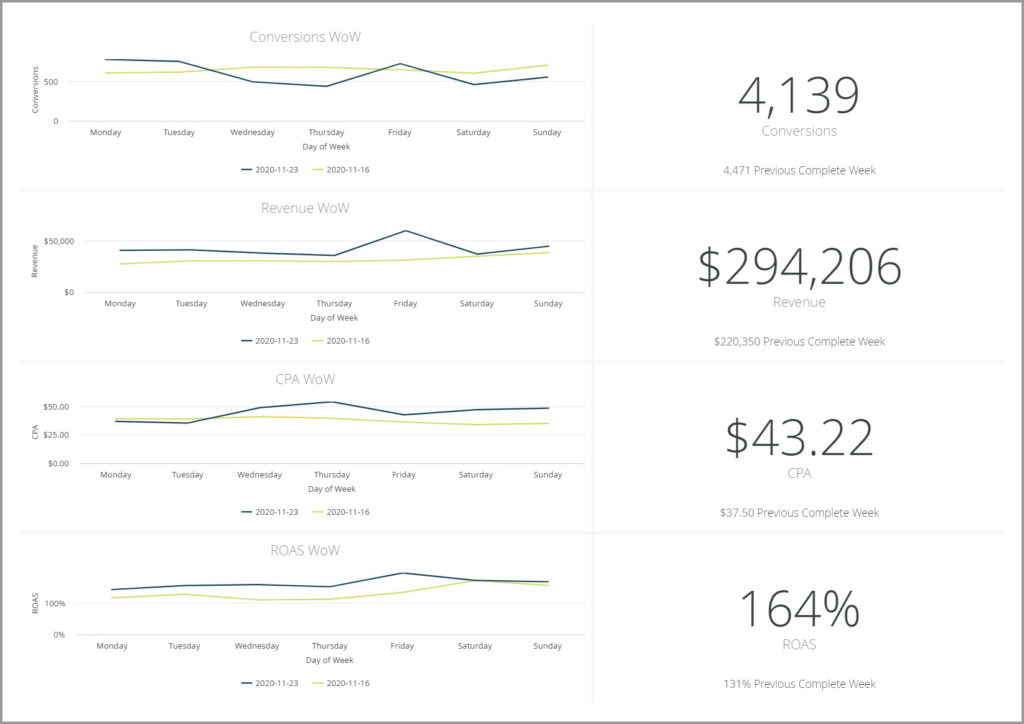
In this widget, we’re presented with two different views of the same fundamental data points. On the right, we’ve got an easily digestible snapshot of the primary KPIs in aggregate, and then on the left, we can see those numbers broken down by day in a time series line graph. A marketing dashboard should be viewed as a steering wheel for optimum performance and this handy visualization helps you smoothly navigate the digital ecosystem of your industry. Within seconds, you can pinpoint any anomalies and major events and evaluate whether your campaigns are trending according to your forecasts.
We can see from the data showcased here that throughout the previous seven days our client generated revenue of a little over $294K compared to $220K the week prior. That’s a 30% to 35% increase, week-over-week, and something that certainly warrants a more exhaustive investigation into the cause.
A swift glance leftwards at the line graph tells us that the variance came from across the entire week, with one particularly meaningful spike on a single day. Armed with that insight, you can then switch over to more granular dashboards to really dig into what triggered the spike. By observing how your metrics fluctuate daily from a weekly perspective, you eliminate any overhasty conclusions from your analysis and avoid latching onto false signals that could easily result in a misallocation of funds.

Overview:
Format: Table
Time Period: Week-Over-Week
Metrics: Impressions, Clicks, Cost, Revenue, Conversions, Profit, ROAS, CPA, Conversion Rate, CTR, CPC, and RPC
As all digital marketers will attest, campaign performance typically varies widely by segment, whether that be by channel, publisher, or any other dimension you’re working with. Once you’ve learned about the state of your program at a very high-level from the charts above, you can then dive deeper into some selective elements.
We can see, for example, that the upturn in revenue was across both Google and Bing despite fewer impressions, a negligible difference in clicks, and incredibly, in the case of Google, far fewer conversions week-over-week. It’s also worth noting that Bing is doing a great job at complementing this particular client’s PPC strategy, bringing in the conversions at a much lower CPA and significantly higher ROAS than Google. Such insights are extremely valuable because they help you continuously optimize your initiatives, exploit previously unforeseen pockets of improvement, and reshape the strategy behind how you’re distributing your marketing dollars to reach your end-of-month - and yearly - objectives.
Overview:
Format: Stacked Bar Charts
Time Period: Week-Over-Week
Metrics: Spend and Revenue
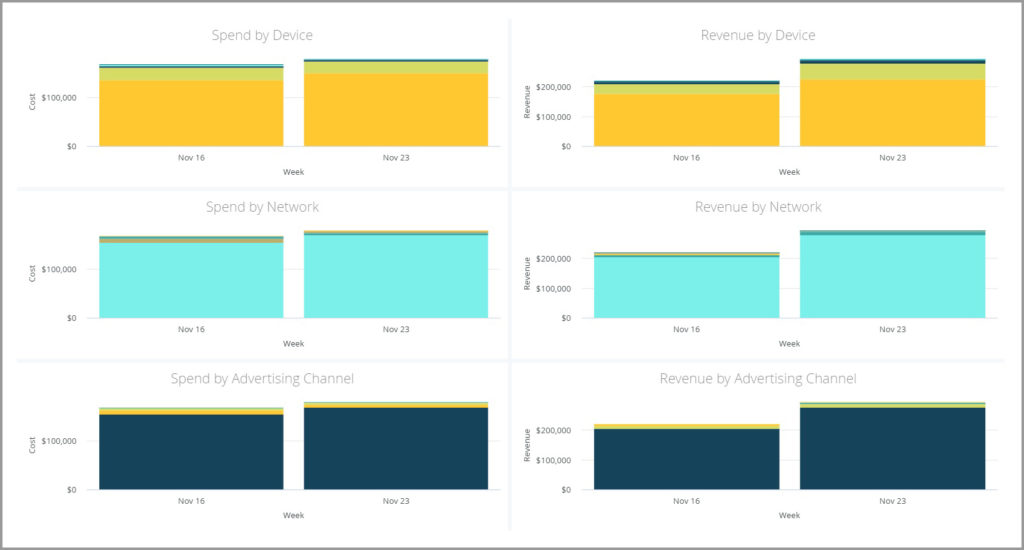
Completing this dashboard look, we have a series of stacked bar charts depicting further granular visualizations of spend and revenue. With marketing campaigns continuing to grow in their complexity as more data, channels, and tools become available to advertisers, the main purpose of this widget is to help you simultaneously compare totals and determine which sharp changes at the item level are likely to have had the most influence on the movements we saw in the components above.
As marketers, we’re tasked with making crucial monetary decisions on behalf of the company every day. By tracking this type of information weekly, you can get a sense of whether a particular device, network, or advertising channel is performing better or more poorly than expected fairly quickly, ultimately empowering you to either pause or invest more heavily in ads where appropriate.
The cycle of experimenting, measuring, and optimizing is rigorous and never-ending. What automated weekly reporting does is provide the actionable insights you need to form better hypotheses and drive accelerated growth by connecting effort with outcome at both micro and macro levels.
Once you have that capability at your fingertips, you can pinpoint market trends like never before and outpace your competitors absolutely everywhere.
~
Our universal reporting and analytics technology is instrumental in driving consistent growth for marketing teams large and small. See for yourself how powerful it can be.
2020 accelerated a slew of consumer trends at a pace our industry had never seen before. Now, we’re looking ahead at how these developments will further impact and create new opportunities for brands and advertisers.
In this webinar, Ryan Manchee and Noor Naseer share what they’re anticipating and excited about for the year ahead.
One of the most critical aspects of building a robust digital marketing strategy is engaging your audience in a consistent, meaningful way online. Social media platforms offer a huge opportunity to do this, yet it’s easy for your brand voice to get lost in the noise these channels generate if you don’t continually test and track your efforts.
Failing to optimize your social media strategy puts you on the path toward poor performance, wasted time, and misallocation of your marketing budget. If you’re serious about social media marketing, you need powerful reporting technology with built-in social media dashboard templates that empower users to continually improve performance.
A social media dashboard is a tool that marketers can use to track the KPIs from all social accounts to ensure strategies are being executed as intended. While you could create your own reports using spreadsheets, it’s much more effective to use a social media dashboard to automate the process. Dashboards pull data directly from your social platforms and summarize performance in easily digestible visualizations that update automatically based on the latest data.
If you’re interested in using social media dashboards to monitor marketing performance and optimize your campaigns, here are five tips for success.
Before investing in a dashboard tool, it’s important to first have a clear understanding of your social media marketing goals. Essentially, you need to be able to answer these questions:
Defining the exact make-up of your strategies before you implement them is paramount. This means investing in a dashboard reporting tool that includes all the integrations and key reporting metrics you need to monitor progress.
Most social media platforms have their own native reporting tools, which leads many marketers to (mistakenly) believe that they are sufficient enough to track performance. While your Facebook Insights Report and Twitter Page Report are valuable, you need to view your data holistically to understand social media performance overall.
When you use a reporting tool that creates social media dashboards, you can integrate performance data from every major platform, including:
If you have any additional social media performance data you want to add to your dashboard beyond these reports, you can import it using CSV files, or arrange for data to be regularly uploaded automatically.
Next, you want to ensure your dashboard reports include the critical data points you need to examine campaigns and work towards achieving your social media marketing goals. With that, there are likely certain KPIs that you’ll want to prioritize and view quickly at a glance. You could build your dashboard reports from scratch, yet the best strategy is to start with a premade template and then customize it to highlight your preferences. Templates include widgets dedicated to the most important performance indicators built right in, affording users the opportunity to rearrange them, switch them out, and build a custom dashboard to fit performance goals more accurately.
Some important KPIs to consider are:
Followers
It’s important to look at the total number of followers you have on each social platform and how they’ve grown over time. The great thing about dashboards is that you can see a combined total of followers on Instagram, Facebook, Twitter, etc. You can understand, therefore, how your social media efforts are impacting your follower growth overall.
Likes and Shares
Tracking how many likes and shares your posts get isn’t just for social media influencers. Marketers can learn a lot about how their content is resonating with their target audience by how they react to it. Tracking your likes and shares across social media channels also tells you a great deal about how each platform is performing. Your number of likes ultimately gives you an idea of how many potential leads you can target on a platform.
Impressions and Reach
These metrics show you how many people could see your posts in their social feeds, regardless or not of whether they have interacted with them. Having high reach and impressions is important to gain visibility for your brand and increase potential engagement. If your impressions and reach are low, you may want to change your posting strategy or invest in boosting posts to garner increased visibility.
Engagement Rate
Having a large number of followers actually isn’t all that important if you’re not doing a good job of engaging with them. There are plenty of brands who build their following and post frequently but are never able to truly interact with their followers and nurture them as leads. That’s why it’s really important to monitor your engagement rate and make sure your marketing efforts work to improve it.
Engagement rate has a formula:
(Total social interactions [Likes, comments, shares, clicks, etc.] /Total number of followers) x 100
Essentially, if you get 1,000 social interactions a day with ten thousand followers, your engagement rate will be much lower than if you got the same number of interactions with only a few thousand followers.
If you’re investing in paid ads, other important metrics to include might be:
Your main dashboard can include reports on any KPIs you want through the use of customizable widgets.
Social media dashboards give you a quick, valuable overview of social media performance with insightful reports. The main benefit of dashboards, though, is the opportunity they offer to zoom in on different reports and break down your data to surface more actionable insights. With just a few clicks, you can change your reports to show performance for different time periods, or filter data by platform, content type, conversions, and more.
By digging into your dashboard reports, you can get a better understanding of how different factors are influencing performance. For example:
You can also examine other key metrics that can reveal opportunities for improvement and inform you where it’s best to invest your marketing efforts, namely:
Succeeding in social media marketing isn’t just about growing your followers, engaging them, and driving traffic back to your website. You want to find the people who are most interested in what your business has to offer, target them on the social media platforms they spend their time on, and optimize CTR and conversion behaviors to drive your marketing goals. Your social media dashboard provides all the data insights you need to achieve this.
If you want to get the most value out of your social media dashboards, then this is the most important tip you should follow. Social media dashboards aren’t just for checking how you’re doing - they’re designed to help you monitor performance and determine how your marketing campaigns are influencing key goals.
Once you understand how your social media engagement performs as a baseline, you can introduce different marketing initiatives to improve it. Dashboards help you monitor week-over-week engagement changes to see if your efforts are paying off.
Your dashboards can also be used to understand how your marketing campaigns help your brand perform compared to competitors in the social media space. You can monitor changes in factors such as:
Dashboards provide the most value when you utilize the actionable insights they expose to create refined, more optimized social media marketing campaigns. Intelligence gleaned from your dashboards can help ensure your efforts are always focused on the right platforms, the right audiences, and the right tactics to achieve your goals.
Social media marketing offers huge opportunities to engage your audience, build your brand image, generate leads, and drive conversions. However, you can end up wasting a lot of resources on social channels if you don’t monitor performance effectively.
Building dashboards is the best way to surface the insights you need to understand how your marketing efforts are driving key goals across your social outlets. Start by investing in a robust reporting platform, then follow the tips outlined in this article. You’ll end up with all the data you need to build a winning social media strategy.
~
At Centro, our universal reporting and analytics dashboard empowers marketing teams to make better, data-driven decisions for campaigns. You can view metrics from programmatic, direct, search, social, and connected TV via one platform. Ready to learn more? Get in touch with us today!
Located in Oklahoma City, VI Marketing and Branding is a fully integrated marketing and branding firm that specializes in behavior change.
In order to maintain their status as leaders in the digital marketing industry in the Oklahoma City area, VI Marketing and Branding’s goal was to bring programmatic digital advertising in-house to build more transparent relationships with clients and increase digital revenue. Past third-party DSP partners had not allowed them to be proactive, transparent, or accountable with their clients. This was causing strains in their relationships and not allowing their business to grow.
Growth: 19 new team members in 2018
Mobility: 18 promotions agency-wide in 2018
Morale: Additional focus on work/life balance, recognition, training, and dedication to being at the forefront of the industry. The VI team using Basis has allowed for additional personal growth for their team members with unparalleled support from the Basis team.
Efficiency: Managing campaigns internally with Basis has allowed ad operations specialists to have more time for strategic optimizations and improving campaign performance rather than resolving delivery issues for clients and trafficking creative tags.
Business Development: The transparency of reporting and increased campaign metrics available in Basis has emboldened their clients to shift more dollars towards digital tactics.
~
Renée Harriman, Vice President, Media, VI Marketing and Branding:
"Using Basis, the transparency of reporting and increased campaign metrics has emboldened our clients to shift more dollars towards digital tactics, namely paid search and programmatic video and display."
~
The selection and implementation of a demand-side platform (DSP) is no small feat. If you've identified a need for one, it's time to consider other requirements, beyond the ability to buy programmatically, in order to support your growing organization. Hint: you need more than a DSP. The decision to in-housing programmatic buying requires the input and involvement of top stakeholders and teammates alike. Read our guide to learn more about the process and do more down the road.