
Technology
Basis Platform
Advertising Operating System
Communication Portal
Intelligent Collaboration
All Channel Activation
Activate Media on Every Channel

Consulting
Resources
Having a point of reference for how we are performing is valuable—both in our personal and professional lives. Benchmarks provide useful information for goal-setting by helping us to understand where we're succeeding and where we can improve. However, finding these starting points is not always easy.
Media professionals often come up against this issue when working on advertising campaigns. In planning, they need guidance on what KPI metric and value they should strive for. While the campaign is running, they can benefit from having something to compare to, ensuring that they're moving in the right direction. At the end, they need the ability to report on how a campaign performed relative to other advertisers.
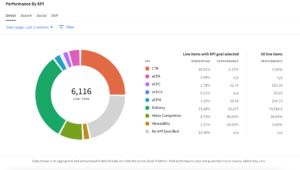
Market Trends, a benchmarking tool exclusive to Basis, was created to address this pain point. By analyzing information from 250,000+ line items and 14,000 brands, Basis gives users access to four graphs with performance and spend data across channels, verticals, properties, and KPIs.
With just a few clicks, advertising professionals can access a consistent source of reliable data, directly in the platform. Users no longer need to waste time browsing through multiple pages to get the information they want. Today, programmatic buyers can access the following graphs:
For each graph, users can customize the data by filtering by date range or by any of the 26 different verticals. See below for a sample "Performance by KPI" Market Trends graph:
Start creating more data-driven media plans and eliminate the time and cost associated with collecting, researching, and organizing information to guide your advertising choices—let Market Trends do the work for you!
Reach out to learn more about how you can utilize Market Trends to strengthen your media strategies.
If you are in the financial services industry, the competition for customers is fiercer than ever.
Digital ad spend for the financial services industry is expected to hit $24.49 billion this year, and will climb to $30.75 billion by 2023. That’s nearly double what the industry was spending back in 2019.
There’s a good reason behind the jump: customers are re-approaching financial services en masse in light of a rapidly changing world. Nearly three-quarters of Americans said they’re revisiting their financial planning due to the pandemic, which is fairly unsurprising given the economic chaos of the past 18 months. Additionally, by 2024, more than 79% of American adults will be using digital banking—a trend that has accelerated with both COVID and the continued growth of fintech companies.
Between the impact of COVID-19 and the rise in digital banking, financial services companies have a once-in-a-generation opportunity to reach customers when they’re re-considering their financial institutions of choice. Whether you are a fintech startup, a hundred-year-old Wall Street institution, an insurance company, or a local credit union, it’s never been more important to differentiate your brand and stand out from the pack.
Here are five tips to help any financial services business in their digital marketing campaigns:
1) Video
In an incredibly competitive field, you want to make sure your company stands out. A video ad (or a series of video ads) can help give your brand personality in a way that resonates more than just words. Plus, with US adults watching an average of 2.5 hours of digital video per day, it’s a good way to meet consumers where they are—whether that’s a streaming platform, a news/information site or a social media feed. Speaking of which...
2) Get Social
In today’s data-rich world, personalization is key, and few places are better for ad personalization than social media. Two-thirds of customers say they expect financial services companies to understand their unique needs and expectations, which means it’s critical you demonstrate that type of personal attention in your ads. By utilizing social media’s unique ability to target hyper-specific audience segments, you can create ads that feel especially relevant to the specific needs and expectations of different customers.
3) Think Local
Even in an increasingly global and digital world, customers care about the impact a business can have on them locally and/or in person. Nearly half of all Google searches are seeking out local information, and 72% of consumers that conduct a local search subsequently visit a store within five miles. This is where geo-targeted ads come in. If you are a finserv institution with brick-and-mortar locations, geo-targeted local ads can steer customers directly to your doors. Meanwhile, if you are a digital-only brand, you can use geo-targeted local ads to demonstrate the convenience of your online offerings...which could help customers avoid having to do such location-based searches in the future. Either way, it’s a valuable part of any financial services brand’s ad campaign.
4) Look Toward the Future
With the economic uncertainty brought on by the COVID-19 pandemic, Millennials and Gen Z are growing increasingly interested in their financial futures and/or turning to financial advisors for help. According to astudy by Northwestern Mutual, 19% of Millennials and 25% of Gen Z said they didn’t have a financial plan before the pandemic but are looking to develop one now, and more than one-fifth of both Millennials and Gen Z said they didn’t have a financial advisor pre-COVID but are seeking to work with one now. Financial services brands should make a concerted effort to reach these customers now, as they look to establish financial relationships that could last for years to come. (One way to reach them? Read up on Gen Z and the future of digital advertising.)
5) Direct Taps to the Apps
With this spike in digital banking and an overall move toward digital for all things finserv, financial services companies have an easy choice when it comes to the CTA for any digital ad: their apps. A Salesforce study found that 68 percent of customers say COVID-19 elevated their expectations of companies’ digital capabilities, and “implementing new technology” simultaneously became the top priority among financial services leaders during the pandemic. Directing customers to your app—and using an ad to demonstrate the app’s top customer-centric features—will help you show off any new investments you’ve made in your tech, while appealing to today’s more demanding customer base.
Want to learn more about financial services marketing? Check out the four trends shaping financial services marketing, or take a look at our Finance in 2021 infographic for additional insights about the consumer and market trends driving change this year.
As marketing and advertising professionals leave their current roles for companies that better serve a diverse array of needs, their teams are struggling to grapple with the fallout of The Great Resignation.
In this episode, Corean Canty, COO of talent platform We Are Rosie, weighs in on the current talent landscape and shares what organizations must provide in order to appeal to sought-after professionals.
Recently, Marketing Brew ran a story about the ongoing trend of brands bringing their programmatic advertising in-house. The rise of in-house media operations has seen the likes of Chase, Molson Coors and Ally Financial take their programmatic ad buying into their own hands.
As you might imagine, given how big some of those brand names are, there are some serious upsides to in-housing your programmatic. However, as the article notes, a successful transition from agency to in-house programmatic buying isn’t as simple as flipping a switch. A few major differentiating factors can make all the difference, and before making any decisions on whether to in-house your programmatic media buying operations, it’s important to consider all the possible benefits and risks of any such move.
Let’s take a quick look at the possible upsides and potential pitfalls of in-house programmatic ad buying, as well as what concrete steps brands can take to mitigate those risks before they begin their programmatic in-housing journey:
First, let’s examine some of the positives.
The motivation behind many in-house media buying teams is a desire for more transparency in the programmatic advertising process. Our industry has seen story after story after story after story after story covering the problems stemming from a lack of trust between brands and their agency partners when it comes to programmatic advertising, so we won’t bore you with the details here. Needless to say, the ability to shirk any further concerns around programmatic transparency by saying “Forget you, I’ll do it myself!” is certainly one of the primary appeals of in-housing programmatic. Having that sort of direct, unfiltered data is no doubt going to appeal to any brand looking to capitalize on its digital advertising efforts, be it programmatic or otherwise.
Then, of course, there are the cost savings: large, mid-sized and challenger brands alike can all stand to save money from cutting out the middleman and doing the programmatic buying themselves. Cutting down on managed services fees—combined with data consolidation, integration and storage cost savings—can equal some serious dollars for a brand’s marketing department. At Basis Technologies, we’ve seen the results first-hand, with brands that in-house their programmatic using Basis achieving a 48% ROI, according to a Forrester study.
Of course, there’s the then-obvious follow-up question of “Are the savings ultimately worth the hassle of having to do everything ourselves?” That brings us nicely to our next topic: the potential risks of in-housing.
There’s a good reason people choose to outsource tasks like programmatic ad buying: it can be complicated, time consuming, and require additional personnel and platforms. Why spend upfront costs on training, talent and tech when you can just pay someone to deal with all of that for you?
In the Morning Brew piece, employees from several brands speak to the need for truly investing in the process of programmatic in-housing. It is not, as they note, something you just “try for a year” or hire a few people to do on your behalf. Rather, it involves the same planning, preparedness and commitment as any other major strategic decision.
What’s more, many (but not all!) DSPs involve an unspeakable amount of monotonous, time-consuming manual work—in the Morning Brew article, one VP described it as “deathly boring”—and the time an in-house team spends executing programmatic ad buys can come at the expense of things like strategy and creative discussions. With talent shortages already a problem in the industry, hiring for such positions can be difficult, to say the least.
Between the upsides and the potential risks, brands clearly have a lot to consider when it comes to in-housing their programmatic ad buying. Those looking to shake up their programmatic strategy should be careful to consider all these concerns before making a choice on whether to proceed with in-housing or stick with outsourcing. However, should you decide to move forward with the transition, there are a few major choices that can make all the difference between in-housing being a transformative decision or a bust.
Ultimately, three key factors can determine whether your brand’s in-housing is a success:
1) The Platform
Your choice of DSP is the foundation upon which your new in-house team will rely. Investing in the right platform can set your team up for success from the outset and will have the tools and capabilities to grow with you as your programmatic efforts increase. What’s more, it can help you make the absolute most of your talent—be they entry level employees or media planning veterans. Think of it this way: you can hire the best driver in the world to lead your new racing team, but if you put them in a 1994 Toyota Camry, they’re probably going to get smoked by that perfectly adequate driver behind the wheel of a Tesla.
So, what does the “right” platform look like? At a minimum, it should address the central problems you were looking to solve when you brought programmatic in-house in the first place: transparency and cost. The right platform should make it easy to see where your dollars are going, find out how a buy performed, and bring everything together into one holistic view—all while respecting the time, competing demands and varying experience levels of your in-house media services team.
This leads us nicely to the next key factor...
2) The Time
On many DSPs, programmatic ad buying is a time-consuming, monotonous process that’s tedious for your talent and takes time and resources away from things like strategy and creative planning. The same problems used to plague email marketing before the advent of marketing automation software, which transformed the industry by streamlining the email marketing process and boosting the productivity (and sanity) of digital marketers.
Today, brands have the opportunity to leverage DSPs that utilize automation for a similar purpose: to take care of time-consuming manual tasks and free up time for your in-house media services team to focus on other, more worthy responsibilities.
While we’re on the subject of time, it’s also important to take the time to plan the transition from agency-driven programmatic buying to an in-house team. And it will take time—we’re talking months or even years here, not weeks. To make the most of the switch, you’ll need to find the right partner to set your team—and your organization—up for success. Which brings us to our last factor...
3) The Training
As you make your way down the path to self-service, it’s critical to identify reliable outside voices who can offer their experience and expertise. Start by looking for someone with digital chops who has done this before. Confirm their media expertise, and ensure they have a viable pool of resources you can tap into. You want a partner who can give not just comprehensive training to your new in-house team, but leave you feeling confident in your ability to take the programmatic reins once they’re handed over (and, of course, that you can still reach out to should you have any questions or needs later on.)
In sum, any brand looking to bring their programmatic buying in-house should try to find a partner that offers not just a DSP, but a platform that automates those “deathly boring” manual tasks, brings together all relevant communication and data into one place for increased transparency, and provides comprehensive training to help you on your path to programmatic self-service.
As with any major strategic decision, there are a myriad of other factors that can help facilitate or impede the success of programmatic in-housing. But if you get it right on those big three, you should be set up for success—and, with it, the transparency and savings in-housing provides.
The idea of in-housing programmatic can seem daunting (just look at that “risks” section up above!) That’s why we put together our Programmatic Readiness Guide. The guide can help you and your brand assess what would constitute the ideal solution for your digital buying needs, prepare your organization for digital buying success, and determine programmatic readiness throughout your business, people, process, technology and future. Whatever your thoughts are on in-housing, we hope you’ll give it a read.
Praxis provided patient recruitment support for a clinical trial to treat Covid-19. They asked their CSM and Basis Technologies’ Managed Services team for help with strategy, set-up, and optimizations. With assistance from their CSM, it was easy to access Hulu’s premier inventory. Basis’ Platform Deals helped them explore inventory they wouldn’t have otherwise considered.
Generate awareness about the trial to enroll participants; reach a wide audience at an optimal CPM.
The eligibility criteria, and time-window to participate in the study are very stringent.
~
Courtney Walczak, Media Planner & Buyer, Praxis
"By using Algorithmic Optimization, there were fewer manual optimizations involved, which allowed for more time to work on analyzing performance."
~
The newly established marketing team at a major state university was determined to increase undergraduate applications in the six weeks leading up to the admissions deadline. Basis’ powerful targeting tools were used to optimize their campaign toward the top-performing audiences in order to reach the university’s goals.
The university wanted to generate 900 completed applications before the admissions deadline. The campaign was divided between in-state and out-of-state students, based on the varying levels of value to the university. The goal was to achieve this application number through the targeted audience with a CPA under $255.
University applications are lengthy and detailed, making conversion tracking a challenge. Basis Technologies’ digital marketing team used retargeting and view-through conversions to stay in front of the target audience. Restrictions on targeting underage audiences also presented a challenge, as many potential applicants were underage. Basis tapped into the client’s CRM and the platform’s powerful DMP for first-party data. This data was then used to create look-a-like models to efficiently target the clearly defined demographic without losing impressions on restricted audiences.
~
A premium cosmetics brand wanted to promote seven product lines, including one of limited-edition. Backed by research and competitor analysis, Basis Technologies recommended video and animated creative for this campaign as its engaging nature and scroll-stopping traction generates positive results for retail and eCommerce products.
Increase year-over-year return on ad spend (ROAS) within the consumer audience.
This 10-month long campaign was planned, and started, before COVID-19. Goals were set based on 2019 consumer behavior.
~
Digital Marketing Specialist, Cosmetics Brand
"We customized creatives per placement to take advantage of the full-screen real estate of “Stories”. The text field was adjusted on other placements to deliver the message without truncation."
~
At Centro, we know that keeping up with trade pubs and latest trends can be tough, not to mention time-consuming. To make that easier, we’ve compiled all the articles, reports, and other bits of awesomeness you may have missed, but should definitely read. Enjoy our latest list below!
Ads, Privacy, and Confusion [:06]
Privacy is coming to the internet, and cookies are going away. Many argue this is long overdue; those of us in advertising are challenged by what happens next. This post dives into how we don’t have much consensus on what online privacy actually means, and addresses how most of what’s on the table conflicts fundamentally with competition.
With Delta Variant and Rising COVID-19 Cases, Brands Recommit to Vaccination Campaigns [:03]
With only half of the U.S. population fully vaccinated and new variants spiking infection cases, brands like Axe body spray, Krispy Kreme and Expedia have reexamined their public health efforts and launched new campaigns. What happens when brands focus on the greater good and societal impact by providing positive encouragement to get vaccinated? Despite the polarization around vaccines, sales should follow.
Brands are Bringing Media In-House, But Not Without Roadblocks [:02]
Big names like Chase, Molson Coors, and Ally Financial have brought media functions in-house over the past couple of years. Transparency, cost-savings, and a super-powered marketing department are attractive to monster brands, as well as mid-sized and challenger brands. Training, talent, and technology are the differentiators that make this either a transformative decision or a bust.
Related: We’ve got all three Ts covered—check out the Total Economic Impact of In-Housing with Basis.
CPG Earnings Show Data-Infused Brands Who Are Upping Their Media Spending [:06]
The pandemic upended consumer buying habits, as well as the way brands market to consumers. Many of the world’s largest food and beverage brands' recent quarterly earnings showed two important themes:
Related: Mastercard plans to ditch the magnetic stripe.
eMarketer US B2B Ad Spend Growth [:02]
In 2020, US B2Bs overhauled their marketing and advertising as the coronavirus pandemic eliminated in-person channels. Digital ad spending—never a central part of B2B go-to market strategies—surged from $6.55 billion in 2019 to $8.68 billion in 2020, increasing 32.5% YoY.
Digital Fuels Ad Spend Rebound as it Secures a Bigger Market Share [:02]
Standard Media Index (SMI) showed an impressive 25% ad spend increase in 1H 2021 for national advertisers in the US, compared to 2020.
What’s up? Digital was the biggest gainer of all media, growing its share of total ad spend from 40% in 2019 to 51% in 2021.
What’s down? TV shrank from 51% to 43% over that two-year span. But TV is just becoming digital, right? The biggest gainers in the digital field over the two-year span, were video, audio, and social media.
CTV Has Expanded the Commercial Opportunities in the TV Landscape [:03]
The dramatic rise in connected TV (CTV) adoption—142 million US adults each week, a number accelerated by the pandemic—has ushered in new commercial models that are fragmenting the landscape in much the same way that the myriad viewing options are. Nielsen breaks it down across “TV” channels.
Related: Our recent blog post where we explore the key digital video advertising trends.
How Companies are Working to Move Beyond the Traditional TV Ad Format [:05]
The :30 spot may be on its way out. New innovative formats that provide both a better consumer experience and a better vehicle for brand messages are becoming the new normal. Everything from a lighter ad load to less disruptive experiences are coming to your screens.
Related: Nielsen losing their MRC accreditation.
Publishers Rethink their Value to Stave Off Subscription Fatigue Among New Paying Readers [:04]
In 2020, subscription revenue for publishers grew 16%, and around 1/5 of American adults now pay for at least one online news outlet. Publishers are investing in personnel, from designers to growth marketers, to grow and retain their subscription base. Another key area is around investing in editorial coverage for better content.
WTF is the Metaverse? [:07]
Over the past year, executives and creatives in the gaming and tech industries have breathed life into the Metaverse concept, framing massive multiplayer games such as Fortnite: Battle Royale, Roblox and Minecraft as precursors to an expansive digital world that combines the fictional Metaverse with a real world that has become increasingly digitized during the COVID-19 pandemic.
Related: Have an Oculus check our Facebook Workrooms here. Also related: Not fully sold? You are not alone.
Bad News: Selling the Story of Disinformation [:25]
Sometimes it seems like no matter where you are on the internet, you encounter the toxic byproducts of modernity—hate speech, foreign interference, trolling, fake news, lies about the origins of pandemics, etc. Disinformation is not new, but the rise and spread has been accelerated by technology and big tech companies, along with political players. This is a long read, but it's worth a look from outside the advertising industry.
Video advertising is promotional content that plays before, during, or after streaming content. It can also run as a standalone when it's placed natively within content.
With streaming video consumption on the rise, it’s no surprise that we’re seeing similar trends within marketing investments. TV ad spend will decline 15% this year, while digital video continues to capture additional dollars with an expected 11.3% increase by the end of 2020. This exponential growth is expected to continue with video ad spend doubling it’s current levels by 2024, reaching $69.4 billion.
As digital video increases, so do the variety of formats to choose from. The chosen type will depend on asset availability, objective you’re aiming to accomplish, and platform.
While there are a wide array of video formats available, they predominantly fall within two main categories:
A variety of video lengths are possible. However, it’s important to align video length with your chosen platform and objective.
Video has historically played a larger role in the awareness and consideration phases of the consumer journey. However, it is an integral part of the marketing funnel, contributing to lower funnel metrics. Your video strategy and the formats you choose will be tailored based on the objective you’re trying to achieve:
With the increasingly blurred lines between digital and traditional, digital allows for a one-stop shop for video inventory transactions Video inventory can be purchased digitally to run across a variety of devices and platforms:
It can also be transacted through a variety of means, depending on the priority objective. See the table below for an overview:
| Campaign Type | Inventory | Objectives |
| Programmatic | Open Exchange | Efficient CPMs Enhanced targeting Ample scale Inventory variety Minimal inventory control |
| Private Marketplace | Premium CPMs Enhanced targeting Ample scale Inventory variety Increased inventory control |
|
| Direct | Site/Partner Direct | Premium CPMs Potential targeting limitations High inventory control & transparency |